66 614 résultats
Ca. 130 leaves, plus numerous inserts and pasteovers. Octavo. Original publisher's letterpress proofs, with authorial corrections and revisions (including substantial insertions and deletions) throughout, with leaves and slips of typescript (many with additional manuscript additions) inserted, bound up with preliminary drawings for the layout of the title leaf and ornaments. Full deep red brown crushed levant by La Haye, with geometric inlays in red and medium brown morocco extending across boards, with doublures with matching red morocco inlays, t.e.g., others untrimmed. One joint a bit rubbed, some spotting along top edge of upper board, with small ink drop on spine, internally very good consistent with nature of material. Maurois's set of corrected galley proofs for this work, the preliminaries mock-ups still reflecting the working title, NICIAS TROIS DIALOGUES SUR LE COMMANDMENT. While the proofs show the usual corrections of mechanicals and the like, Maurois also chose to substantially edit and rework the text in a number of places by way of pasteovers and inserts (including in one instance three full quarto leaves of typescript, and several other instances of almost full leaves of single-spaced typescript). He made substantial deletions of a number of long passages and the original text remains completely accessible. An inserted preliminary bears Maurois's caption title for his work in his hand (including two additional alternate titles), and his presentation inscription: "Pour Jean Lévy-Strauss, ami du livre et de l'auteur, en affecteux souvenir". - Talvart & Place notes the preparation of fifteen copies of the text prior to correction for circulation hors commerce; the corrected text for which these proofs and leaves of manuscript/typescript evidently served as basis was published in the distinguished Les Cahiers Verts series.
Ca. 53:106 mm. Laid onto paper piece and mounted on part of album leaf. Autograph signature with words in his hand: "pro [or pre?] 12s 6d 1634". - Provenance: John Nichols (1745-1826), printer, author and antiquary, an intimate friend of Dr Johnson, Boswell, Horace Walpole, etc. - This autograph was contained in an early 19th century album, the first page of which bears the laid-down inscription "These Autographs were collected by my youngest Daughter Anne Susanna / J Nichols / Oct 29. 1813". John Nichols was apprenticed to William Bowyer (known as "The Learned Printer") in 1759 and eventually succeeded him in the business and became the foremost printer of his time. Nichols was editor and printer of The Gentleman's Magazine from 1788. He was an eminent antiquary and amassed a great quantity of literary and historical documents, mostly in connection with his literary works, such as his "History and Antiquities of Leicester" (1795-1815) and "Illustrations of the Literary History of the Eighteenth Century Consisting of Original Letters of Eminent Persons" (1817). He was not an autograph collector himself and disposed of his papers by giving many away or by donations to museums. Since his death many of his papers were acquired by the British Library, the Bodleian Library in Oxford and the Folger Shakespeare Library in Washington, and many were dispersed by Sotheby's over a period spanning almost 100 years from 1878. However, he encouraged his youngest daughter, Anne Susanna Nichols (1788-1853), in the pursuit, and in a letter to her he wrote: "There can be no reasonable objection to your collecting the Autographs of Persons who have been eminent either for high station or Literary Talent, as the hand-writing often the index of the Mind; the pursuit is harmless and even meritorious, provided it be made as a matter of amusement and not of business which would be incompatible with the duties of a Female. I never had the leisure, or the inclination to make such a Collection for which during the long period of sixty years I had every Facility, and I now regret that I have destroyed many hundreds and given away many more, which might have furnished for you a rich Collection. I am glad, however, to be still able to add a few names of evidence [...]". - Anne Susanna and her brother, John Bowyer Nichols, went on to become two the 19th century's foremost collectors of autographs, many of their choicest items now being held in national collections. Anne Susanna's nephew John Gough Nichols was the author of "Autographs of Royal, Noble, Learned and Remarkable Personages Conspicuous in English History" (1829), which did much to popularise the collecting of autographs. This autograph of John Milton is sold together with John Nichols' laid-down inscription from the first leaf of Anne Susanna's album. - Old creases and tears with some paper losses just touching the "J" of "Jo.", but with no loss to signature or inscription.
8vo. 1 p. With autogr. address. In German, to O. Waniak in Vienna: "Do not come tomorrrow with Miss V - I am on night duty. If the coming Tuesday, 6 o'clock, agrees with you, would you please let me know [...]". - Schiele's "night duty" was performed as a soldier at the Museum of Military History in Vienna. The previous month had seen the important Secession exhibition which had brought Schiele his first artistic and financial success.
8vo. 4 pp. on bifolium. In ink. To his mother, Comtesse Adèle-Zoé de Toulouse-Lautrec, concerning an exhibition at the "Cercle artistique et littéraire Volnay" in January 1892, where the artist showed two of his paintings, among them "La toilette (Celle qui se peigne)". The artist already enjoyed a high reputation at this time (not least for his poster portrait of "La Goulue"), and his exhibited paintings at the Rue Volnay were praised by the press and art critics, among them Arsène Alexandre, who wrote an article in "La Paris" on 8 January 1892. Toulouse-Lautrec is delighted by the favourable response: "Ma chère maman, je viens d'ouvrir l'exposition du Cercle où mes navets, quoique placés le plus mal possible, ont été notés favorablement par la presse. On est d'ailleurs fort aimable pour moi dans les journaux depuis mon affiche. Le ‘Paris' [...] a été jusqu'à me consacrer deux colonnes où on dévoile ma personne sans omettre un détail [...] Distribuez mes amours à qui de droit, votre fils, Henri". - With a minor tear and minor inkstain (no loss of text). Published in: Correspondance (ed. H. Schimmel, 1992), no. 212, p. 187.
8vo. ¾ p. To the unnamed Prussian minister Samuel von Marschall (1683-1749), whom he invites to attend a comedy: "vous avez manqué la comédie ces jours passez. venez monsieur réparer cela aujourduy; apres le soupé de la reine mere [i. e. Königin Sophie Dorothea]. je joue malgré ma maladie je vous feray entrer assurément. il nous faut des spectateurs comme vous [...]". - Besterman Nr. 4053. - With some autograph remarks from Voltaire's editor Louis Nicolas Jean Joachim de Cayrol (1775-1859). - Somewhat browned and spotty; upper edge of the reverse side with a small hinge mark; small clip in the lower right corner.
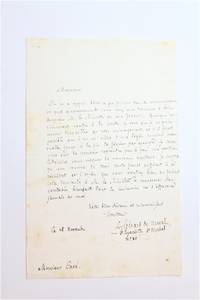
184172914Paris 1841. Fine. Paris 18 novembre 1841 13.90 x 20.80 cm une page sur un feuillet remplié Autograph letter signed by Gérard de Nerval addressed to Auguste Cavé written in careful handwriting in black ink on the first page of a double sheet. Minor traces of folds inherent to posting and some light foxing. This letter was transcribed in Nerval's Complete Works in the Pléiade edition. After two violent nervous breakdowns Gérard de Nerval was compelled to stay at Dr. Blanche's clinic between March and November 1841. Short of money he addressed this letter to his friend Auguste Cavé then director of the Fine Arts section at the Ministry of the Interior to solicit his support with ""M. le Ministre"": ""Quoi qu'entièrement rendu à la santé je sens que je ne puis encore travailler qu'avec ménagement et s'il était possible que l'on m'aidât d'une légère somme mensuelle . je serais plus sûr de pouvoir reprendre peu à peu ma position littéraire sans risquer de nouveaux accidens"" ""Though entirely restored to health I feel that I can only work with care and if it were possible to be helped with a small monthly sum . I would be more certain of being able to gradually resume my literary position without risking new accidents"". unknown
- S.n, s.l. 1947, 39 feuillets. - Précieux et important manuscrit autographe signé de Sacha Guitry de Correspondance de Paul Roulier-Davenel recueillie par Sacha Guitry (1908-1910). Paul Roulier-Davenel est un auteur fictif, né dans l'esprit du jeune Guitry. En effet, celui-ci donna au journal Comoedia, entre octobre et novembre 1908, une série de « lettres » du pseudo-dramaturge introduites par plusieurs préfaces au ton cocasse. L'humour de cette correspondance n'a jamais trompé les journalistes ni les lecteurs sur l'origine de cette fantaisie, comme le révèlent les articles dans la presse de l'époque. Mais ce fut l'une des premières occasions pour Guitry de traiter de manière littéraire de ses deux sujets de prédilection : le monde du théâtre et les femmes. Sont réunis ici une partie du premier manuscrit paru en feuilleton dans Comoedia ainsi que les placards sur lesquels travailla Guitry pour préparer l'édition en volume, publiée en 1910 chez Dorbon l'Aîné. Ces documents révèlent combien il remania les lettres, ainsi que leur agencement, supprimant certains passages, changeant les noms, divisant une même épître en plusieurs. L'ensemble comprend 25 feuillets autographes rédigés à l'encre violette ou au crayon, bien lisibles, et 14 feuillets de placards tirés de Comoedia et largement annotés et complétés de la main de Guitry. Le manuscrit s'ouvre sur une prétendue bibliographie de « l'auteur », composée d'ouvrages pour le moins farfelus - À houille rabattue (moeurs minières), Le Turkestan belge, Manuel de zootechnie ou encore Prophylaxie des maladies vénéneuses (en préparation) -, qui fait écho aux titres non moins fantasques des premières pièces de Guitry (Chez les Zoaques, 1907 ; Le Kwtz, drame passionnel, 1907 ; C'te pucelle d'Adèle, 1909). Cette liste sera largement modifiée pour le livre. Suivent alors huit lettres censément adressées à Guitry par Roulier-Davenel. Dans l'ouvrage, elles seront publiées dans un ordre tout à fait différent que dans Comoedia, parfois même de manière fragmentaire. Ainsi, la première du manuscrit ouvrira le chapitre « Lettres d'Évreux » de l'ouvrage (p. 35) et révèle un Roulier-Davenel tourmenté : « Mon cher ami, Depuis votre départ, j'ai beaucoup pleuré. Votre présence m'avait fait énormément de bien, vos conseils étaient sages et m'avaient remonté, mais votre départ, fatal hélas !, m'a rejeté plus profondément dans la peine. » Mais la deuxième, datée du 27 octobre, est en partie inédite - on n'en retrouvera imprimées que les premières lignes (p. 46) : « Mon cher ami, Je ne sais pourquoi j'ai tardé à vous répondre, car votre lettre m'apporta du réconfort. Ah ! oui, vous avez raison, mille fois raison ! » De même, la troisième lettre n'apparaîtra que de manière parcellaire (p. 39) et la cinquième se trouvera dans la partie « Pneumatiques », considérablement réduite : « J'ai couché hier avec une petite femme très gentille et qui, dans ses rapports avec les messieurs, a l'habitude de remédier à sa maigreur par l'adjonction d'une de ses petites amies. » (p. 73). Dans sa version manuscrite, elle se poursuit par 95 lignes consacrées au directeur de théâtre Antoine : « La valeur d'Antoine est une des choses les moins contestables qui soient. C'est un travailleur admirable et il a fait faire à l'art théâtral un pas de géant. Nous devons à son obstination le silence respectueux du public aux représentations du Canard sauvage et des Revenants. » Dans le livre, Guitry choisira de faire paraître ce portrait, en les remaniant, sous le titre « Lettre où il est question d'Antoine ». Les 14 feuillets de placards avec corrections et variantes autographes comprennent une partie des parutions de Comoedia contrecollées sur deux colonnes. Ainsi, la deuxième préface est presque totalement réécrite, seules les dernières lignes seront conservées pour l'édition en volume. De la troisième préface d'origine, Guitry n'a rien conservé ; il reprend l'ensemble du texte et prévoit sur le feuillet l'e
1839803451839. Fine. s. d. ca 1839 13 x 8 cm une feuille Signed handwritten letter to Louis Desnoyers ca 1839 13 x 8 cm one leaf Handwritten letter signed by Honoré de Balzac addressed to Louis Desnoyers written on a white piece of paper in black ink. My dear Mr Desnoyers extraordinarily today I attend a diplomatic dinner of good-natured folk who want to laugh and drink and as I am in a stupor at work I have not had the courage to refuse this debauchery; I will therefore not be at home. Come early Sunday morning. / Yours / de Balzac. Louis Desnoyers plays an important role in the foundation of the Société des gens de lettres which aims to protect literary and artistic property and to create a solidarity fund. Balzac supported the creation of this Society of which Desnoyers was vice-president. Amusing letter testimony of Balzac's love of good food. unknown
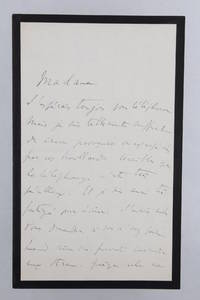
190783638s. l. 1907. Fine. ""New Year's Day is just an occasion for me -- as if occasions were needed! -- to reminisce and weep"" s. l. s. d. ca 1907 12.60 x 20.40 cm 3 pages sur un double feuillet Autograph letter signed to Madame Catusse 126x204cm 3 pages on a double leaf. Autograph letter signed by Marcel Proust probably addressed to Madame Catusse. The recipient and date have been determined by Proust scholar Jean-Yves Tadié. Three pages in black ink on a double leaf edged in black. A fold inherent to the mailing. A sombre and admirable letter steeped in Proustian melancholy. The future author of In Search of Lost Time feels more than ever the loss of his mother during the New Year period. The famously generous Proust also asks his faithful confidante Madame Catusse to buy a gift for the Straus couple whose wife inspired the character of the Comtesse de Guermantes. The end of 1907 apparent date of this letter alluding to the approaching New Year marks the second holiday season spent without Madame Proust who had died two years earlier: ""New Year's Day is only an occasion for me - as if occasions were needed! -- to reminisce and weep"". Proust had also expressed this sentiment in a letter to Anna de Noailles the year before ""New Year's Day had a terrible evocative power over me. It suddenly gave me back the memories of Maman that I had lost the memory of her voice"" February 1906. This fateful moment acted on Proust like a pernicious madeleine at once a sensory reminiscence and an acute awareness of his loss. He would soon begin writing In Search of Lost Time to conjure up this mother figure whose absence would remain unbearable. For the time being Proust is busy writing a series of Pastiches for Le Figaro ""which were in reality only a penultimate detour before writing La Recherche"" George D. Painter. One of these Pastiches dealt with the swindle perpetrated on the president of De Beers in which Proust had invested. Imagining himself already ruined he mentions these unfortunate circumstances in capital letters: ""HAVE I REPORTED MY FINANCIAL DESASTERS TO YOU OVER THE TELEPHONE ."" Overwhelmed by ailments he is also plagued by one of his many asthma attacks ""provoked or exasperated by these terrible fogs"" forcing him into reclusion and even silence: ""telephoning is very dangerous for me. And I'm also very tired when it comes to writing"". The recipient Mme Catusse was a friend of Proust's mother and became an invaluable support to the writer. Proust's prolific correspondence with the woman Ghislain de Diesbach had dubbed the writer's Notre-Dame-des-Corvées represents an inexhaustible resource of insights into his secret life and fears. Proust had called her in a panic during an aphasia attack suffered by his mother shortly before her death. As he became increasingly isolated after moving into 102 boulevard Haussmann the previous year Proust sought her help in many matters including the purchase of numerous gifts: ""I would have liked to ask you if you had by any chance seen anything suitable for the Straus although I always dislike coinciding with New Year's Day"". This sentiment would inspire a passage in The Captive castigating those same ""New Year's Day presents"" given to Madame Verdurin: ""those singular and superfluous objects which still appear to have been just taken from the box in which they were offered and remain for ever what they were at first"" The Captive C.K. Scott Moncrieff's Translation Edited and Annotated by William C. Carter Yale University Press 2023 p. 308. Known for his frenzied displays of prodigality Proust overcomes his aversion to these occasional gifts. The smallest favor to the writer gave rise to extravagant expenses. Lawyer Emile Straus had probably helped the writer sort out his inheritance affairs: ""I FEEL THAT THE NUMEROUS SERVICES PROVIDED TO ME BY MR. STRAUS CANNOT REMAIN WITHOUT THANKS since I believe he would not accept a fee. If you happened to have seen something very unknown
- S.l. [Paris] s.d. [5 mai 1884], 10x12,9cm, 4 pages sur un feuillet double. - Lettre autographe signée de Guy de Maupassant à la comtesse Potocka, 70 lignes à l'encre noire, agrémentée d'un dessin original à l'encre, sur un feuillet double à en-tête « 83, rue Dulong ». Enveloppe jointe. Publiée dans Marlo Johnston, « Lettres inédites de Maupassant à la comtesse Potocka », Histoires littéraires, n°40, octobre-novembre-décembre 2009. Maupassant a, des années durant, été l'un des soupirants les plus assidus de la comtesse Potocka. Il s'apprête à aller la voir sur invitation de son mari : « Vous savez, n'est-ce pas, que je dîne chez vous demain, invité par votre mari. » Son époux le comte Potocki vivait en totale liberté avec la comtesse, occupé qu'il était à entretenir la célèbre courtisane Émilienne d'Alençon, il ne s'offusqua pas des « Macchabées » de son épouse, son groupe de soupirants. Les « Macchabées » avaient érigé l'amour en religion et ils en étaient les pénitents. Ainsi Maupassant écrit-il à la comtesse : « Il n'y a pas deux pénitentes comme vous, d'abord. Et puis j'ai qu'une pénitente qui me fait plutôt l'effet d'une Directrice car je me sens disposé bien plus à lui obéir qu'à la conseiller. » Plus loin, alors qu'il décrit une soirée à laquelle il a assisté, il admet s'être abîmé dans la ferveur que la comtesse provoque chez lui : « Comme j'avais mon chapelet dans ma poche je me suis mis à en réciter une dixaine en répétant entre chaque « ave » - « Notre Dame de Vassivière, patronne du lac Pavin, priez pour moi. » J'étais dans un parfait état de recueillement en sortant de cette maison où j'ai été reçu comme l'enfant prodigue. » Maupassant avait vu la comtesse en Auvergne, lors d'un voyage qui le mena au lac Pavin et au lac de Vassivière. Cette religion devait être bien plus du goût de Maupassant que le petit séminaire d'Yvetot où il fut envoyé étudier de 1863 à 1868. L'amour érigé au rang de religion élève Maupassant à la dignité de saint stylite : « [...] je suis remonté sur ma colonne pour me trouver à votre hauteur. » À la suite, il a esquissé un dessin à l'encre où il s'est représenté lui-même ainsi que la comtesse, tous deux auréolés. Cette dernière est sur une autre colonne et lui tend la main pour le rattraper alors que la colonne sur laquelle il se trouve s'est brisée et tombe. Comme Maupassant, Paul Bourget fut un « Macchabée » : « J'ai parlé de vous hier soir avec Bourget qui vous trouve charmante et qui m'a presque chargé de vous le dire. Je m'acquitte de cette commission parce que je connais les réserves de mon ami, dans ses... déclarations. » Les deux hommes se sont rencontrés en 1877 dans les bureaux de la revue La République des lettres et partagent la même fascination pour la comtesse : « je lui ai parlé de vous selon ma pensée. Et il m'a avoué qu'il craindrait de vous connaître par peur de lui-même et de ses amies. » Paul Bourget est également un habitué des brillants salons de cette époque, il l'introduit chez la princesse Mathilde : « Cette conversation avait lieu chez la princesse Mathilde que je me suis décidé à aller voir entraîné par le dit Bourget. » La princesse Mathilde Bonaparte n'est autre que la cousine de Louis-Napoléon Bonaparte, le futur Napoléon III auquel elle fut longtemps fiancée avant d'épouser un comte russe. Vivant à Paris, elle tient un des salons littéraires les plus courus de la capitale. Après ces considérations religieuses puis mondaines, Maupassant en vient à la littérature : « Aujourd'hui j'ai lu des vers depuis le matin, pour mon article du Gaulois que je n'ai pas encore fait. Je suis troublé décidément. » Il a publié dans la presse nombre de chroniques, nouvelles ou poèmes au cours de sa carrière, notamment entre 1880 et 1889 pour la revue Le Gaulois. Il n'y a pas que la comtesse qui trouble son activité littéraire : « J'avais chez moi un horrible écrivain russe nommé Boborykine, qui m'a empêché de trouver une phrase. » Piotr Boborykine, auteur natur
- Paris 18 novembre [1841], 13,9x20,8cm, une page sur un feuillet remplié. - Lettre autographe signée de Gérard de Nerval adressée à Auguste Cavé, rédigée d'une écriture soignée à l'encre noire sur la première page d'un double feuillet. Infimes traces de pliures inhérentes à la mise sous pli et quelques claires piqûres. Cette lettre a a été retranscrite dans les Oeuvres complètes de Nerval à la Pléiade. Après deux violentes crises de nerfs, Gérard de Nerval fut contraint de séjourner à la clinique du Docteur Blanche entre mars et novembre 1841. Désargenté, il adresse cette lettre à son ami Auguste Cavé, alors directeur de la section des Beaux-Arts au ministère de l'Intérieur, pour solliciter son appui auprès de « M. le Ministre » : « Quoi qu'entièrement rendu à la santé, je sens que je ne puis encore travailler qu'avec ménagement, et s'il était possible que l'on m'aidât d'une légère somme mensuelle [...] je serais plus sûr de pouvoir reprendre peu à peu ma position littéraire, sans risquer de nouveaux accidens ». [ENGLISH DESCRIPTION ON DEMAND]
Zusammen (2½+1 =) 3½ SS. auf 3 Bll. (Qu.-)8vo. Der Brief mit eh. adr. Kuvert, die Karte mit eh. Adresse. Mit einigen Beilagen (s. u.). An den Dirigenten und Komponisten Ernst Hermann Seyffardt mit Dank für eine Widmung (1884) und betreffs einer Verabredung (1887): "Haben Sie herzlichen Dank für Ihre Widmung u. glauben Sie daß ich solches Geschenk zu würdigen weiß. Längst hätte ich es Ihnen gesagt, aber ich war immer in Versuchung weiter zu schreiben. Ich hätte Ihnen dadurch bewiesen wie sehr u. gern ich Ihr Werk betrachtet u. bedacht habe - aber das gehört nicht zu dem ernstlichen Dank der Ihnen zunächst gebührt! Jetzt schreibe ich im Moment der Abreise u. kann nur sagen wie sehr es mich erfreut hat, daß Sie einer Arbeit, die Sie so lange u. ganz erfüllt haben mag, meinen Namen vorgesetzt haben. Aber ich freue mich darauf, wenn wir gelegentlich, ganz abgesehen von meiner dankbaren Freude, wieder zusammen sitzen o. behaglich kritisieren o. plaudern über Gedichte u. Musik! […]" (Brief aus Wien vom [3. XII. 1884]). - "Ich denke Montag Ab[end] spät dort einzutreffen, im Zähringer Hof abzusteigen u. Dienstag früh 10 Uhr weiter zu fahren. Falls Sie nun zu den Frühaufstehern gehören, könnten Sie mich noch beim Frühstück treffen u. etwa ein wenig mit spazieren? Das wäre eine besondere Freude [...]" (Karte aus Thun mit Poststempel vom 11. IX. 1887). - Der Brief mit kleinen Einrissen im Mittelfalz und dort mit Klebefilm hinterlegt; das Kuvert mit Klebestreifen an den Rändern versehen; die Postkarte mit einer kleinen Knickfalte im Bereich der Unterschrift. Beiliegend 2 Kabinettphotographien und zwei Portraitpostkarten.
2 SS. Gr.-4to. Auf Briefpapier mit Briefkopf "Thomas Mann". An seinen Jugendfreund, den späteren Kunsthistoriker und Romanisten Otto Grautoff (1876-1937): "Lieber G.: Besten Dank für das Börsenblatt mit Deinem artigen Aufsatz [d. i. "Die Ex-libris-Sammlung des Grafen zu Leuningen-Westerburg" im Börsenblatt f. d. dt. Buchhandel 68 (1901), S. 1421-24]. Ich werde mich aber besinnen, ob ich Paul Ehrenberg damit ennuyiren soll; ich fürchte, all diese anspruchsvolle und graue Theorie würde ihn nur verwirren und kopfscheu machen. Laß ihn aus! Er wird schon in netter Weise etwas Hübsches zustande bringen. Was er ungefähr machen soll, muß er sehen; das Dociren ist da nicht am Platze. [Zwei Wörter getilgt] Übrigens will ich ihn fürs Erste nicht mahnen, sondern warten, bis er von selbst auf die Sache zurückkommt. - Nein, meine Laune war nicht schlecht, als ich gestern nach Hause ging. Ich hielt es kurz nach 11 Uhr nur vor Müdigkeit nicht länger aus und verabschiedete mich. Übrigens hatte ich Dich ja auf mein Verschwinden vorbereitet. Ich war lange Zeit mit Ehrenbergs, Junghans [der Kunstakademieschüler Julius Paul Junghanns] und den Amerikanern zusammen. Junghans ist ein sehr angenehmer Mensch: das Genre Paul Ehrenberg, soweit ich gesehen habe, nur viel stiller. Bist Du schließlich noch einmal mit Ehrenbergs zusammengetroffen? Ich konnte mich bedauerlicher Weise nur von Carl verabschieden, der am Tische saß, während Paul, den ich vergebens gesucht hatte, sich gerade auch seinerseits auf der Suche nach mir befand [...] Herr Gott, nein, ich verachte Dich nicht! Wie kommst Du darauf! Wenn Du mir einen großen Gefallen thun willst, so sprich nur von dem pfiffigen kleinen Geschöpf, das von Deinem schönen Herzen Besitz ergriffen hat, nicht mehr als von 'Deinem Mädel'. Denn erstens ist diese Bezeichnung ja nicht zutreffend und zweites wirkt sie auch gar zu zusammenziehend. Im Übrigen bin ich überzeugt, daß Du Dich kolossal falsch benommen hast. Die Franzosen sagen: Wenn der Deutsche graziös sein will, so springt er zum Fenster hinaus. Etwas Ähnliches gilt meistens auch von 'uns Todten', wenn wir 'erwachen', d. i. wenn wir einmal Menschen sein möchten. Meistens! Es gehört sehr viel Geschmack und Stilgefühl dazu, da nicht zu outriren, sich nicht zu verzerren. Na, Stil ... es weiß eben nicht Jeder, was das ist: nicht einmal alle Mitarbeiter des Börsenblattes für den deutschen Buchhandel. Ehrlich: (und Du weißt das ja auch) Du machst mich nervös, wenn Du Fasching spielst, und schon darum bin ich froh, daß der Fasching vorüber ist. Nervös machtest Du mich zum Beispiel (und augenscheinlich nicht nur mich) durch das blöde Gekreisch, mit dem Du gestern im Café L[uitpold] Paul Ehrenberg empfingst. Es ist dumm und roh, zu glauben, daß dies, selbst in der Fastnacht, die richtige Art ist, ihm zu begegnen. Dir kann es ja gleichgültig sein, was er von Dir denkt, da hast Du Recht. Ich fürchte nur, daß er manchmal nicht weiß, was uns - Dich und mich - eigentlich verbindet. - Nichts für ungut übrigens! Wir haben schließlich Aschermittwoch. Und damit, daß am Sonntag der Carneval bei meiner Schwester [Julia Löhr] noch ein kleines Nachspiel haben soll, bin ich durchaus einverstanden [...]". Kl. Ein- und -ausrisse (ohne Textverlust). - Nach Grautoffs Tod im Pariser Exil erwarb der Verleger Kurt Leo Maschler (1898-1986) die Korrespondenzsammlung von dessen Witwe Erna Grautoff. Nach Maschlers Flucht aus Österreich 1938 wurde der zurückgelassene Bestand von der Gestapo der ÖNB überstellt und von dieser in deren Autographensammlung einsigniert (am unteren Rand die ÖNB-Signatur von 1939: Autogr. 141/58-65). 1949 wurde die Sammlung an Maschler rückgestellt (vgl. ÖNB, Allg. Verwaltungs- u. Korrespondenzakten 00/1949 A); erworben aus dem Nachlaß Maschler. T. Mann, Briefe an Otto Grautoff 1894-1901 und Ida Boy-Ed 1903-1928, hg. von Peter de Mendelssohn (Frankfurt a. M. 1975), S. 133f. Die Briefe Thomas Manns. Regesten und Register. Bd. I. Briefe 1889-1933, bearb. und hg. von Hans Bürgin u. a. (Frankfurt a. M. 1976) 01/12. T. Mann, Große Frankfurter Ausgabe, Briefe I (1889-1913) (Frankfurt a. M. 2002), S. 156f.
8096s.d. Dossier 24 x 30,5 cm, en demi cuir et à chants rouges, dos lisse, titre en lettres dorées, les plats recouverts de papier marbré, le tout présenté dans un élégant emboîtage en cuir rouge. Le dossier contient un manuscrit incomplet de la main de Paul Morand comptant 15 feuillets numérotés de 0 à 9 (dont un feuillet 1bis), XVIII-XIX et deux feuillets n. ch.
Large oblong 8vo. 53 written and ca. 50 blank ff. with a total of ca. 50 entries. Coloured title page on vellum, 4 armorial miniatures and 5 coloured illustrations; one pen drawing in red ink. Contemporary calf binding with spine label, covers and spine elaborately gilt, all edges gilt. A very charming album. The owner, Andreas Barthold, was born in 1752 into a wealthy merchant family from Stettin. He attended the school of mathematics established by pastor Johann Julius Hecker in 1747, which he left at the age of about 16 years, and was further educated at the Hamburg Academy of Commerce, founded in 1768. In 1773 he returned to Stettin, where he worked as a merchant, became a citizen in 1778, and married the following year. After this, his trail disappears. - Most of the entries in this album are from teachers and classmates at the Realschule in Berlin; another group of entries is by Hamburg merchants. Apart from the identifiable contributions (some 15 entries), the importance of this album lies in its very appealing colour illustrations, some of which are by known artists: this includes a view of a channel with ships by Christian Gottfried Mathes (1738-ca 1805), dated 1768, and a coastal landscape by Johann Carl Wilhelm Rosenberg (1737-1810), dated Stettin 1781. - Slight chipping to spine label; lower cover rubbed; bumped and chafed. Several leaves have been removed. Occasional slight staining and browning; very attractively bound.
116 Bll. mit 132 Einträgen. Marmorierter Lederband der Zeit mit reicher Rückengoldprägung, goldgepr. ornamentalen Deckelbordüren mit Fileten, gepr. Stehkantenbordüre, dreiseitigem Goldschnitt und Marmorpapiervorsätzen. Qu.-8vo (136:250 mm). Reichhaltiges Hallesches Gelehrtenalbum mit vielen lateinischen, deutschen, auch griechischen und wenigen hebräischen Einträgen, meist von arrivierten Professoren, Pfarrern, Predigern und Diakonen, darunter Heinrich Christian Alberti (17. III. 1758), J. C. Berlin (u. a. gleichen Namens), der Anatom Philipp Adolph Böhmer (1711-89, Leibarzt von Friedrich Wilhelm I. von Preußen), der Mediziner Andreas Elias Büchner (1701-69, Präsident der Leopoldina), der Orientalist und Theologe Johann Heinrich Callenberg (1694-1760), Gründer des Institutum Judaicum et Muhammedicum, später mit der Franckeschen Stiftung vereinigt), die Juristen Johann Tobias Carrach (1702-75) und sein Sohn Johann Philipp Carrach (1730 - nach 1781), Nicolaus Heinrich und Johann Joachim Carssow, "Paul Louis Chrysander né a Salzwedel", der Theologe Christian Albrecht Döderlein (1714-89, Gründungsrektor der Friedrichs-Universität Bützow), der Arzt und Theologe Johann Peter Eberhard (1727-79), Johann Just von Einem (Kloster Bergen, 11. IV. 1758), der Philosoph Friedrich Wilhelm Ellenberg (von Zinnendorf), der 1759 eine Deutsche Gesellschaft in Halle gegründet haben soll, der Pfarrer August Richard Eulhardt, der Jurist und Direktor der Universität Halle Johann Ernst von Floercke (1695-1762), der Theologe und Pädagoge Gotthilf August Francke (1696-1769), der Theologe und Direktor der Franckeschen Stiftungen Gottlieb Anastasius Freylinghausen (1719-85), Johann David Gensike (18. III. 1758), mehrere Mitglieder der Familie Hindenburg, Friedrich Hoffmann (Halle, 12. III. 1758), der Jurist, Historiker und Numismatiker Johann Friedrich Joachim (1713-67), der Arzt und Chemiker Johann Juncker (1679-1759, führend in der pietistischen Reformbewegung der Medizin), J. G. Knapp, der Astronom und Mathematiker Ernst Friedrich Knorre (1759-1810), der Mathematiker, Dichter und Mineraloge Johann Joachim Lange (1699-1765), der Historiker und Jurist Samuel Lenz (1886-1776), Samuel Christoph Lietzmann ("Prediger zu Plau im Mecklenbg."), Johann Simon Lindinger (1723-83), der Philosoph Georg Friedrich Meier (1718-77), der Orientalist und Theologe Christian Benedikt Michaelis (1680-1764), der bedeutende Jurist Daniel Nettelbladt (1719-91, Primarius und Praeses der juristischen Fakultät der Universität Halle) sowie etliche andere. - Sehr gepflegtes, gut erhaltenes Album aus der Autographensammlung des Gotthilf Sebastian Rötger mit seinen hs. Ergänzungen, meist in rostroter Tinte.
Deutsche, französische, lateinische und griechische Handschrift auf Papier. 204 SS. mit ca. 187 Einträgen, 5 Aquarellen, 2 Federzeichnungen und 1 Kupferstich. Lederband der Zeit mit Rückentitel "[St]amm Sitten Buch", gepr. Deckelrahmenleisten und -fleurons. Dreiseitiger Goldschnitt. Qu.-8vo (176 x 111 mm). Besonders reichhaltiges Freundschaftsalbum mit zahlreichen Zitaten römischer Dichter. Unter den Einträgern finden sich Studienkollegen und Freunde Drandorfs, darunter einige Mitglieder Nürnberger Patrizierfamilien: Ludwig Wilhelm Arnold (Altdorf, 15. VII. 1743, "[...] und Herr Gustav Georg Zeltner den 29. Junius 1743 die hohe Doctor-Würde in der Arzeney-Kunst auf der Weltberühmten Universität Altdorf rühmlichst übernahmen [...]"), "Charles Frederic de Behaim" (Nürnberger Patrizier), Gustav Georg Biermann (1721-91), Buirette von Öhlefeld, Ernst Friedrich Blüthner aus Altenburg (1713-64), Johann Friedrich Dannreuther (Nürnberger Jurist, geb. 1684), Wilhelm Ebner von Eschenbach ("Altdorffii d. 2 Octobris 1740"), Hans Friedrich Fischer von Ehrenbach, Johann Jakob von Fölseis aus Neustadt in Österreich (mit Arnold u. a. ebenfalls in der "Arzeney-Kunst" promoviert), Johann Christoph Fürer von Haimendorf auf Wolkersdorf (1743), J. J. Haller von Hallerstein (Altdorf, 1743), J. C. Harsdorf von Enderndorf (Altdorf, 23. III. 1743, Nürnberger Patrizier), Johann Friedrich Hartmann (Gotha, 3. IX. 1755), Maximilian Rudolph Helvetius (1738 immatrikuliert in Altdorf), Carl Christoph Sigmund vom Holzschuher ("Erlang den 5. Nov. 1743"), Christoph Karl Kress von Kressenstein (1723-91), Carl Friedrich Wilhelm Lange ("Jubelier Ronneburg den 18 October 1819"), Justinus Gottlieb Linck (Altdorf, 1743), Marschalk von Ostheim (fränkisches Adelsgeschlecht), Sebastian Gottfried Caspar von Mittmeyer (1713-66), G. P. Negelein (Altdorf, 1740), Rupert Maximilian Oelhafen von Schöllenbach (Nürnberger Patrizier), "Frederic Benoit d'Oertel", Friedrich Theodor Örtel von Doebitz (1762), Johann Wilhelm Pampo (Gotha, 4. IX. 1755), v. Plettenberg (zwei Einträge, 1742), "Carl von Poelnitz Herzogenbusch [...] 1746"), Johann Ludwig von Peßler, Karl Gabriel von Pilgram, "Semper lustig numquam traurig G. St. A. Reinhart", Johann Bartholomäus Riederer, L. F. von Savigny ("Homburg vor der Höhe d. 21. Aprilis 1744") und C. H. E. von Savigny, Johann Georg von Scheidlin (1726-91), Friedrich Karl Scheurl von Defersdorf, Karl Alexander Schmidt von Altenstadt, Johann Samuel Serpilius (1740 immatrikuliert in Altdorf), J. F. von Sichartshofen, Johann Jakob Solger aus Velden, Johann Wilhelm Widmann ("der Heil-Kunst Beflissener"), August Christoph Wilcke ("De causis contractum perfectum [...]" 1740) und Gustav Georg Zeltner, "Altdorfii d. 20. November 1742". - Johann Gottlieb Drandorf aus Altenburg immatrikulierte sich 1738 in Altdorf, wurde später Sekretär in Belgershain (vgl. seinen Beitrag im Stammbuch Gustav Georg Zeltner in der Nürnberger Stadtbibliothek, 1718-68) und starb 1773. - Von den fünf farbigen Illustrationen zeigen vier Aquarelle, je zwei auf einem Blatt: Genreszenen, Souper, ein Liebhaber verabschiedet sich, Spazierfahrt. Eine Gouache auf Pergament zeigt ein Haus, die Szene daneben, auf dem gleichen Blatt, eine kleine Tafelrunde. Unter den Federzeichnungen ein Cupido, übertitelt "Consequitur quod cunque petit", und ein gezeichnetes Quodlibet mit Ausrissen aus einem Buch (darunter ein Stück Landkarte, ein Stück Kalender sowie ein Chronogrammtitel "GeDaeChtnVs Des ersten IVbelfests Der VnIVersItaet aLtorf" und ein Wappen). Der Kupferstich zeigt die "Sophienquelle" von Grünsberg. Die erste Rectoseite mit einer Erklärung der Erbin des Stammbuchs, Drandorfs Schwester Johanna Friederike Richter (geb. Drandorf). - Die Bindung etwas locker, der Einband leicht beschabt, die Ecken leicht bestoßen, mit Bruchstelle im Rücken, der Schnitt unregelmäßig. Papier leicht gebräunt bzw. etwas braun- und fingerfleckig sowie angestaubt. Kalligraphisch ansprechend und mit einigen wenigen weiteren kleinen Zeichnungen (darunter eine schöne Initiale). Einige Bll. fehlen (darunter ein Blatt des alphabetischen Registers am Anfang), mit verschiedenartiger und besonders zu Beginn wechselnder Paginierung. Der Kupferstich und zahlreiche weitere Bll. sowie ein Stoffstück einmontiert, mit Spuren alter Montage.
7¼ pp., mostly with address. The so-called "Heidelberg Confederation" was founded in 1553 during a personal meeting between the Elector Palatine and the Dukes of Jülich, Bavaria, and Württemberg, at a time when peace within the Empire was severely threatened by a series of interlocking problems (Franconia, Saxony, Brunswick, Spanish Succession, etc.). The Confederation agreed on defensive politics but would come to one another's aid if necessary. It was dissolved in 1556. - The correspondence comprises: 1) Ludwig von Stolberg (1505-74). Document with papered seal. Gießen, 16 March 1552. 1 p. Oblong folio. - Confirmation for the King of France, the Elector of Saxony, the Duke of Mecklenburg, the Landgrave William of Hesse and other members of the confederation, agreeing not to intervene with their military campaigns and to grant free passage of troops and free access to provisions. 2) Frederick II, Elector Palatine (r. 1544-56). Letter. Heidelberg, 27 Nov.1553. 2¼ pp. and address. 4to. Offering Ludwig von Stolberg the office of chairman of the Confederation. 3) The same. Letter with papered seal. Heidelberg, 29 Jan. 1654. 1 p. and address. Folio. To Ludwig von Stolberg, repeating the previous offer. 4) Christoph, Duke of Württemberg (r. 1550-68). LS. Augsburg, 8 April 1555. 1 p. and address. 4to. To Ludwig von Stolberg, confirming his having passed on a missive of Ludwig's to Albrecht of Bavaria. 5) Albrecht V, Duke of Bavaria (r. 1550-79). LS. Munich, 17 Feb. 1556. 1 p. and address. Oblong 4to with papered seal. Answer to Ludwig von Stolberg, who had asked to be released from his office. 6) The same. LS. Munich, 15 March 1556. 1 p. and address. 4to with papered seal. To Ludwig von Stolberg, referring to his previous correspondence.
A total of ca. 145 pp. on 79 bifolia and 27 single leaves. (Oblong) 12mo, 8vo, (large) 4to, and folio. A comprehensive trove of communications written by an international, often aristocratic clientele to the Imperial and Royal court photographer Josef Löwy, offering interesting details regarding the scope of his services, his fees, quantities and types of portraits ordered, and occasional special requests. - The Löwy Atélier established itself as one of the favourite studios of the Austro-Hungarian monarchy's high society during the heyday of Franz Joseph's government. Apart from providing portrait, art and industry photographs as well as reproduction services, Löwy appears also to have covered the field of erotica: the British veterinarian William Fearnley, for example, requests some "very fine coloured photographs of Ladies" such as he says he has seen at a friend's: "I would like them as [straight] as you have. Cabinet and others [...]" (22 Nov. 1871). Prince Leander Poninski, on the other hand, requests a special "watchkey" which would reveal "the photograph of a person when viewed through a hole against the light" (1872), while Eleonore von Auersperg (1864-1920) wishes "butter boards", to be decorated with photographs of her children (1 Feb. 1892). The collection also gives evidence of Löwy's collaboration with artists such as his colleague Jakub Husník: "Please convey to me the large glass positive of the nude study, for which I enclose 8 guilders [...]" (18 March 1874). Löwy worked with the writer and linguist Karl J. Schröer on his book "Das Bauernhaus mit seiner Einrichtung und seinem Geräthe" (Vienna, 1874; cf. letters dated 21 August and 15 September 1873). The wide range of Löwy's work is showcased by the orders for photographs of the Viennese World Exposition by the Royal Art Cabinet in Munich (two documents and two letters from July 1873 through January 1874), by the technician Julius A. Hülsse in Dresden (30 July 1872), and of landscapes and railway photographs for various schools. Further commissions come from the Imperial and Royal Central Institution for Meteorology and Geomagnetism (22 Nov. 1876) and from the monastery of Klosterneuburg (24 and 27 Oct. 1872); his work for the "Costume Festival" hosted by the Gesellschaft der Musikfreunde is singled out for praise (2 Feb. 1876). - Yet the archive also reveals dissatisfied customers and partners, such as the painter Anton Fink, who complains that Löwy pays only for "accepted pictures": "Likewise, it was a lie that the print of young Baschan was returned to you after delivery supposedly was refused [...]" (26 June 1873). - The illustrious correspondents in this collection include members of the nobility such as Simon Abaschidse, Johanna von Auersperg, Prince Georges Bibesco, Tyra von Cumberland, Demetrius Ghika, Johannes zu Hohenlohe, Gabriele von Rohan, Coelestine von Oppolzer, but also personalities from art, scholarship, science, education, politics, and the military, such as the etcher Ferdinand Laufenberger, the painter Karl Geiger, the sculptors Franz Schönthaler and Leonidas Drossis, the pianist Johann G. Leitert, the cartographer Heinrich Littrow, the architect Hermann J. Hürth, the meteorologist Ferdinand Osnaghi, the theologian Basil Mitrofanowich, and general Ottokar Baron Procházka, to cite but a few. - Mostly with recipient's notes on the reverse. Some waterstains, light ink offsetting or smudging, some items a little foxed or browned, but generally well preserved. A detailed list is available on request.
4to (192 x 217 mm). 39 written pages on 24 leaves. With 29 numbered watercolour plates (3 folding, 7 fragmentary). Contemporary half calf over marbled boards with giltstamped spine and spine label. Patterned endpapers. A highly appealing manuscript on saddlery from Marshal Radetzky's library, discussing the production and characteristics of German and Hungarian saddles with the exact measurements of each component. Possibly not written by Radetzky himself but commissioned by him at a time when he was applying himself to military studies and editing his memoirs ("Denkschriften"), the manuscript is composed in extremely neat handwriting, likely by a secretary. The charming watercolours depict complete saddles seen from various perspectives as well as several stages of their construction and separate elements such as straps and screws. - Radetzky's bookplate to front pastedown. A note about the length of a saddle flap in a different handwriting, this likely by Radetzky himself, is loosely inserted. - Extremities lightly bumped; spine label a little rubbed. Paper evenly browned throughout; plates crisp and clean. Seven plates are preserved only in fragments: substantial parts are cut out of and lacking from three plates; of four others only the cut-out figures remain, which are loosely inserted.
Large 8vo. 3 pp. on bifolium. Probably to the politician and writer Jean-François Roger, editor of a bilingual edition of Joseph de Jouvency's "Appendix de diis et heroibus poeticis" for the study of Ovid. Ampère was charged by the "Commission des livres classiques" of the ministry of public instruction to evaluate the possible use of this publication as a textbook. He advises against discarding any parts of the notes: "indispensable for a beginner who would study alone, they cannot be regarded as useless for students in the various institutions of public instruction" (transl.). Ampère lauds the translations in "correct French" as "the best manner to make difficult passages understood". The only problem would be "the impossibility to examine pupils based on a copy of the book, where they see what they need to say at the bottom of the page". Therefore, Ampère conceives a system of cross-references that would allow for separating text and translation. But he immediately rejects his own ideas since they "probably have no foundation" and he might appear a second-guesser ("faire complètement le gros-jean"). - Ampère only calls the book in question "Appendix", and it is not quite clear to which edition he refers. Jean-François Roger (1776-1842) had first published his Latin-French version in 1806 and several editions followed when it was adopted as a textbook by the "Commission des livres classiques". Both Roger and Ampère were members of the Commission, and as Ampère addresses the recipient as his colleague, it is very likely that this was indeed Roger. - With a collector’s note in pencil. Minor browning.
4to and 8vo. Together 23 pp. on 6 bifolia, one with autograph address on verso. Amicable correspondence with Renée Françoise Adélaïde Lemonnier (1767-1833), wife of the mathematician Joseph-Louis Lagrange (1736-1813), at the Palais National des Sciences et des Arts in Paris. - Missing her greatly, not even feeling it in her power to complain about Lemonnier's new friend: "Oh! je vous ensure mon amie [...] je m'ennui fort de votre absence. Je n'ai seulemen[t] pas les Ressource d'aller (comme à Paris) voir par ma fenestre, si je puis vous appercevoir à la Votre. Je n'ai pas même les Ressources de me mettre de mauvaise humeur contre cette figure à Callot, de Madame M. qui a pris ma place auprès de vous, pour! pour vous aimer moins que je ne vous aimes, assurément [...]" (12 Prairial [1 June]). - In great admiration for Napoleon, crediting him with having an impact on nature as well as politics: "Cet incroyable génie de Bonnaparté s'occupe du Mayence d'y Remédier. Cette Confusion semble s'étendre sur la Nature. Les saison paraissent aussi changées, aussy dérangées que la politique [...] que nous sommes heureux au milieux d'un tel caho, d'avoir un Bonnaparte [...] celuy la est mon dieu [...]" (4 Messidor [23 June]). - About her poor health, having to spend a month in bed, reminding her to be less trusting, alluding to her solitude, and asking for news about mutual friends: "Moy, je vie dans ma maison des champs je ne dirais pas sans chagrins! n'y souris car, J'ay trop d'objets de peines, de Regrêts pour que cela puisse Estre, mais! je crois que je suis un peu plus insousciante sur les vicissitudes de cette miserable vie. Dites moy le que vous faites de vos amis [...]" (5 Complémentaire [22 September]). - Wondering whether she attended a feast given by Napoleon: "Avez vous été témoin [...] de la belle fêtte des honneurs que le brave, le sensible, le spirituel Bouonaparté a fait rendre au temple de Mars en le Grand Turenne: l'on dit que cela estoit superbe [...]" (28 Vendémiaire [20 October]). - Very well preserved.
170 x 110 mm. A photograph of James M. Barrie, best remembered as the creator of Peter Pan. Signed and inscribed in fountain pen by Barrie, reading, "Yours truly, J. M. Barrie." Cabinet Photograph in a handsome profile pose, produced by the famous Elliott & Fry of London. "The firm of Elliott & Fry was founded in 1863 by Joseph John Elliott (1835-1903) and Clarence Edmund Fry (1840-97), who opened their first premises at 55 Baker Street where they stayed at until 1886. The firm employed a variety of operators who took the photographs, including Francis Henry Hart and Alfred James Philpott in the Edwardian era, Herbert Lambert and Walter Benington in the 1920s and 1930s and subsequently William Flowers. In the early 1940s the studio was bombed and most of the early negatives were destroyed. Shortly after the firm's centenary in 1963 it was taken over by and amalgamated with Bassano & Vandyk. The National Portrait Gallery owns all the surviving negatives" (National Portrait Gallery).
Oblong folio. 1 p. on bifolium. Schematic map of Asia Minor in brown ink and red pencil showing in detail the routes of two journeys, entitled: "Route de Busbek de Constantinople a Amasie" and "Route de M. des Monceaux d’Alexandrette a Smyrne", charting numerous towns, important ancient sites such as Pergamon, Ephesus, and Laodicea, as well as geographic markers. The route from Constantinople to Amasya is a graphic reconstruction of Ogier Ghiselin de Busbecq's famous travel account "Itinera Constantinopolitanum et Amasinianum" from 1581. The Flemish humanist and botanist Busbecq (1522-92) served as the ambassador of Emperor Ferdinand I at the Sublime Porte from 1555 to 1562. In the first year of his term, he accompanied Suleiman the Magnificent to Amasya in Anatolia, where the Sultan signed a peace treaty with Shah Tahmasp I that ended the Ottoman-Safavid War (1532-55). Busbecq, who devotedly collected local plants, ancient manuscripts and coins, proved a capable diplomat and an unprejudiced observer of Ottoman society. Soon after his travelogue he published some of his diplomatic relations in separate volumes and, as a collection, "Legationis Turcicae Epistolae Quatuor" (1589), which remains an important source for studies of the 16th century Ottoman court. - The life of the French treasurer and early Fellow of the Royal Society André de Monceaux (d. after 1671), famous during his lifetime for his journeys to the Near and Middle East, remains largely obscure. A copy of a collection of Greek and Oriental manuscripts at the French national library is tied to his name, together with instructions by State Minister Jean-Baptiste Colbert dated 30 December 1667 to aquire rarities for the royal collection and a mémoire on Greek manuscripts by Colbert's assistant, Charles Perrault (BNF: R 138637). De Monceaux "was to look for fine copies of ancient manuscripts in Greek, Persian and other Middle Eastern languages; antique medals, provided they were struck, not moulded; antique engraved stones; and fine goatskins [...]" (Meynell, p. 12); it appears he returned with 62 thick volumes of Greek manuscripts. In a letter to the secretary of the Royal Society, Henry Oldenburg (dated Paris, 26 July 1670), de Monceaux mentions that "he had no wish to publish his own notes unless ordered to do so by the King" (ibid.). According to Bernard de Montfauçon these travel notes were later in the possession of de Monceaux' sister but have since been lost. - For his detailed reconstruction of the route from Alexandretta to Smyrna (Izmir) Barthélemy must have been familiar with de Monceaux' notes or other now unavailable sources. Since both travellers collected coins and medals as well as manuscripts, Barthélemy's interest in their journeys is unsurprising, but the context of his map remains open. It may be connected to the extensive research he performed for his "Travels of Anacharsis the Younger in Greece" (1788), which comprised several professional maps. - Jean-Jacques Barthélemy is best remembered today for deciphering the Palmyrene and Phoenician alphabets and for his early research on Egyptian hieroglyphs. His "Anacharsis" was a considerable literary success and contributed to the growth of European philhellenism. - Some browning and foxing towards the borders. Folded. G. Meynell, André De Monceaux, F.R.S. 1670, in: Notes and Records of the Royal Society of London, Jan., 1993, Vol. 47, No. 1, pp. 11-15.
Folio. Four two-line systems with altogether 16 bars and three underlaid stanzas. 1 p. Autograph transcript of Hawaii's National Anthem which Berger composed in the year before and which is still valid up to now under the title "Hawai'i Pono'i". Its words were written by King David Kalakaua (1836-91), the last reigning king of the Kingdom of Hawaii, who dated and signed the present copy as "David M. Kahanonesi, Re Kai Hanola". - Berlin-born musician Henri Berger arrived in Hawaii in 1872, having been commissioned by the King to turn a handful of local musicians into a royal orchestra. Berger was closely affiliated to the Royal Family, served as Royal Bandmaster up to 1915, and acquired lasting merits for his efforts to transcribe literally hundreds of traditional Hawaiian melodies, saving them from oblivion. - Somewhat spotty, edges with some browning; small tear in the lower left margin.