1 815 résultats
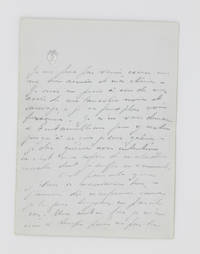
15037French writer. ALS in French 2pp 7" X 5½" n.p. n.d. Addressed to Helas. Fine. "I really don't have much luck with the Rote. I have been told that I cannot cross countries to go see the work of the Cheminean at the Comic Opera. unknown
23135This outfielder debuted in 1921 with the Philadelphia Phillies. Large bold signature in blue ballpoint heavy stock 5" X 3" card n.p. 1974 March 25. Near fine. With original envelope. Rather scarce. unknown
25848Versatile American artist printer and major illustrator throughout the golden age of advertising art 1930s-60s during which he designed an astonishing 37 U.S. postage stamps. Signed First Day Cover 6½" X 3½" cancelled in Hot Springs National Park Arkansas on 9 October 1973 and with "First Day of Issue" boldly stamped. Group of four connected tree stamps "Giant Sequoia" "White Pine" "White Oak" and "Gray Birch" at upper right. Fine. No decorative cachet at left; no distracting recipient's name/address. At lower left in black fineline Richards signs in full large and bold adding "Stamp Design" below. unknown
24604This American career railroad executive championed public safety in 1913 by helping to organize the National Safety Council a U.S. government chartered agency that helps to protect the safety of Americans at home on the roads and at work which he served as its fifth president. Bold full signature heavy stock 5" X 3½" card n.p. n.d. Very good. Slight abrasion along lower edge; mounting traces on verso. Handsomely printed "Christmas Greetings / and Best Wishes for Your Happiness / in the New Year" at center with a lovely printed and embossed color candle image above and Richards' signature in brown fountain pen below. A neglected public safety pioneer. unknown
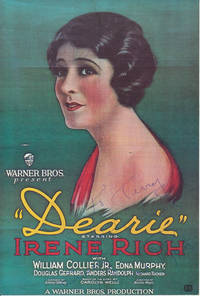
15701Silent film star "Beau Brummell" "Craig's Wife" etc. who appeared in talkies occasionally into the 1950s. Color IPS 7¼" X 11" n.p. n.d. Near fine. Book photograph another image on verso a reproduction of a charming head-and-shoulders Rich portrait on the film poster for Rich's 1927 film "Dearie" inscribed "To Terry / Good Luck / always / Irene Rich" in blue fineline. She pens this over the bust cast names portion near the bottom of this image so contrast is poor. Nevertheless an appealing and unusual item. unknown
40830This prolific American playwright is now remembered primarily for the wildly successful "The Adding Machine" 1923 and the Pulitzer Prize-winning "Street Scene" 1929. TNS 1p 8½" X 7¼" New York NY 1939 October 10.Addressed to Arnold F. Gates 1914-93 noted Lincoln and Civil War scholar. Fine. On letterhead of "The Playwrights' Company" which lists him and other notable such as Robert E. Sherwood S.N. Behrman Sidney Howard Maxwell Anderson and others as "Directors" Rice thanks this admirer "for your birthday greetings. I greatly appreciate your thoughtfulness." Boldly signed. unknown
22684Representative from New York 1847-51. DS 1p 7½" X 5¼" Lansingburgh NY 1862 May 22. Near fine. Cryptic legal agreement in which Reynolds grants one Guethman W. Cornell "his heirs and assignees all my right title and interest in and to the within instrument." Small circular red wax seal present and pristine. Boldly signed. unknown
1953021111London: Unpublished 1953. Original Letter . No Binding. Very Good. Reynolds Was A British Pacifist Who Worked With Gandhi In The 1920'S And Later Was Secretary Of The No More War Movement. Two Page Handwritten Letter 54 Lines Condensed Onto A Sixpence Air Letter. Following Up On A Letter Sent A Week Earlier Now Thanking The Recipient For A Book On Liberia. He Notes That Gilbert Highet Mentioned In The Recipient's Earlier Letter Had Been Saying Nice Things About Reynolds On The Radio. "I Strongly Approve Of This & Hope It Will Be Encouraged. I Have A Feeling I Shall Be Over In The States If This Goes On. Yesterday I Received A Copy Of The Griffin Reader's Subscriptions Inc. With An Article By Jacques Barzun No Less On E. M. Forster's Hill Of Devi. He Said 'With Mr. Reginald Reynolds' A Quest For Gandhi Which Is Its Perfect Autobiographical Counterpart The Hill Of Devi Is The Best Introduction To The Physical And Emotional Realities Of Modern India". This Has Completely Gone To My Head. The Snooty Pederasts Of Horizon And The New Statesman Never Paid Me Such Compliments. Nobody Here Compares My Modern Workto The Great And Monumental Achievements Of Mr. Forster. I Think I Must Go To America Soon The Land Where They Don't Expect Me To Lick Some Old Queen's Arse Before You Can Get A Decent Write-Up. But Does Somebody I Know - You For Example-Happen To Know Jacques Barzun Because He Posted The Thing To Me Himself To Oak Cottage Which Is Even Odder Than Sending It Here To Chelsea." He Then Discusses His Wife Edith Mannin's Recent Diet "And Much Better For It" And Is Worried About What She Will Eat When She Travels To Burma To Stay With U- Indecipherable As He Is Sure They Will Cook All Their Food In Ghee And Then Fry It Too. Then "I Must Cultivate Some More Forsterian Habits But Draw The Line At One; For He Is "Called' As We Say In Chelsea- Called To The Higher Faith Greater Than The Love Of Women Which No Doubt Helped In His Career This Side Of The Atlantic." He Then Closes With Sending His Love To The Recipient "To You Both" Inquiries What The Recipient Is Doing And Asks When They Will See Them Again. In 1964 His Wife Traveled Through The United States Meeting Austin In California Staying With Him And Traveling In California With Him. She Wrote A Book About The Trip "An American Journey" Hutchison 1967 Which She Dedicated "For Rickey With Whom I Made Some Of These Travels And To Whom I Owe So Much - In Enduring Friendship". <br/> <br/> Unpublished unknown
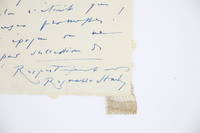
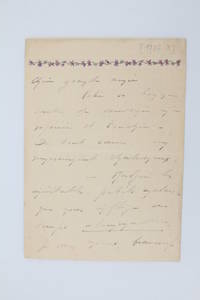
192577543Paris 1925. Fine. Paris 14 décembre 1925 10.60 x 15.70 cm une page sur une carte lettre Signed autograph note by Reynaldo Hahn addressed to Madame Serge André and written on a white paper letter-card in blue ink. Central fold inherent to the mailing. Dominique André is a poetess novelist and playwright. She notably published under the pseudonym Claude Isambert. Reynaldo Hahn declines an invitation from his friend: ""Est-ce possible chère Madame ! Vous m'invitez à goûter ! Hélas je ne pense pas aller nulle part dans la journée ! Un soir à l'Escargot d'Or on avait projeté de se voir : Lacretelle devait me faire signe - que sais-je "" ""Is it possible dear Madame! You invite me for afternoon tea! Alas I don't think I'm going anywhere during the day! One evening at the Escargot d'Or we had planned to see each other: Lacretelle was supposed to let me know - what do I know"" unknown
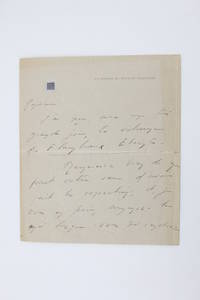
193177544Paris 1931. Fine. Paris 6 avril 1931 14.60 x 19.30 cm une page sur une carte lettre Signed autograph note by Reynaldo Hahn addressed to Madame Serge André and written on a white paper letter-card in blue ink. Central fold inherent to the mailing. Dominique André is a poetess novelist and playwright. She notably published under the pseudonym Claude Isambert. ""J'ai trop tardé chère Madame à vous remercier de votre livre et du plaisir qu'il m'a procuré. Plaisir amer et trouble - mais rare. Ce qui est particulièrement remarquable en ces pages c'est leur extrême distinction."" ""I have delayed too long dear Madame in thanking you for your book and the pleasure it has given me. Bitter and troubled pleasure - but rare. What is particularly remarkable in these pages is their extreme distinction."" unknown
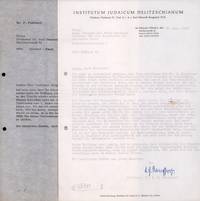
57865Münster Westf. 27. Nov. 1978. . An den Herrn Akad. Oberrat Dr. Peter Freimark "Lieber Herr Freimark! Sie sind so freundlich gewesen uns Ihre . Dokumentation zur 'Kristallnacht' als Geschenk zu übersenden." = Peter Freimark / Wolfgang Kopitzsch: Der 9./10. November 1938 in Deutschland: Dokumentation zur "Kristallnacht" Hamburg 1978. - Rengstorff Gründer u. Leiter des Institutum Judaicum Delitzschianum in Münster widmete seine wissenschaftliche Arbeit vor allem dem antiken u. rabbinischen Judentum u. der Geschichte der deutschen Juden. Er bedauert in diesem Brief daß "die Weiterarbeit an der Tosefta leidet" u. bittet P. Freimark Dozent am Institut für die Geschichte der deutschen Juden um Geduld um womöglich im folgenden Jahr die von Freimark bearbeiteten Traktate zu veröffentlichen. - BEILIEGEND als maschinenschriftlicher Durchschlag die Antwort Freimarks vom 4. Dezember d.J. in dem er sein Hilfsangebot für die Tosefta-Herausgabe noch einmal bestätigt. - Mit Kreuzbugfalte Durchschlag mit Knitterspuren. Münster (Westf.), 27. Nov. 1978. unknown
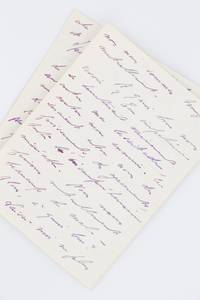
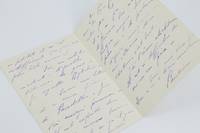
190479022Paris 1904. Fine. Paris s. d. septembre 1904 12.40 x 16.80 cm 8 pages sur 2 doubles feuillets Autograph letter signed ""Pauline"" from Renée Vivien addressed to Natalie Clifford Barney and written in purple ink on two double sheets with violet letterhead and address of 23 avenue du Bois de Boulogne. Transverse folds inherent to posting. A very beautiful and lengthy breakup letter addressed to the Amazon after her impromptu summer 1904 visit to Bayreuth to attempt to win Renée back: "". Les heures passées à Bayreuth étaient de la douceur : et c'est pourquoi je suis revenue."" ""The hours spent in Bayreuth were sweet: and that is why I returned."" The lexical field of death is omnipresent in this missive as if to better emphasize the definitive character of her decision: ""Pourquoi t'acharner à vouloir ranimer vainement les choses mortes Natalie Tu ne l'as point compris : ce que je cherchais auprès de toi c'était le souvenir et rien d'autre. On ne revit point l'autrefois. Tu dois le sentir comme moi-même. . Je souriais à mon passé. Il est doux parce qu'il est mort. Et toi tu veux galvaniser ce cadavre et le rendre odieux."" ""Why persist in trying to vainly revive dead things Natalie You have not understood: what I sought with you was memory and nothing else. One cannot relive the past. You must feel it as I do myself. . I smiled at my past. It is sweet because it is dead. And you you want to galvanize this corpse and make it odious."" The Muse of violets here reveals her suffering and disappointment pleading with Natalie twice: ""Laisse-moi ne plus revenir."" ""Let me not return again."" A veritable funeral oration for extinguished love this letter is very illuminating as to each one's way of loving: ""Nous nous sommes mal comprises. Je voulais un peu de rêve : tu m'offres la réalité."" ""We have misunderstood each other. I wanted a little dream: you offer me reality."" For this is what separates Renée - the dreamy and quasi-platonic poetess - and Natalie - the carnal and fickle lover: ""Ne sens-tu donc pas ne comprends-tu donc pas que je n'ai plus aucun désir d'amour Je suis lasse infiniment ; je ne voulais qu'un peu de douceur. Et tu m'offres la vie et les frissons que sais-je tout dont je ne me soucie point. Les joies charnelles Mais je les possède mon amie me les donne ma chair est satisfaite et au-delà. Je ne cherche point cela : je ne désire point cela. Ces choses m'excèdent venant de toi. J'espérais que assouvie de ton côté tu ne me demanderais que ce que je te demande : un peu de rêve lassé ; un peu de compréhension un peu de regret. Mais nous nous sommes trompées mutuellement. . Cherche un amour de chair chez une autre ."" ""Do you not feel do you not understand that I no longer have any desire for love I am infinitely weary; I wanted only a little sweetness. And you offer me life and thrills what do I know everything I care nothing about. Carnal joys But I possess them my friend gives them to me my flesh is satisfied and beyond. I do not seek that: I do not desire that. These things excess me coming from you. I hoped that satiated on your side you would ask of me only what I ask of you: a little weary dream; a little understanding a little regret. But we have deceived each other mutually. . Seek carnal love with another ."" It was at the end of 1899 and through the intermediary of Violette Shillito that Renée Vivien - then Pauline Tarn - made the acquaintance of Natalie Clifford Barney ""cette Américaine plus souple qu'une écharpe dont l'étincelant visage brille de cheveux d'or de prunelles bleu de mer de dents implacables"" ""this American more supple than a scarf whose sparkling face shines with golden hair sea-blue pupils implacable teeth"" Colette Claudine à Paris. Natalie who had just lived a summer idyll with the scandalous Liane de Pougy who had initiated her into sapphism paid only discrete attention to this new acquaintance. Renée however was totally capt unknown
190078919s. l. Paris 1900. Fine. s. l. Paris s. d. ca. 1900 12.30 x 16.50 cm 4 pages sur un double feuillet Autograph letter signed ""Pauline"" by Renée Vivien addressed to Natalie Clifford Barney and written in black ink on a double sheet with the poetess's silver monogram letterhead. Very beautiful and poetic love letter from the Muse of violets languishing for her ""dear white Lily"": ""Je n'ai pas pu te demander cet après-midi si je te verrais demain mon doux Avril mais tu as bien compris n'est-ce pas qu'il me serait aussi impossible de vivre un jour sans toi que de me priver des lumières du soleil ou des fleurs. . Avril mon doux petit Avril chaque fois que tu t'en vas tu emportes un peu de mon cur qui ne peut se détacher de toi et te suit tristement. Tu es pour moi la poésie la consolation et le rêve. Tu mets de la beauté dans ma vie et dans mon âme - quand je me réveille chaque jour et je pense à toi c'est la perpétuelle éclosion de quelque miraculeuse amour. Je vis dans un conte de fées un pays où tout est bleu et d'où la tristesse a disparu. Pense à moi ce soir avant d'aller rêver dans l'au-delà et le lointain du sommeil."" ""I could not ask you this afternoon if I would see you tomorrow my sweet April but you understood didn't you that it would be as impossible for me to live a day without you as to deprive myself of light sun or flowers. . April my sweet little April each time you leave you take with you a piece of my heart which cannot detach itself from you and follows you sadly. You are for me poetry consolation and dream. You bring beauty into my life and into my soul - when I wake each day and think of you it is the perpetual blossoming of some miraculous love. I live in a fairy tale a country where everything is blue and from which sadness has disappeared. Think of me tonight before going to dream in the beyond and the distance of sleep."" The letter then takes on a more sensual tone: ""J'aime tes cheveux blonds. Je leur envoie un long baiser. Les lys que j'ai dans ma chambre sont tristes parce que tu n'es plus là. Ils t'envoient leur âme dans un parfum. Ils t'aiment comme moi ; mais moins que moi."" ""I love your blonde hair. I send them a long kiss. The lilies I have in my room are sad because you are no longer there. They send you their soul in a fragrance. They love you like me; but less than me."" During their first night of love Renée had filled her room with lilies transforming it into a ""chapelle ardente"" N.Clifford Barney Je me souviens. Jean-Paul Goujon notes: ""The choice of lilies was very much in the taste of the period: let us remember Mucha's posters Schwabe's paintings Lorrain's poems. But Vivien who certainly remembered certain pages filled with flowers and perfumes from Zola's La Faute de l'abbé Mouret seems to have wanted to celebrate mystical nuptials coupled with a sort of perfumed death."" It was at the end of 1899 and through Violette Shillito that Renée Vivien - then Pauline Tarn - made the acquaintance of Natalie Clifford Barney ""cette Américaine plus souple qu'une écharpe dont l'étincelant visage brille de cheveux d'or de prunelles bleu de mer de dents implacables"" ""this American more supple than a scarf whose sparkling face shines with golden hair sea-blue eyes implacable teeth"" Colette Claudine à Paris. Natalie who had just lived through a summer idyll with the scandalous Liane de Pougy who initiated her into Sapphism paid only discreet attention to this new acquaintance. Renée however was totally captivated by the young American and would relate this coup de foudre in her autobiographical novel Une Femme m'apparut: ""J'évoquai l'heure déjà lointaine où je la vis pour la première fois et le frisson qui me parcourut lorsque mes yeux rencontrèrent ses yeux d'acier mortel ses yeux aigus et bleus comme une lame. J'eus l'obscur prescience que cette femme m'intimait l'ordre du destin que son visage était le visage redouté de mon avenir. Je sentis p unknown
190679014Villa Clos fleuri Nice Nice 1906. Fine. Villa Clos fleuri Nice Nice 3 mars 1906 12.40 x 16.80 cm 3 pages sur un double feuillet Autograph letter signed ""Pauline"" by Renée Vivien addressed to Natalie Clifford Barney and written in violet ink on a double sheet with violet letterhead the Parisian address on the letterhead crossed out. Transverse folds inherent to mailing. Fine letter evoking Renée Vivien's execration for Nice: ""Ici un soleil insolent d'ignobles bâtisses des gens Je regrette Mytilène . Mon Dieu entre Nice et Paris il n'y a pas de différence bien marquée quelques oranges de plus ici des palmiers d'opéra comique - une illusion de chaleur c'est tout."" ""Here an insolent sun ignoble buildings people I miss Mytilene . My God between Nice and Paris there is no marked difference a few more oranges here comic opera palm trees an illusion of warmth that's all."" The evocation of Mytilene where the two lovers had traveled the previous summer continues in this missive: ""Encore une lettre de ce vieux filou de Paradellis Je l'ai envoyé promener Il est capable de faire main basse sur tout ce qu'il y a dans la maison "" ""Another letter from that old rogue Paradellis I sent him packing He's capable of making off with everything in the house "" It was Passagisti Paradellis who rented a villa on site with a two-year lease to Renée and Natalie. ""The villa had been tastefully furnished. Collections of rare porcelain mother-of-pearl inlaid furniture a dining room with high-backed armchairs."" J.-P. Goujon Tes blessures sont plus douces que leurs caresses In this letter the Violet Muse also gives the key to one of the characters in Une femme m'apparut whose revised version had just appeared: ""Dis à Madame Mardrus pas de ma part de la tienne ! que Doriane c'est elle telle qu'elle s'est révélée à moi un jour dans l'ardeur et dans la tristesse."" ""Tell Madame Mardrus not from me from you! that Doriane is her as she revealed herself to me one day in ardor and in sadness."" The work whose rewriting had nevertheless tried the poetess is here devalued by the latter: ""En somme je n'aime pas ce volume ou plutôt il m'est indifférent ce qui est plus triste encore "" ""In sum I don't like this volume or rather it is indifferent to me which is even sadder "" It was at the end of 1899 and through the intermediary of Violette Shillito that Renée Vivien - then Pauline Tarn - made the acquaintance of Natalie Clifford Barney ""cette Américaine plus souple qu'une écharpe dont l'étincelant visage brille de cheveux d'or de prunelles bleu de mer de dents implacables"" Colette Claudine à Paris. Natalie who had just lived through a summer idyll with the scandalous Liane de Pougy who had initiated her into sapphism paid only discreet attention to this new acquaintance. Renée on the other hand was completely captivated by the young American and would relate this love at first sight in her autobiographical novel Une Femme m'apparut: ""J'évoquai l'heure déjà lointaine où je la vis pour la première fois et le frisson qui me parcourut lorsque mes yeux rencontrèrent ses yeux d'acier mortel ses yeux aigus et bleus comme une lame. J'eus l'obscur prescience que cette femme m'intimait l'ordre du destin que son visage était le visage redouté de mon avenir. Je sentis près d'elle les vertiges lumineux qui montent de l'abîme et l'appel de l'eau très profonde. Le charme du péril émanait d'elle et m'attirait inexorablement. Je n'essayai point de la fuir car j'aurais échappé plus aisément à la mort."" ""Winter 1899-1900. Beginning of the idyll. One evening Vivien is invited by her new friend to Mme Barney's studio Natalie's mother 153 avenue Victor-Hugo at the corner of rue de Longchamp. Natalie ventures to read verses of her composition. When Vivien tells her she loves these verses she replies that it is better to love the poet. A response quite worthy of the Amazon."" J.-P. Goujon op. cit. Two ye unknown
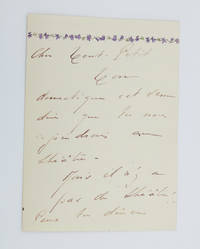
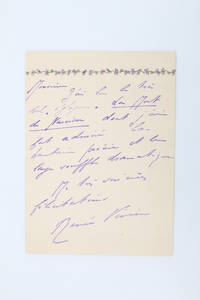
190679017s. l. Paris 1906. Fine. s. l. Paris s. d. ca 1906 11.50 x 15.90 cm 4 pages sur un double feuillet Autograph letter signed ""Paul"" from Renée Vivien addressed to Natalie Clifford Barney and written in black ink on a double sheet bordered with violets. Baroness Hélène de Zuylen has added a small manuscript message signed at the end of the letter: ""Paule a raison vous êtes un être charmant et féerique !"" ""Paule is right you are a charming and fairy-like being!"" Transverse folds inherent to mailing. ""Cher Tout-Petit Ton domestique est venu dire que tu nous rejoindrais au théâtre. Mais il n'y a pas de théâtre ! Peux-tu dîner avec nous jeudi ou vendredi Si dans la soirée de jeudi tu n'es libre qu'après le dîner viens nous rejoindre à n'importe quelle heure. Donne-moi un petit coup de téléphone pour me dire ce que tu feras et si je dois te faire chercher et à quelle heure Dis à tes cheveux que je les aime."" ""Dear Little One Your servant came to say that you would join us at the theater. But there is no theater! Can you dine with us Thursday or Friday If on Thursday evening you are only free after dinner come join us at any hour. Give me a little telephone call to tell me what you will do and if I should have you collected and at what time Tell your hair that I love it."" It was at the end of 1899 and through Violette Shillito that Renée Vivien - then Pauline Tarn - made the acquaintance of Natalie Clifford Barney ""cette Américaine plus souple qu'une écharpe dont l'étincelant visage brille de cheveux d'or de prunelles bleu de mer de dents implacables"" ""this American more supple than a scarf whose sparkling face shines with golden hair sea-blue eyes implacable teeth"" Colette Claudine à Paris. Natalie who had just experienced a summer idyll with the scandalous Liane de Pougy who initiated her into sapphism paid only discreet attention to this new acquaintance. Renée on the other hand was totally captivated by the young American and would relate this coup de foudre in her autobiographical novel Une Femme m'apparut: « J'évoquai l'heure déjà lointaine où je la vis pour la première fois et le frisson qui me parcourut lorsque mes yeux rencontrèrent ses yeux d'acier mortel ses yeux aigus et bleus comme une lame. J'eus l'obscur prescience que cette femme m'intimait l'ordre du destin que son visage était le visage redouté de mon avenir. Je sentis près d'elle les vertiges lumineux qui montent de l'abîme et l'appel de l'eau très profonde. Le charme du péril émanait d'elle et m'attirait inexorablement. Je n'essayai point de la fuir car j'aurais échappé plus aisément à la mort. » ""I evoked that already distant hour when I saw her for the first time and the shiver that ran through me when my eyes met her deadly steel eyes her sharp blue eyes like a blade. I had the obscure prescience that this woman was giving me destiny's order that her face was the dreaded face of my future. I felt near her the luminous vertigo that rises from the abyss and the call of very deep water. The charm of peril emanated from her and attracted me inexorably. I did not try to flee her for I would have escaped death more easily."" « Hiver 1899-1900. Débuts de l'idylle. Un soir Vivien est invitée par sa nouvelle amie dans l'atelier de Mme Barney mère de Natalie 153 avenue Victor-Hugo à l'angle de la rue de Longchamp. Natalie s'enhardit à lire des vers de sa composition. Comme Vivien lui dit aimer ces vers elle lui répond qu'il vaut mieux aimer le poète. Réponse bien digne de l'Amazone. » ""Winter 1899-1900. Beginning of the idyll. One evening Vivien is invited by her new friend to the studio of Mme Barney Natalie's mother 153 avenue Victor-Hugo at the corner of rue de Longchamp. Natalie grows bold enough to read verses of her own composition. When Vivien tells her she loves these verses she replies that it is better to love the poet. A response quite worthy of the Amazon."" J.-P. Goujon Tes blessures sont plus douces qu unknown
190478907s. l. Paris 1904. Fine. s. l. Paris s. d. ca. 1904 11.50 x 15.90 cm 4 pages sur un double feuillet Autograph letter from Renée Vivien addressed to Natalie Clifford Barney and written in black ink on a double sheet bordered with a violet trim. Transverse fold inherent to mailing. A beautiful love letter marking the reconciliation of the Muse of Violets and the Amazon after a two-year separation: ""Your letter was cruelly sweet to me I wept reading it and something within me rejoiced despite everything to think that between us the bond was so powerful and subtle that only death could entirely untie it if death is definitive."" Weary and very jealous of Natalie's infidelities Renée had made the radical decision to leave her. The Amazon had then by every means attempted to win her back sending emissaries as well as numerous letters: ""My tears have flowed over all the letters you have sent me since the silence that had settled between us."" Renée seems this time to have broken her promise never to see Natalie again and addresses this beautiful declaration to her full of hope for the future: ""Forget you! But my lips which are the soul of my soul have kept your reflection and your imprint. . Something in me has been broken since then from having loved too blindly. But if it is true that there remain within us unknown tenderness and ignored sweetness that we can still lavish upon each other in a better future let us not hesitate to discover them in the depths of our souls. I would like to take you in my arms my Little One like a sick child and rock you and console you and heal you and see the smiles of yesteryear bloom again on your lips. You must no longer suffer for me my Blonde Sweetness I love you I will heal you."" These reunions would not last however: torn between Baroness Hélène de Zuylen and Natalie Renée would embark on a series of travels; in turn to Holland Germany Switzerland and Venice she would confide her hesitations to Kérimé Turkhan-Pacha her epistolary companion from the Bosphorus whom she would meet in the summer of 1905 during her last journey with Natalie Clifford Barney to Mytilene. A moving letter from Renée Vivien addressed to the great love of her life. It was at the end of 1899 and through Violette Shillito that Renée Vivien - then Pauline Tarn - made the acquaintance of Natalie Clifford Barney ""cette Américaine plus souple qu'une écharpe dont l'étincelant visage brille de cheveux d'or de prunelles bleu de mer de dents implacables"" ""this American more supple than a scarf whose sparkling face shines with golden hair sea-blue eyes implacable teeth"" Colette Claudine à Paris. Natalie who had just experienced a summer idyll with the scandalous Liane de Pougy who had initiated her into sapphism paid only discreet attention to this new acquaintance. Renée on the other hand was completely captivated by the young American and would relate this love at first sight in her autobiographical novel Une Femme m'apparut: « J'évoquai l'heure déjà lointaine où je la vis pour la première fois et le frisson qui me parcourut lorsque mes yeux rencontrèrent ses yeux d'acier mortel ses yeux aigus et bleus comme une lame. J'eus l'obscur prescience que cette femme m'intimait l'ordre du destin que son visage était le visage redouté de mon avenir. Je sentis près d'elle les vertiges lumineux qui montent de l'abîme et l'appel de l'eau très profonde. Le charme du péril émanait d'elle et m'attirait inexorablement. Je n'essayai point de la fuir car j'aurais échappé plus aisément à la mort. » ""I evoked the already distant hour when I saw her for the first time and the shiver that ran through me when my eyes met her mortal steel eyes her sharp blue eyes like a blade. I had the obscure prescience that this woman was giving me fate's order that her face was the dreaded face of my future. I felt near her the luminous vertigo that rises from the abyss and the call of very deep water. The charm of peril emanat unknown
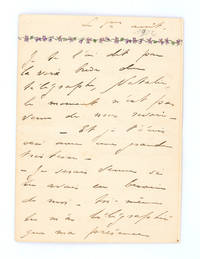
190479913s. l. Paris 1904. Fine. s. l. Paris s. d. ca 1904 11.50 x 16 cm une page sur un double feuillet Handwritten signed letter addressed to the poet Jean-Marc Bernard: I read the very beautiful eclogue La Mort de Narcisse whose haughty poetry and dramatic breath I admired very much. Paris ca 1904 11.5 x 16 cm one page on a double leafHandwritten signed letter from Renée Vivien addressed to Jean-Marc Bernard written in violet ink on a double leaf of paper decorated at the head with a border of violets. Transverse folds from having been sent. Monsieur J'ai lu le très bel ""églogue"" La Mort de Narcisse dont j'ai fort admiré la hautaine poésie et le large souffle dramatique. Mes très sincères félicitations. Renée Vivien. Monsieur I read the very beautiful eclogue La Mort de Narcisse whose haughty poetry and dramatic breath I admired very much. My very sincere congratulations. Renée Vivien. Jean-Marc Bernard was one of the founders of the poetic satirical and monarchist magazine Les Guêpes which welcomed contributions from Paul-Jean Toulet and Francis Carco among others. Together with the latter two he was part of the École fantaisiste a collective of young poets eager to break with the Parnassians and symbolists and whose ambitions were soon to be swept away by the arrival of the Great War. Jean-Marc Bernard lost his life on the front line destroyed by a shell at the age of thirty-three. unknown
190079011s. l. Paris 1900. Fine. s. l. Paris s. d. ca 1900 12.50 x 8.40 cm une carte rédigée des deux côtés Autograph letter signed ""Paul"" and addressed to Natalie Clifford Barney written in black ink on both sides. Silver monogram of the poetess in the upper left corner of the recto. ""Je ne vais pas à la campagne après tout mon Tout-Petit. Ils sont partis de si bonne heure que j'ai pu trouver un prétexte pour ne pas les accompagner dans ma fatigue et l'heure trop matinale. Quand veux-tu que je vienne te chercher et où irons-nous Je serai prête à l'heure où tu voudras. J'aime tes jolies fleurs elles sont charmantes - j'ai porté une de tes roses hier au soir. A tout à l'heure mignon Tout-Petit - Paul"" ""I'm not going to the countryside after all my Little One. They left so early that I was able to find an excuse not to accompany them in my fatigue and the too early hour. When do you want me to come get you and where shall we go I'll be ready whenever you want. I love your pretty flowers they are charming - I wore one of your roses last evening. See you soon sweet Little One - Paul"" It was at the end of 1899 and through Violette Shillito that Renée Vivien - then Pauline Tarn - made the acquaintance of Natalie Clifford Barney ""this American more supple than a scarf whose sparkling face shines with golden hair sea-blue eyes implacable teeth"" Colette Claudine à Paris. Natalie who had just experienced a summer idyll with the sulfurous Liane de Pougy who had initiated her into sapphism paid only discreet attention to this new acquaintance. Renée however was completely captivated by the young American and would recount this coup de foudre in her autobiographical novel Une Femme m'apparut: ""J'évoquai l'heure déjà lointaine où je la vis pour la première fois et le frisson qui me parcourut lorsque mes yeux rencontrèrent ses yeux d'acier mortel ses yeux aigus et bleus comme une lame. J'eus l'obscur prescience que cette femme m'intimait l'ordre du destin que son visage était le visage redouté de mon avenir. Je sentis près d'elle les vertiges lumineux qui montent de l'abîme et l'appel de l'eau très profonde. Le charme du péril émanait d'elle et m'attirait inexorablement. Je n'essayai point de la fuir car j'aurais échappé plus aisément à la mort."" ""I recalled the already distant hour when I saw her for the first time and the shiver that ran through me when my eyes met her deadly steel eyes her sharp and blue eyes like a blade. I had the dark prescience that this woman was commanding me to destiny that her face was the dreaded face of my future. I felt near her the luminous vertigo that rises from the abyss and the call of very deep water. The charm of peril emanated from her and attracted me inexorably. I did not try to flee from her for I would have escaped death more easily."" ""Winter 1899-1900. Beginning of the idyll. One evening Vivien is invited by her new friend to the studio of Mrs. Barney Natalie's mother 153 avenue Victor-Hugo at the corner of rue de Longchamp. Natalie ventures to read verses of her composition. When Vivien tells her she loves these verses she replies that it is better to love the poet. An answer quite worthy of the Amazon."" J.-P. Goujon Tes blessures sont plus douces que leurs caresses There followed two years of unequal happiness punctuated by Natalie's recurring infidelities and Renée's morbid jealousy whose letters oscillated between impassioned declarations and painful mea culpas. ""Renée Vivien is the daughter of Sappho and Baudelaire she is the flower of evil 1900 with fevers broken flights sad voluptuousness."" Jean Chalon Portrait d'une séductrice In 1901 came an important break that would last almost two years; Renée despite Natalie's solicitations and the intermediaries she sent to win her back resisted. ""The two friends met again and it was in August 1905 the pilgrimage to Lesbos which constituted a disappointment for Natalie Barney and remained without sequel. . unknown
190779804s. l. Paris 1907. Fine. s. l. Paris s. d. ca. 1907-1908 11.50 x 16 cm 2 pages 1/2 sur un double feuillet Autograph letter signed by Renée Vivien addressed to Marcelle Tinayre written in black ink on a double sheet of headed paper decorated with a border of violets. Transverse creases inherent to mailing. Also a writer Marcelle Tinayre was close to Renée Vivien who entrusted her first verses to her to read. Upon Vivien's death Tinayre paid tribute to her through several texts notably a very beautiful tribute article published in the review Schéhérazade in 1910 entitled ""Trois images de Renée Vivien"". ""Chère grande amie Votre si bonne carte de souvenir m'a réjouie et touchée. De tout coeur un remerciement chaleureux. Malgré les inévitables petits malaises que nous inflige ce temps abominable je vais mieux beaucoup mieux. Aussi serais-je très heureuse si vous et Monsieur Tinayre étiez libres le 12 et pouviez venir dîner chez moi. J'aurai le plaisir de vous présenter ma soeur et mon beau-frère qui seront à Paris. Vous devinez quelle joie me causera leur présence ! Croyez à toute mon admiration à toute ma sympthie. Renée Vivien."" ""Dear great friend Your so kind remembrance card delighted and touched me. A warm thank you from the heart. Despite the inevitable small ailments this abominable weather inflicts upon us I am better much better. So I would be very happy if you and Monsieur Tinayre were free on the 12th and could come dine at my home. I will have the pleasure of introducing my sister and brother-in-law who will be in Paris. You can imagine what joy their presence will bring me! Believe in all my admiration all my sympathy. Renée Vivien."" The Muse of violets was indeed very close to Toinette her younger sister who lived in London with her husband Francis. Renée Vivien was moreover the godmother of their son Paul a very rare name then in England in honor of his aunt and in 1911 Toinette would give birth to a daughter whom she would name Renée in tribute to her deceased sister. Very beautiful testimony to the friendship that Renée Vivien bore toward Marcelle Tinayre a writer friend who contributed to perpetuating the memory of Sappho 1900. unknown
190078897s. l. Paris 1900. Fine. s. l. Paris s. d. ca 1900 9.50 x 5.60 cm une carte rédigée des deux côtés Autograph manuscript card signed ""Pauline"" and addressed to Natalie Clifford Barney written in black ink on both sides. Two small pinholes at the top of this card which accompanied a bouquet: ""Méchante d'être partie si vite ! - voici des orchidées blanches - elles te défendront contre les doutes et les pensées tristes. Elles te protègeront et t'assureront de ma profonde et éternelle tendresse. Ne sois pas en retard ce soir. Je compterai les secondes aux battements de mon coeur. Ces fleurs ce sont mes lèvres mon âme et mon coeur qui vont vers toi - Toujours."" ""Naughty to have left so quickly! - here are white orchids - they will defend you against doubts and sad thoughts. They will protect you and assure you of my deep and eternal tenderness. Don't be late tonight. I will count the seconds to the beating of my heart. These flowers are my lips my soul and my heart going towards you - Always."" It was at the end of 1899 and through the intermediary of Violette Shillito that Renée Vivien - then Pauline Tarn - made the acquaintance of Natalie Clifford Barney ""cette Américaine plus souple qu'une écharpe dont l'étincelant visage brille de cheveux d'or de prunelles bleu de mer de dents implacables"" ""this American more supple than a scarf whose sparkling face shines with golden hair sea-blue eyes and implacable teeth"" Colette Claudine à Paris. Natalie who had just experienced a summer idyll with the scandalous Liane de Pougy who had initiated her into sapphism paid only discreet attention to this new acquaintance. Renée however was completely captivated by the young American and would relate this love at first sight in her autobiographical novel Une Femme m'apparut: ""J'évoquai l'heure déjà lointaine où je la vis pour la première fois et le frisson qui me parcourut lorsque mes yeux rencontrèrent ses yeux d'acier mortel ses yeux aigus et bleus comme une lame. J'eus l'obscur prescience que cette femme m'intimait l'ordre du destin que son visage était le visage redouté de mon avenir. Je sentis près d'elle les vertiges lumineux qui montent de l'abîme et l'appel de l'eau très profonde. Le charme du péril émanait d'elle et m'attirait inexorablement. Je n'essayai point de la fuir car j'aurais échappé plus aisément à la mort."" ""I evoked the already distant hour when I saw her for the first time and the shiver that ran through me when my eyes met her eyes of mortal steel her eyes sharp and blue like a blade. I had the obscure presentiment that this woman was giving me destiny's order that her face was the dreaded face of my future. I felt near her the luminous vertigo that rises from the abyss and the call of very deep water. The charm of peril emanated from her and attracted me inexorably. I did not try to flee her for I would have escaped death more easily."" ""Hiver 1899-1900. Débuts de l'idylle. Un soir Vivien est invitée par sa nouvelle amie dans l'atelier de Mme Barney mère de Natalie 153 avenue Victor-Hugo à l'angle de la rue de Longchamp. Natalie s'enhardit à lire des vers de sa composition. Comme Vivien lui dit aimer ces vers elle lui répond qu'il vaut mieux aimer le poète. Réponse bien digne de l'Amazone."" ""Winter 1899-1900. Beginning of the idyll. One evening Vivien is invited by her new friend to Mme Barney's studio Natalie's mother 153 avenue Victor-Hugo at the corner of rue de Longchamp. Natalie ventures to read verses of her composition. When Vivien tells her she loves these verses she replies that it is better to love the poet. A response quite worthy of the Amazon."" J.-P. Goujon Tes blessures sont plus douces que leurs caresses Two years of unequal happiness followed punctuated by Natalie's recurring infidelities and Renée's pathological jealousy whose letters oscillated between impassioned declarations and painful mea culpas. ""Renée Vivien c'est la fille de Sappho et de Baudelaire c'est la f unknown
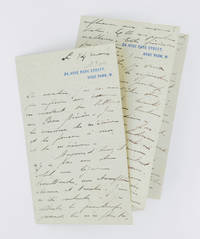
190079025s. l. Londres London 1900. Fine. s. l. Londres London Le 14 mars 1900 9.90 x 15.20 cm 8 pages sur 2 doubles feuillets Autograph letter signed ""Pauline"" by Renée Vivien written in black ink on two double sheets of letterhead paper from 24 Hyde Park Street. Transverse folds inherent to posting. A very beautiful and poetic letter written from London where the young Renée savors a sweet melancholy: ""Today there was no sun a light fog a dark and sad atmosphere. I was pleased by it I hate spring when you are no longer here and the sun and soft air hurt me. I love the sadness of the sky and the moon which goes well with my thoughts."" Despite a very busy schedule ""I am very tired this evening I return from the Alhambra where mama took me to see the military ballet and hear the patriotic songs. . I went skating in the afternoon in the morning I went to see one of my friends here who is very kind although having too much religion for my taste."" the young woman is bored in this city that she profoundly detests ""How can you be jealous you whom I adore of London which I hate I have been unhappy since I entered this city. It is dark it has a bad influence on my destiny. It brings me misfortune. It will end up killing me if I stay. I am afraid of it I want to leave to join you my darling my spring you who are the being of light and beauty my love my happiness and my consolation."" and finds comfort in the memory of her beloved of whom she thinks every moment: ""You are right to feel my thoughts around you I desperately throw my soul across space so that it finds you Your memory is in all my actions all my words it is you that I see through the things that surround me."" Natalie is everywhere even in her reading: ""I will read 'Séraphita' to find you a little in those pages of Balzac. Everything that reminds me of you everything that has some connection with you even distant is dear to me."" As Jean Chalon shows in his biography of Natalie Clifford Barney Portrait d'une séductrice Séraphita is a founding novel of the Amazon's thought and one of the first books she bought upon her arrival in Europe: ""Natalie had vainly sought this philosophical novel by Balzac in the bookstores of Washington. She would find this book in Europe and push refinement to the point of reading the angelic avatars of Séraphitus-Séraphita in that Norway which forms its setting."" From this underlined passage in her copy one notices that she retains more of its feminism than the concept of intersexuality: ""Would this not be using your rights as a man We must always please you relax you always be cheerful and have only the whims that amuse you. What must I do my friend Do you want me to sing to dance when fatigue takes away the use of my voice and legs Gentlemen even if we were dying we must still smile at you! You call this I believe reigning. Poor women! I pity them."" As evidenced by a letter addressed to her previous lover Liane de Pougy she had already introduced her to this Balzacian heroine: ""You will come to me I will go to you and we will marry our lives. That day you will read me Séraphîta. She will awaken our slumbering souls and you will lend to the sleeping words the beauty of your voice. It will be our litany of love."" It was at the end of 1899 and through Violette Shillito that Renée Vivien - then Pauline Tarn - made the acquaintance of Natalie Clifford Barney ""this American more supple than a scarf whose sparkling face shines with golden hair sea-blue pupils and implacable teeth"" Colette Claudine à Paris. Natalie who had just lived a summer idyll with the sulfurous Liane de Pougy who had initiated her into sapphism paid only discreet attention to this new acquaintance. Renée on the other hand was totally captivated by the young American and would relate this love at first sight in her autobiographical novel Une Femme m'apparut : ""I evoked the already distant hour when I saw her for the first time and t unknown
190879911s. l. Paris 1908. Fine. s. l. Paris 1908 13 x 15 cm 3 pages 1/2 sur un double feuillet Autograph letter signed by Renée Vivien addressed to her publisher Edward Sansot written in black ink on a double sheet of headed paper bearing the poet's monogram and her address at 23 avenue du Bois de Boulogne. Transverse folds inherent to mailing two tiny marginal tears without loss at the fold. Fascinating letter written by the Muse of the violets in the last months of her life: ""J'ai reçu avec une très grande joie les volumes des Flambeaux éteints. Remerciez bien de ma part votre soeur d'avoir fait les corrections et je vous en prie amenez-la moi lorsque vous reviendrez Avenue du Bois. Pour les six exemplaires de Sillages décollés donnez-les - je n'ai pas beaucoup d'amis et me soucie peu de distribuer des volumes au hasard. Maintenant s'il est trop tard lorsque ma lettre vous parviendra et que les exemplaires me parvinssent quand même ne soyez pas désolé - cela m'est indifférent je vous les ferai envoyer. Mes meilleurs sentiments d'amitié littéraire. Renée Vivien. Je vous envoie en même temps sept volumes à distribuer au hasard parmi vos amis littéraires."" ""I received the volumes of Flambeaux éteints with very great joy. Please thank your sister on my behalf for having made the corrections and I beg you bring her to me when you return to Avenue du Bois. For the six unbound copies of Sillages give them away - I do not have many friends and care little about distributing volumes at random. Now if it is too late when my letter reaches you and the copies reach me nonetheless do not be sorry - it is indifferent to me I will have them sent to you. My best feelings of literary friendship. Renée Vivien. I am sending you at the same time seven volumes to distribute at random among your literary friends."" The publication of Flambeaux éteints marks the first collaboration between the poet and her new publisher Edward Sansot. In these last painful years of life Sansot and his friend Charles-Brun are her only two links with the literary world whose critics - once highly laudatory - have finally turned their backs on her. It must be said that Renée Vivien has decided to withdraw all her books from commerce and is gradually sinking into solitude and depression. Handsome letter bearing witness to the last literary years of Sappho 1900. unknown
190079000s. l. Paris 1900. Fine. s. l. Paris s. d. 1er semestre 1900 12.30 x 16.70 cm 2 pages sur un double feuillet Handwritten signed letter addressed to Natalie Clifford Barney: I am in the grips of one of my bouts of black and wild melancholy - I can no longer see anyone. Paris 1st half-year 1900 12.3 x 16.7 cm 2 pages on a double leafHandwritten letter from Renée Vivien signed Paule and written in pencil on a double leaf with a silver-coloured heart with the poet's monogram at the top of the first sheet. Transverse fold from having been sent. Beautiful letter of apology after a dispute with the Amazone: Suis en proie à un de mes accès de mélancolie noire et sauvage je ne peux plus voir personne. Je m'en vais demain à Fontainebleau pour y rester jusqu'à ce que je sois guérie je dis : guérie avec intention car c'est une espèce de maladie morale dont je souffre en ce moment. C'est pour cela que j'étais si mauvaise hier j'aurais dû m'enfermer comme je le fais toujours en pareil cas. Une autre fois je m'en irai à temps pour ne pas te faire du mal si toutefois tu me permets de dire : une autre fois et si tu ne me renvoies pas à jamais de ta présence. Je n'ai qu'une excuse c'est que je souffre. Je n'ai pas été digne de l'amour que tu m'as si généreusement et si largement donné je n'ose plus te demander pardon je t'ai tant de fois offensée ! I am in the grips of one of my bouts of black and wild melancholy - I can no longer see anyone. Tomorrow I am going to go to Fontainebleau to stay there until I am healed - I say: healed with intent because it is a kind of moral illness from which I suffer at the moment. That's why I was so bad yesterday - I should have locked myself up as I always do in such a case. Another time I will go sooner so as not to cause you harm - if nevertheless you allow me to say: another time and if you do not dismiss me forever from your presence. I only have one excuse that is that I suffer. I have not been worthy of the love that you have so generously and so widely given me - I dare not ask you anymore for forgiveness - I have offended you so many times! unknown
190078850s. l. 1900. Fine. s. l. Vendredi soir printemps 1900 12.50 x 8.40 cm 6 pages sur 3 cartes Handwritten letter addressed to Natalie Clifford Barney: Je t'écris ce mot dans le train tu t'en apercevras vite en observant l'irrégularité de mon écriture. I write this to you on the train you will quickly notice that by observing the irregularity of my handwriting. s.l Friday evening Spring 1900 12.5 x 8.4 cm 6 pages on 3 cards Handwritten letter from Renée Vivien written in pencil on three blue cards with the poet's monogram. This letter has been published in Renée Vivien et ses masques in A l'Encart n°2 April 1980 A very beautiful letter written on a train: Je t'écris ce mot dans le train tu t'en apercevras vite en observant l'irrégularité de mon écriture. I write this to you on the train you will quickly notice that by observing the irregularity of my handwriting. Renée had just left her cher petit amour dear little love for a short stay outside of Paris: Quelle folie de me séparer de toi même pour deux jours et comme je le regrette amèrement maintenant : - Seulement j'étais inquiète tu sais une fois rassurée j'aurai l'esprit tranquille désormais et je pensais goûter un bonheur absolu et parfait dans ton ombre tout près de toi. Comment ai-je pu être assez stupide et assez folle pour m'en aller ! Deux jours c'est si long ! C'est deux éternités de joie dont je me prive par ma bête faute ! - Vois-tu je t'aime à ne pouvoir vivre sans toi. Ne plus te voir est une souffrance accablante. Pense à moi Lys blanc - Lys blanc aime-moi car je suis triste ce soir. What madness to separate myself from you even for two days and as I bitterly regret it now: - Only I was worried you know once reassured I will have peace of mind from now on and I thought I would taste absolute and perfect happiness in your shadow very close to you. How could I be stupid enough and crazy enough to go away! Two days is so long! It is two eternities of joy that I deprive myself of by my own stupid fault! - You see I love you and cannot live without you. Not seeing you again is an overwhelming suffering. Think of me White Lilly - White Lilly love me because I am sad this evening. In this letter we encounter Vivien's obsession with flowers: J'ai reçu avant de partir l'adorable petit bouquet de violettes blanches que tu m'as si tendrement envoyé et le cher petit mot qui m'a touchée comme une plainte d'enfant triste. Before leaving I received the adorable little bouquet of white violets that you so tenderly sent and the dear little note that touched me like a sad child's complaint. It is at the end of 1899 and through Violette Shillito that Renée Vivien - then Pauline Tarn - met Natalie Clifford Barney cette Américaine plus souple qu'une écharpe dont l'étincelant visage brille de cheveux d'or de prunelles bleu de mer de dents implacables this American woman softer than a scarf whose sparkling face shines with golden hair sea blue eyes never-ending teeth Colette Claudine à Paris. Natalie who had just experienced a summer romance with the scandalous Liane de Pougy who introduced her to sapphism paid little attention to this new acquaintance. Renée on the other hand was totally captivated by the young American woman and describes this love at first sight in her autobiographical novel Une Femme m'apparut: J'évoquai l'heure déjà lointaine où je la vis pour la première fois et le frisson qui me parcourut lorsque mes yeux rencontrèrent ses yeux d'acier mortel ses yeux aigus et bleus comme une lame. J'eus l'obscur prescience que cette femme m'intimait l'ordre du destin que son visage était le visage redouté de mon avenir. Je sentis près d'elle les vertiges lumineux qui montent de l'abîme et l'appel de l'eau très profonde. Le charme du péril émanait d'elle et m'attirait inexorablement. Je n'essayai point de la fuir car j'aurais échappé plus aisément à la mort. I lived again the hour already well past when I saw unknown
190278981s. l. Paris 1902. Fine. s. l. Paris Le 1er avril 1902 11.50 x 15.90 cm 7 pages 1/2 sur deux doubles feuillets Handwritten signed letter addressed to Natalie Clifford Barney: I told you by the raw voice of the telegraph Natalie the time has not come for us to see each other again. Paris 1st April 1902 11.5 x 15.9 cm 7 pages 1/2 on two double leavesHandwritten letter signed Pauline from Renée Vivien addressed to Natalie Clifford Barney and written in black ink on two double leaves edged with violettes. Transverse folds from having been sent. Interesting letter mentioning Brumes de fjords and Freddy Manners-Sutton. Tu te trompes en croyant retrouver dans Brumes de fjords un reflet de femme ou l'influence d'une pensée de poète norvégien. Je les ai faites d'un souvenir très lointain de ce pays mystique et de quelques rêves lourds de nostalgies. You are mistaken when you think that you find a reflection of a woman or the influence of a Norwegian poet's thinking in Brumes de fjords. I wrote them as a very distant memory of this mystical country and of some dreams heavy with nostalgia. Brumes de fjords is the first collection of prose poetry by Renée Vivien to be published in June 1902. Natalie and Renée were then separated but this letter shows that the Muse aux violettes continued to send her texts to the Amazone despite the physical and sentimental distance that separated them. Car j'ai dans ma vie une tendresse que je crois sincère quoi qu'il me soit difficile aujourd'hui de croire à la sincérité même lorsqu'elle me montre ses larmes. Since I have a tenderness in my life which I believe to be sincere - though it is difficult for me today to believe in sincerity even when it shows me its tears. This letter was indeed sent to Natalie Clifford Barney while she was in the United States: Je serais venue si tu avais eu besoin de moi. Toi-même tu m'as télégraphiée que ma présence était inutile. lorsque ton temps était pris par un flirt Freddy Manners-Sutton qui sait et qu'importe Il est trop tard maintenant. Je ne viens pas t'amuser ni remplacer une distraction absente. Si tu viens à Paris cet hiver je te verrai une ou deux fois comme on revoit le visage lointain de son passé sans colère sans haine mais aussi sans amour. I would have come if you needed me. You yourself telegraphed me that my presence was useless. when your time was taken by a flirt Freddy Manners-Sutton Who knows And what does it matter It's too late now. I don't come to amuse you or replace an absent distraction. If you come to Paris this winter I will see you once or twice - as you see the distant face of your past - without anger without hatred but also without love. Here Renée gives free reign to her jealousy mentioning Freddy Manners-Sutton Natalie's friend: En réalité Vivien ne pouvait supporter Manners-Sutton. Dans Une femme m'apparut elle l'appellera tout simplement Le Prostitué et dira de lui : Il est banal comme l'adultère. Cette antipathie se transformera en une haine féroce lorsqu'un peu plus tard Vivien apprendra que cet homme se faisait passer pour le fiancé de Natalie Barney. Sacrilège suprême. ! Mais Vivien ne savait pas ou bien voulait ignorer que cette rumeur était en fait propagée par Natalie Barney elle-même afin de donner le change à ses parents. Non pensait-elle ce personnage au-dessous de toute insulte veut tout simplement capter la fortune de Natalie ! In reality Vivien could not bear Manners-Sutton. In Une femme m'apparut she will very simply call him Le Prostitué and will say of him: He is common like adultery. This antipathy will turn into a fierce hatred when a little later Vivien learns that this man pretends to be Natalie Barney's fiancé. Supreme sacrilege.! But Vivien did not know - or even wanted to ignore - that this rumour was actually spread by Natalie Barney herself in order to pull the wool over her parent's eyes. No she thought this below any insult character simply wan unknown