Renee VIVIENBiblio.com
1 815 résultats
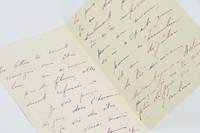
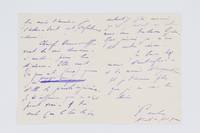
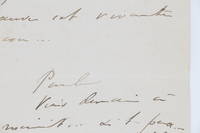
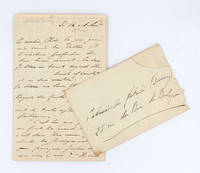
190078982s. l. Londres London 1900. Fine. s. l. Londres London Le 16 octobre 1900 11.30 x 17.50 cm 10 pages sur 2 doubles feuillets et 1 feuillet simple Very long autograph manuscript letter by Renée Vivien signed ""Ton fervent Paul"" written in black ink on two double sheets and one single sheet. Transverse creases inherent to the mailing envelope included. Moving letter recounting Renée Vivien's first encounters with suffering and death. Having returned to her family in London the Violet Muse watches over her dying cousin : ""Mon pauvre cousin va de plus en plus mal. Je crains horriblement que ce ne soit la fin. Il est la plupart du temps en proie à la fièvre et au délire. Ou bien il dort d'un mauvais sommeil de prostration et de faiblesse à la suite des piqûres de morphine. . Cela me fait mal de voir le pauvre squelette qui me sourit si faiblement ce visage est marqué déjà par la mort il y a la trace de sa serre qui ne relâche pas."" ""My poor cousin is getting worse and worse. I am horribly afraid this may be the end. He is most of the time prey to fever and delirium. Or else he sleeps a bad sleep of prostration and weakness following morphine injections. . It pains me to see the poor skeleton who smiles at me so weakly this face is already marked by death there is the trace of its grip that does not let go."" Pain is omnipresent in this letter-torrent: ""J'ai vu une chose horrible aujourd'hui à l'hôpital en allant voir mon cousin. On a apporté sur un brancard une chose épouvantable - un corps couvert d'un drap et une tête d'homme aux joues brûlées - et de cela sortait des gémissements et des hurlements et des râles. Il me semble que je ne pourrai jamais oublier l'affreuse chose inerte qui m'a frôlée de si près cette après-midi. Il paraît que c'était un ouvrier terriblement blessé par une explosion de gaz qui a eu lieu dans une fabrique à une heure cette après-midi. Ah ! la sinistre chose qu'on portait là-bas ! On entend parler d'accidents et de blessures et de mort et on n'y fait pas attention jusqu'à ce qu'on voie ce que c'est. L'horreur de tout cela m'obsède ce soir et s'ajoute à mon abattement et à ma mélancolie."" ""I saw a horrible thing today at the hospital while going to see my cousin. They brought on a stretcher a dreadful thing - a body covered with a sheet and a man's head with burned cheeks - and from this came moans and howls and death rattles. It seems to me I will never be able to forget the awful inert thing that brushed so close to me this afternoon. It appears it was a worker terribly injured by a gas explosion that occurred in a factory at one o'clock this afternoon. Ah! the sinister thing they were carrying there! One hears talk of accidents and injuries and death and pays no attention to it until one sees what it is. The horror of all this obsesses me tonight and adds to my dejection and my melancholy."" At this time Renée Vivien had not yet published anything and even devalued her verses in favor of those of the Amazon: ""Ce matin Chère la joie que m'a causée ta lettre et l'émotion profonde de ton beau sonnet - ce vers « Is there no touch beyond the touch of hands » et ces deux autres : « Is there no love that burns an unseen fire » « Beyond the finish of expressed desire » sont de toute splendeur poétique. . C'est toi qui portes au front la grande lumière c'est dans ton cur que chante la musique sublime parler de mes vers à moi Ils sont pauvres à faire pleurer."" ""This morning Dear the joy your letter caused me and the profound emotion of your beautiful sonnet - this verse 'Is there no touch beyond the touch of hands' and these two others: 'Is there no love that burns an unseen fire' 'Beyond the finish of expressed desire' are of all poetic splendor. . It is you who bears the great light on your brow it is in your heart that the sublime music sings speak of my verses me They are poor enough to make one weep."" Written in a period preceding the sentimental storms this ve unknown
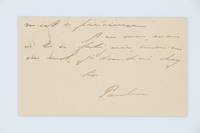
190078898s. l. Paris 1900. Fine. s. l. Paris s. d. ca 1900 9.50 x 5.60 cm une carte rédigée des deux côtés Autograph manuscript card signed ""Pauline"" and addressed to Natalie Clifford Barney written in black ink on both sides. ""Repose-toi aujourd'hui chérie. Je suis inquiète de toi et cela me rend affreusement triste. Repose-toi bien n'est-ce pas Mon si fragile bonheur sois très prudente et ménage ta jolie santé frêle qui m'est si précieuse. A ce soir mais si tu es fatiguée envoie-moi un mot je viendrai chez toi."" ""Rest today darling. I am worried about you and it makes me terribly sad. Rest well won't you My so fragile happiness be very careful and take care of your pretty frail health which is so precious to me. Until tonight but if you are tired send me a word I will come to you."" It was at the end of 1899 and through Violette Shillito that Renée Vivien - then Pauline Tarn - made the acquaintance of Natalie Clifford Barney ""this American more supple than a scarf whose sparkling face shines with golden hair sea-blue eyes and implacable teeth"" Colette Claudine à Paris. Natalie who had just lived a summer idyll with the sulfurous Liane de Pougy who had initiated her into sapphism paid only discreet attention to this new acquaintance. Renée however was totally captivated by the young American and would relate this love at first sight in her autobiographical novel Une Femme m'apparut: ""I evoked the already distant hour when I saw her for the first time and the shiver that ran through me when my eyes met her eyes of mortal steel her sharp blue eyes like a blade. I had the obscure presentiment that this woman was giving me destiny's order that her face was the dreaded face of my future. I felt near her the luminous vertigo that rises from the abyss and the call of very deep water. The charm of peril emanated from her and attracted me inexorably. I did not try to flee her for I would have escaped death more easily."" ""Winter 1899-1900. Beginning of the idyll. One evening Vivien is invited by her new friend to Mme Barney's studio Natalie's mother 153 avenue Victor-Hugo at the corner of rue de Longchamp. Natalie ventures to read verses of her own composition. When Vivien tells her she loves these verses she replies that it is better to love the poet. A response quite worthy of the Amazon."" J.-P. Goujon Tes blessures sont plus douces que leurs caresses Two years of unequal happiness followed punctuated by Natalie's recurring infidelities and Renée's pathological jealousy whose letters oscillated between passionate declarations and painful mea culpa. ""Renée Vivien is the daughter of Sappho and Baudelaire she is the flower of evil 1900 with fevers broken flights sad voluptuousness."" Jean Chalon Portrait d'une séductrice In 1901 came an important rupture that would last almost two years; Renée despite Natalie's solicitations and the intermediaries she sends to win her back resists. ""The two friends saw each other again and it was in August 1905 the pilgrimage to Lesbos which constituted a disappointment for Natalie Barney and remained without consequence. . The spring was definitively broken. The two former friends ceased to see each other from 1907 and Vivien died without their having met again."" J.-P. Goujon Ibid. Precious and very rare card from Sappho 1900 to the Amazon. unknown
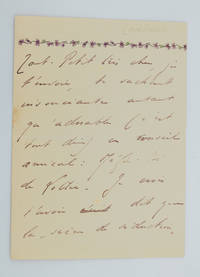
190679012s. l. Paris 1906. Fine. s. l. Paris s. d. ca 1906 11.50 x 15.90 cm 4 pages sur un double feuillet Autograph letter by Renée Vivien addressed to Natalie Clifford Barney and written in violet ink on a double sheet bordered with violets. Transverse folds inherent to mailing. Interesting letter of warning against the opportunist ""Lottie"": ""Tout-Petit très cher je t'envoie te sachant insouciante autant qu'adorable c'est tout dire ce conseil amical : Méfie-toi de Lottie. Je crois t'avoir dit que la « scène de séduction » chez moi était très savamment préparée et combinée. Lottie a besoin d'argent. Elle en cherche avec âpreté. Elle me demande maintenant une « lettre d'introduction » pour Lugné-Poë. et moi qui ne le connais pas ! Elle « t'embêtera » . c'est le mot cru le seul qui convient Elle est exaspérée contre moi parce que je n'ai pas succombé et surtout parce que je ne lui donnerai pas d'argent. Si elle m'en avait demandé loyalement franchement au nom des jours d'autrefois j'aurais cédé mais cette comédie amoureuse me répugne Je te le répète : Méfie-toi Ne la vois point si cela t'est possible."" ""Very dear Little One I send you knowing you to be as carefree as you are adorable which says everything this friendly advice: Beware of Lottie. I believe I told you that the 'seduction scene' at my place was very cleverly prepared and planned. Lottie needs money. She seeks it eagerly. She now asks me for a 'letter of introduction' to Lugné-Poë. and I who don't know him! She will 'bother you'. that's the crude word the only one that fits She is exasperated with me because I did not succumb and especially because I will not give her money. If she had asked me loyally frankly in the name of days gone by I would have given in but this amorous comedy disgusts me I repeat: Beware Do not see her if it is possible for you."" Charlotte ""Lottie"" Stern Countess Venturini was an actress also known by the name of Yorska and a close friend of Sarah Bernhardt. Alice Pike Barney Natalie's mother painted a very beautiful profile of her in pastel entitled ""Vamp of 1900"" and today preserved at the Smithsonian American Art Museum in Washington. The Jacques Doucet library holds eighteen autograph letters that she addressed to Natalie Clifford Barney. It was at the end of 1899 and through the intermediary of Violette Shillito that Renée Vivien - then Pauline Tarn - made the acquaintance of Natalie Clifford Barney ""cette Américaine plus souple qu'une écharpe dont l'étincelant visage brille de cheveux d'or de prunelles bleu de mer de dents implacables"" Colette Claudine à Paris. Natalie who had just lived through a summer idyll with the scandalous Liane de Pougy who had initiated her into sapphism paid only discreet attention to this new acquaintance. Renée on the other hand was completely captivated by the young American and would relate this love at first sight in her autobiographical novel Une Femme m'apparut: ""J'évoquai l'heure déjà lointaine où je la vis pour la première fois et le frisson qui me parcourut lorsque mes yeux rencontrèrent ses yeux d'acier mortel ses yeux aigus et bleus comme une lame. J'eus l'obscur prescience que cette femme m'intimait l'ordre du destin que son visage était le visage redouté de mon avenir. Je sentis près d'elle les vertiges lumineux qui montent de l'abîme et l'appel de l'eau très profonde. Le charme du péril émanait d'elle et m'attirait inexorablement. Je n'essayai point de la fuir car j'aurais échappé plus aisément à la mort."" ""Winter 1899-1900. Beginning of the idyll. One evening Vivien is invited by her new friend to Mme Barney's studio Natalie's mother 153 avenue Victor-Hugo at the corner of rue de Longchamp. Natalie ventures to read verses of her composition. When Vivien tells her she loves these verses she replies that it is better to love the poet. A response quite worthy of the Amazon."" J.-P. Goujon Tes blessures sont plus douces que leurs caresses Two year unknown
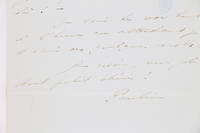
190579002s. l. Paris 1905. Fine. s. l. Paris s. d. 1905-1906 11.50 x 15.90 cm 3 pages sur un double feuillet Autograph letter signed ""Pauline"" by Renée Vivien addressed to Natalie Clifford Barney and written in violet ink on a double sheet bordered with violets. Transverse creases inherent to the mailing. Icy and a fresh attempt at rupture or at the very least a rebuff this letter is completely devoid of courtesy and tenderness: ""Je ne suis pas pareille à toi - j'ai de l'orgueil et de la fierté - cet orgueil tu l'as blessé cette fierté tu l'as froissée - je ne m'exposerai plus à des dégoûts de ce genre. Tes lettres te seront renvoyées sans être lues - ne m'envoie pas de fleurs elles seront refusées. Je vois peu de gens dans l'horreur où je vis des êtres j'en verrai moins encore - cela me procurera peut-être la paix. Je me demande seulement pourquoi tu m'as importunée pour me revoir si ce n'était pour m'humilier et me dégoûter de toi encore davantage. Adieu puisque je ne te reverrai plus de ma vie. Pauline"" ""I am not like you - I have pride and dignity - you have wounded that pride you have bruised that dignity - I will no longer expose myself to such disgust. Your letters will be returned unread - do not send me flowers they will be refused. I see few people in the horror I feel for human beings I will see even fewer - that will perhaps bring me peace. I only wonder why you bothered me to see me again if it was not to humiliate me and disgust me with you even more. Farewell since I will never see you again in my life. Pauline"" Moving letter revealing the suffering and isolation of the Muse of violets sliding inexorably toward her tragic end. It was at the end of 1899 and through the intermediary of Violette Shillito that Renée Vivien - then Pauline Tarn - made the acquaintance of Natalie Clifford Barney ""cette Américaine plus souple qu'une écharpe dont l'étincelant visage brille de cheveux d'or de prunelles bleu de mer de dents implacables"" ""this American more supple than a scarf whose sparkling face shines with golden hair sea-blue eyes implacable teeth"" Colette Claudine à Paris. Natalie who had just experienced a summer idyll with the scandalous Liane de Pougy who had initiated her into Sapphism paid only discrete attention to this new acquaintance. Renée however was completely subjugated by the young American and would relate this coup de foudre in her autobiographical novel Une Femme m'apparut: ""J'évoquai l'heure déjà lointaine où je la vis pour la première fois et le frisson qui me parcourut lorsque mes yeux rencontrèrent ses yeux d'acier mortel ses yeux aigus et bleus comme une lame. J'eus l'obscur prescience que cette femme m'intimait l'ordre du destin que son visage était le visage redouté de mon avenir. Je sentis près d'elle les vertiges lumineux qui montent de l'abîme et l'appel de l'eau très profonde. Le charme du péril émanait d'elle et m'attirait inexorablement. Je n'essayai point de la fuir car j'aurais échappé plus aisément à la mort."" ""I evoked the already distant hour when I saw her for the first time and the shiver that ran through me when my eyes met her mortal steel eyes her sharp blue eyes like a blade. I had the obscure prescience that this woman was giving me destiny's orders that her face was the dreaded face of my future. I felt near her the luminous vertigo that rises from the abyss and the call of very deep water. The charm of peril emanated from her and attracted me inexorably. I did not try to flee her for I would have escaped death more easily."" ""Hiver 1899-1900. Débuts de l'idylle. Un soir Vivien est invitée par sa nouvelle amie dans l'atelier de Mme Barney mère de Natalie 153 avenue Victor-Hugo à l'angle de la rue de Longchamp. Natalie s'enhardit à lire des vers de sa composition. Comme Vivien lui dit aimer ces vers elle lui répond qu'il vaut mieux aimer le poète. Réponse bien digne de l'Amazone."" ""Winter 1899-1900. Beginning of the idyll. One evening Vivie unknown
190078899s. l. Paris 1900. Fine. s. l. Paris s. d. ca. 1900 12.30 x 16.50 cm 1 page1/2 sur un double feuillet Autograph manuscript letter by Renée Vivien signed ""Pauline"" addressed to Natalie Clifford Barney and written in black ink on a double sheet with the poetess's silver monogram letterhead. A very charming letter evoking the flowers so dear to Renée ""Tout-Petit que j'aime je t'envoie des pensées toutes blanches. Garde-les dans ta chambre auprès de toi où sont mes vraies pensées tu le sais."" ""Little one I love I send you pansies all white. Keep them in your room near you where my true thoughts are you know."" as well as a gift from her ""tout petit chéri"" ""dear little one"": ""J'adore mes tablettes tu te rappelles les tablettes des deux petites joueuses de flûte - seulement elles les ont perdues et moi je ne veux pas perdre les miennes. J'ai écrit dessus en grec J'aime Natalie ! Cela m'a fait tant de plaisir ! - quelle bonne et jolie pensée tu as eue là ! -"" ""I adore my tablets do you remember the tablets of the two little flute players - only they lost them and I don't want to lose mine. I wrote on them in Greek I love Natalie! It gave me such pleasure! - what a good and lovely thought you had there! -"" Renée Vivien's Hellenist passion was born from her encounter with Eva Palmer during their stay in the United States where she accompanied Natalie Clifford Barney. This beautiful twenty-six-year-old redhead who it is said had translated all of Plato's Symposium with the Amazon gave Renée her first lessons in ancient Greek and awakened in her the passion for the poetess Sappho that never left her thereafter. It was at the end of 1899 and through Violette Shillito that Renée Vivien - then Pauline Tarn - made the acquaintance of Natalie Clifford Barney ""this American more supple than a scarf whose sparkling face shines with golden hair sea-blue eyes and implacable teeth"" Colette Claudine à Paris. Natalie who had just lived a summer idyll with the sulfurous Liane de Pougy who had initiated her into sapphism paid only discreet attention to this new acquaintance. Renée however was totally captivated by the young American and would relate this love at first sight in her autobiographical novel Une Femme m'apparut: ""I evoked the already distant hour when I saw her for the first time and the shiver that ran through me when my eyes met her eyes of mortal steel her sharp blue eyes like a blade. I had the obscure presentiment that this woman was giving me destiny's order that her face was the dreaded face of my future. I felt near her the luminous vertigo that rises from the abyss and the call of very deep water. The charm of peril emanated from her and attracted me inexorably. I did not try to flee her for I would have escaped death more easily."" ""Winter 1899-1900. Beginning of the idyll. One evening Vivien is invited by her new friend to Mme Barney's studio Natalie's mother 153 avenue Victor-Hugo at the corner of rue de Longchamp. Natalie ventures to read verses of her own composition. When Vivien tells her she loves these verses she replies that it is better to love the poet. A response quite worthy of the Amazon."" J.-P. Goujon Tes blessures sont plus douces que leurs caresses Two years of unequal happiness followed punctuated by Natalie's recurring infidelities and Renée's pathological jealousy whose letters oscillated between passionate declarations and painful mea culpa. ""Renée Vivien is the daughter of Sappho and Baudelaire she is the flower of evil 1900 with fevers broken flights sad voluptuousness."" Jean Chalon Portrait d'une séductrice In 1901 came an important rupture that would last almost two years; Renée despite Natalie's solicitations and the intermediaries she sends to win her back resists. ""The two friends saw each other again and it was in August 1905 the pilgrimage to Lesbos which constituted a disappointment for Natalie Barney and remained without consequence. . unknown
190679020Paris 1906. Fine. Paris 3 mars 1906 12.40 x 16.80 cm 3 pages 1/2 sur un double feuillet Autograph letter signed ""Paule"" from Renée Vivien addressed to Natalie Clifford Barney and written in purple ink on a double sheet with violet letterhead and address of 23 avenue du Bois de Boulogne. Transverse folds inherent to posting. Charming letter allowing hope for an appeasement in Renée Vivien's amorous ubiquity who seems to have finally chosen Hélène de Zuylen: ""Je t'envoie des vers. Les aimes-tu Ils ne me plaisent qu'à moitié c'est déjà beaucoup ! Tu as oublié que tu voulais te tuer pour moi. A part ce léger détail tu as été parfaite Mon amie t'aime je t'adore tout est parfaitement ordonné . N'est-ce pas que mon amie est parfaitement bonne et charmante Je l'aime tant d'une façon si poignante si simple et si bête. ce qui est après tout la meilleure façon d'aimer !"" ""I am sending you verses. Do you love them They only half please me that's already a lot! You have forgotten that you wanted to kill yourself for me. Apart from this slight detail you have been perfect My friend loves you I adore you everything is perfectly ordered . Is it not true that my friend is perfectly good and charming I love her so much in such a poignant simple and silly way. which is after all the best way to love!"" One senses here however a still very deep attachment of the Muse of violets to the Amazon: ""Je baise tes mains d'autrefois et tes mains d'aujourd'hui Et je t'aime plus que je ne sais le dire."" ""I kiss your hands of yesteryear and your hands of today And I love you more than I know how to say."" It was at the end of 1899 and through the intermediary of Violette Shillito that Renée Vivien - then Pauline Tarn - made the acquaintance of Natalie Clifford Barney ""cette Américaine plus souple qu'une écharpe dont l'étincelant visage brille de cheveux d'or de prunelles bleu de mer de dents implacables"" ""this American more supple than a scarf whose sparkling face shines with golden hair sea-blue pupils implacable teeth"" Colette Claudine à Paris. Natalie who had just lived a summer idyll with the scandalous Liane de Pougy who had initiated her into sapphism paid only discrete attention to this new acquaintance. Renée however was totally captivated by the young American and would relate this thunderbolt in her autobiographical novel Une Femme m'apparut: ""J'évoquai l'heure déjà lointaine où je la vis pour la première fois et le frisson qui me parcourut lorsque mes yeux rencontrèrent ses yeux d'acier mortel ses yeux aigus et bleus comme une lame. J'eus l'obscur prescience que cette femme m'intimait l'ordre du destin que son visage était le visage redouté de mon avenir. Je sentis près d'elle les vertiges lumineux qui montent de l'abîme et l'appel de l'eau très profonde. Le charme du péril émanait d'elle et m'attirait inexorablement. Je n'essayai point de la fuir car j'aurais échappé plus aisément à la mort."" ""I evoked the already distant hour when I saw her for the first time and the shiver that ran through me when my eyes met her eyes of mortal steel her sharp blue eyes like a blade. I had the obscure presentiment that this woman was giving me destiny's order that her face was the dreaded face of my future. I felt near her the luminous vertigos that rise from the abyss and the call of very deep water. The charm of peril emanated from her and attracted me inexorably. I did not try to flee from her for I would have escaped death more easily."" ""Hiver 1899-1900. Débuts de l'idylle. Un soir Vivien est invitée par sa nouvelle amie dans l'atelier de Mme Barney mère de Natalie 153 avenue Victor-Hugo à l'angle de la rue de Longchamp. Natalie s'enhardit à lire des vers de sa composition. Comme Vivien lui dit aimer ces vers elle lui répond qu'il vaut mieux aimer le poète. Réponse bien digne de l'Amazone."" ""Winter 1899-1900. Beginning of the idyll. One evening Vivien i unknown
190578939s. l. Paris 1905. Fine. s. l. Paris s. d. ca. 1905 12.50 x 16.70 cm 4 pages sur un double feuillet Autograph letter signed ""Pauline"" and ""P.M.T."" by Renée Vivien addressed to Natalie Clifford Barney and written in black ink on a double folio with silver-violet letterhead and the address 3 rue Jean-Baptiste Dumas. Transverse fold inherent to mailing. Very fine love and reproach letter written after the long two-year separation and probably upon return from Mytilene Lesbos: ""Est-ce vraiment pour moi que tu restes demain Tout-Petit . Qui le saura jamais . Ce doute que le passé justifie un peu entrave mes plus hautains élans et fait de moi la créature misérable et triste que je suis."" ""Is it really for me that you stay tomorrow Little One . Who will ever know . This doubt which the past somewhat justifies hampers my most haughty impulses and makes me the miserable and sad creature that I am."" Renée weakened by Natalie's infidelities struggles to trust her again ""Je ne puis croire en toi"" ""I cannot believe in you"" but continues despite her suffering to be entirely devoted to her: ""Tu m'as dédaignée alors que tu aurais été pour moi la révélation miraculeuse - Tu m'as dédaignée. Et aujourd'hui tu t'étonnes de ne point me trouver telle que tu m'aurais rêvée toi qui n'as pas pris le soin de me façonner à ta guise ! Ecoute. Tu es comme un potier qui voyant à ses pieds un argile informe le repousserait et qui plus tard voyant un de ses élèves en fait une statue imparfaite exhalerait en termes amers sa colère et son dédain."" ""You scorned me when you would have been for me the miraculous revelation - You scorned me. And today you are surprised not to find me as you would have dreamed me you who did not take the care to shape me to your liking! Listen. You are like a potter who seeing at his feet an unformed clay would push it away and who later seeing one of his students make an imperfect statue from it would exhale in bitter terms his anger and disdain."" Torn between pain and desire Renée nevertheless calls for her lover: ""Viens demain à minuit.si tu peux. si tu veux. si Ilse n'en décide pas autrement et si ton caprice te le permet."" ""Come tomorrow at midnight.if you can. if you want. if Ilse doesn't decide otherwise and if your whim allows it."" These reunions would not last however: torn between Baroness Hélène de Zuylen and Natalie Renée would chain together travels; in turn to Holland Germany Switzerland and Venice she would confide her hesitations to Kérimé Turkhan-Pacha her epistolary companion from the Bosphorus. It was at the end of 1899 and through Violette Shillito that Renée Vivien - then Pauline Tarn - made the acquaintance of Natalie Clifford Barney ""cette Américaine plus souple qu'une écharpe dont l'étincelant visage brille de cheveux d'or de prunelles bleu de mer de dents implacables"" ""this American more supple than a scarf whose sparkling face shines with golden hair sea-blue eyes implacable teeth"" Colette Claudine à Paris. Natalie who had just lived a summer idyll with the sulfurous Liane de Pougy who had initiated her into sapphism paid only discreet attention to this new acquaintance. Renée on the other hand was totally captivated by the young American and would relate this love at first sight in her autobiographical novel Une Femme m'apparut: ""J'évoquai l'heure déjà lointaine où je la vis pour la première fois et le frisson qui me parcourut lorsque mes yeux rencontrèrent ses yeux d'acier mortel ses yeux aigus et bleus comme une lame. J'eus l'obscur prescience que cette femme m'intimait l'ordre du destin que son visage était le visage redouté de mon avenir. Je sentis près d'elle les vertiges lumineux qui montent de l'abîme et l'appel de l'eau très profonde. Le charme du péril émanait d'elle et m'attirait inexorablement. Je n'essayai point de la fuir car j'aurais échappé plus aisément à la mort."" ""I evoked the already distant hour when unknown
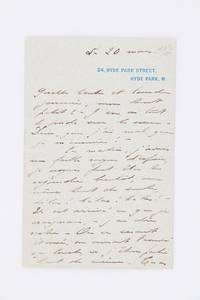
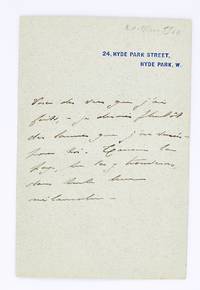
190079031s. l. Londres London 1900. Fine. s. l. Londres London Le 20 mars 1900 9.90 x 15.20 cm 4 pages sur un double feuillet Very long autograph manuscript letter from Renée Vivien signed ""Pauline"" written in black ink on a double sheet of headed paper from 24 Hyde Park Street. Transverse folds inherent to posting. Fine love letter sent from London while Renée was with her family: ""Quelle lente et lourde journée mon tout petit ! j'en ai tout le poids sur le cur Dieu que j'ai mal que je m'ennuie ! Ce matin j'avais un faible rayon d'espoir je croyais peut-être te rejoindre bientôt ou même tout de suite hélas ! hélas ! hélas ! Il est arrivé ce que je craignais j'ai dû rester On se serait étonné on aurait trouvé ça louche si j'étais partie tout de même."" ""What a slow and heavy day my little one! I have all its weight on my heart God how I hurt how I'm bored! This morning I had a faint ray of hope I thought perhaps to rejoin you soon or even right away alas! alas! alas! What I feared has happened I had to stay People would have been surprised they would have found it suspicious if I had left anyway."" This was only a few months since Renée and Natalie began seeing each other and we can read here the importance this relationship held for the Muse of violets who never ceased to flagellate herself: ""Ta pauvre lettre où chaque mot respire la mélancolie et la souffrance me brise le cur. Je souffre en la lisant tout ce que tu as souffert. Pardonne-moi Natalie ma bien-aimée ! Tes reproches sont si doux qu'ils me déchirent l'âme plus que toutes les récriminations amères qu'un autre être moins aimant m'aurait criées. J'ai eu tort cent fois tort mille fois tort de rester pourquoi donc ai-je obéi à un fantôme de Devoir à un spectre de Pitié qui je ne sais pourquoi m'obsède et vient m'ôter des heures divines que le Destin pitoyable m'accorde. La réalité c'est l'Amour il n'y a que lui rien n'est en dehors de lui et on souffre toujours de l'avoir sacrifié à quelque chose si sainte soit-elle."" ""Your poor letter where each word breathes melancholy and suffering breaks my heart. I suffer in reading it everything that you have suffered. Forgive me Natalie my beloved! Your reproaches are so sweet that they tear my soul more than all the bitter recriminations that another less loving being would have cried to me. I was wrong a hundred times wrong a thousand times wrong to stay why then did I obey a phantom of Duty a specter of Pity which I don't know why obsesses me and comes to take from me divine hours that pitiful Destiny grants me. Reality is Love there is only it nothing is outside of it and one always suffers from having sacrificed it to something however sacred it may be."" Very fine letter imbued with the devouring passion of the Muse of violets for her Amazon. It was at the end of 1899 and through the intermediary of Violette Shillito that Renée Vivien - then Pauline Tarn - made the acquaintance of Natalie Clifford Barney ""cette Américaine plus souple qu'une écharpe dont l'étincelant visage brille de cheveux d'or de prunelles bleu de mer de dents implacables"" ""this American more supple than a scarf whose sparkling face shines with golden hair sea-blue eyes implacable teeth"" Colette Claudine à Paris. Natalie who had just lived a summer idyll with the sulfurous Liane de Pougy who had initiated her to sapphism paid only discreet attention to this new acquaintance. Renée however was totally subjugated by the young American and would relate this love at first sight in her autobiographical novel Une Femme m'apparut: ""J'évoquai l'heure déjà lointaine où je la vis pour la première fois et le frisson qui me parcourut lorsque mes yeux rencontrèrent ses yeux d'acier mortel ses yeux aigus et bleus comme une lame. J'eus l'obscur prescience que cette femme m'intimait l'ordre du destin que son visage était le visage redouté de mon avenir. Je sentis près d'elle les vertig unknown
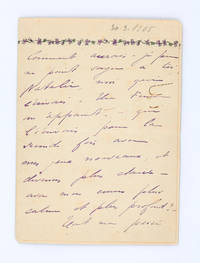
190578968s. l. Paris 1905. Fine. s. l. Paris 30 mars 1905 11.50 x 15.90 cm 6 pages 1/2 sur deux doubles feuillets Autograph letter signed ""Pauline"" by Renée Vivien addressed to Natalie Clifford Barney and written in violet ink on two double sheets edged with violets. Transverse folds inherent to posting. Very fine love letter evoking the only novel by the Violet Muse Une femme m'apparut. ""Comment aurais-je pu ne point songer à toi Natalie moi qui écrivais « Une femme m'apparut » - qui l'écrivais pour la seconde fois avec mes yeux nouveaux et devenus plus clairs - avec mon cur plus calme et plus profond "" ""How could I not have thought of you Natalie I who was writing 'Une femme m'apparut' - who was writing it for the second time with my new eyes which had become clearer - with my heart calmer and deeper"" Published in 1904 this novel - the only one of Renée's literary career - tells the love story of the narrator and ""Vally"" Natalie Clifford Barney from their beginning to their tragic end and the ""apparition"" of the savior Hélène de Zuylen. Reconciled with the Amazon Renée undertakes to rewrite the book which will appear at the beginning of 1906: ""Literary and stylistic improvement No. The concern to justify herself anew but this time in the face of Natalie Barney is beyond doubt. Remorse too: now the apparition that gives the book its title is no longer Eva-Hélène de Zuylen but Lorely-Natalie Barney and this from page 2. When we know that during the summer of 1904 unexpected reunions in Bayreuth came to unite Natalie Barney and Vivien we better understand the meaning of this new version of the novel Renée only returns to her amorous past to deliver us a second version revised and corrected. She thus erases the final choice she had suggested in the first version. Complete palinode confirmed by the very text of the letters that Vivien will write to Natalie Barney in 1904 and especially in 1905."" J.-P. Goujon Tes blessures sont plus douces que leurs caresses This confusion of feelings shows through this letter filled with oxymorons: ""je goûte une tristesse charmante à t'évoquer . quand je songe à toi j'évoque ma plus belle douleur"" ""I taste a charming sadness in evoking you . when I think of you I evoke my most beautiful pain"" The sadness - mixed with unconditional love - is here pushed to its paroxysm: ""Ne te laisse pas attrister par ma lettre grise de ce soir. Il y a des heures ternes - ce sont peut-être les meilleures - Dans tous les cas ce sont les plus vraies . Et ceux qui sont comme tu le dis « ingrats et joyeux » sont fort à plaindre."" ""Do not let yourself be saddened by my grey letter this evening. There are dull hours - these are perhaps the best - In any case these are the truest . And those who are as you say 'ungrateful and joyful' are much to be pitied."" Vivien effaces herself completely in favor of her beloved even proposing to live in her place: ""Va - si tu le peux - là où je voudrais être - à Mytilène. Je verrais l'île merveilleuse à travers tes prunelles - tu me ferais respirer tous ses parfums - A dire vrai le courage m'a manqué pour y aller. Je n'avais plus la force ni le désir de partir ainsi."" ""Go - if you can - where I would like to be - to Mytilene. I would see the marvelous island through your eyes - you would make me breathe all its perfumes - To tell the truth I lacked the courage to go there. I no longer had the strength nor the desire to leave thus."" ""Ne peux-tu toi aller à Mytilène et me rapporter des roses de là-bas "" ""Cannot you go to Mytilene and bring me roses from there"" Yet it is together that the two lovers will soon undertake the journey to Lesbos; it will be the last of their story. It was at the end of 1899 and through Violette Shillito that Renée Vivien - then Pauline Tarn - made the acquaintance of Natalie Clifford Barney ""cette Américaine plus souple qu'une écharpe dont l'étincelant visage brille de cheveux d'or de prunelles bleu de mer d unknown
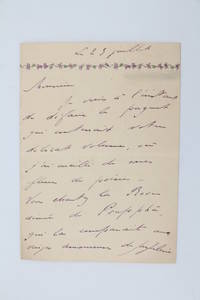
190779815s. l. Paris 1907. Fine. s. l. Paris Le 23 juillet ca. 1907-1908 11.50 x 16 cm 2 pages sur un double feuillet Handwritten signed letter addressed to a poet: You sing the rose loved by Psapphâ who compared it to the loving virgins of Mitilini Paris 23 July ca1907-1908 11.5 x 16 cm 2 pages on a double leafHandwritten signed letter from Renée Vivien addressed to a poet written in violet ink on a double leaf of paper decorated at the head with a border of violets. Transverse folds from having been sent. Monsieur Je viens à l'instant de défaire le paquet qui contenait votre délicat volume où j'ai cueilli de rares fleurs de poésie. Vous chantez la rose aimée de Psapphâ qui la comparait aux vierges amoureuses de Mytilène. Parmi vos poèmes je préfère : ''Sa Voix"" ""Sa Grâce"" et ""Les Mains et l'Apothéose"" . Renée Vivien Monsieur I have just this minute undone the package that contained your delicate volume where I picked rare flowers of poetry. You sing the rose loved by Psapphâ who compared it to the loving virgins of Mitilini. Among your poems I prefer: Sa Voix"" ""Sa Grâce"" and ""Les Mains et l'Apothéose"" . Renée Vivien Despite the precision of the titles mentioned it has not been possible for us to identify the poet to whom Vivien sent this letter of thanks. These titles are reminiscent of the poems of the Muse aux violettes herself. unknown
190078743s. l. Londres London 1900. Fine. s. l. Londres London 24 mars 1900 10 x 15.70 cm 6 pages sur 2 doubles feuillets Handwritten signed letter addressed to Natalie Clifford Barney and enriched with a poem entitled « Le Miroir » London 24 March 1900 10 x 157 cm 6 pages on 2 double leaves Handwritten manuscript letter by Renée Vivien signed Pauline and written in black ink on a double leaf headed 24 Hyde Park Street. This letter contains a handwritten alexandrine poem entitled Le Miroir; never published on the initiative of the poet but it has been transcribed in Renée Vivien et ses masques in à l'encart April 1980: Je t'admire et ne suis que ton miroir fidèle Car je m'abîme en toi pour t'aimer un peu mieux; Je rêve ta beauté je me confonds en elle Et j'ai fait de mes yeux le miroir de tes yeux Je t'adore et mon cur est le profond miroir Où ton humeur d'avril se reflète sans cesse Tout entier il s'éclaire à tes moments d'espoir Et se meurt lentement à ta moindre tristesse Ô toujours la plus douce ô blonde entre les blondes Je t'adore et mon corps est l'amoureux miroir Où tu verras tes seins et tes hanches profondes Ces seins pâles qui sont si lumineux le soir! Penche-toi tu verras ton miroir tour à tour Pâlir ou te sourire avec tes mêmes lèvres Où trembleront encore les mêmes mots d'amour Tu le verras frémir des mêmes longues fièvres Contemple ton miroir de chair tendre et nacrée Car il s'est fait très pur afin de recevoir Le reflet immortel de la beauté sacrée Penche-toi longuement sur l'amoureux miroir! The rest of this long missive has however remained unpublished. A very beautiful letter sent from London by the Muse aux Violettes who misses her little one: Despite its slowness time passes you see and brings the hour that I await feverishly the time to meet again Natalie! Two more sad evenings and the third you will be there to rock me in your arms! . Today I was still disproportionately bored. I so need to see you again that I count the hours as they pass. I only think of you obsessed haunted taken possessed by you and by our memories. I am a poor unhappy thing far from you. Weary of society life We had the queen's dressing room how chic my darling! Lady Augustus Fitz Clarence invited us. She descends from a bastard of the King and is therefore an illegitimate relative of the sovereign! Renée lingers on the contemplation of a present from her darling: Your ring I love it so much it is a bond of our love that never leaves me. I so regretted your dagger that at the last moment I forgot to carry. Your ring you see is your memory on my finger I look at it and part of our tenderness is embodied in it. It is at the end of 1899 and through Violette Shillito that Renée Vivien then Pauline Tarn met Natalie Clifford Barney ""this American woman softer than a scarf whose sparkling face shines with golden hair sea blue eyes never-ending teeth"" Colette Claudine à Paris. Natalie who had just experienced a summer romance with the scandalous Liane de Pougy who introduced her to sapphism paid little attention to this new acquaintance. Renée on the other hand was totally captivated by the young American woman and describes this love at first sight in her autobiographical novel Une femme m'apparut: ""I lived again the hour already well past when I saw her for the first time felt the shiver that ran through me when my eyes met the mortal steel of her look those eyes blue and piercing as a blade. I had a dim premonition that this woman would determine the pattern of my fate and that her face was the predestined face of my Future. Near her I felt the luminous dizziness which comes at the edge of an abyss or the attraction of a very deep water. She radiated the charm of danger which drew me to her inexorably."" ""Winter 1899-1900. Beginnings of the idyll. One evening Vivien is invited by her new friend to Mme Barney's studio Natalie's mother 153 avenue Victor-Hugo on unknown
190679816s. l. Paris 1906. Fine. s. l. Paris s. d. ca. 1906 11.50 x 16 cm 1 page 1/2 sur un double feuillet Autograph letter signed by Renée Vivien addressed to Charles Maurras written in violet ink on a double leaf of headed paper adorned with a border of violets. Transverse folds inherent to mailing envelope included. Beautiful letter of thanks: ""Monsieur En feuillettant votre si intéressant volume : De l'Avenir de l'Intelligence j'ai relu avec un plaisir ému les pages - trop indulgentes vraiment ! - que vous avez consacré à mes ouvrages. Merci infiniment. Et veuillez agréer mes très reconnaissants sentiments de confraternité littéraire. Renée Vivien"" ""Sir While leafing through your most interesting volume: De l'Avenir de l'Intelligence I reread with moved pleasure the pages - too indulgent really! - that you dedicated to my works. Thank you infinitely. And please accept my most grateful sentiments of literary confraternity. Renée Vivien"" Charles Maurras had indeed devoted a dithyrambic chapter of his work to the Muse of violets whose verses he compared to those of Verlaine: ""Le vieux faune sentimental des Fêtes galantes et de Parallèlement reconnaîtrait chez Renée Vivien beaucoup plus qu'une élève certainement une des Surs une de ces Amies terribles qu'il a chantées. Quant à Baudelaire il lui dirait : ""Ma fille"" aux premiers regards échangés. Baudelairisme profond central générateur."" ""The old sentimental faun of Fêtes galantes and Parallèlement would recognize in Renée Vivien much more than a student certainly one of the Sisters one of those terrible Friends he sang of. As for Baudelaire he would say to her: 'My daughter' at first glance. Deep central generative Baudelairism."" unknown
190079028s. l. Londres London 1900. Fine. s. l. Londres London Le 18 mars 1900 9.90 x 15.20 cm 14 pages sur 3 doubles feuillets et 1 feuillet simple Very long autograph letter handwritten by Renée Vivien signed Pauline written in black ink on three bifolia with letterhead from 24 Hyde Park Street and one single leaf. Horizontal folds inherent to mailing. A beautiful love letter sent from London while Renée was staying with her family: « Quand je pense qu'un télégramme va banalement et brutalement t'apprendre que je reste encore une semaine à Londres j'ai envie de pleurer. Et pourtant il ne faut pas que je pleure cela m'affaiblirait trop et j'ai besoin de toutes mes forces et de mon courage. » This painful separation is in the young womans eyes a necessary evil the promise of a radiant future: « Si je te fais ce chagrin mon amie c'est pour que nous soyons plus heureuses après. . Ne m'en veux pas de te faire attendre je souffre plus que toi ; et si je t'impose en me l'imposant moi-même cette souffrance du désappointement c'est afin de mériter mieux l'amour que tu m'accordes et le bonheur que tu me donnes par la douleur et par le sacrifice. Je serai ainsi plus digne de toi et tu m'aimeras mieux pour les larmes que j'ai offertes à notre amour. » Only a few months had passed since Renée and Natalie had begun seeing each other and one can already sense here the importance of this bond for the Muse of Violets and her insatiable need to be loved: « Tu me pardonnes dis Tu me souris toujours Je t'en prie envoie-moi ton pardon afin que je le sente comme une rosée sur mon front. Dis-moi de loin que tu m'aimes toujours et je t'entendrai à travers tout l'espace qui nous sépare. . Je t'aime à en mourir enfant chérie qui es le beau sourire blond de ma vie. Tout ce que je te dis et sic sincère. Crois-moi. Aime-moi. » Idealizing this relationship she launches into a magnificent litany: « Te faire souffrir toi qui m'as donné la joie rayonnante de mon existence ! Toi qui m'as fait aimer la vie ! - Toi qui m'as mis tant de beaux rêves dans l'âme tant de bonheur et tant de chaleur au cur ! - Toi qui es ma consolation mon espérance mon extase la merveille et le miracle de ma vie ! - Toi qui m'as donné l'amour qui me l'as révélé qui me l'as fait sentir et comprendre ! - Toi que j'aime ! » A superb letter-river imbued with the consuming passion of the Muse of Violets for her Amazon. At the end of 1899 through Violette Shillito Renée Vivienthen Pauline Tarnmet Natalie Clifford Barney cette Américaine plus souple qu'une écharpe dont l'étincelant visage brille de cheveux d'or de prunelles bleu de mer de dents implacables Colette Claudine à Paris. Natalie fresh from a summer romance with the scandalous Liane de Pougy who had introduced her to sapphism paid little heed to this new acquaintance. Renée on the other hand was utterly captivated by the young American and would recount this coup de foudre in her autobiographical novel Une Femme m'apparut: J'évoquai l'heure déjà lointaine où je la vis pour la première fois et le frisson qui me parcourut lorsque mes yeux rencontrèrent ses yeux d'acier mortel ses yeux aigus et bleus comme une lame. J'eus l'obscur prescience que cette femme m'intimait l'ordre du destin que son visage était le visage redouté de mon avenir. Je sentis près d'elle les vertiges lumineux qui montent de l'abîme et l'appel de l'eau très profonde. Le charme du péril émanait d'elle et m'attirait inexorablement. Je n'essayai point de la fuir car j'aurais échappé plus aisément à la mort. Winter 18991900. The beginnings of the idyll. One evening Vivien is invited by her new friend to the studio of Mme Barney Natalies mother 153 avenue Victor-Hugo at the corner of rue de Longchamp. Natalie dares to read aloud her own verses. When Vivien tells her she admires them she replies that it is better to love the poet. A response truly worthy of the Amazon. J.-P. Goujon Tes blessures sont plu unknown
190078737s. l. 1900. Fine. s. l. 20 mars 1900 10 x 15.70 cm 2 pages sur un double feuillet Unpublished handwritten poem to Natalie Clifford Barney « à l'absente » 20 March 1900 10 x 157 cm 2 pages on a double leaf Handwritten poem entitled « à l'absente » To the absent one and addressed to Natalie Clifford Barney. Two pages written in black ink on a double leaf headed 24 Hyde Park Street. To our knowledge this three-verse octosyllabic poem is unpublished. It is preceded on the first section of this double leaf by a little handwritten message: These are the verses I have made I would rather say the tears which I have shed for you. Turn the page you will find them there in all their melancholy. Oui c'est toi mon rêve suprême Pendant ces longs ces mornes jours Où je pleure au fond de moi-même L'exil triste de mes amours! . N'as-tu pas entendu ma blonde Le bruit d'un sanglot qui revient Dans le cur de la nuit profonde C'est mon amour qui se souvient. It is at the end of 1899 and through Violette Shillito that Renée Vivien then Pauline Tarn met Natalie Clifford Barney ""this American woman softer than a scarf whose sparkling face shines with golden hair sea blue eyes never-ending teeth"" Colette Claudine à Paris. Natalie who had just experienced a summer romance with the scandalous Liane de Pougy who introduced her to sapphism paid little attention to this new acquaintance. Renée on the other hand was totally captivated by the young American woman and describes this love at first sight in her autobiographical novel Une femme m'apparut: ""I lived again the hour already well past when I saw her for the first time felt the shiver that ran through me when my eyes met the mortal steel of her look those eyes blue and piercing as a blade. I had a dim premonition that this woman would determine the pattern of my fate and that her face was the predestined face of my Future. Near her I felt the luminous dizziness which comes at the edge of an abyss or the attraction of a very deep water. She radiated the charm of danger which drew me to her inexorably."" ""Winter 1899-1900. Beginnings of the idyll. One evening Vivien is invited by her new friend to Mme Barney's studio Natalie's mother 153 avenue Victor-Hugo on the corner of the rue de Longchamp. Natalie finds the courage to read the verses of her composition. As Vivien tells her to love these verses she tells her that it is better to love the poet. A response worthy of the Amazon."" J.-P. Goujon Tes blessures sont plus douces que leurs caresses Two years of unequal happiness will follow punctuated by Natalie's recurring infidelities and Renée's sickly jealousy the letters of which oscillate between inflamed declarations and painful admissions of guilt. ""Renée Vivien is the daughter of Sappho and Baudelaire she is the 1900 flower of evil with fevers broken-up fights sad delights."" Jean Chalon Portrait d'une séductrice In 1901 a major break-up occurred which lasted almost two years; Renée despite requests from Natalie and the others she sent to win her back resisted. ""The two friends saw each other again and in August 1905 went on a pilgrimage to Lesbos which was a disappointment for Natalie Barney and was short-lived. . The spring was broken once and for all. The two former friends stopped seeing each other in 1907 and Vivien died without them seeing each other again."" J.-P. Goujon ibid. unknown
192984821Angers 1929. Fine. Angers 25 Septembre 1929 13.50 x 20.50 cm quatre pages sur un feuillet double Autograph letter dated and signed by Renée Guilloux about friendship that transcends and sublimes human relationships 80 lines written in black ink on four pages. Folds inherent to mailing small tears at foot without any damage to the text. For Renée Guilloux the friendship she feels for her correspondent dominates distance and silence: "". est-ce que les mots ont su dire la joie des coeurs."" ""have words been able to express the joy of hearts."" and momentary disagreements: ""Mais tous ces mois toutes ces années nous pesaient douloureusement. J'avais l'impression que vous vous étiez mis d'un seul coup à parler très vite avec beaucoup d'agitation dans une langue qui m'était étrangère. mais je savais que ce n'était qu'un moment et qu'après nous reprendrions notre conversation rentable."" ""But all these months all these years weighed on us painfully. I had the impression that you had suddenly started speaking very quickly with great agitation in a language that was foreign to me. but I knew it was only a moment and that afterwards we would resume our profitable conversation."" Despite life's vicissitudes Louis Guilloux and his wife have always shown confidence in the brotherhood that unites them above all: ""J'attendais votre retour dans la certitude dans la paix et bien qu'il n'y ait pas de paroles écrites entre nous votre amitié m'apportait toujours sa même force et sa même joie."" ""I awaited your return with certainty in peace and although there were no written words between us your friendship always brought me the same strength and the same joy."" and in the serenity acquired after so many ordeals endured: ""Vous nous avez trouvés transformés dites-vous grandis. cette paix c'est notre conquête la plus belle. après les inquiétudes et les souffrances."" ""You found us transformed you say grown. this peace is our most beautiful conquest. after the anxieties and sufferings."" Renée Guilloux praises this radiating peace that she shares with her friend: ""Cette paix qui est en nous elle est aussi vôtre cher ami et vous avez grandi comme nous. je pense au rêve de Don Quichotte aux paroles qu'il echange avec Dulcinée. Elles sont pleines de cette lumière."" ""This peace that is in us it is also yours dear friend and you have grown like us. I think of Don Quixote's dream of the words he exchanges with Dulcinea. They are full of this light."" Finally she is reassured by her husband's health which is improving and which allows him to return to his writing work. unknown
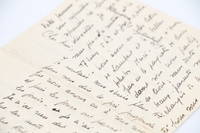
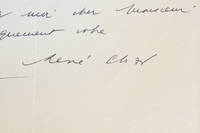
194762727L'Isle-sur-la-Sorgue 1947. Fine. L'Isle-sur-la-Sorgue 2 novembre 1947 21 x 26.90 cm 1 page sur une feuille Autograph letter signed by René Char of 11 lines written in black ink. Folds inherent to the mailing. René Char wrote this letter to René Wintzen editor-in-chief of the magazine Documents from 1929 to 1931. René Wintzen then began to publish a literary magazine Vent debout from which he sent Char a copy. The poet encourages him and tells him to persevere while ""discriminating the wheat from the chaff . "" René Char apologizes for not having a finished text to provide: ""I regret it. I write little and am only an accessory poet! "". This highlighting of a rare writing corresponds to René Char's idea of poetry and opposes the work advocated by Valéry. René Char writes little and submits to the demands of poetry: ""I never cheat. I have spent six months waiting for a word or a formula . This is the requirement of poetry. An absolute requirement. No words are free. Interview between René Char and Édith Mora Nouvelles littéraires 1965. The author also shows a distancing from poetry at the end of the decade. In fact Char experimented with new genres: he tried ballet with La Conjuration in April 1947 but also at the theater with Le Soleil des eaux music with Boulez and finally with the cinema. However he never leaves poetry and publishes the same year Poem sprayed . Char's modesty as to his status as a poet expresses the artist's subjection to the demand for poetry. unknown
14239This French philosopher and historian's "Life of Jesus" 1863 was the first to treat Jesus strictly as a historical figure -- causing a controversy which delayed Renan's confirmation as professor of Hebrew at the College de France by seven years! ANS in French 1p 8" X 12" n.p. n.d. ca. July 1887. Near fine. At the lower left corner of an Autograph Letter Signed from one A. Roblaire from Louargat in northwest France to "Monsier l'Inspecteur d'Academie" Renan pens a brief 5-line note to his correspondent. Not translated. unknown
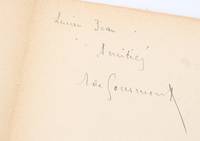
190084926s. l. 1900. Fine. s. l. s. d. ca 1900 8.50 x 11.50 cm une page sur un feuillet double Autograph letter signed by Remy de Gourmont addressed to a writer with whom he collaborates 1 page on a double sheet 14 lines in black ink regarding a sum owed to a publisher: ""On lui doit 3 fr versables quand Ducoté aura donné les fonds du mois de juillet."" ""We owe him 3 francs payable when Ducoté has provided the funds for the month of July."" Two small stains on the verso of the autograph letter. unknown
20956Known as "Gentleman Jim" this influential Country Western singer of the '50s and '60s achieved great popularity with such hits as "He'll Have to Go" 1960; he died at age 40 in a plane crash in Tennessee. Color IPS verso heavy stock 3½" X 5½" n.p. n.d. Near fine. Handsome color picture postcard issued by RCA Victor Records the recto featuring a nice half-length portrait of Reeves in tie and red sweater. Verso features message and address portions and across this in bold large script as red as his sweater Reeves writes "To / Donald / Best of luck always / Gratefully / Jim Reeves." The signature itself which runs from the lower left corner to the upper right corner measures a full 5½"! A superb example of this rarity. unknown
38612This Maine representative 1877-99 and twice Speaker of the House 1889-91 1895-99 was known as "Czar Reed" for his passage of "Reed's Rules" which greatly increased the Speaker's powers. A large and bold full signature plus "Portland / Me" in brown ink on a heavy stock 4" X 2½" slip. Near fine. Accompanied by an ALS from the Young Mens Republican Club of Stratford Iowa date 1894 October 23 requesting "your autograph and if agreeable some political sentiment. as a memento from our choice for President in '96." Not surprisingly Reed declines to be goaded into penning "some political sentiment" that could be viewed as throwing his hat into the presidential ring prematurely! Original House of Representatives envelope from Reed also present. A fun trio. unknown
22725The Cornell All-American football guard later coached the University of Cincinnati and at Pennsylvania College; in 1918 he was elected to Congress from New York as a Republican and was reelected 20 times serving until his death. ALS 2pp single leaf 8½" X 11" "In France" postmarked Paris 1918 January 4. Addressed to "Aunt & Auntee." Near fine. Excellent World War One content penned on the evee of his election to Congress reading in part: "We are leaving for England. after a short time in London we will start for home. I have seen a great deal since leaving home. We have travelled more than 1000 miles in France by auto & I don't know how far by train. I shall bring pictures of most that we have seen & notes that will explain all that we have seen. Aside from this we will have lantern slides & moving pictures." He also notes "It has been a great & thrilling experience to see the battle fields along the entire front. I never thought so much destruction of homes happiness & resources possible." With original envelope from the Hotel de Crillon in Paris addressed in Reed's hand. Most unusual. unknown
29159This failed 1912 Democratic vice presidential nominee was a New York representative 1911-13 best known as the very first U.S. Secretary of Commerce 1913-19 under Wilson. TNS 1p 7" X 10½" New York NY 1923 March 17. Addressed to Albert Johannsen a University of Chicago geology professor who authored "The House of Beadle and Adams and Its Dime and Nickel Novels" 1950 the definitive reference work and bibliography on the subject. Near fine. "I am interested in your professorship of petrology remembering that in Washington we had to appoint a scientist of a type new to me whom I think was called a petrographer. I am wondering just what the scope of your own work is." With Johannsen's 3" X 4" printed "Collection of Albert Johannsen" catalogue slip for this item. unknown
14944This broadcast journalist was the original co-host of "60 Minutes." Color IPS 8" X 10" n.p. n.d. Fine. Later life informal pose at his desk boldly inscribed in thick black ink "To Gina / my best / Harry Reasoner. unknown
1945052168Los Angeles Circa 1940 / 1945: Ronald Reagan 1945. Original Signed Photograph . No Binding. Fine. 7" x 5. An Attractive Three-Quarter Length Portrait Of A Youthful Reagan Folding His Arms And Smiling Circa 1945. Inscribed To "Juanita" From Ronald But Reportedly Actualy Inscribed For His Housekeeper By Reagan's Mother Who Also Signed Elsewhere In A Similar Facsimile Of His Signature; The Apple Never Falls Far From The Tree Anything To Keep The Public Happy. <br/> <br/> Ronald Reagan unknown
24551This Tennessee humorist and novelist authored such popular sidesplitters as "A Kentucky Colonel" 1890 and "Old Lim Jucklin" 1905. TNS 1p 8½" X 11" Chicago IL 1939 June 14. Addressed to "My Dear Professor" Albert Johannsen dime novel authority and author of "The House of Beadle and Adams". Fine. Johannsen researching his "penny dreadful" opus had contacted Read for information about one of the most famous dime novelists "Colonel" Prentiss Ingraham 1843-1904 a colorful soldier of fortune who cranked out some 700 dime novels. Writing shortly before his death Read replies ".the countenance of Colonel Ingraham came into memory; but I cannot recall anything regarding him. He has staggered forth from minute recollection. unknown