Renee VIVIENBiblio.com
1 815 résultats
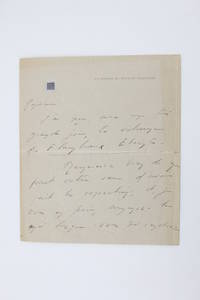
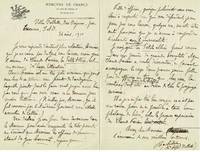
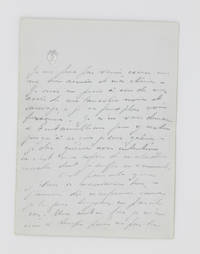
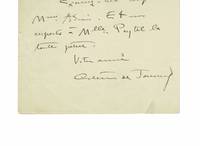
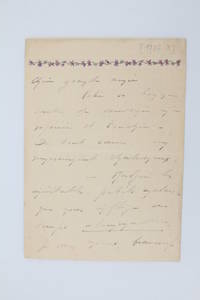
190779804s. l. Paris 1907. Fine. s. l. Paris s. d. ca. 1907-1908 11.50 x 16 cm 2 pages 1/2 sur un double feuillet Autograph letter signed by Renée Vivien addressed to Marcelle Tinayre written in black ink on a double sheet of headed paper decorated with a border of violets. Transverse creases inherent to mailing. Also a writer Marcelle Tinayre was close to Renée Vivien who entrusted her first verses to her to read. Upon Vivien's death Tinayre paid tribute to her through several texts notably a very beautiful tribute article published in the review Schéhérazade in 1910 entitled ""Trois images de Renée Vivien"". ""Chère grande amie Votre si bonne carte de souvenir m'a réjouie et touchée. De tout coeur un remerciement chaleureux. Malgré les inévitables petits malaises que nous inflige ce temps abominable je vais mieux beaucoup mieux. Aussi serais-je très heureuse si vous et Monsieur Tinayre étiez libres le 12 et pouviez venir dîner chez moi. J'aurai le plaisir de vous présenter ma soeur et mon beau-frère qui seront à Paris. Vous devinez quelle joie me causera leur présence ! Croyez à toute mon admiration à toute ma sympthie. Renée Vivien."" ""Dear great friend Your so kind remembrance card delighted and touched me. A warm thank you from the heart. Despite the inevitable small ailments this abominable weather inflicts upon us I am better much better. So I would be very happy if you and Monsieur Tinayre were free on the 12th and could come dine at my home. I will have the pleasure of introducing my sister and brother-in-law who will be in Paris. You can imagine what joy their presence will bring me! Believe in all my admiration all my sympathy. Renée Vivien."" The Muse of violets was indeed very close to Toinette her younger sister who lived in London with her husband Francis. Renée Vivien was moreover the godmother of their son Paul a very rare name then in England in honor of his aunt and in 1911 Toinette would give birth to a daughter whom she would name Renée in tribute to her deceased sister. Very beautiful testimony to the friendship that Renée Vivien bore toward Marcelle Tinayre a writer friend who contributed to perpetuating the memory of Sappho 1900. unknown
190673701Cormeilles-en-Vexin 1906. Fine. Cormeilles-en-Vexin 22 août 1906 ou 1908 12.60 x 17 cm une feuille Friendly autograph letter signed by Octave Mirbeau addressed to the playwright and founder of the Revue Blanche Alfred Natanson. 12 lines in black ink on a folded sheet letterhead paper ""Cormeilles-en-VexinS.&O."" envelope included. ""Cher ami J'avais bien pensé que cette vieille bonne femme qui tape si fort sur les matelas avait du écorcher mon nom. Mais dans l'incertitude car je pouvais penser aussi que vous étiez pris avec quelqu'un de très sérieux . Ceci mon cher Fred pour vous dire que je suis parti de chez vous triste de ne pas vous avoir vu voilà tout et sans le moindre sentiment mauvais. Vous savez que j'ai pour vous une affection solide et je vous connais assez gentil pour moi pour me permettre de supposer des sottises. ."" ""Dear friend I had indeed thought that this old good woman who beats the mattresses so hard must have mangled my name. But in uncertainty for I could also think that you were busy with someone very serious . This my dear Fred to tell you that I left your house sad not to have seen you that's all and without the slightest bad feeling. You know that I have a solid affection for you and I know you well enough to be kind to me to allow myself to suppose foolish things. ."" With an amusing postscript: ""Ne prêtez pas attention à ce gribouillage. L'auto a je ne sais pas quoi j'y travaille. et n'y fait rien de bon. d'ailleurs. Et mon mécanicien se prend la tête à deux mains noires d'huile grasse ."". ""Don't pay attention to this scribbling. The car has something wrong I don't know what I'm working on it. and it's not doing any good. anyway. And my mechanic is holding his head in his two hands black with greasy oil ."". Mirbeau was particularly close to the Revue Blanche group since its launch in Paris in 1891. But it was from the Dreyfus affair that his intimate and lasting friendship with the Natanson brothers Thadée Alexandre and Alfred was strengthened. After aesthetic disagreements about Art Nouveau and the Nabis Mirbeau finally reunited with Thadée around 1900 in a now common inclination for the young Nabis painters of the Revue Blanche Bonnard Vallotton and Vuillard. The Revue Blanche played an essential role in France as confirmed by historian Paul-Henri Bourrelier: ""Most of the most prominent writers painters musicians politicians intellectuals of the late 19th and early 20th centuries collaborated with it or were associated with it. Created financed and directed by the three Natanson brothers young Polish Jews with the enthusiastic complicity of their classmates from the Condorcet lycée La Revue blanche quickly became a place of debate on all subjects that stirred France. It led political battles under the impulse of anarchists like Fénéon Mirbeau; socialists such as Blum G. Moch Péguy; Dreyfusards and founders of the League of Human Rights like Reinach and Pressensé."" unknown
190078897s. l. Paris 1900. Fine. s. l. Paris s. d. ca 1900 9.50 x 5.60 cm une carte rédigée des deux côtés Autograph manuscript card signed ""Pauline"" and addressed to Natalie Clifford Barney written in black ink on both sides. Two small pinholes at the top of this card which accompanied a bouquet: ""Méchante d'être partie si vite ! - voici des orchidées blanches - elles te défendront contre les doutes et les pensées tristes. Elles te protègeront et t'assureront de ma profonde et éternelle tendresse. Ne sois pas en retard ce soir. Je compterai les secondes aux battements de mon coeur. Ces fleurs ce sont mes lèvres mon âme et mon coeur qui vont vers toi - Toujours."" ""Naughty to have left so quickly! - here are white orchids - they will defend you against doubts and sad thoughts. They will protect you and assure you of my deep and eternal tenderness. Don't be late tonight. I will count the seconds to the beating of my heart. These flowers are my lips my soul and my heart going towards you - Always."" It was at the end of 1899 and through the intermediary of Violette Shillito that Renée Vivien - then Pauline Tarn - made the acquaintance of Natalie Clifford Barney ""cette Américaine plus souple qu'une écharpe dont l'étincelant visage brille de cheveux d'or de prunelles bleu de mer de dents implacables"" ""this American more supple than a scarf whose sparkling face shines with golden hair sea-blue eyes and implacable teeth"" Colette Claudine à Paris. Natalie who had just experienced a summer idyll with the scandalous Liane de Pougy who had initiated her into sapphism paid only discreet attention to this new acquaintance. Renée however was completely captivated by the young American and would relate this love at first sight in her autobiographical novel Une Femme m'apparut: ""J'évoquai l'heure déjà lointaine où je la vis pour la première fois et le frisson qui me parcourut lorsque mes yeux rencontrèrent ses yeux d'acier mortel ses yeux aigus et bleus comme une lame. J'eus l'obscur prescience que cette femme m'intimait l'ordre du destin que son visage était le visage redouté de mon avenir. Je sentis près d'elle les vertiges lumineux qui montent de l'abîme et l'appel de l'eau très profonde. Le charme du péril émanait d'elle et m'attirait inexorablement. Je n'essayai point de la fuir car j'aurais échappé plus aisément à la mort."" ""I evoked the already distant hour when I saw her for the first time and the shiver that ran through me when my eyes met her eyes of mortal steel her eyes sharp and blue like a blade. I had the obscure presentiment that this woman was giving me destiny's order that her face was the dreaded face of my future. I felt near her the luminous vertigo that rises from the abyss and the call of very deep water. The charm of peril emanated from her and attracted me inexorably. I did not try to flee her for I would have escaped death more easily."" ""Hiver 1899-1900. Débuts de l'idylle. Un soir Vivien est invitée par sa nouvelle amie dans l'atelier de Mme Barney mère de Natalie 153 avenue Victor-Hugo à l'angle de la rue de Longchamp. Natalie s'enhardit à lire des vers de sa composition. Comme Vivien lui dit aimer ces vers elle lui répond qu'il vaut mieux aimer le poète. Réponse bien digne de l'Amazone."" ""Winter 1899-1900. Beginning of the idyll. One evening Vivien is invited by her new friend to Mme Barney's studio Natalie's mother 153 avenue Victor-Hugo at the corner of rue de Longchamp. Natalie ventures to read verses of her composition. When Vivien tells her she loves these verses she replies that it is better to love the poet. A response quite worthy of the Amazon."" J.-P. Goujon Tes blessures sont plus douces que leurs caresses Two years of unequal happiness followed punctuated by Natalie's recurring infidelities and Renée's pathological jealousy whose letters oscillated between impassioned declarations and painful mea culpas. ""Renée Vivien c'est la fille de Sappho et de Baudelaire c'est la f unknown
191183331s. l.: S. n. 1911. Fine. S. n. s. l. Janvier 1911 21 x 27 cm 2 feuilles Autograph letter signed by the dandy count 31 lines written in black ink addressed probably to his friend and bibliographer the critic Henri Lapauze notably mentioning a work by Ingres in his possession also thanking his correspondent for his always lucid and benevolent critiques toward him. ""Cher ami je crois posséder une miniature d'Ingres père ; c'est laid mais assez curieux un tétard de Georges Rivière junior mais un tétard sur ivoire ! Merci pour votre mot révélateur mais toujours compréhensif et sympathique en ce qui vous concerne tous les deux c'est l'important. Il n'y a qu'un terme que je n'accepte pas dans votre protestation c'est le monosyllabe tous. ""Envers et contre plusieurs"" suffit et d'ailleurs est plus exact. Tous le monde n'est pas si bête que de ne pas voir et entendre ce que je mets dans mes livres bien notamment dans celui-là et ce que ça vaut. Il y a même beaucoup de gens qui s'en aperçoivent m'en félicitant et m'en remerciant de cent façons. Et comme ce sont les meilleurs je suis content. Vous êtes de ceux-là tous deux. Je le savais ; mais une fois d eplus je m'en félicite non sans vous en complimenter un peu. Votre Montesquiou Janvier 911."" ""Dear friend I believe I possess a miniature by Ingres the elder; it is ugly but quite curious a tadpole by Georges Rivière junior but a tadpole on ivory! Thank you for your revealing word but always understanding and sympathetic as far as you are concerned both of you that's what's important. There is only one term I do not accept in your protest it is the monosyllable 'all'. 'Against and despite several' suffices and moreover is more exact. Everyone is not so stupid as not to see and hear what I put in my books particularly in that one and what it's worth. There are even many people who notice it congratulating and thanking me in a hundred ways. And as they are the best I am content. You are among those both of you. I knew it; but once more I congratulate myself for it not without complimenting you a little. Your Montesquiou January 911."" On a separate sheet Robert de Montesquiou added as a postscript: ""P.S. Votre ""L'homme propose et Dieu dispose"" m'a bien fait rire. Cette fois c'est le Dieu d'Israël ; et celui-là n'est jamais tout à fait converti."" ""P.S. Your 'Man proposes and God disposes' made me laugh heartily. This time it's the God of Israel; and that one is never quite converted."" Traces of folds inherent to postal handling. S. n. unknown
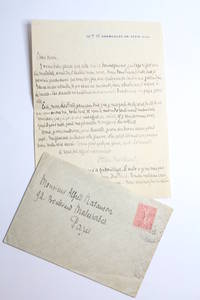
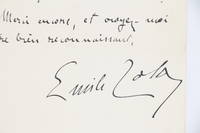
188279108Médan 1882. Fine. Médan 23 juin 1882 13.40 x 21.60 cm 1 page 1/2 sur un double feuillet - enveloppe jointe Autograph letter signed by Emile Zola - apparently unpublished - addressed to Léon Carbonnaux written in black ink on a double sheet. Folds inherent to mailing. Envelope included. Important testimony to the colossal documentation work and the capital role of Emile Zola's informants in depicting his immense natural and social fresco. This letter was sent to Léon Carbonnaux department head at Bon Marché who transmitted precious information to Emile Zola for the creation of the eleventh volume of the Rougon-Macquart series: Au Bonheur des Dames. Only two letters from Léon Carbonnaux to Emile Zola are known: they can be consulted in the digitization of the preparatory file for Bonheur des Dames made available online by the Bibliothèque nationale de France. However we know thanks to this same file which contains a long section entitled ""Notes Carbonnaux"" that this department head at Bon Marché provided a significant amount of information to Zola particularly about employee customs and their remuneration. The two men undoubtedly met when Emile Zola eager for information about the functioning of department stores conducted field research in February and March 1882. This response would therefore be the very first that the writer addressed to the department head in reply to his letter of June 19 1882. Far from imagining the keen success that this new novel would achieve Zola even seems to take it lightly: ""Je désire simplement toucher au sujet dans mon livre pour le besoin du petit drame commercial qui me sert de fable. Vos notes sont excellentes. . Enfin me voilà au travail. Le sujet est à la fois bien vaste - et bien ingrat pour un roman. On devra me tolérer un peu de fiction car il faut bien que je passionne la matière. Mais je tâche de m'en tenir le plus strictement possible à mes notes."" ""I simply wish to touch on the subject in my book for the needs of the little commercial drama that serves as my fable. Your notes are excellent. . Finally here I am at work. The subject is both very vast - and very thankless for a novel. One will have to tolerate a bit of fiction from me for I must make the material passionate. But I try to stick as strictly as possible to my notes."" It must be said that Carbonnaux takes his role as informant very much to heart and having no doubt about the book's success he writes: ""Dans le bâtiment chez nous d'ailleurs partout on attend votre livre. Les lecteurs ne vous manqueront pas. Soyez-en sûr. Vous n'en êtes plus à compter les succès celui-là s'annonce comme devant dépasser les autres."" letter of June 19 1882 For another work on the same subject has just appeared: ""J'ai lu le volume de Pierre Giffard. Il me paraît comme vous injuste et même faux dans plusieurs parties. C'est bâclé. Il aurait fallu pour un pareil ouvrage de documents purs une entière exactitude. Moi qui écris une uvre d'imagination je ne me permettrai pas de tels écarts."" ""I have read Pierre Giffard's volume. It seems to me like you unjust and even false in several parts. It is hastily done. For such a work of pure documents complete accuracy would have been necessary. I who write a work of imagination would not allow myself such deviations.""It was Carbonnaux who had pointed out the work to Zola: ""Pierre Giffard du Figaro vient de faire paraître chez Havard un vol de 300 pages intitulé « Les Grands bazars de Paris ». . On sait que le Figaro est inféodé au Louvre magasin concurrent au Bon Marché & on peut assurer que ce livre a été commandé et bâclé dès que votre intention de traiter le même sujet a été connue. . Il fallait déguiser un peu la réclame pour le Louvre."" letter of June 19 1882 We can clearly see here how much department stores fascinate and we understand the immense success that this novel by Zola describing their advent and supremacy would achieve. unknown
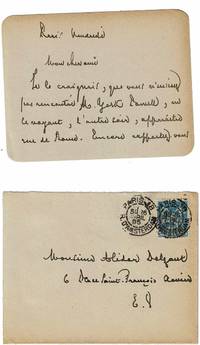
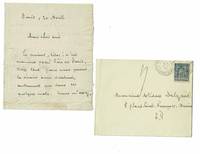
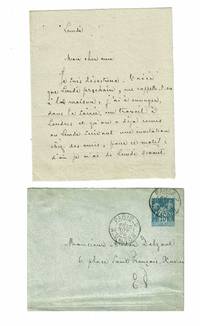
189576349Paris 1895. Fine. Paris 26 avril 1895 11.40 x 8.80 cm une carte recto-verso et une enveloppe Autograph letter signed by Stéphane Mallarmé addressed to Alidor Delzant written on both sides in black ink. Envelope included. Alidor Delzant was a lawyer collector and bibliophile. A friend of the Goncourts he devoted a work to them and was Edmond's secretary and testamentary legatee. ""Je le craignais que vous n'eussiez pas rencontré M. York Powell en le voyant l'autre soir apparaître rue de Rome. Encore rapportez-vous du merveilleux Oxford un souvenir."" ""I feared as much that you had not met M. York Powell seeing him the other evening appear on rue de Rome. Still you bring back from wonderful Oxford a memory."" Mallarmé had recommended his friend Frederick York Powell professor of history to Delzant who was to travel to Oxford in March 1895. It appears from this letter that the two men had not met previously. unknown
190484876s. l. 1904. Fine. Because I also want success I am extremely material in my wishes for those I love and I wish them every pleasure from the highest to the crudest. s. l. mardi 25 octobre 1904 12.60 x 20.40 cm 12 pages sur 3 bifeuillets Autograph letter signed by Marcel Proust addressed to René Peter. Twelve pages written in black ink on three bifolia framed in black. Tears at the ends along the folds of the bifolia not affecting the text. Published in Kolb IV n°168. A very long letter from Proust full of innuendo to the playwright René Peter. Praising Peter's success Proust confesses to his own vanity as a writer and his literary ambitions. He subtly lets his jealousy for Peter's mistress shine through and declares his absolute devotion to Reynaldo Hahn. This is one of the first letters he sends to his childhood friend after recently reconnecting with him. Proust eternally plagued by ailments remains a recluse and apologizes for missing the rehearsal of Peter's new play Le Chiffon. Peter's three-act comedy with music by Reynaldo Hahn premiered at the Athénée the following month and was a huge success with around sixty performances before the end of the year. The young Proust relies on the glowing opinion of Hahn who had attended the rehearsals and the missive becomes a love letter for the composer and his impeccable judgement: ""Reynaldo told me that your play was delightful and ravishing which is not quite the same thing that he laughed and cried in it as he never laughs or cries in the theater and that the language was exquisite. Of that I was certain. But knowing nothing about you I couldn't know if you had dramatic genius. I am certain of it now because even if I do not know a judge as severe as ridiculously severe as Reynaldo I also do not know one who has more taste giving his enthusiasm very great value in my eyes. In a characteristic tangle of confession and denial Proust barely hides his ambitions and his quest for recognition. He hopes and prays for the same laurels he places on Peter's head: your poor and charming mother who like all those who love and who have lived life bruising all our tenderness has suffered so much is witnessing this great happiness these first rays of glory on your charming forehead which Vauvenargues says softer as the rising sun. I only speak of them in quotations having never known them myself! He will even end up instilling his own literary vocation into the fictional life of the narrator of In Search of Lost Time although the narrator's journey as a man of letters is more marked by disappointments than rays of glory so long awaited by Proust himself. However it culminates in Time Regained with an epiphany: the narrator now knows what to write and above all how to write it. The letter marks the beginnings of the Proust-Peter-Hahn trio whose complicity was such that they formed a special vocabulary of which only they had the secret. The river of words in this letter perfectly illustrates the undeniable link between desire and intellectual admiration: Because I also want success I am extremely material in my wishes for those I love and I wish them every pleasure from the highest to the crudest. Despite these displays of generosity the writer cannot however mask a certain jealousy towards Robert Danceny the fictional co-author of Le Chiffon who was none other than Peter's mistress Mme Dansaërt. Proust elegantly but explicitly refers to her: It makes me happy to think that the charming woman who I am assured is hiding under the male name of your collaborator shares half of your work. I am not talking about your success because whether she worked with you or not she would always have shared your success with her heart having I believe a deep friendship for you. Typical of a Proust transposing his desires through fiction the writer will form various dramatic and morbid scenarios between Peter and this young woman in the following years: I unknown
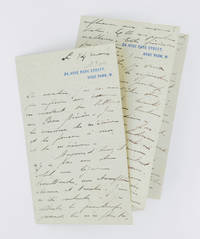
190079025s. l. Londres London 1900. Fine. s. l. Londres London Le 14 mars 1900 9.90 x 15.20 cm 8 pages sur 2 doubles feuillets Autograph letter signed ""Pauline"" by Renée Vivien written in black ink on two double sheets of letterhead paper from 24 Hyde Park Street. Transverse folds inherent to posting. A very beautiful and poetic letter written from London where the young Renée savors a sweet melancholy: ""Today there was no sun a light fog a dark and sad atmosphere. I was pleased by it I hate spring when you are no longer here and the sun and soft air hurt me. I love the sadness of the sky and the moon which goes well with my thoughts."" Despite a very busy schedule ""I am very tired this evening I return from the Alhambra where mama took me to see the military ballet and hear the patriotic songs. . I went skating in the afternoon in the morning I went to see one of my friends here who is very kind although having too much religion for my taste."" the young woman is bored in this city that she profoundly detests ""How can you be jealous you whom I adore of London which I hate I have been unhappy since I entered this city. It is dark it has a bad influence on my destiny. It brings me misfortune. It will end up killing me if I stay. I am afraid of it I want to leave to join you my darling my spring you who are the being of light and beauty my love my happiness and my consolation."" and finds comfort in the memory of her beloved of whom she thinks every moment: ""You are right to feel my thoughts around you I desperately throw my soul across space so that it finds you Your memory is in all my actions all my words it is you that I see through the things that surround me."" Natalie is everywhere even in her reading: ""I will read 'Séraphita' to find you a little in those pages of Balzac. Everything that reminds me of you everything that has some connection with you even distant is dear to me."" As Jean Chalon shows in his biography of Natalie Clifford Barney Portrait d'une séductrice Séraphita is a founding novel of the Amazon's thought and one of the first books she bought upon her arrival in Europe: ""Natalie had vainly sought this philosophical novel by Balzac in the bookstores of Washington. She would find this book in Europe and push refinement to the point of reading the angelic avatars of Séraphitus-Séraphita in that Norway which forms its setting."" From this underlined passage in her copy one notices that she retains more of its feminism than the concept of intersexuality: ""Would this not be using your rights as a man We must always please you relax you always be cheerful and have only the whims that amuse you. What must I do my friend Do you want me to sing to dance when fatigue takes away the use of my voice and legs Gentlemen even if we were dying we must still smile at you! You call this I believe reigning. Poor women! I pity them."" As evidenced by a letter addressed to her previous lover Liane de Pougy she had already introduced her to this Balzacian heroine: ""You will come to me I will go to you and we will marry our lives. That day you will read me Séraphîta. She will awaken our slumbering souls and you will lend to the sleeping words the beauty of your voice. It will be our litany of love."" It was at the end of 1899 and through Violette Shillito that Renée Vivien - then Pauline Tarn - made the acquaintance of Natalie Clifford Barney ""this American more supple than a scarf whose sparkling face shines with golden hair sea-blue pupils and implacable teeth"" Colette Claudine à Paris. Natalie who had just lived a summer idyll with the sulfurous Liane de Pougy who had initiated her into sapphism paid only discreet attention to this new acquaintance. Renée on the other hand was totally captivated by the young American and would relate this love at first sight in her autobiographical novel Une Femme m'apparut : ""I evoked the already distant hour when I saw her for the first time and t unknown
188879098Paris 1888. Fine. Paris 11 février 1888 13.20 x 20.50 cm 2 pages sur un double feuillet Autograph letter signed by Emile Zola addressed to Henry Fouquier written in black ink on a bifolium. Usual folds from mailing. This letter was transcribed in the complete correspondence of Emile Zola published by the CNRS and the Presses de l'Université de Montréal. A fine letter evoking La Terre and Tolstoy's The Power of Darkness. Henry Fouquier 1838-1900 was a literary critic and columnist for numerous newspapers. A close friend of Guy de Maupassant he supported Emile Zolas candidacy for the Académie française. This letter was written to him the day after the performance of Tolstoy's The Power of Darkness at the Théâtre-Libre. We have not found evidence of an article in which the journalist explicitly drew a parallel between the Russian drama and Zolas La Terre but Zola here addresses his thanks: « Merci mon cher Fouquier de ce que vous voulez bien dire de « la Terre » si attaquée. J'en suis touché vivement et croyez à toute ma gratitude. » It must be said that the fifteenth volume of the Rougon-Macquart cycle was harshly received unleashing passions from the moment of its serial publication in Gil Blas. On 18 August 1887 even before the conclusion of the novel was revealed to the public Le Figaro published the Manifeste des Cinq written by Paul Bonnetain J.-H. Rosny Lucien Descaves Paul Margueritte and Gustave Guiches. These young authors issued a severe verdict: « La Terre a paru. La déception a été profonde et douloureuse. Non seulement l'observation est superficielle les trucs démodés la narration commune et dépourvue de caractéristiques mais la note ordurière est exacerbée encore descendue à des saletés si basses que par instants on se croirait devant un recueil de scatologie : le Maître est descendu au fond de l'immondice. . Nous répudions ces bonshommes de rhétorique zoliste ces silhouettes énormes surhumaines et biscornues dénuées de complication jetées brutalement en masses lourdes dans des milieux aperçus au hasard des portières d'express. De cette dernière uvre du grand cerveau qui lança L'Assommoir sur le monde de cette Terre bâtarde nous nous éloignons résolument mais non sans tristesse. Il nous poigne de repousser l'homme que nous avons trop fervemment aimé. » Zola who had been developing the idea of a peasant novel for a decade was deeply affected. Though he never responded publicly to these accusations his correspondence is strewn with clarifications about the work whose sheer brutality alone seemed to occupy readers minds: « Mais vous ajoutez que notre thèse à Tolstoï et à moi est la même et peut se résumer en ceci : le travail de la terre est corrupteur. Tolstoï il me semble protesterait bien haut et quant à moi je vous affirme que je n'ai jamais voulu prouver une telle chose radicalement fausse à mon avis. Ce que je pense c'est que la petite propriété telle qu'elle existe chez nous c'est que la suite de faits sociaux qui ont abouti à notre forme sociale nous ont donné notre paysan d'aujourd'hui avec ses qualités et ses vices. Notre paysan est le prisonnier de sa terre et non l'homme libre qu'il devrait être. Comment voulez-vous qu'il n'y étouffe pas dans son ignorance et sa passion unique Labourer est très sain mais à la condition qu'on sera le maître de son champ au lieu d'en être le forçat. Je me suis exténué à faire sortir cette vérité de mon livre si l'on ne m'a pas compris la faute en est sans doute à moi. » A remarkable letter from the master of Naturalism shedding new light on one of the most brutal volumes of the Rougon-Macquart series. unknown
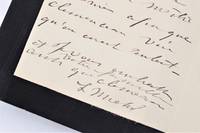
188583956s. l. Paris 1885. Fine. s. l. Paris 20 avril 1885 11 x 17.70 cm 2 pages sur un bifeuillet et un feuillet encollé sur la 3e page Autograph letter signed by Louise Michel addressed to Lucien Barrois; two pages written in black ink on a white paper bifolium with black border. One sheet in the hand of a naval adjutant from Brest pasted on the third page. Transverse folds inherent to postal delivery. Louise Michel asks the recipient of this letter for advice regarding her young cousin: ""Ignorant si Clémenceau aurait le temps d'écrire un mot de recommandation pour quelques leçons à mon petit cousin Dacheux je vous le dis d'abord afin que vous preniez un moment où ce sera possible pour le dire à Clemenceau. Je vous avoue que je n'ai pas trop compris la lettre du petit parce qu'il en est resté une bonne partie dans l'encrier il écrit si mal."" ""Not knowing if Clémenceau would have time to write a word of recommendation for some lessons for my young cousin Dacheux I tell you first so that you may find a moment when it would be possible to mention it to Clémenceau. I confess that I did not quite understand the boy's letter because a good part of it remained in the inkwellhe writes so poorly."" Moving letter testimony to the unwavering devotion of the former Communard. unknown
190879911s. l. Paris 1908. Fine. s. l. Paris 1908 13 x 15 cm 3 pages 1/2 sur un double feuillet Autograph letter signed by Renée Vivien addressed to her publisher Edward Sansot written in black ink on a double sheet of headed paper bearing the poet's monogram and her address at 23 avenue du Bois de Boulogne. Transverse folds inherent to mailing two tiny marginal tears without loss at the fold. Fascinating letter written by the Muse of the violets in the last months of her life: ""J'ai reçu avec une très grande joie les volumes des Flambeaux éteints. Remerciez bien de ma part votre soeur d'avoir fait les corrections et je vous en prie amenez-la moi lorsque vous reviendrez Avenue du Bois. Pour les six exemplaires de Sillages décollés donnez-les - je n'ai pas beaucoup d'amis et me soucie peu de distribuer des volumes au hasard. Maintenant s'il est trop tard lorsque ma lettre vous parviendra et que les exemplaires me parvinssent quand même ne soyez pas désolé - cela m'est indifférent je vous les ferai envoyer. Mes meilleurs sentiments d'amitié littéraire. Renée Vivien. Je vous envoie en même temps sept volumes à distribuer au hasard parmi vos amis littéraires."" ""I received the volumes of Flambeaux éteints with very great joy. Please thank your sister on my behalf for having made the corrections and I beg you bring her to me when you return to Avenue du Bois. For the six unbound copies of Sillages give them away - I do not have many friends and care little about distributing volumes at random. Now if it is too late when my letter reaches you and the copies reach me nonetheless do not be sorry - it is indifferent to me I will have them sent to you. My best feelings of literary friendship. Renée Vivien. I am sending you at the same time seven volumes to distribute at random among your literary friends."" The publication of Flambeaux éteints marks the first collaboration between the poet and her new publisher Edward Sansot. In these last painful years of life Sansot and his friend Charles-Brun are her only two links with the literary world whose critics - once highly laudatory - have finally turned their backs on her. It must be said that Renée Vivien has decided to withdraw all her books from commerce and is gradually sinking into solitude and depression. Handsome letter bearing witness to the last literary years of Sappho 1900. unknown
195080911s. l. Klarskovgaard 1950. Fine. s. l. Klarskovgaard 17 novembre 1950 21 x 34 cm 1 page sur un feuillet Autograph letter signed with the paraph of Louis-Ferdinand Céline addressed to his lawyer Master Thorvald Mikkelsen. One page written in blue ink on a large sheet of white paper; number ""566"" in Céline's hand in red pencil at the top left. Transversal folds inherent to mailing. This letter was very partially transcribed in Année Céline 2005. Early November 1950 Gaby Paul had come to visit Céline and Lucette at Klarskovgaard: ""Mme Gen Paul a repris la route de Montmartre toute ravie de votre accueil ! A moi de vous remercier chaleureusement car enfin j'espère que votre généreuse réception me sera comptée ""à indulgence""."" ""Mme Gen Paul has taken the road back to Montmartre delighted with your welcome! It is for me to thank you warmly because I finally hope that your generous reception will be counted in my favor as 'indulgence'."" Through her intermediary Céline evidently received news of his former Montmartre companions: ""Je ne sais pas quels crimes j'ai commis mais pour ces fourbes canailles du 18eme Arrt. ma légende de bistrot en bistrot est devenue un Super Niebelung d'horreurs ! C'est rigolo. Au point qu'aucun n'ose me venir voir ici !"" ""I don't know what crimes I committed but for these deceitful scoundrels of the 18th district my legend from bistro to bistro has become a Super Niebelung of horrors! It's amusing. To the point that none dare come to see me here!"" In 1947 Céline pursued by French justice for his collaborationist involvement was confined in Denmark. It was in May 1948 accompanied by Lucette and Bébert that he arrived at his lawyer Master Thorvald Mikkelsen's home at Klarskovgaard. The latter owned a large property by the Baltic Sea and invited the exile to stay there. On February 21 1950 as part of the épuration the writer was definitively sentenced in absentia by the civic chamber of the Paris Court of Justice for collaboration to one year of imprisonment which he had already served in Denmark. The Swedish Consul General in Paris Raoul Nordling intervened on his behalf with Gustav Rasmussen Danish Foreign Minister and managed to delay his extradition. On April 20 1951 Jean-Louis Tixier-Vignancour his lawyer since 1948 obtained Céline's amnesty under the title of ""severely disabled veteran of the Great War"" by presenting his file under the name Louis-Ferdinand Destouches without any magistrate making the connection. Céline would leave Denmark the following summer after three years spent at his lawyer's home. unknown
197684739Fleury-Mérogis 1976. Fine. Fleury-Mérogis 21 Octobre 1976 21 x 29.50 cm une page recto verso Autograph letter signed and dated by Jacques Mesrine dated Thursday October 21 1976 70 lines in blue ink on one recto-verso page addressed to his lover at the time Jeanne Schneider thanks to whom the manuscript of Instinct de mort was discreetly smuggled out of prison. Jacques Mesrine then incarcerated at Fleury-Mérogis prison rejoices at having been able to speak with his beloved in the visiting room who was also imprisoned: ""What a very pleasant visit you were moreover very feminine in that outfit which is very much in your style as a woman. even worth double the price because I like it"" and attempts to reassure her so that she does not lose all fight against the prison system that crushes inmates: ""But if by misfortune a new refusal should affect you do not have that bad reaction you told me about because those who surround you and have helped you do not deserve to pay for the injustice of others. You will have to face it as always. Because the doors will open one day and you know it."" As a protective patriarch Jacques Mesrine worries about the despair that could strike her and her daughter Murielle placed with social services: ""But I worry enormously about you because you have a limit. and I believe you have reached it! or almost. Regarding Mury and that bogus judge. we will see about removing her from social services. I prefer to pay for her studies and Mrs. Chevallier and all her upkeep if necessary. If you get out! Tell me. so many women to support. I'd better work overtime sic"" Public enemy No. 1 evokes Jeanne Schneider's upcoming freedom while ordering her not to fall back into criminality: "".If you get out formal prohibition from getting involved with me on a level that we both understand very well. I don't want to see you in prison anymore because you outside is a little bit of myself that will be free. You give your word for this freedom. prove that we others always keep it in good times as in bad"" Jacques Mesrine praises his companion's integrity the keystone of their strong union through the deprivation of freedom: ""This is what unites us most; criminals dangerous. but honest. This is what makes me love you with you no unpleasant surprises; you are 'white-blue' and for me you have the value of a diamond. It is the only stone that is harder than steel sic. but less hard than me resic"" He ends this missive with this humorous note reflecting the terrible intrusive reality of the penitentiary system: ""And if my Christmas package is prepared by you. the administration will X-ray it"" but also with these tender words: ""Sweet kisses rest on your lips. gesture of love that has united us always and for a long time. EL VIEJO Bandido!"" Rare and very beautiful letter from Jacques Mesrine in which we discover him protective and eager for freedom for his companion and for whom honesty must be erected as a rule of life. unknown
191076250Bas-Vignons 1910. Fine. Bas-Vignons 24 août 1910 13.70 x 21 cm 2 pages sur un double feuillet Unpublished autograph letter signed by Rachilde two pages written in black ink on a double sheet with Mercure de France letterhead. Interesting letter addressed to an unknown recipient perhaps a ""naval officer"". Rachilde defends Les Petites Alliées by Claude Farrère and his style in general: ""Je ne veux pas du tout vous laisser croire que l'oeuvre de Claude Farrère les Petites Alliées est un ouvrage de basse littérature . Claude Farrère est un très joli écrivain qui joint aux becs de sa plume une pointe de dandysme laquelle pointe peut le faire mal juger aussi bien par vous que par moi mais n'en demeure pas moins littéraire."" ""I do not want you to believe at all that Claude Farrère's work les Petites Alliées is a work of low literature . Claude Farrère is a very fine writer who adds to his pen's nibs a touch of dandyism which touch may make him badly judged by you as well as by me but nonetheless remains literary."" This ""touch of dandyism"" led to an amusing misunderstanding as highlighted by Henri Troyat Farrère's successor at the French Academy in his reception speech: ""As for the feminist Rachilde deceived by the first name Claude she had led a fierce campaign for Farrère taking him for a fellow woman writer."" unknown
191080881Alger Algiers 1910. Fine. Alger Algiers s. d. ca 1910 16.30 x 20.90 cm 3 pages sur un double feuillet Autograph letter signed by Judith Gautier addressed to Francis Chrétien the husband of her maid Céleste. Three pages written in violet ink on a double sheet with letterhead from 30 rue Washington. Transverse folds inherent to mailing. Judith Gautier sends Francis some instructions regarding the renovation of her house in Dinard le Pré aux oiseaux: ""Je pensais à la cuisine qui va être très noire et à la fenêtre bouchée qui est du côté du jardin sous la fenêtre de la salle à manger. Il me semble qu'elle rendrait du jour et même du soleil si elle était débouchée et bien disposée."" ""I was thinking about the kitchen which will be very dark and the blocked window which is on the garden side under the dining room window. It seems to me that it would provide light and even sunlight if it were unblocked and well arranged."" unknown
189476269Paris 1894. Fine. Paris 30 avril 1894 11 x 13.20 cm 3 pages sur un double feuillet et une enveloppe Autograph letter signed by Stéphane Mallarmé to Alidor Delzant; three pages written in black ink on a bifolium. With the original envelope. Alidor Delzant was a lawyer collector and bibliophile. A friend of the Goncourt brothers he devoted a book to them and served as Edmonds secretary and executor. A cordial letter in which the poet offers his condolences to his friend following his fathers death: ""Vous m'avez au hasard de nos rencontres amicales plusieurs fois parlé de votre père de façon à ce que je devinasse bon haut et délicat et que cette tardive mais prompte séparation à un âge qui donne une illusion chère de continuelle durée soit pour moi comme pour ceux qui vous aiment un deuil."" unknown
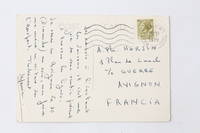
197270632Capri 1972. Fine. Capri 20 juillet 1972 10.40 x 15 cm une carte postale Autograph postcard signed by Maurice Béjart from Capri addressed to André-Philippe Hersin then in Avignon for the theatre and dance festival. On the verso a drawing depicting the coat of arms of Sir Galahad. The choreographer sends a warm message to the editor of Saisons de la danse whose latest issue he had just read. Hersin was indeed a great champion of Béjarts choreographic style and devoted laudatory articles to him in his journal as well as monographic booklets on his work. unknown
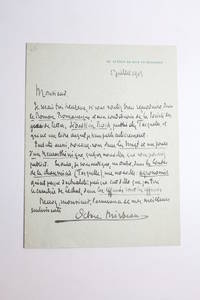
190373704s. l. Paris 1903. Fine. s. l. Paris 1er Juillet 1903 13.80 x 18.30 cm une feuille Autograph letter signed by Octave Mirbeau addressed presumably to Léon Tonnelle director of the review Le Roman Romanesque. 12 lines in black ink on a folded sheet grey paper with letterhead ""68 avenue du bois de Boulogne"". ""Monsieur je serais très heureux si vous vouliez bien reproduire dans Le Roman Romanesque et aux conditions de la Société des gens de lettres Sébastien Roch publié chez Fasquelle et qui est un livre auquel je tiens particulièrement. Peut-être aussi trouverez-vous dans Les vingt et un jours d'un neurasthénique quelques nouvelles que vous pourriez publier. En outre je vous indique en outre dans Les Contes de la Chaumière Fasquelle une nouvelle : Agronomie qui est presque d'actualité puisque c'est d'elle que j'ai tiré le caractère de Lechat dans Les Affaires sont les affaires. ."" ""Sir I would be very happy if you would kindly reproduce in Le Roman Romanesque and under the conditions of the Société des gens de lettres Sébastien Roch published by Fasquelle and which is a book to which I am particularly attached. Perhaps also you will find in Les vingt et un jours d'un neurasthénique some short stories that you could publish. Furthermore I also indicate to you in Les Contes de la Chaumière Fasquelle a short story: Agronomie which is almost topical since it is from this that I drew the character of Lechat in Les Affaires sont les affaires. ."". Octave Mirbeau published his novel Le Calvaire in issue 8 of the review le Roman Romanesque published in December 1903. The titles mentioned in the letter were ultimately not published. unknown
185976839Nohant Nohant-Vic 1859. Fine. Nohant Nohant-Vic 16 août 1859 13.50 x 20.90 cm 4 pages sur un double feuillet Autograph letter signed by George Sand addressed to Ernest Feydeau. Four pages written in blue ink on a double sheet bearing at the head of the first page the sender's blind stamp. This letter was published in the complete correspondence of George Sand established by Georges Lubin. Fine and lengthy letter discussing literature and friendship between writers. Initially a stockbroker and specialist in Antiquity Ernest Feydeau launched himself late into fiction. Anxious to occupy a literary space in which he did not feel justly appreciated he used his connections and maintained a regular epistolary relationship with illustrious correspondents such as Gustave Flaubert Sainte-Beuve and George Sand to whom he sent drafts of his novels and whose opinions he sought. This letter forms Sand's response after having just finished reading Daniel Feydeau's second novel. George Sand then at the height of her literary career describes herself thus: ""I am quite old enough to be your mother for I am 55 years old and I have good hands quite skillful but not beautiful at all. I have earned the right to no longer be coquettish I have been quite reproached for never having been so. I will tell you anything about myself that you wish."" As was her habit much solicited by her peers she delivers a very detailed critique of the text her colleague submits to her: ""I am not against sentences that jar where they need to jar but I am not for harmony being sacrificed to rhythm. Nor am I for the contrary. Understand me well I only blame what is too noticeable what reveals the technique. Do not touch the passages you speak of they are excellent. And in sum I will not insist furiously on the question of form in style seeing that if the qualities of yours should disappear with what sometimes seems to me a flaw I would be in despair at having pointed out the flaw."" Herself very close to Flaubert whom she nicknamed her ""leaden bottom"" Sand seems delighted that the two men know each other: ""I do not have time. But I will have time to receive you when you are free you must come with Flaubert who also has in me an enchanted reader and a wholehearted literary friend. I did not know he was your friend and I am pleased that he is."" The friendship goes so far that Sand soon brings the two writers together placing them on complete equal footing: ""It is no misfortune for you any more than for Flaubert to belong to the race of seers."" A form of solidarity then establishes itself in the face of critical adversity: ""All this is felt better than it can be said and that is why criticism loses its reason three-quarters of the time."" For criticism has had the misfortune of labeling Feydeau as it did with Flaubert a realist: ""People have taken it upon themselves to baptize your manner and his as realism. I do not know why; unless realism is something entirely different from what the first adherents attempted to explain to us. I suspect indeed that there is a way of envisaging the reality of things and beings which is great progress and you bring triumphant proof of it. But the name realism does not suit because art is a multiple infinite interpretation. It is the artist who creates reality within himself his own reality and not that of another. Two painters paint the portrait of the same person. Both create a work that represents the person if they are both masters. And yet the two paintings do not resemble each other. What has become of reality"" This long diatribe - a true manifesto - forms a powerful testimony to the repulsion of George Sand and Flaubert for theorists obsessed with the idea of classifying literature according to a ""system that . blinds"". unknown
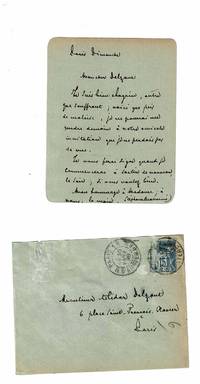
189876329Paris 1898. Fine. Paris 30 janvier 1898 11.40 x 8.80 cm une carte recto et une enveloppe Autograph postcard signed by Stéphane Mallarmé addressed to Alidor Delzant written on the front in black ink. Envelope enclosed. Alidor Delzant was a lawyer collector and bibliophile. Friend of the Goncourts he devoted a work to them and was secretary and testamentary legatee of Edmond. ""Je suis bien chagrin outre que souffrant ; voici que pris de malaise je ne pourrai me rendre demain à votre amicale invitation que je ne perdais pas de vue. Je vous ferai signe quand je commencerai à sortir de nouveau le soir ; si vous voulez bien."" ""I am quite grieved besides being unwell; here I am taken with malaise I will not be able to respond tomorrow to your friendly invitation which I had not lost sight of. I will give you a sign when I begin to go out again in the evening; if you would like."" unknown
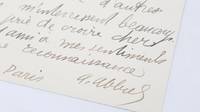
194186762Paris 1941. Fine. Paris s. d. ca 1941 14 x 15.50 cm une page sur un double feuillet Autograph letter signed by sculptor André Abbal 13 lines in black ink on a double sheet. Traces of folding inherent to postal dispatch. The sculptor discusses his various productions: ""I am now certain that my Tarn et Garonne will not return to the workshop. With peace of mind on this front I will work hard on other things that interest me greatly."" André Abbal student of Alexandre Falguière is renowned for his direct-carved stone sculptures. unknown
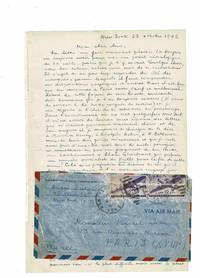
194576388New York 1945. Fine. New York 23 octobre 1945 17.10 x 25.40 cm 2 pages sur un feuillet et une enveloppe Unpublished autograph letter signed by André Breton addressed to Marcel Jean two pages written in blue ink on a sheet. ""Air mail"" envelope enclosed. Creases inherent to mailing. This letter is mentioned and very briefly quoted in Marcel Jean's autobiography Au galop dans le vent. Important and lengthy letter sent from New York when Breton in exile since 1943 as he was considered a ""dangerous anarchist"" by the Pétainist government was forced - like many intellectuals - to leave France in order to continue working. He shares with his friend the ""overwhelming despair"" ""l'accablement"" that the city brings him and one still senses his eagerness to return to his homeland. Painter draftsman and decorator Marcel Jean joined the Surrealist group in 1933 and became one of the movement's first chroniclers. One can sense all his emotion upon receiving this letter which he discusses at length in his autobiography: ""October 1945 I write to André Breton in New York. In response two densely written pages of fine calligraphy. My letter whose tone must have pleased him gave him ""real pleasure"" ""vraiment plaisir"". He finds me ""healthy safe and by no means lacking in that lucid smiling very human way of seeing"" ""sain sauf et nullement dénué de cette façon de voir lucide souriante très humaine"" that he has always known in me ""I just thought ""Je viens de penser"" he says of your firm handshake ""à ta rude poignée de main""."". I had mentioned to him the study on Lautréamont whose elements I am gathering he encourages me to give extracts of it for a Surrealist issue being prepared for the magazine Vrille ""this without prejudice to a drawing by you that Vrille should reproduce"" ""cela sans préjudice de dessin de toi que Vrille devrait reproduire"" and for the same magazine to submit ""a certain number of recent works to an in-depth analytical and critical commentary"" ""un certain nombre d'ouvrages récents à un commentaire analytique et critique approfondi"". This is followed by advice and encouragement regarding a work of literary criticism he would like to see me undertake. Then some news from America and our friends: Max Ernst Tanguy Péret who is bored in Mexico Matta who ""paints large panels in a new genre sadistic figurative much remarked upon."" ""peint de grands panneaux dans un nouveau genre figuratif sadique très remarqués."". And the vigorous signature. Breton's letters their contrast between the text with extremely regular handwriting and the flourish hurried and in both scripts something controlled have always given me the impression that in writing to me he was doing me the favor of an autograph. His message outlined for me a program as chronicler in view of his return to Paris in the spring but I had in mind something other than commenting on the commentaries of critics whose interest he pointed out to me - Maurice Blanchot or Léon-Pierre Quint. My projects concerned the study of Lautréamont and then - or at the same time: to paint and to draw."" unknown
189276338Paris 1892. Fine. Paris 21 novembre 1892 11.20 x 134 cm 2 pages sur un double feuillet et une enveloppe Autograph letter signed by Stéphane Mallarmé addressed to Alidor Delzant; two pages written in black ink on a double sheet. Envelope included. Alidor Delzant was a lawyer collector and bibliophile. Friend of the Goncourts he devoted a work to them and was secretary and testamentary legatee of Edmond. ""Je suis désastreux. Voici que lundi prochain me rappelle-t-on à la maison j'ai du envoyer dans la soirée un travail à Londres et qu'on a déjà remis au lundi suivant une invitation chez des amis pour ce motif."" ""I am disastrous. Here it is that next Monday I am reminded at home I have to send in the evening some work to London and that an invitation from friends has already been postponed to the following Monday for this reason."" The ""work"" mentioned in this letter is the article entitled ""Théodore de Banville"" which would appear in the National Observer of December 17 1892. unknown
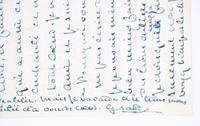
190079000s. l. Paris 1900. Fine. s. l. Paris s. d. 1er semestre 1900 12.30 x 16.70 cm 2 pages sur un double feuillet Handwritten signed letter addressed to Natalie Clifford Barney: I am in the grips of one of my bouts of black and wild melancholy - I can no longer see anyone. Paris 1st half-year 1900 12.3 x 16.7 cm 2 pages on a double leafHandwritten letter from Renée Vivien signed Paule and written in pencil on a double leaf with a silver-coloured heart with the poet's monogram at the top of the first sheet. Transverse fold from having been sent. Beautiful letter of apology after a dispute with the Amazone: Suis en proie à un de mes accès de mélancolie noire et sauvage je ne peux plus voir personne. Je m'en vais demain à Fontainebleau pour y rester jusqu'à ce que je sois guérie je dis : guérie avec intention car c'est une espèce de maladie morale dont je souffre en ce moment. C'est pour cela que j'étais si mauvaise hier j'aurais dû m'enfermer comme je le fais toujours en pareil cas. Une autre fois je m'en irai à temps pour ne pas te faire du mal si toutefois tu me permets de dire : une autre fois et si tu ne me renvoies pas à jamais de ta présence. Je n'ai qu'une excuse c'est que je souffre. Je n'ai pas été digne de l'amour que tu m'as si généreusement et si largement donné je n'ose plus te demander pardon je t'ai tant de fois offensée ! I am in the grips of one of my bouts of black and wild melancholy - I can no longer see anyone. Tomorrow I am going to go to Fontainebleau to stay there until I am healed - I say: healed with intent because it is a kind of moral illness from which I suffer at the moment. That's why I was so bad yesterday - I should have locked myself up as I always do in such a case. Another time I will go sooner so as not to cause you harm - if nevertheless you allow me to say: another time and if you do not dismiss me forever from your presence. I only have one excuse that is that I suffer. I have not been worthy of the love that you have so generously and so widely given me - I dare not ask you anymore for forgiveness - I have offended you so many times! unknown
191475220Paris 1914. Fine. Paris 1914 13.60 x 21.20 cm en feuillets Autograph letter signed by Colette addressed to her friend the man of letters and lawyer Adrien Peytel two pages written in black ink in hurried handwriting on a double sheet with L'Eclair newspaper letterhead. A central fold inherent to the folding of the letter for mailing. Fine letter from Colette testimony to the confusion that seized France at the dawn of the Great War: ""Nothing is working. I am stuck here for a piece they are asking me to write."" The writer worries: ""I have no news from Sidi Henry de Jouvenel. I am creating a whole head of worries for myself. I don't know where he is he wrote to me that he was leaving with the 29th for the Somme. Ah! la la la la la la."" ""Colette a entendu sonner le tocsin en Bretagne où elle passait un séjour ensoleillé avec le baron Henry de Jouvenel et leur fille dans sa maison de Rozven. La guerre la surprend en plein bonheur à quarante et un ans. . Son mari appelé dès le 2 août devant rejoindre le 29e régiment d'infanterie à Verdun elle a aussitôt envoyé sa fille à peine âgée d'un an avec sa nurse au château de Castel Novel en Corrèze - chez sa belle-mère. Et elle est rentrée à Paris."" ""Colette heard the tocsin ringing in Brittany where she was spending a sunny stay with Baron Henry de Jouvenel and their daughter in her house at Rozven. The war surprised her in the midst of happiness at forty-one years old. . Her husband called up from August 2nd having to join the 29th infantry regiment at Verdun she immediately sent her daughter barely a year old with her nurse to the château de Castel Novel in Corrèze - to her mother-in-law's. And she returned to Paris."" Dominique Bona Colette et les siennes unknown