66 625 résultats
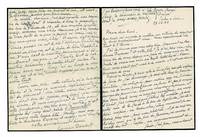
Large 4to. 8 pp. on 8 ff. Humorous "sodomite story" about eleven Chinese men who work in a laundry shop, the fourteen-year-old son of the house's managing agent, and a goat who becomes the object of their desire. According to the envelope enclosed, the story was published in October 1924 in the "Wiener Sonn- und Montagszeitung". - With small edge defects throughout and a small trace of rust from an old paperclip at one corner.
I: 8 SS. auf 4 Bll. 4to. - II: 17½ SS. auf 12 Bll. Wendet sich das erste Manuskript - die "Vorhalle" - expressis verbis an "m[eine] l[ieben] Z[uhörer]", so kommen diese im zweiten Manuskript - betitelt mit "Als Vorwort | Anmerkungen u. Excurse" - als Adressat nicht vor, dürften aber dennoch, Tonfall und Duktus zufolge, dieser gewesen sein. - Beide Manuskripte dürften nicht vollständig sein oder einen jeweils in sich abgeschlossenen Teil einer Serie darstellen, die als solche nicht überliefert ist. - Die "Vorhalle" stellt eine weit ausholende Einleitung zur "Geschichte derjenigen Kunst" dar, "die die Meister v. Ihnen als Lebenszweck erwählt"; als Vorwort bietet einen nicht minder weitläufigen Überblick über Vokalmusik, Philosophie der Musik, Versuche zur Gliederung der Musik in geschichtliche Epochen (nach F. W. Marpurg, vgl. S. 9) u. a. m. - Der aus Butschowitz (Mähren) gebürtige Musiker und Musikpädagoge, der als "einer der besten Pianisten seiner Zeit" gilt (MGG IV, 276) erfuhr seinen Klavier- und Kompositionsunterricht durch Anton Halm und Ignaz von Seyfried und wurde 1833 Professor am Konservatorium der Gesellschaft der Musikfreunde, wo er bis 1856 als Klavierpädagoge wirkte. Fischhof gilt als "Meister der klassischen Wiener Klavierschule [...] er trat besonders als Interpret Bachs, Beethovens, Mendelssohn Bartholdys und Chopins hervor. Seine umfangreiche Musikbibliothek mit Manuskripten und Autographen war vor allem für die Bach- und Beethovenforschung von Bedeutung" (DBE). Zu Fischhof vgl. (Auswahl) die entspr. Artikel in ADB, NDB, ÖBL, MGG, Riemann, Wininger und Wurzbach.
189574263s. l.: S. n. 1895. Fine. S. n. s. l. s. d. circa 1895 12.50 x 17 cm une page et demie sur une feuille Autograph letter signed by the dandy count of a page and a half 13 lines written in black ink to his friend the journalist from Le Gaulois Henry Lapauze so that he might use his decisive influence in the publication of a text: ""Il doit s'imaginer que ce texte est subversif. Détrompez-le."" ""He must imagine that this text is subversive. Disabuse him of this notion."" initially validated by Arthur Meyer but which Robert de Montesquiou wants to ensure through his friend will indeed be printed: ""J'ai vu votre directeur qui accepte en principe. Cependant comme votre intervention pour faire est déterminante j'insiste auprès de vous."" ""I have seen your director who accepts in principle. However as your intervention to make it happen is decisive I insist upon you."" Henry Lapauze 1867-1925 was a journalist art critic then in 1905 curator of the Petit Palais converted four years earlier into a museum and whose collections he considerably enriched by acquiring notably the Courbet Henner Falguière collections with in the twilight of his life a marked predilection for the Decorative Arts of which he was one of the ardent promoters. S. n. unknown
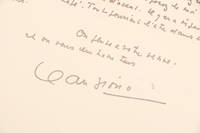
195284966s. l. 1952. Fine. s. l. ca 1952 21 x 27 cm une feuille Autograph letter signed by Jean Giono 14 lines in black ink addressed to Roland Laudenbach who jointly ran the magazine Opéra with his friend Roger Nimier. Fold marks inherent to the mailing. ""Cher Roland j'y pense : Voulez-vous quelque chose pour Opéra de qualité d'assez sensationnel et qui fuisse faire sept à huit numéros peut-être plus à votre gré Le Journal. Le Journal de 1936 à 1949. Si cela vous plait parlez en avec Nimier pensez à un chiffre proposez le moi ça ira sûrement et c'est d'accord. Il y en a déjà pas mal de tapé ! Tout le journal l'être dans un mois. On pense à votre venue et on vous embrasse tous. Jean Giono."" Dear Roland I'm thinking: Would you like something for Opéra Something quality rather sensational that could run for seven to eight issues perhaps more as you wish The Journal. The Journal from 1936 to 1949. If this appeals to you discuss it with Nimier think of a figure propose it to me it will surely work out and we're in agreement. Quite a bit of it is already typed! The entire journal will be ready in a month. We're thinking of your visit and we all embrace you. Jean Giono. A very visual letter bearing Jean Giono's handsome signature. unknown
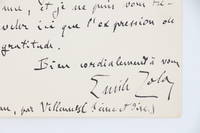
188279109Médan 1882. Fine. Médan 16 novembre 1882 13.60 x 21.40 cm 2 pages sur un double feuillet - enveloppe jointe Autograph letter signed by Emile Zola - apparently unpublished - addressed to Léon Carbonnaux written in black ink on a double sheet. Folds inherent to mailing. Envelope included. Important testimony to the colossal documentation work and the capital role of Emile Zola's informants in depicting his immense natural and social fresco. This letter was sent to Léon Carbonnaux department head at Bon Marché who transmitted precious information to Emile Zola for the creation of the eleventh volume of the Rougon-Macquart series: Au Bonheur des Dames. Only two letters from Léon Carbonnaux to Emile Zola are known: they can be consulted in the digitization of the preparatory file for Bonheur des Dames made available online by the Bibliothèque nationale de France. However we know thanks to this same file which contains a long section entitled ""Notes Carbonnaux"" that this department head at Bon Marché provided a significant amount of information to Zola particularly about employee customs and their remuneration. The two men undoubtedly met when Emile Zola eager for information about the functioning of department stores conducted field research in February and March 1882. ""J'ai pris l'inventaire comme cadre à un de mes chapitres. D'ailleurs je n'ai spécialement besoin que du travail dans le rayon des confections et dans le rayon des soieries. Il est inutile de me renseigner sur les autres rayons."" ""I have taken the inventory as the framework for one of my chapters. Moreover I specifically only need the work in the ready-to-wear department and in the silk department. It is unnecessary to inform me about the other departments."" Thanks to this important letter we understand that it was Léon Carbonnaux who provided the essential information to Emile Zola for writing his very beautiful eleventh chapter devoted to the inventory: ""Vous avez eu l'obligeance de me donner certains détails sur l'inventaire. Vous m'avez dit qu'on choisissait le premier dimanche d'août qu'on fermait les portes et que tous les employés s'y mettaient. On vide toutes les cases n'est-ce pas on jette les marchandises sur les comptoirs ou à terre et l'inventaire n'est terminé que lorsqu'il n'y a plus absolument rien en place."" ""You were kind enough to give me certain details about the inventory. You told me that the first Sunday in August was chosen that the doors were closed and all the employees set to work. All the compartments are emptied aren't they The merchandise is thrown onto the counters or on the ground and the inventory is only finished when there is absolutely nothing left in place.""The final version of Bonheur des Dames contains all the precious information provided by the department head of Bon Marché: ""Le premier dimanche d'août on faisait l'inventaire qui devait être terminé le soir même. Dès le matin comme un jour de semaine tous les employés étaient à leur poste et la besogne avait commencé les portes closes dans les magasins vides de clientes. . Neuf heures sonnaient. . Dans le magasin inondé de soleil par les grandes baies ouvertes le personnel enfermé venait de commencer l'inventaire. On avait retiré les boutons des portes des gens s'arrêtaient sur le trottoir regardant par les glaces étonnés de cette fermeture lorsqu'on distinguait à l'intérieur une activité extraordinaire. C'était d'un bout à l'autre des galeries du haut en bas des étages un piétinement d'employés des bras en l'air des paquets volant par-dessus les têtes ; et cela au milieu d'une tempête de cris de chiffres lancés dont la confusion montait et se brisait en un tapage assourdissant. Chacun des trente-neuf rayons faisait sa besogne à part sans s'inquiéter des rayons voisins. D'ailleurs on attaquait à peine les casiers il n'y avait encore par terre que quelques pièces d'étoffe. La machine devait s'échauffer si l'on voulait finir le soir même. unknown
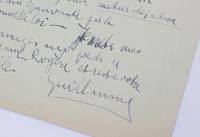
191383938s. l. Paris 1913. Fine. ""I will come to see you to speak to you about naturalization I am appalled by the new law"" s. l. Paris s. d. ca. juin 1913 15.70 x 24.50 cm une page sur un feuillet Unpublished autograph letter signed by Guillaume Apollinaire addressed to Jean Royère one page written in black ink on a sheet. Transverse folds inherent to posting. Very fine letter of thanks from poet to poet. ""I thank you for the admirable article you devoted to me. You have felt my soul like no one else."" Jean Royère had indeed written a laudatory article upon the publication of Alcools in the June 20 1913 issue of La Phalange: ""Here gathered in an 18mo of barely two hundred pages is almost the entire poetic work of Apollinaire. Fifteen years of poetry rest in this small volume. I therefore do not open it without almost a preconceived admiration. In poetry abundance means sterility and one only writes three volumes in a year through inability to devote one's life to a book. Apollinaire evidently will leave only one book of verse like Baudelaire and Mallarmé like Rimbaud: this is a considerable chance of immortality for the true poet is one who has this too rare gift of condensation."" "". I will come to see you in the coming days to thank you first and also to speak to you about naturalization I am appalled by the new law."" The poet here alludes to the Three Year Law dubbed the Barthou Law increasing the duration of military service from two to three years in view of preparing the French army for a possible war with Germany. If Apollinaire's biography prefers to focus on the publication of his works in this year 1913 the letters his mother addresses to her son show that the latter moves heaven and earth to avoid military service and be naturalized as quickly as possible: ""For your papers an Italian colonel attached to the ministry of war who was witness for your act of recognition had written to me once to give me the steps to follow so that you would be exempted from military service in Italy and for your French naturalization. I am going to write to him moreover to ask him to see to the Town Hall."" letter from Angelika Kostrowicka of July 12 1913. War would come soon and on August 3 1914 the day after mobilization the stateless poet would file a request for voluntary enlistment accompanied by a naturalization request. The latter would only be granted to him in 1916. An interesting letter written at the dawn of the Great War bearing witness to Guillaume Apollinaire's two passions: poetry and France. unknown
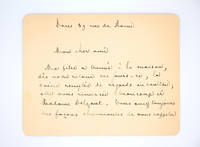
189375921Paris 1893. Fine. Paris 13 octobre 1893 11.40 x 8.90 cm une carte recto verso - enveloppe jointe Signed autograph card from Stéphane Mallarmé addressed to Alidor Delzant written in black ink on both sides. With envelope. Alidor Delzant was a lawyer collector and bibliophile. A friend of the Goncourts he devoted a work to them and was Edmond's secretary and testamentary legatee. A friendly card in which Mallarmé thanks Alidor Delzant for a surprise sent: ""Ma fille a trouvé à la maison dès notre retour ces jours-ci la caisse remplie de regards en coulisse ; elle vous remercie beaucoup et Madame Delzant. Vous avez toujours des façons charmantes de vous rappeler à vos amis même quand ils se souviennent."" ""My daughter found at home upon our return these past days the crate filled with sidelong glances; she thanks you very much and Madame Delzant. You always have charming ways of reminding your friends of yourself even when they remember."" The ""regards en coulisse"" are likely apricots or prunes. unknown
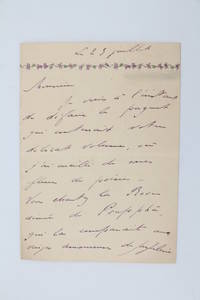
190779815s. l. Paris 1907. Fine. s. l. Paris Le 23 juillet ca. 1907-1908 11.50 x 16 cm 2 pages sur un double feuillet Handwritten signed letter addressed to a poet: You sing the rose loved by Psapphâ who compared it to the loving virgins of Mitilini Paris 23 July ca1907-1908 11.5 x 16 cm 2 pages on a double leafHandwritten signed letter from Renée Vivien addressed to a poet written in violet ink on a double leaf of paper decorated at the head with a border of violets. Transverse folds from having been sent. Monsieur Je viens à l'instant de défaire le paquet qui contenait votre délicat volume où j'ai cueilli de rares fleurs de poésie. Vous chantez la rose aimée de Psapphâ qui la comparait aux vierges amoureuses de Mytilène. Parmi vos poèmes je préfère : ''Sa Voix"" ""Sa Grâce"" et ""Les Mains et l'Apothéose"" . Renée Vivien Monsieur I have just this minute undone the package that contained your delicate volume where I picked rare flowers of poetry. You sing the rose loved by Psapphâ who compared it to the loving virgins of Mitilini. Among your poems I prefer: Sa Voix"" ""Sa Grâce"" and ""Les Mains et l'Apothéose"" . Renée Vivien Despite the precision of the titles mentioned it has not been possible for us to identify the poet to whom Vivien sent this letter of thanks. These titles are reminiscent of the poems of the Muse aux violettes herself. unknown
188486688Bellevue Meudon 1884. Fine. Bellevue Meudon 17 Octobre 1884 13 x 20.50 cm une page sur un double feuillet Autograph letter dated and signed by Ernest Renan to Louis Liard then director of higher education at the Ministry of Public Instruction 14 lines in black ink and on letterhead of the Collège de France of which he has been administrator since the previous year. Postal fold mark inherent to mailing a small tear at the head of the letter at the date level. Ernest Renan requests a meeting in order to discuss with his correspondent the future of the Collège de France: ""Oserai-je vous prier de me fixer l'heure et le jour où je pourrai sans vous déranger vous entretenir de quelques affaires très importantes pour le Collège de France et qui sont assez pressées ."" ""Dare I ask you to set the time and day when I could without disturbing you discuss with you some very important matters for the Collège de France which are rather urgent."" Louis Liard noted in pencil in the upper left corner of the letter: La 1ere lettre que j'ai reçu de Renan. The first letter I received from Renan. unknown
186084915s. l. 1860. Fine. s. l. 15 juillet1860 13.50 x 21 cm une page et demi sur un double feuillet Autograph letter signed by Sainte-Beuve 1 and a half pages on a double sheet. 25 lines in black ink. ""J'ai été très sensible cher monsieur à votre bon français et à l'envoi du très sage et instructif volume qui en est la cause. Vous me rappelez en effet des temps déjà bien anciens mais que ce qui a fini n'a pu effacer de ma mémoire : car à vous parler vrai quoi qu'il y ait bien de l'espace et bien de l'intervalle d'aujourd'hui à ce temps-ci il me paraît souvent qu'il y a du vide : et le tourbillon de la vie littéraire dont vous me parlez je ne le ressens guère. Ce qui me frappe c'est plutôt le contraire du tourbillon c'est à dire l'isolement la disparition ou le peu de mouvement de groupe. On se survit et l'on traîne un peu : je parle du moins pour moi aussi n'en suis-je que plus sensible. . de bons témoignages comme le vôtre qui attestent que le passé n'est pas oublié et qu'il a réellement existé. Croyez-moi je vous prie tout à vous. Sainte-Beuve."" ""I have been very touched dear sir by your good French and by the sending of the very wise and instructive volume which is the cause of it. You remind me indeed of times already quite ancient but which what has ended could not erase from my memory: for to speak truly to you although there is much space and much interval from today to that time it often seems to me that there is emptiness: and the whirlwind of literary life of which you speak to me I hardly feel it. What strikes me is rather the contrary of the whirlwind that is to say isolation the disappearance or the little group movement. One survives oneself and drags on a little: I speak at least for myself so I am all the more sensitive. . to good testimonies like yours which attest that the past is not forgotten and that it really existed. Believe me I beg you entirely yours. Sainte-Beuve."" unknown
194276137Paris 1942. Fine. Paris 29 décembre 1942 13.60 x 17.90 cm 6 pages sur un double feuillet et un feuillet simple Autograph letter signed by Lucien Daudet addressed to Lucien Descaves; six pages written in black ink on a double sheet and a single sheet. Creases inherent to the mailing. Fine and long unpublished letter addressed to Lucien Descaves to whom Daudet had not given news for two years. He outlines broadly the tragic events that occurred since: ""Since that time I remained in Paris I witnessed the days of June 40 . I undertook to forget my life to write a life of my father . Then in August I understood that I was very ill . I was operated on reoperated on in November I was dying I knew nothing anymore then a phlebitis. . A month later I learned of my brother's death."" All these sad misadventures do not prevent him from thinking about the Goncourt Academy which he evokes at length in this missive. Indeed his brother Léon Daudet having died a few months earlier the academicians are seeking a successor and Lucien's name figures among the favorites: ""As soon as the newspapers mentioned my name for the Goncourt Academy I was very embarrassed."" He nevertheless states the reasons why he does not wish to join the ten: ""Because I could not appear my brother being dead to say 'my turn' . And finally it is difficult to write when one is the son of Alphonse Daudet but when in addition one is the brother of Léon Daudet . the game was lost in advance for me."" It is finally La Varende who will be elected on the recommendation of René Benjamin and Sacha Guitry and despite his certainties ""I would present myself one day or another to the Academy"" Lucien Daudet will never join the prestigious jury. Lucien has attached to his first letter another sheet in which he comments on Germaine Beaumont's latest novel: ""One must not have the slightest idea of what a novel is a true novel to not have understood that for years no one had written a novel of such density."" This literary consideration is the occasion for Daudet to address the Céline case who - still in France at this time - has just published his third pamphlet Les Beaux Draps: ""You I a few others loved Céline when he had great talent. And then all the imbeciles discovered him when he imitated himself and it was no longer anything but the waffle iron."" unknown
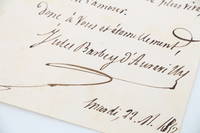
185284884s. l. 1852. Fine. s. l. 22 Mars 1852 13.50 x 20.50 cm une feuille Fine autograph letter dated and signed by Jules Barbey d'Aurevilly addressed to historian Jean-Marie Dargaud 13 lines in black ink. Creases inherent to folding for posting. Jules Barbey d'Aurevilly shows great tact towards his friend also expressing all his affection: ""Je veux vous épargner en allant sous peu de jours vous voir chez vous une course longue et peut-être inutile. On ne me voit que le matin et encore les trois premiers jours de la semaine. J'irai donc vous voir."" ""I want to spare you by going to see you at your home in a few days a long and perhaps unnecessary journey. I can only be seen in the morning and only on the first three days of the week. I will therefore come to see you."" unknown
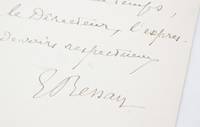
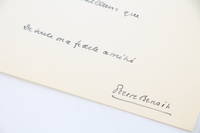
196085012Ciboure 1960. Fine. Ciboure 14 Février ca 1960 21 x 27 cm une page Autograph letter signed by Pierre Benoit from his property in Ciboure 15 lines in black ink. Central fold marks perforations due to filing in a binder having caused no loss. Pierre Benoit will soon be in Paris and will have the pleasure of meeting his friend: ""j'aurais une vraie joie à faire en tête avec vous dans un déjeuner discret un petit tour d'horizon."" I would have true joy in having a private conversation with you over a discreet lunch a brief survey of things. when the latter has determined according to his schedule a date for their meeting: ""Consultez votre emploi du temps et donnez-moi un coup de téléphone de préférence le matin vers 10 heures moment qui convient aux travailleurs que nous sommes."" Check your schedule and give me a telephone call preferably in the morning around 10 o'clock a time that suits workers like us. unknown
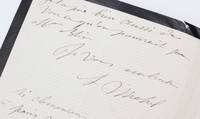
188583961s. l. Paris 1885. Fine. s. l. Paris 15 août 1885 13.40 x 21.10 cm 1 page 1/2 sur un bifeuillet Autograph letter signed by Louise Michel addressed to Lucien Barrois; one and a half pages written in black ink on a bifolium of white paper with black border. Transverse folds inherent to mailing. Tears to lower margin without loss at the fold. Louise Michel requests help for one of her friends: ""Vous savez que le père Blin ne peut plus travailler depuis deux mois passés voici maintenant la mère Blin qui vient de tomber très malade. Voyez ce qu'on pourrait faire vous savez tous les services qu'ils ont rendus en 70-71. Mon petit cousin . aidera le père Blin à tenir son kioske sic mais cela ne donne pas de secours à la maladie de Mme Blin. Mme Barrois devait revenir demain samedi ici qu'elle ne l'oublie pas mais je la prie bien aussi de voir ce qu'on pourrait pour Mme Blin."" ""You know that father Blin has been unable to work for the past two months and now mother Blin has just fallen very ill. See what could be done you know all the services they rendered in 70-71. My little cousin . will help father Blin run his kiosk but that doesn't provide relief for Mme Blin's illness. Mme Barrois was supposed to return here tomorrow Saturday may she not forget it but I also earnestly ask her to see what could be done for Mme Blin."" Mme Blin actively participated in the Paris Commune alongside Louise Michel; with other Parisian women they created the Women's Vigilance Committee and asked Louise Michel to take charge of it. Moving letter testimony to the unfailing devotion of the former Communard. unknown
6 SS. auf gefalt. Bögen. Tinte auf Papier, mit Überarbeitungen in Blei- und Rötelstift. Folio. Der "Waffentanz aus Told' parodierender Posse: 'Wastl, oder die böhmischen Amazonen'" (Überschrift). Franz Xaver Tolds "Wastl oder die böhmischen Amazonen" (eine Variation seines Vorjahreserfolgs "Frauen im Serail") entstand 1841 für das Josefstädter Theater, wo Titl seit 1840 (als Nachfolger von Heinrich Proch) als Kapellmeister wirkte. - Sauber und wohlerhalten.
1 S. 8vo. Mit eh. Adresse (Faltbrief). An die Redaktion der "Leipziger Zeitung" mit der Bitte um Einschaltung: "Ein bekanntes Mittel auf Wahlen einzuwirken sind Verdächtigungen. Das Mittel ist auch in No. 125 dieser Ztg. Beilage S. 2887 gegen mich angewendet. Mit Ausnahme der Thatsache, daß ich aus dem Hannöverschen berufen bin, erkläre ich den ganzen Artikel für ein grobes Lügengewebe. Will sich der verkappte Verleumder nennen, so werde ich mit zu verhoffneter Genehmigung der vorgesetzten Behörde eine actenmäßige Mittheilung sämtlicher dienstlicher Thatsachen veröffentlichen, welche mein hiesiges Wirken betreffen [...]". - Mit kleinen redaktionellen Vermerken.
¾ S. Gr.-4to. "In stiller Klause, fern vom wilden Treiben | Der Menschenwelt, die nach dem Glücke jagt, | Kann deine Seele rein und lauter bleiben, | Auch wenn dir viel das Schicksal hat versagt [...]". - Arthur Pfungst war Herausgeber der freigeistigen Zeitschrift das "Freie Wort. Frankfurter Halbmonatschrift für Fortschritt auf allen Gebieten des geistigen Lebens" und Inhaber der Frankfurter Naxos-Union, des führenden deutschen Importeurs und Produzenten von Schmirgel. Im Jahre 1900 stiftete er der freigeistigen Bewegung den Neuen Frankfurter Verlag, der zu einer Zentrale freigeistiger Literatur in Deutschland wurde, die "Bibliothek der Aufklärung" herausgab und zahlreiche philosophische und kirchenkritische Studien veröffentlichte. Sich besonders für die indische Kultur und den Buddhismus interessierend, war Pfungst Mitbegründer der Deutschen Gesellschaft für Ethische Kultur. Daneben war er Erfinder, vielseitiger Autodidakt, promovierter Naturwissenschaftler, Übersetzer, Publizist und Sponsor von Freibibliotheken, Lesehallen und Volkshäusern; auch brachte Pfungst 1906 den Begriff des "Hooligan" als "russisches" Phänomen (russ. chuligan) nach Deutschland. - In altem Sammlungsumschlag.
1 S. Folio (344:482 mm). Schöne Kalligraphie des Biedermeier. Für jeden Monat drei Spalten mit der Angabe von Datum, Tag und den entsprechenden Namens- und katholischen Feiertagen, die Sonn- und Feiertage in roter Tinte. - Rückstände von Siegellack zur Affichierung verso. Mit fünf kleinen Löchern durch Tintenfraß im Zierrahmen. Die Überschrift durch geringfügigen Tintenfraß leicht beschädigt. Wasserzeichen der Papierfabrik Peter Zöh in Trutnov.
3¼ SS. auf Doppelblatt. 4to. Artikelentwurf mit einer Einleitung zu den Unterschieden in der Bedeutung der Bildung in Österreich, Deutschland und der Schweiz und im Hauptteil mit einer niederschmetternden Kritik an einem Buch des Pädagogen und Reformers Ignaz Thomas Scherr: "Was ist Bildung? / (Schluß.) / Jacob Böhme, sagten wir, war seines äußeren Berufes ein Schuster, seines innern ein Philosoph. Umgekehrt gibt es heutzutage viele Philosophen von Handwerk, die dem individuellen Werth nach nur Schuster sind. Mit Einem Wort: wie die Dinge gegenwärtig stehen ist keine Übereinstimmung des inneren und äußeren Berufes vorhanden [...] Das Buch, in dem Herr Scherr seine Erlebnisse erzählt, somit sein Individuum entfaltet, ist unter aller Kritik. Der Styl ist platt und trivial, die Gedanken erbärmlich und die Bildung, die sich darin ausspricht, so wie sie die Grenze der Fachbildung überschreitet, im höchsten Grade oberflächlich [...] (Es folgt morgen Früh noch eine Fortsetzung u. ein leitender Artikel)". - Mit Sammlernotiz in Bleistift und Vermerk in roter Tinte. Etwas fingerfleckig.
1 S. 4to. "Herz, wie fühlst du dich so schwer, | Seit dein Liebstes dir verloren, | Das du einst dir auserkoren | Und dir nahm ein Ungefähr. | Herz, und kehrt sie auch nicht mehr, | Jene Zeit der Feenträume, | Die geschmückt so schön die Räume | Welche jetzt so wüst und leer; | Herz, o traure nicht zu sehr, | Mag sich auch Dein Himmel schwärzen, | Hast DU doch in Lust und Schmerzen | Einst geliebt, - was willst Du mehr?" - J. N. Vogl gehörte der Literatengruppe im Wiener "Silbernen Kaffeehaus" an, wurde Mittelpunkt einer Tafelrunde von Künstlern und gab zahlreiche Almanache und Taschenbücher heraus; viele seiner in der Tradition der Wiener Spätromantik stehenden Balladen wurden von Carl Loewe vertont, einige Lieder auch von Franz Schubert.
242 x 390 mm. Illustration 195 x 127 mm. Satire auf einen Konflikt zwischen dem Schauspieler und Autor Carl von Zahlhas, genannt Neubruck (1795-1872), und einem nicht identifizierten Theaterrezensenten. Die einfache Illustration mit dem Titel "Was wollen die Herren mit ihrem Gebell?" zeigt Zahlhas, der mit zwei Pistolen und zwei Säbeln in das Arbeitszimmer des Rezensenten stürmt, um ihn zum Duell aufzufordern. Der erschrockene Rezensent ist von seinem Schreibtisch aufgesprungen und hält schützend einen Gänselkiel und ein beschriebenes Blatt Papier vor seinen Körper. Beim Titel handelt es sich um ein Zitat aus Joseph Marius von Babos (1756-1822) Tragödie "Otto von Wittelsbach" (1793). - Der gereimte Dialog von "Bluthund" und "Dintenhund" schließt an die Illustration an: "Bluthund. - Wenn Sie sagen, der Aufsatz wäre von mir, | So sind Sie Schurke für und für! | Doch weil Sie nicht den Degen getragen | So will ich Ihnen den Zweikampf vorschlagen, | Pistolen, oder Degen, mir einerlei, | die Wahl der Waffen steht Ihnen frei. - Dintenhund. - Man hat mich getäuscht, ich gesteh es ein, | Ein Wort wird ja kein Pfeil nicht seyn, | Ich habe freilich den Degen getragen, | Doch war ich niemals ein Freund von schlagen. | Mit dem Maul! -- Ja da bin ich schon geschwind, | Mit dem Degen? -- Nein! Ich habe Weib und Kind. - Bluthund. - Herr! hätten Sie das vorher bedacht, | Eh' Sie das Maul haben aufgemacht! | Ich lasse nicht ab, ich bin rabiatt [!], | Und habe Ihr dummes Geschreibsel längst satt, | Wir müssen uns hauen oder schiessen, | Ich lasse nicht ab, es muß Blut fließen! - Dintenhund. - Es fließe nur Dinte, mein bester Freund! | Ich widerrufe den Aufsatz noch heut. | Ich will Sie auch loben so gut ich kann, | Mit kommts auf ein Maul voll Worte nicht an. | Und wenn es nur ein Duell nicht gibt, | So schimpf' ich, auf wen es Ihnen beliebt. - Bluthund. - Für diesmal mag es genug denn seyn, | Ich stecke Pistolen und Degen ein. | Sie stecken auch ein, was ich Sie genannt, | Und machen Ihren Widerruf bald bekannt. | Man kennt Sie schon, denn jeder sagt frei, | Ihre Theaterkritik ist -- Heuchelei. -- Dintenhund. - Die ganze Welt ist voll Heuchelei, | Davon ist auch eine Kritik nicht frei. | Ihre Gründe haben mich völlig besiegt, | Ich weiß jetzt wo der Haas im Pfeffer liegt. | Nun leben Sie wohl mein bester Freund | Auf Ehre, es war nicht bös gemeint." - Ganz nach dem Motto "Hunde, die bellen, beißen nicht" werden beide Protagonisten verspottet. Obwohl der gekränkte Zahlhas die Rezensionen seines Widersachers als Heuchelei herabwürdigt, lässt er sich vom Versprechen guter Kritiken in seinem Zorn besänftigen. Angesichts der Duellaufforderung zögert der Theaterrezensent nicht, die ursprüngliche Kritik zu widerrufen und seinem schlechten Ruf gerecht zu werden, schließlich sei die ganze Welt voll Heuchelei. Die handschriftliche Identifikation der Protagonisten am unteren Plakatrand weist zwar auf einen konkreten Konflikt hin, jedoch kann die Satire auch als Allegorie auf das zwiespältige Verhältnis zwischen Schauspielern und Rezensenten im Allgemeinen gelesen werden: Solange alle Beteiligten die ihnen zugewiesenen Rollen spielen, bleibt ihr Konflikt bloßer Theaterdonner. - Carl von Zahlhas, ein Bühnenpartner Ferdinand Raimunds, wirkte überaus erfolgreich als Schauspieler in komischen Rollen an Bühnen in Wien, Kaschau und Linz; von 1818 bis 1824 war er am Theater an der Wien engagiert. Bei einem Gastspiel in Pest 1824 erkrankte er und musste aufgrund einer halbseitigen Lähmung die Schauspielerei aufgeben. - Mit großem Ausriss am oberen Rand und mehreren Seiteneinrissen (kaum Bild- und kein Textverlust). Knittrig.
4 SS. auf 4 Bll. Gr.-4to. Mit eh. adr. Kuvert. "Meine Damen! Ich hoffe, daß Sie mir die folgende kleine Geschichte nicht übelnehmen werden; denn sie ist ziemlich leichtfertig. Aber ich möchte Ihnen zur Beruhigung mitteilen, daß sie sich im fernen Indien zugetragen hat, und daß in Europa derartige Frauen nicht vorzukommen pflegen. In Europa gilt, wie bekannt, die Ehe als Sakrament, und noch niemals hat in Europa eine Frau ihrem Gatten die Ehe gebrochen. Es war einmal ein Herr, namens Viradhara, und eine Dame, namens Kamadamini. Letztere war ein junges, zartes und fröhliches Geschöpf, während ihr Gatte Viradhara bereits jenes Alter erreicht hatte, von dem es im indischen Sprichwort heißt: ein alter Esel zieht nicht mehr am Korbwagen. Kamadamini fand nun, daß es noch genug junge Esel gäbe, die ihren kleinen Korbwagen gerne ziehen möchten, sofern sie sie nur einspanne. Solches tat Kamadamini und geriet in einen Ruf, der selbst bis zu ihrem alten Gatten drang [...]". - Die Erzählung wurde erstmals und mit zahlreichen Abweichungen abgedruckt in "Kunterbuntergang des Abendlandes", 1922 im Münchner Roland Verlag erschienen (SS. 143-148), an dessen Inhaber Albert Mundt das Kuvert auch adressiert ist. - Die Recto-Seite von Bl. 1 mit einer zeitgenöss. Bleistiftnotiz von fremder Hand; papierbedingt stärker gebräunt und mit kleinen Randläsuren.
1 S. Folio (223:282 mm). Albumblatt mit gedruckter Bordüre und gedr. Fußzeile "Beitrag zum Selbstschriftenalbum 'Deutschlands Zukunft'", aufgezogen auf einen Bogen Pergamentpapier (ca. 330:344 mm). Umfangreiche Sentenz, die Situation des deutschen Volks mit jener der Polen und Juden vergleichend: "Als die dritte Teilung Polens ein Staatswesen vom Erdball tilgte, ist ja das polnische Volk nicht verschwunden und noch viel weniger der polnische Geist. Auch wir Deutschen haben das staatlich annektierte Drittel dieses Volkes in 130 Jahren keineswegs verdauen können, wohl aber sind in unseren Parlamenten diese Polen ausschließlich Hemmschuh gewesen! [...]". Geschrieben als Beitrag für die von Friedrich Koslowsky im Berliner Eigenbrödler-Verlag herausgegebene Faksimile-Anthologie "Deutschlands Köpfe der Gegenwart über Deutschlands Zukunft" (1928). - Walter Harlans Stück "Gib uns Kinder und hundert Enkel! Ein Spiel aus den Tagen der Erzväter" (Berlin 1928) wurde etwa gleichzeitig veröffentlicht. Der Begründer der Künstlerfamilie Harlan war Vater u. a. des Musikers Peter Harlan und des Regisseurs Veit Harlan. Koslowsky 229.
Titel, 4 SS. auf Doppelblättern. Folio. Mit eh. unterlegtem Text. - Ernst Arnold, Jeschke mit bürgerlichem Namen, komponierte rund 800 Lieder, "Da draußen in der Wachau" und "Du, nur Du" waren seine größten Erfolge; Arnolds Bruder war der Schauspieler Fritz Imhoff. - Beiliegend eine gedr. Fassung des gesamten Liedtextes.
1 S. Folio. Bauernfeld, ein Freund Schuberts, Grillparzers und Moritz von Schwinds, wurde 1831 schlagartig durch sein Lustspiel "Leichtsinn aus Liebe", an der Schwelle zwischen Biedermeier und Vormärz stehend, bekannt, mit dem er "das moderne deutsche Salon- und Konversationslustspiel Wiener Prägung [schuf]. Bis 1889 schrieb er 43 Stücke, die am Burgtheater über tausend Aufführungen erlebten. Bauernfeld, der in seinen Stücken bürgerliches Streben nach privatem Glück aristokratischem Standesdenken gegenüberstellte, kritisierte die politischen Zustände des Vormärz und setzte sich für die Schaffung einer Konstitution ein; seine Wahl in die Frankfurter Nationalversammlung konnte er aus Gesundheitsgründen nicht annehmen" (DBE). 1894 wurde der nach ihm benannte Literaturpreis zum ersten Mal vergeben. - Faltspuren.