66 618 résultats
197684696Fleury-Mérogis 31 Décembre 1976 | 21 x 29.50 cm | une page recto verso
190079031s. l. Londres London 1900. Fine. s. l. Londres London Le 20 mars 1900 9.90 x 15.20 cm 4 pages sur un double feuillet Very long autograph manuscript letter from Renée Vivien signed ""Pauline"" written in black ink on a double sheet of headed paper from 24 Hyde Park Street. Transverse folds inherent to posting. Fine love letter sent from London while Renée was with her family: ""Quelle lente et lourde journée mon tout petit ! j'en ai tout le poids sur le cur Dieu que j'ai mal que je m'ennuie ! Ce matin j'avais un faible rayon d'espoir je croyais peut-être te rejoindre bientôt ou même tout de suite hélas ! hélas ! hélas ! Il est arrivé ce que je craignais j'ai dû rester On se serait étonné on aurait trouvé ça louche si j'étais partie tout de même."" ""What a slow and heavy day my little one! I have all its weight on my heart God how I hurt how I'm bored! This morning I had a faint ray of hope I thought perhaps to rejoin you soon or even right away alas! alas! alas! What I feared has happened I had to stay People would have been surprised they would have found it suspicious if I had left anyway."" This was only a few months since Renée and Natalie began seeing each other and we can read here the importance this relationship held for the Muse of violets who never ceased to flagellate herself: ""Ta pauvre lettre où chaque mot respire la mélancolie et la souffrance me brise le cur. Je souffre en la lisant tout ce que tu as souffert. Pardonne-moi Natalie ma bien-aimée ! Tes reproches sont si doux qu'ils me déchirent l'âme plus que toutes les récriminations amères qu'un autre être moins aimant m'aurait criées. J'ai eu tort cent fois tort mille fois tort de rester pourquoi donc ai-je obéi à un fantôme de Devoir à un spectre de Pitié qui je ne sais pourquoi m'obsède et vient m'ôter des heures divines que le Destin pitoyable m'accorde. La réalité c'est l'Amour il n'y a que lui rien n'est en dehors de lui et on souffre toujours de l'avoir sacrifié à quelque chose si sainte soit-elle."" ""Your poor letter where each word breathes melancholy and suffering breaks my heart. I suffer in reading it everything that you have suffered. Forgive me Natalie my beloved! Your reproaches are so sweet that they tear my soul more than all the bitter recriminations that another less loving being would have cried to me. I was wrong a hundred times wrong a thousand times wrong to stay why then did I obey a phantom of Duty a specter of Pity which I don't know why obsesses me and comes to take from me divine hours that pitiful Destiny grants me. Reality is Love there is only it nothing is outside of it and one always suffers from having sacrificed it to something however sacred it may be."" Very fine letter imbued with the devouring passion of the Muse of violets for her Amazon. It was at the end of 1899 and through the intermediary of Violette Shillito that Renée Vivien - then Pauline Tarn - made the acquaintance of Natalie Clifford Barney ""cette Américaine plus souple qu'une écharpe dont l'étincelant visage brille de cheveux d'or de prunelles bleu de mer de dents implacables"" ""this American more supple than a scarf whose sparkling face shines with golden hair sea-blue eyes implacable teeth"" Colette Claudine à Paris. Natalie who had just lived a summer idyll with the sulfurous Liane de Pougy who had initiated her to sapphism paid only discreet attention to this new acquaintance. Renée however was totally subjugated by the young American and would relate this love at first sight in her autobiographical novel Une Femme m'apparut: ""J'évoquai l'heure déjà lointaine où je la vis pour la première fois et le frisson qui me parcourut lorsque mes yeux rencontrèrent ses yeux d'acier mortel ses yeux aigus et bleus comme une lame. J'eus l'obscur prescience que cette femme m'intimait l'ordre du destin que son visage était le visage redouté de mon avenir. Je sentis près d'elle les vertig unknown
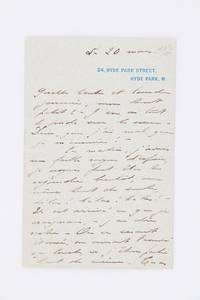
190079031s. l. [Londres] Le 20 mars [1900] | 9.90 x 15.20 cm | 4 pages sur un double feuillet
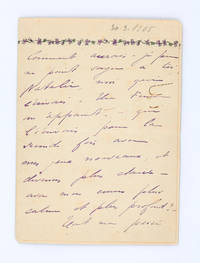
190578968s. l. Paris 1905. Fine. s. l. Paris 30 mars 1905 11.50 x 15.90 cm 6 pages 1/2 sur deux doubles feuillets Autograph letter signed ""Pauline"" by Renée Vivien addressed to Natalie Clifford Barney and written in violet ink on two double sheets edged with violets. Transverse folds inherent to posting. Very fine love letter evoking the only novel by the Violet Muse Une femme m'apparut. ""Comment aurais-je pu ne point songer à toi Natalie moi qui écrivais « Une femme m'apparut » - qui l'écrivais pour la seconde fois avec mes yeux nouveaux et devenus plus clairs - avec mon cur plus calme et plus profond "" ""How could I not have thought of you Natalie I who was writing 'Une femme m'apparut' - who was writing it for the second time with my new eyes which had become clearer - with my heart calmer and deeper"" Published in 1904 this novel - the only one of Renée's literary career - tells the love story of the narrator and ""Vally"" Natalie Clifford Barney from their beginning to their tragic end and the ""apparition"" of the savior Hélène de Zuylen. Reconciled with the Amazon Renée undertakes to rewrite the book which will appear at the beginning of 1906: ""Literary and stylistic improvement No. The concern to justify herself anew but this time in the face of Natalie Barney is beyond doubt. Remorse too: now the apparition that gives the book its title is no longer Eva-Hélène de Zuylen but Lorely-Natalie Barney and this from page 2. When we know that during the summer of 1904 unexpected reunions in Bayreuth came to unite Natalie Barney and Vivien we better understand the meaning of this new version of the novel Renée only returns to her amorous past to deliver us a second version revised and corrected. She thus erases the final choice she had suggested in the first version. Complete palinode confirmed by the very text of the letters that Vivien will write to Natalie Barney in 1904 and especially in 1905."" J.-P. Goujon Tes blessures sont plus douces que leurs caresses This confusion of feelings shows through this letter filled with oxymorons: ""je goûte une tristesse charmante à t'évoquer . quand je songe à toi j'évoque ma plus belle douleur"" ""I taste a charming sadness in evoking you . when I think of you I evoke my most beautiful pain"" The sadness - mixed with unconditional love - is here pushed to its paroxysm: ""Ne te laisse pas attrister par ma lettre grise de ce soir. Il y a des heures ternes - ce sont peut-être les meilleures - Dans tous les cas ce sont les plus vraies . Et ceux qui sont comme tu le dis « ingrats et joyeux » sont fort à plaindre."" ""Do not let yourself be saddened by my grey letter this evening. There are dull hours - these are perhaps the best - In any case these are the truest . And those who are as you say 'ungrateful and joyful' are much to be pitied."" Vivien effaces herself completely in favor of her beloved even proposing to live in her place: ""Va - si tu le peux - là où je voudrais être - à Mytilène. Je verrais l'île merveilleuse à travers tes prunelles - tu me ferais respirer tous ses parfums - A dire vrai le courage m'a manqué pour y aller. Je n'avais plus la force ni le désir de partir ainsi."" ""Go - if you can - where I would like to be - to Mytilene. I would see the marvelous island through your eyes - you would make me breathe all its perfumes - To tell the truth I lacked the courage to go there. I no longer had the strength nor the desire to leave thus."" ""Ne peux-tu toi aller à Mytilène et me rapporter des roses de là-bas "" ""Cannot you go to Mytilene and bring me roses from there"" Yet it is together that the two lovers will soon undertake the journey to Lesbos; it will be the last of their story. It was at the end of 1899 and through Violette Shillito that Renée Vivien - then Pauline Tarn - made the acquaintance of Natalie Clifford Barney ""cette Américaine plus souple qu'une écharpe dont l'étincelant visage brille de cheveux d'or de prunelles bleu de mer d unknown
190578968s. l. [Paris] 30 mars 1905 | 11.50 x 15.90 cm | 6 pages 1/2 sur deux doubles feuillets
3¼ SS. auf Doppelblatt. Kl.-4to. "Die Frauentracht wirkt hauptsächlich durch die Schwere und Gediegenheit der Stoffe; die Farbe derselben ist meist dunkel oder ganz schwarz, nur die beiden Tücher, die Hals und Oberkörper bekleiden, und etwa die Schürze, stechen durch ihre lebhaft bunten Farben von der übrigen Kleidung ab. Der Kopfschmuck ist immer das wellig gescheitelte Haar mit den herabhängenden Zöpfen, an welchen die schwarzen Zopfbänder vom Rückenteile des Mieders ausgehend, befestiget sind. Über dem buntfarbigen seidenen Bruststück bekleidet ein Mieder von schwarzen [!] Samte den Oberkörper, an dem ausgebogenen Rückenteil ist eine reiche Stickerei von Gold- u. Silberfäden, am vorderen Teile aber zu jeder Seite eine Reihe silberner Haken angebracht, durch welche ein schwarzseidenes Band zum Zuschnüren des Mieders gezogen ist. Der daruntergesetzte Latz von schwarzen [!] Samte mit Metallstickerei ist durch schwarzseidene Schleifen an den Achselbändern der Mieder befestigt. Die Schürze von bunt gemusterter Seide oder von Atlas ist weit u. faltenreich, sie erreicht den Saum des langen Rockes u. ist mit einem schmalen Bündchen versehen, über welches am Anschlusse an das Mieder ein metallgestickter Gürtel von schwarzem Samte gelegt wird. Der Rock ist von dunkler Seide. Die Strümpfe sind weiß und die dazu gehörigen, weit ausgeschnittenen Schuhe sind von schwarzen [!] Glanzleder […]". - Auch der zweite Text, "Würtemberg [!] | (Schwenningen)", beschreibt eine dort landesübliche Tracht.
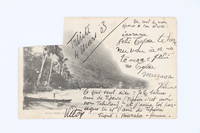
190379067Tahiti Tahiti 1903. Fine. Tahiti Tahiti 4 mars 1903 14 x 9 cm une carte postale ""Tépéva is my name"". Handwritten postcard signed sent from Tahiti and addressed to Émile Mignard Tahiti 4 March 1903 14 x 9 cm one postcard Handwritten signed postcard from Victor Segalen sent from Tahiti and addressed to émile Mignard. A few lines written in black ink around the black and white photographic reproduction of a view of Bora-Bora correspondent's address handwritten on the verso. Some minor stains a cut corner likely due to the removal of the stamp. Doctor Segalen seems to have taken a wife: A word from my wife to you: written by the hand of said wife iaorana fetii Tepeva te here neivou ia se no te mea e fetii no Tapeva Maraéa Vahine. Written by Segalen again Which means: I greet you friend of Tépéva Tépéva is my name in Tahitian and I love you because you are a friend of Tépéva. signed Maraéa-wife. Segalen's biography makes no mention of this exotic wife. Emile Mignard 1878-1966 also a doctor and Brest-born was one of Segalen's closest childhood friends whom he met at the Jesuit Notre-Dame-de-Bon-Secours School. The writer interacted with this comrade in an abundant and closely followed correspondence in which he described with humor and intimacy his daily life in all corners of the world. It was at Mignard's wedding on 15 February 1905 that Segalen met his wife Yvonne Hébert. unknown
Folio. Title page, 2 pp. Entitled "2me Position"; lessons for violin, numbered 1 to 4. - Brownstained.
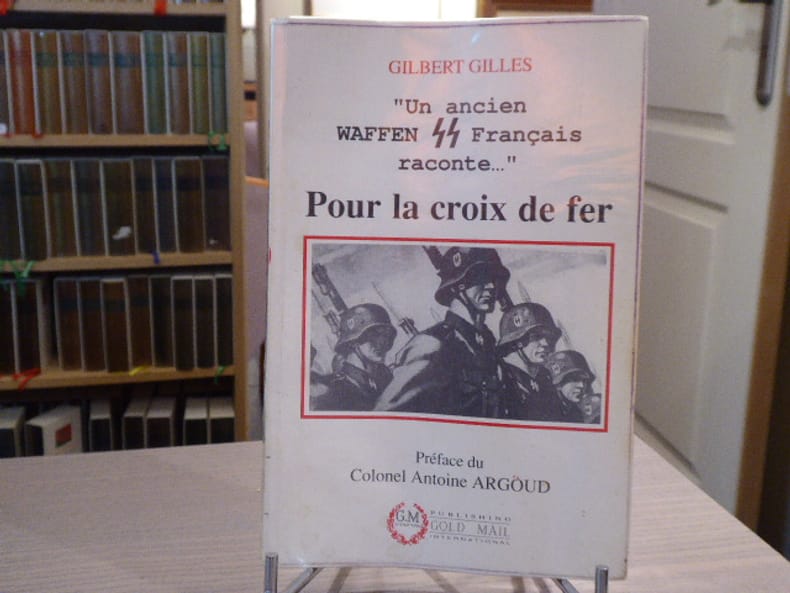
664538Gold Mail International - Fox And Pitt Charleroi 1989 In-8 ( 235 X 155 mm ) de 465 pages, broché sous couverture illustrée. Préface du Colonel Antoine ARGOUD. Photographies hors-texte. EDITION ORIGINALE. Bon exemplaire enrichi d'un envoi autographe signé de l'auteur.
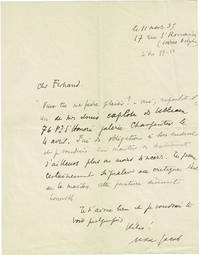
193575865Paris 1935. Fine. Paris 31 mars 1935 21 x 27 cm une page sur un feuillet Unpublished autograph letter signed by Max Jacob addressed to Fernand Pouey. One page written in black ink on a sheet. Two transverse folds inherent to mailing. Remarkable letter in which Max Jacob asks a strange favor of his friend: ""Un de nos amis explose sic des tableaux 76 Fg St Honoré galerie Charpentier le 4 avril. J'ai des obligations à son endroit et je voudrais lui montrer des sentiments d'ailleurs plus ou moins sincères. Tu peux certainement signaler au critique d'art de la maison cette peinture sûrement honorable."" ""One of our friends is exploding sic paintings 76 Fg St Honoré galerie Charpentier on April 4th. I have obligations toward him and I would like to show him feelings that are more or less sincere. You can certainly point out to the house art critic this surely honorable painting."" The mysterious ""friend"" mentioned in this letter could be the painter Balthus who exhibited at the Galerie Charpentier in early April 1935. unknown
193575865Paris 31 mars 1935 | 21 x 27 cm | une page sur un feuillet
47321in-8, pleine basane striée acajou, dos à nerfs, filets dorés, coupes filetées, frise dorée en encadrement intérieur, tranches mouchetées, doublures et gardes de papier marbré, 160 pp. Copie manuscrite d'une écriture non identifiée. Publiée dans la Revue de Paris en 1834, cette longue nouvelle retrace la destinée de l'Aiglon. La page de titre comporte un dessin au crayon représentant une femme au pied de la colonne Vendôme. Beau manuscrit sur vergé crème, très bien établi, dans une élégante reliure d'époque.
8vo. 13 pp. on blue squared paper, written on rectos only. A long, unpublished manuscript recounting the horrors of the "Semaine sanglante" of May 21st through 28th, 1871, which saw the defeat and collapse of the revolutionary government of Paris. Originally drafted as a preface to a never-published sequel volume to Lachâtre's 1870 "Nouvelle encyclopédie nationale", what the author conceived as an apology for the book's long delay constitutes a powerful first-hand account of the "Bloody Week" and of his own persecution. The manuscript is written in a scribal hand but is extensively revised in Lachâtre's own, characteristically graceful handwriting, showing his deletions, insertions and various textual changes on almost every page. Lachâtre describes the Communards' heroic resistance, in which women fought on the barricades alongside their husbands, brothers and sons against the vastly more numerous and better equipped army. He deplores the atrocities which the Communards, too, committed in their desperation (such as the execution of no fewer than 123 clergymen and gendarmes who had been taken hostage), but his emphasis is clearly on the indiscriminate, ruthless cruelty with which the invading soldiers slaughtered men, women and children, the decrepit and infants alike, if they suspected them of any connection at all with the Commune: "Les Versaillais massacrent, fusillent, percent de leurs sabres - baïonnettes et par milliers tous ceux qui leur tombent sous leur main, innocents ou coupables, hommes et femmes, enfants et vieillards; la vapeur du sang les énivre, la soif de la vengeance les pousse à chercher de nouvelles victimes; ils parcourent les rues, envahissent les maisons, fouillent les demeures des citoyens, arrachent de leur lit les malades, tuent tous ceux qu'ils soupçonnent avoir été partisans de la Commune [...] Ceux là sont conduits par files innombrables, prisonniers de tous les âges, hommes et femmes, des mères tenant de petits enfants par la main, quelques unes allaitant un nouveau-né; ces longues files de victimes enchaînées vont s'engouffrer dans les cours des casernes dont les portes se referment avec un bruit lugubre, et où toutes sont massacrées, toutes, jusqu'à la dernière!!!" - Lachâtre himself barely escaped into hiding before a platoon of soldiers arrived looking for him and his associate Félix Pyat (1810-89), with whom he had published the radical papers "Le Combat" and "Le Vengeur": "Se décida à abondonner la place, laissant chez lui deux femmes, deux jeunes filles dont une de dix ans à peine, son enfant. Dans la maison se trouvait également le caissier de la librairie, M. Profilet, vieillard inoffensif, qui jamais ne s’était occupé de politique [...] On était au mercredi, 22 mai! Vers les deux heures de l’après-midi, moins d’une demi-heure après le départ du citoyen Maurice La Châtre, la maison est envahie par une troupe de soldats [...] Après une heure de mortelles angoisses pour le pauvre caissier, il est lui-même emmené prisonnier! Mr. Profilet était porteur d’une montre en or avec sa chaîne, et d’une somme de 400 fr en pièces d’or, quand il fut enlevé de sa maison… Où fut-il conduit par les soldats de 55e de ligne? Quel a été le sort réservé à ce vieillard inoffensif, absolument innocent de tout acte insurrectionnel? C’est ce que ni sa famille, ni ses amis n’ont jamais su! [...] Nous vous devions le récit de ces évènements, chers lecteurs [...] A vous, aimables lectrices, à vous, chers lecteurs, amis connus et inconnus, l’auteur adresse de la terre d’exil de salut fraternel". - Slight paper flaws to bottom edge of the final leaf, otherwise very well preserved. At the head of the first page, Lachâtre has inscribed the manuscript to his longtime collaborator Félix Pyat: "Maurice LaChâtre à Félix Pyat". A diplomatic transcription of the full text is available upon request.
Folio. 2 pp. on 2 ff. 30 bars for voice and piano with the text. - Severe edge flaws.
4to. 180 ff. Collection of copies of letters and other documents concerning the reign of the Hungarian king and the "dominions".
Small folio. 1 p. (42 lines). Apparently unreleased alternative version of the likewise unpublished poem "Uschis Sinneswandel" ("Uschi's change of mind").
1¼ SS. Folio. 48 Takte in sieben zweizeiligen Systemen, links oben bezeichnet "III". Mit einer getilgten Zeile unterhalb der Unterschrift.
- 1969, 30,4x39,5cm, une feuille. - "I knew that whenever I want to be perfectly alone With the memory of you, of that whole day, It's to Vaumort that I'll be turning." Exceptional handwritten poem dated 1969, signed and illustrated with original drawings in graphite, markers and colour pencils by Lawrence Durrell. The poem-art work is sent to Janine Brun, his French lover, and has the inscription "For Buttons," the affectionate nickname given to her by the writer, on top of a heart pierced by an arrow. Pin holes, marginal tears. Published for the first time in Collected Poems: 1931-1974 (1980). In this poem-drawing, the writer looks back on a day of love spent in the company of his lover Janine Brun in the cemetery of the small village of Yonne. At the same time, Durrell is painfully recovering from the premature death of this third wife two years earlier and publishes his series of dystopian novels Nunc (1968) and Nunquam (1970). He also takes refuge in poetry, the last exercise of literary and philosophical asceticism of a writer who, gradually, chooses to withdraw from the world. It is during a journey from the capital towards the Midi in the south, that the lovers stopped for a day in Vaumort: "Below us, far away, the road to Paris. You pour some wine upon a tomb. The bees drink with us, the dead [approve." Durrell's poetry has suffered from the resounding success of his novels, however, here it achieves great lyrical beauty, its free verse, nevertheless, very musical, picking up the cemetery's well-known motif: "One careless cemetery buzzes on and on As if her tombstones were all hives Overturned by the impatient dead We imagined they had stored up he honey their of their immortality In the soft commotion the black bees make." Here the writer attempts to capture in the poem a moment of happiness and carnal pleasure with his lover, and frames the verse he has written in long, graphite lines and many brightly coloured drawings. Here we have a rare example of a double work of art, both poetic and pictorial. Produced in marker and colour pencil, similar to the drawings of Joan Miró, it is a magnificent illustration marked with naivety, which beautifully complements the poem. Durrell continued this activity until the end of his life, which he spent in Sommières: Incidentally, we can also see a real pictorial reference to the "burnt and dusty Languedoc" (verse 12), where he spent the rest of his life. Rare testimony of Durrell's Provençal adventure with the young French lady, who inspired him to write a delightful poem imbued with warmth and Mediterranean colours. [FRENCH VERSION FOLLOWS] Après de nombreuses années passées en Grèce, en Egypte et à Rhodes, l'écrivain voyageur Lawrence Durrell fut contraint de fuir Chypre à la suite de soulèvements populaires qui menèrent l'île à son indépendance. Riche seulement d'une chemise et d'une machine à écrire mais auréolé du succès de ses romans Bitter Lemons of Cyprus et Justine, il arriva en 1956 en France et s'établit dans le village languedocien de Sommières. Dans la «?maison Tartès?», sa grande demeure entourée d'arbres, il écrivit la seconde partie de son uvre, son monumental Quintette d'Avignon, s'adonna à la peinture et reçut ses illustres amis, dont le couple Henry Miller et Anaïs Nin, le violoniste Yehudi Menuhin, l'éditeur londonien Alan G. Thomas, et ses deux filles Pénélope et Sappho. Parmi les oliviers et sous le soleil méditerranéen, il y rencontre au milieu des années 1960 la jeune et pétillante «?Jany?» (Janine Brun), Montpelliéraine d'une trentaine d'années à la beauté ravageuse, qui travaillait au département des Antiquités de la Sorbonne à Paris. Elle fut prénommée «?Buttons?» en souvenir de leur première rencontre, où la jeune fille portait une robe couverte de boutons. Henry Miller tomba également sous le charme de «?Buttons?», louant sa beauté et son éternelle jeunesse dans d'exceptionnelles lettres restées inédites. Les trois compères passèren
Folio. 3½ pages. Voice for first violin, annotated "Chorus / Veritas mea", signature on upper right "F. Volkert".
Drei Strophen zu je vier Zeilen auf 1 S. auf Doppelblatt. 8vo. "Ich hab' verloren, Du gewonnen, | Hiemit bezahl' ich meine Schuld, | Was meine Muse ausersonnen | Nimm' es mit Nachsicht hin und Huld [...]". - Auf Briefpapier mit gepr. Monogrammvignette. Mit kleinen Randläsuren und etwas fleckig.
Titel und 8¼ SS. auf 4 Doppelblatt. Fadengeheftet. 8vo. Wie am Titel von Schilling vermerkt, waren seine "Verwehten Blätter", die mit "Aphorismen", "Nachwehen", "Gedenkblatt" und "Vergebliche Flucht" betitelt sind, "zur gütigen Aufnahme in die Dioskuren gedacht. "Du hast auf vielen kleinen Blättern | Eng ausgekritzelt mir geschrieben, | Daß Du mich aufgibst, daß Du nicht mehr | Gesonnen wärest mich zu lieben. | Dieß läßt mich armen Tiefverkannten | Auf die Versöhnung hoffen leise, | Wer nicht mehr liebt, der schreibt nicht ängstlich | Motive, Schlüße und Beweise […]" (Aus "Aphorismen"). - "Schillings Neigung zur Schriftstellerei entwickelte sich schon frühzeitig, und bis zu Anfang der Fünfziger-Jahre brachte der Büchermarkt öfter die poetischen Spenden aus Schillings Feder" (Wurzbach, XXIX, S. 321). - Mit zeitgenöss. Numerierung in blauem Farbstift.
Folio. German manuscript on paper. Title and 10 pp. on 6 ff. Sewn. A table naming and describing all the 61 accomplices of the legendary bandit Johann Georg Grasl who terrorized Lower Austria's Waldviertel region in the early 19th century, prepared by the criminal court official Schopf shortly before the fugitive's arrest on 19 November 1815. The list notes the real names (if known) and nicknames, along with brief but often colourful signalment. Accomplices thus described include not only a significant portion of Grasel's own family, but also Theresia "Resel" Hamberger, "the mistress of the robber chief Grassl, a very brazen person", and her uncle Johann: "23 years old, of short stature, short brown hair, like eyebrows, no beard, small face, pointy chin, longish nose, pockmarked face, speaks German, a very rakish fellow who has taken part in many of Grassl's crimes". A girl known as "Dog's Soup" (real name unknown) is described as a "young hussy with a scarred face who supports herself by begging"; a similarly nameless carriage driver from Weitersfeld is indicted for having given Grassl lodging; Isaac Stern, a "Jew from Bernschlag", is accused of having "knowingly bought stolen goods", while a tailor from Stalleck "is accused of fraud". - Grasel, who began his career with petty thieveries and ended with robbery and murder, increasingly took to drink and was finally captured through a plot in which he was drugged with opium at an inn. He was publicly hanged in Vienna on 31 January 1818, his last words supposedly being, "Jesus, what a crowd!". - A fascinating police signalment of Lower Austria's poverty-ridden criminal underworld in the early 19th century.
4to. 11½ pp. on 12 sheets. An essay on life in Paris, especially on the history and culture of balls. Augier has decided to celebrate Victor Hugo's 80th birthday by reading his works and thus has discovered the collection of poetry, "Les Orientales", containing lines about a girl who loved balls and even died at one: "Elle aimait trop le bal, c'est ce qui l'a tuée | Le bal éblouissant ! le bal délicieux! | Sa cendre encor frémit doucement remuée | Quand, dans la nuit sereine, une blanche nuée | Danse autour du croissant des cieux [...]". - Last ff. with slight defects to edges; f. 12 with tiny tear to fold. Small label and ms. number "18" on the reverse.
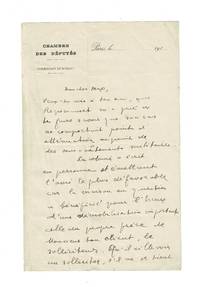
191875931Paris 1918. Fine. Paris s. d. ca 1918 13.30 x 21 cm 2 pages sur un feuillet Unpublished autograph letter signed by Guillaume Apollinaire addressed to Max Jacob. Two pages written in black ink on a sheet with the letterhead of the Chamber of Deputies. Folds inherent to mailing. Unpublished letter concerning the deputy Charles Régismanset then Director at the Ministry of Colonies: ""Veux-tu dire à ton ami que Régismanset m'a prié de te faire savoir que son cas ne comportait point d'atténuation au point de vue des sous-vêtements militaires."" ""La colonie a écrit en personne et émettant l'avis le plus défavorable car la maison en question a bénéficié pour l'heure d'une démobilisation importante."" ""These 'colonies' are hardly distant. He is seconded to Rue Oudinot to the office of Minister Henri Simon who was pleased to be able to assist a poet he had long admired. His duties are rather vague. Assigned to the Press Service he oversees the Bulletin d'Informations coloniales et étrangères occasionally contributing discreetly a task that leaves him sufficient freedom for his own work. His direct superior Charles Régismanset himself a writer calls upon him whenever a 'bushman' passing through might provide information on Bambara customs or Guinean witch doctors."" Pierre-Marcel Adéma Guillaume Apollinaire ""Viens tout de même me voir dirait le père Janvier qui doit pour le moins parler aussi bien que le père de Victor Hugo surtout viens avant janvier et toujours plus haut Excelsior viens j'ai quelque chose d'éditorial à te dire."" unknown