66 618 résultats
191875931Paris s. d. [ca 1918] | 13.30 x 21 cm | 2 pages sur un feuillet
cROU-1494Paris, Editions Montaigne, 1926; in-8 broché, couverture illustrée en couleurs par Gassier; 285pp.,1f. Edition originale tirée à 750 exemplaires numérotés, celui-ci 1 des 200 exemplaires sur pur fil du Marais (après 50 Madagascar).
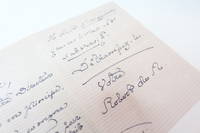
16 Zeilen auf 1 S. 8vo. "Ihr gierigen Vögel! Vergebens | Erwartet ihr heute das Futter. | Die körnerstreuenden Hände, | Sie schlossen sich diese Nacht. | Ihr zetert und pickt an die Scheiben, | Als hättet ihr ewige Rechte. | Der Tote liegt unter Lichtern, | Und Kasten und Speicher sind leer. | Flieget fort! Euer dunkles Gefieder | Ist glänzig und scheckig geworden | Von fetter verwöhnender Speise, | Doch habt ihr das Singen verlernt [...]".
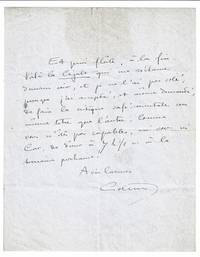
192075260Marseille 1920. Fine. Marseille s. d. circa 1920 19.80 x 25.20 cm une page sur un feuillet Autograph letter signed by Colette addressed to her friend the man of letters and lawyer Adrien Peytel nine lines written in black ink. Some folding marks inherent to the mailing of the letter. ""And then damn it enough already. Here La Cigale is calling me for tomorrow evening and I haven't stolen it since I accepted and even asked to do the café-concert criticism on the same level as the other."" unknown
192075260Marseille s. d. [circa 1920] | 19.80 x 25.20 cm | une page sur un feuillet
180191111Paris 23 pluviôse an IX [12 février 1801] | 11 x 16.5 cm | Une feuille
2 SS. 8vo. "Aus 'Jugend - Lust u. Leid' gesammelte Erzählungen u. Gedichte für die Jugend. Stuttgart u. Leipzig Verl. v. Otto Risch". - "Das Kindlein lag in stiller Rast, | Vom Spiele war's ermüdet fast | Und schlief drum bald im Abendschein | Ganz ohne 'Vaterunser' ein. | So lag es nun geraume Frist, | Da plötzlich, wie im Traum es ist, | Glüht auf ein Licht - das Kindlein schaut. | Von Engelsstimmen tönt es laut, | Und hell, wie goldner Morgenschein, | Die Mutter Gottes kommt herein [...]". - Franz Bonn, von 1862 bis 1865 Staatsanwalt, anschließend Richter in Ansbach, Bayreuth und München und später im Dienst des Fürsten von Thurn und Taxis in Regensburg, war zuletzt Präsident der Domänenkammer und Direktor des Zivilkollegialgerichts; von 1881 bis 86 gehörte er dem bayerischen Landtag an. Sein literarisches Werk umfaßt humoristische Gedichte, Schauspiele und Jugendliteratur. Sein Sohn war der Schauspieler und Schriftsteller Ferdinand Bonn (1861-1933). - Mit einigen von nicht identifizierter Hand stammenden Registraturvermerken in Farbstift.
(1+1 =) 2 SS. auf 2 Bll. 4to. Mit ms. adr. Kuvert. Der Typoskriptauszug schildert eine Erinnerung aus Kindertagen: "In einem Haus, wohin ich über Land manchmal zu Besuch mitgenommen wurde, gab es ein Buch. Ich bekam es, das wußte ich, sobald ich am Tisch Langeweile zeigte [...]". Das Manuskript mit Ausführungen zu Gottfried Benns Dinggedicht "Henri Matisse: Asphodèles": "So wird die Bennsche Strophe kaum als eine Interpretation des Matisse zu nehmen sein; vielmehr als der Fall des Aufnehmens eines Motivs, einer Um- und Neuschöpfung [...]". - Beides übersendet an den Mediziner und Autographensammler Joachim Ruf in Esslingen, der 1986 einen Gedenkband "Begegnungen mit Gottfried Benn" zu Benns 100. Geburtstag in der "Edition Rarissima" (Taunusstein) herausbringen sollte.
Large 4to. 8 pp. on 8 ff. Humorous "sodomite story" about eleven Chinese men who work in a laundry shop, the fourteen-year-old son of the house's managing agent, and a goat who becomes the object of their desire. According to the envelope enclosed, the story was published in October 1924 in the "Wiener Sonn- und Montagszeitung". - With small edge defects throughout and a small trace of rust from an old paperclip at one corner.
I: 8 SS. auf 4 Bll. 4to. - II: 17½ SS. auf 12 Bll. Wendet sich das erste Manuskript - die "Vorhalle" - expressis verbis an "m[eine] l[ieben] Z[uhörer]", so kommen diese im zweiten Manuskript - betitelt mit "Als Vorwort | Anmerkungen u. Excurse" - als Adressat nicht vor, dürften aber dennoch, Tonfall und Duktus zufolge, dieser gewesen sein. - Beide Manuskripte dürften nicht vollständig sein oder einen jeweils in sich abgeschlossenen Teil einer Serie darstellen, die als solche nicht überliefert ist. - Die "Vorhalle" stellt eine weit ausholende Einleitung zur "Geschichte derjenigen Kunst" dar, "die die Meister v. Ihnen als Lebenszweck erwählt"; als Vorwort bietet einen nicht minder weitläufigen Überblick über Vokalmusik, Philosophie der Musik, Versuche zur Gliederung der Musik in geschichtliche Epochen (nach F. W. Marpurg, vgl. S. 9) u. a. m. - Der aus Butschowitz (Mähren) gebürtige Musiker und Musikpädagoge, der als "einer der besten Pianisten seiner Zeit" gilt (MGG IV, 276) erfuhr seinen Klavier- und Kompositionsunterricht durch Anton Halm und Ignaz von Seyfried und wurde 1833 Professor am Konservatorium der Gesellschaft der Musikfreunde, wo er bis 1856 als Klavierpädagoge wirkte. Fischhof gilt als "Meister der klassischen Wiener Klavierschule [...] er trat besonders als Interpret Bachs, Beethovens, Mendelssohn Bartholdys und Chopins hervor. Seine umfangreiche Musikbibliothek mit Manuskripten und Autographen war vor allem für die Bach- und Beethovenforschung von Bedeutung" (DBE). Zu Fischhof vgl. (Auswahl) die entspr. Artikel in ADB, NDB, ÖBL, MGG, Riemann, Wininger und Wurzbach.
198588379S.n. [Imprimerie universelle] | 28 Mars 1985 | 21 x 29.50 cm | 4 pages
2004103193Naples Alfredo Guida, coll. "Passagi e percosi" 2004 1 vol. broché in-8, broché, couverture illustrée, 261 pp., index, en italien. Correspondance du critique italien à Edmond de Goncourt. Vittorio Pica (1864-1930) débute sa carrière littéraire à 18 ans en publiant un essai sur les frères Goncourt. Directeur de la revue d'art Emporium à partir de 1900, cet ami fidèle d'Edmond fut également l'un des initiateurs de la Biennale de Venise. Exemplaire enrichi d'un envoi autographe signé de Nunzio Ruggiero, qui présente cette édition, à Alain Barbier Sainte Marie.
189574263s. l.: S. n. 1895. Fine. S. n. s. l. s. d. circa 1895 12.50 x 17 cm une page et demie sur une feuille Autograph letter signed by the dandy count of a page and a half 13 lines written in black ink to his friend the journalist from Le Gaulois Henry Lapauze so that he might use his decisive influence in the publication of a text: ""Il doit s'imaginer que ce texte est subversif. Détrompez-le."" ""He must imagine that this text is subversive. Disabuse him of this notion."" initially validated by Arthur Meyer but which Robert de Montesquiou wants to ensure through his friend will indeed be printed: ""J'ai vu votre directeur qui accepte en principe. Cependant comme votre intervention pour faire est déterminante j'insiste auprès de vous."" ""I have seen your director who accepts in principle. However as your intervention to make it happen is decisive I insist upon you."" Henry Lapauze 1867-1925 was a journalist art critic then in 1905 curator of the Petit Palais converted four years earlier into a museum and whose collections he considerably enriched by acquiring notably the Courbet Henner Falguière collections with in the twilight of his life a marked predilection for the Decorative Arts of which he was one of the ardent promoters. S. n. unknown
189574263S. n. | s. l. s. d. [circa 1895] | 12.50 x 17 cm | une page et demie sur une feuille
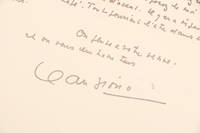
195284966s. l. 1952. Fine. s. l. ca 1952 21 x 27 cm une feuille Autograph letter signed by Jean Giono 14 lines in black ink addressed to Roland Laudenbach who jointly ran the magazine Opéra with his friend Roger Nimier. Fold marks inherent to the mailing. ""Cher Roland j'y pense : Voulez-vous quelque chose pour Opéra de qualité d'assez sensationnel et qui fuisse faire sept à huit numéros peut-être plus à votre gré Le Journal. Le Journal de 1936 à 1949. Si cela vous plait parlez en avec Nimier pensez à un chiffre proposez le moi ça ira sûrement et c'est d'accord. Il y en a déjà pas mal de tapé ! Tout le journal l'être dans un mois. On pense à votre venue et on vous embrasse tous. Jean Giono."" Dear Roland I'm thinking: Would you like something for Opéra Something quality rather sensational that could run for seven to eight issues perhaps more as you wish The Journal. The Journal from 1936 to 1949. If this appeals to you discuss it with Nimier think of a figure propose it to me it will surely work out and we're in agreement. Quite a bit of it is already typed! The entire journal will be ready in a month. We're thinking of your visit and we all embrace you. Jean Giono. A very visual letter bearing Jean Giono's handsome signature. unknown
195284966s. l. [ca 1952] | 21 x 27 cm | une feuille
184184613s. l. 9 Mai 1841 | 11.10 x 18.10 cm | deux pages et demi sur un bifeuillet
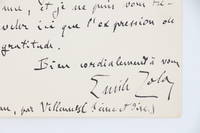
188279109Médan 1882. Fine. Médan 16 novembre 1882 13.60 x 21.40 cm 2 pages sur un double feuillet - enveloppe jointe Autograph letter signed by Emile Zola - apparently unpublished - addressed to Léon Carbonnaux written in black ink on a double sheet. Folds inherent to mailing. Envelope included. Important testimony to the colossal documentation work and the capital role of Emile Zola's informants in depicting his immense natural and social fresco. This letter was sent to Léon Carbonnaux department head at Bon Marché who transmitted precious information to Emile Zola for the creation of the eleventh volume of the Rougon-Macquart series: Au Bonheur des Dames. Only two letters from Léon Carbonnaux to Emile Zola are known: they can be consulted in the digitization of the preparatory file for Bonheur des Dames made available online by the Bibliothèque nationale de France. However we know thanks to this same file which contains a long section entitled ""Notes Carbonnaux"" that this department head at Bon Marché provided a significant amount of information to Zola particularly about employee customs and their remuneration. The two men undoubtedly met when Emile Zola eager for information about the functioning of department stores conducted field research in February and March 1882. ""J'ai pris l'inventaire comme cadre à un de mes chapitres. D'ailleurs je n'ai spécialement besoin que du travail dans le rayon des confections et dans le rayon des soieries. Il est inutile de me renseigner sur les autres rayons."" ""I have taken the inventory as the framework for one of my chapters. Moreover I specifically only need the work in the ready-to-wear department and in the silk department. It is unnecessary to inform me about the other departments."" Thanks to this important letter we understand that it was Léon Carbonnaux who provided the essential information to Emile Zola for writing his very beautiful eleventh chapter devoted to the inventory: ""Vous avez eu l'obligeance de me donner certains détails sur l'inventaire. Vous m'avez dit qu'on choisissait le premier dimanche d'août qu'on fermait les portes et que tous les employés s'y mettaient. On vide toutes les cases n'est-ce pas on jette les marchandises sur les comptoirs ou à terre et l'inventaire n'est terminé que lorsqu'il n'y a plus absolument rien en place."" ""You were kind enough to give me certain details about the inventory. You told me that the first Sunday in August was chosen that the doors were closed and all the employees set to work. All the compartments are emptied aren't they The merchandise is thrown onto the counters or on the ground and the inventory is only finished when there is absolutely nothing left in place.""The final version of Bonheur des Dames contains all the precious information provided by the department head of Bon Marché: ""Le premier dimanche d'août on faisait l'inventaire qui devait être terminé le soir même. Dès le matin comme un jour de semaine tous les employés étaient à leur poste et la besogne avait commencé les portes closes dans les magasins vides de clientes. . Neuf heures sonnaient. . Dans le magasin inondé de soleil par les grandes baies ouvertes le personnel enfermé venait de commencer l'inventaire. On avait retiré les boutons des portes des gens s'arrêtaient sur le trottoir regardant par les glaces étonnés de cette fermeture lorsqu'on distinguait à l'intérieur une activité extraordinaire. C'était d'un bout à l'autre des galeries du haut en bas des étages un piétinement d'employés des bras en l'air des paquets volant par-dessus les têtes ; et cela au milieu d'une tempête de cris de chiffres lancés dont la confusion montait et se brisait en un tapage assourdissant. Chacun des trente-neuf rayons faisait sa besogne à part sans s'inquiéter des rayons voisins. D'ailleurs on attaquait à peine les casiers il n'y avait encore par terre que quelques pièces d'étoffe. La machine devait s'échauffer si l'on voulait finir le soir même. unknown
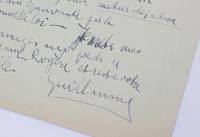
191383938s. l. Paris 1913. Fine. ""I will come to see you to speak to you about naturalization I am appalled by the new law"" s. l. Paris s. d. ca. juin 1913 15.70 x 24.50 cm une page sur un feuillet Unpublished autograph letter signed by Guillaume Apollinaire addressed to Jean Royère one page written in black ink on a sheet. Transverse folds inherent to posting. Very fine letter of thanks from poet to poet. ""I thank you for the admirable article you devoted to me. You have felt my soul like no one else."" Jean Royère had indeed written a laudatory article upon the publication of Alcools in the June 20 1913 issue of La Phalange: ""Here gathered in an 18mo of barely two hundred pages is almost the entire poetic work of Apollinaire. Fifteen years of poetry rest in this small volume. I therefore do not open it without almost a preconceived admiration. In poetry abundance means sterility and one only writes three volumes in a year through inability to devote one's life to a book. Apollinaire evidently will leave only one book of verse like Baudelaire and Mallarmé like Rimbaud: this is a considerable chance of immortality for the true poet is one who has this too rare gift of condensation."" "". I will come to see you in the coming days to thank you first and also to speak to you about naturalization I am appalled by the new law."" The poet here alludes to the Three Year Law dubbed the Barthou Law increasing the duration of military service from two to three years in view of preparing the French army for a possible war with Germany. If Apollinaire's biography prefers to focus on the publication of his works in this year 1913 the letters his mother addresses to her son show that the latter moves heaven and earth to avoid military service and be naturalized as quickly as possible: ""For your papers an Italian colonel attached to the ministry of war who was witness for your act of recognition had written to me once to give me the steps to follow so that you would be exempted from military service in Italy and for your French naturalization. I am going to write to him moreover to ask him to see to the Town Hall."" letter from Angelika Kostrowicka of July 12 1913. War would come soon and on August 3 1914 the day after mobilization the stateless poet would file a request for voluntary enlistment accompanied by a naturalization request. The latter would only be granted to him in 1916. An interesting letter written at the dawn of the Great War bearing witness to Guillaume Apollinaire's two passions: poetry and France. unknown
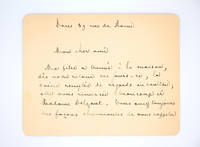
189375921Paris 1893. Fine. Paris 13 octobre 1893 11.40 x 8.90 cm une carte recto verso - enveloppe jointe Signed autograph card from Stéphane Mallarmé addressed to Alidor Delzant written in black ink on both sides. With envelope. Alidor Delzant was a lawyer collector and bibliophile. A friend of the Goncourts he devoted a work to them and was Edmond's secretary and testamentary legatee. A friendly card in which Mallarmé thanks Alidor Delzant for a surprise sent: ""Ma fille a trouvé à la maison dès notre retour ces jours-ci la caisse remplie de regards en coulisse ; elle vous remercie beaucoup et Madame Delzant. Vous avez toujours des façons charmantes de vous rappeler à vos amis même quand ils se souviennent."" ""My daughter found at home upon our return these past days the crate filled with sidelong glances; she thanks you very much and Madame Delzant. You always have charming ways of reminding your friends of yourself even when they remember."" The ""regards en coulisse"" are likely apricots or prunes. unknown
188279109Médan 16 novembre 1882 | 13.60 x 21.40 cm | 2 pages sur un double feuillet - enveloppe jointe
196488346s. n. | Paris 13 Février 1964 | 13.50 x 21 cm | une feuille
191383938s. l. [Paris] s. d. [ca. juin 1913] | 15.70 x 24.50 cm | une page sur un feuillet
189375921Paris 13 octobre 1893 | 11.40 x 8.90 cm | une carte recto verso - enveloppe jointe