66 614 résultats
1986106239Roma-Stockholm Italica 1986 1 vol. relié in-8, cartonnage éditeur, jaquette, 216 pp., 88 reproductions en noir. Textes en italien, anglais et suédois. Avec un envoi de l'artiste sur le premier feuillet de garde. Bon état.
59054o.J. München, Georg Müller, 1915, 8°. Mit 4 Tafeln und 3 Faksimiles. VII, 289 S.OKart..
1983117515Roma Edizioni dell'Elefante 1983 1 vol. broché in-4 oblong (35 x 50 cm), broché, sous couverture bleue muette, 10 pp. Tiré à part de l'introduction d'Yves Bonnefoy à l'album consacré au voyage en Sicile et à Malte du peintre néerlandais Willem Schellinkx, Journey to the South, 1664-1665, édité sous la direction de Bernard Aikema. Avec un bel envoi autographe signé de l'auteur à Jacques et Nancy [Hartmann]. Rare.
5589Stamped 11 Nov. 1929. Printed postcard with manuscript additions minor defects. The printed heading describes him as ""The Autograph King. Unchallenged. Owner of the largest collection of Modern Autographs in the World" lists the Exhibitions at which he has displayed his stock and adds his address and a request to the recipient to write their autograph "Request Register No. 17861". The recipient of this was Philip Yale Drew who added "Young Buffalo" to his full clear signature on the reverse. In this same year 1929 Drew had been arrested as a suspect in the the murder of tobacconist Alfred Oliver. With the original envelope in which the card was returned addressed to Bray in Drew's hand. Note: I don't yet know the connection of Bonar Law with the Company. Stamped 11 Nov. 1929. unknown
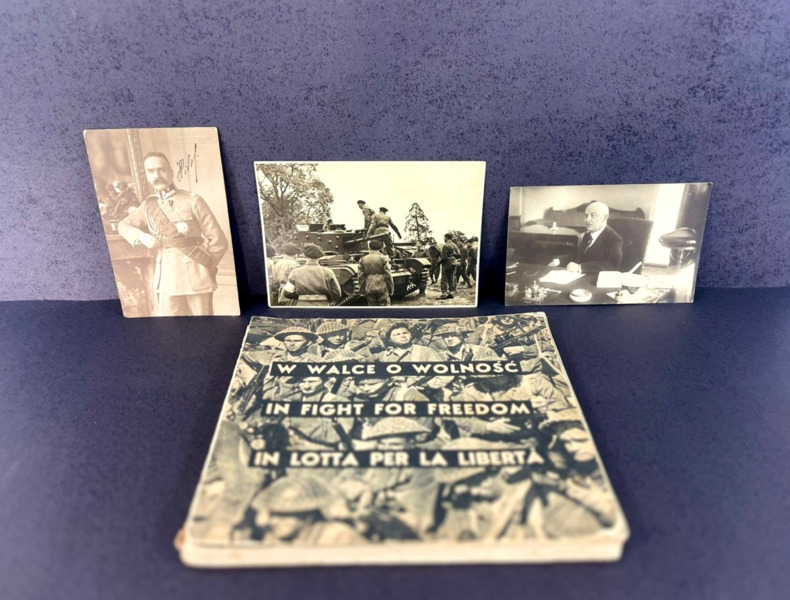
1945517This is a set which belonged to Janusz Gluchowski, a high-ranking Polish military officer at the time of the WW2. The set contains three original B&W pictures. First one: undated postcard showing Marshal Jozef Pilsudski, signed by himself in black ink, 8.5 x 13.5 cm, with two embossed mentions above and below. Second picture: undated postcard showing Poland President Gabriel Narutowicz, with a written mention on the back. Third picture: 11 x 15.5 cm photograph. General Tadeusz Bór-Komorowski inspecting a British Cromwell tank, accompanied by Polish officers of the 3rd Armored Regiment (3 puk pancerny). The image was captured during an official ceremony in the city of Kelso, Scotland, in the immediate post-war period, on June 15, 1945. The scene shows the General in an observation position, climbing onto the tank while surrounded by Polish soldiers. The tank corresponds to a British model widely used by Polish forces in exile during the Western European campaign. On the reverse, the following handwritten inscriptions appear: VI 1945, Kelso. N. Wódz gen. Bór-Komorowski dokonuje inspekcji 3 p. panc. N. Wódz w towarzystwie bryg. puku na czogu." / June 15, 1945, Kelso The book is an illustrated three-languages (Polish, English and Italian) set commemorating the struggles of the Polish II Corps. Edited by Wyda Rererat [Referat] Kultury i Prasy Kresowej Dywizji Piechoty in Rome, 1945. Oblong book of 21 x 19 cm, unpaginated (144 pp.). Cover detached. Endpapers and first page show Janusz Gluchowski's stamp. In publisher's photographically illustrated wrappers. Each page contains a photographic image or a photomontage accompanied with a short text in three languages. Front cover shows some wear and tear, the binding is a bit loose - we would advise having this book bound. The Polish II Corps was a major tactical and operational unit recruited from Polish deportees in the Soviet Gulags in 1943. First they fought in the Middle East, and in 1944 February they were transferred to Italy and as independent part of the British Army to fight in the Italian campaign, in the battles of Monte Cassino and Ancona and also the Battle of Bologna during the final offensive in Italy in 1945. The book goes through the story of Poland and the later established Polish II Corps, starting with the German and Soviet occupation in 1939. It shows the deportation of Poles to forced labour to the Gulag and, after the Polish-Russian Military Agreement in 1941, the establishment of the Polish Army on Soviet soil, also their military training and their fights in various battles. Janusz Julian Gluchowski was a Major General in the Polish Army during the Second Polish Republic. He was born on August 6, 1888, in Bukowa. He fought in the Polish Legions in World War I, the Polish-Ukrainian War, the Polish-Soviet War, and the invasion of Poland by Nazi Germany, Slovakia, and the Soviet Union in 1939, which culminated in the start of World War II. In his adolescence, he attended high school in Czstochowa. In 1905, he became a member of the Combat Organization of the Polish Socialist Party and was wounded in the hand during an attack near Czstochowa. To avoid arrest by the Russian authorities, he left for Belgium, where he studied at the University of Liège. He returned to divided Poland around 1910 and settled in Austrian Galicia. In 1912 he graduated from the Officers' School of the Riflemen's Association in Stroza, near Krakow. In the early hours of August 1914, he commanded a platoon in Oleandria and was Wadysaw Belina-Pramowski's representative during the legendary attack of the so-called Seven Lancers of Belina (Uaska siódemka). On August 6th, together with the First Cadre Company, he left Krakow and marched to Miechów. In October 1914 he was promoted to Lieutenant (Poruchik) and, in November 1916, to Rittmeister (Cavalry Master). Until 1917 he served in the First Uhlan Regiment of the Polish Legions. After the Oath Crisis (Kryzys przysigowy) he was interned first in Fort Beniaminów and later in Werl. Released in October 1918, he went to Lublin, where, in early November, he formed the Third Ulan Regiment (later renamed the Seventh Ulan Regiment of Lublin). Along with his unit, he fought in the Polish-Soviet War. On May 29, 1920, he was promoted to Polkovnik. He was transferred in July 1920 to Eastern Galicia, taking command of the First Cavalry Brigade, fighting against the Soviets in Galicia and Volhynia. After the war, he remained in this position until 1925, when he was transferred to the Fourth Cavalry Brigade. Promoted to Brigadier General on March 16, 1927. Appointed commander of the Center for Higher Military Studies on June 4, 1930, and three years later, after the death of General Stanislaw Tessaro, he was appointed commander of Military District X in Przemyl. In October 1935, he became Deputy Minister of Military Affairs. In the early days of the 1939 invasion of Poland, Gluchowski ordered General Walerian Czuma to prepare the defense of Warsaw. In mid-September 1939, he fled to Romania. After his escape, he managed to travel to the Middle East and, in January 1941, received orders to go to London. In October 1941, he was appointed Commander of the Training Brigade stationed in Scotland. On September 23, 1943, he was appointed commander of all Polish Army units stationed in Great Britain, except the First Independent Parachute Brigade, which remained under the authority of the Commander-in-Chief. He was promoted to Major General on June 1, 1945. He decided not to return to Soviet-occupied Poland and remained in Great Britain. He frequently criticized the Soviet regime and the Soviet occupation authorities in postwar Poland. Furthermore, he was one of the founders and president of the Jozef Pilsudski Institute in London. He was, therefore, an active member of the Polish community in Great Britain. He was president and honorary member of several Polish veterans' organizations. He died on June 11, 1964, in London, England.
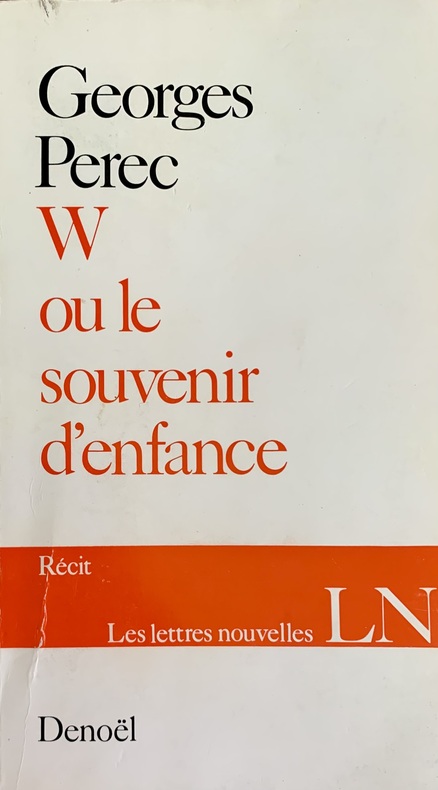
awd-1190Paris, Denoël, Les Lettres nouvelles, 1975. In-8 br., couverture illustrée, 220 pp. Édition originale avec envoi autographe "à Geneviève" (Serreau). Bon état.
1978121318Paris Belfond 1978 1 vol. broché in-8, broché, 188 pp. Edition originale. Envoi autographe signé de l'auteur à un poète et critique. Bon exemplaire.
Présentation et notes par Jean Cabon, 1 vol. in-4 cartonnage éditeur illustré, Editions Normandie Terre des Arts, Brecey, 1996, 290 pp. Deux beaux envois de Jean Cabon et de Guy Allix au Professeur Jean Bernard. Il s’agit du grand médecin, poète, humaniste, membre de l’Académie Française, le professeur Jean Bernard. Bon exemplaire de cet ouvrage peu courant, agrémenté d’un double envoi à un dédicataire prestigieux. Bon état. Avec signature de l'auteur. Français
2003112428Paris Plon, coll. "Feux croisés" 2003 1 vol. broché in-8, broché, couverture illustrée, 406 pp. Édition originale française. Traduit de l'anglais par Elisabeth Peellaert avec un envoi de cette dernière au cinéaste Alain Resnais. En excellente condition. Exemplaire provenant de la bibliothèque d'Alain Resnais.
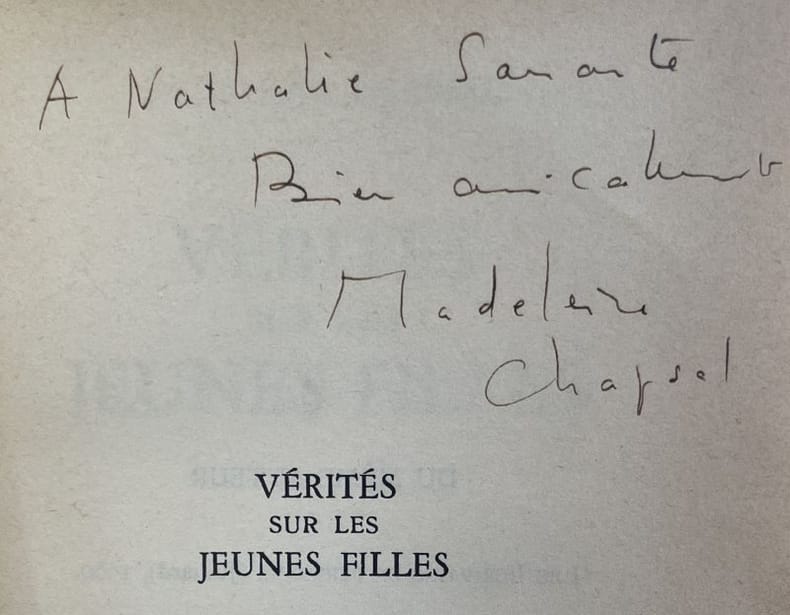
1960106820Paris Grasset 1960 1 vol. broché in-8, broché, couverture illustrée, 207 pp. Édition originale en service de presse enrichie d'un envoi autographe signé de la journaliste à Nathalie Sarraute. Evocation des différentes facettes de la jeune fille en 1960, fruit d'une trentaine d'entretiens individuels et d'une enquête de cinquante questions dont on trouve les résultats statistiques en fin de volume.
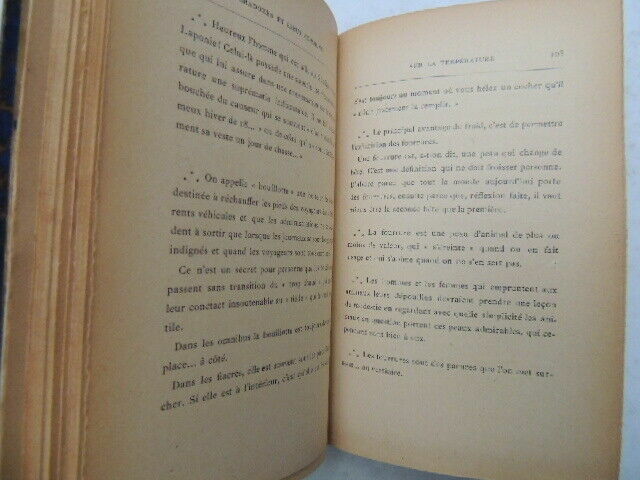
CZC-9179Bel envoi autographe de l'auteur à Émile Albert vol relié demi cuir, 18x12, bon état intérieur, 238pp. Paris, Ollendorff, 1897. ref/13
1955boz_001504Véronique Filozof - Longue lettre autographe signée à l'Abbé Morel - 1955 Artiste peintre Lettre autographe signée de Véronique Filozof, datée du 23 Mars 1955. Rédigée à l'encre bleue sur deux feuillets de papier vélin filigrané. Dimensions : 21 x 27 cm État : Bel état de conservation. Nombre de pages : 3 pages Véronique Filozof Véronique Filozof, née Véréna Valérie Sandreuter, est une artiste peintre, dessinatrice et illustratrice française, d'origine suisse. Dès 1923, elle s'installe en France. Wikipédia Abbé Morel Maurice Morel, dit l'abbé Morel, né à Ornans le 28 mars 1908 et mort à Paris le 15 février 1991, est un prêtre et peintre français. Wikipédia
1954boz_001489Véronique Filozof. Lettre autographe signée à l'Abbé Morel "Noir Périgord", 1954 Artiste peintre Lettre autographe signée de Véronique Filozof, datée d'un lundi soir à Paris. Rédigée à l'encre bleue sur un feuillet de papier vélin filigrané. Dimensions : 21 x 27 cm État : Bel état de conservation. Nombre de pages : 2 pages Véronique Filozof Véronique Filozof, née Véréna Valérie Sandreuter, est une artiste peintre, dessinatrice et illustratrice française, d'origine suisse. Dès 1923, elle s'installe en France. Maurice Morel Maurice Morel, dit l'abbé Morel, né à Ornans le 28 mars 1908 et mort à Paris le 15 février 1991, est un prêtre et peintre français.
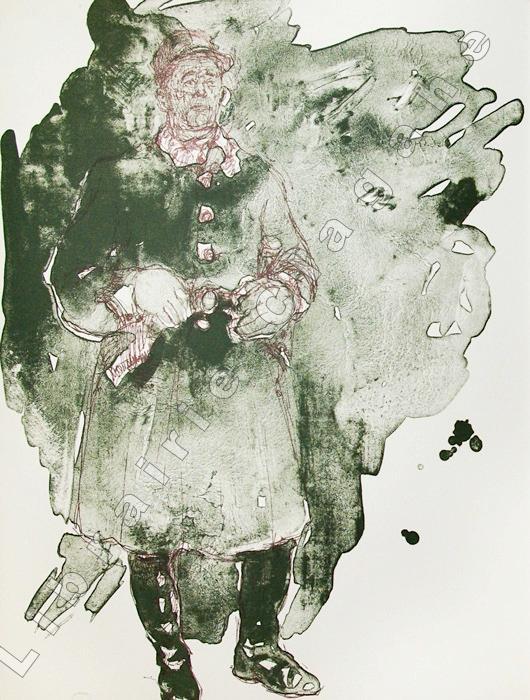
196612447Paris - Bièvres, Pierre de Tartas, 1966 ; in-folio en feuilles sous couverture beige muette, coffret d'éditeur de tissu marron, titre lavande, intérieur de suédine grise ; (106) pp., (2) ff. blancs, 18 lithographies originales en couleurs, dont 7 à doubles pages et 3 en marge du livre par Jean Commère.
2012111252Paris Claude Blaizot, "collection 164" 2012 1 vol. broché in-8 étroit, en feuilles, couverture à rabats bordeaux, non coupé, non paginé. Édition originale. Tirage unique à 60 exemplaires numérotés sur papier mûrier de Thaïlande, signés par l'auteur et l'éditeur. Notre exemplaire est enrichi d'un envoi autographe signé de Michel Déon à Henri Clarac : "ces quelques bribes de souvenirs du temps des heures sur seulement deux roues, amicalement". Premier volume de la collection 164. En parfait état.
- S.n., S.l. 9 Juin 1911, 13,5x21cm, quatre pages sur deux feuilles. - Etonnante lettre autographe datée et signée du comte dandy, de quatre pages sur deux grandes feuilles (16 lignes), écrite à l'encre noire à son "cher ami" Henri Lapauze dénonçant son manquement à la parole donnée et suscitant l'ire épistolaire du poète. Henry Lapauze devait célébrer Robert de Montesquiou dans un livre-hommage regardant ce dernier et, à son grand dam il l'a oublié, piquant ainsi à vif son impulsif amour-propre : "... ce n'est pas pour récriminer, encore moins pour réclamer - tous deux incompatibles avec la fierté - mais pour enregistrer qui dédommage des méconnaissances..." et, affront supplémentaire pour la fierté du dandy-poète : "... vous ne parliez... que de Lavedan !" alors que, double et suprême trahison, Robert de Montesquiou honorait sa promesse en lui dédicaçant son dernier ouvrage : "Dans le moment même où j'inscrivais, pour vous, la dédicace par moi promise, me parvenait le fascicule où devait s'exprimer les commentaires promis par vous, pour le livre qui me rend hommage..." Le poète et écrivain Robert de Montesquiou lui en serait très reconnaissant : "... le poète et l'ami qui, tous deux en un, vous remercient d'avance affectueusement..." Henry Lapauze (1867-1925) fut journaliste, critique d'art, puis, en 1905, conservateur du Petit Palais reconverti quatre ans plus tôt en musée et dont il enrichit considérablement les collections en acquérant notamment les fonds Courbet, Henner, Falguière avec, au crépuscule de sa vie, une nette prédilection pour les Arts Décoratifs dont il fut un des ardents promoteurs. [ENGLISH DESCRIPTION ON DEMAND]
1950118179Paris Gallimard 1950 1 vol. broché in-12, broché, 178 pp. Edition originale de ce recueil d'observations et d'aphorismes tous rédigés à l'imparfait. Exemplaire du service de presse avec un envoi de l'autrice (nom du destinataire découpé). Prière d'insérer joint.
Paris, Albin Michel, 1945. Ilustraciones en negro en el texto. 153 p. 4º menor. Rústica editorial ilustrada algo rozada y con leves falttas. Buen ejemplar. Dedicatoria autógrafa del autor, Jacques Salomon.