4 134 résultats
42 topographic maps, colour-printed. Scale 1:100,000 and 1:253,440 (a quarter-inch to a mile). 680 x 505 mm and 600 x 470 mm. An impressive collection of Iraq maps compiled from the most current aerial photography and produced by the British Army for use in the Persian war theatre. Includes 'Ain Sifni, Aqra, Tel Afar, Salman Pak, Ba'Quba, Sumaika, Penjwin, Halabja, Baghdad, Kirkuk, Dulaim, Erbil and Mosul divisions. - Previously folded. Generally well-preserved.
Oblong 8vo. (4), 42 mounted colour printed plates, some of which heightened in gold, (4) pp. Each plate matted with the corresponding letterpress Qur'an verse with red border to versos opposite. Title-page printed in red and black. Contemporary green full calf with giltstamped title to cover and spine. Top edge gilt. Original stapled plain card slipcase. Only edition. A collection of 42 exquisite illustrations for selected suras from the Qur'an inspired by Persian miniatures. One of the earliest works by the Austrian-born painter and illustrator Lydis (1887-1970), a self-taught artist influenced by Islamic art as well as by the Japanese artist Tsuguharu Foujita. Lydis settled in Paris in 1926 and escaped the Nazis during the occupation, living briefly in England before emigrating to Buenos Aires. Today she is best known for her illustrations in de luxe editions of Boccaccio, Louÿs, Baudelaire, Mirbeau and Valéry. - The plates, in colours and gold, were printed by Ganymed in Berlin, the text by Proeschel & Trepte in Leipzig. - Extremities slightly rubbed. Interior in mint condition. Vollmer III, 278. OCLC 187048571.
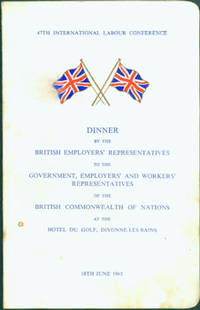
63-7249Divonne-Les Bains France: Hotel Du Golf 1963. 12mo. Light Card Stock 4 pp. Color Illustration to cover printed menu. Very Good. Provenance: Michelin Archives. Collection Guy Legay. Clermont-Ferrand France. Divonne-Les Bains, France: Hotel Du Golf, 1963. unknown
1999111205Schorndorf : Hofmann 1999. 230 S. : zahlr. Ill., graph. Darst. 14,5*21 cm. OBroschur.
(Oblong) 12mo to small 4to. Together 14 pp. on 6 bifolia and 2 single sheets. The programme of the golf banquet stapled. Small archive of Velma Thomas, a golf enthusiast and wife of the Aramco engineer Orlin Orace Thomas, based at Ras Tanura. The programme of the 1953 golf banquet lists the members of the Aramco golf team of Ras Tanura, including team captain and Aramco administrator Karl Deloian. The other items document Velma Thomas's membership in the Rahimah Hollow Country Club of the Ras Tanura Golf Association, the Ras Tanura Women's Group of the Federation of American Women's Clubs overseas, and the Ain Nakhl country club in Abqaiq. - Small marginal flaws; occasional light brownstaining. Interesting collection documenting the thriving expat golf scene of Saudi Arabia.
Tela rigida editoriale con sovracopertina, pp 273
20082092902141302493Hakuhoro Golf Club 2008. Soft Cover. Fine. Number of books: 1 Hakuhoro Golf Club paperback
Fotografias en color. Texto bilingüe ingles-español.
Mostly 4to, with one letter in-8vo. 17 pp. altogether: 1) Leiden, 29 December 1835. 4to. 3 pp. - 2) Leiden, 28 January 1838. 4to. 3 pp. - 3) Leiden, 19 February 1838. 4to. 3 pp. - 4) Leiden, 26 March 1838. 4to. 2 pp. - 5) Leiden 20 March 1843. 4to. 3 pp. - 6) Leiden, 20 May 1844. 8vo. 3 pp. To the antiquary and astronomer Dr John Lee (1783-1866) of Hartwell, concerning oriental manuscripts, the museum at Leiden, and other matters. Together six letters, the first in French, the remainder in English. They include discussion of a Coptic manuscript at Haarlem; Egyptian cylinders at Leiden; Leemans’ work at the Reuvens Library and his Leiden Museum responsibilities; Lee’s own museum and observatory at Hartwell; the recommendation of a language teacher seeking work in London named Abraham Claudius Verspyck and the sending of one of Lee’s manuscripts (82) to Leiden, amongst other matters. - Final page of each letter with penned address panel, postal markings and small tears from seal opening not affecting text, some negligible dusting along old folds, each with small "B.R.A" stamp (sold by British Records Association). In very good condition.
1963216337New York: The New Yorker 1963. 1 vols. 6 x 7 inches. Fine. 1 vols. 6 x 7 inches. The New Yorker unknown books
1961200211Hamburg, Reinbek-Wohltorfer Golf-Club, 1961. 26 S. Mit zahlreichen Abbildungen. 4°, OBrosch.
2001056701Braunschweig., 2001. 63 Seiten mit zahlreichen Abbildungen. Guter Zustand. 4°. OPappband.
200251938Stuttgart-Mönsheim. Stuttgarter Golf-Club Solitude e.v. 2002. 106, (2) Seiten. Mit zahlreichen teils faks. u. teils farbigen Abbildungen. Farbig ill. OKart.-Einband. Gutes Exemplar. 27x22 cm
Hard Cover + DW 8vo, 160 pp, drawings.- SIGNED by Richard AULTMAN. Very Good++/Good+. [CA-12]
5 glass positive lantern slides (85 × 100 mm), each with a black paper mask, paper tape around the edges, a letterpress slip at the foot giving the publisher's name and city, and a slip at the head with the manuscript title. Stored in a contemporary purpose-made wooden box with brass fittings, with the word "Mekka" on the top of the hinged lid. Five of the earliest and best photographs of Mecca and Medina, beautifully preserved as silver gelatin glass plates, including the first photograph of the Ka'ba in Mecca's Masjid al-Haram (Great Mosque). Two of the photographs were taken by the first person to photograph Mecca and Medina, the Egyptian Colonel Muhammad Sadiq Bey (1832-1902), who made them in 1880 for the Ottoman Sultan Abdülhamid II. The others were taken by the first European to photograph Mecca, Christiaan Snouck Hurgronje, and Al-Sayyid 'Abd al-Ghaffâr, who worked closely with him. Snouck Hurgronje (1857-1936), one of the greatest pioneering Dutch Arabists, converted to Islam and lived in Mecca from January to about July 1885. The photographs by these three men are best known and most frequently reproduced from the published collotype facsimiles, while the rare surviving early albumen prints are usually faded or otherwise in bad condition. The present five plates, sold as lantern slides for magic lantern presentations, are therefore of the greatest importance as well-preserved high quality specimens of these famous photographs, providing the best early images of the mosques of Mecca and Medina. - All five slides are in very good condition, with only a bit of dust and the occasional smudge on the glass. They show: 1) The Masjid al-Haram in Mecca (the Great Mosque); 2) a closer view of the Ka'ba in Mecca; 3) the portrait of an unidentified Mu'ezzin in Mecca; 4) a portrait of an unidentified East Indian pilgrim; 5) the al-Masjid an-Nabawi in Medina (the Prophet's Mosque). Cf. D. v.d. Wal, Christiaan Snouck Hurgronje (2011); J. J. Witkam, new introduction to the 2007 reprint of the 1931 English translation of Hurgronje, Mekka.
3 booklets, a magazine, and a menu. (1) EL-KHATIB, M. Fatallah (foreword). Basic Documents of the Arab Unifications. New York, Arab Information Center, June 1958. 8vo. 43 pp. Includes: the Proclamation of the United Arab Republic, the Proclamation of the Arab Union, the Provisional Constitution of the United Arab Republic, the Charter of the United Arab States and the Constitution of the Arab Union. - (2) OMRAN, Abdel-Rahim. Public Health & Welfare in the Arab States: Past, Present and Future. New York, Arab Information Center, November 1959. 8vo. 32 pp. The booklet opens with a history of the Arab contributions to medicine followed by modern statistics. - (3) WRIGHT, Esmond. The Arab World. Current Affairs no. 125. London, Bureau of Current Affairs, 3 February 1951. 8vo. 19, (1) pp. Short overview of the Arab world. - (4) [MENU]. P&O menu. On board the S.S. Arcadia, Sunday 25 March 1962. 8vo. Menu with on front a coloured illustration of a Dhow in the Arabian Sea. Probably offered during a cruise in the Gulf.
Folio (ca. 27 x 36 cm). [255] ll. With 13 illustrations, mostly showing different soil profiles relating to the fossils, including 10 drawn by hand. In a pink cardboard portfolio entitled "Fossils Mesozoic-Age (secondary)", including another portfolio with blue paper wrappers. Extensive correspondence addressed to George Stanfield Blake, mainly from Leslie Reginald Cox, discussing fossil specimens. Blake's additional correspondents were, among others, the deputy director of the "laboratoire de paleontologie" of the French national museum of natural history J. Coltreau and the director of the British museum of natural history C. Tate Regan. - Blake (1876-1940) was a British mineral and mining geologist and was from 1922 to 1939 the geological advisor to the Mandatory Government of Palestine, in which capacity he wrote and received the letters collected in the present portfolio. His work was essential, according to Israeli geologist Picard and others, for the expansion of geological knowledge of Palestine and Transjordan and their natural assets. Cox (1897-1965) was a British palaeontologist and malacologist (a specialist in molluscs), who was attached to the British museum of natural history and was elected a fellow of the Royal Society in 1950. - Most of the letters are typed copies of letters with autograph signatures, except for a few autograph letters. The collection also includes a few illustrations of soil profiles and even some notes of thanks from the trustees of the British museum of natural history addressed to Blake, thanking him for his donations of information on fossils and the specimens themselves. - Paper wrappers show signs of wear, wrappers and documents inside are very slightly discoloured, most leaves are slightly frayed around the edges. Most leaves are numbered in blue pencil and the numbers correspond with the overview of the contents typed on a separate leaf, pasted on the inside of the front pink wrapper.
Folio (ca. 350 x 493 mm). 17 aquatint plates in original hand colour and one double-page-sized aquatint map of the Mediterranean in original hand colour, all with captions in English. Contemporary half calf over marbled boards with giltstamped title and 2 floral ornaments to spine. Marbled endpapers. Collection of 18 of the 43 illustrations from the account of the voyage of HMS Swiftsure and the Battle of the Nile by the British clergyman and artist Willyams (1762-1816), who served as chaplain aboard the ship, a vessel of Admiral Nelson's squadron captained by Benjamin Hallowell Carew. The 17 plates in the present volume show views of the caves of Gibraltar and the Spanish Church in the city, the Bay of Fournelles, Ischia, a street in Caiffe at the foot of Mount Carmel featuring two dromedars, Aboukir castle, caverns near Syracuse and the Temple of Minerva, the Palermo Capuchin catacombs, and a view of Scylla on the coast of Calabria, as well as an attack on the French camp near Aboukir, an attack of Turkish gun boats on the castle of Aboukir, and a group of three Arabs aboard the Swiftsure. The aquatint map shows the Mediterranean Sea with the courses of the British and French fleets up to their encounter in the Bay of Aboukir in August 1798. Designed by Willyams, the illustrations were engraved by Joseph Constantine Stadler. - Binding somewhat rubbed near extremities. Right margins of several plates brownstained or a little worn (not touching image); map brownstained on left and right margins and near the gutter (hardly touching image); the plate with the entrance into the Ear of Dionysius with traces of 2 folds near lower right corner (not touching image). An appealing compilation of decorative images documenting the route of the British fleet leading up to the Battle of the Nile. For the original publication cf. Abbey 196. Blackmer 1813. Atabey (2nd ed.) 1339. Graesse VII, 456.
8vo. IV, 46 ff., 70 pp. (= counted as a total of 116 pp.), 1 blank page. Original coloured paper boards with printed cover label. Only Geman edition (published in German and Arabic parallel text) of this brief catechism of the tenets of Islam, written by Sayyid Muhammad, professor of Arabic in Nazareth and first published in Cairo (al-Matba'ah al-Kubra al-Amiriyah) in 1911. The German translation and vocalisation as well as the word index are by Mohammed Ibn-Brugsch (1860-1929). Includes a preface by Sadr-ad-Din, the Imam of the mosque in Berlin-Wilmersdorf. - Published as vol. 1/3 within the series "Der islamische Orient, 2e Abt.: Arabische Schriften, E. Religion und Ethik". Extremely rare: only two copies known in libraries internationally (Basel and Leiden universities). - Appealingly bound in the style of the famous Insel Bücherei. An immaculate copy from the collection of Friedrich Pfitzner with his exlibris stamp to the title-page. OCLC 604591995.
8vo. LXXII, 452 pp. Near-contemporary half cloth with giltstamped red spine label. Edges sprinkled in red and blue. First edition. - A rare and scholarly investigation of the Arabic origins of star names, incorporating the first edition (with a German translation) of the relevant part of the famous "Aja'ib al-makhluqat" by the astronomer Zakariya al-Qazwini (1203-83), which contains a description of the 48 constellations of Ptolemy and is hailed by Brockelmann as "the most valuable cosmography in Islamic culture" (GAL). Taking Qazwini's text as his guideline, the Prussian astronomer Ideler (1766-1846) provides a detailed commentary elucidating the respective Greek, Latin, oriental, and modern names of the stars. The final chapter is an essay on the Arabic nomenclature of celestial bodies, tracing the names' origins to the ancient nomadic Arabs (Bedu). Although Ideler was not an orientalist and claimed merely a scholarly working knowledge of Arabic, he had the advice of Oluf Gerhard Tychsen and Georg Beigel. The resulting text edition, translation and critical study were highly praised by Fück, who called the annotations "excellent". - Some browning throughout as common; professional repairs to spine. Old stamp and shelfmark of the Boston Arts Academy Library to title; handwritten ownership "J. Johnson / Jan.y 1930" to pastedown. Schnurrer p. 466f., no. 404. Fück 160 ("1810" in error). Kayser III, 248. OCLC 11828254. Cf. GAL S I, 882.
Folio (ca. 31 x 42 cm). 2 vols. 379 ff. with 1 diagrammatic woodcut. 357 ff. Contemporary full calf over wooden boards on four raised double bands, blind- and giltstamped, one volume with 2 brass clasps (and remnants on the other volume). Two complete volumes, in their contemporary Renaissance bindings, of the four-volume Latin edition of Avicenna's magnum opus. Gerard de Cremona's widely received translation was here edited by Jacques Ponceau with the commentaries of Jacobus de Partibus and Johannes Lascaris. - The principal writing of Abu Ali al-Husain ibn Abdullah ibn Sina (ca. 980-1037), the "Qanun" is the most authoritative medical text in the Islamic world. Written in Arabic, it was widely translated throughout the Middle Ages and formed the basis of medical training in the West as late as the mid-17th century. Through this encyclopedic work, the author exerted "perhaps a wider influence in the eastern and western hemispheres than any other Islamic thinker" (PMM). "The 'Qanun' [...] contains some of the most illuminating thoughts pertaining to distinction of mediastinitis from pleurisy; contagious nature of phthisis; distribution of diseases by water and soil; careful description of skin troubles; of sexual diseases and perversions; of nervous ailments" (Sarton, Introduction to the History of Science). "[Avicenna's] Canon is one of the most famous medical texts ever written, a complete exposition of Galenism. Neuburger says: 'It stands for the epitome of all precedent development, the final codification of all Graeco-Arabic medicine'. It dominated the medical schools of Europe and Asia for five centuries" (Garrison/M. 43). - The present two volumes comprise the complete Third Book, fen 1-12 and 13-22, and thus cover the principal part of the Qanun: special pathology and therapy "a capite ad calces" (from head to toe), including ailments of the ear, nose, and throat, as well as obstetrics. Volumes 1 and 4 (not present here) comprised books I (452 ff.) and book IV, fen 1 (142 ff.); books II and V were not part of this edition. - Both volumes lack merely the final blank leaf, otherwise complete with ample margins showing occasional deckle edges. Some light browning, some waterstaining to edges (mainly towards end of vol. 2), otherwise very little staining; some worming mostly confined to blank margins. A few contemporary ms. annotations. Both volumes in their original, prettily blind- and gilt-tooled brown leather bindings over wooden boards. - Provenance: traces of removed bookplates on pastedowns. According to a pencil note on the inside front cover of the first volume, the set was removed from the Fritzlar Cathedral Library, parts of which were dispersed in 1724 and in 1803. Later sold at Venator (Cologne), sale 23/24 (1962), lot 15 (with illustration plate IV); old sales notice pasted to inside front cover of first volume. H 2214. GW 3127. Goff A-1428. BMC VIII, 302. Proctor 8616. BSB-Ink A 964. IGI 1125 u. Corr. Pell. 1668. Polain 444. Voull. Bln. 4708. Claudin IV, 88-93. Klebs 131.13. Panzer I, 553, 200. Not in Oates, Osler, Waller, or Wellcome.
8vo. 3 vols. (8), 15, (1), 587, (1) pp. (6), XII, 543, (3) pp., final blank leaf. (4), IV, 565, (1) pp., final blank leaf. Contemporary brown boards with giltstamped red spine label. First edition, printed with the beautiful Arabic types of the Imprimerie Imperiale by J. J. Marcel, who in 1798 had brought printing to the Arabic world when he set up the first press in Cairo. - "Opus maximopere, nec vero ultra quam fas erat, laudatum et celebratum ab omnibus qui de eo referrent" (Schnurrer). "Like his Grammar, de Sacy's Chrestomathy was first compiled for his students. In the early 19th century there was a very limited body of reading matter for academic learners of Arabic [...] The Chrestomathy was intended to remedy this fault. But de Sacy immediately combined with this practical aim the scholarly task to use and make known valuable texts from the manuscript troves of the Royal Library in Paris, and so his Chrestomathy contains extensive extracts from late historians (Maqrizi) and geographers, from Hariri's Maqamat, from the Druze canon and from Qazwini's cosmography, as well as several poems from Nabiga to Ibn Farid, and, finally, keeping in mind the practical needs of future interpreters, a collection of state documents, all of this in the original Arabic with French translation and a wealth of annotations [...] It is a credit to de Sacy's interpretative mastery that the Chrestomathy [...] enjoyed a much longer life than similar works usually do, which tend soon to show their age due to the progress of scholarship: for nearly a century his work introduced learners to the masterpieces of Arabic literature" (cf. Fück). - Bindings rubbed and bumped at extremeties; interior well preserved. Scarce on the market. Schnurrer 153. Fück p. 146-148. OCLC 3822297.
Folio (254 x 355 mm). 14 leaves (letterpress within lithographed illustrated borders). Loose in original wrapper covers with title printed in French and (in gilt letters) Arabic. Stored in custom-made green half morocco case. Beautifully illustrated publication on the Muslim festivity of Al-Ashura. For Shia Muslims, Ashura, the tenth day of Muharram, the first month in the Islamic calendar, marks the climax of the Remembrance of Muharram and commemorates the death of Husayn ibn Ali, the grandson of the prophet Muhammad, at the Battle of Karbala. Illustrated by the author throughout; a fine, late production of the French press in Egypt. - Contemporary ownership stamp "A.T." to upper cover. Covers slightly stained, otherwise a very good copy. Rare. OCLC 456737731.
Small 8vo. (2), 30 pp. Lithographed and illustrated throughout. Original yellow printed wrappers. Lithographed in Arabic throughout (save for the French wrapper-title): a rare official manual of the legal system of weights and measures used in French Algeria, intended for Arab-French schools. The booklet was drawn up by the school principal Eugène Vayssettes and translated by an Arab known only as Antoine, after an earlier effort by the military interpreter Ahmed ben Lefgoun had been condemned by the board as too complicated and linguistically obscure. The illustrations show various receptacles and measuring units. - In excellent condition. OCLC 493647389.