Livre Rare Book

19 868 résultats
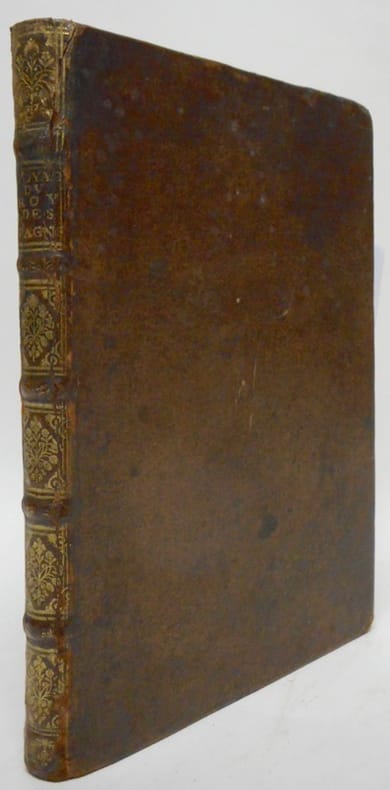
175944495, , 1759-1777. Manuscrit in-12 (149 x 95 mm) de (1) f. (titre) et 50 ff. datés 1759-1808 dans un encadrement noir et rouge, maroquin bleu nuit, dos lisse orné à petits fers, LE VRAI BONHEUR inscrit en capitales dorées sur les deux plats, triple filet doré d'encadrement, frise intérieure, gardes de tabis rose, tranches dorées (Derome).
Ca. 94 x 60 mm. Sanskrit manuscript on polished paper. 222 leaves, 5 lines of Devenagari script in black ink within red, orange, and black rules, some phrases picked out in red, some words gilt. With 14 charming miniature illustrations. Modern full black leather binding. A miniature Sanskrit devotional consisting of the complete text of the Bhagavadgita, the famous Hindu devotional poem. The text is written in black glossy ink with rubricated punctuation marks; significant words, such as chapter titles, are also written in red. The text is elegantly laid out with five lines per page enclosed within a black, orange and red rectangular border, surrounded by ample margins. The 18 fine miniatures in Pahari style, with opaque water-based pigments and gold, depict devotional scenes with a special emphasis on Krishna and show Lord Vishnu in his ten principal manifestations (Avatars). - The Bhagavad-Gita, considered one of the holy scriptures for Hinduism, is a 700-verse Hindu scripture that forms part of the epic Mahabharata. Dated to the second half of the first millennium BCE, it is a work typical of the Hindu synthesis. - A few very minor edge flaws near the end; the final page is annotated in English in a 19th century hand: "The mysterious Bhagavat-gita; a dialogue between Crishna and Arjuna, on the Knowledge of God, & the means of attaining reunion to the divine soul: in eighteen lectures extracted from the Mahábhárata, an epic poem". Provenance: private UK collection.
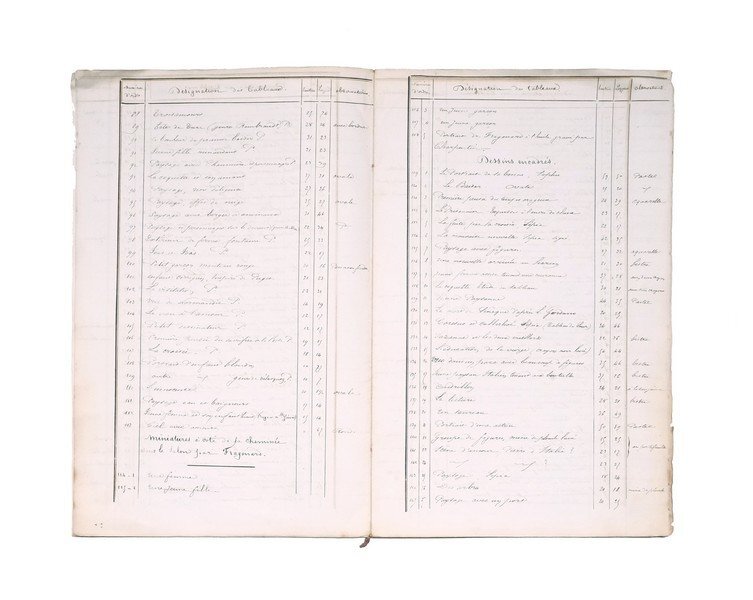
965Paris : Société la Nationale, vers 1863. LE CATALOGUE D'UNE LÉGENDAIRE COLLECTION D'ART DU XVIIIE SIÈCLE, AUJOURD'HUI DISPERSÉE
Folio (206 x 297 mm). Three parts written by two different hands on the same paper stock (watermark: hound with a collar). A total of 270 pp. including 5 full-page pen-and-ink illustrations, with geometrical footers to each page. Later half vellum over marbled boards (ca. 1900). A pretty composite manuscript of the mid-16th century, in the main following closely or styled after the gunsmith manual repeatedly printed by Christian Egenolff between 1529 and 1597. The preface (14 pp., dated "1554" at the end) consists of "Eine lehr so Keiser Maximilian in seiner Jugent durch erfarne treffliche seine Kriegsräht zugestelt ist", an instructional work for Emperor Maximilian also found in Egenolff's book from its 1534 edition onward. This is followed by the first main section: "Büchssenmeysterei von Geschoß, Büchsen, Pülver Salpether und Fewerwergk &c eigentlich zuzurichten, Büchssenmeystern und Schützen zuwissen nötigk" (70 pp.), likewise directly taken over from Egenolff's compilation. The second part is a legal treatise (as in Egenolff's book, though with different content) discussing martial law, entitled "Gerichts Hendell unnd Cautele in malefich Hendelnn Schüldtrechten unnd gastrechten" (72 pp.). The third part is an extensive treatise on a soldier's duties and the oaths to be sworn by the various ranks ("Artickel darauff die Hauptleut [...] unnd gemeine knecht der Ro. Kay. Maj. unserm aller gnedigisten Herrnn gelobenn und schwerenn sollen S. K. M. zu dienen", 114 pp.), going substantially beyond its counterpart in Egenolff's handbook. This is written in a different hand and contains copious explanations as well as five full-page illustrations showing military equipment and devices in red and black ink (fiery arrows, "Wie man eine glüende Kugell inn Holtzwerck schiessen soll", etc.). At the end the manuscript contains an index, military multiplication tables, and legal addenda by various hands, dated 1562, with elaborate geometrical borders. - Provenance: bookplate of the English explorer, horseman, and big game hunter Col. J. Hamilton Leigh (1867-1944) of Stockport. Later in the collection of the collection of Thomas Fremantle, 3rd Baron Cottesloe (1862-1956), commander of the Territorial Army and president of the Society for Army History Research. Cf. Jähns 653 (Egenolff's manual, 1597 ed.).
Small folio (243 x 301 mm). Ink scribal manuscript on paper. 373 (but: 376) pp. Sumptuous red half morocco with giltstamped spine title: "Mémoires (sur l’ambassade de France en Turquie et sur le commerce des Français dans le Levant) du Cte Emmanuel de St. Priest Ambassadeur et Pair de France 1735-1821. Revues et corrigées par le comte Alexis de Saint-Priest de l’Académie Française". Marbled endpapers. Highly interesting autobiographical account of Guignard de Saint-Priest, a French politician and diplomat during the Ancien Régime and French Revolution, and of his diplomatic career. Appointed ambassador to the Ottoman Empire in 1768, he remained in Constantinople until 1785, with a single brief interruption in 1776/78, and there married Wilhelmina von Ludolf. Roughly half of the manuscript covers these decisive years spent at the Ottoman court of Mustafa III and Abdul Hamid I, offering a history of French relations with the Porte, biographies of previous French ambassadors and envoys to Turkey, and a history of French commerce and navigation in the Levant. In spite of his long mission, Guignard clearly was not happy with his posting, complaining of the "faibles et ignorance da la Porte Ottomane", yet he shows a keen eye for detail as well as for the Ottoman Empire's manoeuverings within the broader context of European power politics. His famous portrait of Marie-Antoinette is found in chapter XIX of the manuscript (p. 271-291). His account continues as far as the year 1802, also including his time at the Russian court of Paul I and the last years of Catherine the Great, as well as his stay in Denmark and Norway. - Born in Grenoble, Guignard joined the army at the age of 15. After his mission to Constantinople he became secretary to the Royal household of Louis XVI and Minister of the Interior in Necker’s second cabinet in 1789. Later, he apparently served Russia as a spy at the Swedish court before accompanying the exiled court of Louis XVIII to Blankenburg and Mittau. - The manuscript's editor, Comte Alexis de Saint-Priest (1805-51), was the grandson of François-Emmanuel. His father was François-Emmanuel’s second son Armand-Emmanuel-Charles de Saint-Priest (1782-1863), also a diplomat who later became Governor of Poldolia and Odessa in Russia. After his return to Paris, Alexis moved in literary circles, became a member of the Académie Française, and is mentioned in the preface of the original edition of the "Mémoires" (Calmann-Lévy, 1929) by the baron de Barante. Alexis de Saint-Priest entrusted the manuscript to Prosper de Barante as the basis of a biography published in 1845. - At the beginning of the 19th century this manuscript was still in the hands of a descendant of Barante's, who was responsible for the publication. The present mid-19th century manuscript was probably copied from the original fair copy, as it contains pencil corrections in a different hand throughout and corresponds with important variants in the printed edition. - A single page repaired with tape, a small tear to another page not affecting the text, otherwise a fine and clean copy, splendidly bound. Cf. Hellwald, p. 282. Saint-Priest, Mémoires ... annotée par Nicolas Mietton (2006).
220820S.l., 4 décembre 1700 (1701) in-12, 108 pp., couvertes d'une écriture fine et très lisible (environ 30 lignes par page, quelques biffures et ratures), avec un frontispice gravé avec un cartouche vide (Paris, chez Bonnart), portant un titre manuscrit Journal du sr. Frigard, ordinaire de la musique du Roy, veau brun, dos à nerfs cloisonné et fleuronné, tranches mouchetées de rouge (reliure de l'époque).
Folio portfolio (485 x 340 x 45 mm). 15 manuscript leaves of various sizes (see the detailed list of contents for specific dimensions). 14 of the manuscripts are on paper (varyingly glazed or unglazed), 1 written on vellum (no. 7), most rubricated and/or decorated in various colours, some are heightened or highlighted in gold. All manuscript fragments are mounted (hinged to allow access to both sides of the leaves) in mattes (ca. 465 x 330 mm) with an additional leaf each (ca. 10 x 18 cm), containing explanatory text, mounted at the foot of the matte. Original black and red portfolio with the author in white and title in red on the spine, with three sets of black ties (one on the inside) and a label on the inside of the right black flap giving the information of the limited edition: "Edition limited to forty numbered sets of which this is No 33". Number 33 out of the 40 famous limited edition Ege portfolios containing a collection of 15 leaves from oriental manuscripts, written between the 12th and 18th centuries. - Otto Frederick Ege (1888-1951) was the dean of the Cleveland Institute of Art, a lecturer on the history and the art of the book at Western Reserve University and a famous (or infamous) biblioclast. He was one of the key figures in creating a market for medieval manuscript leaves in America during the 20th century. Between 1917 and 1950, Ege acquired, deconstructed and subsequently dispersed hundreds of mostly medieval manuscripts and early printed books, wanting to give as many private collectors and public institutions as possible the opportunity of owning these individual leaves. He was convinced that his purpose of inspiring as many people as possible by bringing them in contact with historical and artistic heritage justified the means of scattering the manuscript fragments. From the 1940s onwards, he compiled his famous portfolios as limited editions, resulting in 40 portfolios with western medieval manuscript leaves and 40 portfolios with 12th to 18th century oriental manuscript leaves. - The present portfolio includes 15 fragments: 14 manuscripts on paper and one on vellum, many decorated or even heightened in gold. They originate from books produced between the 12th and the 18th century, in Egypt, Syria, Byzantium, Persia, Russia, Tibet and other places. These mainly religious texts were written in several different languages, including Arabic, Syriac, Armenian, Ethiopic, Persian, Tibetan, Greek, and Church Slavic. Two of the fragments, one in Greek and one in Church Slavic, even include including musical notation. - As Ege intended, many of his portfolios and other fragments were sold and distributed worldwide. His personal collection, including 50 unbroken manuscripts, has been part of the special collections at the Beinecke Rare Book & Manuscript Library at Yale since 2015. - A detailed list of contents is available upon request.
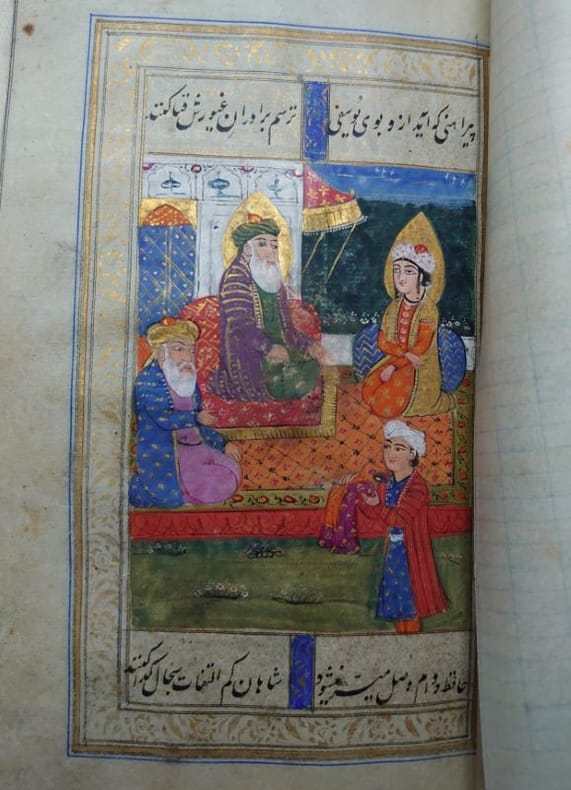
541818,5 x 11,5 cm. 332 pages et 27 miniatures enluminées hors-texte. Manuscrit complet sur papier de 8, 9, 10 ou 12 lignes par page disposées en deux colonnes, texte en persan, à lencre noire, en écriture nastaliq. Enluminures végétales dorées sur fond bleu séparant les colonnes et encadrant les pages. Frontispice en double page enluminé à lor et en polychromie avec texte en réserve sur fond dor encadré de fleurons dorés sur fond bleu, garnis de rinceaux végétaux. Les 27 miniatures sont enluminées à l'or et en polychromie. Reliure à dos de cuir, plats en papier-mâché peint et laqué, décorés en polychromie et or d'arabesques de tiges et fleurs, au centre des plats "rosace" peinte en polychromie et or, encadrement à décor floraux. Nous ne disposons que peu d'élément quant à ce manuscrit, un nom est indiqué Shir Mohamad, sans que nous puissions dire s'il s'agit du peintre ou du calligraphe? Par ailleurs, il s'agit par la facture tant des pages de texte que des planches enluminées d'un manuscrit de l'époque qajar du XIXème siècle.
541818,5 x 11,5 cm. 332 pages et 27 miniatures enluminées hors-texte. Manuscrit complet sur papier de 8, 9, 10 ou 12 lignes par page disposées en deux colonnes, texte en persan, à lencre noire, en écriture nastaliq. Enluminures végétales dorées sur fond bleu séparant les colonnes et encadrant les pages. Frontispice en double page enluminé à lor et en polychromie avec texte en réserve sur fond dor encadré de fleurons dorés sur fond bleu, garnis de rinceaux végétaux. Les 27 miniatures sont enluminées à l'or et en polychromie. Reliure à dos de cuir, plats en papier-mâché peint et laqué, décorés en polychromie et or d'arabesques de tiges et fleurs, au centre des plats "rosace" peinte en polychromie et or, encadrement à décor floraux. Nous ne disposons que peu d'élément quant à ce manuscrit, un nom est indiqué Shir Mohamad, sans que nous puissions dire s'il s'agit du peintre ou du calligraphe? Par ailleurs, il s'agit par la facture tant des pages de texte que des planches enluminées d'un manuscrit de l'époque qajar du XIXème siècle.
Greek, Latin and French autograph manuscript on paper. 3 vols.: 4to (214 x 228 mm), large 4to (224 x 273 mm), and 8vo (132 x 180 mm). Regular cursive script in dark brown ink. (1), 538 ff. 25 pp. 85 ff. Bound in uniform green half mororcco over marbled boards with giltstamped red label to gilt spine. An encompassing study of the weapons of classical antiquity, commissioned by the Duc de Luynes and prepared by the great classical scholar Lepsius, who was to head the Prussian expedition to Egypt in 1842-45. The antiquary and numismatist Honoré d'Albert de Luynes (1802-67) was an important patron of scholarship and the arts. During his sojourn in Paris in the years 1833-35 Lepsius compiled this survey from the Greek and Latin sources to form the basis for an archaeological and philological work of the Duke's that did not materialize. - The hefty first volume, entitled "Arma Graecorum, Romanorum, gentiumque Barbarorum", contains a Greek repertorium with notes in French (f. 128r: "C'est donc une couverture de tous le bras, non pas seulement de la main ce qu'on serait porté à croire d'après l'explication de Pollux [...]"; f. 165r: "sur la fabrication des glaives"; ff. 262-264: extensive discussion of bows and archers), with an alphabetical index beginning on f. 515. A larger, slimmer volume is dedicated to Homer exclusively: Greek text and French notes in two columns with several illustrations, treating shields, helmets, armour, swords etc., also discussing the Durand collection ("Parmi les vases de Monsieur Durand il y a une amphore à fig., représentant le combat d'Hercule contre les Amazones [...]"), the armour of Agamemnon and of Alexander, the skin of the Nemean Lion, as worn by Hercules ("n'est devenue un vêtement de ce héros que depuis Pindare") etc. The octavo volume contains quotations from Greek writings (again with French notes) on helmets, armour, etc. ("Et en effet je crois qu'Homère lui même par ces différents noms d'armures [...] a voulu désigner différentes espèces qu'il semble aujourd'hui [...] je n'hésite nullement de croire que ces noms désignaient autrefois des espèces de casques"). - Bindings insignificantly rubbed; very occasional slight browning or edge flaws. A splendid, unique, unpublished manuscript by the great scholar, bound for the sponsor.
Folio (235 x 314 mm). German ms. on paper with calligraphic captions and several half-titles. 453 ff. Contemporary blindstamped pigskin on wooden boards. Wants ties. Exceptionally attractive and important manuscript from the Bohemian Royal offices; the principal document of the Bohemian national finances in the second year of the rule of Emperor Maximilian II. A beautiful and hitherto unknown document of Renaissance bookkeeping in its well-preserved original binding. - In the present manuscript, Johann Rabenhaupt, head of the Royal bursary and responsible for the accounting year 1565, has testified the correct statement of revenues and expenditures by his signature on every page. The volume begins with an alphabetical index, arranged in double pages and listing revenues (on left) and payments (on right) by name. Among the payers and recipients are several important names, most of them members of German-Bohemian, Czech and Polish noble families, the Tyrolean glass manufacturer Sebastian Hochstetter von Scheibenegg (d. 1573), but also the great physician Pietro Andrea Mattioli (1500-77): "Petter Andreas Mathiolo [...] Ertzherzog Ferdinanden zu Osterreich LeipPhisicus, hatt zu farlicher Provision Ainhundert gulden Reinisch, die khun zwayundvierzig schockh Ainundfunffzig groschen drey pfennig behamisch; dieselb hab ich Ime für dreyzehen Monat Anzuraitten [...]" (f. 263v). Mattioli, known especially for his Dioscorides commentary, moved to Prague in 1552 as personal physician to Archduke Ferdinand, where he was later to be made head medical advisor to Emperor Maximilian II (cf. Hirsch IV, 168). The volume not only documents salaries, duties, and court expenditures, but also the receipt of border taxes, Turk taxes, tithes, loans, deposits, realties, costs of funerals and the Prague castle vineyard, etc. - Johannes Rabenhaupt von Sucha, the man responsible for this splendid Renaissance account book, was a descendant of an old Bohemian noble family which is also documented in the Palatinate, in Franconia, and in Upper Austria. Although there have been attempts at biographical studies of the Royal bursar Rabenhaupt (without knowledge of the present manuscript), historical science has been forced to admit its temporary failure in this respect (see literature below). - Slight worming to several ff. Some offsetting of ink, but generally very well legible and hardly browned. The finely blindstamped binding shows a wide border of arched friezes; the central compartment bears the ms. title. On the back cover, the friezes frame a roll representing Virtues; central compartment decorated with two parallel arched friezes. Edges, spine-ends, and endpapers with traces of professional restoration; otherwise perfect. Beket Bukovinská, "Wer war Johann Rabenhaupt? Unbeachtete Aspekte in den Beziehungen zwischen Prag und Südwest-Deutschland", in: Rudolf II, Prague and the World. Papers from the International Conference. Prague, 2-4 September, 1997. Praha, Artefactum - Institute of Art History, Academy of Sciences of the Czech Republic [1998], p. 89-94.
1892734381892 | 20 x 29.50 cm | 4 pages sur un double feuillet
(15) ff. 14 loose wove paper folio sheets and 1 loose wove paper bifolium. Large folio (55 x 35 cm). With 64 watercolours and manuscript captions on 15 leaves (each leaf drawn on one side only). Collection of impressive watercolour drawings after medieval art objects by Magnus Soyter, an Augsburg-based collector of German medieval art who prepared watercolours of the objects in his collection, adding captions in ink with information about the items depicted. Soyter was a highly skilled watercolourist, and his large reproduction drawings are exquisite. He is today best known for his collection of medieval knights' helmets that ended up in museum collections worldwide. - In 1871 there was an exhibition held in Augsburg of highlights from his collection. A catalogue was made of these objects by Albert Fidelis Butsch, entitled "Waffenstücke, Rüstungen, Kunstwerke & Geräthschaften des Mittelalters und der Renaissance. In einer Auswahl der schönsten Stücke aus der in den Räumlichkeiten des Historischen Vereins für Schwaben und Neuburg aufgestelten Sammlung des Particuliers J. M. Soyter". In 1874 a supplement was published at Augsburg that included 50 photographs of the objects. After Soyter's death his collection was auctioned off and a 51-page catalogue was published under the title "Auctions-Katalog der Antiqutäten-, Gemälde- und Geweih-Sammlung aus dem Nachlass von Magnus Soyter" (Augsburg, Butsch, 1884). - The objects displayed in these drawings are from Soyter's private collection, as the manuscript captions indicate. Many of these artifacts are now lost, making this the only record of some of these superb medieval German pieces. - Wholly untrimmed. In very good condition.
187183318Mardi 7 novembre [1871] | 13.30 x 20.80 cm | 2 pages sur un feuillet double
Folio (210 x 320 mm). 202 ff., about 30 of which are blank. Contemporary vellum, joints using a 15th century vellum manuscript. A hitherto unpublished genealogical work by the Belgian historian Jean Zuallart (1541-1634), best known for his great travelogue of a journey to Jerusalem. Written in his diminutive hand, the present manuscript gives the family trees of important historical personalities, rulers and noble families, including those of Adam and Eve, the Virgin Mary and Noah, Assyrian rulers and kings, the Babylonians, Egyptians and Romans, the dynasties and noble families of Italy, France, Austria, Tyrol, Bavaria, the Palatinate, Saxony, Brandenburg, Nassau, Swabia, Franconia, Spain, Portugal, Flanders, Antwerp, Brabant, and Lorraine, as well as the Goths and Vandals. - Zuallart's account of the Holy Land, which he visited in 1586 as companion and educator of a young nobleman, was first published in Rome in 1587 in Italian; it saw several reissues and translations and was often drawn upon by later writers. A selection of his work can be found in the Bibliotheca Belgica (V, 893-900), which also notes several manuscript works left behind by Zuallart at his death. One of them, kept at the Belgian Royal Library (MS. II 1001), was used to confirm Zuallart's handwriting. - Binding with minor traces of use, rear inner joint loosened. Otherwise well preserved. Provenance: 17th century handwritten ownership by Joannes Masius to lower flyleaf; later armorial bookplate to front pastedown.
- [Paris] 13 [juillet] 1858 (mal datée « juin »), 13,3x20,6cm, 2 pages sur un feuillet remplié. - [Paris] 13 [July] 1858 (wrongly dated "June"), 13.3 x 20.6cm, 2 pages one folded leaf. Signed letter hand-written to his mother: "Tu sais cependant bien que ma destinée est mauvaise," "You know, however, that my destiny is bad." Signed letter hand-written by Charles Baudelaire, written in paper pencil, addressed to his mother. Dry-stamped headed paper from the Grand Hôtel Voltaire, Faubourg Saint-Germain. Madame Aupick's address in Honfleur (Calvados) in the author's hand, as well as several postage stamps dated 13 and 14 July 1858. Some highlighting, crossing out and corrections by the author. Signs of a wax seal with Charles Baudelaire's initials in pencil, likely written by the author. A small section of paper from the second leaf has been removed, without affecting the text. This letter was published for the first time in the Revue de Paris on 15 September 1917. Former collection Armand Godoy, n° 102. Precious document, testimony of a decisive moment in the poet's life?: the reconcilliation with now widowed Aupick, this sacred mother "qui hante le cur et l'esprit de son fils," "who haunts the heart and spirit of her son." The victorious Baudelaire has overcome the obstacle that was his cumbersome step-father, whose death he had even wished for?: he is ready to resume his place next to his mother, from whom he often felt abandoned. After the death of her husband in April 1857, the latter invited her son to come and live with her in her "maison-joujou," "toy house" in Honfleur. This letter shows us a Baudelaire beset by complex feelings?: torn between his aspiration to a live perfectly together and his inexorable attraction to the spleen. For the "bas bohème," "low bohemian," (as the Goncourt call him), harassed by creditors, Honfleur and the exclusive attention of his mother, it is the promises of fulfilling his poetic destiny. It is in these terms that the poet shares this hope with his friends, Antoine Jaquotot in particular (who is also quoted at the end of this letter that we have to offer)?: "Je veux décidément mener cette vie de retraite que mène un de mes amis, [...] qui, par la vie commune qu'il entretient avec sa mère a trouvé un repos d'esprit suffisant pour accomplir récemment une fort belle uvre et devenir célèbre d'un seul coup." (20 février 1858) "I truly want to lead this life of retirement, led by one of my friends, [...] who, by living with his mother has found sufficient peace of mind to accomplish recently a very beautiful piece of work and become famous in one fell swoop." (20 February 1858) "Tu vas, dans peu de jours, recevoir le commencement de mon déménagement [...]. Ce seront d'abord des livres - tu les rangeras proprement dans la chambre que tu me destines. » "In a few days, you will receive the beginning of my move [...]. Firstly, this will be books - you will strictly put them in the room that you have assigned for me." With these books, he entrusts his mother with the task of making him a perfect place in which to be creative. However, on the edge of his promises and hopes for a life that is finally calm and serene, Baudelaire's attachment to his life as a cursed poet betrays him?: "Tu sais cependant bien que ma destinée est mauvaise," "You know only too well that my destiny is bad." Beyond his "nouveaux embarras d'argent," "his new money predicament," it is now his work that keeps him in capital?: "Si mon premier morceau à la Revue contemporaine a été retardé, c'est uniquement parce que je l'ai voulu ; j'ai voulu revoir, relire, recommencer et corriger," "If my first piece for the Revue Contemporaine was delayed, it is only because I wanted it; I wanted to review, reread, restart and correct." The "premier morceau," "first piece," that Baudelaire writes of is non other than "De l'Idéal artificiel, le Haschisch," the first text in the forthcoming Paradis artificiels (1860), which will appear on
- Gallimard, Paris 1958, 11,5x18cm, reliure de l'éditeur. - Later edition of 550 numbered copies on vélin labeur paper. Publisher's paper boards with an original design by Paul Bonet. Precious and beautiful inscription from Albert Camus to René Char : " à vous cher René, ces confidences, et une amitié du même cur, fraternellement. / Albert Camus. / Juin 59" Very nice copy of exceptional provenance. The friendship between Albert Camus and René Char is among the most touching and most fruitful in French literature. There was nothing obvious to bring together the Algerian journalist and author and the Provencal poet, much less to suggest a mutual affinity. Camus had not come across Char's poetry and Char had no taste for novels, apart from those of Maurice Blanchot. Nonetheless, it is through their respective works that the two artists found out about each other and developed a mutual respect. So - before Camus and Char actually met - they had met through Caligula and Hypnos - both illustrating the poet's responsibility in the face of the violent world. "So in our darkness Beauty has no given space. All that space is for Beauty" (Char, Feuillets d'Hypnos). It is this mutual need for Beauty as a political response to the outrageousness of ideologies that united the two artists at the end of the war. Catalyst to their friendship, this first "acknowledgment" inaugurated a twelve-year correspondence, during the course of which their mutual affection grew and revealed an artistic convergence: "I believe that our brotherhood - on all levels - goes even deeper than we think and feel" (Char to Camus, 3 November 1951). "What a great and profound thing it is to detach oneself bit by bit from all that and all those who are worth nothing and to find little by little over the years and across borders a community of spirit. Like with many of us, who all at once feel ourselves finally becoming of 'the few'" (Camus to Char, 26 February 1950). These 'few' are a reference to a quotation from Gide: "I believe in the virtue of small numbers; the world will be saved by a few," whom Char and Camus tried to bring together in establishing the Empédocle review: "It is perhaps time that 'the few' Gide talked about came together," as Camus wrote to Guilloux in January 1949. They published writing by Gracq, Melville, Grenier, Guilloux, Blanchot, Ponge, Rilke, Kafka, and so on. However, internal dissension soon engulfed the review and they abandoned the project together. Their friendship, however, remained unblemished. The two men met regularly in Provence, where Char was from and - thanks to him - Camus' adopted home. They showed each other their manuscripts and confided in each other with their doubts: "The more I produce the less sure I become. Night falls ever thicker on the artist's path, his way. Eventually, he dies completely blind. My only hope is that there is still light inside, somewhere, and though he cannot see it, it continues to shine nonetheless. But how can one be sure? That is why one must rely on a friend, one who knows and understands, one who is walking that same path." They inscribed works to each other (the reprints of Feuillets d'Hypnos and Actuelles) and in each new copy wrote inscriptions in which they both reinforced their comradeship in arms and in spirit. "to René Char who helps me live, awaiting our kingdom, his friend and brother in hope," (manuscript of The Plague). "For Albert Camus, one of the very rare men I admire and love and whose work is the honor of our times. René Char," (Fureur et mystère) "[to RENÉ CHAR], fellow traveler, this guidebook to a mutual voyage into the time of men, waiting for noon. Affectionately, Albert Camus," (Actuelles I) "For Albert Camus, whose friendship and work form a Presence that illuminates and fortifies the eyes," (Art bref). "Oh if only poets would agree to become again what they were before: seers who speak to us of all that is possible...If they only gave us a foretaste o
- Editorial Sudamericana, Buenos Aires 1967, 13,5x20cm, broché. - Cien Años de Soledad [One Hundred Years of Solitude] Editorial Sudamericana | Buenos Aires 1967 | 13,5 x 20 cm | in original wrappers Second edition only one month after the first edition. Spine lightly wrinkled, small signs of folding in the margins of the boards, a light mark on the second board. Rare and precious autograph inscription signed by Gabriel García Márquez on his masterpiece to his friend and translator Claude Couffon: "Para Claude, con un gran abrazo de amigo, Gabriel 1968." "For Claude, with a big hug from your friend, Gabriel 1968." Claude Couffon, a specialist and translator of the major Spanish-speaking writers of the second half of the 20th century, translated Chronicle of a death Foretold a few years later. On the last page, below the colophon, Gabriel García Márquez specified an address in Barcelona, that of his fa mous literary agent for Spain: "c/o Agencia Carmen Ballcells Urgel 241, Barcelona, 11." Rightly considered as one of the most important works op the Spanish language, the novel by García Márquez, however, had difficult beginnings after a first refusal by the avant-garde Barcelona publisher Seix Barral who considered that: "This novel will not be successful [...], this novel is useless." García Márquez sent it from Mexico to the Argentinian publisher Francisco Porrúa who immediately perceived the power of this unknown Colombian writer: "It wasn't a question of getting to the end to find out if the novel could be published. The publication was already decided from the first line, in the first paragraph. I simply understood what any sensible publisher would have understood: that it was an exceptional work." Finished printing in May 1967, One Hundred Years of Solitude appeared in bookshops in June with 8,000 copies selling out in a few days. The second print on 30 June will have the same success, as will the editions that follow week after week. More than half a million copies were sold in three years. Several copies were later inscribed by Gabriel García Márquez who over the years has become one of the most famous South American writers, translated into 25 languages. However, contemporary handwritten inscriptions on the first prints are extremely rare, even more so to one of his French translators who will contribute largely to his international renown. [FRENCH VERSION FOLLOWS] Deuxième édition postérieure de seulement un mois à l'édition originale. Dos légèrement ridé, petites traces de pliures en marges des plats, une légère tache sur le second plat. Rare et précoce envoi autographe signé de Gabriel García Márquez sur son chef-d'uvre à son ami et traducteur Claude Couffon?: «?Para Claude, con un gran abrazo de amigo, Gabriel 1968.?» Spécialiste et traducteur des principaux écrivains hispanophones de la seconde moitié du XXe siècle, Claude Couffon traduira quelques années plus tard, Chronique d'une mort annoncée. Sur la dernière page, en dessous de l'achevé d'imprimer, Gabriel García Márquez a ajouté une note manuscrite précisant une adresse à Barcelone, celle de son célèbre agent littéraire pour l'Espagne?: «?c/o Agencia Carmen Ballcells Urgel 241, Barcelona, 11.?» Considérée comme l'une des plus importantes uvres de langue espagnole, le roman de García Márquez eut pourtant une naissance difficile, après un premier refus de l'éditeur barcelonais d'avant-garde Seix Barral, considérant que?: «?Ce roman ne va pas avoir de succès [...], ce roman est inutile.?» García Márquez l'expédia depuis Mexico à l'éditeur argentin Francisco Porrúa, qui perçut immédiatement la puissance de cet écrivain colombien inconnu?: «?Il ne s'agissait pas d'arriver au bout pour savoir si le roman pouvait être publié. La publication était déjà décidée à la première ligne, au premier paragraphe. J'ai simplement compris ce que n'importe quel éditeur sensé aurait compris à ma place?: qu'il s'agissait d'un ouvrage exceptionnel.?» Achevé d'i
- 30 fructidor 1797 An V [16 septembre 1897], 18,5x21,3cm, 3 pages sur un double feuillet. - Rarissime lettre autographe signée «?Restif Labretone?» adressée à la citoyenne Fontaine. Trois pages rédigées à l'encre noire sur un double feuillet de papier vergé. Reste de cachet de cire, pliures inhérentes à l'envoi. Cette lettre a été publiée, avec quelques inexactitudes, dans Lettres inédites de Restif de Labretone de V. Forest et É. Grimaud, 1883. Les époux Fontaine sont des négociants de Grenoble et Restif de la Bretonne entama une correspondance avec eux à partir du 15 mars 1797. Importante lettre témoignant de l'achèvement de la publication du grand uvre autobiographique de Restif?: Monsieur Nicolas ou les Ressorts du Cur Humain dévoilé. «?J'aurai achevé le Cur humain Dévoilé sous 15 jours - je ferai aussitôt votre paquet, pour le tenir prêt...?» Les huit premiers volumes de cette grande somme autobiographique, imprimés par Restif lui-même - ouvrier typographe de formation - dans son logement du 11 rue de la Bûcherie, ont été confiés au «?malhonnête?» libraire Nicolas Bonneville qui n'honore pas ses dettes auprès de l'écrivain. Outre des déconvenues de santé («?J'échange mes maladies, et ne les guérit pas?»), Restif fait également part à sa correspondante de ses déboires littéraires?: «?L'Auteur de la Nature me conservera une amie sincère pour me dédommager des scélérats de l'Institut, et du perfide Mercier?». En effet, l'année précédente, l'auteur apprend avec amertume qu'il n'est pas admis à l'Institut national et Louis-Sébastien Mercier, qui avait pourtant fait son éloge dans son Tableau de Paris et avait soutenu sa candidature, se détourne alors de lui. À cette somme de malheurs, s'ajoutent les finances. Désargenté et vivant de maigres rentes accordées par l'Etat, il maintient tout son soutien à la République?: «?Par quelle fatalité ne vois-je donc jamais les vues des gouvernans qui m'accueillent?; ou comment ne voient-ils pas tout d'un coup, que je suis attaché à la Révolution au point que je l'aime encor, lorsqu'elle me bat.?» Restif, profondément antiroyaliste, a écrit plusieurs pamphlets en ce sens et vient justement d'ajouter à la fin de Monsieur Nicolas une apologie du coup d'État du 18 fructidor an V. Cependant, cette date signe la fin du versement de l'indemnité que lui avait allouée Lazare Carnot après son échec de l'Institut?: «?Vous connaissez les événemens du 18 fructidor' je ne vous en parlerai pas. Ils m'ont rendu la vie?; mais en affligeant et mon cur et ma reconnaissance.?» Mais le grand chagrin de Restif, c'est la perte de sa fille, Filette, née de son aventure avec Louise Allan et dont la paternité ne lui fut révélée que tardivement?: «?Je vous écris au lit, pleurant sur ma Filette morte depuis 11 mois moins dix jours [...] Filette était ma fille, et de Louise, dont elle avait l'âme et la beauté.?» Les lettres autographes signées de Restif de La Bretonne parvenues jusqu'à nous sont rarissimes. [ENGLISH DESCRIPTION ON DEMAND]
- 26 mars 1808, 20x24,8cm, 3 pages 1/2 sur un double feuillet. - Longue lettre autographe de Stendhal, adressée à sa sur Pauline, rédigée d'une écriture fine à l'encre noire. Adresse du père de Stendhal chez qui réside sa sur, à Grenoble et tampon «?n°51 Grande Armée?». Cachet de cire rouge aux armes de Stendhal. Plusieurs pliures d'origine, inhérentes à l'envoi postal. Un manque de papier, dû au décachetage de la lettre, habilement comblé. Très belle lettre, empreinte de passion romantique, mêlant nostalgie de l'enfance et histoires sentimentales et préfigurant Le Rouge et le Noir. Cette lettre provient de la correspondance qu'entretint le jeune Henri Beyle - ici âgé de vingt-cinq ans - avec sa sur Pauline de trois ans sa cadette. Cette véritable liaison épistolaire, qui prit bien vite la forme d'un «?journal?» - les réponses de Pauline étaient rares - est un jalon essentiel dans la constitution du parcours intellectuel du futur Stendhal?: «?Voilà mes rêveries, ma chère amie ; j'en ai presque honte ; mais, enfin, tu es la seule personne au monde à qui j'ose les dire.?» Dans cette lettre témoignant du lien fort entre frère et sur, Stendhal, alors en Allemagne, fait part de toute sa nostalgie?: «?J'ai repassé dans ma mémoire tout le temps que nous avons passé ensemble?: comment je ne t'aimais pas dans notre enfance ; comment je te bâtis une fois à Claix, dans la cuisine. Je me réfugiai dans le petit cabinet de livres ; mon père revint un instant après, furieux, et me dit?: «?Vilain enfant?! Je te mangerais?!?». Ensuite, tous les maux que nous fit souffrir cette pauvre tatan Séraphie ; nos promenades dans ces chemins environnés d'eau croupissante, vers Saint-Joseph.?» Ces regrets d'un temps passé s'accompagnent d'une mélancolie toute stendhalienne?: «?Hélas?! Ce bonheur charmant que je me figurais, je l'ai entrevu une fois à Frascati, quelques autres à Milan. Depuis lors, il n'en est plus question ; je m'étonne de n'avoir pu le sentir. Le seul souvenir en est plus fort que tous les bonheurs présents que je puis me procurer.?» Cette évocation de l'Italie regrettée va de pair avec les femmes qu'il a aimées?: «?Je t'ai conté qu'étant à Frascati, à un joli feu d'artifice, au moment de l'explosion, Adèle s'appuya un instant sur mon épaule ; je ne peux t'exprimer combien je fus heureux. Pendant deux ans, quand j'étais accablé de chagrin, cette image me redonnait du courage et me faisait oublier tous mes malheurs. Je l'avais oubliée depuis longtemps ; j'ai voulu y repenser aujourd'hui. Je vois malgré moi Adèle telle qu'elle est ; mais, tel que je suis, il n'y a plus le moindre bonheur dans ce souvenir.?» Ce long passage concernant Adèle Rebuffet, sa cousine avec laquelle il vécut une histoire sentimentale forte avant d'entretenir des relations plus intimes avec sa mère, témoigne du sentimentalisme de Stendhal. Il évoque d'ailleurs une autre de ses brûlantes passions, Angelina Pietragrua, idéal de la femme italienne et incarnation de ses souvenirs milanais?: «?Madame Pietragrua c'est différent?: son souvenir est lié à celui de la langue italienne ; dès que, dans un rôle de femme, quelque chose me plait dans un ouvrage, je le mets involontairement dans sa bouche.?» Ce «?rôle de femme?» que mentionne Stendhal est un écho à l'essentiel de cette lettre, l'uvre Il Matrimonio segreto du compositeur Cimarosa?: «?Joues-tu quelquefois le Matrimonio?? C'est le passage Cara sposa au commencement entre Carolina et Paolino. [...] Mais joue le Matrimonio pour l'amour de moi surtout Signor deh permettette et la finale Io rival de mia sorella.?» Cet opéra de Cimarosa, loin d'être une lubie passagère, jalonnera toute la vie et l'uvre de l'écrivain. Dans ses Souvenirs d'égotisme (1832) il explique?: «?à Milan, en 1820, j'avais envie de mettre cela sur ma tombe [...] Je voulais une tablette de marbre de la forme d'une carte à jouer?: «?Errico Beyle - Milanese - Visse, scrisse, amò - Quest'anima adorava Cimarosa, Mozart e Shakspeare - Morì di anni..
195483743s. l. [Meudon] s. d. [1954] | 10 x 21 cm | 34 feuillets
The original joint manuscript travel diary, from 1835 to1840, of Mr. and Mrs. Hermann and Adelheid Garlichs, who settled in America and became founders of the Evangelical congregations. 8vo. 50 pages in manuscript. In addition, inversely there are 18 pages in manuscript by the same two writers, the first entry with a date as early as 1796 and possibly made by Adelheid's mother. The center of the volume contains 6 pages of recipes written by a family member in 1873, the year of Adelheid's death. All text is in German. Black paper boards, with floral cameo surrounding Adelheid's initials A.v.B. and the year 1835 tooled in gilt to front. With the stamp of the Steinlacke von Borries family library to front pastedown. Volume measures approximately 20 x 17,5 x 1 cm. Some wear to boards, otherwise in very good condition, an important primary source account of emigration to Missouri. Hermann Garlichs (1807-1865) was a German theologian and pastor, first arriving in America in 1833. He founded the first Protestant congregations west of the Mississippi and was the first president of the "German Evangelical Church Association of the West" in the USA. He was married to Adelheid von Borries. The couple's life became the subject of emigration research. In Anglo-Saxon literature, his name is sometimes seen as to Herman Garlichs, or Garlich. He grew up in Bremen in a wealthy Protestant family home, his father being a merchant. After completing his doctorate in philosophy, he was employed as an educator on the Steinlake estate of the district administrator C. L. Philip of Borries, and fell in love the administrator's daughter of the house, Adelheid von Borries (1815-1873). In 1833, when Garlichs was invited to go to America, miss Borries was only 16. As such, he emigrated there without her, but with Meller and Westerkappelner emigrants. Garlichs was inspired by Gottfried Duden's well-known descriptions of the good conditions in Missouri at that time. Duden was a Prussian lawyer who visited St. Louis, Missouri, in 1824 in search of land tracts for German settlements. Both Duden and his traveling companion, Ludwig Eversmann, purchased farms about fifty miles west of St. Louis. Duden spent nearly three years in the United States, reading, exploring the country, and writing letters while the Americans that he hired cleared his land and ran his farm. Duden returned to Germany in 1827. The result of this experiment was Report on a Journey to the Western States of North America [Bericht u¨ber eine Reise nach den westlichen Staaten Nordamerika's], which was published in Germany in 1829 to convince Germans to immigrate to Missouri. Duden described the advantages of moving to Missouri, and further provided advice on how to successfully create a new life in the United States. Duden's book was one of a large number of German books about America, but his was one of the most widely read. Germans faced many problems at home, including corrupt rulers, high taxes, and a lack of available land, thus Duden's account of the spacious expanse of Missouri plains sound very enticing to his fellow countrymen. Together with a few other missionaries who would become notable in the history in America, he made the voyage and settled in Missouri. Garlichs founded the first Protestant congregations west of the Mississippi in 1833 before he was ordained, i.e. as a lay preacher, in the small towns of Femme Osage and St. Charles. Originally known as the Deutsche Evangelische Kirchegemeinde, it was the first Evangelical congregation west of the Mississippi River. It still stands today, and has two church cemeteries, the first dating back to the 1830's and located next to the present-day school. Femme Osage was the mother-church for six other congregations: Friedens (St. Charles, 1834), Harmonie (Warrenton, 1842), St. Peter (Washington, 1844), Immanuel (Holstein, 1839), St. John (Cappeln, 1857), and Bethany (Schluersburg, 1844). In 1835 Hermann Garlich returned to Westphalia, married Adelheid von Borries, and was ordained a priest in Bielefeld. He subsequently went back to Femme Osage with his new wife. Unlike most immigrants to Missouri at the time, in 1835 the Garlichs travelled to America as privileged passengers. Apart from the expected rough seas now and again, and Adelheid missing her family, the voyage was a pleasant one. The newlywed couple had a first class room, and dined with the captain. The ship carried only 119 passengers. They reported that the ship was supplied with 100 chickens, 2 pigs, 2 geese, pigeons and ducks for fresh meat. Adelheid studied English and discussed theology with her husband. Hermann entertained the other passengers by playing the violin. Their joint diary records a theatrical performance by the steerage passengers. Initially, the couple, like the other settlers, lived in very simple conditions in a wooden hut five miles from the town. The more elaborate Garlichs house, at Femme Osage, St. Charles County, MO, is now listed as a Historic American Building. Hermann Garlichs is buried at Green-Wood Cemetery in Kings County, Brooklyn, New York. He died at the young age of 58. The famed but elusive original volume - this is the joint diary of Hermann Garlichs and his wife Adelheid, made in their original hands, describing the voyage overseas, their arrival in America, settling in the unmissionized wilds of Missouri in hopes of a better life, and glimpses of daily life as it was for their first five years as founding evangelists in this vast land of opportunity and hope.
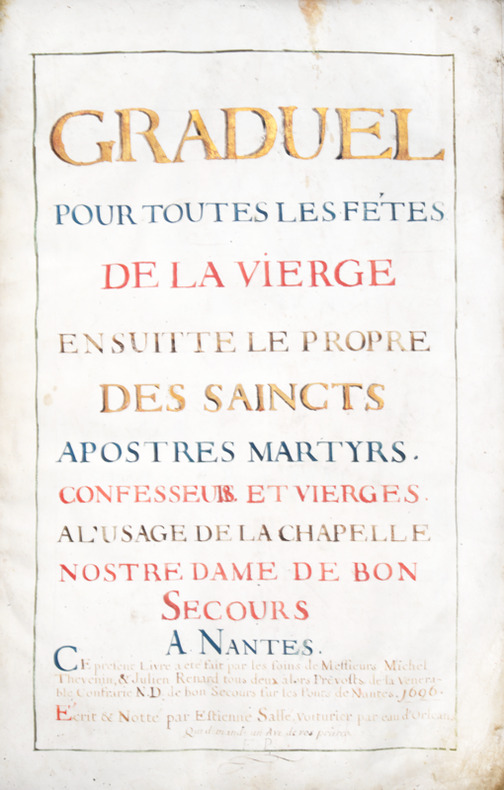
169641766Nantes, , 1696. Grand in-folio manuscrit (56 x 37 cm) de (2)-220-(6) pp. sur parchemin, index, 8 portées par page à l’encre rouge soulignées par le texte latin à l’encre brune, nombreuses initiales peintes à l’encre rouge, bleue ou dorée, 5 lettrines enluminées, veau brun sur ais de bois, dos à sept nerfs, deux cabochons au centre et quatre pièces d’angle de cuivre, ornés, ciselés et cloués sur chaque plat, traces de fermoirs (reliure de l’époque).
Oblong 8vo (214 x 148 mm). Hindu manuscript on wove paper. 175 leaves, 9 lines of Devanagari script in black and red ink within double red rules at left and right. With 5 polychrome painted and gilt illustrations encclosed within black rules and bright red borders. Every chapter opening with a red ink invocation to Sri Ganesha, the Remover of Obstacles; outer borders of each page painted in light yellow, with marginal notes and index. Cardboard binding lined with silver thread-embroidered burgundy silk with floral motifs. Charmingly illustrated Indian manuscript compendium on the Hindu Deities. Includes various texts such as the list of 108 names of Lord Ganesha, the 11th Chapter of the Devi Mahatmya, a prayer to Lord Jagannath, Jagannathastakam, as well as further prayers. The vividly coloured illustrations feature Hindu and Vedic deities. - Binding rubbed and bumped; covers a bit loose. Provenance: private American collection and latterly in a private German collection.
- Paris s.d. [1890], 21,3x14cm, 3 pages in-8 au verso de 4 feuillets de l'Assistance publique de Paris. - VERLAINE Paul Complete autograph manuscript signed by Paul Verlaine of one of his Hospital Chronicles: "We poets, as well as they, the workers, our companions in misery" Paris n. d. [1890], 213 x 140 mm (8 3/8 x 5 1/2 "), 3 pages in-8 at the back of 4 leaves of the Assistance publique de Paris Complete autograph manuscript signed by Paul Verlaine of one of his Hospital Chronicles, 90 close lines in black ink on the verso of paper from the Assistance publique de Paris. The chronicle of one of Verlaine's stays in hospital between September 1889 and February 1890. The note "III" has been crossed out in blue printer's pencil. In the definitive collection, this text is, in fact, second. In the version published by Le Chat noir on 5 July 1890, there appear to be no variations with the text of this manuscript. This is thus the final state of the text, the one sent to the printer. Jacques Borel dates the writing of this chronicle to a hospital stay in Cochin in June 1890. Verlaine spent many days in hospital during his life, especially in this period. During these stays, he wrote Hospital Chronicles, prose poems in eight parts. Here, he mixed anecdotes, observations of the lives of the patients, and a delicate poetical analysis of the world of the hospital. Verlaine starts off with a troubling and tired observation: "But certainly, all the same, the Hospital darkens, despite the fine June weather...Yes, the Hospital is dark despite philosophy, insouciance, and pride." Despite the fine weather, the inflexibility of the system, the misery and the sickness give the poet a gloomy take on things: "let us punish all objections under pain of expulsion, still severe, even in this month of flowers and hay, of warming days and clement nights, if you have the devil at your back and debt and hunger at home." Discharge, whether by way of being thrown out or getting cured, and life outside did not offer more comfort than the stay itself: "Clearly, we'll all get out sooner or later, more or less well, more or less happy, more or less sure of the future, at any rate more or less alive. So we will think sadly...of our suffering, emotional and otherwise, of the doctors, good or inhuman". This was a feeling he had already experienced during what he called "my intervals", the times when he was out of hospital. Life outside hospital was a miserable prospect, despite his established fame. Verlaine compares his misery to that of the working classes who share his stays in various hospitals. The poet calls for resignation from his "brothers, artisans of one sort or another, workers without a life's-work and poets...and publishers too, let us accept our fate, let us drink up the cup of tea with (barely any sugar), or this little hot chocolate, and let us be brave whether it be with our medicine, or an enema, or chewing tobacco. Let us follow their prescriptions closely, let us obey all injunctions, so that injections and colonics will seem sweet to us, and let us reprimand all objections...". And along with them, the poet wanted to take advantage of the beauties of June in quoting two verses from the Chanson sentimentale of Xavier Privas: "We are pleased with ourselves in the strong sun. And under the green branches of the oaks, we poets, as well as they, the workers, our companions in misery...". Equal in the face of misfortune, whether active or passive, they might feel nostalgia once they were out: "And perhaps some day we will miss these good times where you workers, you could rest and where we, we poets, worked, and where you artists earned your wine and your cups ...?" Despite this reverie, Verlaine was: "tired of so much poverty (provisionally, believe me, because I have been so used to it these last five years!)" and concludes bitterly with the observation of the lack of humanity in modern medicine: "Hospital with a capital H, an awful idea, ev