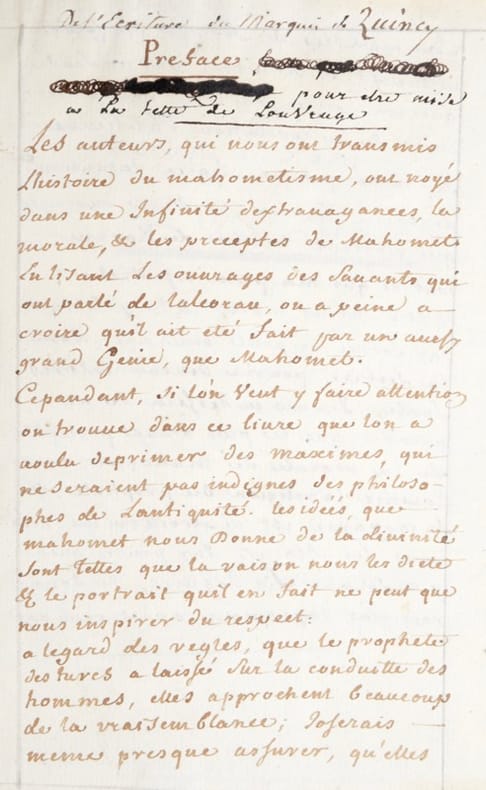
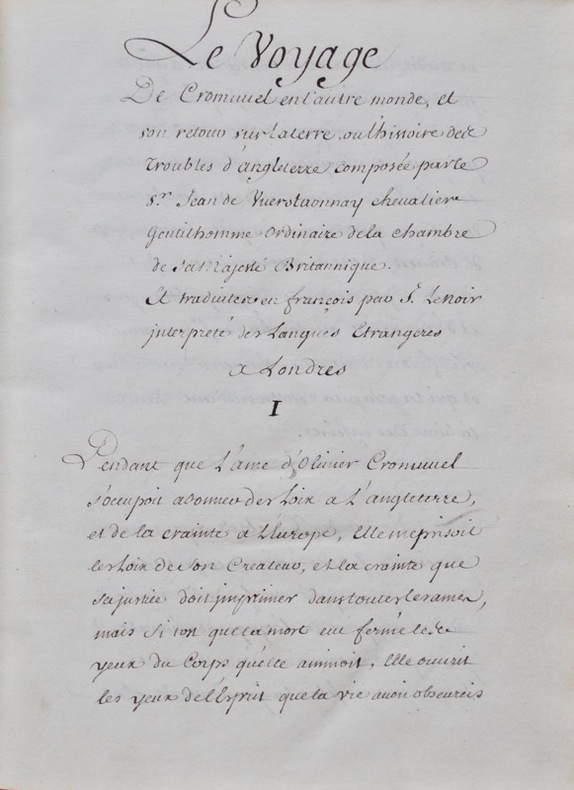
19 878 résultats
Folio (210 x 310 mm). German manuscript on paper. 698 written pages on 396 unnumbered ff. Contemporary calf; spine gilt. Collection of almost entirely German (Austrian) 16th century legal texts, but also comprising a few 15th century sources (and one in Latin), thus assembled in the late 17th century. The tax legislation for all five Lower Austrian countries and Gorizia from 1542 (copied from the printed book) is followed by the extensive Treatises of Bernhard Walther (the "father of Austrian law" who in the mid-16th century collected the Lower Austrian customary law). The present, very complete manuscript comprises 14 of the 15 treatises (all except that on bankruptcy), and it was used by Max Rintelen for his critical edition, published in 1937 (cf. reference below). The treatises are followed by decisions concerning the law of inheritance ("Von Erbschafften drey Fragen, dem Herrn Landtmarschalkh ... alhier anzuzaigen"; "Ob deß abgestorbnen Wittib, oder Glaubiger den Vorgang haben: Der Regierung Rathschlag" etc.), "Bericht wegen der Caution im Landtsrechten in Österreich Under der Enß", "General wegen der Verstorbenen Pfarrer in Steyer Verlassenschafft", "Tractatus de testibus, ex secundo tomo actionum forensium D. Joan. Oldendorffii"; "Königlicher Bevelch daß ain jede Sach vor dem ordentlichen Gericht erster Instanz clagt soll werden (4 March 1534); "Khay. May. Declaration und Spruch zwischen der Löblichen Universitet zu Wienn, und gemainer Statt daßelbst" (1571), "Gemaine Beschwerung der Erblande" (with detailed regulations on mining and minting, manslaughter, gypsies, Jews, etc.), confirmations of decrees issued by Frederick III in 1444, 1462 and 1470, etc. - Some waterstaining near end; occasional slight staining. Spine-ends professionally repaired. Provenance: Handwritten ownership of Baron Anton von Egger (d. 1727): "Ex lib. Ant. L. B. de Egker". Later in the collection of the Austrian legal historian and numismatist Arnold Luschin von Ebengreuth (1841-1932) with his etched bookplate to the front pastedown. After Luschin's death his heirs presented the volume to his student, the legal historian Max Rintelen (1880-1965); cf. his entry in blue ink: "Von Luschins Erben erhalten. Max Rintelen". M. Rintelen, Bernhard Walthers privatrechtliche Traktate (Leipzig 1937), Ms. LE (p. XVIII).
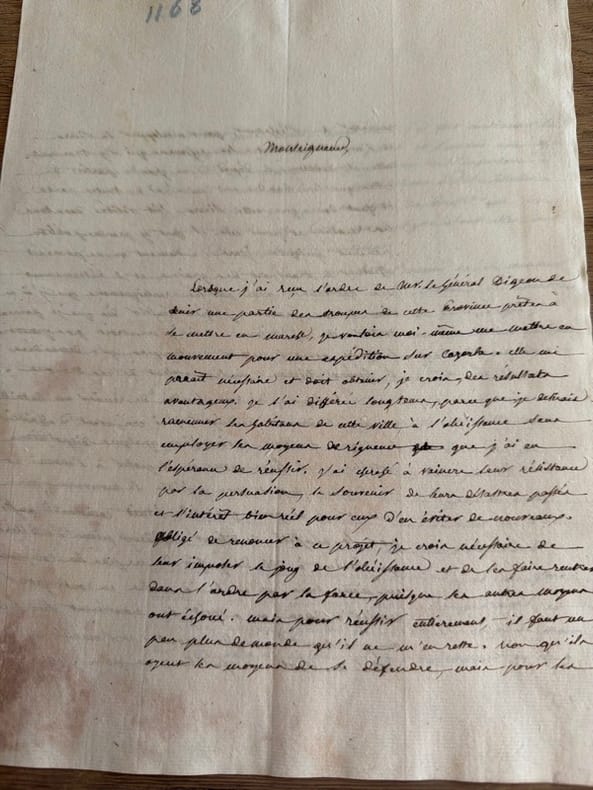
234918Ll. dd., décembre 1811 19 pièces in-folio ou in-4, écritures de différentes mains, certaines pièces comportant ratures et biffures, en feuilles.
234929Ll. dd., octobre 1811 - novembre 1811 35 pièces in-folio ou in-4, écritures de différentes mains, certaines pièces comportant ratures et biffures, en feuilles. Traces d'humidité sur de nombreuses pièces.
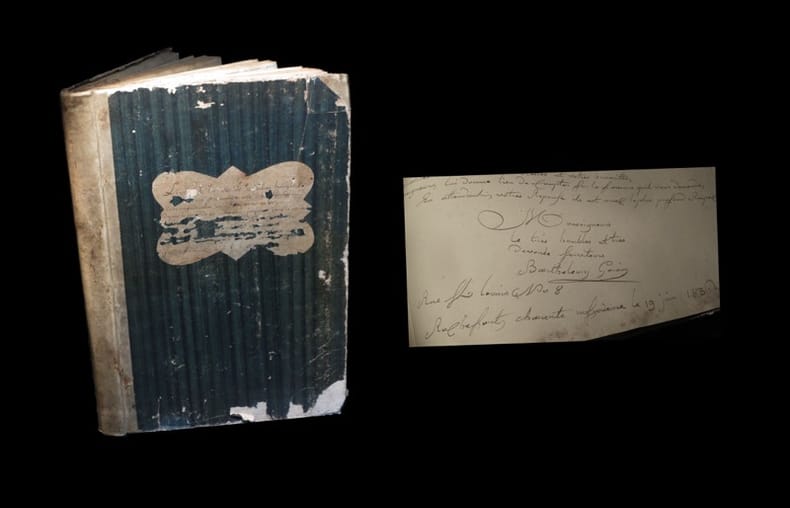
183626477Manuscrit daté in fine de 1836. Un vol. au format in-folio (450 x 302 mm) de [99 ff.]. Reliure de l'époque de demi-vélin ivoire à coins, pièce de titre manuscrite contrecollée au premier plat, dos lisse.
152855S.l. [Douai], s.d. (1791) in-4, [113] pp. (seules les 21 premières sont chiffrées), couvertes d'une écriture fine et lisible (environ 40 lignes réglées par page), avec 11 figures aquarellées dans le texte, et 9 pl. hors-texte (dont deux ff. doubles volants, et une grande carte dépl. aux contours rehaussés de couleurs, représentant le tracé du cours de la Sambre depuis la frontière jusqu'à Namur), en feuilles.
244644S.l. [Paris], s.d. (1760-1767), in-folio, [2] ff. n. ch., 290 pp., un f. n. ch., le tout couvert de graphies à plusieurs mains, régulières et très lisibles, peau de truie retournée teinte en vert, à lacets, dos lisse muet, tranches mouchetées de rouge (reliure de l'époque). Coins abîmés.
172777(1800) , 28 pp. in-4 en cahier.
1836264771836. Manuscrit datÂŽ in fine de 1836. Un vol. au format in-folio 450 x 302 mm de 99 ff. Reliure de l'ÂŽpoque de demi-vÂŽlin ivoire ˆ coins piÂce de titre manuscrite contrecollÂŽe au premier plat dos lisse. Important manuscrit ; comportant in fine la date de 1836. La rÂŽdaction en est pourtant lÂŽgÂrement antÂŽrieure. Une deuxiÂme partie est intitulÂŽe Batailles combats et victoires des armÂŽes franÂaises ˆ laquelle un certain nombre de feuillets font dÂŽfaut. Une derniÂre partie est relative ˆ la mort de l'Empereur ; renfermant poÂmes et Eloges. Cet important travail est dÂŽdiÂŽ au Ministre de la Guerre du temps. Il se compose de 98 ff. narrant la vie de NapolÂŽon rÂŽdigÂŽs ˆ l'encre brune ; le dernier renseigne sur les fonctions et qualitÂŽs du scripteur et est revÂtu de la signature autographe de BarthÂŽlÂŽmy Germain ; auprÂs duquel il servit. Angles et coupes ÂŽlimÂŽs. Manques ÂŽpars affectant le papier marbrÂŽ des plats ainsi que la piÂce de titre. Quelques t‰ches dans le texte. Coulure sans entrave pour la lecture affectant deux feuillets. LÂŽgÂre cerne en marge infÂŽrieure des feuillets pouvant rendre parfois la lecture plus dÂŽlicate. Encre un peu passÂŽe sur quelques feuillets. b42961 unknown
4to (180 x 230 mm). Latin manuscript on paper. (2), 12, (2) pp. The text on each page is written inside a carefully embroidered rainbow composed of concentric circles in multicoloured thread. Sewn binding. Golden decorated paper wrappers with a floral design on Augsburg brocade paper. This beautifully decorated Latin manuscript presents a short play, which dramatises the gratitude of Bavaria towards St. Rupert of Salzburg (ca. 660-710 CE) for his work as an apostolic missionary to the area. The titles translates as "Faithful Bavaria gives honoured thanks to the great Apostle St. Rupert for the faith in Christ she received from him". The play was composed in honour of Father Rupert, Prior of the Servite Monastery and Church Mariae Geburt at Maria Langegg between Melk and Krems, Lower Austria, as he celebrated his name's day (27th March) in 1746. - The play's four characters ("Genius Boyariae" - the Spirit of Bavaria; "Pietas" - Piety; "Virtus" - Virtue; "Genius Conventus Langeggensis" - the Spirit of the Langegg Monastery) are accompanied by a chorus. In rhythmic lines of uneven length, organised as rhyming couplets, the characters recreate Bavaria's internal dialogue with the personified Christian values of piety and virtue. In form and poetic conceit, the piece can thus be placed in the genre of baroque meditation literature ("sacrae meditationes"), which were particularly popular across the Catholic world in the mid-18th century. Accordingly, praise of St. Rupert (and thus also of his namesake Father Rupert of Maria Langegg) is never far from the audience's mind: "Tuam miror virtutem, Ruperte / Cui similem haud vidi certe. / Ast! Quid dabo viro isti, / qui dedit mihi fidem Christi?" ("I admire your virtue, Rupert; / I have hardly ever seen anything like it, for sure. / Oh! What shall I give this man, / who has given me my faith in Christ?"). - The front cover has two small but noticeable stains with small holes which have leaked through to all but the final page. These marks do not affect the text or embroidery. The back cover has a series of light green marks causing no further damage. The pages show light foxing and browning throughout, with very occasional defects on the lower right-hand side of folios, as the result of page-turning. Altogether a unique and well-preserved object with dainty decoration, of interest for the history of 18th c. monastic life and the figure of St. Rupert of Salzburg in the baroque period.
172042893S.l.n.d., , (1720 circa). Petit in-4 (222 x 167 mm) de (1) f. 102 pp. mal chiffrées, 18 lignes par page, veau brun, dos orné à nerfs, pièce de titre en maroquin rouge, signet, tranches jaspées (reliure de l’époque).
8vo (115 x 162 mm). 100 ff. Arabic manuscript on paper. 21 lines, per extensum. Brown ink (as well as light red for rubricated terms) in an essentially drawn, compact, non-serifed Yemeni naskh calligraphy. 19th century Arabic manuscript copy of two much earlier mystical works concerning the virtues and benefits related to the knowledge and recitation of the Holy Qur'an, namely: - 1) Kitab al-Barq al-Lami wa’l-Gayt al-Hami ("The Book of the Shining Flashes and Showering Rain"), epitomizing the work of the early Islamic judge Abu Bakr al-Gassani, probably an abridged version of the "Kitab ad-Durr an-Nazim fi Fada'il al-Qur'an al-Azim" by the Yemeni mystic Muhammad ibn Ahmad ibn al-Hassab (fl. 1250s AD). - 2) Kitab Hawass Ayat min-al-Qur’an wa Fawatih al-Suwar ("The Book of Peculiarities of the Qur'anic verses and the Surahs’ overtures"), a late work by the famous Persian mystic and thinker Abu Hamid al-Gazali (d. 1111 AD), here referred to by his traditional honorific "Huggatu’l-Islam" ("Proof of Islam"). - The book contains an anthological commentary on specific Qur'anic verses (ayat) and their supposed virtues and talismanic properties. The first work’s initial chapter, e.g., deals with the virtues of those verses in the Holy Qur'an that name the Prophet (an-Nabi) Muhammad. Immediately afterwards, the Ayat al-Shifa’ (i.e., “Healing Verses”) are included. Here, they are nine Qur'anic verses deemed effective against illness if recited by a believer with pure heart. The second part of this codex quotes several Qur'anic verses suitable for specific occasions, listed after each Surah. - Dated in the first colophon, where Amr bin Abi Hurayra is mentioned, the son of a famously prolific Yemeni traditionist and hadith collector (Sunni scholars ascribed to Abu Hurayra more than 5000 hadiths). The scribe is named as Ahmad ibn al-Hagi Muhammad. Cf. F. Sobieroj, Variance in Arabic Manuscripts - Arabic Didactic Poems from the 11th to the 17th Centuries (Berlin 2016), pp. 90f. & note 128.
8vo (160 x 110 mm). 32 written pp. on 18 foliated ff. Contemporary grey wrappers. The first two folios (f. 1r-2v) contain notes on expenditures and revenues from January 1 through 27, 1506. From fol. 3r onwards (to 17r), the booklet contains notes (by another hand) regarding rental receipts udring the year 1538. - Wrappers made of twice-folded grey paper; slightly smudged; exterior layer of paper damaged. Paper with watermark (scales with letter "A" above: not recorded by Briquet thus, while the letter "A" is listed (no. 7919) and confirmed for Venice, 1503.
Folio (ca. 212 x 310 mm). German and Latin manuscript on paper. 258 ff., including 6 blank leaves. Contemporary full vellum with spine title and leather straps. A unique compilation of 16th century Austrian legal texts, most of them by the lawyer and chancellor Bernhard Walther (1516-84), the "father of Austrian jurisprudence" (cf. Luschin-Ebengreuth 1896). Includes his code of procedure of Lower Austria (ordinaria and extraordinaria), of the lex familiae, an instruction for law students, the fees of the Lower Austrian chancellery, a copy of imperial privileges confirmed or newly issued by Emperor Charles V in 1522, an order by the Landmarschall of Lower Austria, Georg von Puchheim (died 1531), the rules for court hearings, including the hearing of witnesses, and regulations for procurators. Followed by 14 of Walther's famous 15 private-law treatises, omitting the one on familial trees. The treatises were edited and published by Max Rintelen in 1937, who, however, fails to note this manuscript source in his index of extant codices. - Folios 252-258 contain copies of imperial charters from 1528, 1568 and 1583, belonging to the treatise on fiefdom; folios 255-257 written by another hand. 1650 ownership by Hans Sauer v. Sauerburg, the town scribe of St. Pölten (1635-52), to flyleaf. - Binding somewhat brownstained, a little scratched. Cover warped, upper hinge starting. Paper evenly browned and brownstained throughout. Small tears to a few pages, mostly affecting the lower margins. Tear in f. 76 repaired with sealing wax. Flaws at the margins of the first page, rebacked with paper. Signs of use: some passages crossed out, old marginal annotations by another hand. Last in the library of the Viennese collector Werner Habel, with his signed and stamped ownership to front pastedown, dated 1978. Not in M. Rintelen, Bernhard Walthers privatrechtliche Traktate aus dem 16. Jahrhundert (1937).
Folio (250 x 375 mm). (100) Bll. Deutsche Handschrift auf Papier. Durchschossen. Mit 3 Lacksiegeln. Halblederband der Zeit mit blindgepr. Rücken und dekorativem Titelschild am Vorderdeckel. Sauberes Rechnungsbuch des Kellermeisters der Herrschaft Rauhenstein-Weikersdorf in Baden bei Wien unter der Regierung Anton I. von Doblhoff-Dier (1733-1812). In monatlich geführten "Journalen" werden der Weinkonsum der Herren und deren Bediensteten, der Weinverkauf sowie der in der Heiligen Messe verwendete Wein in Eimer, Maß und Seidel über einen Zeitraum von drei Jahren verzeichnet. - Auf jedes der drei Dezember-Journale folgt das jährlich geführte "Haubt-Buch über das bey denen hochfreyherrlich Doblhof Dierischen Herrschafften Rauchenstain und Weickerstorff geführte Keller Journal", unterzeichnet vom Kellerbesorger Franz Xaver Hueber. Die "Hauptbücher" ergänzen die vorangehenden "Journale" durch genauere Angaben, welche Menge Wein wann an wen in welchem Zusammenhang verkauft bzw. abgegeben wurde. Daraus geht hervor, dass die Doblhoff'schen Weingüter einige Wirtshäuser belieferten, darunter Christian Wallner, "Würth in Saurhof", und Sebastian Ludler, "Würth am Anger"; auch der herrschaftliche Fassbinder erhielt monatlich eine Ration, und selbst einige "alhier anwesende Wienner Mahler" wurden am 29. Mai 1772 mit Wein versorgt. Auch nach Wien, möglicherweise direkt an den Kaiserhof, lieferten die Doblhoffs ihren Wein. Ferner hatte die Herrschaft Abgaben an Stift Melk und das Kloster Klein-Mariazell sowie Almosen an Bettelorden zu leisten. Insgesamt 54 Eimer Wein scheinen in diesem Zusammenhang für das Jahr 1772 auf. - Die Herrschaft Rauhenstein-Weikersdorf, seit 1741 im Besitz der Freiherren von Doblhoff-Dier, war für ihre fortschrittliche und gewinnbringende Wirtschaftsführung bekannt. Mit ein Grund für ihren Erfolg dürften minutiös geführte Amtsbücher wie das vorliegende gewesen sein. - Einband an den Rändern etwas berieben; im Inneren ausgezeichnet erhalten. Die Journale der Monate Oktober und November 1774 herausgetrennt.
195375729Paris 8 janvier 1953 | 21 x 27 cm | 1 pages et quelques lignes sur un feuillet
8vo. Dutch manuscript on paper. 87 ff., last blank pasted to back cover (collation: A-L8). Interesting devotional manuscript in Dutch containing extensive instructions and rules for behaving, praying and meditating, and living a good religious life in a monastery from hour to hour. The booklet also gives the texts prayers and meditations to perform during the day. It is a sort of "Diurnale" (a shortened Breviary), written by the prior of a monastery ("het Syon"), for his brothers. - Strangely enough the text seems to have been written by a Dutchman from the northern Netherlands where all the monasteries were demolished during the beginning of the Eighty Year's War, and where the Roman-Catholic faith was tolerated at best. "Het Syon" is an often used name for a monastery, for example one near Beverwijck, or near Delft, but, again, these cloisters were no longer in existence. Possibly, Johannes Baptista van den Bossche was a refugee from the north and active in the Southers Netherlands. The manuscript is written in a clear, sophisticated, and almost calligraphical handwriting (by Johannes van den Bossche himself?) in two scripts: italic and a script reminding the civilité type. - Very well preserved.
19304275Paris J.L.L. d'Artrey 1930 in-8 bradel Paris, J.L.L. d'Artrey, sd [1930-1956]. 7 volumes in-8, 4 - (6) - 674, 737 (2), 4 - 715 (3), (4) 626 (1), 861 (2), 4 - 743 (1), 75 (2) - 47 - 16 pp., reliés uniformément (pleine toile chamois à la Bradel), couvertures supérieures conservées.
67928Barcelona, M. Moleiro Editor, 2019 Bound in luxurious brown-marron leather with gilt lettering, housed in a slipcase with gold motifs. 100 pages, 94 illuminations with gold richly decorated miniatures, either full-page or arranged across the page in multiple pictorial strips. Full-colour facsimile edition. Size: 32 × 23 cm. ****NUMBERED COPY NO. 418 OF A LIMITED FACSIMILE EDITION OF 987 COPIES, ISSUED WITH A CERTIFICATE OF AUTHENTICITY.*** Includes a full-colour commentary volume, 276 pages, hardcover with dustjacket, text by Richard K. Emmerson. ISBN 9788488526793.
185876111Nohant 3 juin 1858 | 13.40 x 20.90 cm | 4 pages sur un feuillet remplié
187275733Nohant 19 semptembre 1872 | 13.20 x 20.60 cm | 20 pages 1/2 sur 21 feuillets
191875931Paris s. d. [ca 1918] | 13.30 x 21 cm | 2 pages sur un feuillet
193320863S.d. (circa 1933-1934); in-folio en feuilles, couverture rempliée gris clair illustrée, chemise demi velin et pièce de titre en cuir, titre doré, papier à la cuve multicolore et doré en forme de feuillage, étui de même ; 86 feuillets non chiffrés, le dernier blanc ; couverture et 50 aquarelles originales de Barta, dont 3 hors-texte.
1595715481 registre in-8 (27 x 20 cm) reliure plein vélin de remploi, rédigé tête-bêche, Mention de titre en couverture: «Memoyre : [… ] testamens, mariage [… ] Declaration d’actes, d’achapts et autres mémoires» et sur l’autre couverture: «Memoyre des quitances Dachpts [ Mémoire des Quittances d’Achat ], 1 f. blanc, 17 ff. manuscrits, 53 ff. blancs, 55 ff. manuscrits. On joints quelques actes de même provenance (dont une transaction immobilière à Saint-Astier).Passionnant «Livre de Raison» de la famille de Paul de Lacoste, époux de Fr. de la Grace (marié en 1659), ayant passé son testament devant notaire royal à Sainte-Foy-la-Grande. La généalogie remonte à Mathieu de Lacoste, né en 1560, puis à Jean, fils de Mathieu, né en 1595, Etienne (né en 1597) et Suzanne (née en 1599). Jean est baptisé par Mollay, ministre de Fauillet, Etienne par le ministre Danglade, Suzanne par Desparats, «ministre de cette ville», juste après la promulgation de l’Edit de Nantes. Parmi d’autres documents joints, un acte daté d’octobre 1709 fait mention de «Noble Alexandre de Lacoste, Escuyer seigneur de Lussac», manifestant l’ascension sociale de la famille de Lacoste. Comme dans tout livre de raison, on y trouve non seulement mention des actes d’état civil, mais également de tous les achats, échanges de terre et de consolidation parcellaire révélatrice de l’accroissement de la fortune des Lacoste. On y découvre surtout un remarquable «Estar du Raport du bled de la ville & iurysdicion de St foy En Ajenois sur dordogne despuis lannee 1577. iusques a lannee 1642 et suyvantes ainsy quil a communement valeu au marche dicelle annee par annee, Ledict Raport S'estrant au vray des livres de monsieur Proizeau S. de [masse]... & de Faure. Et afin que le raport iuste puisse servir a ceux de Montravel faut scavoir que la mesure dud. montravel Est plus grande que Celle de St foy dune neufviesme. ainsy quand Le bled a valu dans st Foy huit solz il faut conter neuf pour Montravel. Et lorsquil a bally [valu] vingt & quattro solz faut conter vint & sis Et un quart ou quan pour sept de plus. la forée se fait du prix du bled d'ung St martyn a lautre St Mich. la l’autre.» [ Transcriptionrapide : État du rapport du blé de la ville et juridiction de Sainte-Foy-en-Agenois sur Dordogne [Sainte-Foy-la-Grande], depuis l'année 1577 jusqu'à l'année 1642 et suivantes, tel qu'il a couramment valu, année après année, sur le marché de ladite ville. Ce rapport est extrait fidèlement des livres de monsieur Proizeau, seigneur de Masse, et de Faure. Et afin que ce rapport exact puisse également servir pour Montravel, il faut savoir que la mesure dudit Montravel est plus grande d'un neuvième que celle de Sainte-Foy. Ainsi, lorsque le blé vaut huit sols à Sainte-Foy, il faut compter neuf sols pour Montravel. Et lorsqu'il a valu vingt-quatre sols, il faut compter vingt-six sols et un quart (ou un quarton) en plus. La forée [i.e. le prix moyen officiel] s'établit d'une Saint-Martin à l'autre (ou d'une Saint-Michel à l'autre) ]. Le document est en réalité plus complet, car il contient les relevés systématiques du prix des grains à Sainte-Foy-la-Grande de 1577 jusqu’à 1699 (liste de 1577 à 1676 puis de 1677 à 1699), pour le froment, le seigle et l’avoine, mesuré par quart (l’unité locale de mesure des grains)! On y relève l’explosion des prix certaines années, comme en l’année 1595, en 1598 ou en 1694, fameuse année de famine... La seconde partie rédigée tête-bêche s’ouvre sur une longue description(une page et demie) de l’inondation d'une cité (sans doute Sainte-Foy) par la Dordogne, survenue le 15 mars 1615. On y évoque la place du Foirat, le lieu dit La Crabière, la porte du chay appelée la Libournaise (ou Libournette), la fonte subite des «neiges des montagnes» qui surpris la plaine. Suit une brève description d’un autre tempêtedu 20 février 1617 «fust un sy grand vent qui dura presque tout le jour» qu’il abattit «grand quantité de grands noyers et autres grands arbres» [ … ]
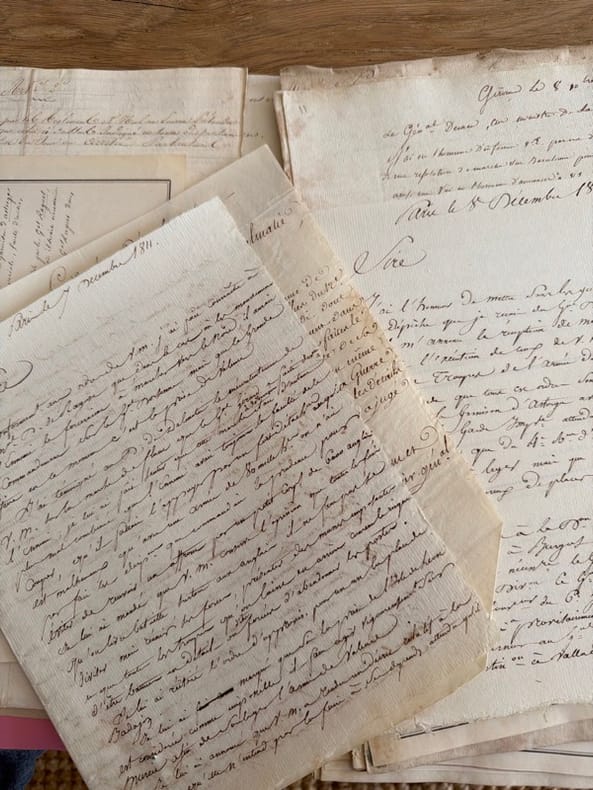
175011691, , 1750 ca. Manuscrit in-4 (18 x 24 cm) de (212) ff. à 20 lignes par page, veau fauve glacé, dos à nerfs orné d'une hermine et d'un macle couronnés, tranches rouges (reliure de l'époque).
177690973Versailles 31 janvier 1776 | 18.3 x 24.4 cm | Bifeuillet