Pergamino, GiacomoBiblio.com
153 résultats
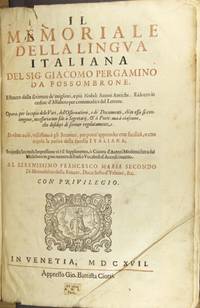
161743152Venetia: Apresso Gio. Battista Ciotti 1617. Seconda impressione two parts in one folio pp. 12 609 1 8 236; a6 A-2N8 2O-2p6 †4 A-O8 P6; V4 of the first section missigned R4 with manuscript cancellation; woodcut printer's device initials and head- and tail-pieces; title page printed in red and black; text in double columns; full contemporary vellum soiling calf bands manuscript spine title and ornamentation; vertical hatch marks to upper cover edges quite rubbed and worn; endpapers supplied title page edges rather ragged minor worming to preliminaries else textblock mostly very good. Small period manuscript paper label "Ad usum A.M.L. Parm." mounted to bottom of title page. Zaunmüller p. 209. OCLC does not locate any copies in the United States. Apresso Gio. Battista Ciotti unknown
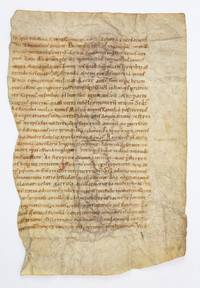
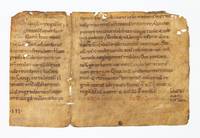
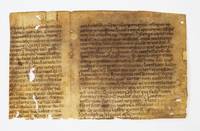
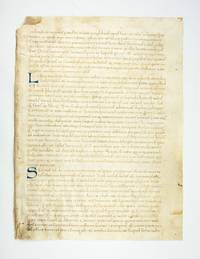
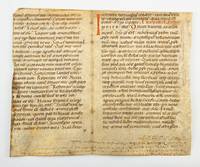
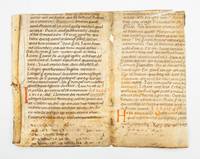
ST19350-006Germany 12th century. 272 x 185 mm. 10 3/4 x 7 1/4". Single column 28 lines in a late Caroline hand. <br/> ◆Leaf trimmed irregularly along one side about 18 lines lacking a letter or two vellum a bit wrinkled and worn text a little faded in places but still very presentable and the text almost entirely legible.<br/> <br/> Penned in a pleasing and very legible late Caroline hand this leaf has sustained very little loss and is remarkably well preserved for having been previously reused as binding scrap. Although the text includes several abbreviations that are commonly found in proto-gothic scripts the hand also shares a number of similarities with the Caroline minuscule that dominated Western Europe scribal hands in earlier periods including a long "s" with the shaft on the line and the use of the ampersand as a general abbreviation for the letters "et" occurring anywhere in a word. The text here comes from Pope Gregory the Great's "Moralia" conceived as a commentary on the book of Job and begun when Gregory was just a young papal envoy to Constantinople. It is a guide to the Christian life written in simple direct language which transforms the thought of Augustine into a practical manual of behavior. unknown
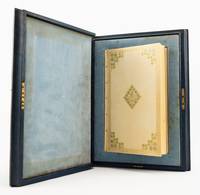
1937ST21066London: William Heinemann Limited 1937. FIRST EDITION. Book: 245 x 152 mm. 9 3/4 x 6"; Case: 330 x 235 mm. 13 x 9 1/4". 3 p.l. 34 pp. <br/> LOVELY CONTEMPORARY STIFF VELLUM GILT AND PAINTED covers with delicate gilt frame sprays of flower and leaves at each corner outlined in gilt and painted blue and green central lozenge outlined in gilt dots and framed by painted flowers and leaves a large initial "A" in gilt at center smooth spine divided into compartments with gilt and painted floral ornament turn-ins with gilt floral roll sky blue silk endleaves all edges gilt. Housed in a fine oversized blue morocco case designed to look like a book with gilt lettering on the upper cover raised bands gilt ruled compartments and lettering to spine the interior constructed and padded to hold the smaller book and lined with blue velvet spine of case a bit sunned corners a little rubbed clasp no longer functional. A FINE COPY clean and fresh internally in a pristine binding.<br/> <br/> With very considerable visual and tactile appeal this is a gracefully bound copy of the the final book of verse issued by Richard Aldington published before he turned exclusively to writing prose. A leading poet of the early 20th-century Imagist school Aldington né Edward Godfree Aldington 1892-1962 was a prolific writer whose 50-year career produced novels biographies translations and literary criticism as well as sharp minimalist free verse. He was part of the contemporary London avant-garde crowd being close friends with Ezra Pound T. S. Eliot Amy Lowell and D. H. Lawrence; and he was especially close to the poet H. D. Hilda Doolittle his first wife from 1913-38. As literary editor of the leading Modernist periodical "The Egoist" he was an integral part of the pre-World War I literary scene and his first largely autobiographical work "Death of a Hero" 1929 was considered by George Orwell and Lawrence Durrell to be the best of the English Great War novels. The poems here were written in the mid-1930s when Aldington had decamped to the United States after the woman he loved Netta Patmore rejected his proposal of marriage. While tracing his grief and longing the verses also build the image of a "crystal world" created by the love of an ardent couple concluding that "Only from the purity of extreme passion / And alas the purity of extreme pain / Can you build the crystal world." Happily Aldington's beloved Netta to whom the work is dedicated reversed her decision and agreed in 1938 to help him build their crystal world together. The present lovely binding is unsigned but the delicate precise tooling and elegant design indicate the work of very talented hands. The romantic contents and the rather feminine aspect of the binding suggest that this was a gift from one lover to another perhaps a recipient sharing the initial "A" with our author. And the oversized and extravagant custom case indicates how much this object was treasured. William Heinemann Limited unknown
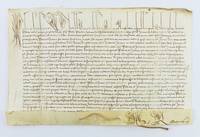
1622ST12778-0281Rome 1622. 295 x 410 mm. 11 5/8 x 16 1/8". Single column 23 lines in a papal chancery hand. <br/> Elaborate lettering across top line of text. Lower margin with several signatures in ink; verso with brief notes in ink; lacking the original hemp tie and lead seal. Two tears at bottom of the document where ties were removed not affecting text vellum lightly soiled but in excellent condition overall.<br/> <br/> Addressed to the Archbishop of Naples this Papal Bull grants a marriage dispensation between Fabritio Virgopia and Judith Cuono. An online search finds nothing about the couple named here but the document reveals that they were petitioning for a dispensation because they fell into the second and third degrees of consanguinity meaning that they shared at least one common ancestor. Although marrying within four degrees of consanguinity was prohibited by the church it was not uncommon for the Holy See to issue dispensations as here allowing such marriages to take place—particularly for the privileged classes. The Papal Bull takes its name from the lead seals called "bullae" lacking in the present example that were issued with official documents of the papacy as a way of ensuring their authenticity. Apart from the very rare Solemn Privilege like Innocent III's famous granting of England in 1214 to his involuntary vassal King John there are three categories of Papal Bulls: Simple Privileges also called Solemn Letters Letters of Grace which confirm privileges and rights but are somewhat smaller and Mandates which are differentiated by their use of hemp ties as opposed to silk as would have been the case here. Pope Gregory XV born Alessandro Ludovisi 1554-1623 ruled for just over two years from 1621-23. His brief papacy was marked by efforts to support the Catholic Counter-Reformation including the establishment of the Congregation for the Propagation of the Faith to oversee missionary work. He also played a key role in the election of Holy Roman Emperor Ferdinand II canonized notable saints such as Ignatius of Loyola and Francis Xavier and issued the last papal mandate concerning witchcraft. Documents issued by Gregory XV are unsurprisingly rare given the shortness of his rein: we could trace just one sold at auction since 1995. unknown
1614ST12778-0352Rome 1614. 203 x 319 mm. 8 x 12 5/8". Single column 25 lines in a papal chancery hand. <br/> With braided cloth tie for appended seal now gone. Elaborate lettering all across top line of text especially the first 8-line initial and at lower right corner. Lower margin with several signatures in ink behind the fold; verso with brief notes in ink; remains of hemp tie for appended seal which has been cut away. Three vertical and one horizontal fold creases faint overall yellowing to verso possible erasure correction in second line of text otherwise the page bright and the hand clear.<br/> <br/> Addressed to the Archbishop of Naples this Papal Bull grants a marriage dispensation between Pietro Palladino and Giovanna Cabalone. An online search finds nothing about the couple named in the present document but they were apparently high-ranking Neapolitan citizens who had the means to procure a Papal intercession. Likewise the particular impediment prohibiting the marriage is not apparent here. This type of document takes its name from the lead seals called "bullae" that were issued with official documents of the papacy as a way of ensuring their authenticity. Apart from the very rare Solemn Privilege like Innocent III's famous granting of England in 1214 to his involuntary vassal King John there are three categories of Papal Bulls: Simple Privileges also called Solemn Letters Letters of Grace which confirm privileges and rights but are somewhat smaller and Mandates which are differentiated by their use of hemp ties as opposed to silk as here. A member of the influential Borghese family Pope Paul V born Camillo Borghese 1550-1621 reigned as head of the Catholic Church for 16 years from 1605 until his death. As a staunch defender of the rights and privileges of the church he often came into conflict with secular leaders. He is perhaps best remembered for financing the completion of St. Peter's Basilica and for his involvement in the Galileo controversy in which he warned the scientist against advocating heliocentrism. unknown
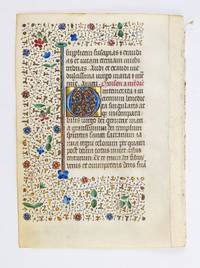
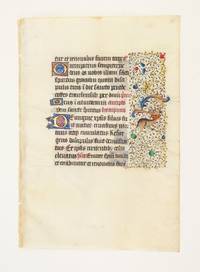
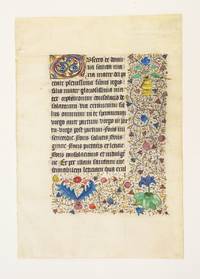
1475ST19653NNorthern France ca. 1475. 155 x 110 mm. 6 x 4 1/4". Single column 16 lines in a gothic book hand. <br/> Rubrics in dark pink ONE EXQUISITE FOUR-LINE INITIAL painted blue with white detailing filled with red and blue vines and leaves on a burnished gold ground with a painted and gilt bar border on one side each end capped with a flower the text surrounded on three sides with a border of acanthus leaves dense rinceaux colorful flowers gold ivy leaves and bezants. A couple negligible imperfections but IN VERY FINE CONDITION<br/> <br/> One of the most popular optional prayers in the 15th century Book of Hours "O Intemerata" "Oh immaculate virgin" is a brief supplication in which the Virgin is glorified for her purity as the "unspotted and forever blessed singular and incomparable Virgin Mary Mother of God." The present leaf is given special emphasis with the presence of a three-quarter rinceaux border surrounding the text and the opening of the prayer is marked by an especially pretty and finely detailed initial that glitters with burnished gold. The leaf is unusually beautiful precisely rendered and in very fine condition. unknown
ST18310cGermany ca. 1100. 130 x 204 mm. 5 1/8 x 8". Single column 13 extant lines in a late Caroline hand. <br/> Rubrics in red. ◆Recovered from a binding and thus noticeably browned stained and vaguely wavy one side somewhat faded several small holes just two touching any letters other imperfections but still a very presentable specimen the ink especially dark on one side and legible on both.<br/> <br/> This is an early fragment in a distinctive hand lacking the heaviness of other scripts of the period and with a feeling of the elongated grace of the humanistic. Despite having previously been used as a binding scrap the fragment remains definitely readable partly because of the clarity of the scribal hand. Elected pope in 590 Gregory I ca. 540-604 also known as Gregory the Great was one of the most influential pontiffs in the history of the Church. In addition to revising liturgical worship he wrote extensively on theology offering homespun wisdom rather than esoteric debates. His "Homilies on the Gospels" were intended to be preached to common people rather than a monastic audience and as a consequence were greatly admired for their straightforward language and pastoral relevance. unknown
ST18310bGermany ca. 1100. 120 x 200 mm. 4 3/4 x 8". Single column 21 extant lines in a late Caroline hand. <br/> ◆Recovered from a binding and thus noticeably browned and stained several small holes costing perhaps 30 letters other imperfections but still a very presentable specimen the ink dark and with loss of legibility in only one small place.<br/> <br/> This is an early fragment in a distinctive hand lacking the heaviness of other scripts of the period and with a feeling of the elongated grace of the humanistic. Despite having previously been used as a binding scrap the fragment remains extremely legible partly because of the clarity of the scribal hand. Elected pope in 590 Gregory I ca. 540-604 also known as Gregory the Great was one of the most influential pontiffs in the history of the Church. In addition to revising liturgical worship he wrote extensively on theology offering homespun wisdom rather than esoteric debates. His "Homilies on the Gospels" were intended to be preached to common people rather than a monastic audience and as a consequence were greatly admired for their straightforward language and pastoral relevance. unknown
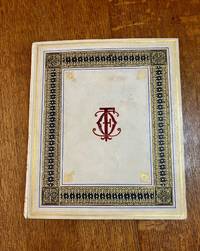
10997<p>NP. ND. . FINE LARGE DECORATIVE VELLUM BINDING. Folio. 14.8 x 12.8 inches. A collection of 211 items of late 19th and early 20th century cards and ephemera including 26 rare 3-D movable lift-up Valentines and Christmas cards each mounted onto a white stiff card page and with multiple pieces of ephemera attached around the page. Attractive late nineteenth century binding of full white vellum. Spine with decorative gilt designs within double gilt ruled lines in compartments. Boards with triple gilt ruled borders to the very edges and elaborate dark brown morocco panels with highly decorative gilt tooling. A thin blue ink line inside and out of the brown panels. Four gilt corner pieces inside the middle panel. Red painted initials with gilt borders to the centre of the front panel. Board edges and turn-ins with decorative gilt rolls. Green and white patterned endpapers. All edges gilt. Inner hinges reinforced with buff cloth strip. A little marking and a couple of small splits to the binding but overall a fine and attractive vellum binding housing an interesting collection of rare unusual and highly decorative items.</p> NP. ND. hardcover
ST17060NFrance probably Besançon 3rd quarter of 15th century. 239 x 165 mm. 9 3/8 x 6 1/2". Single column 15 lines in an elegant gothic book hand. <br/> Rubrics in dark pink line enders in pink and blue with white tracery and gold bezant one- and two-line initials painted gold on pink and blue ground with white tracery each side with a panel border decorated with hairline vines gold bezants and ivy and colorful flowers and acanthus RECTO BORDER INHABITED BY A CHARMING DOG-LIKE CREATURE. ◆A small light stain in border decoration largely masked by dense hairline vines but IN FINE CONDITION--bright clean and well preserved.<br/> <br/> From a large Book of Hours probably produced in Besançon this leaf features very pretty panel borders including one with a particularly charming inhabitant in the form of a dog-like creature with no front legs wearing an orange collar and emitting an acanthus leaf from its mouth. Imaginative touches like this and luxurious elements such as the several dozen gilt bezants and ivy leaves in each border and the unusually wide margins point to this manuscript having been quite a costly production. For additional leaves from this same manuscript at different price points please check our website. unknown
ST12083fItaly ca. 1150. 406 x 273 mm. 16 x 10 3/4". Double column 42 lines in a fine rounded early proto-gothic hand. <br/> With rubrics in red one three-line initial "I" and A PANELLED 13-LINE INITIAL "F" all of these on the very faded recto and consequently indistinct. Formerly used in a binding with text on the recto unreadable the verso with a narrow band of darkening along one edge not obscuring text edges very wormed but 90 percent of the worming in the margin with very little damage to the text; some obvious condition problems but the large and beautiful script on one of the sides entirely legible and certainly very pleasing.<br/> <br/> This leaf comes from a very large copy of one of the major texts by one of the great popes of the early Middle Ages and it is notable for the spaciousness and elegance of its script. The sermon here is based on the Gospel reading for Easter Sunday John 20:1-9 which reports Mary Magdalene's discovery of the empty tomb and her running to tell the apostles what she had--and hadn't--found. Given the fact that the passage under discussion celebrates the most critical event in Christianity the opening phrase "Fractus longa molestia stomachus" is unexpected who would have thought it appropriate to mention protracted gastrointestinal problems and probably more effective as a result. Gregory says he is so weakened that he had given up explaining the Gospel to his flock but now he must resume. He recounts how Mary Magdalene told John and Peter about the empty tomb how John arrived first but did not enter the sepulcher and how Peter the tardier one did. Gregory then gives an allegorical interpretation of this episode: John he says represents the Synagogue Peter the Church; the Jews were prior to the Christians but they hesitated on the brink of belief in the Son of God while the Christians entered into full belief. unknown
ST12668bDNortheastern France probably Arras late 15th century. 146 x 95 mm. 5 3/4 x 3 3/4". Single column 15 lines in a pleasing bâtarde hand. <br/> Rubrics in red one- and two-line initials in brushed gold on a red or blue ground EACH SIDE OF EACH LEAF WITH A BRUSHED GOLD PANEL BORDER WITH VERY PRETTY ILLUSIONISTIC FLOWERS; EACH LEAF WITH ONE SMALL MINIATURE measuring approximately 40 x 25 mm. Headlines written in French in a later 18th century calligraphic hand. ◆Light soiling a couple small stains in margins Trinity leaf with one initial a bit rubbed and a few very tiny chips of paint to miniature otherwise excellent specimens generally clean and smooth with ample margins and attractive decoration.<br/> <br/> From a charmingly decorated 15th century prayer book these lovely leaves offer the opportunity to acquire a miniature with considerable gold ornamentation at an attainable price. One leaf depicts an image of the Trinity in which God the Father holds the body of a crucified Christ in his arms; the other leaf depicts St. James patron saint of Spain shown in bright green and red robes and holding a long staff. For other leaves from this same manuscript please check our website. unknown
190273377London: Edwin Arnold 1902. Limited to 165 numbered copies on vellum at the Essex House Press under C. R. Ashbee. Small octavo. 45 1 pp. Hand-colored frontispiece and two full-page hand-colored illustrations and eighty-five hand-colored ornamental letters by Edith Harwood. Tail-piece. Caslon type. Publisher's vellum with rose and gilt lettering to front cover. Bit of natural mottling to vellum. Custom folding cloth chemise and slipcase. A very good copy.Great Poems Series No. 6. "In 1886 C.R. Ashbee established the Guild of Handicraft at Essex House London. Around the same time Ashbee created the Essex House Press. The Essex House Press published its first book in 1898. The work of the press was very much a part of the Arts and Crafts Movement. Ashbee continually linked the aims of the press with those of John Ruskin and William Morris and described the object of the movement as “making useful things…making them well and…making them beautiful.†The critics however were not so sure about the work of Essex House Press calling it “articraftiness.†Later booklovers came to admire much of its work. Some of the presses and some of the workmen for Essex House Press came from the Kelmscott Press after its demise in 1897 following the death of William Morris. Ashbee designed his own typeface called “Endeavor†for the press. In 1902 the press moved to Glouscestershire. The Essex House Press closed in 1910 having produced more than seventy titles." Univ. of Utah Edwin Arnold hardcover
ST17060PFrance probably Besançon 3rd quarter of 15th century. 239 x 165 mm. 9 3/8 x 6 1/2". Single column 15 lines in an elegant gothic book hand. <br/> Rubrics in dark pink line enders in pink and blue with white tracery and gold bezant each leaf with a three- or four-line initial painted pink or blue with white tracery filled with pink and blue vines and flowers all on a burnished gold ground ONE SIDE OF EACH LEAF WITH A HALF OR THREE-QUARTER BORDER featuring hairline vines gold ivy and bezants colorful acanthus various flowers fleshy plants and vases with floral arrangements the other side of each leaf with a panel border similarly decorated. ◆Vellum slightly yellowed minor smudging to hairline vines and slight rubbing to paint on a few of the border decorations one leaf with some small stains in the border largely masked by the hairline vines but these issues quite minor and the leaves IN FINE CONDITION overall--very clean bright and well-preserved.<br/> <br/> From a large Book of Hours probably produced in Besançon these leaves feature exceptionally pretty borders each with unique decoration that includes vases of different shapes sizes and hues each containing a different flower arrangement fleshy vegetation and colorful floral accents. The large initials here coupled with the expansive border decoration indicate that these leaves marked the openings of major prayers including "Obsecro te" "O Intemerata" the "Joys of the Virgin" and the "Seven Requests to Our Lord." Luxurious touches such as the several dozen gilt bezants and ivy leaves in each border and the unusually wide margins point to this manuscript having been quite a costly production. For additional leaves from this same manuscript at different price points please check our website. unknown
ST12668bLNortheastern France probably Arras late 15th century. 146 x 95 mm. 5 3/4 x 3 3/4". Single column 15 lines in a pleasing bâtarde hand. <br/> Attractively framed leaves with full borders showing one side only and the leaf with images of saints in double-sided glass frame showing both recto and verso. All leaves with rubrics in red and one- and two-line initials in brushed gold on a red or blue ground some leaves with three-line initials on orange or green ground. Each leaf WITH EITHER A FULL BORDER OR PANEL BORDER WITH BRUSHED GOLD GROUND AND VERY PRETTY ILLUSIONISTIC FLOWERS AND FRUITS the leaf with the panel border also FEATURING TWO SMALL MINIATURES OF SAINTS. Headlines written in French in a later 18th century calligraphic hand. ◆Brushed gold a little faded in places otherwise excellent specimens generally clean and smooth.<br/> <br/> From a charmingly decorated 15th century prayer book these beautifully framed leaves are ready to hang on the wall or give as a gift to a lucky recipient. Two types of leaves are offered here: the first consists of a full border with illusionistic flowers fruit and at least one insect or creature; the second contains a panel border and two small miniatures depicting St. Anthony often called the Father of all Monks and the lesser known St. Eligius patron saint of metalworkers. For unframed leaves from this same manuscript please check our website. unknown
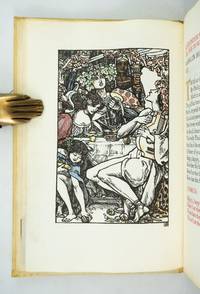
1904ST20796London: Essex House Press 1904. No. 1 OF 140 COPIES all on vellum. 195 x 131 mm. 7 3/4 x 5 1/8". 1 p.l. frontispiece 3-11 2 pp. <br/> Original stiff vellum over thin boards front cover with embossed rose design. In custom-made linen clamshell box with red morocco label on spine. Hand-colored woodcut frontispiece and final tailpiece both by Reginald Savage hand-painted initials in burnished gold red blue or green. Printed in black and red. Front pastedown with red morocco bookplate of William Andrews Clark Jr.; front endleaves with evidence of bookplate and inscription removal. Tomkinson p. 76; Ransom p. 268; Franklin p. 200. A VERY FINE COPY clean bright and free of the splaying that very frequently afflicts the boards of this work.<br/> <br/> This is a most appealing example of the luxurious hand-crafted volumes produced under the auspices of the Essex House Press with our copy coming from the library of a noted Dryden collector. The book is the 11th from the Essex House series of 14 "Great Poems in the English Language" a group of lovely little works all printed on vellum and with delightful colored illustrations and historiated initials. Generally considered to be the best example in English of the choric hymn the present work is set at a feast given by Alexander the Great who finds himself entranced by the poet and lyrist Timotheus. The great leader is lost in reveries of exploits and victory he sighs and cries over battles lost and warriors slain and he finds inspiration for new conquests. Our printer C. R. Ashbee founded the Essex House Press in 1898 by purchasing the presses and other production equipment though not the type formerly owned by the Kelmscott Press which had shut down at the death of William Morris. Ashbee printed books for 12 years with vellum ink and paper identical to that used by Kelmscott in an effort to carry on the tradition Morris had established. But the Essex House Press because it was conceived of and continued as part of a larger enterprise involving various artisans at work in a group of workshops at Ashbee's Guild of Handicrafts located at Essex House in London's Mile End Road always had its own special identity a fact which Cave reflects when he calls it the "Arts and Crafts press 'par excellence.'" The illustrator here Reginald Savage fl. 1886-1904 is deemed by Houfe "a talented and imaginative designer and woodcut artist" and Houfe notes that he was also commended by his fellow illustrator Walter Crane 1845-1915 for his "weird designs." Former owner William Andrews Clark Jr. 1877-1934 put together one of the most distinguished collections of English and French literature of his day. He had strong holdings in many areas but especially in Shakespeare and the other Elizabethans in Dryden in Oscar Wilde and in the French drama. After a fire in his home in 1923 Clark constructed a separate fireproof building to house his collection; in 1926 this library building with its distinguished collection was deeded to the University of California and now serves as a prominent center for literary research. Essex House Press unknown
ST12778-0082South Germany or more probably Austria second half of the 12th century. 429 x 304 mm. 16 7/8 x 12". Double column 36 lines of text in a fine proto-gothic hand. <br/> ◆Text a bit faded on one side an upper corner slightly defective minor soiling and with the grain of the vellum apparent on verso but with the beautiful text entirely legible and the leaf as a whole quite pleasing.<br/> <br/> The hand here is memorable featuring wide upright letters that could not be more regular. Elected pope in 590 Gregory ca. 540-604 was one of the most influential pontiffs in the history of the Church. In addition to revising liturgical worship he wrote extensively on theology offering homespun wisdom rather than esoteric debates. He was declared a saint immediately upon his death. unknown
ST20981Italy 15th century. 264 x 200 mm. 10 3/8 x 7 7/8". Single column 41 lines in a neat humanist hand. <br/> With two two-line initials in blue. One corner torn away not affecting text a few marginal wormholes vellum a bit soiled and with a few small stains but a very good example the text entirely legible and overall clean and presentable.<br/> <br/> Containing text by an author who was much admired during the Renaissance this leaf is a lovely example of the humanistic script that emerged in Italy during the 15th century. The elegance and legibility of humanistic script derives from Caroline miniscule the predominant style of writing in Western manuscripts from the ninth through 12th centuries. Both scripts favor clear rounded letter forms wider spacing between letters and few abbreviations resulting in manuscripts that are extremely attractive and easy to read. The text here comes from a work titled "De Opificio Dei" exploring the handiwork of God with a concentration on the marvels of the human body and soul. The present leaf includes chapters 8-10 which discuss the human head including especially the seats of the senses: eyes ears nose and tongue. Our author Lactantius ca. 260-340 was a late-in-life Christian who became one of the ablest defenders of the faith in its early centuries. He was held in high esteem by Renaissance intellectuals and was one of the earliest authors to be printed first appearing in 1465. unknown
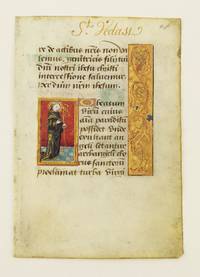
ST12668bKNortheastern France probably Arras late 15th century. 146 x 95 mm. 5 3/4 x 3 3/4". Single column 15 lines in a pleasing bâtarde hand. <br/> Rubrics in red one- and two-line initials in brushed gold on a red or blue ground EACH SIDE OF EACH LEAF WITH A BRUSHED GOLD PANEL BORDER WITH VERY PRETTY ILLUSIONISTIC FLOWERS and one panel with acanthus apparently unfinished; EACH LEAF WITH ONE SMALL MINIATURE measuring approximately 40 x 25 mm. DEPICTING SAINTS. Headlines written in French in a later 18th century calligraphic hand. ◆Light soiling otherwise excellent specimens generally clean and smooth with ample margins and attractive decoration.<br/> <br/> From a charmingly decorated 15th century prayer book these lovely leaves offer the opportunity to acquire a miniature andconsiderable gold ornamentation at an attainable price. One leaf depicts Sts. Peter and Paul in a single frame and the other shows St. Vedast or Waast--a saint that was particularly venerated in France especially in the Arras region whence we be believe these leaves originated. For other leaves from this same manuscript please check our website. unknown
ST20509a-bGermany Late 11th or early 12th century. Largest bifolium measures 221 x 275 mm. 8 7/8 x 10 3/4". Single column 25-27 lines in a late Caroline hand. <br/> Rubrics in orange each bifolium with one or more one one-line initial in orange and one or more large four- to five-line initials in orange. With marginal notations in a later hand. Recovered from a binding and thus with some soiling abrasions glue residue and other small problems; the pages nearly complete but with a couple of letters and/or lines cut away from one side of each bifolia with more extensive abrasions on one side affecting legibility but very good specimens overall the better side in each case quite clear and readable.<br/> <br/> Once part of a Lectionary a collection of scriptural readings appropriate for Masses through the year and other ceremonial occasions these attractive mostly legible binding fragments display an excellent transitional script with both Caroline minuscule and proto-gothic characteristics. The present examples include short lessons or "lectiones" taken from the Old and New Testaments including among other passages excerpts from John in which Christ casts the sellers out of the temple and Daniel relating the prayers of the three men who refused to bow to Nebuchadnezzar's golden idol. The lovely script here shares much in common with the pure Caroline miniscule of earlier centuries--particularly in the overall legibility of the text the space between individual letters and the limited use of ligatures and abbreviations; also of note is the exclusive use of the long "s" unless at the beginning of a sentence and the ampersand as a general abbreviation for the letters "et" occurring anywhere in a word e.g. "propheta" written "proph&a" here. Evidence of a progression toward proto-gothic script can also be observed here in the appearance of certain letter forms such as the closed "g" a more oval "o" and the use of two forms of "d" both upright and Uncial the latter with a sloping shaft. There is added interest here in the form of marginal notations in a later hand--probably dating from the time these bifolia were in situ as binding waste. unknown
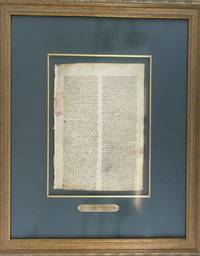
ST12778-0799Italy ca. 1275. 272 x 193 mm. 10 3/4 x 7 1/2". Double column 67 lines of text in a pleasing regular gothic hand. <br/> In a very attractive 21 1/2 x 17 1/2" walnut frame of antique design with the leaf in a sunken compartment with a gold lip a brass label below the compartment. Once purchased from Quaritch with their description on the back. ◆Formerly used as the flyleaf in a binding so slightly soiled text with minor fading a very small portion perhaps one or two lines of the text trimmed off at bottom half a dozen small round wormholes but still an attractive legible example of an unusual text.<br/> <br/> The Quaritch description says that the leaf is from "a Medieval medical work based on Galen concerned with fevers especially those that last a single day 'febres ephemerae'; the present leaf contains the text of chapters 4-7. The author speaks about bloodletting not . . . for the young or elderly baths honey the better kind is clean clear and of sharp odor and delicate Roman women. He cites Hippocrates and the 'Regimen Sanitatis' of Salerno as well as his own writings 'Quisquis igitur se non exercet in meis libris non poterit intelligere' 'Whoever then does not train himself in my own books will not be able to understand'. The text has a strong Galenic tone although it is not a translation of Galen's 'De Differentiis Febrium' and suggests a Medieval work based on Galen and possibly from the great Salerno medical school. The vocabulary includes post-classical words such as 'acetositas' acidity and even some words unrecorded in the massive 'Thesaurus Linguae Latinae' Oxford Medieval Latin Dictionary and Du Cange such as 'crapulositas' drunkenness and 'indigestabilitas.'" The leaf has obvious interest for its content and it is well presented in its attractive frame. unknown
ST16379-008France late 13th century. 125 x 88 mm. 4 7/8 x 3 1/2". Single column 15 lines in a gothic book hand. <br/> Attractively matted. Folio number in red several line enders in gold with blue penwork 10 one-line initials in gold on blue and pink ground one two-line initial painted pink and filled with blue and orange acanthus on gilt ground verso with a three-quarter border branching from the larger initial composed of pink and blue curling lines accentuated with gold spikes bezants and painted ivy leaves UPPER BRANCH TERMINATING IN A WONDERFUL HYBRID CREATURE WITH THE FACE OF A MAN AND THE BODY OF AN ORANGE BEAST AND THE LOWER BRANCH INCORPORATING ANOTHER FACE WITH A LONG BEARD. From the collection of Joseph Pope his MS Bergendal 116 about whom see below. ◆A little soiling and staining along edges of vellum and a couple of small marks in lower margin verso but in excellent condition overall the paint especially bright and fresh.<br/> <br/> From the distinguished collection of Canadian financier Joseph Pope 1921-2010 this charming leaf comes from a small-format Psalter intended for private use and features two amusing drolleries incorporated into the marginal design. Pope's collection was sold by Sotheby's on 5 July 2011 where this leaf appeared as part of lot 115; it was later listed in Quaritch Catalogue 1422 no. 88 which states that "according to Pope's note this leaf was found tipped in to a much later Book of Hours his MS Bergendal 64--produced in the southern Netherlands for a southern French patron during the first half of the 15th century--at f. 94 the middle of the Penitential Psalms; the manuscript was acquired by Pope at Sotheby's sale of 6 December 1983 lot 79.". unknown
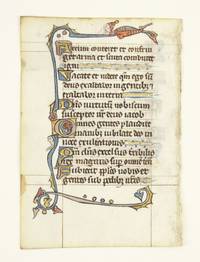
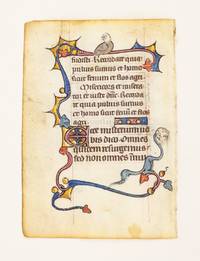
ST16985LFrance first half of 14th century. 110 x 82 mm. 4 3/8 x 3 1/4". Single column 12 lines in a gothic book hand. <br/> Line enders in pink and blue with gold accents each leaf with one or more one-line initials in blue with red penwork or gold with blue penwork each leaf with one two line initial painted pink or blue filled with painted floral motifs and on a gold or blue ground one side of each leaf with A NEAR-FULL BORDER composed of pink and blue tendrils accompanied by spikey gold decoration and gold accents often terminating in ivy leaves and incorporating EXTRAORDINARILY CHARMING EXAMPLES OF MARGINALIA INCLUDING ANIMALS HUMANS AND HYBRIDS. ◆Vellum a little soiled and lightly stained and wrinkled in places some of the gold a bit rubbed one leaf with some noticeable smudging affecting some of the text and decoration including the head of one of the hybrids but the other examples of marginalia quite well preserved and still retaining much of their original charm.<br/> <br/> Though diminutive in size these leaves contain enormously appealing marginal decoration in the form of humans animals and hybrid creatures inventively incorporated into the lively borders in manners that range from adorable to bizarre. Especially popular in Flanders Northern France and England during the 13th and 14th centuries marginalia such as these comprise some of the most memorable and entertaining images to be found in any Medieval manuscripts. Despite being found largely in religious books such as Psalters and Books of Hours the images are often strange humorous or even outrageous and they provide us with consistent delight. Being by definition outside of the central text or miniature the margins seem to have been a place where illuminators felt more at ease to experiment resulting in highly imaginative and unique artistic expressions. The present specimens come from a fragmentary manuscript with many leaves either missing or rendered defective where portions of the vellum were cut away. Fortunately this group of leaves is intact and retains much marvelous imagery including a particularly annoyed-looking bird two human-beast hybrids with long necks and bushy tails and a trumpeter emerging from the border decoration blowing into a long instrument decorated with gold accents. For additional leaves from this same manuscript at different price points please check our website. unknown
ST20509c-dGermany Late 11th or early 12th century. Larger bifolium measures 221 x 275 mm. 8 7/8 x 10 3/4".; smaller bifolium measures 207 x 275 mm. 8 1/8 x 10 3/4". Single column 25-27 lines in a late Caroline hand. <br/> Rubrics in orange each bifolium with one or more one-line initial in orange and one or more large four- to five-line initials in orange. With marginal notations in a later hand. Recovered from a binding and thus with some soiling abrasions glue residue and other small problems as well as limited loss of legibility in a few places; the pages nearly complete but with a couple of letters and/or lines cut away from one side of each bifolium; even with the problems very good specimens overall the letters on the better side quite clear and readable in each case.<br/> <br/> Once part of a Lectionary a collection of scriptural readings appropriate for Masses and other ceremonial occasions through the year these attractive mostly legible binding fragments display an excellent transitional script with both Caroline minuscule and proto-gothic characteristics. The present examples include short lessons or "lectiones" taken from the Old and New Testaments including among other passages excerpts from John in which Christ casts the sellers out of the temple and Daniel relating the prayers of the three men who refused to bow to Nebuchadnezzar's golden idol. The lovely script here shares much in common with the pure Caroline miniscule of earlier centuries--particularly in the overall legibility of the text the space between individual letters and the limited use of ligatures and abbreviations; also of note is the exclusive use of the long "s" unless at the beginning of a sentence and the ampersand as a general abbreviation for the letters "et" occurring anywhere in a word e.g. "propheta" written "proph&a" here. Evidence of a progression toward proto-gothic script can be observed here in the appearance of certain letter forms such as the closed "g" a more oval "o" and the use of two forms of "d" both upright and Uncial the latter with a sloping shaft. There is added interest here in the form of marginal notations in a later hand--probably dating from the time these bifolia were in situ as binding waste. The price given here is for one bifolium. unknown
14501058951450. Dutch school: c. 1450 or later. <br /> <br /> Single leaf 138 x 98 mm. Miniature without text image of Christ before Caiaphas being held by a soldier with a jester dancing behind him disciples and a cockerel seen through a doorway in the courtyard beyond within a three-sided border of simple flowers. In good condition.<br /> <br /> § Origin and provenance unknown; from a private California collection. unknown