Illuminated manuscript leaf on vellumBiblio.com

153 résultats
87191250. Central Italy c.1250. <br /> <br /> Matted in fine condition.<br /> <br /> § A well-painted initial of a man in flowing blue and pink robes holding a book to which he gestures probably Saint Paul. Italian miniature paintings of this period are known to be difficult to localize with any accuracy but as the face is strongly drawn with well-proportioned features it might well hail from central Italy. unknown
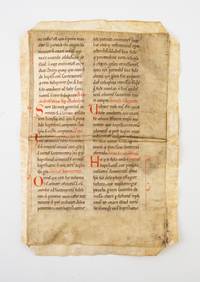
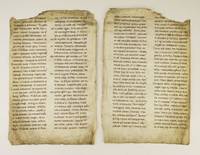
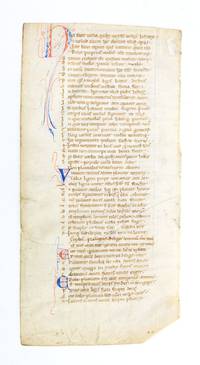
ST12083eItaly ca. 1150. 406 x 273 mm. 16 x 10 3/4". Double column 42 lines in a fine rounded early proto-gothic hand. <br/> Recto with a pleasing three-line red initial. ◆Formerly used in a binding and consequently a bit soiled and trimmed at the head with loss of the first line perhaps 100 or so small wormholes in the margin only a few causing trivial harm to the text a faint grayish stain affecting a couple of words in the top 20 lines of one column on each side but the entirety of the text completely clear and the stately leaf quite fresh and unusually well-preserved in general for a recovered specimen.<br/> <br/> This leaf comes from a very large copy of one of the major texts by one of the great popes of the early Middle Ages. Dealing in part with the central occurrence in the salvation of humanity the text here treats of John 20:19-31 which tells of the risen Christ's appearance to the Apostles. Doubting Thomas insists on touching the Lord's wounds before he will be convinced of the Resurrection. Gregory tells his audience that Thomas was healed of unbelief and so must they be although they cannot see Jesus in the flesh as did Thomas. Written ca. 593 Pope Gregory's 40 homilies on the Gospels enjoyed enduring popularity throughout Medieval times as they offered ordinary Christians practical guidance on applying the lessons of the Gospels to their own lives. Elected pope in 590 Gregory ca. 540-604 was one of the most influential pontiffs in the history of the Church. In addition to revising liturgical worship he wrote extensively on theology offering homespun wisdom rather than esoteric debates. He was declared a saint immediately upon his death. The script here is regular rounded and very pleasing--almost soothing--to the eye. Moreover the letters are so large and there is so little significant damage to the leaf that the text can be easily read from a considerable distance. unknown
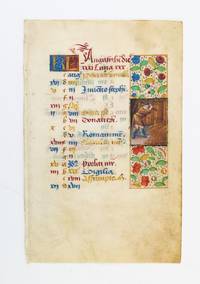
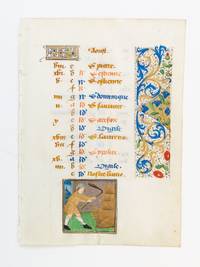
1470ST17245-09Northern France probably Rouen ca. 1470. 180 x 117 mm. 7 x 4 5/8". Single column 18 lines text in a bâtarde hand. <br/> Text in red blue and gold two-line "KL" in shell gold on blue and red ground both sides with panel border composed of flowers and ink dots WITH TWO SMALL MINIATURES each centered in the middle of the panel borders featuring the labor of the month Threshing and the zodiac sign a young woman for Virgo. Vellum a bit soiled and slight wrinkling in margins small area of rubbing at bottom of the Virgo miniature but in excellent condition overall the fine details in the miniatures well preserved.<br/> <br/> Situated among the flowers of the panel borders here are two small but charming miniatures depicting the labor of the month "Threshing" and the zodiac sign for August. According to Roger Wieck far fewer than half the Books of Hours of the period contain illustrated calendars "even in manuscripts with otherwise lavish cycles of miniatures"; when they do appear they are invariably charming as is the case here. In the threshing scene a young layman brings down his grain flail two hinged pieces of wood the longer one called a helve and the other a beater joined by a thong in an effort to separate the grain while neatly gathered bushels of straw appear just behind him. On the verso we see a representation of Virgo as a young woman holding appropriately two long stalks of grain in her hands. The rich palette used in these miniatures allows the delicate gold highlighting on the harvested crop and garments to shine through adding a fine sense of detail to each image. unknown
ST12668bJNortheastern France probably Arras late 15th century. 146 x 95 mm. 5 3/4 x 3 3/4". Single column 15 lines in a pleasing bâtarde hand. <br/> Rubrics in red one- and two-line initials in brushed gold on a red or blue ground EACH SIDE OF EACH LEAF WITH A BRUSHED GOLD PANEL BORDER WITH VERY PRETTY ILLUSIONISTIC FLOWERS; EACH LEAF WITH TWO SMALL MINIATURES measuring approximately 40 x 25 mm. depicting saints shown with their attributes. Headlines written in French in a later 18th century calligraphic hand. ◆Light soiling rubrics faded otherwise excellent specimens generally clean and smooth with ample margins attractive decoration and shining gold.<br/> <br/> From a charmingly decorated 15th century prayer book these lovely leaves offer the opportunity to acquire a miniature and considerable gold ornamentation at an attainable price. One leaf depicts St. Andrew holding an "X" shaped cross and St. Etienne i.e. St. Stephen here shown with three stones on his body and the other shows St. Remigius the so-called "Apostle of the Franks" and St. Quentin--a saint that was particularly venerated in France especially in the north whence we be believe these leaves originated. For other leaves from this same manuscript please check our website. unknown
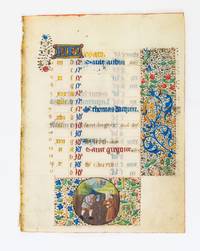
ST17245-04France possibly Rouen mid-15th century. 173 x 130 mm. 6 3/4 x 5 1/8". Single column 16 ruled lines text in a gothic book hand. <br/> Text in gold blue and dark pink "KL" in blue with white tracery on a gold ground decorated with dark pink baubles and leaves and with a floral spray extension both sides with panel border composed of densely packed acanthus flowers and hairline vines with gold bezants WITH A SMALL ROUNDEL MINIATURE at the bottom depicting the labor of the month Pruning set on a panel of flowers hairline vines and gold bezants. With numbering to the left of the golden numbers and a few calendar entries in a later hand. ◆Light soiling to vellum a few small smudges in the borders a little paint transfer affecting a couple lines of text and margins of the verso but these issues all very minor and on the whole in fine condition with a particularly well-preserved miniature with rich uneroded paint.<br/> <br/> With lovely panel borders and a particularly charming roundel miniature showing the labor of the month this leaf likely comes from a high-quality manuscript made for a person of means. Though miniatures depicting the labors of the month are often illustrated with just a single person performing the task here we are treated to two laypeople--a man and a woman--working together to prune and break ground in their field. The man appears to be carrying an axe for trimming branches while the woman carries a long stick to loosen dirt for spring plantings. The names of several saints have been added to the calendar by a later hand though it would appear that they were erroneously placed in March: St. Hugh belongs on 9 April Pope Leo on 11 April and St. Tiburtius on 14 April. While almost all of these feast days are commonly found in Books of Hours of this period Hugh Bishop of Rouen is slightly unusual suggesting that the manuscript may have been made in or at least ended up in Rouen. unknown
1415ST19350-056Germany and Low Countries 14th & 15th centuries. Smallest piece: 209 x 152 mm. 8 1/8 x 5 7/8"; largest piece: 372 x 235 mm. 14 3/4 x 9". <br/> Recovered from bindings and thus with uneven trimming and occasional small holes resulting in loss staining and toning to vellum some leaves with remnants of pastedowns obscuring the script but generally the leaves quite legible substantially complete and in presentable condition.<br/> <br/> This packet contains five vellum manuscript leaves all complete or nearly so all with musical notation and all serving as linings or covers of a binding when reused in their second lives. Prepared with an academic audience in mind the group presents an excellent opportunity for libraries teachers and students to develop or expand their teaching or personal collections. In addition to their obvious value as manuscripts containing the text and music of the Medieval period these leaves are also of educational importance as physical artifacts demonstrating the reuse of manuscript material in the production of later bindings. The shape of each binding is still easily discernable and a few of these specimens even include early spine labels and ink notations as well as paper remnants used in the bookbinding process. unknown
1891ST15049London: Seeley and Co 1891. No. 85 OF 160 COPIES ON LARGE PAPER. 382 x 275 mm. 15 x 10 3/4". 4 p.l. 111 1 pp. <br/> Publisher's gilt-stamped vellum upper cover with titling and the Tennyson coat of arms BOTH COVERS WITH LOVELY HAND-PAINTED DESIGN BY JOHN T. BEER upper cover with urn at foot and blooming rose branches emanating from a medallion bearing the date 1902 and curving around the title and escutcheon lower cover with branches of apple blossoms dividing the board into quadrants each inhabited by a bird in flight smooth spine with gilt titling edges untrimmed. With frontispiece photographic portrait of Tennyson 31 vignettes in the text and 14 copper-plate engravings after drawings by Edward Hull. Verso of title page and limitations page with ink stamp of Gloucester County Library. Weber "The Fore-Edge Paintings of John T. Beer" 195. Small scratch near head of front joint minor soiling and rubbing to edges of boards mild foxing mostly marginal and not affecting copper engravings otherwise an excellent copy clean and fresh internally with wide margins the binding especially bright the pretty decoration perfectly preserved. AN EXTREMELY ATTRACTIVE COPY.<br/> <br/> This very large format deluxe illustrated work describing the places associated with England's beloved Poet Laureate Alfred Lord Tennyson is enhanced by former owner John T. Beer's Arts & Crafts-style embellishments to the vellum binding. After retiring from a successful career as a clothier Merseyside book collector Beer ca. 1826-1903 occupied himself decorating books from his library mostly with fore-edge paintings but in a score of instances with painted bindings. Jeff Weber considers Beer "one of the most highly skilled artists of fore-edge paintings" noting that he was the first artist to put his signature to such works. Weber's catalogue raisonnée of Beer's works lists 189 fore-edge paintings 22 painted bindings including this one #195 and three bindings designed by Beer and executed by Fazakerley of Liverpool. The design here is clearly influenced by the Arts & Crafts movement and Beer owned several works by William Morris including a Kelmscott Press "Godefrey of Bologne" on the vellum covers of which he had painted a design of tulips and lilies. Among the locations discussed and pictured in the "The Laureate's Country" are Tennyson's childhood homes in Somersby and Bag Enderby Trinity College Cambridge where he matriculated and his estates Farringford on the Isle of Wight and Aldworth in West Sussex. Seeley and Co unknown
ST12668bHNortheastern France probably Arras late 15th century. 146 x 95 mm. 5 3/4 x 3 3/4". Single column 15 lines in a pleasing bâtarde hand. <br/> Rubrics in red one- and two-line initials in brushed gold on a red or blue ground EACH SIDE OF LEAF WITH A BRUSHED GOLD PANEL BORDER WITH VERY PRETTY ILLUSIONISTIC FLOWERS AND FRUITS and intricate strapwork design in colors; WITH TWO SMALL MINIATURES measuring approximately 40 x 25 mm. depicting John the Baptist and John the Evangelist shown with their attributes. Headlines written in French in a later 18th century calligraphic hand. ◆Light soiling a touch of paint loss to frames and background not very noticeable and not affecting the figures otherwise an excellent specimen generally clean and smooth with ample margins winning decoration and shining gold.<br/> <br/> From a charmingly decorated 15th century prayer book this leaf offers the opportunity to acquire two particularly nice miniatures each depicting an important saint. The recto shows St. John the Baptist with a lamb at his side and a book balanced on his knee; and the verso depicts St. John the Evangelist as a young man holding a chalice with what ought to be snakes emerging from it in reference to the poisoned cup he was invited to drink as a test of faith but which instead look more like tendrils of smoke. For other leaves from this same manuscript please check our website. unknown
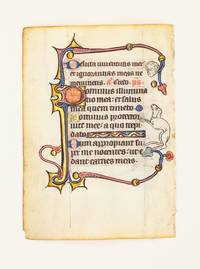
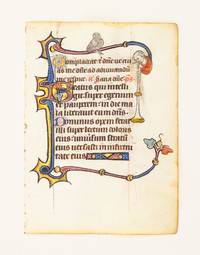
ST16985MFrance First half of 14th century. 110 x 82 mm. 4 3/8 x 3 1/4". Single column 12 lines in a gothic book hand. <br/> Line enders in pink and blue with gold accents each leaf with one or more one-line initials in blue with red penwork or gold with blue penwork each leaf with one two line initial painted pink or blue filled with painted floral motifs and on a gold ground one side of each leaf with A NEAR-FULL BORDER composed of pink and blue tendrils accompanied by spikey gold decoration and gold accents often terminating in ivy leaves and incorporating EXTRAORDINARILY CHARMING EXAMPLES OF MARGINALIA INCLUDING HUMAN-BEAST HYBRIDS. ◆Vellum a little soiled and with a few small stains one leaf with more noticeable smudging affecting some of the text and decoration another leaf with one of the heads a little rubbed but all other examples of marginalia very well preserved.<br/> <br/> Though diminutive in size these leaves contain enormously appealing marginal decoration in the form of humans animals and hybrid creatures inventively incorporated into the lively borders in manners that range from adorable to bizarre. Especially popular in Flanders Northern France and England during the 13th and 14th centuries marginalia such as these comprise some of the most memorable and entertaining images to be found in any Medieval manuscripts. Despite being found largely in religious books such as Psalters and Books of Hours the images are often strange humorous or even outrageous and they provide us with consistent delight. Being by definition outside of the central text or miniature the margins seem to have been a place where illuminators felt more at ease to experiment resulting in highly imaginative and unique artistic expressions. The present specimens come from a fragmentary manuscript with many leaves either missing or rendered defective where portions of the vellum were cut away. Fortunately this group of leaves is intact and retains much marvelous imagery including a beast with an exaggeratedly long body and horns and long-necked beasts with human heads--one who appears to be blowing smoke into the air one with a bearded face as its bottom and another with the body of a stork sporting a hat with a long pointy tendril. For additional leaves from this same manuscript at different price points please check our website. unknown
ST20837bGermany late 12th or early 13th century. 335 x 224 mm. 13 1/4 x 8 7/8". Double column 29 lines in an elegant proto-gothic book hand. <br/> Rubrics in red several two-line initials in red. Recovered from a binding and so the vellum a bit soiled creased and wavy recto with a lighter patch where a title label was once situated light stains and glue and paper residue on the verso but overall the leaf remarkably clean entirely legible and surprisingly well preserved.<br/> <br/> Once serving as a cover for a later book this leaf comes from a nearly contemporaneous copy of Peter Lombard's "Sentences" considered the most important theological book of the 12th century. Written between 1155 and 1158 and arranged topically Lombard's "Sententiae" summarize past learning about Christian doctrine by quoting authorities in an attempt to resolve textual disagreement by dialectical analysis. As a source collection that continued to spark discussion Lombard's great work enjoyed sustained success as a theological textbook until the 17th century and inspired numerous commentaries including those of Aquinas and Luther. This leaf comes from Book IV "On the Doctrine of Signs" which is primarily concerned with the seven sacraments: Baptism Confirmation the Eucharist Penance Extreme Unction Sacred Orders and Matrimony. The script is an upright and very legible proto-gothic book hand with a few distinctive letter forms and abbreviations that may help determine a more definitive point of origin these include a "g" with a downward cross on its tail and a conjoined "qe" for "que". It is unusual and very lucky that this leaf survives completely intact as Medieval manuscripts used in later bindings were often cut down in size to make smaller covers or used as waste paper for pastedowns or other binding elements. unknown
ST15769aPerhaps France mid-12th century. Each leaf measures approximately 370 x 240 mm. 14 1/2 x 9 1/2". Double column 32 lines in a fine proto-gothic hand. <br/> See: Thompson "An Introduction to Greek and Latin Paleography" p. 436. ◆Recovered from a binding and thus with one side of each leaf somewhat browned soiled and with a few creases one leaf with several small blotches of red paint in the text not affecting overall legibility one corner of each leaf torn away affecting running title and one to two lines of text other trivial defects but still very nice specimens with clear and legible script and one side of each leaf quite clean and well preserved.<br/> <br/> Once part of a large and elegant Romanesque Bible these leaves are excellent examples of a high quality proto-gothic book hand. Sometimes referred to as "praegothica" or "late Caroline" the proto-gothic script is characterized by letterforms that are more or less unchanged from Caroline minuscule but with a number of traits starting to show elements of gothic script--most notably the addition of feet appearing here as an upward flick of the pen on the bottom of minims but also including the use of more abbreviations the fusion of certain letter combinations a more elongated "o" and a straight-backed "a." Whatever the level of its evolution the script here has very pleasing rounded letterforms that are highly legible and generously spaced. Though the vellum is not unmarred by its former life as binding material the script here has not lost any of its beauty revealing a hand that is practiced regular and distinctly pleasing to the eye. As Thompson notes "In the twelfth century the scribes seem to have vied with each other in producing the best types of book-writing of which they were capable with the result that remarkable precision in the formation of the letter was attained and that the century may be named as excelling all others for the beauty of its MSS." Our leaves come from Deuteronomy the Old Testament book consisting primarily of three sermons made by Moses just before entering the Promised Land. One leaf contains brief summaries of chapters 2-18 with some chapters numbered in the margins while the other leaf contains part of the first of Moses' speeches in which he recalls the Israelites' 40-year journey through the wilderness. unknown
ST17245-02France probably Rouen second half of 15th century. 162 x 117 mm. 6 3/8 x 4 5/8". Single column 17 ruled lines text in a bâtarde hand. <br/> Text in gold blue and red "KL" in scrolling white letters on a gold ground with small blue and red blossoms both sides with panel border of acanthus flowers small ink dots and gold bezants WITH TWO SMALL MINIATURES showing the labor of the month Threshing on recto and the zodiac sign Virgo on verso. ◆Small wrinkle in lower margin just touching the lower edge of the miniatures trivial smudging but IN VERY FINE CONDITION the vellum especially clean and bright the paint quite rich and the miniatures extremely well preserved.<br/> <br/> With clean white vellum small but appealing miniatures and attractive lettering and decoration this is a desirable example of a calendar leaf from a high-quality Book of Hours likely made in Rouen. According to Roger Wieck far fewer than half the Books of Hours of the period contain illustrated calendars "even in manuscripts with otherwise lavish cycles of miniatures"; when they do appear they are invariably charming as is the case here. In the lower margin of the recto is a small miniature depicting the typical labor for August "Threshing" in which a young layman brings down his grain flail two hinged pieces of wood the longer one called a helve and the other a beater joined by a thong in an effort to separate the grain while neatly stacked unprocessed clumps of straw appear just behind it. On the verso we see a representation of Virgo as a young woman holding appropriately a long sheaf of grain in her hand. While most of the feast days that appear in the calendar are typical for the period the inclusion of St. Sauveur i.e. Transfiguratio Domini on 6 August is characteristic of a calendar for the use of Rouen suggesting that the parent manuscript may have been produced in that place or the region around it. unknown
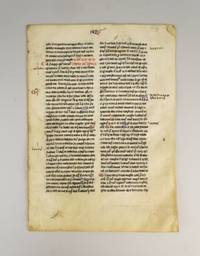
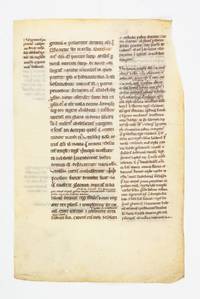
ST13657aFrance second half of the 13th century. Each leaf measures 330 x 240 mm. 13 x 9 3/8". Double column 38 lines of text in a proto-gothic hand. <br/> Rubrics in red running title and numerous paragraph marks in red and blue one leaf with one two-line initial in blue with red pen flourishes. Margins with several text corrections one leaf with a catch-word. Faint soiling and a few negligible stains touching text not affecting legibility but overall FINE SPECIMENS with very few flaws.<br/> <br/> Containing part of a popular treatise on the Vices these well-preserved and attractive large format leaves come from a manuscript that may have been contemporary to the life of the author William Perault ca. 1190-1270. Although the so-called "Seven Deadly Sins" that we still recognize today remained a popular moral paradigm throughout the Middle Ages it was by no means canonical. Authors were free to borrow manipulate and elaborate on the topic at will resulting in a profusion of treatises and competing systems of morality. This work by Perault Latin: Peraldus was a particularly prominent treatise that not only survived the Middle Ages but later went into print in several editions. The "Summa of Vice" expounds upon the Seven with which most of us are familiar--Pride Envy Anger Sloth Greed Gluttony and Lust--but it also includes an eighth sin which Perault called "peccatum linguae" or "the sin of the tongue." The present leaves consider the sin of Pride Superbia the most severe and dangerous of all the vices in Medieval imagery it is often depicted as the root of all other sins with some interesting discussion of garish dress make-up hair coloring and wigs. unknown
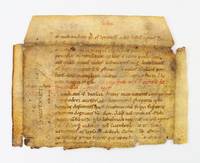
ST17587France late 12th century. 176 x 132 mm. 7 x 5 1/4". Single column 18 lines in a protogothic hand text on one side only. <br/> Rubrics in red "Liber" in upper margin in red. Recto and verso with scribblings by later hands the name "Simon Pivante" clearly visible on recto but the others illegible. ◆Recovered from a binding and thus with obvious staining folds and rubbing a couple lines at top and bottom and a few other words here and there too rubbed to make out but by and large still very legible and in a pleasing hand.<br/> <br/> This leaf is primarily of interest for its content containing a rare example of Anastasius Bibliothecarius' "Historia Ecclesiastica" of the Byzantine Church also known as the "Chronographia tripartita" compiled from the works of the near-contemporary Greek authors Theophanes Nicephorus and Syncellus. According to the Catholic Encyclopedia Anastasius Bibliothecarius ca. 810-79 "learned Greek from Greek monks and obtained an unusual education for his era so that he appears to be the most learned ecclesiastic of Rome in the barbaric period of the ninth century." He earned the moniker "Bibliothecarius" from his appointment as librarian of the Roman Church a position he held during the reign of popes Adrian II 867-72 and John VIII 872-82. It is possible that Anastasius was also the same figure elected antipope in 855 as recorded in at least one contemporary chronology but historians disagree on the validity of this identification. Anastasius' work appears to be extremely rare in the marketplace. unknown
ST16985NFrance first half of 14th century. 110 x 82 mm. 4 3/8 x 3 1/4". Single column 12 lines in a gothic book hand. <br/> Line enders in pink and blue with gold accents each leaf with one or more one-line initials in blue with red penwork or gold with blue penwork each leaf with one two line initial painted pink or blue filled with painted floral motifs and TWO INHABITED BY HUMAN FACES and on a gold ground one side of each leaf with A FULL BORDER composed of pink and blue tendrils accompanied by spikey gold decoration and gold accents often terminating in ivy leaves and incorporating EXTRAORDINARILY CHARMING EXAMPLES OF MARGINALIA INCLUDING ANIMALS HUMAN HEADS AND HUMAN-BEAST HYBRIDS. ◆Vellum a little soiled and with a few small stains one leaf with more obvious soiling varying degrees of smudging two leaves with more noticeable smudging affecting some of the text and decoration another leaf with two of the human heads slightly rubbed but all other examples of marginalia very well preserved and paint quite fresh and the gold sparkling.<br/> <br/> Though diminutive in size these leaves contain enormously appealing marginal decoration in the form of humans animals and hybrid creatures inventively incorporated into the lively borders in manners that range from adorable to bizarre. Especially popular in Flanders Northern France and England during the 13th and 14th centuries marginalia such as these comprise some of the most memorable and entertaining images to be found in any Medieval manuscripts. Despite being found largely in religious books such as Psalters and Books of Hours the images are often strange humorous or even outrageous and they provide us with consistent delight. Being by definition outside of the central text or miniature the margins seem to have been a place where illuminators felt more at ease to experiment resulting in highly imaginative and unique artistic expressions. The present specimens come from a fragmentary manuscript with many leaves either missing or rendered defective where portions of the vellum were cut away. Fortunately this group of leaves is intact and retains much marvelous imagery including several animals a dog a bird a squirrel and a large hare human and bestial heads capping the ends of border tendrils many with a memorable detail such as a bushy beard a massive gold horn or wearing a tall pointy hat including the torso of a person holding a long antler-like club and colorful human-beast hybrids. A couple of these leaves also have initials inhabited by charming little human faces. For additional leaves from this same manuscript at different price points please check our website. unknown
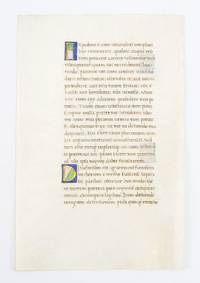
ST19578Northern Italy last quarter of 15th century. Each leaf measuring 250 x 164 mm. 9 7/8 x 6 3/8". Single column 24 lines in a handsome humanist hand. <br/> Each leaf with three to four large initials one measuring two lines all others three lines in burnished gold in-filled with pink and green paint with white embellishment on blue ground with white embellishments. See: Baldwin "Medieval Rhetoric and Poetic" pp. 216-23. ◆Insignificant wrinkling and a couple faint creases to vellum tiny snag along top edge of each leaf but IN VERY FINE CONDITION the vellum especially clean and bright the paint and ink fresh and the margins generous.<br/> <br/> Written in a beautiful humanistic script enclosed by wide margins and adorned with tasteful gilt initials these leaves come from what must have been a particularly fine manuscript made for a person of means. The text comes from the "Candelabrum" of Bene of Florence an early 13th century treatise on rhetoric and the art of elegant writing. The work consisted of eight parts instructing readers on word choice composition rhythm style and other important considerations in the construction of effective letters and prose. Apart from their enormous aesthetic appeal the present leaves are of great interest because few manuscripts of the text have survived. The style of the initials--elegant burnished gold on a ground of pale pink green and sapphire blue with whisps of white embellishments--suggest that the manuscript was executed in Northern Italy perhaps Milan Bologna or Florence by a craftsman of great technical skill. Fine examples of humanistic script are becoming increasingly difficult to find on the market and the present examples are among the loveliest we have ever acquired. unknown
ST17586Abbey of St. Oyan at St.-Claude du Jura France ca. 1175. 245 x 158 mm. 9 3/4 x 6 1/4". Single column of text with two columns of gloss text column with 26 lines in a fine proto-gothic book hand. <br/> Verso with scant remnants of mounting tape in a couple of places along one edge. See Gwara Handlist no. 77. ◆Upper margin of fore edge unevenly trimmed away but no text lost a dozen-and-a-half small round wormholes touching just a couple letters light soiling to edges and other minor imperfections but still IN FINE CONDITION the vellum very clean and the ink dark and legible.<br/> <br/> The most important innovation in biblical scholarship during the 12th century was the development of the "Glossa Ordinaria" to the Bible. Drawing on the whole earlier tradition of biblical exegesis but especially that of Latin patristic writers like Augustine and Jerome scholars working in the French cathedral schools of Laon and Paris systematized this material in an apparatus of marginal and interlinear glosses arranged around the relevant biblical passages. The present leaf showing a particularly beautiful and regular script is a lovely example of one such work. The biblical text appearing in the center column is differentiated by larger lettering and gloss appears interlineally and in a column on either side of the main text all in smaller lettering by the same hand. Scott Gwara notes that the parent manuscript was formerly in the Medieval library of St. Oyan at St.-Claude du Jura a Benedictine monastery founded as the Abbey of Condat around 425 and later known as St. Oyen after an obscure saint who served as Condat's fourth abbot. In the 13th century it was renamed St.-Claude. By the 20th century the manuscript was in the collection of William L. Clements d. 1934 the bulk of which was sold by his estate between 1934-37. The manuscript was then acquired and dismembered by biblioclast Otto Ege around 1939. Gwara notes that the manuscript was incomplete by the time it reached Ege containing only 80 leaves but was "otherwise in excellent condition." The present leaf certainly attests to this assertion being extremely clean bright and with comfortable margins. unknown
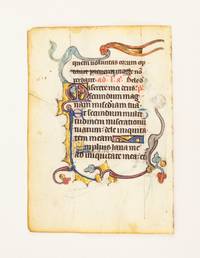
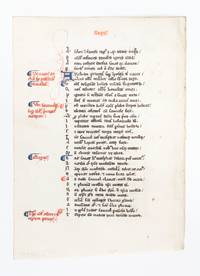
ST18542England ca. 1375. 287 x 198 mm. 11 1/4 x 7 3/4. Single column 32 lines in a small rounded English gothic hand with rubrics in the margins. <br/> Rubrics in red running title in red paragraph marks in red or blue two initials measuring two lines in height and colored blue with red penwork. See: P. E. Beichner "Aurora Petri Rigae Biblia Versificata A Verse Commentary on the Bible." ◆Remnants of mounting tape in top margin of recto but a really excellent specimen the hand very clear the ink especially rich and the vellum extremely clean and quite bright.<br/> <br/> Written in a gothic hand heavily influenced by the English secretarial style this leaf comes from a copy of the "Aurora" a commentary on the Bible in verse form written in the late 12th century by French poet Petrus Riga 1140-1209 a canon of Rheims cathedral. Although little is known about the author's life Riga's text became immensely popular throughout Europe and was routinely studied in Medieval universities. According to Beichner "for those who could read Latin it supplied Scriptural lore in a popular form and it also served as a book of popular theology devotional reading moral instruction and entertainment. Its influence was propagated by teachers preachers and lexicographers by poets and other writers. It was studied imitated translated and quoted. Not only was it widely read in monasteries and convents but it was also recommended reading for the sons of nobles." It is interesting to note that although Riga's work was copied numerous times in the 13th century copies from the later Medieval period such as the present work are uncommonly rare. The parent manuscript containing our leaf was previously in the possession of the Dukes of Westminster and was sold at Sotheby's on 11 July 1966 lot 229 when it was advertised as having 267 leaves missing the first gathering plus 13 other leaves. Bookseller Francis Edwards acquired the manuscript at that sale removed three damaged leaves and sold the remainder. It was thereafter broken up and dispersed. Several sister leaves are now in the collections of Marquette University Lawrence University and the University of South Carolina. unknown
ST16985PFrance first half of 14th century. 110 x 82 mm. 4 3/8 x 3 1/4". Single column 12 lines in a gothic book hand. <br/> Line enders in pink and blue with gold accents each leaf with one or more one-line initials in blue with red penwork or gold with blue penwork each leaf with one two line initial painted pink or blue--filled with painted floral motifs or a gold cross and ONE INHABITED BY HUMAN FACE--all on a gold ground one side of each leaf with A FULL BORDER composed of pink and blue tendrils accompanied by spikey gold decoration and gold accents often terminating in ivy leaves and incorporating EXTRAORDINARILY CHARMING EXAMPLES OF MARGINALIA INCLUDING ANIMALS HUMAN HEADS AND HUMAN-BEAST HYBRIDS. ◆Occasional minor smudging vellum a little soiled and with a few small stains one leaf with noticeable staining affecting some of the text and decoration but with extremely appealing imagery making up for it another leaf with some marginal offsetting and the inhabited initial slightly rubbed but all other examples of marginalia VERY WELL PRESERVED.<br/> <br/> Though diminutive in size these leaves contain enormously appealing marginal decoration in the form of humans animals and hybrid creatures inventively incorporated into the lively borders in manners that range from adorable to bizarre. Especially popular in Flanders Northern France and England during the 13th and 14th centuries marginalia such as these comprise some of the most memorable and entertaining images to be found in any Medieval manuscripts. Despite being found largely in religious books such as Psalters and Books of Hours the images are often strange humorous or even outrageous and they provide us with consistent delight. Being by definition outside of the central text or miniature the margins seem to have been a place where illuminators felt more at ease to experiment resulting in highly imaginative and unique artistic expressions. The present specimens come from a fragmentary manuscript with many leaves either missing or rendered defective where portions of the vellum were cut away. Fortunately this group of leaves is intact and retains much marvelous imagery including two very alert hares an owl and a wonderful stork with a long beak grabbing the equally long beard emanating from a human-beast hybrid in the upper margin and the heads of humans some in the guise of a fool and storks with long beaks each holding a gold bezant incorporated into the border tendrils. One leaf shows more damage than the others here but contains some very desirable marginalia: a human-beast hybrid with an orange speckled body and a long tail in a stand-off with a snail in the upper margin and the torso of a trumpeter emerging from one of the border tendrils blowing into an extremely long gold instrument held vertically in the fore margin. For additional leaves from this same manuscript at different price points please check our website. unknown
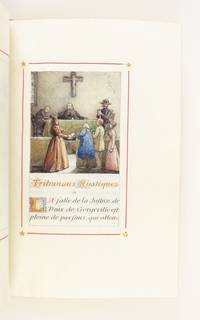
1896ST17129-026Paris 1896. 200 x 135 mm. 7 7/8 x 5 3/8". 11 leaves. Single column 16 lines plus headline in a thin graceful italic script. <br/> Attractive red crushed morocco by Marcellin Lortic stamp-signed on front doublure covers framed by multiple-rule gilt strapwork raised bands spine compartments with gilt French fillet gilt titling vellum doublures with gilt frame in the Romantic style leather hinges vellum endleaves all edges gilt. In matching morocco-trimmed slipcase. Title in burnished gold embellished with red and blue penwork text with red-ruled border and burnished gold stars at corners numerous one-line burnished gold initials with red or blue penwork two-line opening initial in burnished gold on a blue white and pink background and A HALF-PAGE MINIATURE measuring 71 x 64 mm. SHOWING A COURTROOM SCENE. Front free endleaf with morocco bookplate of Robert Hoe. ◆Just the slightest hint of rubbing to joints but A VERY FINE SPECIMEN entirely fresh bright and clean inside and out.<br/> <br/> This elegant little manuscript in French recounts Guy de Maupassant's satirical tale of a trial in the provinces; it was created by a man who knew the inside of a courtroom all too well. Bouton 1819-1901 was a young rebel during the 1848 Revolution who spent five years in jail for his participation in a bombing in Paris. Oddly enough the dedicated republican was also an expert on heraldry and paleography publishing pamphlets on those subjects as well as on politics and producing manuscripts like the present one. De Maupassant 1850-1893 is generally acknowledged as one of the great masters of the short story. In the present tale a wealthy older woman who had tried to buy a young peasant's love by giving him land sues unsuccessfully for the return of her property when the object of her affection forsakes her for a younger woman. According to Beverly Chew the library of Robert Hoe 1839-1911 founding member and first president of the Grolier Club was "the finest America has ever contained." Hoe acquired illuminated manuscripts early printing he owned a Gutenberg Bible on paper and one on vellum fine bindings French and English literature and Americana and when his library was sold in 1911-12 it fetched nearly $2 million a record that held until the Streeter sale more than 50 years later. Hoe owned several Bouton manuscripts of de Maupassant stories and the Morgan Library also has Bouton creations. The Lortic name was made famous in the history of French binding by Pierre Marcellin Lortic 1822-92 a leading Parisian binder for 40 years; the binder here was Lortic's son Marcellin or "Lortic Fils" 1852-1928. unknown
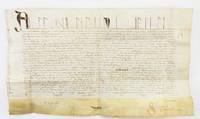
1502ST17895Rome 10 August 1502. 305 x 513 mm. 12 x 20 1/4". Single column 29 lines in a papal documentary script plus signatures at bottom. <br/> First line of text much larger and with elongated letters and calligraphic flourishes. WITH THE ORIGINAL LEAD SEAL AND HEMP TIES ATTACHED. Verso with several ink notations in different contemporary and later hands recto with a long ink line in one margin and the letter "A" in the other both by a later hand. Several folds to vellum as usual one-inch tear near where the hemp tie is attached a couple of small holes in the large "A" at the top of the document seal a little worn around edges and to the contours of the faces but overall in excellent condition with no major issues the vellum especially clean and bright.<br/> <br/> Issued to the overseer of a church in Frilingen probably modern Freilingen in Germany this bull orders the return of the vacated ecclesiastical seat and benefices of the church of St. James in Hergelzhausen in the diocese of Frilingen to two people. The church's rector Andrew Kuefuelz is to receive the position and things that once belonged to Leonard Walter the procurator while George Maltzel of Erding a priest of the same church is to receive the provisions and annual rents pertaining to the church. A member of the powerful Borgia family Rodrigo Borgia 1431-1503 served as vice-chancellor to five successive popes before being elected to the papacy in 1492 taking the name Alexander VI. One of two Borgias to ascend to the papacy the other was Callixtus III who died after just three years as pope Alexander held his own among a notorious family known for scandal. He led a sordid personal life--he was accused of participating in an orgy when he was a cardinal and openly admitted to fathering several children by his mistresses--and his reign was characterized by acts of nepotism and promoting his own family's interests above all else--especially with matters related to foreign policy. However he was also known as a patron of the arts having commissioned work by Raphael Michelangelo and Pinturicchio adopted a rather tolerant attitude toward Jews during this period and succeeded in cracking down on crime in Rome. The Papal Bull takes its name from the lead seals called "bullae" that were issued with official documents of the papacy as a way of ensuring their authenticity. Apart from the rare Solemn Privilege like Innocent III's famous granting of England in 1214 to his involuntary vassal King John there are three other categories of Papal Bulls: Simple Privileges also called Solemn Letters Letters of Grace which confirm privileges and rights and Mandates. The present item is of this final type differentiated by its use of hemp ties as opposed to silk. unknown
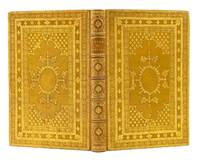
1882ST16453Glasgow: Printed by Robert Anderson for Private Circulation 1882. ONE OF ONLY 50 COPIES. 195 x 122 mm. 7 3/4 x 4 7/8". 1 p.l. x 103 1 pp.From George Bannatyne's manuscript compiled A.D. 1568. <br/> BEAUTIFUL CITRON CRUSHED MOROCCO ELABORATELY TOOLED IN GILT BY RAMAGE stamp-signed on front turn-in covers with six concentric frames--intricate filigree roll pointillé-tooled floral vine and alternating small ornaments--enclosing a central panel with cornerpieces semé with rows of fleurs-de-lys large oval medallion at center radiating ornate fleurons raised bands spine compartments with large central medallion containing a vase of flowers delicate tooling in corners gilt titling turn-ins framed by filigree roll and alternating small ornaments brown and tan silk jacquard endleaves patterned in a Medieval motif top edge gilt. Printer's device on title page decorative woodcut initials and headpieces. Spines evenly sunned to a warm honey brown corners lightly rubbed short faint scratch to lower board but the binding virtually unworn and happily free of the splaying that plagues vellum books. Leaves lightly rumpled but A VERY FINE COPY the vellum leaves creamy clean and bright and the binding glittering with gold.<br/> <br/> Printed on luxurious vellum and limited to just 50 copies presumably for private circulation among friends of the printer this is a lovely edition of 16th century poems by a mysterious author believed to have been a poet and musician associated with the court of Mary Queen of Scots. This work contains all 36 extant poems attributed to Scott ca. 1520-82/3 including what is considered to be his most historically important work "Ane New Yeir Gift to Quene Mary" 1562 written in support of the young Scottish queen caught between Catholic and Protestant agendas. His other poems consist largely of lyric verses on love and sexuality which DNB describes as possessing "exceptional metrical variety and vernacular directness" with "a musician's ear for rhythm and melody." Scott's poems are known to us via the Bannatyne manuscript now held in the National Library of Scotland which ranks among the most important documents of Scottish Medieval literature. Written by George Bannatyne in 1568 during a period of confinement due to an outbreak of plague it contains a mixture of both secular and religious material including the sole extant copies of several texts. In the preface to the present work the publisher notes that Scott's poetry has been faithfully reproduced from that manuscript and thus "for the first time accurately printed." Very little is known regarding the life of Alexander Scott but he seems to have been attached to the court of Mary Stuart through John Erskine a guardian and counselor to the queen. Given the very limited number of copies made it is not surprising that this work is extremely rare on the market. Printed [by Robert Anderson] for Private Circulation unknown
ST18250bEngland first half of 13th century. 235 x 117 mm. 9 1/4 x 4 1/2". Single column 49-50 lines in a gothic hand. <br/> Rubrics in dark brown ink three two-line initials in red or blue with contrasting penwork one four-line puzzle initial in red and blue with red and blue penwork decorations and long marginal extenders. With a few contemporary corrections in a different hand verso with scant remnants of mounting tape. Gwara Handlist no. 7. ◆Top edge trimmed cutting into the large initial's ascender one corner cut away not affecting text a couple of wrinkles and a bit of soiling to vellum but in excellent condition overall quite clean and entirely legible.<br/> <br/> Noticeably different in appearance from the Medieval leaves more commonly encountered on the market such as Books of Hours Bibles liturgical books etc. this leaf features a tall thin "ledger" format and offset initials spaced slightly apart from the rest of the line. The text here comes from the "Aurora" a commentary on the Bible in verse form written in the late 12th century by French poet Petrus Riga 1140-1209 a canon of Rheims cathedral. Although little is known about the author's life Riga's text became immensely popular throughout Europe and was routinely studied in Medieval universities. In fact it is likely that the present leaf came from a manuscript intended for a student or academic as its dimensions suggest it was made for easy transport and could even have been slipped into a pocket. In the 20th century the parent manuscript was owned and dismembered by biblioclast Otto Ege and leaves appeared as specimen no. 7 in his "Fifty Original Leaves from Medieval Manuscripts Western Europe XII to XVI Century." Single leaves from this manuscript appear at auction very rarely. The last example we were able to track on RBH and ABPC sold at Bloomsbury in 2016 for an all-in price of £3100. unknown
ST16985QFrance first half of 14th century. 110 x 82 mm. 4 3/8 x 3 1/4". Single column 12 lines in a gothic book hand. <br/> Line enders in pink and blue with gold accents each leaf with one or more one-line initials in blue with red penwork or gold with blue penwork each leaf with one two line initial painted pink or blue ONE INHABITED BY HUMAN FACE others filled with painted floral motifs all on a gold ground one side of each leaf with A FULL BORDER composed of pink and blue tendrils accompanied by spikey gold decoration and gold accents often terminating in ivy leaves and incorporating EXTRAORDINARILY CHARMING EXAMPLES OF MARGINALIA INCLUDING ANIMALS HUMAN HEADS AND HUMAN-BEAST HYBRIDS. ◆Vellum with a little soiling and a few small stains slightly more noticeable on one leaf where it is touching the text though not obscuring meaning a few instances of rubbing to gold and decoration including one bird with its detailing rubbed away other minor imperfections but none of these flaws egregious and the most desirable imagery here still very well preserved.<br/> <br/> Though diminutive in size these leaves contain enormously appealing marginal decoration in the form of humans animals and hybrid creatures inventively incorporated into the lively borders in manners that range from adorable to bizarre. Especially popular in Flanders Northern France and England during the 13th and 14th centuries marginalia such as these comprise some of the most memorable and entertaining images to be found in any Medieval manuscripts. Despite being found largely in religious books such as Psalters and Books of Hours the images are often strange humorous or even outrageous and they provide us with consistent delight. Being by definition outside of the central text or miniature the margins seem to have been a place where illuminators felt more at ease to experiment resulting in highly imaginative and unique artistic expressions. The present specimens come from a fragmentary manuscript with many leaves either missing or rendered defective where portions of the vellum were cut away. Fortunately this group of leaves is intact and retains much marvelous imagery including an owl and two other birds one apparently holding a worm in its mouth human heads and torsos capping off the ends of border tendrils including a trumpeter blowing into a particularly long instrument and a man reaching both arms straight into the air as if trying to grab the head attached to the tendril above him and a hybrid with the head of a human in a gold hood and the body of a hare perched gingerly on an ivy branch. For additional leaves from this same manuscript at different price points please check our website. unknown
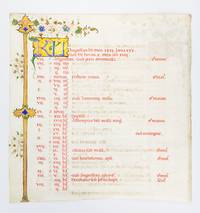
1441ST19882Italy Ferrara 1441-48. 205 x 200 mm. 8 x 7 7/8". 35 lines in a very fine rounded gothic hand. <br/> Text in dark brown and red capitals touched with yellow two four-line "KL" initials in blue pink and green on burnished gold ground with leafy marginal extensions the initials on the recto crowned with an exuberant spray of green blue and gold acanthus hairline tendrils pink flowers and gilt bezants and leaves the verso initials with a long bar border on outer margin painted pink on gilt ground with pink green and blue motifs at middle and top the border traced with black the top of the border accompanied by a spray of hairline tendrils colorful flowers gold bezants and leaves. ◆Lower margin of the verso trimmed away with loss of the end of bar border though not the text some of the other margins trimmed close crowding but not affecting the decoration some fading to brown ink less faded on recto legible on both sides in any case negligible dampstain in upper margin short closed tear just entering gold bar at top left of verso; not without imperfections but still an exquisite and very desirable leaf with richly colored and gilt embellishment.<br/> <br/> This item presents a very special perhaps singular opportunity to own the only known calendar leaf from the renowned Llangattock Breviary to emerge since the manuscript was taken apart in the 20th century. Executed with great skill and delicacy in sensitive Italianate colors highlighted by spring green and pink our leaf is unsurprisingly from a manuscript intended for a powerful aristocrat. It comes from the celebrated Breviary illuminated for the chapel of the Marquises of Este rulers of Ferrara and Mantua a manuscript commissioned by Leonello d'Este duke of Ferrara from 1441-50. According to the d'Este family records this manuscript seems to be the Breviary done for Leonello by Giorgio d'Alemagna Bartolomeo de Beninc Guglielmo Giraldi and Matteo de' Pasti see Toniolo "La Miniatura a Ferrara dal Tempo di Cosm Tura all'eredit di Ercole de' Roberti" 1998 pp. 19-20 and 76-77. Leaves from this manuscript show subtle variations in the style of the illuminations a result of work performed individually by a team of artists doing variations on a theme. At one time in a Spanish library the manuscript was brought to Britain during the Peninsular War and came to be owned by the Rolls family later Lords Llangattock of Monmouth in Wales from whom it takes its name. By the time the work reached Britain most of the miniatures had already been cut out. The Breviary sold at Christie's on 8 December 1958 lot #190 after which it was acquired and subsequently dismembered by Goodspeed's of Boston. The attribution of this leaf to the Llangattock Breviary is based its script ruling and style of decoration as well as physical attributes such as width of the leaf and the appearance of the vellum which all correlate to other known leaves from this manuscript. Furthermore according to the 1958 auction description of the complete manuscript the entire calendar section had its lower margins trimmed away as here. The present leaf appeared in a 1979 catalogue of bookseller Kenneth Rendell and it remains the only known calendar leaf from this manuscript that has ever been advertised. unknown