Prunai, G B (VELLUM BINDING)Biblio.com

153 résultats
19023402<p>F. Lumachi publisher. 1902. Florence. Full vellum limp with leather ties. This is a nice example of one of the Florence gift bindings done around the turn of the century. The front cover is hand painted titling and decoration in a fine hand. A slight bit of discoloration to the vellum otherwise a clean unmarked copy. Yapp edges all ties present.</p> F. Lumachi hardcover
1464<p>London: Macmillan and Co. 1895. Octavo. A sensuously romantic but chaste gift binding in full vellum with the initials " J. J. de W." in gilt on the front cover and " 25. June 1895 d. d. G. B. R." on the back cover. 184 pages. The gilt titled spine has an ornament of a single gilt inverted lily blossom on a sinuous stem with the date 1895 in gilt at the foot of the spine. Small gilt lily blossoms also adorn the corners of both covers. Vellum turn-ins with double gilt rules. Top edge gilt. Although this binding is unsigned it was obviously the work of a skilled binder producing a gift volume to represent the affection of the presenter and hopefully the cherished regard of the receiver.</p> hardcover
195474499Philadelphia: American Dredging Company 1954. A lovely calligraphic memorial resolution calligraphed by by W. G. Strickland of Philadelphia. Octavo 6 3/4 x 9 1/2 inches. 6 leaves of vellum of which four bear the memorial versos only. Capitals done in gilt and blue. Opening leaf elaborately decorated. Final leaf signed by each Member of the Board. Original black pebbled morocco gilt turn-ins white moire silk doublures matching slipcase. An excellent example of this form of the Golden Watch.The American Dredging Company of Philadelphia began operations in 1867 and soon became the largest dredging company in the country. E. Homan Stroud joined the company in 1904 and rose through the ranks to become its president in 1944. He died on June 24 1954 and this memorial was dated the day after. Apparently there were two copies as it states near the rear that a copy shall be given to his widow. [American Dredging Company] hardcover
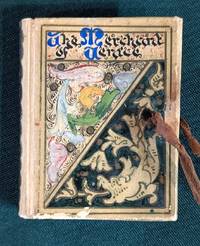
50727Venice: S. Rosen - Publisher Piazza S. Marc MDCCCCVI. 1906 . Scarce miniature book with hand-painted decoration. 2.75" x 2.25" x 0.5" 7.2cm x 5.8cm x 1.4cm. pp.256. Soiled vellum binding in very good condition. Both boards and spine with hand-painted decoration. Original leather tie still attached. Patterned endpapers. Gift inscription in red to front free-endpapers: "Of great value. Hand painted cover. From Father brought from Venice July 1909. A.D. To Ailen Mary Danby." Portrait frontis. Clean English text throughout plus a further 3 full-page illustrations. VG . Venice: S. Rosen - Publisher Piazza S. Marc, MDCCCCVI. [ 1906 ] . hardcover
32636Burt Franklin New York. Reprint of the 1822 Edition 1969. 9 Vols. small 4to orig. cloth. "The first bibliography of books printed on vellum; it describes 1750 books owned by what is now the Bibliothèque Nationale Paris and 2750 works which the author traced in other public and private libraries. But it is much more than a mere bibliography of books printed on that precious material; the copious notes make it a valuable bibliography of rare books in many fields." - Breslauer & Folter Grolier Club Bibliography 123. Burt Franklin, New York. (Reprint of the 1822 Edition) 1969 hardcover
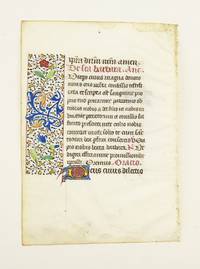
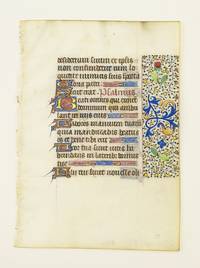
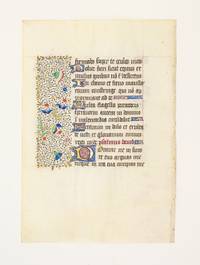
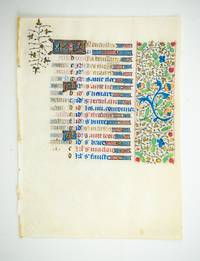
1475ST19653GNorthern France ca. 1475. 155 x 110 mm. 6 x 4 1/4". Single column 16 lines in a gothic book hand. <br/> Rubrics in dark pink some leaves with line fillers in pink and blue with white embellishment and gilt bezants each leaf with at least one and some with many one- to three-line initial either in gilt on a pink and blue ground with white embellishment or painted blue with white embellishment filled with flowers or ivy on a gilt ground most leaves with one panel border of hairline vines gilt ivy and bezants and painted flowers. Occasional light soiling wrinkling and other very minor imperfections but in fine fresh condition overall very clean and with wide margins.<br/> <br/> Undoubtedly the work of a top atelier these lovely manuscript leaves have been written and decorated with a high degree of skill. Many of the leaves feature numerous glittering initials and the delicate panel borders add a bit of extra sparkle to the page. unknown
148552035France c.1485-1515. Small8vo. 80 x 12 mm. 1 leaf in vellum single column with text to both verso and recte. Fine flower ornamentation in red blue and gold to outer margin both verso and recte. Horisontal catchword. Small worm-hole to upper right corner far from affecting text. hardcover
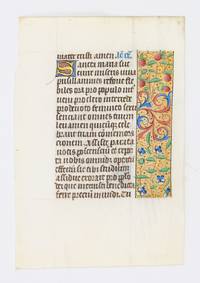
1480ST18547Northern France ca. 1480. 164 x 111 mm. 6 1/2 x 4 3/8". Single column 17 lines in a gothic book hand. <br/> Rubrics in blue many leaves with line fillers in pink and/or blue with gilt bezants and white tracery each leaf with at least one and often many one- or two-line initials in burnished gold on blue and pink ground with white tracery every side with a panel border consisting of colorful acanthus and different types of flowers on a ground that is either entirely painted gold or with a pattern of painted gold and bare vellum. A few leaves with light wrinkling or a hit of soiling or foxing a couple of leaves with inoffensive marginal repairs but IN VERY FINE CONDITION EXTREMELY CLEAN AND BRIGHT.<br/> <br/> Featuring both burnished and painted gold in their decoration and offering a multitude of border patterns to choose from these are extremely attractive leaves that are all the more appealing for their fine condition. unknown
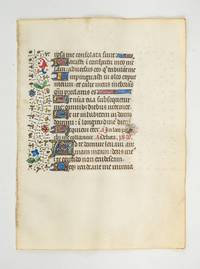
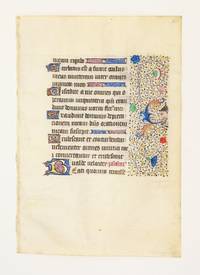
1450ST11774DParis ca. 1450. 159 x 108 mm. 6 1/4 x 4 1/4". Single column 15 lines per page in an excellent gothic book hand. <br/> Rubrics in red each leaf with two or more two-line initials in burnished gold on red and blue ground with white tracery some also with one-line initials and line fillers similarly decorated one or both sides with a swirling panel border featuring flowers leaves strawberries and many burnished gold ivy leaves on hairline stems. Isolated trivial stains or imperfections but VERY BRIGHT CLEAN AND FRESH.<br/> <br/> In fine condition beautifully decorated and sparkling with gold these leaves are marvelous examples of a high-quality Parisian Book of Hours made for a person of means. The borders here are especially pleasing with skeins of hairline vines accented by burnished bezants and ivy bright blue and gold acanthus pale green leaves and cheerful red blossoms. For leaves at other price points please check our website. unknown
1450ST11774EParis ca. 1450. 159 x 108 mm. 6 1/4 x 4 1/4". Single column 15 lines per page in an excellent gothic book hand. <br/> Rubrics in red each leaf with line fillers and multiple one- and two-line initials in burinshed gold on red and blue ground with white tracery one or both sides with swirling panel border featuring flowers leaves strawberries and many burnished gold ivy leaves on hairline stems. Isolated trivial stains or imperfections but VERY BRIGHT CLEAN AND FRESH.<br/> <br/> In fine condition beautifully decorated and sparkling with gold these leaves are marvelous examples of a high-quality Parisian Book of Hours made for a person of means. The borders here are especially pleasing with skeins of hairline vines accented by burnished bezants and ivy bright blue and gold acanthus pale green leaves and cheerful red blossoms. For leaves at other price points please check our website. unknown
ST17060HFrance probably Besançon 3rd quarter of 15th century. 239 x 165 mm. 9 3/8 x 6 1/2". Single column 15 lines in an elegant gothic book hand. <br/> Rubrics in dark pink line enders in pink and blue with white tracery and gold bezant each with multiple one- and/or two-line initials in burnished gold on dark pink and blue ground with white tracery each side of each leaf with a lovely panel border composed of hairline vines with gold ivy and bezants and colorful flowers and acanthus some with floral arrangements in vases and/or especially leafy vegetation. A couple leaves with a little yellowing or light soiling to vellum occasional small stains or smudges other negligible imperfections but on the whole VERY CLEAN BRIGHT AND WELL PRESERVED.<br/> <br/> From a large Book of Hours probably produced in Besançon these leaves feature very pretty panel borders on every page each with unique flourishes that include colorful acanthus flowers and/or fruits as well as a couple special examples with particularly large fleshy vegetation and vases of floral arrangements. Luxurious touches such as the numerous gilt initials several dozen gilt bezants and ivy leaves in each panel border and the unusually wide margins point to this manuscript having been a costly production. For additional leaves from this same manuscript at different price points please check our website. unknown
1822mon0003529457Chez de Bure Freres 1822. Paperback. Good. . Extremely scarce in any condition. 5 volumes in 4 physical books II and III in one. Fragile but fully intact. Some chipping at edges. Pages clean. Chez de Bure Freres paperback
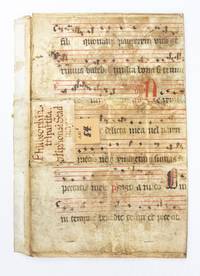
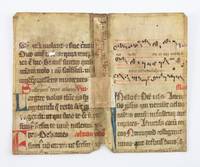
ST19350-050Germany 14th century. 250 x 175 mm. 9 7/8 x 6 7/8". Six extant lines of text and music in a gothic hand. <br/> Rubrics and staves in red one large initial in red and two large decorative initials in black and red. With the binding's original paper labels on spine remnants of old paper lining on verso. Somewhat soiled and stained but a good specimen overall.<br/> <br/> Recovered from a 17th century binding this specimen presents an excellent opportunity to examine how Medieval manuscripts were used in the construction of later bindings. The two preserved spine labels tell us that the leaf previously covered a copy of Alphonso Stadlmayer's "Philosophia Tripartita" first published in 1650. unknown
1440ST12158bAParis ca. 1440. 222 x 162 mm. 8 3/4 x 6 3/8". Single column 16 lines of text in a beautiful gothic book hand. <br/> Rubrics in red leaves with varying numbers of line fillers and one- and two-line initials in burnished gold blue and magenta highlighted with white tracery and WITH LOVELY RINCEAU BORDERS on one or both sides these composed of delicately twining hairline stems bearing red and blue blossoms and FEATURING A PROFUSION OF BURNISHED GOLD IVY LEAVES. IN OUTSTANDING CONDITION the vellum extraordinarily bright fresh and clean and WITH MARGINS AS VAST AS ONE COULD EVER HOPE FOR.<br/> <br/> Commissioned for use by a woman as indicated by the feminine form in the "Obsecro te" the Book of Hours from which these leaves come could only have been a manuscript of great beauty prepared for a household of very substantial wealth and importance. The level of achievement manifested here in both the scribal hand and the execution of the illuminated decoration clearly indicates that some of the best artisans money could buy were at work on this book and only a powerful family could afford to pay their price. Further corroboration of this fact is seen in the leaves' noticeable size and immense margins which are at least as wide as on any Book of Hours leaves we have ever owned. Such a conspicuous display of purchasing power those extra millimeters meant the slaughtering of extra animals and that meant greater cost announces an owner's self-congratulatory consequence that is uncommon except in the grandest of prayer books of the period. Happily the condition here matches the importance of the manuscript which was obviously considered from the beginning--and ever after--an object to be carefully preserved. For additional leaves from this Book of Hours at different price points please check our website. unknown
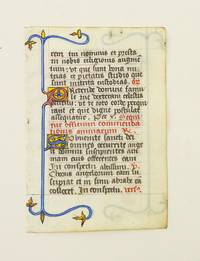
1440ST11459-11Paris ca. 1440. 121 x 89 mm. 4 3/4 x 3 1/2". Single column 15 lines of text in a very fine gothic book hand. <br/> Rubrics in red with multiple one-line initials and line fillers all in blue maroon and burnished gold and with two-line initials in the same colors and gold but also enclosing charming flowers on scrolling stems with marginal extension in the form of gilt ivy leaves on sinuous stems and WITH A FINE SWIRLING PANEL BORDER ON EACH SIDE featuring flowers leaves strawberries and many burnished gold ivy leaves on hairline stems. IN FINE CONDITION with the paint and gold bright fresh and entirely intact.<br/> <br/> This is a lovely little leaf from a fragment of a Book of Hours that obviously was produced for a client of considerable means by skilled craftsmen in a Parisian studio probably a little before the middle of the 15th century. This was clearly intended to be put into a book that could be carried easily on one's person and part of what makes it so charming is this portable size. unknown
1740ST12778-0377Rome 1740. 180 x 312 mm. 7 x 12 1/4". Single column 18 lines in an arcane "scrittura bollatica." <br/> Elaborate lettering across top line of text and at lower right corner. Lower margin with several signatures in ink; verso with brief notes in ink; remains of hemp tie for appended seal which has been cut away. With faint folds a little natural yellowing to vellum but in fine condition.<br/> <br/> Appearing almost as a dancing musical score this is Papal Bull that leaves a lot to be deciphered. The document is written in the so-called "scrittura bollatica" which the Catholic Encyclopedia calls "an archaic and very artificial type of writing . . . with manifold contractions and an absence of all punctuation which was practically undecipherable by ordinary readers." The script was used from after the Reformation until it was discontinued through papal edict by Leo XIII in 1878. Apart from the name of the issuing pope and the date the only readily identifiable part of the text here is the name of the Archbishop of Naples the addressee on the top line. We acquired this document along with several other bulls addressed to this archbishop all having to do with marriage dispensations and we suspect that the present item probably contains similar content. The esteemed polymath Pope Benedict XIV born Prospero Lorenzo Lambertini 1675-1758 headed the Catholic Church from 1740 until his death. A scholar and reformer he worked to modernize church administration promote scientific study and improve relations with secular rulers. unknown
ST19350-049Germany 14th century. 132 x 164 mm. 5 1/4 x 6 3/8". Double column 12 extant lines in a gothic book hand. <br/> Rubrics and four-line staves in red capitals touched in red four large initials in red or blue. Spine with two old paper labels one with ink titling. Vellum a bit soiled a couple small holes ink a little faded on verso paper remnants on verso obscuring a few lines but still a good specimen demonstrating use and reuse of Medieval manuscripts.<br/> <br/> From a noted Missal that had outlived its use this manuscript leaf was later repurposed as a cover for a 17th century printed book. The spine label indicates it was a copy of Jacob Bidermann's "Herodiados libri tres" a lengthy Latin poem relating the story of John the Baptist and Herod first published in 1622. unknown
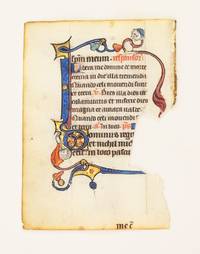
ST17060RFrance probably Besançon 3rd quarter of 15th century. 239 x 165 mm. 9 3/8 x 6 1/2". Single column 15 lines in an elegant gothic book hand. <br/> Rubrics in dark pink line enders in pink and blue with white tracery and gold bezant several one-line initials and one two-line initial in burnished gold on dark pink and blue ground with white tracery each side with a panel border composed of hairline vines with gold ivy and bezants a few colorful flowers and EACH FEATURING THE FACE OF A MAN EMITTING ACANTHUS LEAVES FROM HIS MOUTH. ◆A few tiny marginal spots one of the faces slightly rubbed otherwise IN BEAUTIFUL CONDITION.<br/> <br/> In addition to the floral decoration and vines often found in the borders of Books of Hours this leaf features a duo of delightful inhabitants in the form of faces emitting colorful acanthus from their mouths. Each figure is individualized the face on the recto with dark hair flushed cheeks and a prominent nose; on the verso is a face with a much paler complexion a tonsured hairstyle a large but very short nose and fine gray whiskers. This kind of imaginative work together with luxurious touches such as the many gilt initials several dozen gilt bezants and ivy leaves in each panel border and the unusually wide margins point to this manuscript having been a costly production. For additional leaves from this same manuscript at different price points please check our website. unknown
1450ST12778-0485-05BFrance ca. 1450. 97 x 61 mm. 3 3/4 x 2 5/8". Single column 20 lines in an attractive gothic book hand. <br/> Each leaf with two or more one- to two-line initials painted in blue or maroon with delicate white tracery and charming enclosed flowers all on a field of burnished gold the left or right margin on one or both sides with a bar border of blue and white terminating in gold ivy leaves in the upper and lower margins. ◆The bar borders just slightly trimmed by the binder otherwise in excellent condition the text well preserved the vellum unusually clean the colors quite bright and the glistening gold without any erosion or loss of brilliance.<br/> <br/> Taken from an intact manuscript we sold in 2006 that was subsequently dismembered these lovely leaves have considerable aesthetic appeal and charm as well as notable interest because of their surprising size distinctive musical and textual content and peculiar hypothetical provenance. In origin the collectarium sometimes called a collectar collectarius collectaneum orationale or capitulare was a compilation of the collects or prayers said during the various hours of the Divine Office. But over time it came to comprise an ad hoc collection of the prayers and ceremonies not found in other service books that were specific to the uses of a particular house congregation or religious order. The presence of music throughout the original book indicates that our leaves were part of a choir book; however unlike most choir book leaves which range from very large to enormous in order to allow simultaneous use by a number of singers the present pocket-size manuscript is quite atypical in that it could only have been used by a single person at any one time. These leaves are also highly unusual and therefore most interesting in that we know from consulting other portions of the original that this collectarium was written not for a monastic house but for a community of religious women who are referred to in other parts of the manuscript as "sisters." Judging from the frequency with which she is mentioned in the original members of that community using the present choirbook seem clearly to have identified closely with the penitent Magdalene the original book containing a portion of the double feast they celebrated for her and her presumed sister Martha. This suggests a fascinating possibility in terms of the manuscript's provenance: beginning in the 13th century houses of penitential sisters known as Magdalens were established in many European cities often by wealthy lay persons with the aim of providing former prostitutes with a safe haven in a religious community. It is just possible that our manuscript leaves were part of a book that was used in such a convent. unknown
a5097632x16 cm folded in sixths. Sepia-toned ink manuscript letter in Latin on one third of inside surface with heading in manuscript on outside. Original cord with metal seal formed over and around the strings holding string ends together. Seal is about 1.3 inches in diameter. One side of seal shows a King and Pope. and reads: Veneti .DVX.Hierpriolus. Verso reads HIH Ronimus Priolus Die Grad VX Venetiar et C with narrow decorated circular border around edge. Text appears to concern political affairs. Girolamo Priuli 1486 - 1567 was Doge in Venice 1559-1567. Legible. Highly unusual item. Rare and Unique. Pictures available on request. . unknown
161771548Venetia: appresso Gio. Battista Ciotti 1617. pergamino. Folio. appresso Gio. Battista Ciotti unknown
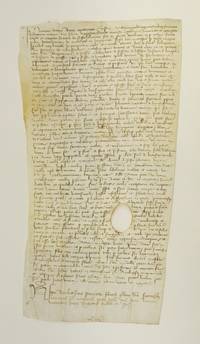
1429ST12778-0360Italy 1429. 323 x 173 mm. 12 3/4 x 6 3/4". Single column 60 lines in a neat cursive script. <br/> Notarial signature at lower left; verso with a date and notations in contemporary hands. ◆Vellum trimmed a little close four horizontal and three vertical fold creases slight darkening to verso five very small holes no text obscured and one larger naturally-occurring hole in the text otherwise in excellent condition with a very clear hand.<br/> <br/> This is a notarized document recording an agreement made between the chapel and convent i.e. the whole community of the house of St. John a group of female religious located in the parish of St. Peter and the brothers of Bonsignioribus another religious house in the parish of St. Laurence Major. The women of St. John agree to pay to the brothers of Bonsignioribus a sum of 11 libras 8 soldas and 9 denarios. The reason for this payment is unclear pending further investigation into some of the more abbreviated portions of the text. The document is of additional interest for the fact that several female members of the house of St. John are mentioned by name. Based on these names and that of the notary Ambrosius Spanzota . . . Parmensis it would appear that the document was written in Italy possibly in Parma and that the two houses were also located there. unknown
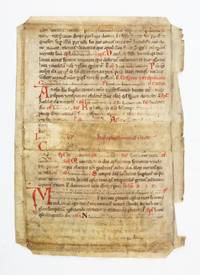
ST19350-013Germany early 13th century. 273 x 193 mm. 10 3/4 x 7 1/2". Single column 31 lines text in two sizes in a gothic hand. <br/> Rubrics in red several one- and two-line initials in red and two larger initials in red. A few lines with neumes later notations in the margins now quite faded. ◆Vellum a bit soiled and creased as expected fading to four or five lines where the spine was placed several notches along one edge other imperfections due to its reuse as binding scrap but still an excellent specimen that is almost entirely legible.<br/> <br/> Written in a neat and attractive hand this sizable leaf from a Missal remains mostly quite legible with all its rubrication intact despite having been used as part of a binding. A few lines also show musical notation from the earliest generation of neumes. They are described as "in campo aperto" which means literally "in an open field" because they and they alone occupy the space or "field" above the text. They are also described as adiastematic because they appear in a straight line whereas later diastematic neumes reflect changes in pitch by being placed in a higher or lower vertical position above the text. At the time the present leaf was written out the neumes here simply served as an "aide memoire" to the singer who had already learned the melody orally. unknown
ST16985GFrance first half of 14th century. 110 x 82 mm. 4 3/8 x 3 1/4". Single column 12 lines in a gothic book hand. <br/> Rubrics in red line enders in pink and blue with gold accents each leaf with one or more one-line initials in blue with red penwork or gold with blue penwork some leaves with one two-line initial painted blue filled with either decorative shapes or INHABITED BY A HUMAN HEAD all on a gold ground one side of each leaf WITH A FULL BORDER composed of pink and blue tendrils accompanied by spikey gold decoration and gold accents often terminating in ivy leaves and incorporating EXTRAORDINARILY CHARMING EXAMPLES OF MARGINALIA INCLUDING ANIMALS HUMANS AND HYBRIDS. ◆Vellum slightly soiled and with a few minor imperfections one leaf with a little offsetting in one corner each leaf with a small area excised by a former owner affecting marginalia and a few words of text but each leaf with at least two fully intact examples of marginalia and on the whole the leaves quite clean the colors very bright and the gold sparkling.<br/> <br/> Though diminutive in size these leaves contain enormously appealing marginal decoration in the form of humans animals and hybrid creatures inventively incorporated into the lively borders in manners that range from adorable to bizarre. Especially popular in Flanders Northern France and England during the 13th and 14th centuries marginalia such as these comprise some of the most memorable and entertaining images to be found in any Medieval manuscripts. Despite being found largely in religious books such as Psalters and Books of Hours the images are often strange humorous or even outrageous and they provide us with consistent delight. Being by definition outside of the central text or miniature the margins seem to have been a place where illuminators felt more at ease to experiment resulting in highly imaginative and unique artistic expressions. The present specimens come from a fragmentary manuscript with many leaves either missing or rendered defective where portions of the vellum were cut away as here. Fortunately these leaves each retain at least two excellent examples of marginalia including a very alert hare hybrids with the heads of humans and the bodies of two-legged beasts humans emerging from the border tendrils to help hold up initials a human head with a wizened beard and a stylized hat incorporated into the border and a trumpeter blowing into a long instrument accented with gold. Though fragmentary in appearance these leaves present an excellent opportunity to acquire fine examples of marginalia at an affordable price. For additional leaves from this same manuscript at different price points please check our website. unknown
1928120551928. Original illuminated large manuscript page on vellum comprising a central panel of calligraphic text in red and black ink with a miniature of a young herald surrounded by a decorative border of larger armorial shields set within a stylised foliate background in blue red green and gilt with a fine miniature of a knight’s tournament at the foot. 41 x 25.5cm. Mounted on card with ink title to the head: “Illuminated page on vellum. / Testimony of study for Board of Education Exam in industrial design 1928.†In very good condition.WITH: Two further pencil drawings by the same artist the first of an elderly gentleman the second of a classical sculpture measuring 57.5 x 38cm and 56 x 39cm respectively each signed “Bate†and dated 1927. The pencil drawings have a few short tears to the edges otherwise they are in very good condition. A fine example of 1920s illumination hardcover