16 724 résultats
1955156909Burbank CA: Warner Brothers 1955. Draft script for the 1956 revisionist Western. <br /> <br /> Near the end of Randolph Scott's career producer Harry Brown Scott and director Budd Boetticher began work on a series of intelligent films that would combine Scott's minimalist acting style with Boetticher's lean approach to filmmaking. The result was a series of films today referred to as the "Ranown" cycle a rich canon that formed a strong stylistic whole. Boetticher's approach to storytelling was traditional in the sense that it involved traditional Western characters but revisionist in that his protagonist invariably worked alone and sought his own brand of morality rather than one established by tradition government and family. Apart from ardent fans of Westerns these films went unrecognized by most until Martin Scorsese made a case for them in his 1995 BFI documentary "A Personal Journey with Martin Scorsese Through American Movies." <br /> <br /> Gray titled wrappers dated September 15 1955 with credits for screenwriter Burt Kennedy. Title page present dated September 15 1955 with credits for screenwriter Burt Kennedy. 100 leaves with last page of text numbered 99. Mimeograph duplication rectos only with blue revision pages throughout dated variously between 9/19/55 and 9/20/55. Pages and wrapper Very Good plus with tide marks on the bottom edges of the title page and front wrapper bound internally with three gold brads. Housed in a custom brown quarter-leather clamshell box. <br /> <br /> Pitts 3788. Schrader 52. Scorsese A Personal Journey Through American Movies. Warner Brothers unknown
1957152173London: Attica Film Company 1957. Archive of material from the 1957 British film including a Draft production script a post-production Release script and a reference photograph inscribed by director Charlie Chaplin to production manager Mickey Delamar: "To Mickey / Thanks for a wonderful job / Charlie Chaplin / July 30th." <br/><br/>Also included are a presumably complete set of nine soundtrack LPs made for use with film projection all in their original mailing box and sealed with the label of the Master Sound System Company in the UK. <br/><br/>Lastly included are approximately 100 vintage photographs all with the stamp of Eric Gray the film's still photographer on the verso. Photographs all have a significant horizontal curl but are all separate and otherwise supple and clean. This segment of the archive is offered as is.<br/><br/>Chaplin's final starring role about a dethroned and penniless king from a fictional European nation living in New York where he inadvertently becomes the target of a HUAC investigation after meeting a politically minded youngster played by Chaplin's son Michael whose parents have been jailed as communist sympathizers. A pointed satire of McCarthyism American consumerism and celebrity culture the film was produced in Europe due to Chaplin's own exile from the United States as a result of his leftist political beliefs and did not receive an US release until 1973. <br/><br/>Mickey Delamar worked as a producer production manager and assistant director on over 30 films and was active in the film industry for four decades. His credits include Julien Duvivier's "Anna Karenina" 1948 Francois Truffaut's "Fahrenheit 451" 1966 and Terence Young's "Mayerling" 1968.<br/><br/>Set in New York shot on location in London. <br/><br/>Draft script:<br/><br/>Tall red untitled wrappers. Title page present undated with credits for screenwriter Charles Chaplin. 163 leaves with last page of text numbered 163. Mimeograph duplication rectos only. Pages Very Good plus wrapper Very Good plus bound with a silver prong.<br/><br/>Post-Production Release script:<br/><br/>Tall self wrappers. Title page present dated 7th March 1957 noted as RELEASE SCRIPT. Approximately 135 leaves. Mimeograph duplication rectos only. Pages Very Good plus bound with two silver brads.<br/><br/>Presentation photograph:<br/><br/>7.5 x 9.5 inches. Very Good plus lightly toned. <br/><br/>Soundtrack LP set:<br/><br/>LPs well used and scratched but not cracked untested. Outer mailing box Very Good.<br/><br/>Reference photograph set:<br/><br/>All photographs extensively curled and though not examined carefully apparently not stuck together in any way. Very Good. Attica Film Company unknown books
1944139807Los Angeles: Twentieth Century-Fox 1944. Final Shooting script from the 1945 film. With credit on the title page for screenwriter Anita Loos who would go uncredited in the final film. <br/><br/>Based on the classic 1943 coming-of-age novel by Betty Smith. Nominated for Best Screenplay and James Dunn won for Best Supporting Actor. Peggy Ann Garner was also awarded a special Academy Juvenile Award for her lead performance. <br/><br/>Tan titled wrappers noted as Shooting Final on the front wrapper rubber-stamped production No. 944 dated May 1 1944. Title page present dated May 1 1944 noted as Shooting Final with credits for screenwriters Tess Slesinger and Frank Davis and "contributions by" Anita Loos. 176 leaves with last page of text numbered 178. Mimeograph duplication with blue revision pages throughout dated variously between 5/23/44 and 7/6/44. Pages Fine wrapper Very Good plus bound internally with two gold brads. <br/><br/>National Film Registry. Twentieth Century-Fox unknown books
1924143516Beverly Hills CA: Metro-Goldwyn-Mayer MGM 1924. Vintage herald or broadside for the 1924 film. A clever and excessively rare bit of advertisement designed as a "Wanted" poster pulling together the main character from Frank Norris' novel John "Doc" McTeague a photo of "McTeague" Gibson Gowland and mention of a specific screening at San Francisco's Imperial Theatre on Market Street today the Market Street Cinema. <br/><br/>The first cut of Stroheim's "Greed" was a mammoth 9.5-hour presentation. All that survives today is a restored slightly choppy but coherent 240-minute version supplanted with still photographs that conveys to the viewer the unimaginable grandeur of the original. Very little paper advertisement has survived. The only poster that has ever surfaced is a disappointing window card showing none of the characters and this remarkable broadside the only example we have ever encountered. <br/><br/>13 x 6 inches. Near Fine with a couple of tiny internal tears overall extremely clean and with no paper loss. Metro-Goldwyn-Mayer [MGM] unknown books
1941137464Universal City CA: Universal Pictures 1941. Draft script for the 1941 film here under the working title "The Great Man" with holograph annotations on nearly every page. W.C. Fields' last starring film before his death in 1946. <br/><br/>Told as a "real life" film starring Fields as himself "Never Give a Sucker an Even Break" is an off-beat and slightly bizarre spoof on the Hollywood and filmmaking industry of Fields' time. The film doesn't quite follow a storyline and is instead intentionally riddled with inconsistencies forgotten characters and wacky plot holes. <br/><br/>Light blue titled wrappers. Title page integral with the first page of text with credits for screenwriters John T. Neville Prescott Chaplin and Fred Cribblecobbis W.C. Fields pseudonym. 156 leaves with last page of text numbered 156. Typescript on onionskin stock. Pages Near Fine wrapper Near Fine bound internally with two gold brads. Universal Pictures unknown books
1938137535Universal City CA: Universal Pictures 1938. Draft script for the 1939 film. Director George Marshall's working copy with his profuse substantive annotations throughout. <br/><br/>Ne'er-do-well circus owner Larsen E. Whipsnade W.C. Fields struggles to keep his performers and carnival business just a few steps ahead of the law in order to avoid foreclosure. Meanwhile Whipsnade's co-ed daughter Vicky attempts to navigate her equally confounding romantic entanglements in light of her father's financial trouble. <br/><br/>Also starring Edgar Bergen and Charlie McCarthy as fictitious versions of themselves likely in an attempt to drawn attention to the duo's famous "radio feud" with Fields. <br/><br/>Light blue titled wrappers noted as REVISED SCRIPT on the front wrapper. Title page integral with the first page of text dated 10/31/38 noted as REVISED SCRIPT. 139 leaves with last page of text numbered 164. Typescript on onionskin stock with light green pink and gray revision pages throughout. Pages Near Fine front wrapper Near Fine bound with two gold brads. Lacking rear wrapper. Universal Pictures unknown books
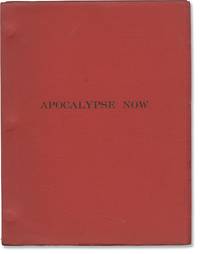
162426Beverly Hills CA: United Artists 1975. Draft script for the 1979 film. <br /> <br /> Loosely based on the 1899 novella "Heart of Darkness" by Joseph Conrad. The ultimate reflection of the American experience in Vietnam taking Conrad's dark vision of an expedition up the Congo and transplanting it to Vietnam-era Cambodia. <br /> <br /> Nominated for eight Academy Awards winning two. Winner of the Palme d'Or.<br /> <br /> Shot on grueling location in the Philippines. <br /> <br /> Red untitled wrappers. Title page present dated December 3 1975 with credits for director Francis Ford Coppola screenwriter John Milius and author Joseph Conrad. 154 leaves with last page of text numbered 153. Xerographic duplication rectos only. Pages Near Fine wrapper Very Good plus with front wrapper partially detached from the binding bound with two gold brads.<br /> <br /> National Film Registry. Ebert I. Godard Histoires du Cinema. Rosenbaum 1000. United Artists unknown
1959139477Paris: Les Films du Carrosse 1959. Original French Grande poster for the 1959 film. Poster design by Boris Grinsson. <br/><br/>Truffaut's auspicious debut winner of Best Director at Cannes nominated for the Palme d'Or and also nominated for a Best Original Screenplay Oscar the following year. <br/><br/>47 x 62 inches27 x 41. Linen backed and rolled. Bright and Fine. <br/><br/>Capitaine 207. Warren Vol. 1 p. 159. Les Films du Carrosse unknown books
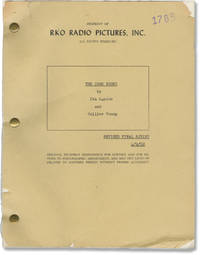
1952158191Culver City CA: RKO Radio Pictures 1952. Revised Final Script for the 1953 film here under its working title "The Cook Story." Carbon typescript master clean with just a handful of typeovers throughout.<br /> <br /> Based on the true account of serial killer Billy Cook. Gilbert and Roy Lovejoy and O'Brien are two buddies on a fishing trip who stop to pick up a hitchhiker named Emmett Talman whom they learn is an escaped serial killer. To make things more daunting Emmett informs the buddies of their impending death carried out once they reach Mexico.<br /> <br /> This early draft of the script precedes shooting-which began on June 24 1952-by nearly three months and includes a bookend context at the beginning and end of the story wherein we are introduced to the home lives and problems of the film's two protagonists. The final film takes a more minimal approach wherein these bookends are removed and the story begins simply with the two men on a vacation together in the mountains of the California.<br /> <br /> Shot on location in California. One of Lupino's final and best known directorial credits followed the same year by "The Bigamist" 1953 and finally "The Trouble with Angels" 1966. <br /> <br /> Tan titled wrappers noted as REVISED FINAL SCRIPT on the front wrapper dated 4/9/52 stamped production number 1785 at the top right corner with credits for screenwriters Lupino and Young. Carbon typescript master on onionskin stock. 94 leaves with last page of text numbered 92. Mechanical duplication. Pages Near Fine wrapper Wrapper Very Good or better pages Near Fine bound with three gold brads. <br /> <br /> National Film Registry. Grant US. Selby Canon US. Silver Classic Noir. Spicer US.2. RKO Radio Pictures unknown
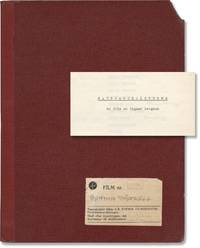
1962171100Stockholm: Svensk Filmindustri SF 1962. Draft script for the 1963 Swedish film. Copy belonging to actor Bertha Sånnell with her name in manuscript ink on a label affixed to the front wrapper her annotations in manuscript ink and pencil on two script pages and on a sheet of lined paper bound in at the rear of the script.<br /> <br /> The second entry in Ingmar Bergman's legendary and highly personal "Faith" trilogy a series of films that launched an important phase in the director's career. A quiet relentless meditation on the nature of faith imperfection and beauty. <br /> <br /> Red untitled wrappers. Title page present undated with credit for Bergman. 135 leaves with last page of text numbered 133. Mimeograph duplication rectos only. Pages Very Good plus wrapper Good perfect-bound with the spine of the wrapper and the first two leaves detached from the text block.<br /> <br /> Criterion Collection 210. Ebert III. Svensk Filmindustri [SF] unknown
1991139828Manhattan Beach CA: Lightstorm Entertainment 1991. Revised Draft script for the 1991 film dated February 19 1991. Script pages watermarked "T20029" and bearing the ownership watermarks of director Cameron's production company Lightstorm Entertainment as called for. With an alternate ending to the film which was shot but ultimately cut before release. <br/><br/>Included is a set of pencil sketches featuring concept art as well as shooting schedules props lists and other production documents. <br/><br/>The second film in what has become an ongoing multi-media franchise incorporating six feature films a television series video games comic books novels toys and even an amusement park ride. Winner of four Academy Awards and nominated for two more including Best Cinematography.<br/><br/>While the first film is arguably the most profitable low budget film ever made the sequel was the first with a production budget of over 100 million dollars featuring groundbreaking CGI and visual effects and jaw dropping action sequences becoming one of the highest grossing R rated films of all time. <br/><br/>Set in Los Angeles shot on location throughout California and in Santa Fe New Mexico. <br/><br/>Black untitled wrappers. Title page noted as Revised script dated February 19 1991 with credits for screenwriters Cameron and Wisher. 127 leaves with last page of text numbered 124. Xerographically duplicated with white blue green pink goldenrod and yellow revision pages throughout dated variously between 9/10/90 and 2/19/91. Near Fine overall bound internally with two gold brads. <br/><br/>Lentz US. Newman US. Lightstorm Entertainment unknown books
1934144598Culver City CA: RKO Radio Pictures 1934. Draft script for the 1935 film. In a custom quarter leather clamshell box.<br /> <br /> The second of two films based on Liam O'Flaherty's 1925 novel the first being Arthur Robison's 1929 British feature about a former Republic Army member during the Irish War of Independence who turns in one of his comrades to the British in order to use the bounty money to book passage to America for himself and his girlfriend who has been forced into prostitution. <br /> <br /> Winner of four Academy Awards including Best Adapted Screenplay Best Director and Best Actor for McLaglen nominated for two others including Best Picture. Screenwriter Dudley Nichols became the first person to decline an Academy Award when his refused his Oscar due to an ongoing dispute between the Screen Writers Guild and the Academy though he would eventually claim it three years later. <br /> <br /> Detached green wrappers noting the title screenwriter and director on the spine in manuscript ink. Title page integral with first page of text with credits for screenwriter Nichols and novelist O'Flaherty. 105 leaves with last page of text numbered 105. Mimeograph duplication. Pages Near Fine wrapper Very Good side-stapled. <br /> <br /> National Film Registry. RKO Radio Pictures unknown
1969144659New York: Jerome Hellman Productions 1969. Draft script for the 1969 film. Copy belonging to the film's still photographer Ron Munkasci with this name in red holograph ink at the top right corner of the title page.<br/><br/>Based on the 1965 novel by James Leo Herlihy about an unlikely friendship between a would-be gigolo and an ailing con artist. Cornerstone film of the New Hollywood cinema nominated for seven Academy Awards winning Best Adapted Screenplay Best Director and Best Picture. <br/><br/>Set in New York City shot on location in Miami Manhattan and Big Spring Texas. <br/><br/>Dark blue titled wrappers noted as DRAFT SCREENPLAY at the bottom right and with the logo for JEROME HELLMAN PRODUCTIONS at bottom center. Title page present with credits for screenwriter Waldo Salt novelist James Leo Herlihy producer Jerome Hellman and director John Schlesinger noted as "A JEROME HELLMAN-JOHN SCHLESINGER PRODUCTION." 122 leaves with last page of text numbered 113. Mimeograph duplication. Pages Near Fine with some offsetting to the title page due to a newspaper clipping still present laid in wrapper Very Good plus.<br/><br/>National Film Registry. Jerome Hellman Productions unknown books
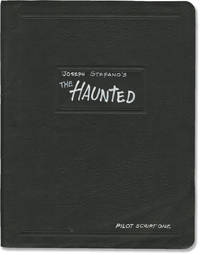
1964147167Los Angeles: Villa di Stefano Productions 1964. First Draft script for the 1964 television film which originally aired on CBS. With actor Martin Landau's copied annotations throughout. Included are a set of synopses for proposed episodes a shooting schedule a distributor's announcement booklet and various other documents related to production. <br/><br/>Also included is an original celluloid print of the film on a single reel in its original mailing case with cloth straps dated 2/18/65 addressed from director Joseph Stefano to Landau on the mailing label in holograph black ink and INSCRIBED by Stefano to Landau at the top left corner of the case in the same ink: "To Martin / Whose splendid brilliance and warmth put the special spark in this bright fire / Your grateful and admiring friend / Joe Stefano."<br/><br/>Fearful of being buried alive a woman installs a phone in the crypt in which she plans to be in case of emergencies. Months after her death the phone begins to ring presenting a new ghostly case for Landau's paranormal investigator. <br/><br/>The film was intended to be the pilot for a new paranormal thriller series tentatively titled "The Haunted" as titled on the front wrapper but the series wasn't picked up and the pilot was released as a television movie after additional footage was shot. <br/><br/>Black titled wrappers with credits for director-screenwriter Joseph Stefano noted as PILOT SCRIPT ONE. Title page present dated July 27 1964 noted as PILOT SCRIPT ONE with credits for director-screenwriter Joseph Stefano. 77 leaves with last page of text numbered 76. Early Xerox rectos only. Pages Near Fine wrapper Near Fine bound internally with three silver brads. <br/><br/>Film reel and film stock are unexamined. Villa di Stefano Productions unknown books
1961145470Culver City CA: Columbia Pictures 1961. Early Draft script for the 1970 film "Cromwell" seen here under the title "Oliver Cromwell." Copy belonging to director/screenwriter Ken Hughes with his annotations throughout. With 11 pages of reproductions from "The Commonweal" newspaper from August and September 1885 laid into the front of the script along with a drawing of how to add pages to the spring binder. <br/><br/>A biographical account of the 17th century political and religious struggles taking place in England under the reign of King Charles Alec Guinness. Likely one of the earliest screenplay drafts shelved for almost ten years due to an inability to find funding. Director Ken Hughes' favorite of his own films. Winner of an Academy Award for Best Costume Design and nominated for one other. <br/><br/>Shot on location in Spain and England. <br/><br/>Red leatherette spring binder with holograph felt ink titles on tape. Title page present dated 26th July 1961 noted as 2nd Screenplay with credits for screenwriter Ken Hughes. 279 leaves with last page of text numbered 279. Mimeograph duplication rectos only with pink revision pages throughout dated 26th July 1961 and 29th September 1961. Pages Near Fine spring binder Very Good plus. Columbia Pictures unknown books
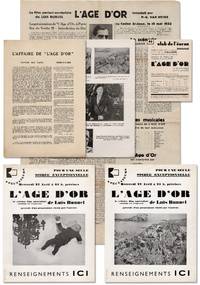
1932169144N.p.: N.p. 1932. A small archive of five vintage French pamphlets flyers and broadsides announcing 1931 and 1932 screenings of the banned 1930 surrealist film. All items are housed loose in a custom bound volume with a "L'Affaire de L'Age d'Or" label on the spine with each item laid in on separate leaves overlaid with heavy protective tissue housed in a custom slipcase. Rare.<br /> <br /> The archive includes:<br /> <br /> "L'Affaire de 'L'Age d'Or'" bi-fold pamphlet printed on rectos and versos with a satin-finish photo illustrated insert also printed on the recto and verso published by Nancy Cunard on the occasion of her January 1931 private screening of the film in London. The bi-fold includes the essay "Exposé des Faits" "Statement of Facts" describing the film's initial riotous reception "Extraits du Programme" "Excerpts from the Program" a "Questionnaire" regarding political and legal actions taken in response to the film and an extensive "Extraits de la Presse" "Excerpts from the Press" followed the names of signatories Maxime Alexandre Aragon André Breton René Char René Crevel Salvador Dali Paul Eluard Georges Malkine Benjamin Péret Man Ray Georges Sadoul Yves Tanguy André Thirion Tristan Tzara Pierre Unik and Albert Valentin.<br /> <br /> Two satin-finish variants of a flyer printed on rectos only for a screening of the film on April 27 1932 by Les Spectateurs de l'Avant-Garde at La Bellevilloise a workers' cooperative theatre with each flyer featuring a different image from the film. A second screening was later added on April 30 not noted on the flyers. The screenings were decidedly low-key private events with Buñuel insisting "No protests." French director Jean Vigo was reportedly among the participants of the screenings.<br /> <br /> And two items relating to a screening presented by Le Club de L'Ecran at Cine-Casino in Belgium on May 10 1932:<br /> <br /> A 4 x 5.5 inch announcement for the screening printed on the recto only noting the film as being presented by P.G. van Hecke Paul-Gustave Van Hecke followed by seating and ticket prices purchase locations and Club de L'Ecran membership prices.<br /> <br /> A large newsprint broadside printed on the recto and the verso for Le Club de L'Ecran announcing the May 10th screening with articles on the recto regarding the film club's activities and an excerpt from the Surrealist manifesto published upon the film's premiere with the verso dedicated entirely to numerous texts and articles on "L'Age d'Or" featuring two images from the film and a portrait of Buñuel.<br /> <br /> A key and archetypal work of Surrealist cinema alongside "Un Chien Andalou" 1929 also written by Buñuel and Dali and directed by Buñuel featuring a series of absurdist vignettes scathingly and sardonically rebuking the sexual hypocrisy of bourgeois society the Catholic Church and 20th century European society in general.<br /> <br /> The violence the uproar "L'Age d'Or" created remains as shocking as the film itself: days into the first screenings at Studio 28 on December 3 1930 the theatre was stormed by fascist youths enraged at the film's perceived anti-patriotic and anti-Christian message. Demonstrators threw ink at the screen shouted anti-Semitic death threats smashed the theatre windows and completely destroyed an exhibition of surrealist books and art in the foyer. In response the Board of Censors re-reviewed the film and on December 10 the film was banned from further public showings in France. The film's producers subsequently withdrew "L'Age d'or" from commercial distribution and public exhibition for more than 40 years although three years later in 1933 the film was privately exhibited at the Museum of Modern Art in New York.<br /> <br /> "L'Affaire de 'L'Age d'Or':" Bi-fold 7.5 x 10.5 inches. About Near Fine with a Very Good plus 7.5 x 10 inch insert with both items previously folded horizontally.<br /> <br /> Two Les Spectateurs April 27 Flyers: 8.25 x 10.5 inches. One Near Fine. One Very Good plus with light creasing faint toning and a .25 inch closed tear to the top edge.<br /> <br /> Le Club de L'Ecran Announcement: 4 x 5.5 inches. Near Fine.<br /> <br /> Le Club de L'Ecran Broadside: 14.25 x 21.75 inches folded as issued. About Near Fine with an additional lightly toned horizontal fold.<br /> <br /> Housed in a 9.25 x 12 inch custom bound Near Fine volume with a 9.5 x 12.25 inch Near Fine slipcase.<br /> <br /> BFI. Rosenbaum 1000. Vogel Film as a Subversive Art. N.p. unknown
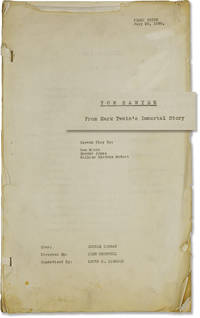
1930147544N.p.: N.p. 1930. First White script for the 1930 pre-Code film the first talking picture adaptation of Twain's novel. Screenplay divided into nine alphabetical Sequences A through J omitting I presumably as issued.<br /> <br /> The third screen adaptation of Mark Twain's 1876 classic coming-of-age novel and the first sound version. The top box office attraction of 1930 it prompted the studio to release "Huckleberry Finn" directed by Norman Taurog the following year with largely the same cast.<br /> <br /> In a custom quarter leather clamshell box. <br /> <br /> Wrapper integral with title page dated July 20 1930 noted as FIRST WHITE with credits for author Mark Twain screenwriters Sam Mintz Grover Jones and William Slavens McNutt star Jackie Coogan director John Cromwell and supervisor Louis D. Lighton. 143 leaves with last page of text numbered J-6. Mimeograph duplication rectos only. Pages Near Fine wrapper Very Good detached at the punch holes with closed tears and light soiling side stapled with three staples. N.p. unknown
1941149562Culver City CA: RKO Radio Pictures 1941. Early Draft script for the 1948 film dated June 13 1941 preceding its release by seven years.<br/><br/>Based on Edward Anderson's 1937 novel "Thieves Like Us" about an escaped convict who falls in love with a woman who nurses him back to health after he is injured in a robbery. <br/><br/>In December 1936 RKO's considered Anderson's novel but rejected it prior to any adaptation being written. Writer-director Rowland Brown who by 1941 controlled the rights to the novel wrote the first attempted draft of a screenplay. This time around RKO accepted it and Brown sold the rights to them for $10000. When Brown's script was first submitted to the Breen Office in April 1941 director Joseph I. Breen deemed it "unacceptable" claiming that it contained too much criminal activity and "loose sex." Brown revised the first draft on June 13 1941 but it was again rejected by the Breen Office. <br/><br/>A revised script written by Robert D. Andrews was submitted in October 1941 and was rejected for the same reasons as Brown's drafts. RKO did not submit the script again until September 1944 when it was rejected for a fourth time. From Aug 1946 to May 1947 when Ray was working on the script the PCA rejected three more versions of the story stating each time that the adaptation dwelt too much on the characters' crimes and not enough on morality.<br/><br/>Script approval finally came in June 1947 after RKO executives met directly with Breen an incorporated his suggestions into the story. <br/><br/>Set in the American West shot on location throughout California including Canoga Park Newhall Arcadia Griffith Park Benedict Canyon the San Fernando Valley San Bernardino Mountains and the RKO Encino Ranch. <br/><br/>Gray titled wrappers noted as production No. 1243 dated June 13 1941 with a credit for Rowland Brown. Title page integral with first page of text with a credit for Rowland Brown. 153 leaves with last page of text numbered 152. Carbon typescript rectos only. Pages Near Fine wrapper Very Good plus bound with three gold brads with washers. RKO Radio Pictures unknown books
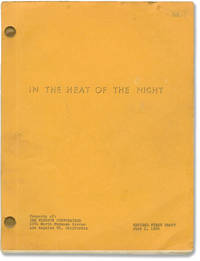
1966152454Los Angeles: The Mirisch Corporation 1966. Revised First Draft script for the 1967 film. Laid in is a Call Sheet from the production dated Tuesday November 29 1966. <br/><br/>Based on John Ball's 1965 novel. An African American police detective from Philadelphia is recruited to help solve a murder in a small bigoted Mississippi town. Winner of five Academy Awards including Best Picture and Best Actor for Rod Steiger nominated for two others. After the success of the film version the characters were developed further for a police procedural television series in 1988 developed by James Lee Barrett and starring Carroll O'Connor and Howard Rollins which aired on NBC then CBS from 1988 to 1995.<br/> <br/>Set in the fictional town of Sparta Mississippi and shot largely on location in Illinois. Poitier insisted the movie be filmed in the North because of a 1964 incident in Mississippi in which he and Harry Belafonte had been run off the road and almost killed by Klansmen while in the state to support the SNCC Student Non-Violent Coordinating Committee.<br/><br/>Goldenrod titled wrappers noted as REVISED FIRST DRAFT on the front wrapper rubber-stamped copy No. 84 dated July 1 1966. Title page present dated July 1 1966 noted as REVISED FIRST DRAFT with credits for screenwriter Stirliing Silliphant. 134 leaves with last page of text numbered 140. Mimeograph duplication rectos only with blue pink and white revision pages throughout dated variously between 7/27/66 and 8/10/66. Pages with damp stain on top right of last several pages else Near Fine wrapper Very Good plus bound with two gold brads.<br/><br/>Call Sheet 8.5 x 14 inches folded horizontally. Near Fine<br/><br/>National Film Registry. Criterion Collection 959. Penzler 101 Greatest Films of Mystery and Suspense. The Mirisch Corporation unknown books
1940138843Prague: Elektafilm 1940. Collection of 44 vintage oversize double weight photographs from the 1940 film based on the 1897 novel by Vilem Mrstik. The photographs have been tipped into a contemporary photo album with a title page executed in holograph paint and tissue paper between each page. <br/><br/>The sweet and shy Helen daughter of a game warden lives with her father in a hunting lodge in the beautiful Moravian countryside. She meets a worldly ambitious young man who is studying law in Prague and in the course of their romance she becomes less innocent and he less cynical. <br/><br/>Filmed once prior to this adaptation in 1926 by Karl Anton under the auspices of the company Elektajournal which in 1933 became Elektafilm in the wake of its international success with Gustav Machaty's "Ecstasy."<br/><br/>Shot on location in and around the city of Dobris in the Central Bohemian Region of the Czech Republic. <br/><br/>Photographs 11 x 9 inches. Near Fine. <br/><br/>Photo album 15 x 11 inches bound with a string binding. Fraying to the edges else Near Fine. Elektafilm unknown books
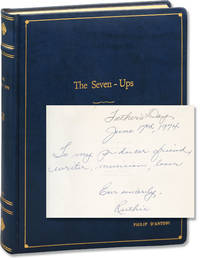
153621Los Angeles: Twentieth Century-Fox 1972. Final Shooting script for the 1973 film. The script supervisor's copy with their photocopied annotations on virtually every page bound as a Specially bound copy for director-producer Philip D'Antoni. <br /> <br /> Warmly inscribed by D'Antoni's wife Ruth to Philip on the front endpaper: "Father's Day / June 17th 1974 / To my producer friend writer musician lover / Ever sincerely Ruthie."<br /> <br /> Based on an original fictional original story by real-life NYPD officer Sonny Grosso about the "Seven-Ups" a secret New York detective squad with unorthodox methods of questionable legality. An informant for the squad is secretly behind a kidnapping scheme with the kidnappers impersonating police officers. A masterfully executed script supervisor's document with the legendary car chase scene in the film broken down frame by frame for nearly 30 pages.<br /> <br /> Set in New York City shot on location in New York City New York State and Weehawken New Jersey. <br /> <br /> Blue full leather binding with gilt titles and rule and D'Antoni's name to the bottom right corner of the front wrapper in gilt. Title page present dated October 27 1972 with credits for screenwriters Albert Ruben and Alexander Jacobs story writer Sonny Grosso and director Phil D'Antoni. Approximately 271 leaves with last page of text numbered 7. Xerographic duplication rectos only with shooting notes bound in opposite their corresponding script pages. Pages Fine leather binding Near Fine. Twentieth Century-Fox unknown
1943133635Hollywood: Paramount Pictures 1943. Revised Draft script for the 1943 film. Co-written for the screen by Raymond Chandler and Frank Partos. Chandler's contribution to the script had mostly to do with Alan Ladd's character and his tough dialogue elements sneered at by the media upon the film's release. Laid in is an 8-page shooting schedule on blue stock a 6-page revision to sequence "A" on yellow onionskin stock and 14 pages of "inter-office communication" on yellow studio stationery comments on scenes sequences and pages of the script. <br/><br/>Based on Rachel Field's 1942 novel about Emily Blair Loretta Young a wealthy deaf girl whose hometown is named for her family. Doctor Vance Ladd who grew up on the other side of town resents the Blair family but is working on a serum to cure deafness which he tries on Emily and she is eventually cured. <br/><br/>One of only five screenplays written by Chandler this being the second following his script for the classic "Double Indemnity" 1944 based on James M. Cain's novel. <br/><br/>Chandler had a tumultuous career in Hollywood including a suspension in late 1945 from Paramount for "refusing to perform under a contract which is not a proper expression of my standing in the motion picture business" but his influence on film adaptation is nearly unmatched with scripts and stories that pushed the limits of the Production Code Administration. <br/><br/>Script:<br/><br/>White self wrappers production No. SF 8577 dated December 3 1943 with credits for screenwriters Partos and Chandler. Title page integral with front wrapper in the Paramount style. 137 leaves mimeograph duplication with blue and light blue revision pages throughout dated variously between 1/11/43 possibly a typo and 3/30/44 other leaves dated variously between 12/3/43 and 12/5/44 possibly a typo. Pages Near Fine wrapper now encapsulated in mylar with cello tape and spine label remnants bound with two gold brads. <br/><br/>Shooting Schedule:<br/><br/>Corner-stapled blue stock noted as 4TH TENTATIVE BLUE / BASED ON A-B-C-D-E PART SEQUENCES dated 12/13/43 start and 2/9/44 close with credits for director Pichel assistant director O. Oscar Rudolph and businessmanager B. Bernard McEveety. 8 pages folded horizontally rust to the staple else Near Fine. <br/><br/>Revision:<br/><br/>Yellow onionskin stock loose but bound with a paperclip. Holograph annotations in pencil to the last leaf recto and verso detailing a few scene changes. 6 pages folded horizontally paperclip indentation and rust to the clip else Near Fine. <br/><br/>Inter-Office Communication:<br/><br/>Corner-stapled yellow studio stationery dated variously between 2/15/43 and 1/3/44. The earliest dated page contains notes on the script noting Talbot Jennings as the screenwriter. 14 pages hole punches at the top edges rust to the staples else Near Fine. <br/><br/>Luhr Raymond Chandler and Film US. MacShane US. Paramount Pictures unknown books
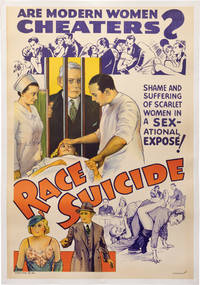
1938155557N.p.: Willis Kent Productions 1938. Vintage one sheet poster for the 1938 film.<br /> <br /> An early exploitation film masquerading as an educational exposé of the medical underground about a district attorney who becomes hell-bent on taking down an overzealous doctor who is pressuring young women into procuring illegal abortions. "Race suicide" was an alarmist term used in eugenics rhetoric in the mid-nineteenth and early twentieth centuries and referred to the supposed birth rate differential between "desirable" i.e. white wealthy educated Protestant and "undesirable" religious and racial minorities poor uneducated immigrant criminal populations with the former under threat of becoming extinct as a result of overpopulation by the latter. A disturbing and fascinating document of the intersection of the eugenics and anti-abortion movements of the 1930s. <br /> <br /> 27 x 41 inches. Linen backed and rolled. Near Fine. Willis Kent Productions unknown
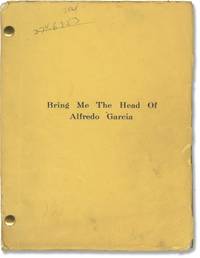
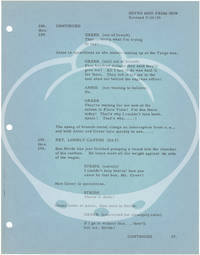
166560N.p.: N.p. 1972. Early Draft script for the 1974 film file copy belonging to director Sam Peckinpah. Dated July 8 1972 over a year before production commenced and notably featuring the original ending with Bennie getting away-in true Peckinpah fashion the director would later rewrite the ending to show Bennie dying in a shootout. With Peckinpah's brief annotations in manuscript ink on the title page and two leaves of the script. <br /> <br /> Warren Oates stars as Bennie a bartender who travels through the Mexican underworld accompanied by his sex worker girlfriend to collect the bounty on the head of a gigolo. The only Peckinpah film not re-cut by the studio.<br /> <br /> Shot on location in Mexico. <br /> <br /> Yellow titled wrappers. Title page present dated July 8 1972 with credits for Peckinpah and screenwriter Gordon Dawson. 128 leaves with last page of text numbered 126. Xerographic duplication rectos only. Pages Near Fine wrapper Very Good plus bound with two gold brads.<br /> <br /> Ebert II. Nilsen Warped and Faded. Rosenbaum 1000. Twilight Time 497. N.p. unknown
1925140430Beverly Hills CA: Metro-Goldwyn-Mayer MGM 1925. Draft script for the 1926 silent film "The Blackbird" seen here under the working title "The Mocking Bird." <br/><br/>Lon Chaney again serves as a versatile "man of a thousand faces" here playing the role of high-profile thief The Blackbird who lives a double-life as a beloved local bishop. He falls in love with a vaudeville starlet who's already being courted by another wealthy thief. The Blackbird attempts to use his Bishop persona to break up the pair and fails becoming crippled and nearly being caught by the police in the process. <br/><br/>Set in the Limehouse district in London. <br/><br/>Tan titled wrappers rubber-stamped copy No. 2 and production No. 1537 dated October 10 1925 with credits for screenwriter Waldemar Young. Title page integral with the first page of the text with credits for screenwriters Tod Browning and Waldemar Young. 120 leaves with last page of text numbered 119. Ditto style mimeograph duplication. Pages Very Good plus wrapper Good bound with two gold brads. <br/><br/>Spicer US Neo-Noir. Metro-Goldwyn-Mayer [MGM] unknown books