16 722 résultats
1931134294Beverly Hills CA: Metro-Goldwyn-Mayer MGM 1931. Draft script for the 1932 film based loosely on Edgar Rice Burroughs' novel "Tarzan of the Apes." Two black and white reference photographs for the film also laid in. <br/><br/>The first of Weissmuller's twelve Tarzan films and the first appearance of Cheeta Tarzan's chimpanzee friend. In this variation of the much-adapted Burroughs tale Tarzan and Jane fall in love and although Jane desires to take him back to England when Jane's father James Parker dies on the expedition Jane remains behind in the jungle instead. <br/><br/>Set in Africa shot on location in California and Florida. <br/><br/>Pale yellow titled wrappers rubber-stamped VAULT COPY and FILE COPY on the front wrapper and rubber-stamped copy No. 1871 and production No. 4608 dated Dec. 11/31 with credits for screenwriter Novello. Title page not present as issued. 116 leaves mimeograph duplication with white revision pages throughout dated variously between 11-20-31 and 12-16-31. Pages Near Fine. Front wrapper detached else wrappers Very Good bound with two gold brads. Photos both 8.25 x 10 inches Fine condition. Metro-Goldwyn-Mayer [MGM] unknown books
20032110502150907640Maruzen Co. Ltd. Idemitsu Museum of Art 2003. Soft Cover. Fine. Number of books: 3 Maruzen Co., Ltd. Idemitsu Museum of Art paperback
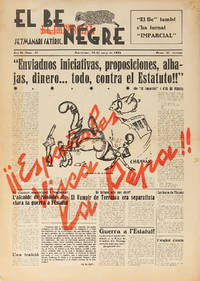
55088Barcelona: June 1931-July 1936. Folios 50 × 35 cm and later 52 × 37.5 cm. Original illustrated self-wrappers; most of the issues consist of 4 pp. a few numbers count 8 pp. nos. 81 100 111 115 119 132 159. Minor age toning in a few issues; some edges chipped old horizontal crease marks; a few issues stained; else good to very good. Significant run of the rare satirical Catalan Republican weekly journal with contributions and drawings by some of the country's best-known artists. The near complete run comprises 201 issues of 245 published including an unbroken run of the first 167 numbers with the earliest issues being particularly scarce. The journal covers the important years before the outbreak of the Spanish Civil War: the first issue was published just two months after the foundation of the Second Spanish Republic and the last issue shortly before the outbreak of the war. Josep Maria Planes the journal's director was murdered by members of the Iberian Anarchist Federation just one month after the last issue was published on August 24 1936. The terrorist actions by the F.A.I. had previously been the subject of biting satires and clear condemnation by "El Be Negre". But for all the sympathy that "El Be Negre" had for Catalan social democracy and despite Josep Maria Planes' membership of the "Acció Catalana" party the journal did not demonstrate any partiality. One of its role models was the French satirical journal "Le Canard Enchainé" founded in 1915. No political party or orientation was spared the irony and ridicule. Although El Be Negre focused mainly on politics in Catalonia and Spain its criticism was also also directed at international politics in particular Italian Fascism under Benito Mussolini and National Socialism under Adolf Hitler. Despite its short existence El Be Negre left a lasting impression on Catalan press history and is considered an outstanding example of political humor and satire at the time.<br /> <br /> The issues are illustrated with satirical drawings by Salvador Mestres Valenté Castanys Soka Tisner Kim and others.<br /> <br /> As of March 2025 KVK OCLC show no copies in North America. unknown
191912574Paris: Pathe Freres 1919. Original wraps. Very Good . Hebdomadaire. An impressive crop of 32 issues of this early very uncommon Parisian trade magazine issued by "Pathe Freres" one of France's and the world's leading film production companies at the time. Spanning 1918 and 1919 the magazine's 5th and 6th years in existence this weekly and sometimes bi-weekly offers a detailed very sophsiticated look at mostly the world of French film and cinematography but also covers the world of French theatre concert-going and music halls. Crisp black-and-white photos run thru each issue as does wonderful multi-colored typography and design. Magazine-formatted uniform tall quartos in their stapled pictorial wrappers. A razor-thin innocuous crease running vertically along all of the front covers; otherwise each issue is clean and crisp and easily VG to Near Fine. Internally immaculate as well with no writing or markings to any of the issues. One of the great undertakings in early French and international cinema. Pathe Freres unknown
191912574Paris: Pathe Freres 1919. Original wraps. Very Good . Hebdomadaire. An impressive crop of 32 issues of this early very uncommon Parisian trade magazine issued by "Pathe Freres" one of France's and the world's leading film production companies at the time. Spanning 1918 and 1919 the magazine's 5th and 6th years in existence this weekly and sometimes bi-weekly offers a detailed very sophsiticated look at mostly the world of French film and cinematography but also covers the world of French theatre concert-going and music halls. Crisp black-and-white photos run thru each issue as does wonderful multi-colored typography and design. Magazine-formatted uniform tall quartos in their stapled pictorial wrappers. A razor-thin innocuous crease running vertically along all of the front covers; otherwise each issue is clean and crisp and easily VG to Near Fine. Internally immaculate as well with no writing or markings to any of the issues. One of the great undertakings in early French and international cinema. <br/><br/> Pathe Freres paperback books
1896056105Mecca: Hicâz Vilâyet Matbaasi Mecca AH 1314 CE 1896/97. 1896. 1st Edition . Hardcover. Very Good. 8vo - over 7¾ - 9¾" tall. Contemporary quarter purple cloth. 4to. 28 x 20 cm. In Ottoman Turkish and Arabic with sporadic Persian verses. 1 blank page 3 222 p. A label on spine slight wear to spine single leaf of index is loosely inserted. Else a very good and collectible copy "Al-Matba'a al-Miriyya" seal on colophon as a common practice of preventing counterfeits in the period. An exceptionally rare first Mecca edition of a single-volume work containing two celebrated texts representing the final nineteenth-century Turkish commentaries on the Qasîda-i Burda. Authored by Necib Bey of Antioch an Ottoman official who served in the Hijaz the volume was printed at the first press established in the region by Osman Nuri Pasha. The Qasîda-i Burda is a thirteenth-century ode of praise to Muhammad composed by the Egyptian Shadhili mystic al-Bûsîrî. The first two pages of the work are devoted to complimentary letters written for the book by the then Governor of the Hijaz Ahmed Ratib Pasha 1846-1913 and by the Arab scholars Abd al-Jalil Burade and Arif Khan Tashkendi. One of the letters is in Arabic the other in Ottoman Turkish. The final Turkish commentary on the Qasîda-i Burda produced in the nineteenth century belongs to Necib Bey of Antioch d. after 1319/1902 who served as an official in the Hijaz region. Necib Bey held administrative posts at both institutions known as al-Tekiyyât al-Miriyya The Egyptian Tekke charitable imarets established by Mehmed Ali Pasha of Kavala the Khedive of Egypt d. 1265/1849 one in Mecca and the other in Medina. As he himself states in his commentary Necib Bey received his education in Western Anatolia and travelled extensively across a wide geographical area including regions beyond Ottoman territory such as Europe and Russia marking him as a Turkish traveller and scholar of broad experience. In addition to these qualities he was also active as an educator and is known to have tutored members of the elite including Khedive Abbas Hilmi II of Egypt d. 1944 and his brother Mehmed Ali Pasha. Two works by Necib Bey are known both of which are Turkish commentaries on the Qasida-i Burda poems of Ka'b b. Zuhayr and al-Bûsîrî. The first bears the title Is'âd: Shar-i Bânet Su'âd and the second Mukhtaar Tawassul: Shar-i Qasîda-i Burda. These two works were published together in a single bound volume in 1896/97 at the Hijaz Provincial Printing House. The title Mukhtaar Tawassul derives from the fact that this work is an abridgement of the commentary entitled Tawassul by Mekkî Mehmed Efendi d. 1212/1797. The commentary entitled Is'âd takes its name from the Arabic commentary Is'âd 'alâ Bânet Su'âd written by the Egyptian scholar Ibrâhîm b. Muammad al-Bâjûrî d. 1277/1860. The commentator explains this choice of title with the statement: "This commentary being in the nature of a translation of Bâjûrî's commentary has therefore been named Is'âd after its original title." However the diversity of sources evident in the work the inclusion of autobiographical details Sufi narratives poetic examples in three languages and several critical remarks directed at the primary source clearly demonstrate that the text stands much closer to an original composition ta'lîf than to a mere translation tarjama. Gürler. ON THE FIRST PRINTING HOUSE IN THE HIJAZ: The distinctive cultural character of Meccan society as a centre for learning intellectual exchange and scholarly debate was a decisive factor in the introduction of printing to Mecca. This development was welcomed by both scholars and the local population and materialized in 1882 under the auspices of the Ottoman governor of the Hijaz Osman Nuri Pasha. Although the Ottoman government had established the first printing press in the Arabian Peninsula earlier in Sana'a in 1877 1295 AH Mecca became acquainted with printing shortly thereafter in 1300 AH 1882-83 with the founding of an official government press. The Meccan pres <br/> <br/> Hicâz Vilâyet Matbaasi, Mecca, AH 1314 [CE 1896/97]. hardcover
1967149869New York: Andy Warhol Film 1967. Vintage poster for the 1967 film. Two versions of the film were shot - one with an all nude all male cast that was never released publicly and one with both male and female actors wearing G-strings which was originally screened at the Hudson Theater in New York. <br/><br/>A stylistic breakthrough in that the film entirely jettisons any pretense to plot dramatic action or sex found in Andy Warhol's previous sexploitation experiments instead featuring extended monologues by superstar Viva and conversations with others that touch on a variety of controversial topics. One of Warhol's most overtly political films also starring draft resister Andrew Duggan and the first pairing of Viva with Taylor Mead who would appear together in several more Warhol films. <br/><br/>19 x 25 inches rolled on archival linen with a small amount of professional restoration and repair. Near Fine with minor soil. <br/><br/>Murphy The Black Hole of the Camera. Warholstars. Andy Warhol Film unknown books
1931151422Beverly Hills CA: Metro-Goldwyn-Mayer MGM 1931. Draft script for the 1931 film with annotations in manuscript pencil primarily in later half of script largely regarding dialogue but also setting and shots. <br /> <br /> A largely fictionalized account of the life of Mata Hari exotic dancer and courtesan who was executed by France for espionage during World War I. A sensation in the US and Europe it was Greta Garbo's most commercially successful film. The pre-Code film was censored upon its reissue in 1936 which was the only version believed to exist until 2005 when an uncut French and Dutch subtitled version was screened at the Cinematheque Royale de Belgique in Brussels.<br /> <br /> Set in 1917 Paris shot on location in Agoura California. <br /> <br /> Tan titled wrappers with credits for screenwriters Benjamin Glazer and Leo Birinski and M-G-M label dated "Copied May 4 1931." Title page present with credits for screenwriters Benjamin Glazer and Leo Birinski. 172 leaves with last page of text numbered 169. Mimeograph duplication rectos only with six white revision pages dated June 5 1931. Pages Very Good plus with foxing and edgewear and stain to upper right of title page Wrapper Very Good with light soiling and chipping and closed tears to extremities and spine and upper right section cut from rear wrapper bound with two gold brads. Metro-Goldwyn-Mayer [MGM] unknown
1931151422Beverly Hills CA: Metro-Goldwyn-Mayer MGM 1931. Draft script for the 1931 film with annotations in holograph pencil primarily in later half of script largely regarding dialogue but also setting and shots. <br/><br/>A largely fictionalized account of the life of Mata Hari exotic dancer and courtesan who was executed by France for espionage during World War I. A sensation in the US and Europe it was Greta Garbo's most commercially successful film. The pre-Code Hollywood film was censored upon its reissue in 1936 which was the only version believed to exist until 2005 when an uncut French and Dutch subtitled version was screened at the Cinematheque Royale de Belgique in Brussels.<br/><br/>Set in 1917 Paris shot on location in Agoura California. <br/><br/>Tan titled wrappers with credits for screenwriters Benjamin Glazer and Leo Birinski and M-G-M label dated "Copied May 4 1931." Title page present with credits for screenwriters Benjamin Glazer and Leo Birinski. 172 leaves with last page of text numbered 169. Mimeograph duplication rectos only with six white revision pages dated June 5 1931. Pages Very Good plus with foxing and edgewear and stain to upper right of title page Wrapper Very Good with light soiling and chipping and closed tears to extremities and spine and upper right section cut from rear wrapper bound with two gold brads. Metro-Goldwyn-Mayer [MGM] unknown books
1957138838Czechoslovakia: N.p. 1957. Vintage keybook likely unique for the 1957 film comedy containing 119 vintage double weight photographs featuring both scenes from the film and candid photographs from the set. The photos are tipped in two to a page in a contemporary photo album with a title page credits in holograph white paint including the director cinematographer producer and still photographer. Non-sequential numbering to the right of each photograph and occasional captions in silver ink and tissue paper between each page. <br/><br/>An unconventional character-driven comedy about a group of varied and interesting folk occupying a Prague bus station platform and then a bus traveling on a four-hour journey from Prague to Karlovy Vary. <br/><br/>Photographs approximately 7 x 5 inches. Near Fine extremely well preserved. <br/><br/>Album 15 x 11.25 inches bound with string. Fraying to the extremities else Near Fine. N.p. unknown books
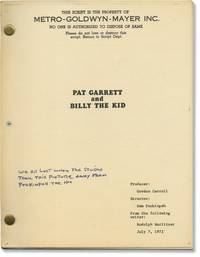
166485Beverly Hills CA: Metro-Goldwyn-Mayer MGM 1972. Draft script for the 1975 film. Annotation in manuscript ink on the front wrapper noting "We all lost when the studio took this picture away from Peckinpah the hed" sic. <br /> <br /> A very nearly experimental Western made by Sam Peckinpah at his peak sufficiently strange to have remained of interest only to the most intense fans of Western revisionism. Comparable only to "McCabe and Mrs. Miller" 1971 and "The Shooting" 1966 in terms of sheer impressionism being laid upon the genre with iconic imagery and super-stylization in every frame. <br /> <br /> Shot on location in Durango Mexico.<br /> <br /> Beige titled Metro-Goldwyn-Mayer front wrapper dated July 7 1972 with credits for Peckinpah and screenwriter Rudolph Wurlitzer. Missing rear wrapper. Title page integral with front wrapper. 125 leaves with last page of text numbered 134. Mimeograph duplication rectos only with blue and gray revision pages throughout dated variously between July 3 and 25 1972. Pages Very Good plus wrapper Very Good bound with two gold brads. Metro-Goldwyn-Mayer [MGM] unknown
1967149909New York: Andy Warhol Film 1967. Vintage poster for the 1967 film. The film originally screened at the Hudson Theater in a 95 minute version although this cut is considered lost. A 109 minute version would screen in 1968 as the first film shown at the New Andy Warhol Garrick Theater renamed as such after Warhol recovered from being shot by Valerie Solanas. <br/><br/>One of several sexploitation influenced films made by Warhol an episodic story of a biker who has no bike and is both eroticized by the camera and emasculated by various Warhol superstars throughout. <br/><br/>19 x 25 inches rolled. Near Fine with some light soil and an almost imperceptible professional repair to a tear at the top edge. <br/><br/>Murphy The Black Hole of Cinema. Warholstars. Andy Warhol Film unknown books
1961122148Universal City CA: Republic Pictures / Pax Films / Universal Pictures 1961. Forrest J. Ackerman's copy of scripts from two key science fiction films bound together including original front wrappers in red buckram with Ackerman's name in gilt at the bottom right corner of the front board. <br/><br/>"The Lady and the Monster": Shooting script for the 1944 film. The first of three adaptations of Curt Siodmak's classic 1942 novel in which an honest hard-working scientist preserves a dead man's brain only to be remote-controlled by it. Shot by the legendary John Alton at the very peak of his work in the mid-1940s. Yellow front studio wrapper noted as SHOOTING SCRIPT at the top right dated October 13 1943 a penciled notation of the working title "The Lady and the Monster" just below the printed title noted as production No. 1194 and with credits for associate producer George Sherman and Republic Studios at the bottom. Two-page cast of characters with the actors' names added in ribbon copy type just below the character names. Title page present with credits for director Sherman and novelist Siodmak. <br/><br/>94 leaves mimeograph duplication with blue yellow green and pink revision pages leaves dated variously between 10/18/43 and 11/8/43. Pages and wrapper about Near Fine. <br/><br/>"The Day the Earth Caught Fire": An early and apparently abandoned draft by director Val Guest to film his screen story for Pax Films as a five-part British serial. Guest ultimately directed the story as a feature-length movie for Pax one of the most understated and intelligent science fiction films ever made. Light green wrappers both front and rear wrappers present. The front wrapper reads: "A Five Part Serialisation of / THE DAY THE EARTH CAUGHT FIRE / A Val Guest Production." Just below in holograph ink and in what we would assume is Guest's hand is written "Dedicated to Brian Aldiss." We think it likely that the script was gifted to the very connected Ackerman by Guest though the provenance beyond Ackerman's ownership is unknown. <br/><br/>41 pages divided into five parts each beginning with a two-color memo on PAX stationery describing what will happen in the following section. Pages and wrapper about Near Fine. <br/><br/>Buckram binding containing the two scripts is Very Good with some light scuffing and soil. <br/><br/>Martin 413. Republic Pictures / Pax Films / Universal Pictures unknown books
1952121979Mexico City: Ultramar Films 1952. Draft script for the 1954 Mexican film. Included is a typed letter signed from the film's producer Edward L. Alperson on his custom rough-edged stationery discussing the possibility of distribution within the US. Distribution was eventually taken on by United Artists and Daniel O'Herlihy received a Best Actor nomination for his performance. Also included are seven film still photographs from the film. <br/><br/>A rare pre-production script from Luis Bunuel's first color film one of the key productions from his Mexican period written with Hugo Butler who was at the time living in self-imposed exile in Mexico with Dalton Trumbo both blacklisted by the HUAC and writing under various pseudonyms. Single substantive holograph pencil correction toward the end of the text. <br/><br/>One of Bunuel's more straightforward narratives quite faithful to the source material but with a whopping dream sequence as bizarre as anything one might find in the director's later work. <br/><br/>Tall side-stapled self-wrappers dated "Mexico / 1952" with credits for director-screenwriter Bunuel screenwriter Butler under the Roll pseudonym and producers Oscar Dancigers and Henry F. Ehrlich. 95 leaves mimeograph duplication. Very Good condition toned at the edges some offsetting to the front wrapper and a 1-inch tear at the left margin. Ultramar Films unknown books
1937149222N.p.: N.p. 1937. Treatment script here called a "Suggested Screen Treatment" for the 1939 film by British playwright and screenwriter Mordaunt Shairp. Annotation in holograph pencil on upper left of front wrapper partially lost because of chipping. <br/><br/>Shairp during his brief three year run as a screenwriter worked previously with producer Samuel Goldwyn in 1935 on "The Dark Angel" directed by Sidney Franklin and starring Fredric March and Merle Oberon.<br/><br/>Based on the 1847 novel by Emily Bronte.<br/><br/>While "Wuthering Heights" proved to be a difficult production following a difficult casting Goldwyn insisted for years that it was the best film he ever created-and it is certainly one of his finest. After a prolonged dispute with director William Wyler about the film's grim tone Goldwyn went over Wyler's head to shoot a final scene suggesting that Heathcliffe Laurence Olivier and Cathy Merle Oberon were together in the afterlife strongly departing from the source work and creating a rift between Goldwyn and Wyler that would never heal even as the film went on to be both critically and publicly lauded. <br/><br/>Olivier would later attribute much of his film acting technique to Wyler who was known for forcing actors to repeat scenes ad nauseum in this instance forcing Olivier to tone down sequences of overacting that were better suited for the stage. <br/><br/>Winner of an Academy Award and nominated for seven others including Best Picture. <br/><br/>Gray titled wrappers noted as Suggested Screen Treatment on the front wrapper with credits for author Emily Bronte and screenwriter Mordaunt Shairp. Title page integral with first page with credits for author Emily Bronte and screenwriter Mordaunt Shairp. 44 leaves with last page of text numbered 44. Mimeograph duplication rectos only. Pages Near Fine wrappers Fair with the very dry and brittle front wrapper separated closed tears and chipping at extremities of front and rear wrapper. bound with three gold brads. N.p. unknown books
1969137209Burbank CA: American Broadcasting Company ABC 1969. Collection of 217 individually numbered contact sheets amounting to 2650 images from the 1969 film. Housed in two original three-ring binders from the film's publicity department. The occasional frame is circled or crossed through in red marker. A robust collection that documents nearly every facet of the film's production including numerous candid images of the cast and crew at work. <br/><br/>Woody Allen's first film as a director one of the great American comedies the film that set the template for Allen's 1970s work. A massive archive documenting the birth of an utterly new and unique voice in cinema one that would become something even bigger in 1979. <br/><br/>Set and shot in San Francisco and inside the walls of San Quentin State Prison. <br/><br/>Sheets 8 x 10 inches most in three-hole mylar sleeves some with holes punched directly in left margin others laid in. Very Good overall few frames excised general modest edgewear. Binders with signs of use as expected one spine label missing other partially lacking but with titles intact. American Broadcasting Company [ABC] unknown books
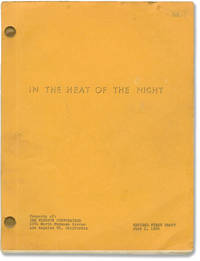
1966152454Los Angeles: The Mirisch Corporation 1966. Revised First Draft script for the 1967 film. Laid in is a Call Sheet from the production dated Tuesday November 29 1966. <br /> <br /> Based on John Ball's 1965 novel. An African American police detective from Philadelphia is recruited to help solve a murder in a small bigoted Mississippi town. Winner of five Academy Awards including Best Picture and Best Actor for Rod Steiger nominated for two others. After the success of the film version the characters were developed further for a police procedural television series in 1988 developed by James Lee Barrett and starring Carroll O'Connor and Howard Rollins which aired on NBC then CBS from 1988 to 1995.<br /> <br /> Set in the fictional town of Sparta Mississippi and shot largely on location in Illinois. Poitier insisted the movie be filmed in the North because of a 1964 incident in Mississippi in which he and Harry Belafonte had been run off the road and almost killed by Klansmen while in the state to support the SNCC Student Non-Violent Coordinating Committee.<br /> <br /> Goldenrod titled wrappers noted as REVISED FIRST DRAFT on the front wrapper rubber-stamped copy No. 84 dated July 1 1966. Title page present dated July 1 1966 noted as REVISED FIRST DRAFT with credits for screenwriter Stirliing Silliphant. 134 leaves with last page of text numbered 140. Mimeograph duplication rectos only with blue pink and white revision pages throughout dated variously between 7/27/66 and 8/10/66. Pages with damp stain on top right of last several pages else Near Fine wrapper Very Good plus bound with two gold brads.<br /> <br /> Call Sheet 8.5 x 14 inches folded horizontally. Near Fine<br /> <br /> National Film Registry. Criterion Collection 959. Penzler 101 Greatest Films of Mystery and Suspense. The Mirisch Corporation unknown
132794Universal City CA: Universal Pictures 1986. Archive of three title card maquettes hand lettered by Harold Adler for the 1963 film. Also included are two fascinating autograph letters both elaborately designed and executed in a calligraphic style from Adler to author illustrator and editor Fridolf Johnson relating to Adler's work with Hitchcock. <br /> <br /> Harold Adler was a calligrapher who created hand lettered titles on over 100 films worked frequently with Alfred Hitchcock and was a favorite of legendary title sequence designers Saul Bass and Pablo Ferro. In addition to "The Birds" 1963 his credits include "Comanche!" 1956 "The Man with the Golden Arm" 1955 "The Seven Year Itch" 1955 "Carmen Jones" 1954 "Psycho" 1960 "In the Heat of the Night" 1967 and "Justine" 1969. <br /> <br /> In 2012 an exhibition of Adler's work was organized by noted typographer and design historian Jill Bell at the American Advertising Federation Kansas City. <br /> <br /> In the first letter dated May 16 1986 Adler describes after touching on other topics meeting Hitchcock and then presenting him with layout ideas for the titles. He then goes into detail regarding his answer to a question about the techniques of artist Eric Gill stating that Hitchcock "was amazed" by this answer and after that would "request 'to be sure to bring that nice young man along" meaning Adler whenever he had a job for Adler's firm. <br /> <br /> The second letter dated June 10th 1986 focuses almost exclusively on Adler's work on "The Birds" going into some detail regarding both the creative and technical processes of producing hand lettered titles for films. He also describes Hitchcock as "an unusual person to work with. He was a master at what he did knew what he wanted and smoked the finest cigars." He then concludes the letter with some brief remarks on how his approach to title lettering evolved over the course of his career. <br /> <br /> The letters themselves are works of art executed in a variety of inks in Adler's detailed penmanship with Johnson's name on each in particular receiving full calligraphic treatment. <br /> <br /> Also included are draft title cards for the film stylistically similar to each other but much different from the titles used in the finished film. Two of the cards are marked as "camera ready" in manuscript colored pencil with titles executed in white paint on black board. The third card photo stat on black paper which accompanied the June 10th letter has been annotated by Adler on both the recto and verso explaining the in more detail the technical process of putting the lettering on film. <br /> <br /> Overall a significant collection of material illuminating a little explored aspect of film design with a direct and significant connection to a seminal work by a director known for personally overseeing all aspects of production. <br /> <br /> Each letter 19 x 24 inches single leaf rectos only. May 16th letter folded twice for mailing June 10th letter folded. Two long diagonal creases to the May 16th letter else both are Fine. Original mailing envelope for the May 16th letter included. <br /> <br /> "Camera ready" title cards 22 x 14 inches. Lightly rubbed and about Near Fine. Third card 18 x 4 inches. Near Fine. <br /> <br /> National Film Registry. Clover Men Women and Chainsaws. Godard Histoires du cinema. Universal Pictures unknown
19621487061962. Draft script for the 1963 film. Text and titles in Japanese.<br/><br/>A legendary Japanese noir based on American author Ed McBain's 1959 novel "King's Ransom." A wealthy industrialist is contacted by a gang of crooks who inform him that they have kidnapped his son and are holding him hostage in exchange for an enormous ransom. The industrialist soon realizes however that the boy they have taken is in fact the son of his chauffeur-and must decide whether he will bankrupt himself and his family in order to save a child that is not his own. A nuanced portrait of a man facing the potential destruction of his future further elevated by morally ambiguous characters and the gritty realism of its world. The fifteenth and penultimate film that leading actor Toshiro Mifune would make with director Akira Kurosawa and one of the highest grossing Japanese films of 1963 breaking Kurosawa's box office record for the third time.<br/><br/>Shot on location in Kanagawa Japan. <br/><br/>White perfect bound wrappers dated 1962 with a protective titled dust jacket. 189 leaves with last page of text numbered e-37. Mimeograph duplication printed on rectos and versos. Book Very Good plus with light foxing to the page edges and light offsetting to the front and rear wrapper. Jacket Very Good plus with light foxing to the extremities and two small nicks to the spine ends.<br/><br/>Criterion Collection 24. Grant Japan. Selby Japan. Spicer Japan. unknown books
1963148710Tokyo: Kurosawa Production Co 1963. Draft script for the 1965 Japanese film preceding the release by nearly two years. Text and titles in Japanese. <br/><br/>Based on Shugoro Yamamoto's short story collection "Akahige Shinryotan." Toshiro Mifune's final film with director Akira Kurosawa considered one of the director's masterpieces following a small-town doctor and his new intern a highly educated arrogant young man. <br/><br/>Set in the Edo district of Koishikawa.<br/><br/>White titled wrappers with a blue titled dust jacket. Title page present dated 1963. 65 leaves with last page of text numbered g-17. Mimeograph duplication rectos only. Pages Very Good plus wrapper Very Good plus with light foxing to the rear wrapper with perfect binding. Jacket is Very Good plus with light foxing to the fore-edges and rear panel. Kurosawa Production Co unknown books
1944147297Los Angeles: Vanguard Films 1944. Temporary Shooting script for the 1945 film here under the working title "The House of Dr. Edwards." <br/><br/>Based on the 1927 novel "The House of Dr. Edwardes" by Hilary Saint George Saunders and John Palmer. Producer David O. Selznick wanted to make a "psychiatric" story for the screen and Alfred Hitchcock persuaded Selznick to buy the rights to the novel which Hitchcock and his wife were adapting. Nominated for six Academy Awards including Best Picture Best Director and Best Supporting Actor for Michael Chekhov winning one. <br/><br/>Blue titled wrappers noted as TEMPORARY SHOOTING SCRIPT on the front wrapper dated June 14 1944 with a credit for screenwriter Hecht. Distribution page present rubber-stamped copy No. 1620 with receipt removed. 176 leaves with last page of text numbered 176. Mimeograph duplication rectos only. Pages Near Fine wrapper Near Fine bound with three gold brads. <br/><br/>In a custom cloth covered clamshell box with black leather spine label and titles and decoration in gilt.<br/><br/>Grant US. Hardy The BFI Companion to Crime. Selby Canon. Silver Classic Noir. Spicer US. Vanguard Films unknown books
1939147517Los Angeles: Selznick International Pictures 1939. Two early treatments for the 1940 film consisting of 1 a Synopsis by Franclien Macconnell dated October 10 1938 and 2 a Chapter Breakdown by Mary Bowie dated May 10 1939. Both issued for the studio's review of the novel's content prior to it having been green-lit for adaptation to film. <br/><br/>Macconnel was "one of the best 'readers' from Val Lewton's story department" at Selznick's studios according to Steve Wilson's 2014 The Making of Gone with the Wind as well as an assistant story editor for the studio. <br/>A note on first page of synopsis states: "Throughout the book no hint is given as to the heroine's name . For synopsis purposes I am giving her the name of the authoress: Daphne. This unnamed character in the novel would for the film as in du Maurier's novel be given only the name of her husband <br/>Mrs. de Winter.<br/><br/>Bowie was also a writer working at Val Lewton's story department at Selznick studios.<br/><br/>Alfred Hitchcock's first American project the elegant dreamlike adaptation of du Maurier's novel of the same name about a young woman who marries a mysterious aristocratic widower and must contend with the spectral influence of the former mistress of the house the eponymous Rebecca. The film was the start of Hitchcock's work in Hollywood under contract with producer David O. Selznick a collaboration which produced six films in total including "Spellbound" 1945 "The Paradine Case" 1947 and "Under Capricorn" 1949. Although Selznick initially argued for "Rebecca" to remain fully faithful to the plot of the novel the Production Code Administration forbade murder to go unpunished and as a result the film's ending differed from du Maurier's-a change which purportedly angered Selznick so strongly that he considered releasing the film without code approval. Upon its release the film was nominated for eleven Academy Awards winning two for Best Picture and Best Cinematography.<br/><br/>Set on the French Riviera and southwest England shot partially on location in Big Sur Palos Verdes and Point Lobos State Natural Reserve California.<br/><br/>Together in a custom quarter leather clamshell box.<br/><br/>Synopsis:<br/><br/>Blue titled wrappers noted as Synopsis on the front wrapper dated October 10 1938 with credits for novelist Daphne du Maurier and screenwriter Franclien Macconnell. Distribution page present with receipt intact dated October 10 1938 and rubber stamped Script "A 2036.". 39 leaves with last page of text numbered 38. Mimeograph duplication rectos only. Pages Near Fine wrapper Near Fine bound with two gold brads.<br/><br/> Chapter Breakdown of the Novel:<br/><br/>Blue titled wrappers noted as Chapter Breakdown of the Novel on the front wrapper dated May 10 1939 with credits for screenwriter Mary Bowie. Distribution page present with receipt intact dated May 10 1939 and rubber stamped script " A 2123." 49 leaves with last page of text numbered 48. Mimeograph duplication rectos only. Pages Near Fine wrapper Very Good plus with 2" closed tear at the lower left edge and 1/2" chip and small closed tear at the lower right edge bound with two gold brads.<br/><br/>Quarter leather clamshell box Fine.<br/><br/>National Film Registry. Criterion Collection 135. Grant US. Penzler 101. Rosenbaum 1000. Selby US. Spicer US. Selznick International Pictures unknown books
1968149896New York: Andy Warhol Film 1968. Vintage poster for the 1967 film. The film originally screened at the Hudson Theater in New York in a 99-minute version. In early 1968 a 110-minute cut played at the Cinematheque 16 in Los Angeles. This poster which mentions the Los Angeles screenings and contains a blurb from the likely corresponds to the latter version. <br/><br/>A final 95-minute cut was completed later in 1968 and is the version available today.<br/>Andy Warhol's first attempt to make a "commercial" sexploitation film eight unconnected scenes in which actor Tom Baker attempts to convince various women to have sex with him. Originally intended to star The Doors' Jim Morrison and unsimulated sex the finished film contains neither.<br/><br/>19 x 25 inches rolled on archival linen with minor professional repair and restoration. Near Fine. <br/><br/>Murphy The Black Hole of the Camera. Warholstars. Andy Warhol Film unknown books
1942149229Universal City: Universal Pictures 1942. Archive of three scripts and one post-production script for the 1942 film. May 4 script missing one page likely as used or issued.<br /> <br /> First an early Draft script under the working title "Sherlock Holmes vs. Lord Haw-Haw" by screenwriter John Bright noted as "Contract File Copy" on front wrapper. Carbon typescript preceded by a four page ribbon copy typescript outline dated 3/10/42. Annotation of inquiry into necessary story elements and plotline on title page in manuscript pencil. Several annotations throughout of Bright's name page numbers strikes question mark and dates ranging from 3/10/42 to 3/27/42 in manuscript pencil and ink.<br /> <br /> Second is a Draft script under the working title "Sherlock Holmes #1" by screenwriter Lynn Riggs dated April 2 1942. Annotations in red and graphite manuscript pencil on front wrapper some illegible citing Arthur Conan Doyle and the story upon which script is based and "Copy from which we mimeod yellow script 4/27/42." Carbon typescript on onionskin with annotations in manuscript pencil and ink throughout primarily amending page numbers scene numbers and character names as well as striking the "#1" on title page title and adding "Saves London" amending title to "Sherlock Holmes Saves London" another early working title. <br /> <br /> Third is a Draft script under the working title "Sherlock Holmes' Series #1 'Sherlock Holmes Saves London'" credited as "A Free Adaptation" by Robert Andrews and credits for screenwriters Lynn Riggs and John Bright dated May 4 1942. One annotation in manuscript pencil of the name "M. Nicht" on top right of page 107 likely a stenographer.<br /> <br /> Lastly the post-production Dialogue and Contitnuity script here under the working title "Sherlock Holmes and the Voice of Fear" dated July 28 1942. Annotation on front wrapper in manuscript pencil striking "Fear" in title adding "Terror" amending title to it's release title.<br /> <br /> Based on the 1917 short story "His Last Bow. The War Service of Sherlock Holmes" by Sir Arthur Conan Doyle and loosely on the real-life exploits of Lord Haw-Haw several broadcasters but most notably William Joyce a US born Briton who broadcast Nazi Propaganda from Germany to the UK during WWII. Joyce would be convicted of high treason in 1945 and hanged in 1946 the last person executed for treason in the UK.<br /> <br /> The third Sherlock Holmes movie starring Basil Rathbone and Nigel Bruce and the first produced at Universal Studios. Preceded by "The Adventures of Sherlock Holmes" 1939 directed by Alfred L. Werker and followed by "Sherlock Holmes and the Secret Weapon" 1942 directed by Roy William Neill.<br /> <br /> Watson and Holmes transplanted from their usual Victorian setting and from the WWI setting of the original story are now in England at the start of WWII investigating the mysterious broadcasts by "The Voice of Terror" apparently from Nazi Germany warning of acts of terror moments before their occurrence.<br /> <br /> 3/10/42 script "Sherlock Holmes vs. Lord Haw-Haw":<br /> Gray titled wrappers with credits for screenwriter John Bright. Title page present with credits for screenwriter John Bright. 126 leaves with last page of text numbered 121. Carbon typescript rectos only. Pages Near Fine wrapper Very Good plus with some chipping creasing and closed tears at extremities primarily to front wrapper bound with three gold brads.<br /> <br /> April 2 1942 script "Sherlock Holmes #1":<br /> Gray titled wrappers dated April 2 1942 with credits for screenwriter Lynn Riggs. Title page integral with first page with credits for screenwriter Lynn Riggs. 127 leaves with last page of text numbered 122a. Carbon typescript on onionskin. Pages Near Fine wrapper Very Good plus with some creasing and small closed tears to extremities on front wrapper bound with three gold brads.<br /> <br /> May 4 1942 script "Sherlock Holmes' Series #1 'Sherlock Holmes Saves London'":<br /> Gray titled wrappers dated May 4 1942 with credits for adaptation by Robert Andrews author Sir Arthur Conan Doyle and screenwriters Lynn Riggs and John Bright. Title page integral with first page. 115 leaves with last page of text numbered 113. Mimeograph duplication rectos only with blue revision pages throughout dated variously between 5/8/42 and 5/14/42. Pages Near Fine wrapper Very Good with some chipping creasing and closed tears to extremities bound with three gold brads.<br /> <br /> July 28 1942 Dialogue and Contiuity post-production script:<br /> Title self wrappers noted as DIALOGUE CONTINUITY on the front wrapper dated July 28 1942. 117 leaves. Mimeograph duplication rectos only. Pages Near Fine bound at top with two gold brads. Universal Pictures unknown
1929121976Hollywood: Paramount Pictures 1929. Early Treatment script for the 1929 film the first Sherlock Holmes film to have been produced with sound and the first to include the Holmes utterance "Elementary my dear Watson" a phrase never used by Doyle though that statement regrettably does not appear in this draft. <br/><br/>The first known treatment was written by Oliver P. Garrett followed by this one scripted by F. Hugh Herbert and the final writing credits went to Garrett Fort and director Basil Dean. This treatment differs substantially from the finished film and is more faithful to Doyle's source material. A rare surviving artifact from the great detective's earliest days on the screen. <br/><br/>Tall side-stapled self wrappers noted as an "Outline Treatment" on the front wrapper rubber-stamped project No. 1491 and MASTER FILE dated May 21 1929 with a credit for screenwriter Herbert. 52 leaves mixed original and carbon typescript on yellow stock with a few holograph pencil annotations on the first leaf including "1st Rough Draft." Very Good condition with some wear to the first leaf at the bottom stitch. Paramount Pictures unknown books