658 résultats
1st edition. Original boards. 8vo. 122 pages, 21 cm. In Yiddish. Title translates to Around Me. Includes 10 beautiful Art Nouveau illustrations by Zuni Maud, which are repeated throughout the text. Kaluschiner (1893-1968) , also known as Joseph Leiser, was a Yiddish poet who released five books of Yiddish poetry. OCLC lists 29 copies worldwide (OCLC 40822983) . SUBJECTS: Yiddish poetry - literature. Author inscription from 1922 to the previous owner. Wear to boards. Some damp stains in bottom left of leaves. Overall Good Condition. (YID-40-71-L)
1st edition, original wrappers, 62 pages. In Yiddish, back cover in English. Title translates as, Zionism and Yiddishkayt in Soviet Russia: A Trip Across the Soviet Union in 1940.Holocaust-era Zionist eye-witness account of Jewry in the USSR during 1940, with an introduction by Rabbi Meyer Berlin, or Meir Bar-Ilan. Meir Berlin, later Hebraized to Meir Bar-Ilan, was an Orthodox rabbi and leader of Religious Zionism, the Mizrachi movement in the United States and the British Mandate of Palestine. He inspired the founding of Bar Ilan University in Israel which is named for him. (wikipedia 2018) Heri Karp Ondenk Bibliotek Populere Broshurn-Num. 4-5. SUBJECT(S) : Zionism. Travel. Zionism. Soviet Union -- Description and travel. OCLC: 1011223445, OCLC lists 6 copies worldwide. Cover is wavy from moisture, rubbed and has some pencil markings, ex library sticker inside cover and blind stamp on title page. Internally very good. Good Condition overall. (HOLO2-141-32)
8vo; 424 pages; 21 cm. . In Yiddish. Special issue to "Unser Weg". Errata slip inserted. "The extermination of the Jews of Kowno (Kaunas) " on copyright page. Includes index, portraits, music and 18 pages of photo plates. The US Holocaust Memorial Museum keeps their copy in their Rare Book Collection. Missing front cover. Small tears and pieces missing to back cover. Ex-library with label on spine and bookplate in back. Edgewar to title page, small tears to first 8 pages. Pages tanned. INSCRIBED BY THE AUTHOR. Backstrip missing pieces. Corner of back cover torn off, no text affected. Pages lightly tanned. Good condition. (YIZ-3-10)
pages; 1st edition. Original publisher's cloth, large 8vo 566 pages. In Yiddish. Yizkor book to murdered teachers in Poland. Very Good Condition. (yiz-20-13) xx
Later Cloth. 12mo. 88 [i. E. 176]; 131 [i. E. 262] pages. 18 cm. Two volumes in one. In Hebrew. Running title: Tikun lel Shavu? Ot. With: Seder Tikun lel Hosha? Na raba. Zultsbakh: Z. Arnshtain, 1830. Printed in Sulzbach at the press of Arnstein & Sons, begun by Seckel Arnstein in 1751 after his ancestor Ahron Fraenkel in 1645, who established a printing press business in 1699. Seckel Arnstein continued the business of printing of Hebrew bibles, which became famous all over Central and Eastern Europe under the name S. Arnstein & Sons. Bound in later cloth; printed on fine ragpaper. Subjects: Hoshana Rabba - Liturgy - Texts. Judaism - Liturgy - Texts. Hoshana Rabba - Liturgy. Judaism - Liturgy. Shavuot - Liturgy - Texts. Liturgy and ritual. Hosha'nah Rabbah readings. 1830. Shavuot readings. 1830. One listing for the 1830 edition (Univ Michigan) on OCLC; five other holdings for editions from 1827-1835. Light foxing to pages; otherwise fresh and clean. Very good condition. (GER-43-51)
1st Edition, Original Printed Paper Wrappers, 54 pages. Includes portrait of the author; 19 cm. Grigory Andreyevich Gershuni (18701908) was born in Kaunas, in the Kovno Governorate of the Russian Empire (present-day Lithuania) , to a petty bourgeois family of Lithuanian Jews . In 1898, his parents were killed in a pogrom . Gershuni was a socialist and a founding member of the Workers' Party for the Political Liberation of Russia. This led to his arrest in 1900 by the Okhrana (secret police. After his release he joined with fellow revolutionaries including Catherine Breshkovsky, Victor Chernov, Alexander Kerensky and Yevno Azef to establish the Socialist-Revolutionary Party in 1901. Gershuni also founded the SR Combat Organization in 1902, which planned and executed the assassination of Dmitry Sipyagin, the Minister of Interior, in April 1902 and of N. M. Bogdanovich, the Governor of Ufa, in May 1903. They failed to assassinate Prince Ivan Mikhailovich Obolensky, the Governor of Kharkov, in July 1902. Gershuni was unaware that Yevno Azef, his deputy, was working as an Okhrana spy. In May 1903, Gershuni was arrested in Kiev. In February 1904, Gershuni was tried by a military court in Saint Petersburg and received a death sentence, which later was reduced to life imprisonment at a hard labour camp by Tsar Nicholas II of Russia. In 1906, he hid in a barrel of sauerkraut and escaped from the Akatuy katorga to China. From China he traveled to Japan and the United States, giving speeches from San Francisco to New York City in support of the socialist-revolutionary causes. In Chicago he met Jane Addams. He returned to Europe in February 1907 in time for the Second Extraordinary Party conference of the Socialist-Revolutionary Party. There he continued to argue for a campaign of terror to overthrow the Tsarist Empire in Russia (Wikipedia) . SUBJECT(S) : Political prisoners -- Russia (Federation) -- Siberia -- Biography. Exiles -- Revolutionaries. OCLC: 13419225 OCLC lists 18 copies worldwide. (KH-8-72 BLOR)
1st edition. Original boards. 8vo. 89, 111 pages, 23 cm. In Yiddish. Title translates to "Literature-Lore. " Two parts: Ershter teyl: Elementn fun ritm un stil -- Tsveyter tley: Geboy fun Kinstlerishn verk un literarishe zshanren. Hofstein (1889-1952) was a prominent Russian-Yiddish poet. He rose to prominence through his elegies of the Jewish communities that suffered during the White pogroms of 1922, many of which were illustrated by Marc Chagall. He emigrated to Palestine in 1923 as a result of the official banning of Hebrew and subsequent persecution of Hebrew writers. He ultimately returned in 1939 and joined the Communist Party. Hofstein was executed on the Night of the Murdered Poets in 1952, along with 12 other Yiddish writers and artists (Wikipedia, 2019) . SUBJECTS: Yiddish language -- Rhetoric. Poetics. OCLC lists 16 copies worldwide (OCLC: 19306025) . Spine rebacked. Boards are worn and browning. Contents very good. (YID-33-72-EJLXGG'o)
1st edition. Original modernist illustrated cloth cover, 8vo, 160pages ; 22 cm. In Yiddish. Title translates as, "Sung" or "Songs" Holocaust-era Poetry. Inscribed by the author on front end paper. Features construtivist cover by Aron Gudelman, who is featured in Hillel Kozovskys CEtait lEpoque ou lOn a Commence a Illustrer les Livres Juifs, [appearing in French Translation in Futur antérieur: l'Avant-garde et le livre yiddish (1914-1939) , p. 47]. Aron Gudelman (Ataki, Bessarabia, 1890 - New York, 1978) was a sculptor, illustrator, etcher, lecturer, and teacher. Born in Russia, he immigrated to New York in 1905 at the time of pogroms in Russia. After attending the Cooper Union and the National Academy of Design, in 1914 he studied with Jean-Antoine Injalbert at the Ecole des Beaux-Arts in Paris. Supporting himself as a machinist in the 1920s, Goodelman became a communist. His concerns about social and economic conditions were expressed in his art. He participated in exhibitions at the John Reed Club in the early 1930s. After World War II, Goodelman created artworks related to the Holocaust. He taught at City College of New York in the 1960s (National Museum of American Art, 1996). Malka Lee (1904- 1976) "was an American poet and author. She is the author of Durkh Kindershe Oygn (Through the Eyes of Childhood), published in 1955 and dedicated to her family, who were killed by the Nazis in the shtetl of Monastrishtsh (now Monastyryska, Ukraine) in 1941, as well as six volumes of poetry in Yiddish, her mother tongue, much of it about her experience of observing the Holocaust from the safety of the United States" (Wikipedia). OCLC: 19307681 Touch of wear, Very Good Condition, a beautiful inscribed copy (Yid-26-8E-AELX-'+) x
1st edition. Original modernist illustrated cloth cover, 8vo, 159, [1] pages ; 22 cm. In Yiddish. Title translates as, "Lamentations of our Time." Holocaust-era Poetry. Inscribed by the author on front end paper. Features construtivist cover by Aron Gudelman, who is featured in Hillel Kozovskys CEtait lEpoque ou lOn a Commence a Illustrer les Livres Juifs, [appearing in French Translation in Futur antérieur: l'Avant-garde et le livre yiddish (1914-1939) , p. 47]. Aron Gudelman (Ataki, Bessarabia, 1890 - New York, 1978) was a sculptor, illustrator, etcher, lecturer, and teacher. Born in Russia, he immigrated to New York in 1905 at the time of pogroms in Russia. After attending the Cooper Union and the National Academy of Design, in 1914 he studied with Jean-Antoine Injalbert at the Ecole des Beaux-Arts in Paris. Supporting himself as a machinist in the 1920s, Goodelman became a communist. His concerns about social and economic conditions were expressed in his art. He participated in exhibitions at the John Reed Club in the early 1930s. After World War II, Goodelman created artworks related to the Holocaust. He taught at City College of New York in the 1960s (National Museum of American Art, 1996). Malka Lee (1904- 1976) "was an American poet and author. She is the author of Durkh Kindershe Oygn (Through the Eyes of Childhood), published in 1955 and dedicated to her family, who were killed by the Nazis in the shtetl of Monastrishtsh (now Monastyryska, Ukraine) in 1941, as well as six volumes of poetry in Yiddish, her mother tongue, much of it about her experience of observing the Holocaust from the safety of the United States" (Wikipedia). OCLC 11430181. Touch of wear, Very Good Condition, a beautiful inscribed copy (Yid-26-8C-AELX-'+) xx
1st edition. Original modernist illustrated cloth cover, 8vo, 159, [1] pages ; 22 cm. In Yiddish. Title translates as, "Lamentations of our Time." Holocaust-era Poetry. Inscribed by the author on front end paper. Features construtivist cover by Aron Gudelman, who is featured in Hillel Kozovskys CEtait lEpoque ou lOn a Commence a Illustrer les Livres Juifs, [appearing in French Translation in Futur antérieur: l'Avant-garde et le livre yiddish (1914-1939) , p. 47]. Aron Gudelman (Ataki, Bessarabia, 1890 - New York, 1978) was a sculptor, illustrator, etcher, lecturer, and teacher. Born in Russia, he immigrated to New York in 1905 at the time of pogroms in Russia. After attending the Cooper Union and the National Academy of Design, in 1914 he studied with Jean-Antoine Injalbert at the Ecole des Beaux-Arts in Paris. Supporting himself as a machinist in the 1920s, Goodelman became a communist. His concerns about social and economic conditions were expressed in his art. He participated in exhibitions at the John Reed Club in the early 1930s. After World War II, Goodelman created artworks related to the Holocaust. He taught at City College of New York in the 1960s (National Museum of American Art, 1996). Malka Lee (1904- 1976) "was an American poet and author. She is the author of Durkh Kindershe Oygn (Through the Eyes of Childhood), published in 1955 and dedicated to her family, who were killed by the Nazis in the shtetl of Monastrishtsh (now Monastyryska, Ukraine) in 1941, as well as six volumes of poetry in Yiddish, her mother tongue, much of it about her experience of observing the Holocaust from the safety of the United States" (Wikipedia). OCLC 11430181. Wear to edges of cover, about Very Good- Condition, a beautiful inscribed copy (Yid-26-8D-AELX-'+) xx
Original quarter leather. 8vo. 68; 115; 79; IV, 85 pages. 24 cm. First edition. Principally in German. 'Phoenician Studies'. Contains six fold out charts (housed at the rear of each volume) . Volume one published 1856, volume two, 1857, volume three, 1864, volume four, 1870. Moritz Abraham Levy (1817-1872) , German Orientalist ... Having received a rabbinical education, he became teacher in the Synagogen-Gemeinde of Breslau, where he was active for nearly thirty years. For his scientific labors he received from the King of Prussia, in 1865, the title of professor. Levy was preeminent in the field of Semitic paleography. He was the first person after Gesenius to treat the subject in a comprehensive manner. In the deciphering and interpretation of Phenician, old Hebrew, Punic, Aramaic, Himyaritic, and later Hebrew coins, seals, gems, and monuments his peculiar intuition guided him more surely than mere philological knowledge did others; such, for example, was the case with his deduction from the inscriptions found on the Hauran that at the beginning of the Christian era an Arabic people lived there which used the Aramaic language and alphabet. - 1906 JE. Contents: 1. Hft. Erklärung der grossen sidonischen und anderer phönizischen inschriften. Die ältesten formen des phönizischen alphabets und das prinzip der schriftbildung. --2. Hft. Herr professor Ewald nochmals als Punier gewürdigt. Backsteine, gemmen und siegel aus Mesopotamien mit phönizischer (altsemitischer) schrift. Erklärung sämmtlicher neuphönizischer inschriften. --3. Hft. Neue cyprische inschriften. Die sechste inschrift von Athen. Inschrift von Ipsambul. Eine zweite inschrift von Sidon. Drei inschriften von Umm-el-Awamid. Eine dreisprachige inschrift aus Sardinien. Neunzig carthagische inschriften. Unedirte neuphönizische inschriften aus Nordafrika. 2 unedirte siegelsteine. --4. Hft. Uebersicht über die erscheinungen auf dem gebiete der phönizischen wissenschaft seit 1863. Revision einiger älteren denkmäler durch bessere copieen: Athen IV und VI, Melit III. Inschrift von Cossura und eine dritte von Saida (Sidon) Inschriften von Abydos in Aegypten. Inschriften aus Sardinien. Inschrift aus Spanien. Inschriften aus Nordafrika. Ergänzungen zum Phönizischen wörterbuche. Nachtrag. Subjects: Inscriptions, Phoenician. Phoenician language - Alphabet. Inscriptions, Phoenician. Phoenician language Alphabet. Light rubbing to leather backstrip; previous owners inscription on endpage and title page, light pen marks in margins on a few pages; third chart has a tear; otherwise fresh and clean. Very good condition. (GER-43-29)
First edition. Original wrappers. 4to. 48 + [4] pages. 32cm. In Yiddish. Final issue. Milgroym was published bi-monthly in separate Hebrew and Yiddish editions (The Hebrew editions were titled Rimon) from 1922-1924 for a total of 6 issues and "embraced the study, both retrospective and contemporary, of art in all its manifestations painting, sculpture, music, theatre. " In Geveb called Milgroym "arguably the most visually stunning of the interwar Yiddish journals." Each issue contains illustrations and literary works from a wide array of Jewish artists. Milgroym also published works by the likes of Chaim Nachman Bialik, Jacob Klatzkin, Marc Chagall, El Lissitzky, and A. Z. Idelson. For a detailed analysis of the importance and cultural context of Milgroym, see Naomi Brenner's excellent essay, "Milgroyms Cultural Context (https://ingeveb.org/blog/milgroym-s-cultural-context), part of In Geveb's series on Milgroym and other interwar Yiddish journals. She discusses this issue in particular in her essay, "Milgroym and Rimon, Fraternal Twins" (https://ingeveb.org/blog/milgroym-and-rimon-fraternal-twins). For more on Milgroym, see the In Geveb special issue dedicated to this wonderful periodical (https://ingeveb.org/issues/the-milgroym-project). SUBJECT(S):Jews -- Periodicals. Yiddish literature Jewish arts -- Periodicals. Art, Modern -- 20th century -- Periodicals -- Yiddish. Germany. Jüdische Kunst. OCLC: 1200783324. Wrappers are very lightly soiled and browning.Wear to spine. Internally Very Good. (ART-27-6C)
Original Cloth. 8vo. XVII, 184, [1] pages. 23 cm. First edition. In Yiddish. 'Women in the Ghettos'. Contents: In di getos un untererd - Partizanen in kamf - Geshtaltn - Portretn - Parashutistn - Tsu di bregn fun heymland. Emphasizes women partisans and the ghetto resistance, entire section devoted to Hannah Senesh. Illustrated throughout. Compiled by Leib Spizman (1903-1963) , Yiddish writer, member of the Farband-Labor Zionist Orders national executive committee and of the secretariat of the World Congress for Jewish Culture, he came to the United States via Japan in 1940. Subjects: Jewish women in the Holocaust. World War, 1939-1945 - Jewish resistance. Holocaust, Jewish (1939-1945) Senesh, Hannah, 1921-1944. OCLC: 18995782. Pen notations in Yiddish on 5 pages, otherwise Very good condition. (HOLO2-115-49-AELX)
1st Yiddish Edition. Original publishers decorated cloth, 12mo, 114 pages ; 18 cm. In Yiddish. The translator, Itzik Feffer (1900 1952) was a Soviet Yiddish poet executed on the Night of the Murdered Poets during Joseph Stalin's purges During the Second World War, he was a military reporter with the rank of colonel and was vice chairman of the Soviet Jewish Anti-Fascist Committee (JAC). He and Solomon Mikhoels traveled to the United States in 1943 in a well-documented fund-raising trip. In 1948, after the assassination of the JAC Chairman Solomon Mikhoels, Feffer, along with other JAC members, was arrested and accused of treason. Feffer had been an informer for the NKVD (predecessor of the KGB) since 1943. FeFfer reportedly cooperated with the investigation, providing false information that would lead to the arrest and indictment of over a hundred people, but at the trial, he made openly nationalistic statements and expressed pride in his Jewish identity. Feffer had also allegedly been one of the most loyal and conformist Yiddish poets, who had helped to enforce strict ideological control over other Yiddish writers, and had a history of denouncing colleagues for their nationalistic hysteria. However, in 1952, Feffer, along with other defendants, was tried at a closed JAC trial, and executed on August 12, 1952, at Lubyanka prison ..The American concert singer and actor Paul Robeson met Feffer on July 8, 1943, in New York during a Jewish Anti-Fascist Committee event chaired by Albert Einstein, one of the largest pro-Soviet rallies ever held in the United States. After the rally, Paul Robeson and his wife Eslanda Robeson, befriended Feffer and Mikhoels. Six years later, in June 1949, during the 150th anniversary celebration of the birth of Alexander Pushkin, Robeson visited the Soviet Union to sing in concert. According to David Horowitz: In America, the question "What happened to Itzik Feffer?" entered the currency of political debate. There was talk in intellectual circles that Jews were being killed in a new Soviet purge and that Feffer was one of them. It was to quell such rumors that Robeson asked to see his old friend, but he was told by Soviet officials that he would have to wait. Eventually, he was informed that the poet was vacationing in the Crimea and would see him as soon as he returned. The reality was that Feffer had already been in prison for a half year, and his Soviet captors did not want to bring him to Robeson immediately because he had become emaciated from lack of food. While Robeson waited in Moscow, Stalin's police brought Feffer out of prison, put him the care of doctors, and began fattening him up for the interview. When he looked sufficiently healthy, he was brought to Moscow. The two men met in a room that was under secret surveillance. Feffer knew he could not speak freely. When Robeson asked how he was, he drew his finger nervously across his throat and motioned with his eyes and lips to his American comrade. They're goin to kill us, he said. When you return to America you must speak out and save us. During his concert in Tchaikovsky Hall on June 14 - which was broadcast across the entire country - Robeson publicly paid tribute to Feffer and the late Mikhoels, singing the Vilna Partisan song Zog Nit Keynmol in both Russian and Yiddish .Feffer was a prolific poet who wrote almost exclusively in Yiddish, and his poems were widely translated into Russian and Ukrainian. He is considered one of the greatest Soviet poets in the Yiddish language and his poems were widely admired inside and outside Russia (Wikipedia, 2019). SUBJECT(S): Yiddish literature -- Translations from Russian. Russian literature. OCLC: 19304065. OCLC lists 15 copies worldwide, but 13 of these are in a listing which indicates Also issued online, so some (or many of these?) may be online access copies. Very Good Condition, a beautiful copy. (yid-41-82A)
1st edition. Original boards. 8vo. 109 pages, 22 cm. In Yiddish. Inscribed by author. Title translates to Toward Purity: Lyrical Prose. Sternberg (1889-1957) was a renowned Yiddish poet and author. Some of his works were translated into English. SUBJECTS: Yiddish literature. OCLC Number: 872520315. Illustrated boards show slight damp. Overall Very Good Condition. (YID-40-81)
Later Cloth. 4to. XIII, 903 pages. 27 cm. First edition. In Yiddish; with added title page in German and Belorussian (Zeitschrift = Chasopis) , abstracts in German. Band 2-3, 1928. Academic journal of the Jewish department at the Institute of Belorussian Culture, devoted to Jewish history, folklore, and Yiddish language and literature. Contains maps and materials for a Yiddish dialect atlas and various essays on Yiddish philology, the Jewish workers movement in Belorussia, essay on Sabattai Zevi, etc. Contributions from scholars outside the Soviet Union include essays from Maks Erik, Zalman Reizin, and Max Weinreich. Subjects: Jews - Periodicals. Yiddish literature - Periodicals. Yiddish language - Periodicals. Jews. Yiddish language. Yiddish literature. OCLC lists 27 copies. Rebacked in later cloth, original wraps pastedown; some pages previously repaired with tape; overall clean and fresh. Good condition. (YID-22-49)
IN HEBREW AND YIDDISH. Contains photos in b&w. 220x275 mm. Gilt hardcover. Cover stained and slightly bumped. Pages yellowing. Else in good condition.
65779, Brepols, 2020 Hardback, 924 pages, Size:156 x 234 mm, Illustrations:4 tables b/w., Language: French. ISBN 9782503569741.
TEXT IN YIDDISH, with table headings, captions and contents pages (Inhalts-Verzeichnis) IN GERMAN. RARE FOUR VOLUMES (No.1 through 4 BOUND TOGETHER) of a journal of Jewish demographics founded by the World Jewish Congress in order to better learn about, and thus better help the impoverished Jewish communities. Published from 1923 to 1924, and collected in one volume in 1924, the journal contains data on the Jews of the European countries, the USA, North and South Africa, Australia and New-Zealand, Palestine, Syria and India. Among other data, the journal contains statistical information on the geographical distribution of Jews, distribution of income, ages and family size, along with data such as the fate of Jewish assets that were seized during the pogroms of the late 1910s. 300x230mm. 292 pages. Maroon cloth Hardcover with gilt front cover and spine. Gilt lettering and decorations partly peeled. Cover curved. Cover and spine rubbed and stained. Cover corners and bottom edge bumped. Spine edges bumped and tattered/peeling. Front whitepages coming loose from binding. Binding visible on front inner cover and between front whitepage and title-page. Front whitepage fore edge slightly torn. Pages 289-292 and rear whitepage detached from binding. Library stamp on pre-title and title-pages, and page 292. Small ink inscriptions on title-page and page 292. Pages yellowing/browning. [SUMMARY]: This valuable collection of hard data on Jewish life prior to the Holocaust is otherwise in good condition.
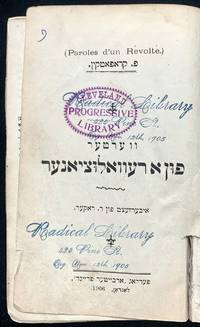
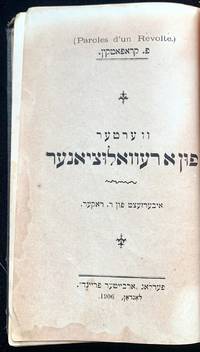
190643217London: "Arbayter fraynd 1906. First Yiddish edition. Period boards 8vo xiii 426 pages 19 cm. In Yiddish. Title translates as “Words from a Revolutionary.â€<br> Translation of “Paroles d'un re´volte´.†Includes translation of the forewords by the author and Elise´e Reclus. Includes bibliographical references.<br> “During his long exile Kropotkin wrote a series of influential works the most important being ‘Paroles d’un révolté’ 1885; “Words of a Rebelâ€.Kropotkin’s aim as he often remarked was to provide anarchism with a scientific basis. In Mutual Aid which is widely regarded as his masterpiece he argued that despite the Darwinian concept of the survival of the fittest cooperation rather than conflict is the chief factor in the evolution of species. Providing abundant examples he showed that sociability is a dominant feature at every level of the animal world. <br> Among humans too he found that mutual aid has been the rule rather than the exception. He traced the evolution of voluntary cooperation from the primitive tribe peasant village and medieval commune to a variety of modern associations—trade unions learned societies the Red Cross—that have continued to practice mutual support despite the rise of the coercive bureaucratic state. The trend of modern history he believed was pointing back toward decentralized nonpolitical cooperative societies in which people could develop their creative faculties without interference from rulers clerics or soldiers.â€<br> SUBJECTS: Anarchism. OCLC: 19303211.<br> Ex-library with early 19th Century left-wing library markings see photos. Good- Condition YID-48-41-LXCCGG-’e. London: "Arbayter fraynd unknown
190643219London: "Arbayter fraynd 1906. First Yiddish edition. Period boards 8vo xiii 426 pages 19 cm. In Yiddish. Title translates as “Words from a Revolutionary.â€<br> Translation of “Paroles d'un re´volte´.†Includes translation of the forewords by the author and Elise´e Reclus. Includes bibliographical references.<br> “During his long exile Kropotkin wrote a series of influential works the most important being ‘Paroles d’un révolté’ 1885; “Words of a Rebelâ€.Kropotkin’s aim as he often remarked was to provide anarchism with a scientific basis. In Mutual Aid which is widely regarded as his masterpiece he argued that despite the Darwinian concept of the survival of the fittest cooperation rather than conflict is the chief factor in the evolution of species. Providing abundant examples he showed that sociability is a dominant feature at every level of the animal world. <br> Among humans too he found that mutual aid has been the rule rather than the exception. He traced the evolution of voluntary cooperation from the primitive tribe peasant village and medieval commune to a variety of modern associations—trade unions learned societies the Red Cross—that have continued to practice mutual support despite the rise of the coercive bureaucratic state. The trend of modern history he believed was pointing back toward decentralized nonpolitical cooperative societies in which people could develop their creative faculties without interference from rulers clerics or soldiers.â€<br> SUBJECTS: Anarchism. OCLC: 19303211.<br> Spine is taped.Tight binding but text block is clean and intact. Good Condition YID-48-40-LXCCGG-’e. London: "Arbayter fraynd unknown
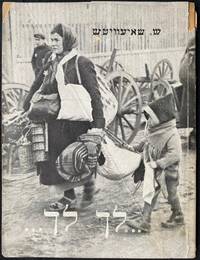
194643433Lodzsh: Tsentraler Yidisher Historisher Komisye baym Tsentral-Komitet fun Poylishe Yidn 1946. 1st edition. Original dramatic photgraphic covers 8vo 70 1 page 1 leaf. Includes facsimiles. 21 cm. In Yiddish. Poems. "Oysgabes fun Der Tsentraler Yidisher Historisher Komisye baym Tsentral-Komitet fun Poylishe Yidn. Serye yidishe literatur 1." <br> "Published by a commission The Central Jewish Historical Commission dedicated to recording the fate of Polish Jews published this book length poem by Simkhah Szajewics. Written in the Lodz Ghetto it appeared immediately after the war in 1946; Szajewicz perished in a concentration camp in 1944" from an exhibit at the National Yiddish Book Center which houses their copy in their Rare Book Collection. <br> The book includes two long poems: "Lekh-lekha" and "Friling 702 " as well as letters and other related material. <br> See David Roskies' interesting reflection on this work and it's stunning photographic cover at <br> jtsa.edu/torah/go-forth-the-grammar-of-remembrance. <br> For more about the author-poet see Chava rosenfarb's essay on Shayevitch in Tablet Magazine at <br> tabletmag.com/sections/arts-letters/articles/the-last-poet-of-lodz. <br> SUBJECTS: Jews -- Persecutions -- Poland -- Lódz. Holocaust Jewish 1939-1945 -- Poetry. Jews -- Correspondence. Crease and wear to wrapper and foot and crown of spine see photo better condition than usually found attractive. Good Condition. B HOLO2-110-36A-CCALX-'emm H-40-10. Lodzsh: Tsentraler Yidisher Historisher Komisye baym Tsentral-Komitet fun Poylishe Yidn unknown
1st edition. Original paper wrappers in protective cardboard binder. 8vo. 16 pages, 21 cm. In Yiddish with some Russian on title page. Title translates to A Little Chrestomathy. Chrestomathy refers to the selection of literary passages from a foreign language assembled for studying the language. Features passages by Y.L. Perets, Mendele Mokher Sefarim, and Avrom Reizen. SUBJECTS: Yiddish language study. OCLC: 233376695/58407193. OCLC lists three copies worldwide (NLI, YIVO, Harvard). Pages browning. Very good condition. Scarce. (YID-33-4-+)
1st edition. Original boards. 8vo. 364 pages, 22 cm. Features illustrations and portrait of Shvartsbard. In Yiddish. Title translates to In the Course of Years. Shalom-Shmuel Schwarzbard (1886-1938) was a Russian-born French Yiddish poet of Jewish descent. He served in the French and Soviet military, was a bolshevik, and is known for his assassination of the Ukrainian national leader Symon Petliura while in Paris. His trial was highly publicized and he claimed to have killed Petliura in retribution for the pogroms in Ukraine. He was eventually acquitted (Wikipedia, 2018) . He was viewed as a hero by many; this work is published by the Shalom Shvartsbard Committee in Chicago. SUBJECTS: Jews -- Ukraine -- Biography. Ex-library with usual markings. Very good Condition. (YID-40-91-X-'fl)
Title translates as Mendele Anthology: Published for the 100th Birthday of MMS. A nazi-era Yiddish language study book on Mendele Mokher Sefarim, produced by the children's publishers Grinke Beymelekh ("Green Saplings"). Mendele Mokher Seforim (1835-1917) is revered as the grandfather of Yiddish literature for his innovations in laying a new literary framework for Yiddish. His work realistically portrayed Jewish life with honesty and without judgment and depicted the world of the shtetl [village] with all its poverty and decay; all its joy and poetry. Mendele was born in Belorussia (Belarus) and came from a comfortable family of Lithuanian rabbis. He initially wrote in Hebrew and was a proponent of the Haskalah, but started writing writing in Yiddish in the 1860s (Stevens, 2019). SUBJECTS: Yiddish-language study. OCLC Number:234575366. OCLC lists 5 copies worldwide (NLI, YIVO, Harvard, NYBC, HUC). Spine rebacked with tape, paper toning, a bit fragile at the edges with some light damp stains. Pages and wrappers are edge worn with no loss to contents. About Good- Condition. Scarce. (YID-33-63-'elx)