658 résultats
1st edition, original paper wrappers. 16mo, 54 pages. In Yiddish. honors the 10ter Literarisher Konkurs far Yugntlekhe A"N fun Shmerke Katsherginski. The series lasted at least 15 volumes into the 1960s (SUBJECT(S) : Yiddish literature Argentina periodicals. OCLC: 33634165. Good condition. (MX-20-4-+-l)
Good Solid condition.; 8vo; 387 pages; In Yiddish. Not in Robinson & Friedman nor Wolff. Jewish partisan's memoirs of resistance against the Nazis in Poland. Illustrated with many photographs throughout. Inscribed by Kaczerginski in year of publication. Kaczerginski (19081954) was a Yiddish writer and cultural activist. Born in Vilna to a poor family and educated at that citys Talmud Torah, Shmerke (Pol., Szmerke) Kaczerginski lost both his parents during World War I. As a youth, he was involved with outlawed Communist groups and was arrested several times, serving a lengthy prison term. In the 1930s, two of his revolutionary poems became popular in Poland. He wrote short stories with a radical bent and was a correspondent and reporter for literary publications, including the semilegal leftist press in Poland and the New York Communist daily Morgn-frayhayt. Kaczerginski played a key role in shaping the writers and artists group Yung-Vilne; he organized its evening events and was the de facto publisher of its three miscellanies between 1934 and 1936. During the period of Soviet control over Lithuania in 19401941, he was even more active in the field of Yiddish culture, but at the same time experienced his first disappointments with the attitude of the Soviet regime toward Jewish culture. During the first period of Nazi occupation, Kaczerginski wandered through villages and towns posing as a deaf mute; after many difficulties, he ended up in the Vilna ghetto. Kaczerginski was very involved in the ghettos cultural activities. As a leader of its youth club, he wrote its Yugnt-himen (Youth Hymn), a song that immediately became popular. In 1943, he wrote the song Shtiler, shtiler in memory of the mass murders committed at Ponar. Set to music that Aleksander Volkoviski (later known as Aleksander Tamir) had submitted to a contest organized by the ghetto, the song was first heard at an evening performance there and over the years became one of the best-known songs of the Holocaust. With Avrom Sutzkever and others, Kaczerginski became part of a group of forced laborers whom the Germans designated to sort Jewish cultural treasures at YIVO and other locations. Known as the Papir-brigade (Paper Brigade), the groups members risked their lives to hide the most significant items, smuggling them back into the ghetto or entrusting them to non-Jewish acquaintances. Kaczerginski was a member of the Fareynikte Partizaner Organizatsye (United Partisans Organization; FPO), and, since YIVOs building was located outside the ghetto walls, he took part in smuggling weapons into the ghetto. In September 1943, Kaczerginski, along with Avrom and Freydke Sutzkever and other members of the FPO, escaped from the Vilna ghetto as part of an organized group of fighters just before its liquidation. They joined a Soviet partisan unit in the Naroch Forests, where Kaczerginski fought as a partisan until liberation in July 1944. Kaczerginskis books describe the destruction of Vilna, the partisan struggle, and his own experiences during the Holocaust period: Khurbn Vilne (The Destruction of Vilna; 1947), Partizaner geyen (Partisans on the Move; 1947), and Ikh bin geven a partizan (I Was a Partisan; 1952) (YIVO, 2010). Wear to cover and edges, very good condition. (HOLO2-87-3A)
New York, No Publisher (United Hebrew Trades) , 1928. Paper Wrappers, Large 4to, 160 pages. 30 cm. In Yiddish. Includes beautiful cover art and period ads and portrait photos. Feinstone (1878-1945),was born in Warsaw and trained as a woodcarver there. "After completing school he emigrated to England where he became president of a woodcarvers' union in London (1895). Later in Birmingham he was active in the beginnings of the British Labour Party. In 1910 Feinstone emigrated to the U.S. where he found employment in various skilled trades, securing permanent work in the umbrella industry. He soon became an official of the Umbrella Handle and Stick Makers' Union and an important figure in the United Hebrew Trades, an organization which sheltered the smaller and weaker American Jewish trade unions. Feinstone was a close associate of the organization's outstanding leader, Max Pine, whom he succeeded as United Hebrew Trades' secretary in 1928. Feinstone continued Pine's policy of supporting the socialist labor sector in Jewish Palestine through the Histadrut. He also represented the United Hebrew Trades on the executive board of the Central Trades and Labor Council of Greater New York, wrote articles in the New York Call and the Yiddish Jewish Daily Forward endorsing socialism and labor Zionism, and worked for the establishment of an independent labor party. With the advent of the New Deal, Feinstone's socialist teachings were incorporated by the American Labor Party, which satisfied his desire for a working class political organization. Thereafter, until his death he concentrated on obtaining support for Jewish labor in Palestine" (Melvyn Dubofsky in EJ). SUBJECT(S):Jewish labor unions -- United States. Jewish socialists -- United States. OCLC lists 3 copies worldwide (Harvard, Florida, NYPL), none west of New York. Tears to front cover, lacks rear cover, otherwise Good Condition. (Y-18C)
New York, N. Y. : American Representation of the General Jewish Workers' Union of Poland, No Date (1956? ) . Paper Wrappers, 8vo, 39 pages. Yiddish Monthly of the Bund in America, originally beginning in Feb 1941. 25 cm. In Yiddish. Light wear, Good Condition (Y-21-C)
8vo; 1st edition. Cloth, Small octavo, 334 pages. In Yiddish. Section headings include "The Jews in Amsterdam", The Theological Storm", and "Leibnitz". Includes bibliographical references (pages 319-334).SUBJECT(S): Spinoza, Benedictus de, 1632-1677. "Jacob Shatzky (also: Yaakov, or Yankev Shatski; in Polish: Szacki) (18931956) was a distinguished Jewish historian.Shatzky was born in Warsaw. He received a traditional Jewish education and went on to study at universities in Lwów, Vienna, Berlin and Warsaw. He earned his Ph.D. from the University of Warsaw in 1922 with a thesis on 'The Jewish Question in the Kingdom of Poland During the Paskiewicz Era.' Historians who studied under Shatzky include Lucy Dawidowicz.Shatzky enlisted in Pilsudski's Legion and fought with distinction in the First World War; he was promoted to the rank of lieutenant. He was sent by the Polish Foreign Ministry in 1918 to report on a pogrom in Vilna. He resigned from his post when it became clear that the government would not act to punish the perpetrators of the pogroms.Shatzky emigrated to the United States in 1923. He served as Chief Librarian of the New York State Psychiatric Institute from 1930 to 1956. He acquired the personal library of Sigmund Freud for the collection" (Wikipedia). OCLC: 19308492. Some wear, Good Condition. (YID-42-43-EL-'x)
Small folio, 17, 33pages. First Edition. With an introductory essay by Abraham Joshua Heschel. A most moving depiction of vibrant Jewish life before the Holocaust. 31 black and white photographs, many now iconic images of Eastern European Jewish life. Original boards, with most of jacket present (as often found). No marks except for a faint damp stain in the upper right blank margin corner of the text page introduction (it also has a former owner's attractive bookplate). It has a jacket showing the dramatic photo on the cover--but the border area, starting at the left side of the photo through the spine, is missing. About Very Good in damaged but attractive Jacket. (EE-3-20) xx
Paper wrappers, 8vo, 40 pages (uncut) , in Yiddish, Publisher specialized in Yiddish drama. SUBJECT(S) : Yiddish -- Drama -- Operetta. OCLC lists 1 copy worldwide (National Library of Israel) Inscription on cover page. Edge wear to all pages, no text loss. Spine repaired. Good condition. (YID-20-1)
1st edition. Original boards. 8vo. 247 pages. 21 cm. In Yiddish. Title translates to Songs of my Field: Memories of my Exhausted life. Title on title page verso: Espigas de mi campo. Dujowich (1873-1951). SUBJECTS: Jews -- Russia -- Biography. OCLC lists 16 copies worldwide (OCLC: 12385305). Wear to boards. Pages browning. Otherwise Good Condition. (YID-40-96-L-'x)
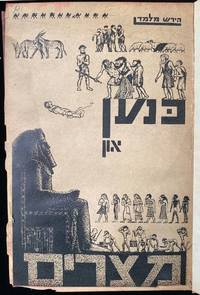
193042782Rige Riga: Yungbukh 1930. 1st edition. Period boards with original covers bound in. 8vo. 157 pages 21 cm. In Yiddish with Latvian "front" cover and title page at rear. Title translates as "Canaan and Egypt: A Novel." <br> Wonderfully illustrated cover bound in featuring cartoonish drawings of Canaanites and Egyptians. Two volumes in one: 1. Yoysef in Mitsroyim and 2. Yosef der reter fun Mitsroyim. <br> <br> SUBJECTS: Yiddish fiction. OCLC: 503648109. OCLC lists 8 copies worldwide including copies of an undated edition which we assume to be a later reprint. <br> <br> Ex-library with usual marks. Paper brown and somewhat fragile old dampstain to lower edge of boards extending into margins of first and last leaves. Original bound-in covers have come loose. Good condition thus. B YID-33-27-L-'ccex. Rige [Riga]: Yungbukh unknown
194613981Lodzsh: Tsentraler Yidisher Historisher Komisye baym Tsentral-Komitet fun Poylishe Yidn 1946. 1st edition. Later cloth with original dramatic photgraphic cover mounted on front 8vo 70 1 pages 1 l. includes facsimiles. 21 cm. Poems. "Oysgabes fun Der Tsentraler Yidisher Historisher Komisye baym Tsentral-Komitet fun Poylishe Yidn. Serye yidishe literatur 1." <br> A committee dedicated to recording the fate of Polish Jews published this book length poem by Simkhah Szajewics. Written in the Lodz Ghetto it appeared immediately after the war in 1946; Szajewicz perished in a concentration camp in 1944" from the permanent exhibit at the National Yiddish Book Center which houses their copy in their Rare Book Collection. <br> The book actually includes two long poems: "Lekh-lekha" and "Friling 702 " as well as letters and other related material. <br> See David Roskies interesting reflection on this work and it's stunning photographic cover at jtsa.edu/torah/go-forth-the-grammar-of-remembrance. <br> For more about the author-poet see Chava rosenfarb's essay on Shayevitch in Tablet Magazine at tabletmag.com/sections/arts-letters/articles/the-last-poet-of-lodz. SUBJECTS: Jews -- Persecutions -- Poland -- Lódz. Holocaust Jewish 1939-1945 -- Poetry. Jews -- Correspondence. Expertly rebound in attractive black cloth with the original photographic front cover mounted on the front. Very Good Condition. B HOLO2-110-36-CCALX-'emm H-40-10. Lodzsh: Tsentraler Yidisher Historisher Komisye baym Tsentral-Komitet fun Poylishe Yidn unknown
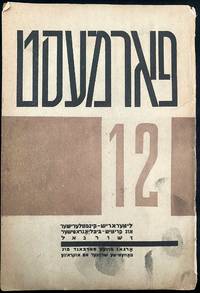
193543308Kharkov: Ukrmelukhenatsmindfarlag 1935. First edition. Original illustrated paper wrappers 8vo 156 pages.Includes illustrations. 21-23 cm. In Yiddish. Title translates roughly as “Challenge: A Literary Artistic and Critical Bibliographical Journal.â€<br> At the time the only Yiddish literary periodical in Ukraine.<br> Farmest 1933–1937 was a monthly Yiddish literary magazine published in Kharkhiv Ukraine by the Ukrainian Committee for Soviet Writers.<br> “Edited by the poet Itsik Fefer 1900–1952 it was continued in Sovetishe literatur: Literarish-kinstlerisher un kritish-bibliografisher zhurnal Soviet Literature: Literary-Artistic and Critical-Bibliographical Journal; 1938–1941.<br> In 1927 Fefer was a founding member of the Jewish Section of the All-Ukrainian Union of Proletarian Writers and from 1928 one of the editors of its Kharkov-based journal Prolit Proletarian Literature. He also coedited the nonproletarian Kharkov journal Di royte velt The Red World from 1929. From 1933 to 1937 he edited the Kiev periodical Farmest Challenge; known as Sovetishe literatur Soviet Literature between 1938 and 1941 which replaced Prolit and Di royte velt and was thereafter the only Yiddish literary periodical in Ukraine.†YIVO. Avrom Gontar was also involved in the collective and editorial committee. <br> The editor Itsik Fefer 1900–1952 “began writing poems in 1918 and in 1922 joined Vidervuks New Growth in Kiev a group of young Yiddish literati whose mentor was Dovid Hofshteyn. That same year the appearance of Fefer’s small collection Shpener Splinters established him as a rising literary star. His poetry amalgamated the Kultur-lige poets’ revolutionary romanticism with the propagandist objectives of the workers’ movement.<br> Fefer was known for his literary credo of proste reyd simple speech a concept he formulated in 1922. In the early 1920s poetry particularly avant-garde poetry swamped the literary pages of Soviet Yiddish periodicals. This phenomenon worried editors and critics who were wary of the fact that Yiddish readers usually could not identify with this style of literature. All Yiddish readers by contrast could understand Fefer’s proste reyd.<br> In 1927 Fefer was a founding member of the Jewish Section of the All-Ukrainian Union of Proletarian Writers and from 1928 one of the editors of its Kharkov-based journal Prolit Proletarian Literature. He also coedited the nonproletarian Kharkov journal Di royte velt The Red World from 1929†Gennady Estraikh.<br> For more see: Gennady Estraikh “The Kharkiv Yiddish Literary World 1920s–Mid-1930s†East European Jewish Affairs 32.2 2002: 70–88; Chone Shmeruk “Yiddish Literature in the U.S.S.R.†in The Jews in Soviet Russia since 1917 ed. Lionel Kochan pp. 242–280 London and New York 1970.<br> SUBJECTS: Yiddish literature -- Ukraine -- Periodicals. Yiddish literature. OCLC: 35051038.<br> Pages toning as expected some sunning and stains to cover Good Condition. BYID-46-2A-LGG-’excc. Kharkov: Ukrmelukhenatsmindfarlag unknown
195932876New York: Celia Adler Foundation / Shulsinger Bros. Linotyping & Publishing Co 1959. Very Good/Very Good. New York: Celia Adler Foundation / Shulsinger Bros. Linotyping & Publishing Co. 1959. First Edition. Two octavo volumes 23.5cm; 688pp. Black and white photographs. Photo-illustrated dust jackets; blue cloth boards. Yiddish-language text throughout. Dust jackets show mild chipping with a few short tears along edges; general rubbing and sun-fading. Old damp-marks to board edges of both volumes causing discoloration to cloth but no structural damage. Bindings sound. Glue residue to endpapers of volume II else unmarked and still a Very Good set of this uncommon autobiography of "The First Lady of Yiddish Theater." Adler was known for creating leading roles in Yiddish versions of many classic plays and was the first actor to portray a Holocaust survivor in her brother Luther's 1946 Broadway production A Flag is Born. Scarce. Celia Adler Foundation / Shulsinger Bros. Linotyping & Publishing Co unknown
195949878New York: Celia Adler Fondeyshon un bukh-komitet Celia Adler Foundation 1959. First Edition. Two octavo volumes 24cm. Blue cloth boards; dustjackets; viii688pp; illus. Old damp-marks to board edges of both volumes causing discoloration to cloth but no structural damage. Text clean tight and unmarked; jackets lightly worn and sun-faded; complete sound and Good. Text entirely in Yiddish save verso of title page which provides both a transcription and an English-language translation of the title and publisher. Exceedingly uncommon autobiography of Celia Adler 1899-1979 daughter of Jacob Adler and half-sister to Stella Adler known as the "First Lady of the Yiddish Theatre." Adler was associated with the Yiddish Art Theater movement of the 1920s and gave one of the first theatrical portrayals of a Holocaust survivor in her brother Luther's 1946 Broadway production A Flag is Born. Unaccountably scarce even for an American work written entirely in Yiddish: OCLC notes a single location only in the U.S. Northwestern; five more copies are in European and Israeli institutions. Celia Adler Fondeyshon un bukh-komitet [Celia Adler Foundation] unknown books
1st edition. Original wrappers. 8vo. 68 pages, 24 cm. In Yiddish. Title translates to Practical Guide and Information on Erets Israel. Nazi-era tips for newly arrived Yiddish speakers in Palestine. SUBJECTS: Palestine -- Guidebooks. Middle East -- Palestine. OCLC lists 5 copies worldwide (YIVO, Harvard, NYBC, JHU, HUC) (OCLC: 19312759) . Ex-library with usual markings. Original wrappers bound in to later library cardboard protector. Some damp stains. Light soiling to wrappers. Dog ears in bottom left margin. (YID-41-61)
1st edition. Original paper wrappers. 8vo. 48 pages, 27 cm. In Yiddish. Title translates to Canada: Periodical Literature Journal. S Edited by Y. Rabinowitz and S. Skolnikov. The Montreal Jewish community is Canadas second largest and is home to many Canadian Jewish institutions, including the Jewish Public Library of Montreal, Saidye Bronfman Centre for the Arts, Dora Wasserman Yiddish Theatre and Montreal Holocaust Memorial Centre. (Wikipedia, 2018) . SUBJECTS: Jews -- Canada -- Periodicals. Yiddish literature. OCLC lists 5 copies worldwide (NYPL, YIVO, JTS, Brandeis, NLI) , none south or west of New York. Ex-library with usual markings. Wrappers are edge worn. Internally Very Good. Overall Good Condition. Scarce. (YID-40-58)
Original boards. 8vo. 192, 186 pages, 21 cm. In Yiddish. Title translates to Theater and Drama. Michael Weichert (1890-1967) was a Galician Jewish theater director, historian, activist, and critic. He directed plays for the Vilner Trupe and published numerous articles on drama and theater history (YIVO). SUBJECTS: Theater, Yiddish. OCLC lists 16 copies worldwide (OCLC:42036360). Title page repair. Pages browning. Overall good condition. (YID-33-15-L-xe)
Original Cloth. 8vo. VI, 508 pages. 25 cm. First edition. In German. 'History of the Jews of Baden since the Reign of Charles Frederick, 1738-1909'. Bound in original dark blue cloth. Important source for history of the Jewish communities in Baden in the modern period; especially details the struggles for emancipation, the jewish communities during the revolutionary periods (especially the 1806 and 1848 periods) , and state recognition. Adolf Lewin (18431910) , German rabbi and historian. Lewin, who was born in Pinne, Prussian Posen, studied in Breslau at the Jewish theological seminary and at the university there, obtaining his doctorate for the thesis Die Makkabaeische Erhebung (1870) . He served as rabbi at Koschmin (from 1872) , Coblenz (1878) , and Freiburg im Breisgau (from 1885) . - EJ 2008 Subjects: Jews - Germany - Baden - History. Jews. History. Baden. Juden. Germany - Baden. Light soiling to cloth and upper outer edge, otherwise very fresh. Very good + condition. (GER-43-44)
Contemporary marbled paper over boards. 12mo. 154; 140 pages. 17 cm. Only edition. Two Volumes in one. In German. A volume of Biblical history (including a retelling of many Bible stories) , with moral notes by Heimann Schwabacher. It is designated on the title page as a work for more mature youth. The author is also known as Hayyim Hirsch Schwabacher, and is listed as the translator of Behinot Olam by Jedaiah ben Abraham Bedersi and also of Olelot Ha-Bohen (by the same author) . These are both works on ethics, and in both the German translation is transliterated using Hebrew letters. He also wrote a book in Yiddish on ethics, entitled Keren Tushiya (Fuerth, 1817) . Attractively bound in marbled boards and leather backstrip. Printed on ragpaper. Subjects: Bible Germany Haskalah. OCLC lists three copies, none of which seem to contain both parts (UCLA, HUC, Natl Libr Israel) , none east of Cincinnati. Light wear to hinges, otherwise verry clean and fresh. Very good condition. (GER-43-48)
Original Cloth. 4to. XLVII, 828 pages. 31 cm. First edition. In Yiddish; added title page and abstracts in German. Double column pagination. Edited by Elias Tcherikower; Historishe shriftn (Historical Writings) ; three volumes were published in 1929, 1937, and 1939. The "primary journal for serious historical scholarship in Yiddish in the interwar period. " - Yivo Encyclopedia. . First volume of the Historishe Shriftn (Historical Writings) of the Historical Section of the YIVO. Articles by S. Dubnow, I. Shiper, N. M. Gelber, E. Ringelblum, Z. Rubashov, H. Borodianski, A. Menes, S. Barkin, I. Shatzky, A. Tcherikower, M. Balaban, A. Landoy, P. Kon, N. Prilutski, and others. Articles on Moses Mendelssohn, the family letters of Ferdinand Lasalle (with facsimiles) , the life and writings of Nathan ben Moses Hannover, the Jews in Poland in the 10th and 11th centuries, Jews in Medieval Warsaw, the struggle for Jewish emancipation in England, Jews in the Polish uprising of 1863, the Jewish Socialist Movement, the 1876 Articles of the Jewish Socialist Union in London with facsimile, history of the first Russian-Yiddish journal; reports on important Materials and Documents held at archives and research institutes. Subjects: Jews - Europe, Eastern - History. YIVO Historical Section. Jewish socialists - Europe, Eastern - History. Jews - History. Ethnic relations. Jewish socialists. Jews. History. Europe, Eastern - Ethnic relations. Bound in brown cloth with gilt title. Binding repaired; edges bumped, endpages lightly soiled, otherwise fresh and clean. Good + condition. (YID-22-50)
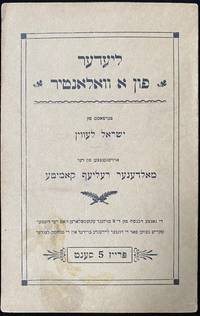
191942896No Place Malden MA: Maldener Relief Komite 1919. No Date 1919. 1st Edition. Original printed paper wrappers 8vo 14 pages. 21 cm. In Yiddish. Title translates as “Verses of a Volunteer.†No city or date listed but clearly published during or immediately after WW I with the Leksikon suggesting Malden MA 1919 OCLC suggests Boston the location of the printer and a clearly incorrect date of 1900 perhaps intending "1900s". Malden the poet’s home town just outside of Boston and clearly the home of the "Maldener Relief Komite" makes much more sense making this is the first documented yiddish publication in Malden MA north of Boston.<br> "The poet dedicated the entire income of 5 thousand copies to the brothers suffering from hunger in the countries at war†Translated from the front cover. Includes 4 poems: Der Volontir; Ikh Zukh a Vort; Nach der Milhome; Hazkharot Neshimot. The final poem is “in memory of the fallen Jewish heroes in all the war-torn lands.â€<br> Israel Levine 1878-1970 “was born in a village in Minsk district Byelorussia. In 1895 he arrived in the United States lived in various cities worked as a teacher in Talmud Torahs and was secretary for Mizrachi in the town in which he lived Malden Massachusetts. <br> He debuted in print in 1904 in Fraye arbeter-shtime Free voice of labor in New York with a poem entitled ‘Funken shpritsn’ Sparks fly and from that point he went on to contribute poetry and translations from Tanakh and from ethical books to: Yidishes tageblat Jewish daily newspaper Forverts Forward Dos yudishe folk The Jewish people Di varheyt The truth and Idisher kemfer Jewish fighter—in New York; Idishe shtime Jewish voice in Boston; and more. He published in book form: Lider fun a volontir Poems of a volunteer Malden 1919 16 pp.; Sefer naim zemirot tehilim Naim Zemirot on Psalms translated into a poetic form with short prefaces by Dr. Meir Vaksman and Aharon Kaminska Jerusalem 1934 19 pp†Khayim Leyb Fuks in Leksikon Fun Der Nayer Yidisher Literatur<br> OCLC: 19307496. OCLC lists 4 copies worldwide YIVO Brandeis Harvard NYBC none outside the northeast. A few stains & discoloring Very Good Condition an excellent copy. Scarce. B YID-45-9XX-LE-’. No Place [Malden, MA]: Maldener Relief Komite unknown
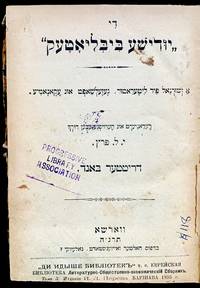
189543079Warsaw: Izdanie I.L. Perets 1895. First edition period boards 8vo 179 pages. 23 cm. In Yiddish. Title translates as “The Jewish Library: A Journal for Literature Society and Economics.â€<br> Third volume of semiannual publication edited by I.L. Peretz. Di Yudishe Bibliotek was published periodically between 1891 and 1904. This issue includes belle-lettres poetry and scientific essays.<br> “To encourage Jews toward a wider knowledge of secular subjects Peretz for several years wrote articles on physics chemistry economics and other subjects for Di yudishe bibliotek which he also edited.†Encyclopedia Britannica.<br> Yitskhok Leybush Peretz 1852-1915 is one the best known Yiddish and Hebrew authors of the 19th century. Peretz was one of the three classic Yiddish writers with S. Y. Abramovitsh and Sholem Aleichem and the founder of Yiddish modernism. In the first decade of the 20th century he was at the center of an active literary circle in Warsaw. <br> SUBJECTS: Yiddish literature -- Poland -- Periodicals. Jews -- Poland -- Periodicals. Jews. Yiddish literature. OCLC: 992802478. <br> Ex-library with usual markings and normal wear and age to pages but otherwise in good condition. Good Condition. YID-46-19-GGLEX-’cc. Warsaw: [Izdanie I.L. Perets] unknown
1912224381912. Schwartz Isidor Publisher. Vi Azoy Tsu Veren a Sitizen. / The Citizen: A Guide to Naturalization. All Important Questions and Answers Printed in Hebrew and Yiddish Also Translations in Plain English Which You are to Know When Applying for Your Final Citizen Papers. Brooklyn: Aroysgegeben fun Isidor Schwartz / Published by Isidor Schwartz n.d. after 1912. Only edition. 31 page. Text in English and Yiddish both transliterated and Hebrew script. 6" x 4.5. Stapled pamphlet in printe wrappers.<br /> <br /> An immigrant-era Yiddish-English naturalization guide for Jewish immigrants preparing to become U.S. citizens published by Isidor Schwartz in Brooklyn. This vernacular instructional manual contains sample questions and answers in three formats: English Yiddish in Hebrew script and transliterated English in Latin script referred to on the cover as "Jewish-English". Designed for oral preparation it walks new arrivals through both general and localized questions commonly asked at the naturalization interview particularly for applicants in New York. Questions range from general American civics-"How does a bill become a law"-to specific regional knowledge-"What is the capital of New York State" and "How many stars has the American flag" The answer is noted as "Forty-eight stars" dating the publication to after Arizona and New Mexico's 1912 admission but before Alaska and Hawaii. The phrasing used-"We vote for the candidate who is in our opinion best fitted to occupy the office he wishes to be elected to"-illustrates the pamphlet's focus on simplified phonetic civic literacy.<br /> <br /> A vital artifact of Jewish immigrant life and Americanization in the early 20th century this pamphlet exemplifies how Jewish community publishers mediated state bureaucracies for recent arrivals. Yiddish language guides like this one offered more than instruction-they were part of the infrastructure of mutual aid and cultural transition particularly within New York's dense immigrant communities.<br /> <br /> Fragile condition with moderate chipping and edgewear to front and rear wrappers including some closed tears and loss at corners; interior pages clean and legible. Overall good condition. A scarce and historically significant publication supporting Jewish American integration during a peak period of Yiddish-speaking immigration; OCLC locates only 8 institutional holdings worldwide. unknown
32 pages. Features: Full-page Datsun ad shows girl getting her first car; A Man's Best Friend is his Helpmate - Elaine and Norman Campbell, Farley and Claire Mowat, and Gloria and Morton Shulman are featured with nice colour photos and write-ups; Everyone's Guide to Yiddish; The Unlovables - Baseball Umpires - great colour photo with article; Earl Kraul of the National Ballet of Canada wanted to teach Panamanians ballet but they said "Gringo, Go Home!" - article with photo; Moustache Cups. Printed by newspapers across Canada as a weekend supplement. Unmarked with moderate wear. A nice vintage copy. Magazine
Leipzig: F. A. Brockhaus, 1882. Disbound; 8vo. Xii, 587 pages. Marbled endpapers. In German. Bibliographical citations. Max Grünbaum was a distinguished Munich Orientalist. A Chrestomathy is an aid, by means of prose passages, in learning a language. Contains Medieval Yiddish translations of the Bible. SUBJECT (S) : Yiddish language -- Translating into German. Ex-library with minimal markings. Some age staining. Corners of a few pages chipped. Although cover not present, binding is tight. Text in good condition. (GR-07-8)
New York: Yiddish Scientific Institute [YIVO], American Branch [Yidisher visnshaftlekher institut.; Amerikaner sektsie], 1927-29. Original Wraps, Large 8vo. In Yiddish. Four loose issues. This periodical survived only 2 volumes, ending with vol. 2, Nr. 1 in 1929. A quarterly devoted to the study of Yiddish literature, language, folklore and bibliography. SUBJECT(S): Yiddish philology -- Periodicals. Yiddish language -- Periodicals. OCLC: 122810294. OCLC lists 20 holdings worldwide. Not in Shunami. Binding repaired, good solid copy of this important Yiddish literary and linguistic journal. (CT-15-2A)