Heidenheim, WolfMareMagnum

658 résultats
Period Wrappers. 8vo, 32 pages, 19 cm. In Hebrew with Judeo-German commentary underneath. Yaari, 779. OCLC lists one copy worldwide (Harvard) . Pages are foxing and occasionally edgeworn. Overall good condition. (Hag-18-17)
Nyu york [New York]: Idisher sotsyalistisher federatsye in Amerika, 1914. Paper Wrappers, 8vo, 110 pages. Annual. Includes illustrations. 23 cm. In Yiddish. Periodical lasted until 1918 issue; Vols II (1915) and later are titled "Idishe yohrbukh. " "In 1908 a Jewish Agitation Bureau was established [by the Socialist Party of America] in order to spread socialism among Yiddish-speaking Jews. Stimulated by immigrants with experience in the East European Bund, the Bureau developed into the Jewish Socialist Federation (J. S. F. ) from 1912, over strong opposition from Abe Cahan and other Yiddish-speaking stalwarts opposed to such "separatism. " Actually the J. S. F. Disavowed any distinct Jewish purpose and attempted only to spread socialism, while it vigorously combated Zionism. Its membership was drawn mainly from immigrants of Bundist background" (Schneier Levenberg in EJ) . SUBJECT(S) : Socialism -- Periodicals. Jews -- New York (State) -- New York -- Periodicals. OCLC lists 6 holdings. Edgewear, rear cover detached. Otherwise good condition with good paper. (AMR-56-14X)
Nyu york [New York]: Idisher sotsyalistisher federatsye in Amerika, 1914. CLoth, 8vo, 110 pages. Annual. Includes illustrations. 23 cm. In Yiddish. Periodical lasted until 1918 issue; Vols II (1915) and later are titled "Idishe yohrbukh. " "In 1908 a Jewish Agitation Bureau was established [by the Socialist Party of America] in order to spread socialism among Yiddish-speaking Jews. Stimulated by immigrants with experience in the East European Bund, the Bureau developed into the Jewish Socialist Federation (J. S. F. ) from 1912, over strong opposition from Abe Cahan and other Yiddish-speaking stalwarts opposed to such "separatism. " Actually the J. S. F. Disavowed any distinct Jewish purpose and attempted only to spread socialism, while it vigorously combated Zionism. Its membership was drawn mainly from immigrants of Bundist background" (Schneier Levenberg in EJ) . SUBJECT(S) : Socialism -- Periodicals. Jews -- New York (State) -- New York -- Periodicals. OCLC lists 6 holdings. Hinges starting, but still good and solid. Good Condition. (AMR-56-14X)
Small 8vo; First Edition. Paper Wrappers, 4to (Large), 36 pages. One of 8000 issued. In Yiddish with English Cover, table of contents, & photo captions. Important journal lasting 10 issues which written & published by Jewish DPs themselves to document crimes and survival in the Holocaust. The publisher's decision to include the English table of contents, probably in part to insure the journal's use in future war crimes trials, makes these first hand accounts especially user-friendly today, almost 60 years later. Robinson & Friedman #1247: "The Historical Commission [was] established in 1945 under the auspices of the Central Committee of Liberated Jews in the U. S. Zone. [It] Ceased operations early in 1949. Details of the activities of the Munich center can be found in No. 1247 [Fun Letsten Churbn]..." Hagit Lavsky notes in the Encyclopedia of the Holocaust (Gutman, ed., 1990, p. 383) that, "Commemoration and documentation projects [by Jewish DPs] included the work of the Tsentraler Historisher Komisiye (Central Historical Commission), established in December 1945 by the Central Committee in Munich, to assist in bringing Nazi criminals to trial. A network of regional committees was set up under the commission's auspices whose task it was to take evidence and collect documentary material, including material on DPs. In August 1946, the commission published the first issue of the monthly FUN LETZTEN HURBAN." Published under DP-Publications License US-E-3 OMGB, Information Control Division. This first issue is the only large magazine-size issue published, and remains the scarcest of the set. This copy fragile, with original blue detached edgeworn wrappers mounted on attached later paper for stabilization. Paper is somewhat fragile, but complete and usable. Fair condition, complete. (HOLO2-122-51G)
Original illustrated cover wrappers with distinctive modernist typeface and design. Chidlrens literature. Printed on quality glossy paper. Includes 6 illustrations by Gudelman and photo of author. Aron Gudelman (1890 - 1978) was a sculptor, illustrator, etcher, lecturer, and teacher. Born in Russia, he immigrated to New York in 1905 at the time of pogroms in Russia. After attending the Cooper Union and the National Academy of Design, in 1914 he studied with Jean-Antoine Injalbert at the Ecole des Beaux-Arts in Paris. Supporting himself as a machinist in the 1920s, Goodelman became a communist. His concerns about social and economic conditions were expressed in his art. He participated in exhibitions at the John Reed Club in the early 1930s. After World War II, Goodelman created artworks related to the Holocaust. He taught at City College of New York in the 1960s (National Museum of American Art, 1996) . Blue cover Variant. Shul Pinkas Chcago Nr. 203 . Light wear to cover, Very Good Condition, (Yid-24-7)
Original publishers cloth in dramatic modernist color illustrated dust jacket designed by Zuni Maud with illustrations on front and rear; 8vo, 243 pages. 23 cm. In Yiddish. SUBJECT (S) : Yiddish literature -- 20th century. Illustrator Zuni Maud (born 1905) was an Artist, cartoonist, puppeteer, playwright, writer and poet. [He] Studied at the Cooper Union Art School, Baron de Hirsch Art School and National Academy of Art, New York. [and] Did illustrations for *Der kibitser* and stage and costume design for productions by Maurice Schwartz in the Yiddish Art Theater. Contributed articles to Der kundes (N. Y. ) , Jewish Daily Forward (N. Y. ) , Di tsayt (N. Y. ) , Kinderland (N. Y. ) , Kinder zshurnal (N. Y. ) , Frayhayt (N. Y. ) . [He was the] Illustrator of a number of books. In 1925, together with Yosel Cutler, [he] founded the Modicot marionette theater. [He] Wrote plays, children's stories and poems (YIVO, 2018) . Author Yitzchak Rayz (1885-1943) , better known by his pen name Moyshe Nadir was an American Yiddish language writer and satirist . In 1898, at the age of 13, Rayz immigrated to New York and adopted the Americanized name Isaac Reiss. Within a few years his work was published widely in the New York Yiddish press, under a variety of pseudonyms, including Rinnalde Rinaldine, Dilensee Mirkarosh, Der Royzenkavalir, Doctor Hotzikl, and, finally, Moishe Nadir. The name Nadir is a Yiddish expression meaning here you are or that's for you, but can also mean take this and choke on it. As a teenager, he wrote for Der Groyser Kundes (The Big Prankster) and later co-edited Der Yiddisher Gazlon (The Yiddish Bandit) with Jacob Adler. He wrote for an assortment of Communist Yiddish publications including the Frayhayt (Freedom) newspaper and its successor Morgn Frayhayt (Morning Freedom) and the magazines Der Signal (The Signal) and Der Hammer (The Hammer) . When his sharp-tongued theater reviews caused him to be banned from theatrical productions, he resorted to attending plays in disguise. His own plays were performed by Maurice Schwartzs Yiddish Art Theater, Zuni Maude and Yosl Cutlers Modicut puppet theater, Artef (Arbeter Teater Faraband, Workers Theater Alliance) and the Federal Theater Project. Among his better known poems are the erotic Vilde Royzen (Wild Roses, 1915) and his 1932 Rivington Strit (Rivington Street) . After a long association with the Frayhayt and the Morgn Frayhayt, Rayz began to distance himself from the Communist cause with the onset of the show trials in the Soviet Union and publicly broke with the Morgn Frayhayt in the wake of the Molotiv-Ribbentrop Pact. He set out his reasons in Di, vos blayben mit der Morgn Frayhayt (Those who stay with the Morgn Frayhayt) in response to Morgn Frayhayt editor Moissaye Olgins Di vos gayen avek (Those who leave) . Rayz discusses his relationship to the Communist Party in his posthumous Moyde Ani (Wikipedia, 2019) . Very Good Condition in dust jacket which shows some edgewear affecting some letters on the spine. Very Good in Good Jacket. (yid-41-92)
1st Yiddish Edition. Original illustrated photographic paper wrappers. 8vo. 46 pages, 22 cm. In Yiddish. Holocaust stageplay. Title translates to The Medem Sanitorium. Translated into Yiddish by Mosheh Lokiec. Zygmunt Turkow (18961970) was a Polish actor, director, playwright and director of Jewish origin from Warsaw, who became famous for roles in the pre-war Jewish films and stage plays in Yiddish. His brother, Jonas Turkow, was also a noted actor and stage manager. Shortly after German invasion of Poland in 1939 he left Poland together with his second wife. In 1940 he settled in Brazil. In 1952 he moved to Israel (Wikipedia, 2019). SUBJECTS: Holocaust, Jewish (1939-1945) -- Drama. OCLC 122833421, OCLC lists 6 copies worldwide (NYPL, YIVO, UIllinois, NYBC, Toronto, McGill). Crease through enter of pamphlet. Otherwise very good condition. Scarce. (YID-33-55-'elx)
First edition. Original paper wrappers. 8vo, 172 pages. 23 cm. SUBJECTS: Yiddish language -- Congresses. Yidisher visnshaftlekher institut -- Congresses. Browning to cover and pages. Very good condition. (AC-1-16)
Birobidzhan-Shtot [USSR], The Committee, 1974. Newspaper, Elephant Folio, 4 pages each issue. "Organ fonem Gegntlekhn Komitet fun der Komunistisher Partay fun Sovetntnforbond un fonem Gegentlekhn Sovet fun Deputatn fun di Arbetndike fun der Yidisher Avtonomer Gegnt. " Yiddish daily established in 1930 in the Jewish Autonomous region of the USSR. "Stalin's suppression of Yiddish culture in 1948-1952, however, stopped the production of Yiddish periodical literature [in the USSR] except in the Jewish Autonomous Region (Birobidzhan) , where the newspaper Birobidzhaner shtern (Birobidzhan Star) , which had begun publication in 1930, was able to continue" (Yivo, "Yiddish Newspapers and Periodicals, N. D. ) . No Copies listed on OCLC, and only 1 holding (Columbia) with microfilm (Y-35)
1st edition. Original paper wrappers with modernist typeface, 8vo, 32 pages each. In Yiddish. Semimonthly Yiddish literary periodical which ceased publication in the 1930s. 22 cm. SUBJECT(S) : SUBJECT(S): Jews -- Poland -- Periodicals. Yiddish literature -- Juifs -- Pologne -- Pe´riodiques. Litte´rature yiddish. OCLC: 22650745. OCLC lists 9 libraries with holdings of any issues. Ex-library with usual markings, Paper browning as expected, some staining, Nr 11 is fragile with edgewear and spine repair, all are complete, no loss, Fair condition overall (yid-41-94-ELCC-'x)
1934STLE0064a?ernovits : Seminar far Jid. Literatur- un ?prachkenteni?, 1934. kl.-8°. 96 S., OKart. mit mont. Deckel- u. Rückenschildchen. Errata-Zettel beiliegend. In romanisiertem Jiddisch. Das Romanisierungsystem ist im Anhang erläutert.
Varshe [Warsaw]: Farlag "di Velt", 1928. Paper Wrappers, 8vo, 95 pages. Monthly Bundist periodical ran from Vol. I, Nr, 1 (Oct. 1927) to 1932. 23 cm. In Yiddish. Unobtrusive Bund rubber stamp on some volumes. For example, Levin (1977) reports that it was in UNZER TSAYT that the very first reports of the Bund's split over the National Question with the Russian Social Democrats were published (in 1927). The Bund in Poland, here providing its unique Polish Jewish Socialist anti-Zionist perspective. The General Jewish Labour Bund in Lithuania, Poland and Russia (Yiddish: algemeyner yidisher arbeter-bund in lite, poyln un rusland), generally called The Bund or the Jewish Labour Bund, was a secular Jewish socialist party.... founded in Vilnius on October 7, 1897 ..In 1917 the Polish part of the Bund, which dated to the times when Poland was a Russian territory, seceded from the Russian Bund and created a new Polish General Labor Bund which continued to operate in Poland in the years between the two world wars .The Bund sought to unite all Jewish workers in the Russian Empire into a united socialist party, and also to ally itself with the wider Russian social democratic movement to achieve a democratic and socialist Russia. The Russian Empire then included Lithuania, Latvia, Belarus, Ukraine and most of present-day Poland, areas where the majority of the world's Jews then lived. They hoped to see the Jews achieve a legal minority status in Russia. Of all Jewish political parties of the time, the Bund was the most progressive regarding gender equality, with women making up more than one-third of all members. The Bund actively campaigned against anti-Semitism. It defended Jewish civil and cultural rights and rejected assimilation. However, the close promotion of Jewish sectional interests and support for the concept of Jewish national unity (klal yisrael) was prevented by the socialist universalism of the Bund. The Bund avoided any automatic solidarity with Jews of the middle and upper classes and generally rejected political cooperation with Jewish groups that held religious, Zionist or conservative views. Even the anthem of the Bund, known as "the oath" (di shvue in Yiddish), written in 1902 by Sh. An-ski, contained no explicit reference to Jews or Jewish suffering. At the heart of the vision of the future of the Bund was the idea that there is no contradiction between the national aspect on the one hand and the socialist aspect on the other. As a strictly secular organization, the Bund renounced the Holy Land and the sacred language (Hebrew) and chose to speak Yiddish .In its early years the Bund had remarkable success, gaining an estimated 30,000 members in 1903 and an estimated 40,000 supporters in 1906, making it the largest socialist group in the Russian Empire . the Bund was a founding collective member at the RSDLP's first congress in Minsk in March 1898. For the next 5 years, the Bund was recognized as the sole representative of the Jewish workers in the RSDLP, although many Russian socialists of Jewish descent, especially outside of the Pale of Settlement, joined the RSDLP directly .The Bund generally sided with the party's Menshevik faction led by Julius Martov and against the Bolshevik faction led by Vladimir Lenin during the factional struggles in the run-up to the Russian Revolution of 1917 .In the Polish areas of the [Russian] empire, the Bund was a leading force in the 1905 revolution. At that time the organization probably reached the height of its influence. It called for an improvement in living standards, a more democratic political system and the introduction of equal rights for Jews. At least in the early stages of the first Russian Revolution, the armed groups of the "Bund" were likely the strongest revolutionary force in Western Russia. During the following years, the Bund went into a period of decay .The Bund eventually came to strongly oppose Zionism, arguing that emigration to Palestine was a form of escapism. The Bund did not advocate separatism. Instead, it focused on culture, rather than a state or a place, as the glue of Jewish nationalism. . The Bund also promoted the use of Yiddish as a Jewish national language and to some extent opposed the Zionist project of reviving Hebrew. The Bund won converts mainly among Jewish artisans and workers, but also among the growing Jewish intelligentsia. It led a trade union movement of its own. It joined with the Poalei Zion (Labour Zionists) and other groups to form self-defense organisations to protect Jewish communities against pogroms and government troops. During the Russian Revolution of 1905 the Bund headed the revolutionary movement in the Jewish towns, particularly in Belarus and Ukraine ..In 1921, the Communist Bund [in the USSR] dissolved itself and its members sought admission to the Communist Party....Many former Bundists, like Mikhail Liber and David Petrovsky, perished during Stalin's purges in the 1930s. The Polish Bundists continued their activities until 1948. During the latter half of the 20th century the Bundist legacy was represented through the International Jewish Labor Bund, a federation of local Bundist groups around the world .Among the exiled Bundists who went on with Socialist politics in America was Baruch Charney Vladeck (18861938), elected to the New York Board of Aldermen as a Socialist in 1917 [and] 1937 [and] manager of The Jewish Daily Forward Moishe Lewis (18881950)....the father of David Lewis (19091981), a leader of the New Democratic Party in Canada .David Dubinsky (18921982), though never formally a member of the party, had joined the bakers' union, which was controlled by the Bund, and was elected assistant secretary within the union by 1906 ..He later became a member of the Socialist Party of America, helped found the American Labor Party in 1936 and was from 1932 till 1966 the leader of the International Ladies' Garment Workers' Union ..under the name Max Goldfarb, David Petrovsky (18861937) was a member of the Central Committee of the Jewish Socialist Federation of America, a member of the Socialist Party of America, and the labor editor of The Forward (Wikipedia). SUBJECT(S) : Jews -- Poland -- Periodicals. Jewish labor unions -- Periodicals. Socialism and Judaism -- Periodicals. Yiddish literature -- Poland -- Periodicals. OCLC Number: 642969688. OCLC lists only 4 runs (Arizona State, Stanford, LOC, U of Washington), all of which appear to be incomplete. Nr. 3-4 was printed as Nr. 3 (Dec. 15, 1927), but then has Nr. 4 (Dec. 20, 1927) on a superimposed lable--not sure if Nr. 3 actually existed or in what form. Interestingly, evey copy of this issue that we have ever seen has had pages 1-6 removed, perhaps by the publisher and related to the re-issuing as a later number. We offer pages 1-6 here in facimile. Good Condition. (Y-1-10) xx
1st edition. Original boards. 8vo. 80 pages, includes maps, 22 cm. In Yiddish. Title translates to Jews after the War: Report from the First Conference of the Jewish Labor Committee. The Jewish Labor Committee was founded in 1934 in response to the rise of Nazism in Europe. Today, it works to maintain and strengthen the historically strong relationship between the American Jewish community and the trade union movement, and to promote what they see as the shared social justice agenda of both communities (Wikipedia, 2018). OCLC 937355974.SUBJECTS: Holocaust Reconstruction (1939-1951) -- Jews. Very Good Condition. (YID-40-84)
Later Cloth. 8vo. [194] pages. 23 cm. First edition. In German. 'Asaf Judaeus, the oldest medical writer in the Hebrew language'. A landmark study on the Sefer Asaf, the earliest known Hebrew work on medicine, extant in 16 manuscripts, some complete; it constitutes a source of information on ancient customs and Jewish medical ethics as well as of ancient Jewish remedies and Hebrew, Aramaic, Persian, Latin, and Greek medical terminology. Excerpts from Greek medical books, some of which have been lost and are not known from any other sources, appear in Hebrew in this book. The most complete manuscripts are in Munich, Oxford, Brit. Museum London, Florence, and Paris. The book was not written by Asaph himself, but by his disciples. They mention, as teachers, R. Johanan b. Zavda and R. Judah ha-Yarhoni, as well as Asaph. Some sections of the book are very old, though others were written or translated from other languages as late as the seventh until the tenth century. The antiquity of the work is apparent from its style, similar to that of the older Midrashim, from its use of Persian (rather than Arabic) synonyms, and from the mention of weights current in Palestine during the talmudic period. - EJ 2008. Collection of the three parts of Asaf Judaeus published in the periodical: Jahresbericht der Franz-Josef-Landes-Rabbinerschule in Budapest; this collection spans the issues 38-40. Other material from the Jahresbericht is contained in the collection (namely, the annual report of the Franz Josef Landes-Rabbinerschule in Budapest for the years 1915-17) ; however, this bound collection of the Jahresbericht is specifically of Asaf Judaeus. Written by Lajos Venetianer (18671922) , Hungarian rabbi and historian He edited the publications of the first Jewish medical writers in linguistic and medical-historical respects: Asaf Judaeus (13, 191517) , a work of pioneering importance despite the sharp criticism that Immanuel Loew leveled against it. - EJ 2008. An edition was also published in Strassburg, 1916-1917. Subjects: Jews - Medicine. Asaph ben Berechiah. Later cloth loose; title page of issue 38 loose and edges brittle; later blank endpages are loose and brittle; internal paper with text is clean and fresh. Good - condition. (GER-43-25A)
Original Cloth. 8vo. 414 pages. 24 cm. First edition. In Yiddish. The Yeshiva. "The monumental, two-volume novel Tsemakh Atlas (19671968; translated as The Yeshiva) is Grade's richest work about the Musar world and its attempt to shape the ethical personality. Through the memorable character of Tsemakh Atlas, a tortured teacher of Musar who is trapped between its self-abnegating demands, the enticements of the secular world, and his own elemental desires, readers enter a universe of high religious ideals, intellectual and moral debate, and intense spiritual struggle. " - YIVO Encyclopedia. "Grade was one of the rare interpreters of yeshivah life in modern Yiddish literature, recreating the daily life of the yeshivah student with photographic accuracy, objectivity, and affection, and illustrating it with such scenes as rabbis discussing talmudic law, as in the novel Tsemakh Atlas" - EJ 2008. Printed by Shulsinger Bros, New York. Subjects: Yeshiva Yiddish Fiction. Chaim Grade. Light stain and touch of wear to cloth, about Very good condition. (YID-21-50A) xx
1st edition. Original paper wrappers inside later stiff pamphlet protector. 8vo. 128 pages with illustrations, portraits, maps; 23 cm. In Yiddish. Title translates to Latvia: Her Culture, Economy, Government, Politics, Society, and Resorts. A Latvian tour guide of sorts for Yiddish speakers, printed by the press division of the Latvian foreign ministry. The author hailed from Riga, Latvia where he was a speaker for the press division of the Latvian foreign ministry. He contributed to the Riga Yiddish daily newspaper Frimorgn (Morning) and was the author of a series of Yiddish-language guides to Latvia which the Latvian government published for Jewish tourists from other countries. (Yiddish Leksikon, 2017) . SUBJECTS: Latvia -- Civilization. OCLC lists 5 copies worldwide (NYPL, LOC, Harvard, HUC, UCL) (OCLC: 19306073) . Ex-library with usual markings. Light soiling to front wrapper. Pages browning with some damp stains in margins. Overall Good+ Condition. Scarce. (YID-40-54)
1st edition. Original boards. 8vo. 32 pages each. 24 cm. In Yiddish with some English. Title translates to The Jewish Workers Voice. Published by one of the two Jewish organizations making up the Farband. The NJWA was founded in 1912 as a Jewish mutual aid program. Its official organ was the Yidishe Kempfer or Jewish Fighter, edited by Baruch Zuckerman (Wikipedia, 2018) . SUBJECTS: Periodicals - Socialism. OCLC lists 6 copies worldwide (OCLC: 36938329) . Light wear to boards. Contents very good. Overall Very Good Condition. (YID-41-10)
Later Wraps. 8vo. 112 pages. 21 cm. First edition. In Yiddish and Hebrew. 'Jargon-Hebrew dictionary. Yiddish Holy-Tongue Dictionary. ' Yiddish-Hebrew Dictionary. Subjects: Yiddish language - Dictionaries - Hebrew. Yiddish language. Dictionaries. OCLC lists 8 copies. Scarce. Rebound in later wraps. Pages aged, otherwise fresh. Good condition. (YID-22-47)
1st edition. Later boards. 8vo. 153 pages, 25 cm. In Yiddish. Title translates to From My Notebook. Medem (1879-1923) was a Russian Jewish activist and ideologue of the Jewish Labor Bund. The Jewish Labour Bund, founded in 1897 in the Lithuanian Vilnius, was committed to the cultural and national rights of Jews in Eastern Europe. In this regard, Medem dared to oppose the view of Russian Marxists, and even of Lenin. These objectives received support in Central and Western Europe, e.g. from Austromarxists, and especially in several Jewish immigrant workers' clubs in Paris, whose members described themselves as Bundists. One such club, which also saw the education of the workers as its main task was given the name Arbeter-klub afn nomen Vladimir Medem (Workers' Club on behalf of Vladimir Medem). His educational policy ambitions culminated in 1929 in the founding of the Medem Library, which at 30,000 volumes is now the largest Yiddish cultural institution in Europe (Wikipedia, 2019). SUBJECTS: Socialism - Zionism - Nationalism and socialism. OCLC lists 11 copies worldwide (OCLC:144652941). Pages toning, Very good condition. First Edition of an Important Memoir. (YID-33-58-LX-'e)
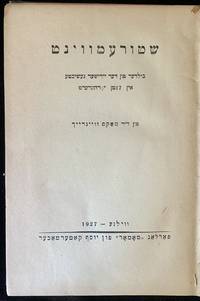
192743261Vilne: Tamar 1927. First edition. Original boards. 8vo 220 pages 21 cm. In Yiddish. Title translates as “Storm Winds: Images from Yiddish History in the 17th Century.â€<br> Max Weinreich’s historical work on Jews in Europe in the 17th Century focusing on the Chmelnitski pogroms.<br> “While Weinreich was first and foremost a linguist other topics he wrote about included psychology he translated Freud into Yiddish sociology economics theater studies literary history education ethnography and philosophy. He had a second career as a writer of popular articles in the Yiddish Forward frequently under the unlikely pseudonym Sore Brener. His linguistic interests included the history of linguistics orthography grammar he coauthored an early Yiddish grammar etymology and the etymological components of Yiddish dialectology stylistics and the influence of traditional Jewish culture in all its facets on the development of the Yiddish language.<br> In 1925 on the initiative of the linguist Nokhem Shtif the Yidisher Visnshaftlekher Institut Yiddish Research Institute; YIVO was founded in Berlin and began its work in Vilna; its first headquarters was located in a room in Weinreich’s apartment. Weinreich quickly became the driving force behind the new institute which was originally to have been known as an academy but Weinreich insisted on institute. Although YIVO may not have been Weinreich’s brainchild it was his child in every other way even after it acquired its own building on Wiwulski Street in Vilna.†<br> SUBJECTS: Jews -- Poland -- History -- Persecutions. Chmelnicki massacres. Blood accusation -- Lithuania -- Vilnius. Blood accusation. Jews -- Persecutions. History. OCLC: 649090568. OCLC lists 8 copies worldwide AJHS SUNY- Albany YIVO AJU Stanford Harvard NYBC Penn<br> Spine separation and some markings but text block is in good condition. Good Condition. Important and somewhat scarce. YID-48-62-BX'L-’emccgg. Vilne: Tamar unknown
1st Edition. Original printed paper wrappers, 12mo [1], 15 [2] pages. In French and Yiddish. Issued by the Association Philanthropique de l'Asile de Nuit, Asile de Jour et de la Crèche Israélites. With extracts from the Rapport Moral de l'Oeuvre des Asiles, de Jour, de Nuit et de la Crèche Israélites de Paris (April, 1931). As more and more Jews fled, in successive waves, from the pogroms of Eastern Europe, many sought to take refuge in France. The "Asile Israélite philanthropic society was founded to provide temporary lodging for refugees who were passing through Paris. OCLC lists only 1 copy worldwide (NLI). Rare. Very Good Condition (K-1-1)
Original Wraps. 8vo. 316; 120; 125 pages. 22 cm. First edition. In Yiddish. Contents also in Ukrainian. First three issues (complete run? ) of Der Shtern (The Star) , published Kiev 1947-1948; literary almanac (poetry, short stories, criticism, music) of the Yiddish section of the Soviet Writers Union of the Ukraine; contains contributions from Itsik Fefer, David Hofshteyn, Avrom Kahan, Arn Kushnirov, Hershl Polianker and many others. Subjects: Yiddish literature - Ukraine - Periodicals. Jews - Ukraine - Literary collections. Jews. Yiddish literature. Literary collections. Periodicals. OCLC lists 11 copies. Scarce. Wraps aged, worn, and bumped. Pages aged but not brittle. Good - condition. (YID-22-44)
No Date [ ca1920s?]. 1st edition. Original Printed paper wrappers, 12mo, 31, [1] pages 151:115 mm. In Yiddish and English. A study guide for Jews wanting to become naturalized U.S. citizens. Includes questions and answers that might appear in the test taken in order to get an American citizenship, such as: "How many stars are there on a quarter or nickel, "How does a bill become a law?" "What is a bigamist?," "Who was the first president?," "What are the colors of the American flag?," etc. The questions and answers are in English, with translations into Yiddish. SUBJECT(S): Citizenship -- United States. Emigration and immigration law -- Jews -- Migrations. -- Handbooks, manuals, etc. OCLC: 928739570. OCLC lists 3 copies worldwide (NLI, Cleveland Public, Balch), none at any Ivy League nor American Jewish Institution. Paper toning at edges, with a bit of edgewear to outer margins of front cover. Otherwise Very Good Condition. Scarce. (YID-42-24-'lx)
19262310310184xbvkBerlin, 1926 [Druck: Leipzig, Offizin W. Drugulin, 1925/1926]. XVI, 97 Seiten / (58) Blätter, alles auf kräftigem tlw. unbeschnittenem Papier. - Dunkelblauer kräftiger Original-Pappeinband mit goldgeprägtem Deckelsignet; 4to.(ca. 26 x 20 x 2 cm; ca. 1 kg.).
a61093London 1904-1905. 45 issues of thisYiddish anarchist weekly bound in one volume. 4to. about 370pp. hardcover with new paper spine. Good corners of the binding are worn. The leaves are browned and a bit fragile. Issues 46 47 and 48 are chipped at the top corner with some loss of text all other issues are intact. Very scarce. hardcover