Judge, Edward H.MareMagnum

658 résultats
Publishers cloth. 8vo. X, 186 pages. 24 cm. First edition. In February of 1903, in a small town in the southwestern part of the Russian empire, a peasant stumbled upon the corpse of 14-year-old Mikhail Rybachenko, bruised and covered with stab wounds, in a garden. The murder immediately fueled wild rumors that he had been killed by local Jews in need of his Christian blood to prepare their matzah bread. Panic rumors, grounded in sinister superstitions of Jewish sorcery and ritual murder, quickly spread to nearby towns. By April, they had hit Kishinev - a growing metropolis of 100, 000 inhabitants rife with the unrest of rapid expansion, ethnic rivalry, revolutionary agitation, and anti-Semitism - with full force. The resulting massacre left dozens dead, and hundreds wounded, maimed, widowed, orphaned, or homeless. This is the story of Kishinev. In this extensively researched book, Edward Judge examines these anti-Jewish riots, detailing their background, cause, and aftermath. He traces the evolution of the riots, analyzing the broader impact of imperial policies, urbanization, nationalism, population growth, and revolutionary activism upon the Jewish situation in Russia. Recounting the activities and attitudes of anti-Semitic agitators and Kishinev officials, the book examines the spiral of violence, the inaction of the authorities in the wake of the pogrom, the storm of indignation that followed the pogrom, and the efforts of tsarist officials to counter subsequent negative publicity. Easter in Kishinev also portrays the investigation of the disorders and the trials of the rioters and carefully considers the question of government responsibility for the outbreak of the pogrom. (Publishers Description) Subjects: Jews - Persecutions - Moldova - Chisinau. Massacres - Moldova - Chisinau - History - 20th century. Antisemitism - Moldova - Chisinau - History - 20th century. Kishinev Massacre, Chisinau, Moldova, 1903. Antisemitisme. Pogrom Geschichte 1903 Chisinau (Moldova) - Ethnic relations. Very good condition. (EE-5-16)
Mm 120x220 Collana "Piccola enciclopedia". Volume nella sua brossura originale con alette, 119 pagine con un ricco corredo di illustrazioni in nero e a colori nel testo e fuori testo. Opera in ottime condizioni. Spedizione in 24 ore dalla conferma dell'ordine.
FONDO DI MAGAZZINO SEGNI DEL TEMPO, UNA LEGGERISSIMA PIEGA AL RETROCOPERTINA, MA IL VOLUME è INTONSO, MAI SFOGLIATO. ANCORA PRESENTE LA FASCETTA PUBBLICITARIA: NUOVA EDIZIONE. Il volgere del nuovo secolo, il passaggio delle generazioni, la difficile elaborazione del lutto della Shoah, insieme alle domande che nascono dalla crisi mediorientale, ci portano ad interrogarci sulle radici europee dell'identità ebraica. Questo libro racconta sei secoli di storia degli ebrei in Europa, dal Trecento fino alle soglie del Novecento: una storia che è quella degli ebrei dell'Occidente cristiano, delle condizioni della loro esistenza, dei rapporti con la cultura esterna, di esilio e migrazioni, chiusura nei ghetti e vitalità sociale e culturale.
Original Wraps. 4to. 49 pages. 26 cm. First edition. In German and Hebrew. 'The Struggle for Truth; Max Brod on his 65th Birthday. ' With two illustrations. Contains contributions from Martin Buber, Felix Weltsch, Schalom Ben-Chorin, Mayer Ebner, Erwin Pollak, and others. Contains several biographies of Brod written by his associates, with a chronology of his life. Max Brod (18841968) , Czech-born German author, composer, and representative member of the 'Prague Circle' (Prager Kreis) . -2008 EJ. Subjects: Brod, Max, 1884-1968. Bibliographie. Wraps chipped, aged, fragile. Internally clean and fresh. Good - condition. (GER-43-57)
280x205mm. 230+37 pages. Gilt hard water damaged cover. Cover and spine both torn at edges and corners. Pages yellowing wrinkled (water damaged) and partly stained. If fair condition. With B/W photos. 1.3 Kg
8vo; aprox. 400 pages; 22 cm. Complete in 2 volumes, bound together. Many photos. In the original Hebrew. Those who never yielded: the History of the Chassidic Rebel Movement in the Ghettoes of German-Occupied Poland. Subjects: Jews--Persecutions--Poland. Hasidim--Poland. Holocaust, Jewish (1939-1945) --Poland. World War, 1939-1945--Jewish resistance--Poland. Poland--Ethnic relations. Very Good Condition in Very Good Jacket. (H-41-22)
16.5x11.5 cm. 96 pages. Pages are yellowing and age stained. Else in good condition.
22.5x16 cm. 7+364+759 pages. Gilt hardcover. Front cover slightly rubbed. Spine slightly loose. Pen writing on front inner cover. Else in good condition. PLEASE NOTE: This item is overweight. We may ask for extra shipping costs.
SERIES: Hippocrene Practical Dictionary Book
IN YIDDISH. 230X155 mm. 448 pages. Hardcover with dust-jacket. Jacket yellowing. Jacket edges slightly torn. Cover corners and edges slightly bumped. Spine edges slightly bumped. Stamp on inner cover. Pen inscription on first whitepage. Pages slightly yellowing. Else in good condition.
N°141, 35è année, de septembre 1957, de la revue mensuelle "Europe". Au sommaire, dossier sur l'historien d'art Elie Faure (1873-1937); suivi d'un article sur la littérature yiddisch avec traductions de 3 poèmes de Dora TEITELBOIM et de 2 nouvelles d'E. KAGANOWSKI, d'un article sur l'auteur dramatique Louis-Benoît Picard (1769-1828) avec extraits de ses pièces, d'une nouvelle de Luc MONAY, de lettres de 1916 de Jean-Richard BLOCH, et des chroniques habituelles d'actualité. Français
195715099Paris, Les Editeurs français réunis, 1957 1 volume In-8° (13,5 x 21,3 cm) Broché sous couverture au 1er plat orné d'une grande photo. 175p. Bon état.
First edition. Original paper wrappers. 8vo, 112 pages. 23 cm. In Yiddish. Title translates to "Twenty One and One: About Twenty-One Yiddish Actors Murdered by the Nazis in Vilna, 1941-1942." Preface by A. Morewski and Leiser Ran. Subjects: Jewish actors -- Biography. Jews -- Persecutions -- Lithuania -- Vilnius. Yiddish drama. Holocaust, Jewish (1939-1945) -- Lithuania -- Vilnius. Jewish actors. Jews -- Persecutions. Yiddish drama. OCLC lists 23 copies worldwide. Spine is starting. Light soiling to cover. Internally very clean. Overall good condition. (YID-23-6)
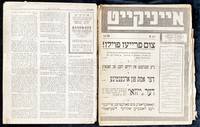
194542269New York Der Komitet 1945. Paperback. 1st edition. Paper Wrappers Folio Road Atlas size 35 cm 32 pages. "Unity." <br> Yiddish Communist bimonthly from May 1944-Jan 15 1945 then monthly through 1947 for writers artists and scientists a periodical certainly read by many of those swept up in the Atom Spy witchhunts 10 years later. <br> "Aroysgegebn fun Komitet fun Yidishe shrayber kinstler un visnshaftler in Amerike." Preceded by periodical of the same name also published in New York in 1942. Important issues from the early post war period. <br> <br> SUBJECTS : Jewish communists -- United States -- Periodicals. <br> <br> January issue missing front cover which is pages 1-2; February issue has detached covers but complete. Good strong white paper. Good Condition Thus B Y-37D. New York, Der Komitet paperback
New York, Der Komitet, 1946-47. Paper Wrappers, Folio (Road Atlas size, 35 cm) , 32 pages. "Unity. " Yiddish Communist bimonthly (from May 1944-Jan 15 1945) , then monthly (through 1947) for writers, artists, and scientists, a periodical certainly read by many of those swept up in the Atom Spy witchhunts 10 years later. "Aroysgegebn fun Komitet fun Yidishe shrayber, kinstler un visnshaftler in Amerike. " Preceeded by periodical of the same name, also published in New York, in 1942.SUBJECT(S) : Jewish communists -- United States -- Periodicals. OCLC lists 3 holdings worldwide (LOC, UCLA, Columbia) . Bound in blank paper wrappers. Cover on 1945 has detached, with a bit of edgewear to the first and last pages; All printed on good paper, so condition remains Good+ Solid. Important volumes straddling the end of the war and the early post war period. (Y-37B) . Price per each issue.
New York, Der Komitet, 1943. Paper Wrappers, Large 4to (Life Magazine size) , 28 pages. "Unity. " Short-lived (1942-43 only) Yiddish Communist monthly for writers, artists, and scientists, a periodical certainly read by many of those swept up in the Atom Spy witchhunts 10 years later. "Aroysgegebn fun Komitet fun Yidishe shrayber, kinstler un visnshaftler in Amerike. " Succeeded by periodical of the same name, also published in New York, in 1944. SUBJECT(S) : Jewish communists -- United States -- Periodicals. OCLC lists 2 holdings worldwide (LOC & NYPL) . Very Good Condition. (Y-38)
Nyu York : Forshung-Instiut baym Yidishn Arbeyer-komitet, 1947-1952. Glossy Paper wrappers, 4to, 12 pages per issue. Monthly. "Facts and Opinions. " Published by the research committee of the Jewish Labor Committee. We located only 1 holding of this periodical (Harvard-partial run) , and none others on OCLC. OCLC does list a later (1971 on) periodical of a similar name, with one holding worldwide (NYPL) . SUBJECT(S) : Jewish labor unions -- Periodicals. Labor movement -- United States -- Periodicals. Jews -- New York (State) -- New York -- Periodicals. Very Good Condition. Price is per issue(Y-5A)
Vols: 1945 (Nrs. 1-12, Running Nrs. 38-49); 1946 (Nrs. 1-12, Running Nrs. 50-61, not bound); 1947 (Nrs. 1-12, Running Nrs. 62-73), 1948 (Nrs. 1-12, Running Nrs. 74-85); 1951 (Nrs. 1-12, Running Nrs. 109-120); 1952 (Nrs. 1-12, Running Nrs. 121-132); 1953 (Nrs. 1-12, Running Nrs. 133-144); Nyu York : Forshung-Instiut baym Yidishn Arbeyer-komitet, 1947. Cloth, 4to, 12 pages per issue. Monthly. "Facts and Opinions. " Published by the research committee of the Jewish Labor Committee. Postwar period volume. We located only 1 holding of this periodical (Harvard-partial run) , and none others on OCLC. OCLC does list a later (1971 on) periodical of a similar name, with one holding worldwide (NYPL) . SUBJECT(S) : Jewish labor unions -- Periodicals. Labor movement -- United States -- Periodicals. Jews -- New York (State) -- New York -- Periodicals. Very Good Condition. (Y-5B) Price per annual.
IN YIDDISH AND HEBREW. RARE Yizkor book (memorial book) commemorating the Jewish community of Falenica annihilated in the Holocaust. Falenica is a part of Wawer, one of districts of Warsaw on the right bank of the Vistula, in the far southeastern corner of the city (until 1951 a separate village, afterwards became part of Warsaw). Falenica is located along the main rail line, which connects Warsaw with Lublin. During World War II the Germans opened a Jewish ghetto there, called Falenica-Miedzeszyn Ghetto. All of its inhabitants were transported to Treblinka in August 1942. Contains many b&w photographs. 280x220mm. 478 pages. Black cloth Hardcover with gilt front cover and spine. Cover dirty and slightly scratched. Front cover upper corner and spine edges bumped. Rear endpaper upper edge/corner slightly peeling. Rear whitepage bottom corner creased/wrinkled. Pages slightly yellowing. [SUMMARY]: This extremely rare Yizkor book commemorating the exterminated Jewish community of Falenica is in good condition. PLEASE NOTE: This item is overweight. We may ask for extra shipping costs.
Traduzione: Fonzi Bruno dall'inglese . Edizione: Seconda edizione . Pagine: 872 . Illustrazioni: Sovracoperta di Massimo Santambrogio e alberi genealogici alle prime pagine . Formato: 16° . Rilegatura: Cartonato avorio con sovracoperta originale . Stato: Buono . Caratteristiche: Bruniture . Collana: La gaja scienza n°28 .
1st edition. Original dramatic constructivist paper covers 8vo, 135 pages ; 22 cm. In Yiddish. Title also in Russian on copyright page: Dlia stseny. SUBJECT (S) Yiddish literature. OCLC lists 3 copies worldwide (LOC, UMaryland, NLI) . Ex-library, but only with bookplate to later boards and faint blindstamp on non-illustarted title page. 1 inch closed tear to illustrated cover, one corner repaired, lacks spine. Paper browning with dampstaining throughout, but staining is not obtrusive on the illustrated cover. Lacks backstrip, otherwise Good Condition thus. (YID-26-10)
Original illustrated cover wrappers with distinctive modernist typeface and design. Chidlrens literature. Printed on quality glossy paper. Includes 6 illustrations by Gudelman and photo of author. Aron Gudelman (1890 - 1978) was a sculptor, illustrator, etcher, lecturer, and teacher. Born in Russia, he immigrated to New York in 1905 at the time of pogroms in Russia. After attending the Cooper Union and the National Academy of Design, in 1914 he studied with Jean-Antoine Injalbert at the Ecole des Beaux-Arts in Paris. Supporting himself as a machinist in the 1920s, Goodelman became a communist. His concerns about social and economic conditions were expressed in his art. He participated in exhibitions at the John Reed Club in the early 1930s. After World War II, Goodelman created artworks related to the Holocaust. He taught at City College of New York in the 1960s (National Museum of American Art, 1996) . Blue cover Variant. Shul Pinkas Chcago Nr. 203 . Light wear to cover, Very Good Condition, (Yid-24-7)
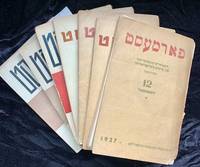
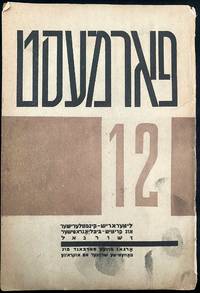
193743101Kharkov: Ukrmelukhenatsmindfarlag 1937. First edition. Original illustrated paper wrappers 8vo issues range from 129-196 pages each. Includes illustrations. 21-23 cm. In Yiddish. Title translates roughly as “Challenge: A Literary Artistic and Critical Bibliographical Journal.â€<br> At the time the only Yiddish literary periodical in Ukraine.<br> Farmest 1933–1937 was a monthly Yiddish literary magazine published in Kharkhiv Ukraine by the Ukrainian Committee for Soviet Writers. “Edited by the poet Itsik Fefer 1900–1952 it was continued in Sovetishe literatur: Literarish-kinstlerisher un kritish-bibliografisher zhurnal Soviet Literature: Literary-Artistic and Critical-Bibliographical Journal; 1938–1941.<br> In 1927 Fefer was a founding member of the Jewish Section of the All-Ukrainian Union of Proletarian Writers and from 1928 one of the editors of its Kharkov-based journal Prolit Proletarian Literature. He also coedited the nonproletarian Kharkov journal Di royte velt The Red World from 1929. From 1933 to 1937 he edited the Kiev periodical Farmest Challenge; known as Sovetishe literatur Soviet Literature between 1938 and 1941 which replaced Prolit and Di royte velt and was thereafter the only Yiddish literary periodical in Ukraine.†YIVO. Avrom Gontar was also involved in the collective and editorial committee. <br> The editor Itsik Fefer 1900–1952 “began writing poems in 1918 and in 1922 joined Vidervuks New Growth in Kiev a group of young Yiddish literati whose mentor was Dovid Hofshteyn. That same year the appearance of Fefer’s small collection Shpener Splinters established him as a rising literary star. His poetry amalgamated the Kultur-lige poets’ revolutionary romanticism with the propagandist objectives of the workers’ movement.<br> Fefer was known for his literary credo of proste reyd simple speech a concept he formulated in 1922. In the early 1920s poetry particularly avant-garde poetry swamped the literary pages of Soviet Yiddish periodicals. This phenomenon worried editors and critics who were wary of the fact that Yiddish readers usually could not identify with this style of literature. All Yiddish readers by contrast could understand Fefer’s proste reyd.<br> In 1927 Fefer was a founding member of the Jewish Section of the All-Ukrainian Union of Proletarian Writers and from 1928 one of the editors of its Kharkov-based journal Prolit Proletarian Literature. He also coedited the nonproletarian Kharkov journal Di royte velt The Red World from 1929†Gennady Estraikh.<br> For more see: Gennady Estraikh “The Kharkiv Yiddish Literary World 1920s–Mid-1930s†East European Jewish Affairs 32.2 2002: 70–88; Chone Shmeruk “Yiddish Literature in the U.S.S.R.†in The Jews in Soviet Russia since 1917 ed. Lionel Kochan pp. 242–280 London and New York 1970.<br> SUBJECTS: Yiddish literature -- Ukraine -- Periodicals. Yiddish literature. OCLC: 35051038.<br> Some pages brittle some wear to spines. Overall Good Condition. Rare. YID-46-2-LGG-’excc. Kharkov: Ukrmelukhenatsmindfarlag unknown
193543308Kharkov: Ukrmelukhenatsmindfarlag 1935. First edition. Original illustrated paper wrappers 8vo 156 pages.Includes illustrations. 21-23 cm. In Yiddish. Title translates roughly as “Challenge: A Literary Artistic and Critical Bibliographical Journal.â€<br> At the time the only Yiddish literary periodical in Ukraine.<br> Farmest 1933–1937 was a monthly Yiddish literary magazine published in Kharkhiv Ukraine by the Ukrainian Committee for Soviet Writers.<br> “Edited by the poet Itsik Fefer 1900–1952 it was continued in Sovetishe literatur: Literarish-kinstlerisher un kritish-bibliografisher zhurnal Soviet Literature: Literary-Artistic and Critical-Bibliographical Journal; 1938–1941.<br> In 1927 Fefer was a founding member of the Jewish Section of the All-Ukrainian Union of Proletarian Writers and from 1928 one of the editors of its Kharkov-based journal Prolit Proletarian Literature. He also coedited the nonproletarian Kharkov journal Di royte velt The Red World from 1929. From 1933 to 1937 he edited the Kiev periodical Farmest Challenge; known as Sovetishe literatur Soviet Literature between 1938 and 1941 which replaced Prolit and Di royte velt and was thereafter the only Yiddish literary periodical in Ukraine.†YIVO. Avrom Gontar was also involved in the collective and editorial committee. <br> The editor Itsik Fefer 1900–1952 “began writing poems in 1918 and in 1922 joined Vidervuks New Growth in Kiev a group of young Yiddish literati whose mentor was Dovid Hofshteyn. That same year the appearance of Fefer’s small collection Shpener Splinters established him as a rising literary star. His poetry amalgamated the Kultur-lige poets’ revolutionary romanticism with the propagandist objectives of the workers’ movement.<br> Fefer was known for his literary credo of proste reyd simple speech a concept he formulated in 1922. In the early 1920s poetry particularly avant-garde poetry swamped the literary pages of Soviet Yiddish periodicals. This phenomenon worried editors and critics who were wary of the fact that Yiddish readers usually could not identify with this style of literature. All Yiddish readers by contrast could understand Fefer’s proste reyd.<br> In 1927 Fefer was a founding member of the Jewish Section of the All-Ukrainian Union of Proletarian Writers and from 1928 one of the editors of its Kharkov-based journal Prolit Proletarian Literature. He also coedited the nonproletarian Kharkov journal Di royte velt The Red World from 1929†Gennady Estraikh.<br> For more see: Gennady Estraikh “The Kharkiv Yiddish Literary World 1920s–Mid-1930s†East European Jewish Affairs 32.2 2002: 70–88; Chone Shmeruk “Yiddish Literature in the U.S.S.R.†in The Jews in Soviet Russia since 1917 ed. Lionel Kochan pp. 242–280 London and New York 1970.<br> SUBJECTS: Yiddish literature -- Ukraine -- Periodicals. Yiddish literature. OCLC: 35051038.<br> Pages toning as expected some sunning and stains to cover Good Condition. BYID-46-2A-LGG-’excc. Kharkov: Ukrmelukhenatsmindfarlag unknown
Original Cloth. 16mo. 180 pages. 15 cm. First edition. Inscribed by Peretz Hirschbien, Colorado, 1918; . In Yiddish. On the Morningstar, a work of drama composed by poems by Peretz Hirshbeyn (18801948) , the acclaimed playwright, novelist, journalist, travel writer, and theater director. OCLC lists 20 copies. Subjects: Yiddish Literature. Hinges starting, light stain to back page, otherwise fresh and clean. Good condition. (YID-18-5)