658 résultats
1st edition. Original wrappers. 8vo. 68 pages, 24 cm. In Yiddish. Title translates to Practical Guide and Information on Erets Israel. Nazi-era tips for newly arrived Yiddish speakers in Palestine. SUBJECTS: Palestine -- Guidebooks. Middle East -- Palestine. OCLC lists 5 copies worldwide (YIVO, Harvard, NYBC, JHU, HUC) (OCLC: 19312759) . Ex-library with usual markings. Original wrappers bound in to later library cardboard protector. Some damp stains. Light soiling to wrappers. Dog ears in bottom left margin. (YID-41-61)
Original Cloth. 8vo. XIII, 159; 546 pages. 24 cm. First edition; first appearance. In German. First volume (in two books) of the monumental The Prussian State and the Jews by Selma Stern. Teil I. Die Zeit des Grossen Kurfürsten und Friedrichs I. 1. Abt. Darstellung. 2. Abt. Akten. Akademie für die Wissenschaft des Judentums. Historische Sektion. Veröffentlichungen. Bd. 3. The voluminous publication is both an analysis and a source edition of the policy of the Prussian rulers towards the Jews from 1640 to 1786, covering the times from the Great Elector up to Frederick the Great. It is a social and economic history of the era leading up to the emancipation and assimilation of Prussia's Jewry. In it Stern emphasizes the relationship between the Prussian state and the Jewish minority. Highlighting the active role and interest of the Absolutist state (and its officialdom) in a gradual juridification of the status of the Jews, Sterns research offered, in the 1920s, a new perspective on Jewish emancipation. Her argument went beyond previous scholarly views on the subject, which had conceptualized Prussian-Jewish emancipation mainly as an outcome of the Enlightenment. Although dealing with early modern Prussian-Jewish history, Stern's research interest was clearly informed by contemporary concerns. - LBI Yearbook 2013. Selma Stern-Taeubler (18901981) , German historian. Selma Stern-Taeubler, born in Kippenheim (Baden) , was the first girl to attend the Gymnasium in Baden-Baden. She then studied history and languages at the universities of Heidelberg and Munich, graduating in 1913. She specialized at first in general German history, but became interested in the history of German Jewry. In 1919 she was appointed a research fellow at the Akademie fuer die Wissenschaft des Judentums in Berlin at the invitation of its founder and director, the historian Eugen Taeubler , whom she married in 1927. Her special field was compiling source material on the relationship between the Prussian state and its Jews from 1648 to 1812. Her scholarly publications were based on the premise that Judaism had to be studied in the context of the political and cultural environment. The first two volumes of her chief work, Der preussische Staat und die Juden, were published in 1925, and a third volume followed in 1938, but almost the entire edition was destroyed by the Nazis. - EJ 2008. She returned to her work on the Preussische Staat later in life, and published a total of four volumes (in eight books) between 1962 and 1971, under the auspices of the LBI. Subjects: Jews - Germany - Prussia. Jews. Juden. Deutschland. Preußen. Germany - Prussia. Light soiling to cloth, otherwise clean and fresh. Very good + condition. (GER-43-55)
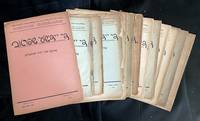
Original Wraps. 8vo. 316; 120; 125 pages. 22 cm. First edition. In Yiddish. Contents also in Ukrainian. First three issues (complete run? ) of Der Shtern (The Star) , published Kiev 1947-1948; literary almanac (poetry, short stories, criticism, music) of the Yiddish section of the Soviet Writers Union of the Ukraine; contains contributions from Itsik Fefer, David Hofshteyn, Avrom Kahan, Arn Kushnirov, Hershl Polianker and many others. Subjects: Yiddish literature - Ukraine - Periodicals. Jews - Ukraine - Literary collections. Jews. Yiddish literature. Literary collections. Periodicals. OCLC lists 11 copies. Scarce. Wraps aged, worn, and bumped. Pages aged but not brittle. Good - condition. (YID-22-44)
Original Wraps. 12mo. 38, [4] pages. 18 cm. First edition. In Yiddish. English title: The Gaon of Wilna; Biography by P. Wiernik. A biography of Elijah Ben Solomon (also called Elijah Wilna, Elijah Gaon, and Der Wilner Gaon) the famous Lithuanian Talmudist, cabalist, grammarian, and mathematician; born at Wilna April 23, 1720; died there Oct. 9, 1797. Written by the American Yiddish Journalist Peter Wiernik, "editor for New York's most important Yiddish daily, the Jewish Morning Journal. His editorials, possessed of intelligence, good taste and tolerance, advocated a fusion of modern Orthodoxy and Americanism, and evinced a coolness to political Zionism and hostility to socialism. " (Joseph Hirsch, EJ) Subjects: Elijah ben Solomon, Gaon of Wilna, 1720-1798. OCLC lists 8 copies. Light soiling to cover, otherwise clean and fresh. Very good + condition. (YID-18-13)
Later boards. 16mo. 32 pages. 14 cm. First edition. In Yiddish. A collection of 243 Yiddish proverbs; compiled by the famous Yiddish folklorist Yehuda Leib Cahan (1881-1937) . Subjects: Proverbs, Yiddish. Folklore. OCLC lists 17 copies. Lightly soiled first few pages, otherwise fresh. Very good condition. (YID-18-14)
1st Edition. Original paper wrappers bound into period cloth, 4to, 6-16 pages per issue. In Yiddish. Includes some cartoons and other illustrations, including one we noticed by William Gropper. Der Yunion Arbayter (The Union Worker) lasted 2 volumes, running weekly until 1927. The first volume, complete, is here. A.L.G.V.Y / I.L.G.V.Y. stands for the Yiddish name for the heavily Yiddish speaking International Ladies Garment Workers Union; this newspaper was published by an Anarchist section within the union. Yiddish-speaking Jewish anarchists were one of the pillars of the U.S. anarchist movement before World War II. This largely immigrant radical milieu was centered in New York City and opposed capitalism, the state, and organized religion. Yiddish-speaking anarchists built militant unions, anarchist newspapers, and other organizations to further their cause. Many famous anarchists were linked to this movement, including Johann Most, Emma Goldman, Alexander Berkman, and Rudolf Rocker. Yiddish-speaking anarchists played a pivotal role in unions like the International Ladies Garment Workers Union (ILGWU), while the Yiddish anarchist newspaper the Fraye Arbeter Shtime (The Free Voice of Labor) was the largest and longest-lasting U.S. anarchist publication and formed a significant part of the Yiddish cultural landscape. In the 1930s a second generation of bilingual Jewish anarchists emerged, including Sam and Esther Dolgoff, and Audrey Goodfriend, whose influence is still felt in todays anarchist movement.Despite the importance of Yiddish anarchism to the histories of both the U.S. Left and the Jewish community, it has been largely forgotten and written out of historical scholarship (YIVO). Cited in Paul Avrichs Anarchist Portraits (Princeton, 1988) pp 192 & 196. Listed in John Pattens Yiddish Anarchist Bibliography - Periodicals (https://www.katesharpleylibrary.net/w9gk09). SUBJECT(S): Jewish anarchists. OCLC 10218086. OCLC lists 3 holdings worldwide LOC, YIVO, NYU), with NYU holding only this one volume and the Union List of Serials suggesting that the run may have "Ceased with Sept. 26, 1927 issue?" Rear hinge starting. Three issues printed on lower quality paper have darkened, but without any edgewear or breakage. The other 49 issues, printed on quality paper and well protected, remain bright white. All issues clear and very well preserved. Very Good Condition. An outstanding complete volume of a very rare and important Yiddish Anarchist periodical. (YID-42-20)
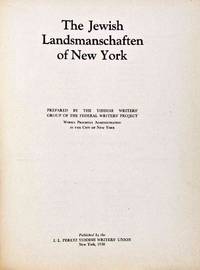
193842985Nyu York New York: Aroysgegeben fun Y.L. Perets shrayber fareyn 1938. First edition. Original printed leather binding 4to 397 3 pages. Includes illustrations and facsimiles. 29 cm. In Yiddish. Title translates as “The Jewish Mutual Aid Societies of New York.â€<br> Research project led by the Works Progress Administration which contains articles about the history and activities of Jewish mutual aid societies in New York. Contains reviews of landmanshaft publications as well as a directory of all landsmanshaftn in the New York. <br> “Landsmanshaftn are societies formed by Jewish immigrants from the same villages towns and cities in Central and Eastern Europe. The landsmanshaft became a dominant form of Jewish social organization in the late 1800s. The many types of landsmanshaftn include religious and socialist organizations as well as American-style fraternal orders. Landsmanshaftn provided immigrants with formal and informal social networks and members helped one another with financial needs such as medical care and burial plots. In 1938 a Federal Works Progress Administration WPA project identified 2468 landsmanshaftn in New York City. The number of landsmanshaftn began to decline in the 1950s though some societies continue to exist today.†Center for Jewish History<br> SUBJECTS: Jews -- New York State -- New York. Fraternal organizations -- New York State -- New York. Jews. OCLC: 1018012020.<br> Wear to spine and inside hinges Good Condition. YIZ-23-32S-CCLEX. Nyu York [New York]: Aroysgegeben fun Y.L. Perets shrayber fareyn unknown
193843069Nyu York New York: Aroysgegeben fun Y.L. Perets shrayber fareyn 1938. First edition. Original printed leather binding 4to 397 3 pages. Includes illustrations and facsimiles. 29 cm. In Yiddish. Title translates as “The Jewish Mutual Aid Societies of New York.â€<br> Research project led by the Works Progress Administration which contains articles about the history and activities of Jewish mutual aid societies in New York. Contains reviews of landmanshaft publications as well as a directory of all landsmanshaftn in the New York. <br> “Landsmanshaftn are societies formed by Jewish immigrants from the same villages towns and cities in Central and Eastern Europe. The landsmanshaft became a dominant form of Jewish social organization in the late 1800s. The many types of landsmanshaftn include religious and socialist organizations as well as American-style fraternal orders. Landsmanshaftn provided immigrants with formal and informal social networks and members helped one another with financial needs such as medical care and burial plots. In 1938 a Federal Works Progress Administration WPA project identified 2468 landsmanshaftn in New York City. The number of landsmanshaftn began to decline in the 1950s though some societies continue to exist today.†Center for Jewish History<br> SUBJECTS: Jews -- New York State -- New York. Fraternal organizations -- New York State -- New York. Jews. OCLC: 1018012020.<br> Slight wear on spine. Good Condition. YIZ-23-32S-CCLEX. Nyu York [New York]: Aroysgegeben fun Y.L. Perets shrayber fareyn unknown
1st edition. Original boards. 8vo. 32, 32, 64 pages. 24 cm. In Yiddish with some English. Title translates to The Jewish Workers Voice. Published by one of the two Jewish organizations making up the Farband. The NJWA was founded in 1912 as a Jewish mutual aid program. Its official organ was the Yidishe Kempfer or Jewish Fighter, edited by Baruch Zuckerman (Wikipedia, 2018) . SUBJECTS: Periodicals - Socialism. OCLC lists 6 copies worldwide (OCLC: 36938329) . Light wear to boards. Binding is starting. Contents very good. Original wrappers are bound in. Overall Very Good Condition. (YID-41-12)
1st edition. Original boards. 8vo. 32 pages each. 24 cm. In Yiddish with some English. Title translates to The Jewish Workers Voice. Published by one of the two Jewish organizations making up the Farband. The NJWA was founded in 1912 as a Jewish mutual aid program. Its official organ was the Yidishe Kempfer or Jewish Fighter, edited by Baruch Zuckerman (Wikipedia, 2018) . SUBJECTS: Periodicals - Socialism. OCLC lists 6 copies worldwide (OCLC: 36938329) . Light wear to boards. Contents very good. Overall Very Good Condition. (YID-41-10)
1st edition. Original paper wrappers. 8vo. 181 pages, 21 cm. Includes portraits. In Yiddish with some Spanish. Title translates to The Last Era in the Life of Isaac Manger. Written by Solomon Kazdan (18831979) , the prominent Jewish educator from Ukraine who later moved to the US. "Mayn arbet ... Iz in tokh a tsveyter tayl fun mayn frierdikn bukh 'Itsik Manger'"--Page 9. SUBJECTS: Authors, Yiddish -- Biography. Very Good Condition. (YID-41-23-F)
1st Yiddish Edition. Original illustrated photographic paper wrappers. 8vo. 46 pages, 22 cm. In Yiddish. Holocaust stageplay. Title translates to The Medem Sanitorium. Translated into Yiddish by Mosheh Lokiec. Zygmunt Turkow (18961970) was a Polish actor, director, playwright and director of Jewish origin from Warsaw, who became famous for roles in the pre-war Jewish films and stage plays in Yiddish. His brother, Jonas Turkow, was also a noted actor and stage manager. Shortly after German invasion of Poland in 1939 he left Poland together with his second wife. In 1940 he settled in Brazil. In 1952 he moved to Israel (Wikipedia, 2019). SUBJECTS: Holocaust, Jewish (1939-1945) -- Drama. OCLC 122833421, OCLC lists 6 copies worldwide (NYPL, YIVO, UIllinois, NYBC, Toronto, McGill). Crease through enter of pamphlet. Otherwise very good condition. Scarce. (YID-33-55-'elx)
1st edition. Original Paper Wrappers, Large 8vo, 48 pages. Monthly. Yiddish Socialist monthly which survived from May 1898 (Vol I, Nr. 1) - May 1899 (Vol II, Nr. 1) . 25 cm. From the English-language cover: "A Monthly Magazine devoted to Popular Science, Literature and Socialism, Die Neue Zeit (The New Time) . " Published by the Yiddish-Speaking Section of the Socialist Labor Party of North America. "The harsh and degrading working conditions among the immigrants in....the sweatshops of the needle trade in New York City" led many Jews "to join the radical left wing of the American socialist movement....When [Morris] Hillquit, [Meyer] London, and [Abraham] Cahan left the socialist labor party in 1898, and formed the more moderate socialist party, " others "remained loyal to the revolutionary socialist labor party [SLP]..... In 1913, during the strike of New York City men's tailors, " many in the SLP "supported the tailors against their parent organization, the United Garment Workers of America (UGWA) , which opposed the strike. As a result of the conflict with the UGWA's national officials, the tailors formed their own local organization, the Brotherhood of Tailors, and elected [Joseph] Schlossberg secretary. In 1914 Schlossberg's supporters seceded from the UGWA convention and founded the Amalgamated Clothing Workers of America (ACWA) . " (Melvyn Dubofsky in EJ) . Singerman S35. SUBJECT(S) : Jews -- Periodicals. OCLC lists 4 holdings (UCLA, LOC, NYPL, Brown) . Light wear to wrappers, Very Good Condition. (Y-10-D)
New York : Idish-shprekhende sekssianen fun der Sotsialist. Arbayter Partey fun Nord-Amerika, 1898. Paper Wrappers, Large 8vo, 48 pages. Monthly. Yiddish Socialist monthly which survived from May 1898 (Vol I, Nr. 1) - May 1899 (Vol II, Nr. 1) . 25 cm. From the English-language cover: "A Monthly Magazine devoted to Popular Science, Literature and Socialism, Die Neue Zeit (The New Time) . " Published by the Yiddish-Speaking Section of the Socialist Labor Party of North America. "The harsh and degrading working conditions among the immigrants in....the sweatshops of the needle trade in New York City" led many Jews "to join the radical left wing of the American socialist movement....When [Morris] Hillquit, [Meyer] London, and [Abraham] Cahan left the socialist labor party in 1898, and formed the more moderate socialist party, " others "remained loyal to the revolutionary socialist labor party [SLP]..... In 1913, during the strike of New York City men's tailors, " many in the SLP "supported the tailors against their parent organization, the United Garment Workers of America (UGWA) , which opposed the strike. As a result of the conflict with the UGWA's national officials, the tailors formed their own local organization, the Brotherhood of Tailors, and elected [Joseph] Schlossberg secretary. In 1914 Schlossberg's supporters seceded from the UGWA convention and founded the Amalgamated Clothing Workers of America (ACWA) . " (Melvyn Dubofsky in EJ) . Singerman S35. SUBJECT(S) : Jews -- Periodicals. OCLC lists 4 holdings (UCLA, LOC, NYPL, Brown) . Edgewear to wrappers, Very Good Condition. (Y-13-D)
1st edition. Original paper wrappers. 8vo. 142 pages, 23 cm. In Yiddish with some advertisements in English and alternate title page in English. Title translates to The New World. A quarterly journal started by Yankev Milkh for the study of American society, politics, and institutions ran only 2 issues, ending with Issue Nr 2 in January 1910. His desire was to build a journal "for the most intelligent readers, " namely Yiddish cultural nationalists (Michel, 2009). "Gevidmet dem studyum fun amerikaner leben in institutsyes. " Also listed as Neie welt; Naye Welt. Not to be confused with a like-named periodical published in Warsaw in 1910. SUBJECT(S) : Jews -- Periodicals. Manners and customs. Politics and government. Social conditions. United States -- Social life and customs -- 1865-1918 -- Periodicals.(OCLC: 36666770). Light wear, lacks bottom of spine, heavy rag paper very strong and bright, about Very Good Condition. (YID-33-51-'elx)
Original publishers cloth in dramatic modernist color illustrated dust jacket designed by Zuni Maud with illustrations on front and rear; 8vo, 243 pages. 23 cm. In Yiddish. SUBJECT (S) : Yiddish literature -- 20th century. Illustrator Zuni Maud (born 1905) was an Artist, cartoonist, puppeteer, playwright, writer and poet. [He] Studied at the Cooper Union Art School, Baron de Hirsch Art School and National Academy of Art, New York. [and] Did illustrations for *Der kibitser* and stage and costume design for productions by Maurice Schwartz in the Yiddish Art Theater. Contributed articles to Der kundes (N. Y. ) , Jewish Daily Forward (N. Y. ) , Di tsayt (N. Y. ) , Kinderland (N. Y. ) , Kinder zshurnal (N. Y. ) , Frayhayt (N. Y. ) . [He was the] Illustrator of a number of books. In 1925, together with Yosel Cutler, [he] founded the Modicot marionette theater. [He] Wrote plays, children's stories and poems (YIVO, 2018) . Author Yitzchak Rayz (1885-1943) , better known by his pen name Moyshe Nadir was an American Yiddish language writer and satirist . In 1898, at the age of 13, Rayz immigrated to New York and adopted the Americanized name Isaac Reiss. Within a few years his work was published widely in the New York Yiddish press, under a variety of pseudonyms, including Rinnalde Rinaldine, Dilensee Mirkarosh, Der Royzenkavalir, Doctor Hotzikl, and, finally, Moishe Nadir. The name Nadir is a Yiddish expression meaning here you are or that's for you, but can also mean take this and choke on it. As a teenager, he wrote for Der Groyser Kundes (The Big Prankster) and later co-edited Der Yiddisher Gazlon (The Yiddish Bandit) with Jacob Adler. He wrote for an assortment of Communist Yiddish publications including the Frayhayt (Freedom) newspaper and its successor Morgn Frayhayt (Morning Freedom) and the magazines Der Signal (The Signal) and Der Hammer (The Hammer) . When his sharp-tongued theater reviews caused him to be banned from theatrical productions, he resorted to attending plays in disguise. His own plays were performed by Maurice Schwartzs Yiddish Art Theater, Zuni Maude and Yosl Cutlers Modicut puppet theater, Artef (Arbeter Teater Faraband, Workers Theater Alliance) and the Federal Theater Project. Among his better known poems are the erotic Vilde Royzen (Wild Roses, 1915) and his 1932 Rivington Strit (Rivington Street) . After a long association with the Frayhayt and the Morgn Frayhayt, Rayz began to distance himself from the Communist cause with the onset of the show trials in the Soviet Union and publicly broke with the Morgn Frayhayt in the wake of the Molotiv-Ribbentrop Pact. He set out his reasons in Di, vos blayben mit der Morgn Frayhayt (Those who stay with the Morgn Frayhayt) in response to Morgn Frayhayt editor Moissaye Olgins Di vos gayen avek (Those who leave) . Rayz discusses his relationship to the Communist Party in his posthumous Moyde Ani (Wikipedia, 2019) . Very Good Condition in dust jacket which shows some edgewear affecting some letters on the spine. Very Good in Good Jacket. (yid-41-92)
Original Wraps. 8vo. 70 pages. 24 cm. First edition. In Yiddish. Back cover title: Die Anfange der Emigration und Kolonisation bei den Juden im XIX. Jahrhundert. The beginnings of colonization and emigration of the Jews in the nineteenth century, a detailed monograph with demographic statistics by Jakob Lestschinsky (18761966) , historian and sociologist; specialist in Jewish demography and economic history. In 1921, Lestschinsky worked in Berlin as a correspondent for the New York Yiddish daily Forverts, and continued to write for this newspaper for more than 40 years. Conducting extensive research on the economic and social history of East European Jews, he was one of the founding members of the YIVO Institute for Jewish Research and participated in the inaugural meeting of its Historical Section in Berlin on 31 October 1925. Lestschinsky edited Bleter far yidisher demografye, statistik, un ekonomik, which appeared in Berlin from 1923 until 1925. He laid the groundwork for the Economic-Statistical Section of YIVO, which he headed from its inception in 1926, and edited its publications Ekonomishe shriftn and Yidishe ekonomik. (YIVO Encyclopedia) . Subjects: Jews - Migrations. Jews - Colonization. OCLC lists 12 copies. Light soiling, light edgewear to wraps. Otherwise fresh and clean. Good + condition. (YID-18-7)
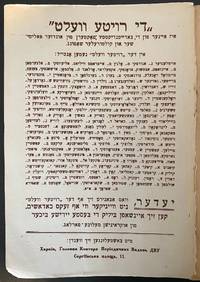
193017315Kharkov Ukraine: Ukrinishn Melukhe-Farlag 1930. 1st edition. Original Paper Wrappers lacks front wrapper 8vo 160 pages. 21 cm. In Yiddish. Di Royte Velt was a monthly Yiddish literary magazine which began publication in 1924. <br> “The Yiddish literary journal Di royte velt The Red World published in 1924-33 in Kharkiv Kharkov in Russian then the Ukrainian capital was one of the strongholds of 'anti-Litvakovism'. In general terms the story of Di royte velt represents an insightful chapter in the history of Soviet Yiddish literary life of the 1920s and 1930s.<br> In 1924 there arose the question of moving the Yiddish literary centre from Kiev to Kharkiv and of launching a Kiev-based Yiddish literary journal. This matter was discussed in a special memorandum of the Press Department of the Central Committee of the Ukrainian Communist Party. The head of the department M. Ravitsh-Cherkasky was Jewish. Motl Kiper the head of the Ukrainian Jewish Section backed this proposal arguing that Yiddish literature would benefit immensely from the capital's proletarian environment where it would liberate itself from the nationalist and Yiddishist hang-ups of Kiev.<br> In reality the Kharkiv Jewish proletariat was more acculturated than elsewhere in Ukraine: only 36 per cent of Kharkiv Region's Jewish trade unionists were Yiddish-speakers compared with 89 per cent in the Berdichev Region 55 per cent in the Kiev Region and 42 per cent in the Odessa Region.<br> It was no easy matter to create overnight a literary centre in a city which had a number of journalists but no literary lions. Moshe Taitsh for instance had been transferred to Moscow to reinforce the editorial staff of Der emes.<br> For all that the apparatchiks' initiative resulted in creating in Kharkiv a new Yiddish literary journal Di royte velt.<br> The first editors of Di royte velt were Henekh Kazakevich and M. Ravitsh-Cherkasky. While the latter was a king for a day in Yiddish literatureKazakevich was a remarkable figure in Soviet Yiddish journalism….<br> The first issue of the new journal appeared in September 1924 with a print-run of 2000. It was labelled a 'political-social literary-scientific bi-weekly journal'. Indeed the first issue contained only two literary works: a poem by Itsik Fefer and a story by Shmuel Persov. The other materials were devoted to theatre politics cosmology and literary criticism. Significantly the journal stressed its international character. <br> Among its potential contributors we find the names of the editors and writers of the New York communist Yiddish daily Frayhayt Freedom Moshe Olgin Morris Vinchevsky Shakhne Epshtein Moshe Kats and Moshe Nadir. Also it was announced that the Vilna-based Boris Kletskin publishing house was preparing for publication books by four Soviet writers listed among the journals' contributors: Arn Kushnirov Moshe Khashtshevatsky Ezra Finninberg and Nokhum Oislender†Gennady Estraikh 2002: 'The Kharkiv Yiddish literary world 1920s-mid-1930s'East European Jewish Affairs 32: 2 70 — 88; for Estraikh’s extensive discussion of the importance of Di Royte Velt see the full article at https://www.yiddishweb.com/wp-content/uploads/2018/01/Kharkiv-Yiddish_Estra ikh.pdf. <br> SUBJECTS : Yiddish literature -- Periodicals. OCLC: 10594044. <br> Lacks Yiddish cover and 1st 2 leaves. Russian cover is present. YID-47-6. Kharkov [Ukraine]: Ukrinishn Melukhe-Farlag unknown
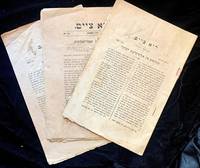
189843426New York: N.M. Shaikewitz 1898. First edition staple binding 4to 29-31 pages each issue 30 cm. In Yiddish. <br> Three issues of Di Tsayt a monthly Yiddish language publication published in New York. The journal ran from 1897-1898. Singerman S582; Freidus p. 282 Weissberger 56. <br> "Menahem Mendel Dolitzky was a Hebrew and Yiddish poet and novelist. Born in Bialystok he received a traditional Orthodox education and as a teenager became interested in the ideas of the Haskalah.He served as a Hebrew teacher in various towns and in 1881 was an eyewitness to pogroms in southern Russia which had a profound effect on him.<br> .In 1892 when the Jews were expelled from Moscow Dolitzki emigrated to New York and was warmly received by the small band of Hebrew maskilim in the U.S. He began publishing descriptions of the persecution of Jews in Russia in the journal Ha-Ivri mainly in poetic form.Despite the efforts of the Hebraists in the U.S. to assist him he found no way of making a living from Hebrew writing. After working at various jobs he finally took up writing for the daily Yiddish press turning out serialized novels which catered to the popular reader" EJ. <br> <br> SUBJECTS: Jews -- New York State -- New York -- Periodicals. Yiddish literature -- Periodicals. Jews. Yiddish literature. OCLC: 50546431. OCLC and Singerman together locate 4 complete holdings Harvard NYPL YIVO HUC and one of vol I only Yale. <br> <br> Lacks original outer paper wrappers some toning Good Condition Scarce YID-48-109. [New York: N.M. Shaikewitz] unknown
8vo. 156 pages. In Yiddish. First edition. SUBJECT (S) : Literature, Jewish. Samuel Niger was the pseudonym of Samuel Charney (1883-1955) . A Zionist influenced by Adah Ha-Am and a Russian socialist revolutionary, he joined the Zionist-Socialist Workers Party, and was repeatedly arrested and tortured by Russian authorities. Though his first literary efforts were in Russian and Hebrew, his mature work was written mostly in Yiddish. In 1908, he, with A. Veiter and S. Gorelik, founded Literarishe Monatshriften, which became very popular and influential after the Czernowitz Yiddish Conference. In 1912, after three years in Europe, he began editing DiYidishe Velt. After being imprisoned by Polish legionaires in 1919, Niger left for the United States. In New York, he worked for Der Tog, a Yiddish daily; beginning in 1920, he worked for the paper for 35 years, becoming the most revered and feared Yiddish critic of his generation. Outside of strictly literary work, Niger worked with the YIVO Institute for Jewish Research from its inception, a and helped found the Congress for Jewish Culture. (Liptzin, EJ) Edgeworn, publisher's stamp on flyleaf, good condition. (HEB-4-10)
193042139Kiev: Katedr far Yidisher Kultur ba der Ukr. Visnshaftl. Akademye Filologishe Sektsye 1930. Paper Wrappers. 1st edition. Original printed publisher’s color paper wrappers 4to large ca 72-116 columns ca 36-58 pages per issue. 28 cm. In Yiddish. Title translates roughly as “The Yiddish Language.†Succeeded in 1931 by “Afn shprakhfront.â€Di Yidishe Shprakh was a “Yiddish linguistic journal published in Kiev from 1927 to 1930. A bimonthly journal Di yidishe shprakh The Yiddish Language was published by the cooperative publishing house Kultur-lige and was the main philological publication of the Kiev Yiddish academic center. Its editor was the veteran Yiddishist Nokhem Shtif a founder of YIVO who had returned to Kiev from Germany in 1926. The journal’s inaugural issue March–April 1927 was published under the auspices of the Central Yiddish Bureau of the Ukrainian Commissariat for Education. With the next issue Di yidishe shprakh was an organ of the Chair and from July to October 1929 it was an organ of the Institute for Jewish later Proletarian Jewish Culture at the Ukrainian Academy of Sciences. Initially defined as a 'journal for practical Yiddish linguistics' from May to June 1927 it appeared as simply a 'journal for Yiddish linguistics. 'Shtif distinguished three language registers: the vernacular of the old generation partly represented in the works of Sholem Aleichem and predecessors; the highbrow language of modern writers such as Dovid Bergelson; and the contemporary 'culture language' most notably of the press. Although Shtif sought to target speakers of the mass 'culture language' the journal’s circulation hovered around 500 copies read mainly by Yiddish teachers.Apart from Shtif who published articles on various language-planning problems the most active contributors to Di yidishe shprakh were Ber Slutski Ayzik Zaretski Elye Falkovitsh Lipe Reznik and Shimen Dobin. In early 1929 Moscow literary critic Aron Gurshteyn criticized the journal for its purist approach to language planning. In the July–October 1929 issue Shtif published his article 'Di sotsyale diferentsiatsye in yidish' The Social Differentiation in Yiddish heralding an intensification of Soviet linguists’ anti-Hebraist campaign. That issue of Di yidishe shprakh adopted completely reformed Soviet spelling omitting for example final consonant letters.Although the last—twenty-fifth—issue of the journal was dated November–December 1930 it included materials from the First All-Union Yiddish Language Conference convened in Kiev from 8 to 13 February 1931 that issue is present here. Published under the imprint of the Central Publishing House this issue also signaled the demise of the remaining vestiges of the Kiev Kultur-lige. Yoysef Liberberg’s article 'Far parteyishkayt in der yidisher visnshaft-arbet' For a Party Approach to Yiddish Linguistics marked a full break with YIVO scholars particularly with YIVO director Max Weinreich whom Liberberg ridiculed for presenting Yiddish as an emanation of the Ashkenazic Jews’ soul. The Yiddish Language Conference decided to change the name of the journal. Between 1931 and 1939 it appeared sporadically under the title Afn shprakhfront On the Language Front reflecting its new more aggressive and politically charged approach' Gennady Estraikh in YIVO Encyclopedia of Jews in Eastern Europe 2010. For more see David Shneer “Yiddish and the Creation of Soviet Jewish Culture 1918–1930†Cambridge and New York 2004. SUBJECTS: Yiddish language -- Periodicals. Title also listed on covers in Russian “Ievreis'ka Mova†and German “Jiddische Sprachâ€. OCLC: 22840298. Most holdings in OCLC appear to be fragmentary. Covers are browning and fragile as expected but are otherwise very well preserved with very little edgewear. Internal text pages are also toning but remain relatively strong as pulp paper. Very important journal scarce in this degree of completeness Note that Estraikh suggests a circulation of only 500!. B YID-43-5-E. Kiev: Katedr far Yidisher Kultur ba der Ukr. Visnshaftl. Akademye, Filologishe Sektsye unknown
1938297232Peretz Yiddish Writer's Union 1938. Hardcover . Good. 397 pages in Yiddish tears to spine and side of spine covers worn stained black mark on yiddish copy right page Peretz Yiddish Writer's Union hardcover
8vo; 262 pages; 1st edition. Original publisher's cloth. 8vo, 262 pages. 24 cm. Includes added title page in English: "The Jews in the Ukraine, from the earliest times through 1648-1649." Only 2000 copies printed. Very Good Condition. (YIZ-6-7)
Rear board scuffed, otherwise Very Good Condition; 8vo; 262 pages; 24 cm. Includes added title page in English: "The Jews in the Ukraine, from the earliest times through 1648-1649." 1 of only 2000 copies printed. Good condition. (EE-3-35)
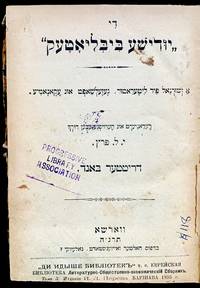
189543079Warsaw: Izdanie I.L. Perets 1895. First edition period boards 8vo 179 pages. 23 cm. In Yiddish. Title translates as “The Jewish Library: A Journal for Literature Society and Economics.â€<br> Third volume of semiannual publication edited by I.L. Peretz. Di Yudishe Bibliotek was published periodically between 1891 and 1904. This issue includes belle-lettres poetry and scientific essays.<br> “To encourage Jews toward a wider knowledge of secular subjects Peretz for several years wrote articles on physics chemistry economics and other subjects for Di yudishe bibliotek which he also edited.†Encyclopedia Britannica.<br> Yitskhok Leybush Peretz 1852-1915 is one the best known Yiddish and Hebrew authors of the 19th century. Peretz was one of the three classic Yiddish writers with S. Y. Abramovitsh and Sholem Aleichem and the founder of Yiddish modernism. In the first decade of the 20th century he was at the center of an active literary circle in Warsaw. <br> SUBJECTS: Yiddish literature -- Poland -- Periodicals. Jews -- Poland -- Periodicals. Jews. Yiddish literature. OCLC: 992802478. <br> Ex-library with usual markings and normal wear and age to pages but otherwise in good condition. Good Condition. YID-46-19-GGLEX-’cc. Warsaw: [Izdanie I.L. Perets] unknown