658 résultats
1st edition. Period boards with original illustrated cover mounted on front, 12mo, 138 + [5] pages ; 22 cm. In Yiddish. Complete Yiddish texts printed after each song. Contents: [1]. Folk? S-lider -- [2.] 80 Folk? S-lider. Yiddish folk songs for (medium) solo voice. Menahem Kipnis was "born in Ushomir, Ukraine in 1878. He was a singer, folklore collector, writer and photographer. From 1912 to 1932 he toured Poland, Germany and France, appearing in concerts with his wife Zimra Seligfeld in combined lecture - performances of the Jewish folk songs which he had collected and studied. He published collections of folk songs and songs for children, and was active in the Polish cantors' organization. He submitted a number of his photographs to the Forverts which were published in that newspaper in the 1920's. He died in 1942 in the Warsaw Ghetto. " (Guide to the Yivo Archives) . SUBJECT(S) : Folk songs, Yiddish. OCLC lists 10 copies worldwide. Paper browning and fragile as expected. Rear hinge starting, but very usable. About Good- condition. (music-7-2).
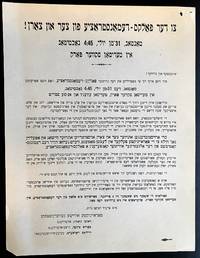
194443416No Place New York Fereynigte Yidishe Geverkshaftn United Hebrew Trades 1944. 1st edition broadside single-sided flyer 4to. In Yiddish. <br> <br> Translation: "ALL OUT TO THE PUBLIC DEMONSTRATION OF GRIEF AND RAGE!<br> Monday July 31st 4:45 PM<br> in Madison Square Park<br> <br> Sisters and brothers!<br> We invite you to participate in the great public demonstration that will take place<br> Monday July 31 4:45 p.m.<br> in Madison Square Park Madison Avenue and 24th Street<br> <br> Millions of Jews were murdered by the Nazis in all parts of Europe. Young and old women and men were driven into gas and death chambers and destroyed. In the current hour the greatest danger for those still alive in the Nazi countries.<br> The Hitlerian beast which conquered and humiliated countries and murdered millions of people is ready to strangle and murder the surviving remnants of the Jewish people. Hundreds of thousands of Jews from Hungary are now in danger of death the tens of thousands of Jews left alive in Poland in France in Belgium in the Czech Republic where they are under Hitler's rule.<br> <br> In order to express our grief and anger to cry out our grief and appeal for help to the United Nations at the last moment a public demonstration is called by the Rescue Committee of the General Jewish Conference.<br> <br> We cannot and must not remain silent. People must help save the survivors. Come express your feelings desires and demands! It is demanding that the United Nations do everything possible to stop the death march! It is demanded that all those who are guilty of the murders will be brought to justice!<br> The Nazi victims who are now struggling between death and life must know that we are with them.<br> At a conference of representatives of the trade union organizations called by the Jewish Labor Committee it was decided to actively participate in the great national demonstration. We must do everything we can so that the demonstration will be imposing and effective.<br> <br> Leave the store no later than 4 o'clock. Marched to the site of the demonstration in Madison Square Park. Overtime is not allowed on this day.<br> With Trade Union Regards<br> United Hebrew Trades<br> Reuven Guskin President<br> Maurice Tigel Vice-President<br> William Wolpert Executive Secretary"<br> <br> <br> The rally was covered by the Jewish Telegraphic Agency JTA the next day:<br> <br> "Tens of thousands of Jews and non-Jews crowded Madison Square Park today at an open-air mass-demonstration in behalf of the Jews of Hungary and other parts of Nazi Europe sponsored by the 64 affiliated agencies of the American Jewish Conference with the cooperation of the American Jewish Committee and other national organizations.<br> Speakers at the demonstration included Assistant U. S. Attorney General Norman M. Littell who is secretary of the National Committee Against Persecution of Jews; Dr. Stephen S.Wise president of the American Jewish Congress and co-chairman of the American Jewish Conference; Judge Joseph M. Proskauer president of the American Jewish Committee; Henry Monsky president of B'nai B'rith and co-chairman of the American Jewish Conference; Adolph Held president of the Jewish Labor Committee and many other noted Jewish and Christian leaders.<br> The huge mass-meeting in which Jews from all walks of life participated adopted a declaration stating that it is not yet too late 'to save thousands upon thousands' of Jews for the day of liberation. The meeting appealed in the first instance to President Roosevelt and the Government of the United States and through them to the United Nations and to the neutral states." <br> <br> The original JTA covers including a full list of the demands from the rally and other details can be viewed at www.jta.org/archive/huge-open-air-demonstration-in-new-york-demands-rescue-of-jews-from-europe<br> <br> Leading national Jewish organizations organized this July 31 1944 Madison Square Park mass rally to demand Allied action against the Nazi slaughter of European Jews. <br> New York had at the time the world's biggest Jewish population with a Jewish community of around 2 million. The city had hosted numerous similar rallies over the previous decade all focused on building opposition to Hitler and support for the struggling Jews of Europe. <br> <br> Beginning on March 4 1934 "One year after Hitler's ascension to power in Germany tens of thousands of New Yorkers gathered at Madison Square Garden to hear the words of Rabbi Stephen Wise. 'Despite the oceanic tragedy which has befallen us' Wise pronounced 'we Jews tonight joining in the chorus of civilization indict Hitlerism as humans as members of civilized society before the high court of human judgment.' <br> Wise's words resonated for audience members attending the rally that March night. Over the course of the evening they heard from a chorus of voices representing the American public self-identifying across different racial religious and ideological lines. Framed as a 'court' the speakers at the rally gathered to indict Hitler for his crimes against civilization an intentionally pointed term that would offend Nazi ideologues claiming to protect civilization through Aryan supremacy. This mock trial was part of a larger trend of American Jewish protest performances staged during the Third Reich that intended to garner support for the rescue of European Jews.<br> On March 27 the AJCongress American Jewish Congress successfully staged a rally titled Stop Hitler Now to an audience of twenty thousand Jews in Madison Square Garden. Outside of the Garden thirty-five thousand people stood protesting and ten thousand more marched through Brooklyn in solidarity. Simultaneous protests also occurred in major cities across the country. The United Press estimated that one million protesters participated in the nationwide demonstration that day. <br> In retaliation to the American uproar Hitler threatened a one-day boycott against German Jewish businesses to be resumed three days later if 'international protests' did not cease. Wise after speaking with Undersecretary William Phillips at the State Department agreed to a brief silence on the matter" Gonzalez Maya. Imagining the "Day of Reckoning": AmericanJewish Performance Activism during the Holocaust. Masters Thesis UMass-Amherst 2023. https://hdl.handle.net/20.500.14394/33069 <br> We could locate no recorded examples of this flyer anywhere using OCLC ArchiveGrid or a google search. <br> <br> Staple hole in upper right corner margin slight corner loss to lower left margin no text affected in either case light toning about Very Good Condition. Rare and displayable Holo2-163-30. No Place [New York], Fereynigte Yidishe Geverkshaftn [United Hebrew Trades] unknown
191026282Jerusalem: Druck vermutlich bei Gebr. Monsohn. um 1910). Quer-Oktav, 10,5 x 16,5 cm. (etwas beschabt, eine kleine Ecke des hinteren Deckels fehlt, innen etwas gebräunt, Stempel auf Titel verso, insgesamt abr recht gut erhalten und farbfrisch) 12 Blatt. Original-Halbleder mit Orig.-Zedernholz-Deckeln,
IN YIDDISH. 175X245 mm. xxxix+321 pages. Gilt hardcover. Ex-library copy with usual marks. Cover slightly stained. Cover edges slightly bumped. Pen inscription on first whitepage. Else in good condition.
196157242CBOlten/Freiburg im Breisgau, Walter-Verlag, 1961. 8°. 21 cm. 486 Seiten. Roter Original-Ganzlederband mit goldgeprägtem Rückentitel. Kopffarbschnitt. (Mendele Moicher Sfurim, Werke).
Nyu York : Y. L. Perets shrayber farayn, 1945. Paper Wrappers, 4to, 196 pages. Includes illustrations & portraits. 28 cm. In Yiddish. SUBJECT (S) : Journalism -- United States -- History. Yiddish newspapers -- United States. Yiddish newspapers -- United States -- History. Also includes title in English: "75 [Seventy-five] years Yiddish press in the United States of America 1870-1945" OCLC lists 17 copies worldwide. Good Condition. (Y-23)
Original Cloth. 8vo. 192 pages. 24 cm. First edition. In Yiddish. Finf un tsvantsig yor folks-bine: aroysgegebn tsum finf un tsvantsig yorign yubiley fayerung fun der dramatisher institutsye fun Arbayter ring, Brentsh 555. 25 Years of the Folksbiene (The People's Stage) . A jubilee celebration volume, with contributions from Avrom Reyzen, Ab. Cahan, Hillel Rogoff, Avrom Goldfaden, and a history of the folks-bine by Yankev Fishman. The Folksbiene, Branch 555 of the WC a Yiddish theatre troupe which presented classics in Yiddish translation as well as original works. Subjects: Jewish theater. Folksbiene. Workmen's Circle Theatre. Workmen's Circle (U. S. ) . Branch 555, New York. OCLC lists 23 copies. Light soiling to cloth, previous owners name in pencil on endpage, otherwise clean and fresh. Good + condition. (YID-22-42)
<br/>Collana OSCAR NARRATIVA FIABE E LEGGENDE DI TUTTO IL MONDO<br/>Legatura brossura<br/>Formato Sedicesimo<br/>Num Pagine 238<br/>Traduttore Maria Teresa Giannelli<br/>Prima Edizione
Original Cloth. 16mo. 180 pages. 15 cm. First edition. Inscribed by Peretz Hirschbien, Colorado, 1918; . In Yiddish. On the Morningstar, a work of drama composed by poems by Peretz Hirshbeyn (18801948) , the acclaimed playwright, novelist, journalist, travel writer, and theater director. OCLC lists 20 copies. Subjects: Yiddish Literature. Hinges starting, light stain to back page, otherwise fresh and clean. Good condition. (YID-18-5)
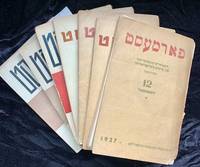
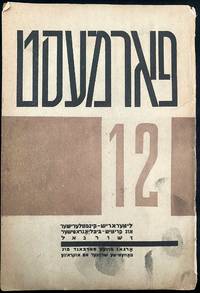
193743101Kharkov: Ukrmelukhenatsmindfarlag 1937. First edition. Original illustrated paper wrappers 8vo issues range from 129-196 pages each. Includes illustrations. 21-23 cm. In Yiddish. Title translates roughly as “Challenge: A Literary Artistic and Critical Bibliographical Journal.â€<br> At the time the only Yiddish literary periodical in Ukraine.<br> Farmest 1933–1937 was a monthly Yiddish literary magazine published in Kharkhiv Ukraine by the Ukrainian Committee for Soviet Writers. “Edited by the poet Itsik Fefer 1900–1952 it was continued in Sovetishe literatur: Literarish-kinstlerisher un kritish-bibliografisher zhurnal Soviet Literature: Literary-Artistic and Critical-Bibliographical Journal; 1938–1941.<br> In 1927 Fefer was a founding member of the Jewish Section of the All-Ukrainian Union of Proletarian Writers and from 1928 one of the editors of its Kharkov-based journal Prolit Proletarian Literature. He also coedited the nonproletarian Kharkov journal Di royte velt The Red World from 1929. From 1933 to 1937 he edited the Kiev periodical Farmest Challenge; known as Sovetishe literatur Soviet Literature between 1938 and 1941 which replaced Prolit and Di royte velt and was thereafter the only Yiddish literary periodical in Ukraine.†YIVO. Avrom Gontar was also involved in the collective and editorial committee. <br> The editor Itsik Fefer 1900–1952 “began writing poems in 1918 and in 1922 joined Vidervuks New Growth in Kiev a group of young Yiddish literati whose mentor was Dovid Hofshteyn. That same year the appearance of Fefer’s small collection Shpener Splinters established him as a rising literary star. His poetry amalgamated the Kultur-lige poets’ revolutionary romanticism with the propagandist objectives of the workers’ movement.<br> Fefer was known for his literary credo of proste reyd simple speech a concept he formulated in 1922. In the early 1920s poetry particularly avant-garde poetry swamped the literary pages of Soviet Yiddish periodicals. This phenomenon worried editors and critics who were wary of the fact that Yiddish readers usually could not identify with this style of literature. All Yiddish readers by contrast could understand Fefer’s proste reyd.<br> In 1927 Fefer was a founding member of the Jewish Section of the All-Ukrainian Union of Proletarian Writers and from 1928 one of the editors of its Kharkov-based journal Prolit Proletarian Literature. He also coedited the nonproletarian Kharkov journal Di royte velt The Red World from 1929†Gennady Estraikh.<br> For more see: Gennady Estraikh “The Kharkiv Yiddish Literary World 1920s–Mid-1930s†East European Jewish Affairs 32.2 2002: 70–88; Chone Shmeruk “Yiddish Literature in the U.S.S.R.†in The Jews in Soviet Russia since 1917 ed. Lionel Kochan pp. 242–280 London and New York 1970.<br> SUBJECTS: Yiddish literature -- Ukraine -- Periodicals. Yiddish literature. OCLC: 35051038.<br> Some pages brittle some wear to spines. Overall Good Condition. Rare. YID-46-2-LGG-’excc. Kharkov: Ukrmelukhenatsmindfarlag unknown
193543308Kharkov: Ukrmelukhenatsmindfarlag 1935. First edition. Original illustrated paper wrappers 8vo 156 pages.Includes illustrations. 21-23 cm. In Yiddish. Title translates roughly as “Challenge: A Literary Artistic and Critical Bibliographical Journal.â€<br> At the time the only Yiddish literary periodical in Ukraine.<br> Farmest 1933–1937 was a monthly Yiddish literary magazine published in Kharkhiv Ukraine by the Ukrainian Committee for Soviet Writers.<br> “Edited by the poet Itsik Fefer 1900–1952 it was continued in Sovetishe literatur: Literarish-kinstlerisher un kritish-bibliografisher zhurnal Soviet Literature: Literary-Artistic and Critical-Bibliographical Journal; 1938–1941.<br> In 1927 Fefer was a founding member of the Jewish Section of the All-Ukrainian Union of Proletarian Writers and from 1928 one of the editors of its Kharkov-based journal Prolit Proletarian Literature. He also coedited the nonproletarian Kharkov journal Di royte velt The Red World from 1929. From 1933 to 1937 he edited the Kiev periodical Farmest Challenge; known as Sovetishe literatur Soviet Literature between 1938 and 1941 which replaced Prolit and Di royte velt and was thereafter the only Yiddish literary periodical in Ukraine.†YIVO. Avrom Gontar was also involved in the collective and editorial committee. <br> The editor Itsik Fefer 1900–1952 “began writing poems in 1918 and in 1922 joined Vidervuks New Growth in Kiev a group of young Yiddish literati whose mentor was Dovid Hofshteyn. That same year the appearance of Fefer’s small collection Shpener Splinters established him as a rising literary star. His poetry amalgamated the Kultur-lige poets’ revolutionary romanticism with the propagandist objectives of the workers’ movement.<br> Fefer was known for his literary credo of proste reyd simple speech a concept he formulated in 1922. In the early 1920s poetry particularly avant-garde poetry swamped the literary pages of Soviet Yiddish periodicals. This phenomenon worried editors and critics who were wary of the fact that Yiddish readers usually could not identify with this style of literature. All Yiddish readers by contrast could understand Fefer’s proste reyd.<br> In 1927 Fefer was a founding member of the Jewish Section of the All-Ukrainian Union of Proletarian Writers and from 1928 one of the editors of its Kharkov-based journal Prolit Proletarian Literature. He also coedited the nonproletarian Kharkov journal Di royte velt The Red World from 1929†Gennady Estraikh.<br> For more see: Gennady Estraikh “The Kharkiv Yiddish Literary World 1920s–Mid-1930s†East European Jewish Affairs 32.2 2002: 70–88; Chone Shmeruk “Yiddish Literature in the U.S.S.R.†in The Jews in Soviet Russia since 1917 ed. Lionel Kochan pp. 242–280 London and New York 1970.<br> SUBJECTS: Yiddish literature -- Ukraine -- Periodicals. Yiddish literature. OCLC: 35051038.<br> Pages toning as expected some sunning and stains to cover Good Condition. BYID-46-2A-LGG-’excc. Kharkov: Ukrmelukhenatsmindfarlag unknown
Original illustrated cover wrappers with distinctive modernist typeface and design. Chidlrens literature. Printed on quality glossy paper. Includes 6 illustrations by Gudelman and photo of author. Aron Gudelman (1890 - 1978) was a sculptor, illustrator, etcher, lecturer, and teacher. Born in Russia, he immigrated to New York in 1905 at the time of pogroms in Russia. After attending the Cooper Union and the National Academy of Design, in 1914 he studied with Jean-Antoine Injalbert at the Ecole des Beaux-Arts in Paris. Supporting himself as a machinist in the 1920s, Goodelman became a communist. His concerns about social and economic conditions were expressed in his art. He participated in exhibitions at the John Reed Club in the early 1930s. After World War II, Goodelman created artworks related to the Holocaust. He taught at City College of New York in the 1960s (National Museum of American Art, 1996) . Blue cover Variant. Shul Pinkas Chcago Nr. 203 . Light wear to cover, Very Good Condition, (Yid-24-7)
1st edition. Original dramatic constructivist paper covers 8vo, 135 pages ; 22 cm. In Yiddish. Title also in Russian on copyright page: Dlia stseny. SUBJECT (S) Yiddish literature. OCLC lists 3 copies worldwide (LOC, UMaryland, NLI) . Ex-library, but only with bookplate to later boards and faint blindstamp on non-illustarted title page. 1 inch closed tear to illustrated cover, one corner repaired, lacks spine. Paper browning with dampstaining throughout, but staining is not obtrusive on the illustrated cover. Lacks backstrip, otherwise Good Condition thus. (YID-26-10)
Traduzione: Fonzi Bruno dall'inglese . Edizione: Seconda edizione . Pagine: 872 . Illustrazioni: Sovracoperta di Massimo Santambrogio e alberi genealogici alle prime pagine . Formato: 16° . Rilegatura: Cartonato avorio con sovracoperta originale . Stato: Buono . Caratteristiche: Bruniture . Collana: La gaja scienza n°28 .
IN YIDDISH AND HEBREW. RARE Yizkor book (memorial book) commemorating the Jewish community of Falenica annihilated in the Holocaust. Falenica is a part of Wawer, one of districts of Warsaw on the right bank of the Vistula, in the far southeastern corner of the city (until 1951 a separate village, afterwards became part of Warsaw). Falenica is located along the main rail line, which connects Warsaw with Lublin. During World War II the Germans opened a Jewish ghetto there, called Falenica-Miedzeszyn Ghetto. All of its inhabitants were transported to Treblinka in August 1942. Contains many b&w photographs. 280x220mm. 478 pages. Black cloth Hardcover with gilt front cover and spine. Cover dirty and slightly scratched. Front cover upper corner and spine edges bumped. Rear endpaper upper edge/corner slightly peeling. Rear whitepage bottom corner creased/wrinkled. Pages slightly yellowing. [SUMMARY]: This extremely rare Yizkor book commemorating the exterminated Jewish community of Falenica is in good condition. PLEASE NOTE: This item is overweight. We may ask for extra shipping costs.
Vols: 1945 (Nrs. 1-12, Running Nrs. 38-49); 1946 (Nrs. 1-12, Running Nrs. 50-61, not bound); 1947 (Nrs. 1-12, Running Nrs. 62-73), 1948 (Nrs. 1-12, Running Nrs. 74-85); 1951 (Nrs. 1-12, Running Nrs. 109-120); 1952 (Nrs. 1-12, Running Nrs. 121-132); 1953 (Nrs. 1-12, Running Nrs. 133-144); Nyu York : Forshung-Instiut baym Yidishn Arbeyer-komitet, 1947. Cloth, 4to, 12 pages per issue. Monthly. "Facts and Opinions. " Published by the research committee of the Jewish Labor Committee. Postwar period volume. We located only 1 holding of this periodical (Harvard-partial run) , and none others on OCLC. OCLC does list a later (1971 on) periodical of a similar name, with one holding worldwide (NYPL) . SUBJECT(S) : Jewish labor unions -- Periodicals. Labor movement -- United States -- Periodicals. Jews -- New York (State) -- New York -- Periodicals. Very Good Condition. (Y-5B) Price per annual.
Nyu York : Forshung-Instiut baym Yidishn Arbeyer-komitet, 1947-1952. Glossy Paper wrappers, 4to, 12 pages per issue. Monthly. "Facts and Opinions. " Published by the research committee of the Jewish Labor Committee. We located only 1 holding of this periodical (Harvard-partial run) , and none others on OCLC. OCLC does list a later (1971 on) periodical of a similar name, with one holding worldwide (NYPL) . SUBJECT(S) : Jewish labor unions -- Periodicals. Labor movement -- United States -- Periodicals. Jews -- New York (State) -- New York -- Periodicals. Very Good Condition. Price is per issue(Y-5A)
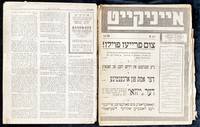
New York, Der Komitet, 1943. Paper Wrappers, Large 4to (Life Magazine size) , 28 pages. "Unity. " Short-lived (1942-43 only) Yiddish Communist monthly for writers, artists, and scientists, a periodical certainly read by many of those swept up in the Atom Spy witchhunts 10 years later. "Aroysgegebn fun Komitet fun Yidishe shrayber, kinstler un visnshaftler in Amerike. " Succeeded by periodical of the same name, also published in New York, in 1944. SUBJECT(S) : Jewish communists -- United States -- Periodicals. OCLC lists 2 holdings worldwide (LOC & NYPL) . Very Good Condition. (Y-38)
New York, Der Komitet, 1946-47. Paper Wrappers, Folio (Road Atlas size, 35 cm) , 32 pages. "Unity. " Yiddish Communist bimonthly (from May 1944-Jan 15 1945) , then monthly (through 1947) for writers, artists, and scientists, a periodical certainly read by many of those swept up in the Atom Spy witchhunts 10 years later. "Aroysgegebn fun Komitet fun Yidishe shrayber, kinstler un visnshaftler in Amerike. " Preceeded by periodical of the same name, also published in New York, in 1942.SUBJECT(S) : Jewish communists -- United States -- Periodicals. OCLC lists 3 holdings worldwide (LOC, UCLA, Columbia) . Bound in blank paper wrappers. Cover on 1945 has detached, with a bit of edgewear to the first and last pages; All printed on good paper, so condition remains Good+ Solid. Important volumes straddling the end of the war and the early post war period. (Y-37B) . Price per each issue.
194542269New York Der Komitet 1945. Paperback. 1st edition. Paper Wrappers Folio Road Atlas size 35 cm 32 pages. "Unity." <br> Yiddish Communist bimonthly from May 1944-Jan 15 1945 then monthly through 1947 for writers artists and scientists a periodical certainly read by many of those swept up in the Atom Spy witchhunts 10 years later. <br> "Aroysgegebn fun Komitet fun Yidishe shrayber kinstler un visnshaftler in Amerike." Preceded by periodical of the same name also published in New York in 1942. Important issues from the early post war period. <br> <br> SUBJECTS : Jewish communists -- United States -- Periodicals. <br> <br> January issue missing front cover which is pages 1-2; February issue has detached covers but complete. Good strong white paper. Good Condition Thus B Y-37D. New York, Der Komitet paperback
First edition. Original paper wrappers. 8vo, 112 pages. 23 cm. In Yiddish. Title translates to "Twenty One and One: About Twenty-One Yiddish Actors Murdered by the Nazis in Vilna, 1941-1942." Preface by A. Morewski and Leiser Ran. Subjects: Jewish actors -- Biography. Jews -- Persecutions -- Lithuania -- Vilnius. Yiddish drama. Holocaust, Jewish (1939-1945) -- Lithuania -- Vilnius. Jewish actors. Jews -- Persecutions. Yiddish drama. OCLC lists 23 copies worldwide. Spine is starting. Light soiling to cover. Internally very clean. Overall good condition. (YID-23-6)
N°141, 35è année, de septembre 1957, de la revue mensuelle "Europe". Au sommaire, dossier sur l'historien d'art Elie Faure (1873-1937); suivi d'un article sur la littérature yiddisch avec traductions de 3 poèmes de Dora TEITELBOIM et de 2 nouvelles d'E. KAGANOWSKI, d'un article sur l'auteur dramatique Louis-Benoît Picard (1769-1828) avec extraits de ses pièces, d'une nouvelle de Luc MONAY, de lettres de 1916 de Jean-Richard BLOCH, et des chroniques habituelles d'actualité. Français
195715099Paris, Les Editeurs français réunis, 1957 1 volume In-8° (13,5 x 21,3 cm) Broché sous couverture au 1er plat orné d'une grande photo. 175p. Bon état.
IN YIDDISH. 230X155 mm. 448 pages. Hardcover with dust-jacket. Jacket yellowing. Jacket edges slightly torn. Cover corners and edges slightly bumped. Spine edges slightly bumped. Stamp on inner cover. Pen inscription on first whitepage. Pages slightly yellowing. Else in good condition.
SERIES: Hippocrene Practical Dictionary Book