658 résultats
22.5x16 cm. 7+364+759 pages. Gilt hardcover. Front cover slightly rubbed. Spine slightly loose. Pen writing on front inner cover. Else in good condition. PLEASE NOTE: This item is overweight. We may ask for extra shipping costs.
16.5x11.5 cm. 96 pages. Pages are yellowing and age stained. Else in good condition.
8vo; aprox. 400 pages; 22 cm. Complete in 2 volumes, bound together. Many photos. In the original Hebrew. Those who never yielded: the History of the Chassidic Rebel Movement in the Ghettoes of German-Occupied Poland. Subjects: Jews--Persecutions--Poland. Hasidim--Poland. Holocaust, Jewish (1939-1945) --Poland. World War, 1939-1945--Jewish resistance--Poland. Poland--Ethnic relations. Very Good Condition in Very Good Jacket. (H-41-22)
280x205mm. 230+37 pages. Gilt hard water damaged cover. Cover and spine both torn at edges and corners. Pages yellowing wrinkled (water damaged) and partly stained. If fair condition. With B/W photos. 1.3 Kg
Original Wraps. 4to. 49 pages. 26 cm. First edition. In German and Hebrew. 'The Struggle for Truth; Max Brod on his 65th Birthday. ' With two illustrations. Contains contributions from Martin Buber, Felix Weltsch, Schalom Ben-Chorin, Mayer Ebner, Erwin Pollak, and others. Contains several biographies of Brod written by his associates, with a chronology of his life. Max Brod (18841968) , Czech-born German author, composer, and representative member of the 'Prague Circle' (Prager Kreis) . -2008 EJ. Subjects: Brod, Max, 1884-1968. Bibliographie. Wraps chipped, aged, fragile. Internally clean and fresh. Good - condition. (GER-43-57)
FONDO DI MAGAZZINO SEGNI DEL TEMPO, UNA LEGGERISSIMA PIEGA AL RETROCOPERTINA, MA IL VOLUME è INTONSO, MAI SFOGLIATO. ANCORA PRESENTE LA FASCETTA PUBBLICITARIA: NUOVA EDIZIONE. Il volgere del nuovo secolo, il passaggio delle generazioni, la difficile elaborazione del lutto della Shoah, insieme alle domande che nascono dalla crisi mediorientale, ci portano ad interrogarci sulle radici europee dell'identità ebraica. Questo libro racconta sei secoli di storia degli ebrei in Europa, dal Trecento fino alle soglie del Novecento: una storia che è quella degli ebrei dell'Occidente cristiano, delle condizioni della loro esistenza, dei rapporti con la cultura esterna, di esilio e migrazioni, chiusura nei ghetti e vitalità sociale e culturale.
Mm 120x220 Collana "Piccola enciclopedia". Volume nella sua brossura originale con alette, 119 pagine con un ricco corredo di illustrazioni in nero e a colori nel testo e fuori testo. Opera in ottime condizioni. Spedizione in 24 ore dalla conferma dell'ordine.
Publishers cloth. 8vo. X, 186 pages. 24 cm. First edition. In February of 1903, in a small town in the southwestern part of the Russian empire, a peasant stumbled upon the corpse of 14-year-old Mikhail Rybachenko, bruised and covered with stab wounds, in a garden. The murder immediately fueled wild rumors that he had been killed by local Jews in need of his Christian blood to prepare their matzah bread. Panic rumors, grounded in sinister superstitions of Jewish sorcery and ritual murder, quickly spread to nearby towns. By April, they had hit Kishinev - a growing metropolis of 100, 000 inhabitants rife with the unrest of rapid expansion, ethnic rivalry, revolutionary agitation, and anti-Semitism - with full force. The resulting massacre left dozens dead, and hundreds wounded, maimed, widowed, orphaned, or homeless. This is the story of Kishinev. In this extensively researched book, Edward Judge examines these anti-Jewish riots, detailing their background, cause, and aftermath. He traces the evolution of the riots, analyzing the broader impact of imperial policies, urbanization, nationalism, population growth, and revolutionary activism upon the Jewish situation in Russia. Recounting the activities and attitudes of anti-Semitic agitators and Kishinev officials, the book examines the spiral of violence, the inaction of the authorities in the wake of the pogrom, the storm of indignation that followed the pogrom, and the efforts of tsarist officials to counter subsequent negative publicity. Easter in Kishinev also portrays the investigation of the disorders and the trials of the rioters and carefully considers the question of government responsibility for the outbreak of the pogrom. (Publishers Description) Subjects: Jews - Persecutions - Moldova - Chisinau. Massacres - Moldova - Chisinau - History - 20th century. Antisemitism - Moldova - Chisinau - History - 20th century. Kishinev Massacre, Chisinau, Moldova, 1903. Antisemitisme. Pogrom Geschichte 1903 Chisinau (Moldova) - Ethnic relations. Very good condition. (EE-5-16)
Traduzione: Oddera Bruno dall'inglese . Edizione: Seconda edizione . Pagine: 208 . Formato: 8° . Rilegatura: Brossura editoriale . Stato: Buono . Caratteristiche: Bruniture . Collana: I narratori n°12 .
IN YIDDISH. SIGNED BY AUTHOR. 200X160 mm. 178 pages. Softcover. Cover age-stained. Spine slightly wrinkled. Pages slightly yellowing. Few pages slightly age-stained - No damage to text. Else in good condition.
8' 484pp. red gilt hardcover, cover slightly worn and slightly stained. spine faded. Pages slightly yellowing. else in good condition. Author's signature on first white page. Over 1kg.
1st edition. Original binding with leather spine and gold gilt lettering. 8vo. 745 pages, 23 cm. In Yiddish. Title translates to The New Life. A complete 1st year of this important Yiddish monthly. Zhitlowsky, an immigrant socialist revolutionary, sought to synthesize socialism with nationalism as early as 1883. He demanded for Jews "national equal rights with all peoples" and asserted that only through the Yiddish language could the social and national revival of the Jewish people be effected. He maintained that one could remain identified with the Jewish nationality even if abandoning the Jewish religion. He urged the Jewish masses to participate in the class struggle as a national unit. Alone among the cosmopolitan Jewish socialists he favored national socialism. In 1897 he began publishing philosophical studies in Jewish history and a comprehensive program of action which later appeared in book form as Pisma o starom I novom yevreystvie ("Letters on Old and Modern Judaism, " 1907) . His main thesis was that national consciousness consists mainly of spiritual-cultural determinants and that these national characteristics can be maintained by the Jews in the future in the lands of their dispersion, just as they have survived the lack of territory or unity of language since the end of the second commonwealth. After emancipation of the individual the Jews as a group should be granted national self-government within the framework of the state along with other national minorities. His secularization of the national idea as opposed to those who saw the essence of Judaism in religion, and his optimistic view of the future of Judaism in the Diaspora, were the main underpinnings of his insistence on national cultural autonomy. Zhitlowsky was "in favor of the centrality of Yiddish in the national Jewish experience and labored toward the recognition of that language, and of those who lived out their lives in it, as one of the several cultural linguistic communities of Eastern Europe, and of the Western world as a whole" (Isaac Levitas, et al, in EJ) .Includes volume title pages and Zhitlowskys 16 page prologue (usually missing) entitled This program and the dissemination of the monograph 'The New Life.' Ex-library with usual, minimal markings. Binding repaired. Pages are clean and good. Good condition. (YID-30-6)
1st edition. Original, beautifully illustrated boards. 8vo. 745 pages, 23 cm. In Yiddish. Title translates to The New Life. A complete 1st year of this important Yiddish monthly. Zhitlowsky, an immigrant socialist revolutionary, sought to synthesize socialism with nationalism as early as 1883. He demanded for Jews "national equal rights with all peoples" and asserted that only through the Yiddish language could the social and national revival of the Jewish people be effected. He maintained that one could remain identified with the Jewish nationality even if abandoning the Jewish religion. He urged the Jewish masses to participate in the class struggle as a national unit. Alone among the cosmopolitan Jewish socialists he favored national socialism. In 1897 he began publishing philosophical studies in Jewish history and a comprehensive program of action which later appeared in book form as Pisma o starom I novom yevreystvie ("Letters on Old and Modern Judaism, " 1907) . His main thesis was that national consciousness consists mainly of spiritual-cultural determinants and that these national characteristics can be maintained by the Jews in the future in the lands of their dispersion, just as they have survived the lack of territory or unity of language since the end of the second commonwealth. After emancipation of the individual the Jews as a group should be granted national self-government within the framework of the state along with other national minorities. His secularization of the national idea as opposed to those who saw the essence of Judaism in religion, and his optimistic view of the future of Judaism in the Diaspora, were the main underpinnings of his insistence on national cultural autonomy. Zhitlowsky was "in favor of the centrality of Yiddish in the national Jewish experience and labored toward the recognition of that language, and of those who lived out their lives in it, as one of the several cultural linguistic communities of Eastern Europe, and of the Western world as a whole" (Isaac Levitas, et al, in EJ) . Ex-library with usual, minimal markings. Lacks Zhitlowskys original 16 page prologue entitled This program and the dissemination of the monograph The New Life and the title page of issue one. Boards fading and worn, but in tact; hinges starting. Internally Very Good with original illustrated boards. (YID-30-11)
1st edition. Mixed period and later boards. 8vo. 745 pages; 550, 16, 24, 24, 24 pages; 690 pages. 23 cm. In Yiddish. Title translates to The New Life. The complete first three years of this important Yiddish monthly. Zhitlowsky, an immigrant socialist revolutionary, sought to synthesize socialism with nationalism as early as 1883. He demanded for Jews "national equal rights with all peoples" and asserted that only through the Yiddish language could the social and national revival of the Jewish people be effected. He maintained that one could remain identified with the Jewish nationality even if abandoning the Jewish religion. He urged the Jewish masses to participate in the class struggle as a national unit. Alone among the cosmopolitan Jewish socialists he favored national socialism. In 1897 he began publishing philosophical studies in Jewish history and a comprehensive program of action which later appeared in book form as Pisma o starom I novom yevreystvie ("Letters on Old and Modern Judaism, " 1907) . His main thesis was that national consciousness consists mainly of spiritual-cultural determinants and that these national characteristics can be maintained by the Jews in the future in the lands of their dispersion, just as they have survived the lack of territory or unity of language since the end of the second commonwealth. After emancipation of the individual the Jews as a group should be granted national self-government within the framework of the state along with other national minorities. His secularization of the national idea as opposed to those who saw the essence of Judaism in religion, and his optimistic view of the future of Judaism in the Diaspora, were the main underpinnings of his insistence on national cultural autonomy. Zhitlowsky was "in favor of the centrality of Yiddish in the national Jewish experience and labored toward the recognition of that language, and of those who lived out their lives in it, as one of the several cultural linguistic communities of Eastern Europe, and of the Western world as a whole" (Isaac Levitas, et al, in EJ) . Includes Zhitlowskys original, first volume, 16 page prologue entitled This program and the dissemination of the monograph The New Life. Some internal binding repair, but solid, paper toning as expected but nice and clean, a Good, solid complete set. (YID-30-8)
1st edition. Original boards. 8vo. 690, 16 pages. 23 cm. In Yiddish. Title translates to The New Life. A complete second year of this important Yiddish monthly. Zhitlowsky, an immigrant socialist revolutionary, sought to synthesize socialism with nationalism as early as 1883. He demanded for Jews "national equal rights with all peoples" and asserted that only through the Yiddish language could the social and national revival of the Jewish people be effected. He maintained that one could remain identified with the Jewish nationality even if abandoning the Jewish religion. He urged the Jewish masses to participate in the class struggle as a national unit. Alone among the cosmopolitan Jewish socialists he favored national socialism. In 1897 he began publishing philosophical studies in Jewish history and a comprehensive program of action which later appeared in book form as Pisma o starom I novom yevreystvie ("Letters on Old and Modern Judaism, " 1907) . His main thesis was that national consciousness consists mainly of spiritual-cultural determinants and that these national characteristics can be maintained by the Jews in the future in the lands of their dispersion, just as they have survived the lack of territory or unity of language since the end of the second commonwealth. After emancipation of the individual the Jews as a group should be granted national self-government within the framework of the state along with other national minorities. His secularization of the national idea as opposed to those who saw the essence of Judaism in religion, and his optimistic view of the future of Judaism in the Diaspora, were the main underpinnings of his insistence on national cultural autonomy. Zhitlowsky was "in favor of the centrality of Yiddish in the national Jewish experience and labored toward the recognition of that language, and of those who lived out their lives in it, as one of the several cultural linguistic communities of Eastern Europe, and of the Western world as a whole" (Isaac Levitas, et al, in EJ) . Ex-library with usual, minimal markings. Some wear to boards. Binding repaired. Contents clear. Good+ Condition. (YID-30-9)
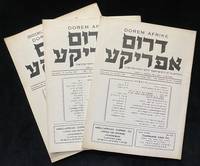
199042134Yohanesburg Johannesburg South Africa: Dorem Afrikaner Yidisher Kultur Federatsye 1990. Paper Wrappers. 1st edition. Original wrappers. 8vo. Approximately 32 pages each 23 cm. In Yiddish withs some English advertisements. Title translates to "South Africa." South Africa's most well-known Yiddish journal published in Johannesburg from 1948-1991. Interesting period covered here the tumult of the late 60s. SUBJECTS: Jews -- Periodicals. Yiddish literature -- Periodicals. OCLC: 01800240. Very Good Condition.Price per issue please specify YID-33-48AXX-EL. Yohanesburg [Johannesburg, South Africa]]: Dorem Afrikaner Yidisher Kultur Federatsye unknown
Original wrappers. 8vo. 260 pages, 20 cm. In Yiddish. Title translates to Documents of Crime and Martyrdom. A Montevideo-published Yiddish translation of Michal Borwiczs Dokumenty zbrodni I meczénstwa. Michal Borwicz (Maksymilian Boruchowicz) was born in Krakow in 1911, and died in Paris in 1987. A graduate of the Jagiellonian University in Krakow, he was a Jewish Polish author and historian, who studied the history of Polish Jewry during the Holocaust. Borwicz was an inmate in the Janowska camp in Lwow from 1942-1943. He was sentenced to death by hanging, however when the sentence was being carried out, the rope broke. He escaped from the camp and joined the partisans and commanded an Armia Krajowa (AK) unit in the Krakow area. After the war, he headed the Jewish Historical Commission in Krakow from 1945 to 1947. After emigrating to France in 1947, he directed the Centre d'etude de l`histoire des Juifs (Polonais) (Center for Research of the History of the Jews of Poland) in Paris until his death. (EHRI, 2018) . SUBJECTS: Holocaust, Jewish (1939-1945) -- Poland. World War, 1939-1945 -- Personal narratives, Jewish. OCLC lists 6 copies worldwide (OCLC: 10601885) . Pages are browning and brittle. Some chipping and edge wear. Otherwise good. (YID-40-61-L-'x)
br. La nuova edizione del dizionario ebraico si presenta riveduta, corretta e aggiornata in tutti i suoi lemmi. L'impaginazione è stata razionalizzata e la qualità grafica, per la resa dei caratteri ebraici, è stata riportata agli standard contemporanei. L'introduzione grammaticale, pur conservando l'impianto originale, è stata interamente rivista, nell'intento di facilitarne la comprensione, al di là della semplice memorizzazione, senza allontanarsi eccessivamente da un approccio scientifico. La terminologia tecnica è stata allineata alle tendenze della linguistica semitica contemporanea.
Original Wraps. 8vo. 91 pages. 20 cm. First edition. In German. 'The Future of the Jews. ' A controversial work on the economic position of diaspora Jewry. Werner Sombart (18631941) , German political economist and sociologist. Born in Ermsleben, Sombart acquired a reputation through his work Der Moderne Kapitalismus (2 vols. , 1902, 1916) in which he traced the development of capitalism from the late Middle Ages. In 1917 he was appointed professor of political economy at the University of Berlin. He wrote two works on capitalism and the Jews: Die Juden und das Wirtschaftsleben (1911; The Jews and Modern Capitalism, 1913, 1951) , and Die Zukunft der Juden (1912) which aroused considerable controversy. In Sombart's view, the Jews were the principal cause of the disruption of the medieval economic system and its replacement by capitalism. The Jews, he held, were foreigners and came up against the hostility of the guilds which controlled the commerce of the medieval cities. Consequently they sought to break away from the restrictive economic framework of city life and, by doing so, became the pioneers of international trade. In this way they helped to lay the foundation of the capitalist system. Sombart maintained that the Jewish intellect, 'concrete, stubborn, and systematic, ' was ideally suited to fostering a capitalist economy: 'When Israel appears upon the face of Europe, the place where it appears comes to life; and when it departs, everything which had previously flourished withers away. ' Such statements made for the ambivalent reception of Sombart's work among Jews at the time. Thus, while liberal Jews strongly criticized Sombart as an antisemite, others, particularly in the Zionist camp, praised him as a nonpartisan researcher and held up his theses as evidence of Jewish perseverance and as acknowledgement of the special contribution of the Jews. - EJ 2008. Subjects: Civilization - Jewish influences. Jews - Germany - Social conditions. Civilization - Jewish influences. Ethnic relations. Jews - Social conditions. Germany - Ethnic relations. Wraps bumped, slightly torn along backstrip, light soiling to outer edges, otherwise clean and fresh. Very good condition. (GER-43-41)
Original Cloth. 8vo. IV, 402 pages. 23 cm. First edition. In German, with some Hebrew. 'Talmudic Education as a Guide: for the Contemporary School and Home. ' Self published by the author. Subjects: Jews - Education. Talmud. Talmud - Study and teaching. Jewish religious schools. Cloth lightly rubbed, minor soiling to title page, otherwise fresh and clean. Very good condition. (GER-43-24)
30.5x21.5cm. 143 pages. Hardcover. In as new condition.
Softbound. 12mo. 219 pages. 19 cm. Second edition. Reprint of the Frankfurt a. M. , 1886 edition. In German. The Jewish Colonies in Russia; Culture-Historical Study and Contribution to the history of the Jews in Russia. History and documentation of the limited nineteenth century Jewish agricultural colonies in tsarist Russia. Subjects: Jews - Russia. Jewish farmers. Agricultural colonies - Russia. Clean and fresh. Very good condition. (EE-5-45)
Publishers cloth. 4to. 112 pages. 26 cm. First edition. In German. The Jewish City of Lublin. With 60 illustrations. Monograph of Lublins Jewish history by Majer Balaban (18771942) , historian and educator. Majer Balaban was a founder and architect of modern Polish Jewish historiography and the first to synthesize both Polish archival sources and Jewish communal records and rabbinic responsa. Balaban completed his dissertation in 1904, on Jews in Lwów at the turn of the sixteenth and seventeenth centuries (Zydzi lwowscy na przelomie XVIgo I XVIIgo wieku; 1906) . Thereafter he taught in secondary schools until the outbreak of World War I, when he served as a military chaplain in the Austrian army. While stationed in Lublin, he took advantage of the opportunity to prepare a short monograph on the history of Jews in that community. (YIVO Encyclopedia) . His book on the Jews of Lublin, Die Judenstadt von Lublin (Berlin, 1919) , is a vivid survey of history of the Jews in that city. (EJ 2008) . Subjects: Jews - Poland. Lublin (Poland) . Poland; social history under capitalism, before 1945; social conditions; social groups; (movements of) national minorities; Jews. Binding repaired; light soiling to cloth, pages aged, otherwise fresh and clean. Good condition. (EE-5-31)
Original Wraps. 8vo. 112 pages. 24 cm. First edition. In German. The Jewish Question in Romania. Provides a historical narrative with specific details about various pieces of legislation. In the series: Kriegspolitische Einzelschriften, Hft. 21. Subjects: Jews - Romania. Romania; social and political history; 1878 - 1944; social and political structure; social conditions, social groups; ethnic minorities, in Transylvania only after 1918, Dobrudza. Light soiling to wraps, edge wear, small tear to cover, otherwise fresh and clean. Good condition. (EE-5-12)
Original Wraps. 8vo. 88 pages. 24 cm. First German edition. Authorized German Translation. The Jews in Romania; Lazares first hand account and denunciation of the terrible fate of Romanian Jews, after his visit to Romania in 1900 and 1902; originally published in LAurore, 1900. Lazare, (1865-1903) was famous for his defense of Alfred Dreyfus, his activity in French Anarchist circles, his correspondence with Ahad Haam, and his brief friendship and break with Theodor Herzl. Subjects: Jews - Romania. OCLC lists 19 copies. Light soiling and chipping to wraps, otherwise fresh and clean. Good + condition. (EE-5-13)