42 295 résultats
34845VERONA KULGIN D. DUVAL 1982. LIMITED TO 150 COPIES THIS BEING NUMBER 27. WITH FOUR ETCHING BY PIETRO ANNIGONI. SIGNED BY ANNIGONI. PRINTED AT OFFINA BODONI IN ITALY. QUARTER GREEN LEATHER. A NEAR FINE COPY IN A SLIPCASE. VERY SMALL NICK TO TOP OF LEATHER SPINE. VERONA, KULGIN D. DUVAL, 1982 hardcover
2 vols., folio, First and Sole Edition, with 277 reproductions of engravings and 25 head- and tail-pieces; original white buckram, covers mildly age-soiled else a very good, clean copy. EDITION LIMITED TO 210 COPIES.
1994015384Munchen Gina Kehayoff verlag 1994 In-8 Broché, couverture à larges rabats
1729BB0664London: printed for I. Tonson in Ye Strand 1729. First Edition. Full Calf. Near Fine. Large 4to: 18450xci1pp with engraved title page four full-page copper-engraved plates including frontispiece portrait of Waller engraved by Vertu after Kneller and numerous superb head- and tailpieces and historiated initials. Contemporary cambridge-style calf sides decorated in blind and framed with rat's tooth roll ribbed spine richly gilt in seven compartments red morocco lettering piece gilt chipped plain period end papers. Near Fine or better with light offsetting sporadic foxing and the odd smudge else clean and crisp throughout; joints very skillfully repaired spine ends renewed. Provenance: signature of the bibliophile Douglas Grant in pencil to front fly-leaf. Wither to Prior 941. Grolier English 100 27. First Collected Edition the "most sumptuous ever published. It contains all the poems which had hitherto appeared to which the editor has added four new . . . Waller's letter are added for the first time and the various prefaces to the earlier editions are reprinted. Finally the information given in the notes is so full and accurate that little has been left to the research or correction of later editions." Wither to Prior Waller's poems were widely read during the late seventeenth and early eighteenth centuries. "Dryden who greatly admired Waller and consistently treated him as mentor and precursor claimed that ‘the well-placing of words for the sweetness of pronunciation was not known till Mr. Waller introduced it.' . . . When neo-classical canons of correctness fell out of fashion in the nineteenth century Waller's poetic reputation plummeted and it has never fully recovered though . . . renewed interest in court culture and in the intersection of literature and history toward the end of the twentieth century has led to a modest Waller revival." ODNB N. B. With few exceptions always identified we only stock books in exceptional condition. All orders are packaged with care and posted promptly. Satisfaction guaranteed. Fine Editions Ltd is a member of the Independent Online Booksellers Association and we subscribe to its codes of ethics. printed for I. Tonson in Ye Strand unknown
192647172Minneapolis, Minn., The Physicalreview, 1926. 4to. Contemp. full buckram. Small tear to first hinge at foot. A stamp in upper right corner on titlepage and 2 other pages. In: ""The Physical Review. Conducted by the American Physical Society"", Vol. 28, Second Series. VI,1343 pp. (Entire volume offered).Schrödinger's paper: pp. 1049-1070. Internally clean and fine.
192647172Minneapolis Minn. The Physicalreview 1926. 4to. Contemp. full buckram. Small tear to first hinge at foot. A stamp in upper right corner on titlepage and 2 other pages. In: "The Physical Review. Conducted by the American Physical Society" Vol. 28 Second Series. VI1343 pp. Entire volume offered.Schrödinger's paper: pp. 1049-1070. Internally clean and fine. <br/><br/><em>First appearance of the first treatment of Wave Mechanics in English.The paper reviews Schrödinger's own wave-mechanics and De Broglie's "phase waves" and covers all the results Schrödinger had hitherto obtained in his main communications of 1926 the 3 papers in German. An English translation of Schrödinger's main papers was not published until 1928."The paper gives an account of the author's work on a new form of quantum theory. §1. The Hamiltonian analogy between mechanics and optics. §2. The analogy is to be extended to include real "physical" or "undulatory" mechanics instead of mere geometrical mechanics. §3. The significance of wave-length; macro-mechanical and micro-mechanical problems. §4. The wave-equation and its application to the hydrogen atom. §5. The intrinsic reason for the appearance of discrete characteristic frequencies. §6. Other problems; intensity of emitted light. §7. The wave-equation derived from a Hamiltonian variation-principle; generalization to an arbitrary conservative system. §8. The wave-function physically means and determines a continuous distribution of electricity in space the fluctuations of which determine the radiation by the laws of ordinary electrodynamics. §9. Non-conservative systems. Theory of dispersion and scattering and of the "transitions" between the "stationary states." §10. The question of relativity and the action of a magnetic field. Incompleteness of that part of the theory." From the Abstract in front of the paper. </em> hardcover
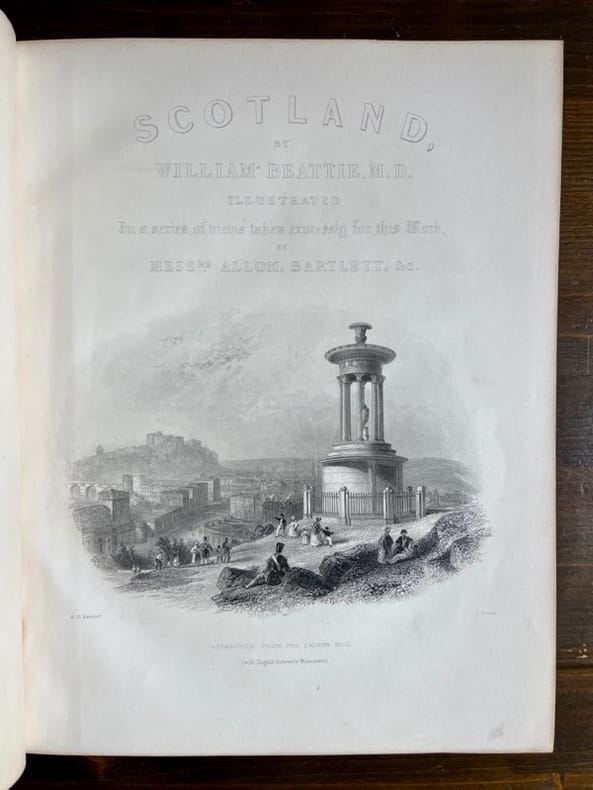
186020070London, James S. Virtue, circa 1860. 2 volumes in-4, pleine percaline d'éditeur richement ornée, tranches dorées.
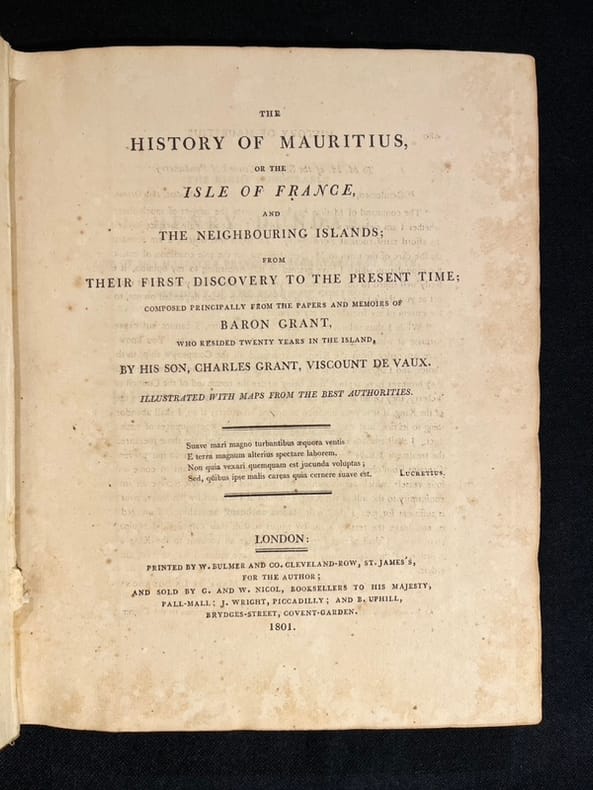
18012119London, Printed by W. Bulmer and Co, 1801. In-4 de XXI-571 pages, pleine percaline brune sillonnée de noir (façon écorce), dos lisse, étiquette de titre noire (reliure moderne).
1811AQ33894Lewes: Sussex Press Printed and sold by John Baxter 1811. In two volumes. With an engraved title page to each volume and a further 30 of 32 plates. Contemporary red straight-grain morocco richly tooled in gilt and blind A.E.G. marbled endpapers. A trifle rubbed. Armorial bookplates of John Trotter Royal Artillery to both FEPs naive clear tape repair of head of leaf 4Z2 of Vol. I small marginal hole to leaf 5N2 loss to lower corner of leaf 6M1 with slight loss of sense slight marginal loss to leaf 7S1 small central hole to leaf 10Q1 naive marginal paper repairs to initial two leaves of Vol. II second leaf misbound closed tear to leaf 12E2 loss to lower corner of leaf 12S1 marginal clear tape repairs to leaves 13G1-2 13H2 loss to lower corner of 14C1 15Q2 and 16Y2. A handsomely bound - albeit slightly defective - early nineteenth century provincially published illustrated Bible with explanatory notes by Brightonian Church of England clergyman John Styles 1782-1849. . Quarto. Sussex Press, Printed and sold by John Baxter unknown
65346London: Printed by George Eyre and Andrew Strahan 1827. Large 4to. 31 x 24 cm. Handsomely bound in contemporary full burgundy morocco sides framed and decorated in blind spine with gilt-decorated raised bands compartments tooled in blind gilt lettering gilt inner dentelles green watered silk endpapers and doublures original brass clasps all edges gilt. Text printed in two columns. Inner board with gilt presentation: 'A tribute of respect and esteem from the parishioners of Stoke Next Guildford to the Rev. C. Neat. For his faithful and much valued ministrations among them. 1835.' Some light rubbing to exterior contents clean and unmarked generally a very handsome presentation copy given to the Rev. Charles Neat who met with an unlucky end just three years after his parishioners presented him with this thoughtful gift see below. Royal Cornwall Gazette 6 July 1838 Death of the Rev. Charles Neat MELANCHOLY AND FATAL ACCIDENT.-On Tuesday last the Rev. Charles Neat was proceeding from Penzance to St. Ives to hold a Church Missionary Meeting; when near Halse-town the horse he was driving took fright and the reverend gentleman with his servant was thrown out from the gig. Mr. Neat we regret to say fell on his head and fractured the base of his skull and received other very serious injuries. The accident occurred about five o'clock and shortly after the Rev. Mr. Havart of St. Ives arrived with medical assistance.- Every thing that skill could devise and kindness dictate was promptly done; but was of no avail. Mr. Neat lingered in a state of insensibility till half past one o'clock on Wednesday morning when it pleased God to take him to his reward. He had preached on Sunday afternoon in St. Ives Church to a very large congregation; and very many were preparing to attend the Missionary Meeting on Tuesday evening when this mysterious providence prevented their assembling. Mr. Neat has left a widow and one son to deplore his untimely loss. The servant received no injury. The horse ran into the town about a mile and a half distant but did no further mischief. Royal Cornwall Gazette 13 July 1838 ST IVES. The funeral of the Rev. Chas. Neat whose melancholy death we announced last week took place on Tuesday the 10th instant. His remains were borne to the grave by ten of the most respectable Gentlemen of St. Ives; and followed by his afflicted son and many of the neighbouring clergy. Upwards of 3000 persons were present and with that decorum which a people so religious and right-minded would be sure to exhibit upon an occasion so solemn and touching. The beautiful service of our church was read with great feeling and propriety by the Rev. Wm. Havart the perpetual curate of St. Ives. Among the clergymen present to pay their last tribute of respect we observed the Rev. T. Vyvyan of Penzance; U. Tonkin of Lelant; H. E. Graham of Ludgvan; H. Rogers of Camborne; - Townsend of Marazion; H. Pinnock of Madron; Zennor; F. Bazeley of St. Dominick; Browne of Penzance &c. &c.-Mr. Neat was 44 years of age; although many of our readers may have considered him much older; his long residence abroad having considerably altered his appearance. Stoneman of Zennor; F. Bazeley of St. Dominick; - Browne of Penzance &c. &c. - Mr. Neat was 44 years of age; although many of our readers may have considered him much older; his long residence abroad having considerable altered his appearance. London: Printed by George Eyre and Andrew Strahan, 1827. hardcover
1685AQ22730London: Printed by the Assigns of John Bill deceas'd: And by Henry Hills and Thomas Newcomb 1685. 271pp 1. ESTC R7189 Wing A105. Bound with: Rules and articles For the better Government of His Majesties Land-Forces In Pay during this present rebellion. London. Printed by Printed by the Assigns of John Bill deceas'd: And by Henry Hills and Thomas Newcomb. 1685 36pp. ESTC R28828 Wing R2239. 8vo. Contemporary gilt-tooled speckled calf later rebacked preserving contemporary backstrip. Rubbed head-cap perished. Early manuscript shelf-marks to FEP early inscription of Hugh Scott to title page of first mentioned work dampstaining primarily confined to margins of first work more extensive in second. A scarce late seventeenth-century martial manual on the English army line infantry formations. First printed in 1676 the work is primarily devoted to the correct battlefield positioning of pikes and muskets; detailed instruction is provided for the efficient command of personnel in order to maximise damage inflicted and minimise friendly losses. The information is presented in an efficient and remarkably accessible manner the directions for the 'exercise of the musquet' for example are arranged as a list of succinct stages easily comprehended: 'Handle you Charger / Open it with your Teeth / Charge with Powder.' Successive editions each a revision on the last accommodated advances in military technology such as the introduction of flintlock firing mechanisms and the wide-spread employment of the bayonet. This copy is paired with a reissue of the regulations for the conduct of the infantry occasioned by the onset of the Monmouth Rebellion during which the ranks of the English Army swelled in response to the threat of the deposition of James II. . Printed by the Assigns of John Bill deceas'd: And by Henry Hills, and Thomas Newcomb unknown
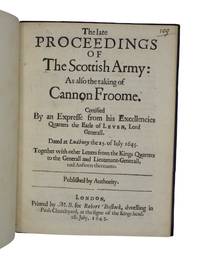
1645AQ22725London: Printed by M. B. for Robert Bostock 1645. 2 6pp. Modern navy morocco lettered in gilt to spine T.E.G. Marbled endpapers early alternate manuscript pagination to upper corners. With a loosely inserted letterpress receipt from bookseller Frank Hammond addressed to Lord Cottesloe acknowledging payment of £12 for the book in 1961. The sole edition of a decidedly uncommon news-book account of the actions of the Army of the Solemn League and Covenant - led by veteran Scottish Army officer Alexander Leslie 1st Earl of Leven c.1580-1661 - in the summer of 1645 reporting most particularly on their taking of a royalist garrison within the moated house at Cannon Froome Herefordshire. Following the defeat of a Royalist rebellion against the Covenanting-led Scottish Government in the Spring of 1645 the Scottish army of the Solemn League and Covenant - named after the 1643 treaty between the reforming parliaments in England and Scotland- led by the Earl of Leven marched south to assist their allies. As this news-book reports a 'party of 4500 Horse Foot and Dragoons' en route to Hereford became aware of a Royalist garrison led by 'Governor Colonell Barnold' in the small Herefordshire village of Castle Froome. After the Royalist commander refused to surrender the moated house which had been reinforced with Irish volunteers after the battle of Newark Leven the 'Lieut. Generall.gave order for storming the place'. The heat of the battle is described thus from a purely Roundhead perspective: 'The Grasses were about nine foot deep and as broad and in most places full of water; The Works above the Grasses were so high that all the Ladders we could get were too short; the Enemy behaved themselves valourously but it pleased the Lord to give our Souldiers to much courage that after a hot dispute they were beate from their works after which they fled to the house where they fought desparately till a great part of them were killed. We lost about 16. and 24. are wounded; of the Enemy were killed about 70. Colonell Barnold deadly wounded Captain Briskoe Capt. Houke & thirty others taken Prisoners.' ESTC records copies at just seven locations in the British Isles Advocates Library BL Hereford Cathedral Newcastle NLS Oxford Trinity College Dublin and just three further elsewhere California State Harvard Texas and Yale. Provenance: Recently dispersed from the Cottlesloe Military Library 'probably the most extensive private collection of early printed books focused on military matters'. ESTC R200176 Thomason E.294 Wing L557. First edition. Quarto. Printed by M. B. for Robert Bostock unknown
1712AQ23533Edinburgh: Printed by James Watson 1712. 30 308 2 309-429pp 1. Title page in red and black. Leaf B1 is a cancellans with 'nople asure' in line eight of text corrected to 'no pleasure'. Some copies have both states of B1 the present copy does not. Handsomely bound in later richly gilt-tooled dark green morocco A.E.G. Lightly rubbed. Elaborate brocade endpapers armorial bookplate of Thomas Maitland Dundrennan to FEP internally clean and crisp. An attractively bound eighteenth-century Edinburgh-printed edition of the controversial ‘Laud’s Prayer book’ an avowedly English-influenced version of the liturgy issued by Robert Young printer to Charles I in 1637. Drafted by the Bishops of Ross and Dunblane John Maxwell d. 1639 and James Wedderburn 1585-1639 the Scottish Book of Common prayer was largely based upon the rite first issued in 1549 during the reign of King Edward VI. Introduced to an unaccepting Scottish population on 23rd July 1637 by Archbishop Laud at the behest of King Charles I it attempted to replace John Knox's Calvinist Book of Common Order and proved the greatest symbol of the unpopular standardisation of Anglican Protestantism throughout the British Isles. The text was one of several triggers of the Covenant movement and the first stages of the War of Three Kingdoms.Despite its unpopularity this historic text influenced the 1662 revision of the English Liturgy the 1789 American Book of Common Prayer and the Scottish Episcopalian Liturgy of 1929. Thomas Maitland Lord Dundrennan 1792-1851 judge and sometime Solicitor General for Scotland. A devotee of antiquarian literature Dundrennan amassed an extensive library - 'a monument' according to Lord Cockburn 'honourable to his taste and judgment'. The contents on which was dispersed by sale over nine days in November 1851. ESTC T138343. 8vo. Printed by James Watson unknown
1772AQ15188Oxford: Printed by T. Wright and W. Gill 1772. 416pp. Contemporary gilt-tooled red morocco 'William Crosbie Esq. Mayor. 1776' stamped in gilt to upper board A.E.G. Extremities rubbed and discoloured loss to gilt tooling joints worn. Marbled endpapers internally clean and crisp but for tear to margin of K2. A handsomely bound eighteenth-century edition of the Church of England liturgy bound for the Mayor of Liverpool and merchant slave trader William Crosbie. ESTC locates three copies of this quarto edition in British libraries BL Bristol and Oxford and a further two in North America Brown and Pennsylvania. ESTC N32792. Quarto. Printed by T. Wright and W. Gill unknown
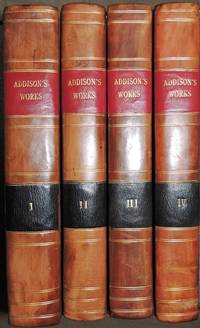
1761biblio137<p><i>First Baskerville edition. Printed by John Baskerville for J. and R. Tonson at Shakespear's Head in The Strand London. Birmingham. 1761. 4 volumes. Quarto. Complete</i><i> with the rare "Directions to the Binder". Text and plates all complete.</i></p><p><i>Vol. I: I title ii blank iii-v dedication vi blank vii-xx Preface xxi-xxv Poem xxvi-xxvii Contents xxvii blank 1-501 Poems on Several Occasions 502 blank 503-37 Poemata 538 blank 3z2 blank 3z2 verso "Directions to the Binder. This leaf is to be cut out". therefore usually missing 413-537 Dialogues upon the Usefulness of Ancient Medals 538 blank 539-42 index 543-4 blank. 3 engraved plates plus 6 plates included in pagination.</i></p><p><i>Vol. II: Title A1 blank A2 sub title to Remarks on Several Parts of Italy A2v blank. A3-A3v Dedication A4-A4v Preface 1-171 Remarks on Several Parts of Italy 172 blank 173-372 The Tatler 373-538 The Spectator 539-40 Index 550 blank. 7 engraved plates.</i></p><p><i>Vol. III: Title blank 3-579 The Spectator 580 blank 581-91 Index 592 blank.</i></p><p><i>Vol. IV: Title blank 3-117 The Spectator 118 blank 119-271 The Guardian 272-8 The Lover 279-300 The Present State of the War 301-7 The Trial of Count Tariff 308 blank 309-32 The Whig-Examiner 333-522 The Free Holder 523-55 Of the Christian Religion 556 blank 557-66 Index 567-8 blank. </i></p><p><i>Full calf spines renewed with gilt rules leather labels in red and black with gilt lettering. Marbled endpapers. Minor paper fault to I p.401 II p.148 no loss; marginal spot II p.100/101; slight marginal browning to IV p.487/8 text unaffected. A handsome set.</i></p><p><b><i>Provenance</i></b><i>: From the library at Thurland Castle. Armorial bookplate of R. H. Welch to fep of each volume illustrated with a Star Wand and Garter crest. Robert Welch Liverpool Merchant. d.1780 of Thurland Castle Lune Valley.</i></p><p><i>ESTC T89166. </i><i>Gaskell 17.</i></p><p><i><br /></i></p> Printed by John Baskerville, for J. and R. Tonson, at Shakespear's Head in The Strand hardcover
14400<p>London: 1955. In very good condition on aged paper in a brown card folder. The material in this collection relates to a book that was never published and included here are copies of two typed letters from WMP to HS casting light on the nature of this doomed collaborative project. In WMP's first letter dated 26 July 1955 he writes to 'Dear Swaff' to 'finalise the manner in which your book is to be written'. Presaging future problems he urges him: 'I do entreat you to remember the fact that a book is different to a series of paragraphs. It must have cohesion. . I don't mind at all whether my name appears or not. That is really of no consequence to me. But I want to see YOU set forth properly and clearly frankly and concisely so that your full genius can be appreciated. If you would rather make it a species of autobiography with successions of stories linked by comments by me I do not mind at all - so long as we understand the method to be used. But those stories must be properly placed.' He concludes by urging HS to 'Think all this over - and when once we can agree on a workable form we shall get a book of which we can both be proud.' The second letter also 2pp. 4to is undated but clearly indicates that the project has hit the buffers: '. it was always my intention that you should speak for yourself on the subject of Northcliffe and also Beaverbrook . If the Northcliffe story goes in as you have given it to me . the whole structure of the book falls to the ground. I don't suppose you have read what I have already written or you would have noticed this. . So far as I can see you want me simply to compile stories and perhaps occasionally comment thereon. I don't know if I can do that. I shall have to consider it. I am not one for blowing my own trumpet and I am never obstructive but I happen to have a small reputation of my own as an author - I have written fourteen books which have all been successful save one . I really do know something of how successful books should be constructed. . It is a very different thing to writing articles .'. An indication of WMP's method is given by Item Seventeen below where he writes: 'Tell Popie to describe how I used to hide at the back of the theatre. Hated being so much the object of attention. It was terrible. I loathed it. I don't like being pointed out. You miss it though when you are not signing autographs. Bloody nonsense. But if everyone stopped . . .' The more substantial items in the collection number as follows: ONE: Untitled typescript by HS largely devoted to Winston Churchill. 14pp. 4to. HS's authorship is made clear on p.8 where typed references to 'I' are amended in pencil to 'Swaffer' and 'he'. The chapter discusses: an occasion on which 'Winston invited Swaffer to join his luncheon table at which his son Randolph and Professor Lindeman afterwards Lord Cherwell were among the party' '"Ah when I was a Liberal" replied Winston "we used to do things. We were not like you Socialists."'; Churchill's meeting with Eddie Cantor; HS's meeting with Churchill and Lloyd George in Marrakesh in 1935; and the results an anti-Churchill's speech by HS at the General Election of 1945. At a meeting 'in the Pinafore Room at the Savoy at which a successor to Churchill was to be demanded' H. G. Wells 'seated in a corner created a sensation when he walked over to the table beside which Swaffer had a chair. . "How dare you talk about racial quality or inequality" demanded Wells. "The only two Englishmen in this room are Swaffer and myself. We both come from Kent. The rest of you are a lot of bastards."' HS encounters Lloyd George while he is writing the 'terrible chapter' of his war memoirs 'in which he indicted Kitchener and Haig': '"They cannot deny one word I have said" began L.G. reading from the chapter. "I am an old solicitor and so I always keep the documents and as I am the only man who was a Cabinet Minister all through the war I am the only one with all the documents. Asquith has some and the Foreign Permiers have some; but I have the lot. Do you know we cannot have another war As Clemenceau once said to me "War is too serious a business to be trusted to soldiers." When a war breaks out you have to create gods for the public to worship. Afterwards when you discover they have feet of clay you cannot destroy the gods of your own creation because the public are still worshipping them."' TWO: 'The Swaffer Legend by W. Macqueen-Pope. Author's Explanation.' Typescript by WMP. 21pp. 4to. With a few emendations. It begins: 'Frederick Hannen Swaffer - more commonly known as Hannen Swaffer - and more commonly known still as Swaff - decided that this book which is perhaps not a Biography but some account of that very remarkable personage which is himself - should be called "The Swaffer Legend". I had wanted another title but I defer to his wishes. We are very old friends and I think we understand each other.' THREE: 'Chapter blank The Dramatic Critic'. Typescript by WMP. 15pp. 4to. With emendations. Ending with anecdote about Paul Robeson 'a man whom he admired as an artiste and as a representative of his race and colour . Swaffer has no colour bar.' FOUR: 'Grant Morden and the People Strike'. Typescript by HS. 11pp. 4to. Paginated 1-17 but lacking 3-8. Begins: 'Hannen Swaffer was perhaps the worst Tory editor that London has ever known.' FIVE: 'Drunks.' Typescript by HS. 7pp. 4to. Beneath title: 'H. S. suggests that you put a line on the top of each chapter in italics. "The legend is also that of a drunk . . .".' Begins: 'This sort of thing continued. Going into an Albert de Courville first night at the Palace having had a lot of drink he accused Archie de Bear who was the Press Manager and whom he had never met before of dodging the Army.' SIX: 'Pemberton-Billing'. Typescript by HS. 9pp. 4to. Begins: 'The most remarkable story that Swaffer has never himself printed is the account of the extraordinary happenings behind the Pemberton-Billing case which some said at the time "nearly stopped the War."' SEVEN: Untitled typescript by Maurice Barbanell 1902-1981 editor of 'Two Worlds' on 'the Spiritualist side of Swaff's life'. 17pp. 4to; consisting of fifteen paginated pages on yellow paper with two unpaginated pages of white paper loosely inserted after p.7. Begins: 'So far as Spiritualism is concerned Swaff is a living paradox. By virtue of the fact that he is the Honorary President of the Spiritualists' National Union - Sir Arthur Conan Doyle is its "spirit" President - Swaff is the head of an organization which has five hundred churches.' EIGHT: Part of typescript by HS. 6pp. 4to; paginated 16-21. Begins: 'He called on Mrs Janis the most famous theatrical "mother" of all time indeed the founder of that race.' NINE: Typescript in red by HS. 3pp. 4to. Begins: 'Swaff first came to the Gallery First Nighters' Club about the year 1908. In those days the cream of speakers and debaters interested in matters Theatrical regularly visited the Club to join in the talks and idscussions which were a feature.' TEN: Typescript. 1p. 4to. Anecdote regarding Lloyd George. ELEVEN: 'Swaffer Stories' list of themes. Typescript by WMP. 3pp. 4to. Including headings 'Northcliffe' 'Daily Mirror' 'Names of people who worked for him and became famous'. Last entry: 'The Captain who used to work for Bairnsfather - who messed up The Daily Mirror Sancastle sic competition - and when you went to Monte Carlo with him - just as you stood.' TWELVE: Typescript by WMP. 1p. 4to. With manuscript additions. Progress report beginning: 'Book now up to Northcliffe - as ending an epoch.' THIRTEEN and FOURTEEN: Typed Letters Signed to WMP from C. L. Shard 9 March 1955 and J. Canning 9 September 1955 of Odhams Press Ltd. Shard hopes that 'our association will not be confined to the Swaffer book' for which he is sending 'the contract in its final form including the amendments to Rubens'. FIFTEEN and SIXTEEN: Copies of Typed Letters from WMP to 'Kate' at Odhams 9 and 21 November 1955 reporting on progress. SEVENTEEN and EIGHTEEN: Undated Typed Notes from HS. Both 1p. 4to. Item Seventeen quoted above. Item Eighteen note headed 'Crusades' and beginning 'Tell Popie he'd better say that the first one he remembers was the Pit Ponies.' NINETEEN: Covering letter to Item Seven from Barbanell 1p. landscape 8vo on letterhead of 'Two Worlds' 15 July 1955. With a small collection of miscellaneous related material including rough notes in pencil and ink; three letters to WMP one from 'Lesley' and another from 'Arnold'; a menu/programme for a 'Variety Club Luncheon to honour The Doyen of International Journalists Hannen Swaffer' 19 March 1953 illustrated with photographs of HS; and six newspaper cuttings relating to HS.</p> [London: 1955.]
First Edition, imprimatur leaf, engraved frontispiece, [4], 219, [5] pp., contemporary panelled calf, hinges partly cracked, label, a nice copy. Written by the judge, traveller, diplomatist and pamphleteer, Sir Thomas Burnet, (with the collaboration of George Duckett). In fact the correspondence between Burnet and Duffett (Roxburghe 1914) makes it clear that this was a joint production. This political satire on the statesman Robert Harley, Earl of Oxford, is far from being destitute of wit and humour and takes the form of an account of Martin Powell (fl.1709-29), the somewhat physically deformed showman who ran a celebrated puppet-show in Covent Garden. It also, of course, adopts the title of Swift's celebrated 'Tale of a Tub' (but is not recorded by Teerink-Scouten in the list of this work's spurious sequels etc.).
18702090502128301282Not Available 1870. Soft Cover. Fine. The book is in fine condition. Not Available paperback
1751628960London, Osborne & Sandby, 1751-61. Leder d. Zeit mit Rückenvergoldung u. marmorierten Vorsätzen (berieben, Ecken etwas bestoßen, einige Bände mit Wurmspuren, Schabstellen oder kl. Ausbrüchen an den Kapitalen, 3 Bände mit größeren ergänzten Fehlstellen im Bezug, 4 Rückenschilder abgerieben). [2 Warenabbildungen]
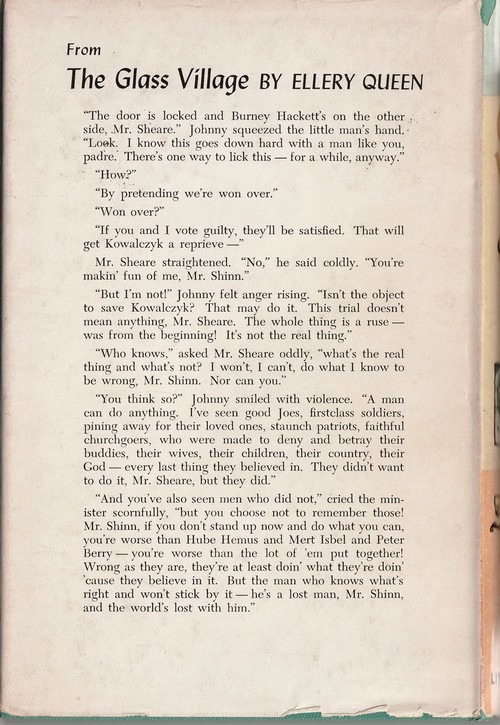
19487581Etats-Unis, Boston and Toronto, Little, Brown and Company, 1954. In-8 cartonnage éditeur, pleine toile vert pâle, de 282 pages au format 14 x 3,5 x 21 cm. Couvertures muettes. Dos rond avec titre. Complet de la superbe jaquette illustrée par J.O'H. Cosgrave II, en superbe état, avec quelques infimes frottis et minuscules manques épars. Plats et intérieur frais. Carte illustrée en pages de garde. Rare édition originale américaine et canadienne, publiée simultanément dans les 2 pays et portant la mention " First Printing " au colophon. Superbe état de fraicheur. Précieux exemplaire enrichi d'une cordiale et belle dédicace autographe, signée, de Ellery Queen à Thomas Narcejac : To Thomas Narcejac with the warmest thanks of Ellery Queen. Provenance idéale. Les dédicaces d'Ellery Queen sont très rares.
194818151Etats-Unis, Cleveland and New York, The World Publishing Company, 1948. In-12 cartonnage éditeur, pleine toile grise, de 288 pages au format 13 x 19 cm. Couverture avec petite illustration. Dos rond avec titre. Complet de la belle jaquette illustrée, en superbe état, avec quelques infimes frottis épars. Plats et intérieur frais. Anthologie qui contient 14 histoires inédites en volume, par Dashiell Hammett, Agatha Christie, G. K. Chesterton, T. S. Stribling, E. C. Bentley, John Dickson Carr, Anthony Boucher, Ellery Queen, etc. Illustrations en noir par Seymour Nydorf. En fin d'ouvrage on trouve une liste des 101 plus importants livres policiers avec notes, critiques et bibliographie. Rare édition originale américaine en superbe état de fraicheur. Précieux exemplaire enrichi d'une cordiale et belle dédicace autographe, signée, de Ellery Queen à Thomas Narcejac : To Thomas Narcejac with my best wishes. Provenance idéale. Les dédicaces d'Ellery Queen sont très rares.
First edition, 4to (208 x 160 mm), [12], 52pp., with 16 mounted albumen prints by the Sheffield photographer Theophilus Smith and text by John Holland, including a frontispiece and a circular photograph on the half-title that is possibly photolithographic, all with original guards scattered foxing as usual, the deluxe edition (probably issued for civic presentation) in full brown/red morocco, inner gilt dentelles, all edges gilt, with elaborate blind stamped and gilt blocking, a very nice copy. The first of Theophilus Smith's photographically illustrated Sheffield books issued in the year of the flood in 1864. Gernsheim, 233; Goldschmidt & Naef, The Truthful Lens, 151.
4to, [2], 130pp., etched frontispiece, limitation statement in ink below imprint "Only 150 Copies printed and is now (1844) very scarce, TLP", small ink number to verso of title-page, 19 plates drawn and etched by John Chessell Buckler, plus a folding pedigree, unobtrusive stamp to verso of final plate, recent calf calf, marbled paper boards, spine gilt with morocco lettered label. The first guide to Browsholme Hall and one of the rarest and finest of the genre. The guide was compiled by Thomas Lister Parker and "privately printed by the author for distribution among his friends. The sale was afterwards limited to 100 copies."?Upcott, p. 1410. The next historical guide was written by Colonel Robert Parker in 1957 when Browsholme Hall was opened to the public. Thomas Lister Parker (1779?1858) was born at Browsholme Hall and obtained possession of the family estate as soon as he came of age at the age of twenty-one. "He went on his grand tour in 1800, visiting France, Italy, and Russia, and returned home in 1801 with a collection of paintings, drawings, and prints. In 1805?7 he altered the sixteenth-century Browsholme Hall, using Jeffry Wyatt (later Sir Jeffry Wyatville) as architect to rebuild and extend the west wing: this provided a new drawing-room and dining-room, suitable for the display of his growing picture collection. Landscape gardening and forestry also engaged his interest. In the house he displayed a collection of antiquities, a feature of which was the creation of interiors evoking Browsholme's mainly Jacobethan past."?(Oxford DNB). Boyne CXCI; Upcott, pp. 1408-10.
192923537London: The Haymarket Press 1929. Limited edition. Hardcover. Very good. Illustrated with four color plates by W Russell Flint. Thin 4to. 47pp. One of 100 copies; this is number 8. Limp vellum spine and upper board with title in gilt. General light soil to the vellum and ties else a very good copy.<br /> <p><br /> The extra suite of plates has been mounted on blank pages leaving a small adhesive discoloration on the margin of the plates and on the supporting page.<br /> <p>. The Haymarket Press hardcover
1830257842Thame Oxfordshire 1830. 50 pp of manuscript hymns responses and chants with four-part vocals and organ accompaniment. Oblong 4to. Bound in full black morocco covers blind-stamped and tooled in gold to a panel design with wide rolls stamped with the initials "S.E.W." on the front cover and "W" with a crown on the rear cover. 50 pp of manuscript hymns responses and chants with four-part vocals and organ accompaniment. Oblong 4to. A musical notebook beautifully bound in the Regency style belonging to Sophia Elizabeth Wykehanm 1st Baroness Wenman of Thame Park 1790-1870. She was an early love interest of the future King WIlliam IV - when he later ascended the throne he revived the title of Baroness Wenman. Provenance: Sophia Elizabeth Wykehanm 1st Baroness Wenman of Thame Park her monogram in gilt on the binding unknown