42 295 résultats
5 Vols., 4to (268 x 180 mm), limited to 130, frontis., portrait, a very good ex-library set, later red quarter calf, cloth boards. Huth's collection, which ranked among the finest in England, was rich in incunabula, voyages, Shakespearean and early English literature, and Bibles. He began compiling this catalogue late in life, but finding it too time-consuming, he employed W.C. Hazlitt and F. S. Ellis to do most of the work. "With the assistance of Ellis and Hazlitt, Huth had started printing a magnificent catalogue of his library, with full titles of every item and exact collations, both entirely novel features in a library catalogue. The work was completed in five volumes two years after his death and has remained... a corner-stone of British bibliography." De Ricci, p. 151.
6 volumes, 8vo, large paper?, illustrated with 2 of 3 frontispieces and an engraved letter, handsomely bound in a full period straight grained green morocco, floral gilt decoration in compartments, Greek key inner dentelles and gilt edges. Anna Seward 1742-1809 was an English poet, often called the Swan of Lichfield. She benefited from her father's progressive views on female education. Provenance: Small armorial on the boards Impiger et Fidus - family of David Constable and signed by the publisher Archibald Constable, Edinburgh on the endpaper.
34861VERONA OFFICINAE BODONI 1952. LIMITED TO 225 COPIES THIS BEING NUMBER 24. ILLUSTRATED WITH WOODCUTS BY BARTOLOMEO DI GIOVANNI RECUT BY FRITZ KREDEL PRINTED IN GRIFFO TYPE ON HAND-MADE FABRIANO PAPER. QUARTER VELLUM OVER PATTERNED CLOTH. A FINE COPY IN A DAMAGED SLIPCASE. WITH THE BOOKPLATE OF ROBERT ELWELL TO FRONT PASTEDOWN. VERONA, OFFICINAE BODONI, 1952 hardcover
1649150001London: Printed in the Year 1650 i.e. 1649. One of five editions all listed by ESTC as printed in 1649 with a 1650 date with minor variations; the author argues against duties of obedience to a usurping power naturally directed against Parliament and the new Commonwealth. Authorship is unclear - an attribution to Richard Hollinworth is still held by ESTC based on a report by the contemporary Adam Martindale but is also credited to Charles Herle and DNB places it as by Edward Gee "with little doubt". The latter attribution is most commonly accepted. Small quarto 182 x 131 mm. Recent brown quarter calf gilt ornaments in compartments marbled sides vellum tips. Contemporary ownership signatures "John Bryan 3d" and "E. Bailey" to title. Selbourne Library stamps to title verso and to p. 51 small slip of paper affixed to p. 53 covering a few letters. Binding fine; contents generally a little browned and soiled as usual for pamphlets of this date. A good copy. ESTC R201998; Wing G449. hardcover
9853Ginerva, e si vende a Parigi / London, G.-J. Paschoud / Printed for J. Murray by T. Davison, 1818 / 1814 / 1821. In-12 de XXIV-93; [8]-128; [4]-VII-47; 81-[2]; [4]-XVIII-[1]-20 à 271 pages, demi-veau blond à petits coins, dos lisse orné de filets et titre dorés, étiquette de titre caramel. Coins et dos frottés, rares rousseurs. Ex-libris Charles de Constant-Rebecque.
181920072ABLondon, Printed for T.M'Lean, Bookseller and Publisher, 1819. 22 : 14 cm. LXXXVIII; 376; VII, 403; XVI, 370; VIII,440 pages. Together with 24 colourd engravings. Red full morocco, spine and boards richly gilt, two back labels, innerfilets, edges gilt. 4 volumes
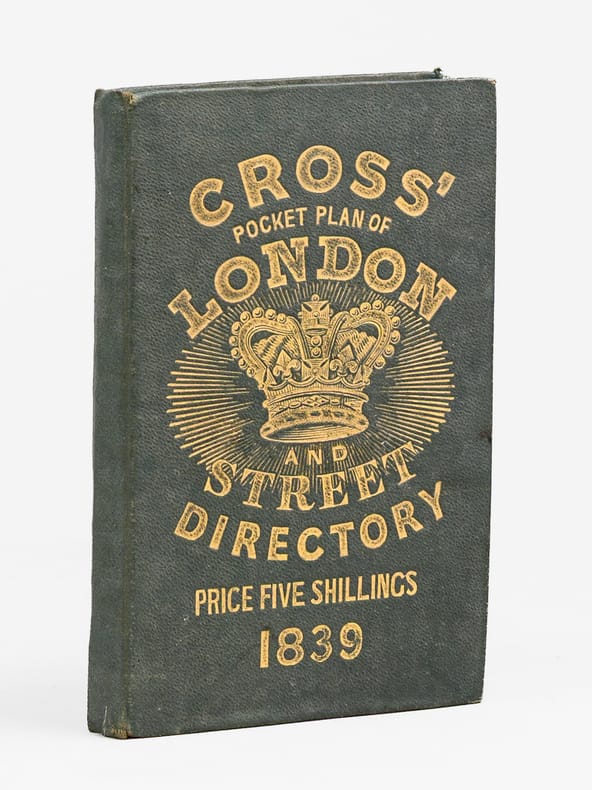
1839715771 carte dépliante en entoilée en couleurs, format 44 x 75 cm sous chemise cartonnée avec liste de repérage, Engraved & Published by J. Cross, 18, Holborn opposite Furnival's Inn. J. Cross, London, 1839
1997015820Paris Claude Duthuit 1997 In-4 Cartonnage toilé, jaquette illustrée
FIRST EDITION OF THIS EXCERPT OF THE CHRONICON SYRIACUM DEALING WITH RICHARD THE LION-HEART'S DEEDS IN THE HOLY LAND (often involving Saladin), WRITTEN BY GREGORY BAR HEBRAEUS, widely regarded as a highly reliable source. 20, XI pp. Syriac text and Latin translation. BEAUTIFULLY PRINTED AT THE CLARENDON PRESS WITH ELEGANT SYRIAC AND ROMAN TYPES ON EXTREMELY FINE, THICK LAID PAPER, WITH HUGE MARGINS. Bruns published this text, in part, as a specimen of his full edition of the Chronicon, published in 1789 (see Gentleman's Magazine, 1781, pp. 131-132. Also 1789, second part, pp. 1109-10.) 4to. Sewn into plain wraps, as issued. A bit of wear and tear to wraps, else A PRISTINE COPY, ENTIRELY UNCUT, BRIGHT, AND FINE. EXTREMELY RARE, IF NOT UNIQUE, IN THIS STATE.
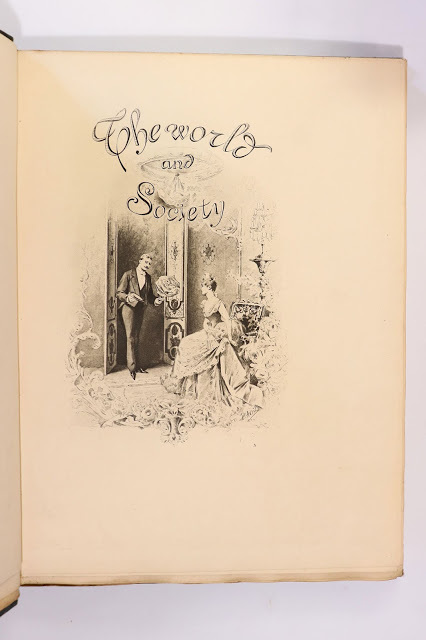
1889AMO-3090London, John C. Nimmo, 1889 1 volume in-4 (32 x 23 cm) de 160 pages. 160 illustrations illustrations autour du texte tirées en plusieurs couleurs (bleu, noir, rouge, polychrome, violet, argent, doré, etc.). Cartonnage pleine toile bleue de l'éditeur (cartonnage usagé mais solide, usures et taches). Intérieur du volume frais. Papier Japon non rogné. Tirage spécial sur grand papier du Japon "Large Japanese Paper Edition" à 100 exemplaires seulement. Chaque exemplaire est numéroté à la plume. Celui-ci porte le numéro 85. L'édition originale française a paru chez Albert Quantin à Paris le 7 novembre 1887. A peine plus d'une année après cette édition anglaise paraît chez Nimmo à Londres. En réalité l'impression des illustrations en couleurs a été réalisée dans les ateliers parisiens d'Albert Quantin. Seul le texte semble avoir été imprimé en Angleterre chez Ballantyne et Hanson. Il faut noter également que les pages de faux-titre pour chaque chapitre du volume ont été redessinées spécialemennt par Paul Avril avec une nouvelle calligraphie du texte (pour pouvoir intégrer le texte en anglais). De même il n'existe pas de couverture illustrée pour l'édition anglaise (elle n'a pas été refaite par Paul Avril). Cependant nous avons que le tirage courant a été recouvert d'un cartonnage toile illustré sur le premier plat (différents coloris de percaline ont été observés - lie de vie - gris). Voici la liste des chapitre. Proscenium. The world and society. Arts and Literature. Home life. Study. Love. Travel. Sports. The Table. The Reverie. The country. "De tous les livres faits par l'auteur de l’Éventail avec la collaboration de Paul Avril, celui-ci est incontestablement le mieux réussi au point de vue rendu des dessins par procédés divers, héliogravure en creux et en relief, fac-similés Gillot, chromogravures typographiques, emploi des bronzes pâles, feu, orange, verts, usage des glacis de platine et d'étain alliés aux couleurs repérées, etc. Livre essentiellement nouveau que celui-ci, il faut le dire, et qui témoigne, aux yeux des gens du métier, de mille difficultés vaincues et d'audaces décoratives heureusement couronnées de succès. Le Bibliophile, en tant qu'éditeur artistique, a quelque vanité de n'avoir rien raté dans la mise en oeuvre si complexe de ce livre. Quant au texte, il n'est peut-être pas parfait pour plaire à beaucoup, car sa philosophie antimondaine, parfois même antisociale, a le défaut d'être très personnelle et par conséquent exclusive ; l'écrivain étant d'un absolutisme de pensée rigoureux que d'aucuns trouvent très souvent excessif." (extrait du Catalogue de Quelques-uns des Livres Contemporains en exemplaires choisis, curieux ou unique tirés de la Bibliothèque d'un écrivain et bibliophile parisien et qui seront livrés aux enchères les 2 et 3 mars 1894. Paris, Durel, mars 1894. n°440 pour ce commentaire). Ce livre, pour l'avoir lu attentivement malgré quelques longueurs et lassitudes nichées au sein de quelques chapitres, nous livre la pensée d'Octave Uzanne à l'aube de ses 36 ans. Jeune célibataire (L'amour), épris de libertés et d'indépendance, ayant déjà un goût prononcé pour les voyages qu'il effectuera bientôt en grand nombre, philosophe, penseur, critique et journaliste, misanthrope aussi, déjà, rêveur presque asocial par certains aspects. Voilà l'Octave qu'il nous dépeint en quelques cent cinquante pages presque toujours richement illustrées. C'est sans doute l'un des livres les plus intimistes qu'il a donné au public avec le Paroissien du célibataire publiée en 1890. Ce livre est négligé par erreur par les bibliophiles qui ne lisent pas. Il doit, au contraire, nous le croyons, occuper une place de choix dans la bibliothèques de bibliophiles qui lisent. Rare tirage de luxe sur Japon de l'édition anglaise.
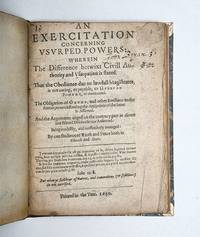
First edition, 4to, [8], some light dust soiling to title and margins slightly chipped. "An "Answer" to an Advice to a Painter in which the loyal members of the Artillery Company of Bristol had been attacked. The author, an ardent Anglican Tory, satirized the non-conformists (Presbyterians, Anabaptists, Antinomians, Brownists, Adamites, Chiliasts, Quakers, Muggletonians, and Independents) and accused them of plotting rebellion against the King." (Osborne). Wing A639 & ESTC (EN, CH; WF only); Osborne, Advice-to-a-Painter Poems 1633-1856. p. 48.
1707265207London: Charles Bill and the Executrix of Thomas Newcombe; G. Croom for the Company of Stationers 1707. Engraved title-page. 8vo. Early 19th-century full diced Russia preserving original 18th-century brass clasps and catches clasps engraved with the initials "R" and "D" rebacked preserving spine a.e.g. Covers lightly worn textblock trimmed touching headings edges of title and first few leaves worn dampstain at lower margin of first few leaves soiling and browning throughout. Engraved title-page. 8vo. An early 18th century Bible belonging to Robert Dewhurst and family with an elaborate full-page calligraphic ownership inscription on the ffep and Dewhurst's initials engraved onto the binding clasps. ESTC N11371; Darlow & Moule 701 with 1708 engraved title. Provenance: Robert Dewhurst b. 1682 initials engraved on clasps calligraphic ownership inscription on ffep Dewhurst family register on versos of New Testament and Psalms title-pages Charles Bill and the Executrix of Thomas Newcombe; G. Croom for the Company of Stationers unknown books
8vo (140 x 90 mm), newly corrected & imprinted, with new additions, 176, [9]pp., title within a decorative border, black letter throughout, 3 contemporary ink notes in the blank margins, small pieces missing from lower blank margins of P1, Z3 & Z4 (just touching the text), with the 4 final contents leaves, faint pink stain (ink?) on tip of lower corner of 25 leaves, later vellum, new endpapers and ties, a nice copy. The first dialogue is a modified translation of his "Dialogus de fundamentis legum Anglie et de conscientia." STC, 21577.
188083103c.1880. Charming country scene showing the river Thames with Windsor Castle in the background. Original watercolour. Size: 360 x 520 mm Excellent condition. unknown
26515Cambridge. Undated but written shortly before the publication of his poems in 1801. 3pp. 4to. Bifolium. In good condition lightly aged with thin stub from mount neatly adhering. A long closely written letter of 116 lines including eight-line postscript at head of first page. Addressed by Dyer on reverse of second leaf: 'To Lord Buchan Dryburgh Abbey Berwickshire Scotland.' Buchan has annotated the reverse of the second leaf: 'George Dyer Characteristic while I reasoned with George Dyer in my Library at Dryburgh Abbey on the Economy of Nature and the Providence of God I said Heaven itself will one day bear witness to my Words. At the instant there was a flash of Lightning so vivid as to deprive us for a moment of Sight This . subject for Poetry' latter part obscured by stub. Both men have interesting entries in the Oxford DNB. Dyer's entry stresses his eccentricity of which the present letter is indeed 'Characteristic'. The main topic is Dyer's obsessive belief that his conversation has in some way offended Buchan and 'given very undesignedly some offence to my friends in Scotland'. Dyer also discusses the preparation for publication of privately-printed 'Poems' of 1801 whose 'Ode XXXIX' is titled 'After visiting Dryburgh Abbey in Berwickshire the Seat of Lord and Lady Buchan'. The poem carries the following footnote: 'This delightful spot now the residence of Lord and Lady Buchan was formerly a monastery. In a part of the chapel are now placed the busts of our English poets. Lord Buchan is well known as a man of letters.' The florid opening paragraph of the letter starts: 'Kind Sir It is unpleasant to write and no less unpleasant to read letters of apology: they move heavily and leave behind nothing worth remembering. The writer feels like a prisoner at the bar and if conscious of crime recollection of civilities received he finds painful and without waiting for the decision of the judge he confesses himself worthy of punishment.' The second paragraph sets out Dyer's specific concerns: 'I intended writing to you from Berwick and to acknowlege sic your civilities to me when at Kelso: but I thought it expedient afterwards to defer writing till after I had been at Richmond more particularly as my mind at the time was quite occupied with poetical reveries though I said nothing on the subject to my ingenious and sensible fellow-traveller. On my arrival in London I expecterd to receive letters from Dr. Anderson the author and editor Dr Robert Anderson 1750-1830 who like Buchan was a member of the American Antiquarian Society to be conveyed to sic me under cover to James Marten: one was to have been a letter to Park from Dr. Anderson as a kind of introductory letter. From Park I expected to hear every thing relative to the Richmond business: but I waited in vain for letters and knew nothing concerning the place for solemnizing the birth-day of Thompson. I was extremely puzzled to account for this silence and was at length unhappy fearful that I had given very undesignedly some offence to my friends in Scotland: I have however since recd: letters perfectly satisfactory from Dr. Anderson and others: having however no letter to Park and the birth day of Thompson having passed by unnoticed I was perplexed and knew not what to say to you.' He gives the gist of a speech made by Buchan 'when I had the pleasure of seeing you at Dryburgh' on the subject of acknowledging the giving of pain by ones words and confesses: 'Now Sir I did recollect having made two speeches of this kind and though probably you may not recollect them or indeed might not have noticed them at the time yet the recollection of them gave pain to me.' He explains at length how he 'wished to apologize' but 'knew not what to say or how to begin'. But now Buchan's 'very civil letter' has 'removed my suspicions that he has given offence and increased my respect for you.' Again he had wished to answer immediately but could not get a frank: 'I had not an opportunity of getting the name of an M.P. as the friends who are kind enough to favour me with their names occasionally were not in town'. He has been 'pedestrianizing backwards & forwards to Cambridge time insensibly stole away … and therefore now write to you from Cambridge though I have no M.P. at hand'. After further apologies and explanations he praises Buchan's 'delightful retreat of Dryburgh Abbey and the learned Hermit residing there' adding: 'you may rest assured yourself that I shall not forget them in my poems ere long to be published. I am at present quite enslaved to Poetry. I am just ready with a volume of poems in which I shall not be forgetful of the hospitality of sic natural beauty of Scotland: The Muse however is obliged to give way for a reason and a violent head-ach a bad substitute supplies its place: a pain which I assure you is not diminished by contemplating the contents of this letter.' He hopes he will have 'the pleasure of revisiting Dryburgh at some future opportunity when I shall be in better spirits than I am at present and when I may be able to express in person what I now do by letter viz: that I have a high sense of your civility and worth.' He may return to Dryburgh with his 'particular' friend James Ramsay Cuthbert of neighbouring Ednam. He has 'delivered' Buchan's 'remembrance to Laetitia. Barbauld D. Gregory & Dr. Tytler' and hopes to see him on his return to town. In the concluding paragraph he states that he has delivered Buchan's 'papers to the Editor of the Monthly Magazine: they as yet have not I perceive made their appearance but owing to no neglect of mine. I delivered them immediately on coming to London: one indeed is I believe precluded from being inserted there as having been published before: the other will I doubt not appear next month'. At the end of the letter Dyer declares that he holds 'some peculiarities of sentiment' and in the postscript he expresses the hope that he will be 'in better spirits' if he has 'occasion to write again to Dryburgh … on a more agreeable topic'. He ends with reference to his 'fellow traveller J. Leyden who was kind enough to accompany me from Edinburgh to Newcastle is very clever; as also is your neighbour Landie the son of the Dissenting minister'. Accompanying the letter is an engraving of Dyer by Henry Meyer from a drawing by 'Miss Beetham' 'Published by Mathews & Leigh 1809'. In good condition in windowpane mount. Cambridge. Undated, but written shortly before the publication of his poems in 1801. unknown
37537LIVORNO POZZOLINI 1827. THREE VOLUMES COMPLETE. FIRST AND ONLY LIVORNO EDITION BEING A RE-IMPRESSION OF THE TRUE FIRST EDITION OF MILAN. CONTEMPORARY HALF VELLUM GILT LETTERED GREEN MOROCCO LABELS CLEAN AND TIGHTLY BOUND. BOUND WITHOUT HALF TITLES. ITALIAN TEXT. pp.328 353 398. WITH THE ARMORIAL BOOKPLATE OF CHARLES FIRST VISCOUNT OF EVERSLEY OF HECKFIELD SOUTHAMPTON 1794-1880 FORMER SPEAKER OF THE HOUSE. AN ATTRACTIVE SET. LIVORNO, POZZOLINI, 1827 hardcover
052681Cambridge Printed by John Archdeacon, Printer to the University 1775 in 8 (21;5x14) 2 volumes reliures plein maroquin vert de l'époque, dos lisses ornés de riches caissons dorés, plats ornés d'un encadrement de filets et guirlandes dorées, tranches dorées (contemporary green morocco), non paginé, texte sur 2 colonnes, ex-libris sur pièce rectangle de maroquin vert de John Lawes Clarendon, Jamaïca 1 1779 (à l'intérieur des 2 plats supérieurs) Printed by John Archdeacon and sold by John, Francis, & Charles Rivington, Benjamin White, Edward Dilly and Thomas Beecroft, in London; and T. & J. Merrill in Cambridge. Archdeacon was University Printer from 1766 to 1793. Rare exemplaire à provenance Jamaïcaine. Bel exemplaire ( Photographies sur demande / We can send pictures of this book on simple request )
177411283Paris, Panckouck, 1774 ; 2 tomes in-8 ; plein veau fauve marbré, dos à nerfs décoré et doré, titre doré, tranches rouges (reliure de l'époque) ; (4), XLVI, 428 pp. ; (4), 589, (3) pp. de Privilège, 1 grande planche dépliante ; le faux-titre porte "État général de la culture anglaise".
18210032London, John Murray on Albemarle Street, 1825. First edition. Two volumes, 230 x 148 mm, (xii) 373 + (viii) 380 pp. Recently rebound in half morocco leather with 5 raised bands, author's name, title, volume number and year stamped in gold, marbled papers on covers and as endpapers. Headbands. Volume I features a picture of two masked women as "The Usual Walking Costume of Lima", a short preface, 12 chapters, 5 colored plates and an unfolding map of South America. Volume II features four color plates, including a frontispiece as well, chapters 13-19, no less than 26 appendixes and a very long folding map. "Caldcleugh came to Brazil as private secretary to the British Ambassador, Edward Thornton. From October, 1819, until 1821 he lived in Rio, and from there travelled to Argentina and Chile. His return journey again took him through Brazil, and this time he visited Minas Geraes which he describes on pp. 178-288 of the second volume. Caldcleugh's work has great documentary value. An excellent and impartial observer, he describes Rio de Janeiro with great accuracy, and studies the social, agricultural, financial, and political situations in Brazil. The part referring to the mines in Minas Geraes is of great interest. The first volume contains two very beautiful views of Rio de Janeiro." (Borba de Moraes, I:144) "An example of the very important travel literature of the period" (Griffin 3455). Abbey Travel 699, Sabin 9877. This work also includes appendices on matters such as meteorology, the slave trade, and shipping.
London, printed by J. Worral and Co. A. Shuckburgh, T. Waller, P. Uriel, W. Owen, B. White, H. Woodfall, W. Strahan, J. Rivington, R. Baldwin, L. Hawes and Co. T. Longman, Z. Stuart, W. Johnston, B. Law, T. Caslon, T. Payne, and T. Cadell, 1768-1770, volumi 5, in-folio, legatura novecentesca in piena pelle con punte, i piatti in pelle antica, alcuni con motivi fitomorfi a secco, labbri dei piatti (antichi) decorati, dorso a 6 nervi con singoli ferri e filetti in oro, titolo e autore in oro su tassello in pelle rossa, pp. [20], 692 - [20], 687 - [22], 823 - [16], 698 - [14], 544, [10]. Una traccia di tarlo al vol. V ma ben lontana dal testo; qualche traccia di umidità, marginale, al vol. II; consunzioni alla pelle antica dei piatti. Nel complesso un bell'esemplare di questa terza edizione del celebre “Bacon's Abridgment”. Raro.
187219774LONDRES 1872 Un acte Notarié Manuscrit à l'encre brune, rouge et noire, sur velin (doubles feuilles écrites d'un seul côté), format : 70,5 x 55 cm, avec en bas 6 cachets de cire rouge "aux armes", signatures, cachet sec bleu et argent ten schillings, cachet encre noir de la couronne London 2/10/72, daté du 30 Décembre 1872, ceci est l'acte marqué B visée de Charles Ughtred Shuttleworth et rose Isabella susan Shuttleworth sous serment devant moi 14 TH Dayol avril 1882, en la Haute Cour de Justice, division de la Chancellerie (LONDON), HALL vice-chancelier,
Contents: "XVI Poems", "Reilly" (Part I, Reilly Dead - Part II, Reilly Born - Part III, Reilly Living). Allegate 16 pagine dattiloscritte su carta velina (per copie di macchina da scrivere) con poesie dell'Autore, di cui alcune presenti nel libro, con piccole varianti, altre ancora inedite in volume. Le poesie dovevano molto probabilmente servire per una traduzione italiana Stampato a Roma dalla Tipografia Laziale. 8vo. pp. 84. Dedica autografa dell'Autore ad un importante letterato italiano, datata Aprile 1962 (Inscribed and signed by the Author to an important Italian literary man). Molto buono (Very Good). . Prima edizione di 250 esemplari. . Prima raccolta di poesie di O'Grady. " This book is the first indipendent collection of poems to be published by a young Irish poet whose work may be familiar to the readers of experimental magazines. What principally distinguishes these poems from those of the generation that preceded them is, simply, their indisimulated or Arnoldian seriousness." (dalla aletta della sovracoperta)
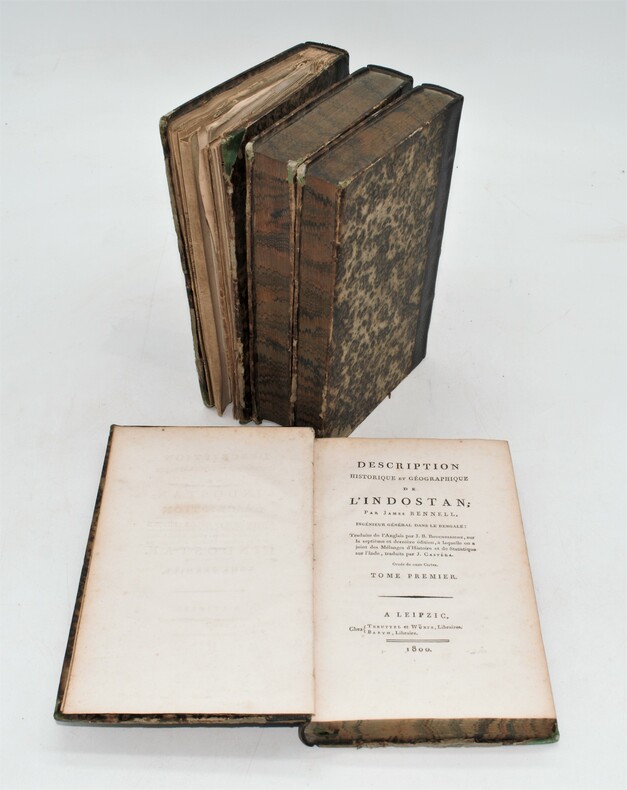
1800P2-8BLeipzic, Treuttel & Wurtz ,1800. 4 volumes in-8 , relié demi basane , dos à nerfs avec auteur , titre et tomaison , tranches et gardes peignées , coupes et coins usés , petites rousseurs . Complet en 3 volumes de texte et 1 volume d’Atlas , de XXXVIII pp., 302 pp. - 2 ff., 410 pp. - 2 ff., 362 pp. - Atlas, 39 pp., 11 cartes dépliantes. Première édition française, traduite par Jean-Baptiste Boucheseiche sur la septième édition anglaise. Elle est illustrée de 11 cartes repliées réunies dans un atlas séparé
1903RO60109917Adam and Charles Black. 1875-1903. In-4. Relié. Etat d'usage, Couv. légèrement passée, Dos frotté, Quelques rousseurs. 35 volumes d'env. 900 pages chacun. Illustrés de très nombreuses gravures, cartes et photo-gravures en noir et blanc, dans et hors texte. Texte sur 2 colonnes. Reliures d'éditeur vertes ou noires, à titres et motifs dorés. Tranches de tête dorées. Quelques dos et quelques plats abîmés ou défraîchis. Quelques couvertures se détachant. Quelques feuillets déchirés. Texte globalement bien lisible.. . . . Classification Dewey : 423-Dictionnaire anglais
xxxvi + 640, xvi + 552 pages. Balance of title reads as follows: "Containing an Account of the Cruel Civil Wars Between the Houses of Orleans and Burgundy; of the Possession of Paris and Normandy By the English; Their Expulsion Thence; and of Other Memorable Events That Happened in the Kingdom of France, as well as in other Countries. A History of Fair Example, and of Great Profit to the French. Beginning at the Year MCCCC., Where that of Sir John Froissart Finishes, and Ending at the Year MCCCCLXVII., and Continued by Others to the Year MDXVI." Illustrated with woodcuts. Bookplate of Reginald Hibbert Tupper upon each front free endpaper. Mr. Tupper was the son of the Canadian Prime Minister of the same name. Ink signature upon verso of front blank leaf of volume I. Some foxing to colour title page of volume I. Faded marbling to edges. Back hinge of Volume I starting. Somewhat above-average external wear. Both volumes tight and square. Book