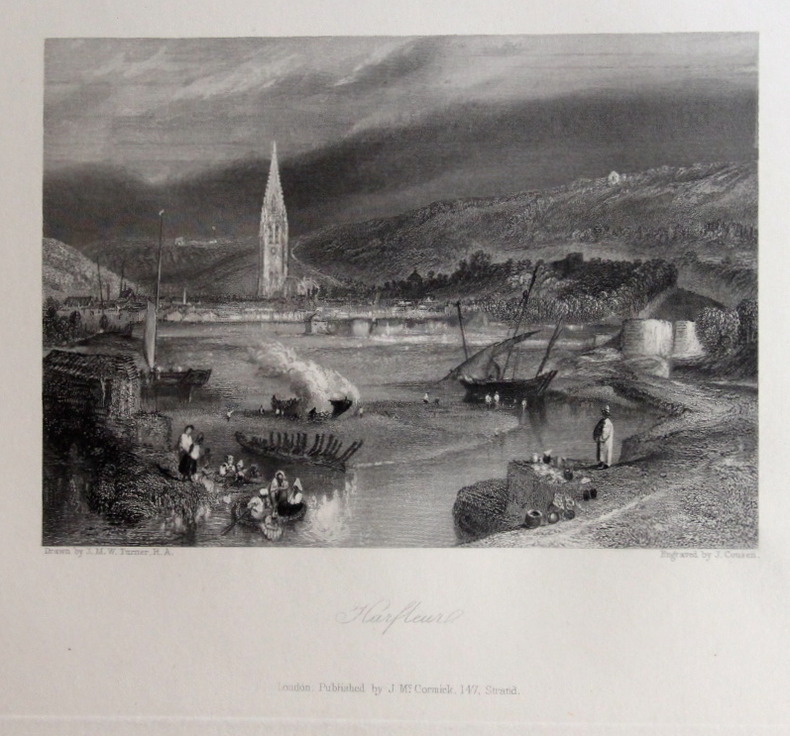
TURNER J. M. W:Livre Rare Book
42 295 résultats
2426London, Longman, Rees, Orme, Brown, Green & Longman, sans date. 1 vol. in-8 de [60 ff.] suivis des planches, pleine percaline mauve d’éditeur, dos et plats richement ornés d’un décor feuillagé, plats encadrés à froid, tranches dorées. Dos passé, légers accrocs aux coiffes.
1912125805Hodder and Stoughton. London New York Toronto. (No Year 1912). VII, (2), 10-319, (1) pages. With 8 plates and 2 maps and one illustration in text (so complete). Blue original cloth binding with an gilded illustration. (Partially used. With some additionally illustrations by Maple White, placed on empty paper parts). 19,5x13 cm
Natura morta da tavolo con rose e altri fiori in un ampio vaso di vetro bombato, illuminata da sinistra. Da un dipinto di Jean Baptiste Le Monnoyer. Mezzotinto, 1691 circa, firmato sotto l'immagine "J Baptiste Monnoyer pinxit" e "J Smith fecit & excudit". Esemplare del secondo stato di tre, prima della rielaborazione con i ritocchi alla lastra. Buona impressione su carta vergata, con margini molto sottili, una piega obliqua della carta nell'angolo superiore sinistro, per il resto buone condizioni. Nagler indica per questa lastra la data del 1691. John Smith (1652-1743) fu un editore e stampatore dotato e ambizioso, la cui lunga carriera iniziò sotto il regno di Carlo II e si concluse dopo l'ascesa di Giorgio II. Nato nel Northamptonshire, lavorò a Londra, specializzandosi nella tecnica relativamente nuova del mezzotinto. Tra il 1683 e il 1729 produsse oltre trecento stampe. La raffinatezza e la "modernità" delle sue stampe gli procurarono fama e poi prosperità materiale. Smith apprese la tecnica del mezzotinto dal tipografo Isaac Beckett (1653-88 circa) e dall'artista olandese Jan Van der Vaart (1653-1727). Riprodusse anche opere di alcuni artisti contemporanei britannici e stranieri. Secondo il curatore del British Museum questo è la sequenza degli stati: (i) con la scritta "J Baptiste Monnoyer pinxit". (ii) scritta "J Baptiste Monnoyer pinxit // J Smith fecit & excudit". (iii) come sopra, ma con lastra ritoccata. L'opera è molto rara; le altre impressioni conosciute sono: Londra BM, 1876,1111.21 (ii); Parigi BN (i, ii); Chatsworth (ii, 2 impressioni); Cambridge Fitzwilliam (ii); Glasgow Hunterian (ii); Haddington albums (ii); Londra NPG (ii); New York PL (riedizione Boydell; Stuart Collection 226); Oxford Christ Church (ii); Amsterdam RPK (ii); Londra V&A (ii); CLB (3 impressioni, ii). Al verso della stampa firma della collezione di Giuseppe Storck (Lugt 2291), più altro timbro di collezione sconosciuto a Lugt. Bibliografia Antony Griffiths, Early Mezzotint Publishing in England I John Smith, 1652-1743, in “Print Quarterly”, VI 1989 pp. 243-57; Wessely, John Smith: Verzeichniss seiner schabkunstblätter, n. 482; Chaloner Smith, British Mezzotinto portraits from the introduction of the art to the early part of the present century (undescribed); Nagler, Neues allgemeines Künstler-Lexikon n. 500. Table-top still-life with roses and other flowers in a wide, rounded glass vase, lit from the left; after Monnoyer. Mezzotint, circa 1691, lettered below image with 'J Baptiste Monnoyer pinxit' and 'J Smith fecit & excudit.' Example of the second state of three, before the plate reworked. A good impression on laid paper, with very thin margins, an oblique paper crease at upper left corner, otherwise good condition. Nagler gives the date 1691 for this plate. John Smith (1652-1743) was a gifted and ambitious printmaker and publisher whose long career began in the reign of Charles II and closed after the accession of George II. He was born in Northamptonshire and worked in London, specializing in the relatively new technique of mezzotint printing. Between 1683 and 1729 he produced over three hundred prints. Trained as a printmaker he was able to retain a controlling hand when, in the early 1690s, he turned from pure printmaking to printmaking and publishing. The refinement and 'modernity' of his prints brought him fame and then material prosperity and Smith's career, largely independent of interference from outside publishers, must have been an inspiration to William Hogarth (1697-1764) and the next generation of printmakers. Smith learnt the technique of mezzotinting from the printmaker Isaac Beckett (c.1653-88) and the Dutch artist Jan Van der Vaart (1653-1727). Smith also reproduced works of a number of contemporary British and foreign artists. According to the curator of The British Museum this is the list of states: (i) lettered 'J Baptiste Monnoyer pinxit' (ii) lettered 'J Baptiste Monnoyer pinxit // J Smith fecit & excudit.' (iii) lettering as above; plate reworked.). The work is very rare; the other known impressions are: London BM, 1876,1111.21 (ii); Paris BN (i, ii); Chatsworth (ii, 2 impressions); Cambridge Fitzwilliam (ii); Glasgow Hunterian (ii); Haddington albums (ii); London NPG (ii); New York PL (Boydell reissue; Stuart Collection 226); Oxford Christ Church (ii); Amsterdam RPK (ii); London V&A (ii); CLB (3 impressions, ii). Collection mark of Giuseppe Storck (Lugt 2291). Bibliografia Antony Griffiths, Early Mezzotint Publishing in England I John Smith, 1652-1743, in “Print Quarterly”, VI 1989 pp. 243-57; Wessely, John Smith: Verzeichniss seiner schabkunstblätter, n. 482; Chaloner Smith, British Mezzotinto portraits from the introduction of the art to the early part of the present century (undescribed); Nagler, Neues allgemeines Künstler-Lexikon n. 500.
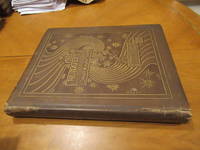
1884059813Boston: Houghton Mifflin 1884. 1st Edition . Hardcover. Good. Binding 16" X 13 1/4" Leaves 15 1/2" X 12". Brown Cloth Rounded Edges Gilt Top Edge Gilt Gray Endpapers With Pastedowns Illustrated In Color.127 Unnumbered Pages All Tipped In Mounted On Stubs. Drawings And Text Reproduced By Albertype Process Printed On One Side Of Leaves Only. First Edition American Trade Edition. Gilt Bright Wear To Covers Tiny Frays At Tips Worn And Split Along Upper And Lower Parts Of Front Joint. Light Foxing In Margins; Small Area Of Faint Tidemark/ Waterstain At Center Of Fore Edges Of Pages 107-127. Shipping Weight About 12 Pounds Insurance Required. International Shipment Will Require Additional Cost Far More Than Standard Shipping Rate Quoted. <br/> <br/> Houghton Mifflin hardcover
18824Royal Academy of Music High Street & Fitzjohns Avenue Hampstead etc London various pleaces and hotels when he travels 1926-1934. An unusual survival the letters of a composer Harold Jervis-Read to his lover illustrating the growth of a relationship and an ability to express his feelings against the backcloth sometimes foreground of his musical activities and his marriage. Total of letters circa 350 three hundred and fifty Autograph Letters 118 one hundred and eighteen apparently complete letters many start and end abruptly dated 432 four hundred and thirty two pages with some APCSs mainly 12mo 1-8pp. each 55 of these letters dated 1933 and 30 dated 1934 1926-1928 comprising one letter only. There are more than 140 undated letters and a similar quantity of apparently incomplete letters no. of pages c.150. Subjects and quotes: 1926 his one night a week flatmate found him unconscious; a lot to do; her birthday; 1928 "can't write about 'intimate things'"; 1927 asking how he should react to something she's written hot or cold etc.; 1929 lost coat; health; illness; suggestion that relationship is on the edge; social life; compliments her "fine"; dinner invitation; "My piece for Oulston went well"; quotes to illustrate attitude to her "If of herself she will not love thee ."; she has obviously complained that he doesn't show enthusiasm recurrent theme; "joy of creation" but not the "joy of human communication"; his human shortcomings; she cannot appreciate the "Marcia Buffa" because of lack of appreciation of satire in her; his company described; leaving flat for good; moving to 29 High Street NW3; his obsession with her perhaps only soluble legally marriage; nature of love and their relationship recurrent theme; movements; reference to Margery - his wife see below; he'd sacrifice all for his children; Margery has no money "I earn at an artistic profession enough for six of them"; £160 per annum private income; he describes "the littleness of her perceptions" on family finances; 6 Oct. 1929 he's been writing a lot - "a violin sonata"; suggests she book a ticket for the Royal Academy of Music where a Recital of some of his work is to be given finishing with his "6tet by professional players"; she shies away; says he'll never write a quartet; busy; "Everything here is called a 'Practice' Concert unless the Principal is personally responsible for it"; Margery wife happy for him to see Brynnie - she's had a lover for more than two years "a rich doctor"; 25 Nov. 1929 "The Concert was a good success" Malvern; literary reference recurrent - part of his not being comfortable writing about emotions. Note: Subjects from now on avoiding the personal or the ups and downs and insecurities of a relationship unless very revealing of character. Subjects continued: 1930 invitation to the Norwich Festival; too much work at the Academy; asked to give lectures where he was asked to play some of his music; lecture is being printed; asks about her progress at work Are you an Almoner yethe doesn't ask her about her work much; lecturing in Bristol then the Wigmore; 1931 "written lots of good stuff"; "I write incessantly - music lectures letters of all sorts"; "controversy with Percy Scholes on Musical Appreciation . I love fighting these doctrinaire writers"; "various new things"; Academy Lecture; "I do not follow Mac P or anyone in my method of grouping! Feste underlined; Trinity Dublin catalogue guesses published in 1933 is out ."; his pupils; Elkin & Co.; Murdoch's about to publish "other things" beside Feste; would she type a lecture of his "wanted for publication"; received a proof of a piano sonata; at studio with private pupils; getting on with his "Elegiac Symphony" discussed at length; ex-pupil Robin Tucker "starting music publishing company a most daring and novel proposition"; he advises outlines problems discusses the works he has provided them with; 1932 glad she likes the "sonatina. I love playing for you: I feel you get inside the music. You know men always like my music more than women: I wonder why this is" - theory follows about "feminine not effeminate content"; asks her of she really wants a piano - which he will provide; Troubadours book; accuses her of game-playing - adding "the sett is now finished"; "I am mezzoforte only today"; "two lines in Fioretta" misunderstood by most; pays two rents c.£200 pa; his wife wrote to Brynnie's mother; "3 new private pupils at £2.2.0 per hour!"; recalls the Wagner Brunhilda; recalls meeting her at a concert; a bit of musical notation two others in other parts of correspondence; going to the Academy for a concert; received proofs of the new song 31 March; examining at the RC; numerous literary allusions some quotes; their options secret marriage etc; she is his "musical" inspiration; his reading; going to a concert expecting a violinist in the evening and commenting on proofs "the cover of Winter Tree"; someone commenting on his writings; reminiscences; temptations; several references to George Moore as if strong influence; recurrently cruel words; meets the singer of his sonatas Marjorie Grant; thinks of them as Heloise and Abelard repeated theme involving learned discussion; angry report on poor candidate not just playing but her smell; another was the opposite; his itinerary; compares his situation to Peter Warlock's - near suicide 25 July; two new songs; enjoyment of Welsh tour; 1934 "Ethel Smythe's music is an example of what happens to a woman when she seeks inspiration of man rather that sic of God . It is insufferably dull monotonous ." 6 March; encounter with policeman while loitering at night near her flat; he gets more expressive as time goes on - inhibition goes somewhat; jealous thoughts; planning to see her father marriage though his wife is capable of "any subterfuge" including private detectives; he writes as if she's wants to break up driving him to pleading; misery; the odd meeting referred to; his misery has interfered when he's working well and he's worried about becoming "a 'hack' conventional musician - which I am not"; only his "writing" is more important than her; finds northerners "sallow and ill-featured"; shown two articles about himself in musical periodicals 3 July; he's "finished his final movement" 8 Aug.; he's hardly ever discussed or referred to her work; proofs of his book arrive but he's not able to deal with them because of her and other factors; he quotes himself on the nature of music "music never discloses her ultimate secret"; last dated letter 9 Sept. 1934. WITH: A large quantity of typed and two autograph notes and letters drafts duplicates indicating second thoughts some or many abruptly ended or unfinished from Brynhild Granger to Jervis-Read which mirror Jervis-Read adding her own thoughts accusations words of love attendance at musical events responses to his music and information about her life. She gives reasons for not marrying at one point. AND: 10 ALSs two incomplete and/or damaged undated from Margery Jervis-Read wife of Harold Jervis-Read to Brynnie attempting to undermine the relationship between Harold and Brynnie discussing the situation and Harold's character he has "good points" but. "numerous love affairs he had had and always will have" her own affair etc suggesting that she should marry but not Harold and including references to meetings. NOTE: Brunhild Granger was a member of the "Ferguson Gang" see Wikipedia - a group of women raised money for the National Trust before the War characterised by masks and mystery and recently published Anna Hutton-North's book "Ferguson's Gang: the Maidens behind the Masks". She was "Sister Agatha". [Royal Academy of Music, High Street & Fitzjohns Avenue, Hampstead, etc, London], various pleaces (and hotels) when he travels, hardcover
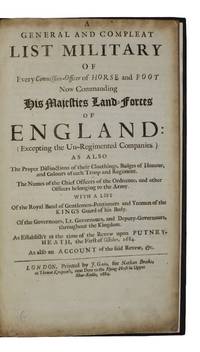
1684AQ22744London: Printed by J. Gain for Nathan Brooks 1684. 4 19pp 1. Modern gilt-tooled calf contrasting red morocco lettering-piece. Minor Shelf-wear. Leaves browned and spotted leaf D1 cropped at foot with some loss of text and sense. The first edition of a Restoration list of officers in the English Army including 'The Proper Distinctions of their Cloathings Badges of Honour and Colours of each Troop and Regiment' and an account of the review upon Putney Heath 1st October 1684. ESTC R14469. Wing G407. First edition. Folio. Printed by J. Gain, for Nathan Brooks unknown
21391Without place or date. English late eighteenth century. 2pp foolscap 8vo. On the rectos of the leaves of a bifolium. In fair condition lightly aged and worn. On laid paper with indistinct watermark. The context of the document with the capitalisation and spelling 'mechanick' 'shou'd' 'Publick' 'tyed down' 'lookt' 'Profitt' points to a late eighteenth-century origin certainly before the Speenhamland System and Michael Nolan's 1805 'Treatise of the Laws for the Relief and Settlement of the Poor'. No title or heading. A forthright document whose rhetorical tone suggests that it was intended for public delivery. The author asserts that '3 fourths of the People now upon the poor List are such poor as shou'd not be relieved Namely the loose Profligate and those who do not like work. If this is the Case the public loose sic near another Million by relieving so many who shou'd work'. The cost of poor relief he claims all 'falls upon the Landed Interest'. He does not however 'Wish that our Poor Laws were all abolish'd as amended that ever Man shou'd have a Liberty of living where he please'd which would be always where he could get a living best.' The document begins: 'The Plan of the Poor Laws of England tho Calculated upon the Principles of Humanity and Charity are far from answering the Salutary purposes intended. For tho the Lame the Blind the Impotent and Aged are amply provided for and I might add the Drones and those who do not chose to work. Yet the Poor Labourer the little Farmer and the Mechanick are under great Restraints and Difficulties on Account of their Settlement being tyed down to a particular Parish where they find it very difficult to get their living and yet oftentimes cant get a Certificate to remove to another Parish where there is great Probability they may Have Work enough and live better.' The author expands on his view with reference to 'a poor Man who is not of ability to Rent 10£ P Ann' 'the Industrious who mean to Maintain Themselves by Labour' and 'the Interest of the Landed Man'. He notes the 'hardship' that 'lies upon the Man of Ability to Rent 10£ a Year' who 'removes from the Place of his Settlement and Rents 8 or 9 A Year in another Parish. He is there lookt upon as a sort of a Charge to that Parish as they cant Tax him to the Parish Rates without makeing him a Settlement and therfore oftentimes procure him to be removed'. Elsewhere he asks: 'Do not we now and then see a Shop keeper in a Country Village who is daily pillaging the Poor by selling his Good to them in very small Quantities at 50 P Cent Profitt during the Time of the Execution of that Office turn Advocate for the poor and plead for an Increase of their Allowance and this I don't wonder at as the more he can get Allowed them the more Profitt comes To his Till'. Towards the end he states: 'We all know that the Poor only live from Hand to Mouth that when Corn is at the Dearest they make a Shift to live and when it is Cheapest they save nothing at the Weeks End if it is very low they will perhaps work only 4 Days out of 6. they have no Idea of laying any thing by and I fear what Incourages them in their way of Thinking is the certainty they have of themselves and Family being maintained at the Expence of the Parish when Sickness or old Age comes on'. He states: 'I Believe there is no Nation in the World have got a poor Law but England and I will venture to Assert that there is no Nation where Charity and Benevolence more abound'. He ends with the proposal 'That one publick Workhouse Infirmary and House of Maintainance should be Erected in the Center of Every County where all the Sick Lame and Aged should be sent whenever they can't take Care of themselves to be there maintained taken Care of & set to work as their Particular Circumstances require.' Without place or date. [English, late eighteenth century.] unknown
24420Three from 1937 18 January 28 November and 10 December; seven from 1938 13 20 and 27 February 6 March 7 April 6 May and 13 November. All addressed from ‘P.O. Box 286. Tsingtao. China / via Siberia’. A good well-written correspondence painting a good picture of the day-to-day life of an English expatriate in the occupied city. Letters are signed ‘Malcolm’ and once ‘Mac’. Young names himself in valedictions as Celia’s brother. He does not sign with his surname which can however be deduced from the combination of postscripts signed ‘M H Y’; and Celia being named in the endorsement to one letter as ‘C. G. Young’. He is is presumably ‘Malcolm H. Young agent’ who features in the Tsingtao / Hong Kong List for 1941. Several references indicate a conventionally Christian religiosity and some connection with a church for English expatriates in the city. Ten long letters. Three from 1937 18 January 28 November and 10 December; seven from 1938 13 20 and 27 February 6 March 7 April 6 May and 13 November. A total of 30pp 4to neatly and closely written. A little aged and worn but in good overall condition. Two of the letters are incomplete; that of 10 December 1937 only consists of the first page; that of 13 November 1938 lacks the fourth page of five. The correspondence contains a deal of personal matter but the extracts that follow concentrate on the political situation on the ground. Letter One 18 January 1937 puts us straight in the action: ‘I think I last wrote to you on Sunday before last just before the Japanese came in. This took place on the Monday without incident or conflict of any kind - no one killed or injured & no shot fired. It was a tense time however all the forenoon as it was not known what would happen. From early morning Airplanes were flying all over quite low & making an noise. It was alarming but they were only making quite sure that there were no soldiers here. They dropped a few bombs in the outskirts to frighten people - & where they thought there might be soldiers - but no harm was done. / It was a day of deliverance & thankfulness when in the afternoon they marched in quietly & took possession.’ He refers to ‘many unpleasantnesses’ as ‘a new City Govt: is inaugurated - this took place yesterday just a week after the troops came in - we are glad to have the war cloud removed - that is we hope it will be - Shops have been kept close shut & the poor Chinese much frightened by their rough treatment & seizure of houses goods & people. However they also gave employment to many coolies. Even the houses of Foreigners were not exempt from intrusion but on the whole as invading armies go they have not been too bad.’ This brings us to the end of the first of the thirty pages of text. He continues the first letter with more news of the state of affairs including: ‘We had a lot of the soldiers encamped just below here in empty summer bungalows some of whom were a nuisance & our servants were alarmed; - they even intruded on ours and our neighbours premises but did no harm: and on our complaining to the Consel who took prompt action with the Japanese Military Head Quarters were soon checked. This crowd has moved on elsewhere now & I hope we shall have no more.’ He reports that ‘The Censors . are at work here in the P.O. making delay in delivery of mails’. In the second letter November 28 1937 he reports: ‘The Japanese are advancing in the N. of the province but rather hesitantly - I suppose negotiations are going on. They have huge commercial interests in Shantung - especially at Tringtao which it is to their interest to preserve. The Chinese may be using these to bargain with the enemy at our gates. It is hard to know what is happening. Meanwhile Shai is suffering terrible aftermath of war with its hungry crowds of refugees poorly clad & with sickness among them; & still the Japanese advance & Nanking is threatened is threatened.’ He has every sympathy for ‘the Chinese who have fought so bravely’ but believes it is time to make peace ‘since they cannot hope to win in the unequal struggle. Japan’s better trained & equipped armies carrying all before them. Locally the tension increases & the price of food & coal increases. The railway being if not actually interrupted so denuded of cars removed South by the Govt. that no coal trains can come from the mines.’ On 13 February 1938 he reports on ‘Work on clearing the port - blocked by departing Chinese troops with sunken ships & other obstructions - . while the demolition of buildings - destroyed by the Chinese - is progressing preparatory to re-building later. Whatever happens the Japanese are going to keep Tsingtao so the only thing is to make the best of things & as far as possible work with them - this for Chinese & Foreigners alike . I fear that the Chinese will be afraid to open up their shops much. The Japanese are opening & numbers of them returning by every steamer from Japan & Dairen. Commodities too are showing cheaper prices. Water is very short but work is in hand for repairs & they say that after 10 days there will be improvement.’ On 6 March 1938: ‘As you surmise it is still far from plain sailing both for ourselves and the original inhabitants of these regions the Chinese. The power & authority of the new masters is everywhere felt and we as well as the Chinese have to mind our Ps & Qs with them. The name and authority of the Occidental powers is not what it was - & they like to let us know it. . The Railway is not yet working fully & the harbour is still closed’. On 6 May 1938 he bemoans ‘the present disturbed state of the country which alas shows no signs of improvement. - But what would you - if the incomers win peace & order follow but naturally the people of the land oppose them in all ways with resulting chaos & danger to all. It is very sad. & fighting with heavy losses on both sides continues. . all along the Railways we are told villages on both sides have been burned down. Business of all kinds is very little except among the Japanese who appear to be very busy & are re-building their factories & doing other business - giving employment it is true to some workmen but as they are self-sufficient & very efficient they have no use for Foreign help. Chinese with money have largely departed elsehwere & those remaining will not do anything this year. - The new regime have installed a very good & quick Bus service which gives rapid & convenient transportation to & fro town’. In the last letter 13 November 1938 he complains that ‘The days are short now & “Tokyo†time is tiresome but we adjust things to some extent by altering times. For instance Early Service Holy Communion is put at 8.30 instead of 8 which helps. We were glad to be there this morning & the church room was warmed by a welcome stove fire The first time it has been required this season. There were not so many present . On Friday 11th. we went out to the British. Cemetery here at the Cenotaph the usual memorial service was held. It as a bitter day. A detachment from H.M.S. “Folkestone†now in port were present many of the men being war veterans. There were also of course the United States Service Association members with their medals.’ Three from 1937 (18 January, 28 November and 10 December); seven from 1938 (13, 20 and 27 February, 6 March, 7 April, 6 May and unknown
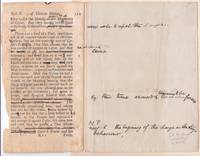
11593Undated early 1850s. The two leaves were evidently disbound from a copy of an edition of Dryden's Plutarch in which the grey 4to leaf of writing paper following the 12mo printed leaf was one of those that interleaved the volume. In fair conditon on lightly-aged paper. The two leaves are tipped in onto a larger leaf removed from an album. The printed leaf is 12mo from volume 5 of Dryden's translation with the pages numbered 511 and 612 sic. The two sides of the leaf carry a total of approximately 25 emendations and deletions. Both sides of the 4to leaf carry longer interpolations by Clough those on the verso relating to a page not present. In pencil at foot of recto: 'A. H. Clough's corrections of proof' and on verso also in pencil 'MS Arthur Clough'. Clough began work on his revision of Dryden's translation in the early 1850s. Undated [early 1850s?] unknown
40193LONDON THE FOLIO SOCIETY 2005. LIMITED TO 1250 COPIES THIS BEING NUMBER 178. FOURTH PRINTING. SMALL QUARTO FINELY BOUND IN FULL WASSA TAN GOATSKIN BLOCKED WITH DESIGN BY QUENTIN BLAKE. WITH A BOOKLET ' READING DON QUIXOTE' AND A SOLANDER BOX. A VERY FINE COPY. LONDON, THE FOLIO SOCIETY, 2005 unknown
13822Undated five of the illustrations appearing in the Pall Mall Budget London in May and June 1894. The six illustrations and seven pages of text totalling 13pp. 4to 22.5 x 18cm on seven leaves of laid paper removed from an album. On aged brittle paper with chipping and slight loss to the edges. The illustrations are simple sketches indicating the layout of the page with titles and occasional words of text by Sullivan. Five of the six designs are for the Pall Mall Budget: 'The Thumbmark by H. G. Wells' 28 June 1894 thumbmarks around title and a newspaper seller with headline reading 'Anarchist Outrage'; 'The Stolen Bacillus by H. G. Wells' 21 June 1894 lady pursues thief running towards coach above sketch of gentleman in top hat and cloak sweeping his left hand; 'The Quest of the White Cat' 11 June 1894 by 'Miss <Orteroyd> page filled with designs showing three images of a fashionable lady in a cape; 'Love & Chronology' 1 May 1894 apparently including Pan with his pipes; 'To the Modern Heroine' 16 May 1894 a fashionable young lady leans over above the head of the title reading a book. The sixth illustration titled '<Ville Ciature>' and with the phrase 'I half-forgot how much you bore me' is untraced. It carries the most finished image showing a fashionable lady staring at a mirror on an elegant table in a wood-panelled room. The pages of text are heavily-corrected in Sullivan's tiny and elegant hand. They include a page headed 'The Author's Apology by way of preface.' Following the preface is the beginning of the first chapter: 'At last Lord Asterisk awoke. He was a man who seldom spoke of himself so he must be described.' Other character include 'Rose LeClerc' and 'Dr. May Bevan the clinical lecturer' and the other pages include text from chapters II and IV. The text is intriguing showing the influence of French symbolism and written in a style that would have been at home in 'The Yellow Book' which was beginning publication around the same time as Sullivan's designs appeared. The beginning of Chapter II gives a good indication of the style: 'He rang the bell & the servant came in. Have my robes come said he. Yes sir. I will try them on - said Lord Asterisk. They were brought - in the meantime his lordship had taken his tub; he dressed himself entirely in his robes of state. - with silk ermine coronet and all & went down stairs to dinner. We live half our live by not following out our impulses. I am going out said his lordship. What clothes shall I put you out your lordship How so Am I not fittingly dressed as becomes a lord Certainly sir - I am going out said his lordship - & I would have you fetch me a donkey in ten minutes while I smoke my cigarette Rudge was hard put to it - but he rang up 25 messengers & in ten minutes two donkeys had arrived simultaneously. Since there are two we will make four. .' Undated [five of the illustrations appearing in the Pall Mall Budget, London, in May and June 1894.] hardcover
18549Three of the letters from 13 Warren Street London . All four undated. Four 16mo letters three of them of one page and the other of two pages. In good condition on lightly-aged paper. In a crabbed hand. One addressed to 'J T Smith Esqre British Museum' and another to 'J T Smith Esqre 22 Carmarthen Street an answer'. Little more than short notes. In one letter to J. T. Smith she asks him for 'Mr Vance's address for a married gentleman' in the other she tells him that 'Mrs Martin of Liverpool whose intimate friends are yours also . wishes to be indebted to your obliging attention'. In one letter to Miss Smith she explains that she has been 'prevented from calling your door but troublesome as I know it to be cannot but beg to be favoured with a bulletin' and in the other she reminds her 'kind friends' that she is expecting them that evening and making a request regarding 'the table' for which 'indeed am I not your and Papas thankful E Benger'. Three of the letters from 13 Warren Street [ London ]. All four undated. unknown
22343Letter: 'Sunday noon' no date. On letterhead of the Royal Hotel Devonport. Pencil sketches without date or place. Yates studied in Paris before setting up a successful practice in San Francisco also teaching there at the Art Student League. His portraits include the educator John Haden Badley and the only president of Hawaii Sanford Ballard Dole. He returned to England in 1900 but was invited back to America to attend the inauguration of Woodrow Wilson and to paint his portrait. Wilson presented Yates with the flag that his hand rested on whilst he took his oath of office. The Oldham family moved in artistic circles and Constance Oldham was John Ruskin's god-daughter and corresponded with him. Two items: a letter and two pages of pencil sketches. LETTER: 4pp 12mo. Bifolium. Other papers suggest that the recipient was resident at Walpole Chislehurst Kent. The subject of the letter is a painting Yates is planning of HMS Foudroyant present whereabouts unknown evidently commissioned by the recipient. Yates is an excellent letter writer and he begins by giving Mrs Oldham the details of his journey to Devonport 'after a most pleasant journey coming down by the Great Western'. He 'arrived at Plymouth but came on to Devonport knowing the old warships are nearer this neighbourhood than Plymouth'. He continues: 'The “Foudroyant†lies out in the stream and can only just be distinguished from her neighbours from the shore. - I engaged a boatman and sailed round her and have quite decided what kind of a picture to paint.' Beneath this Yates has drawn a small simple ink sketch of the wreck of the ship. He continues: 'The snow was falling and the wind terribly keen - the boat man with a thin jersey on looking quite used to the weather I in overcoat hugging my knees together my teeth chattering – a regular landlubber.' There follows another ink sketch of the scene he has just described with the two men in their boat in the rain and the ship in the background. He continues: 'I have engaged this craft for tomorrow at 8.30 – weather permitting and in the evening will report progress to you – this county is full of beauty around Exeter the place looked the very home for a painter'. He adds regretfully: 'I wish some portraits were wanted down here then I would run down for two months in the summer. He asks for 'a Postal Order for £3' as he 'did not bring enough and the railway costs more than I expected and the cost of a boat I had not calculated. I am improvident.' PENCIL SKETCHES: On both sides of a 12mo piece of paper. In good condition with four fold lines one of which has a short closed tear at edge. On one side of the paper are two simple sketches the top one showing the wreck of HMS Foudroyant at sea captioned 'As she is' with side note indicating what are 'not masts only stumps'; beneath this another sketch of a ship 'As other ships of the same date now are'. On the other side of the paper is a larger sketch showing Foudroyant in her prime captioned by Yates 'What I suppose must have been'. The letter must have been written after 1884 when the Foudroyant which had been Nelson's flagship for a couple of years ceased to be a training vessel. In 1897 she was towed to Blackpool and in the same year she was wrecked in a violent storm damaging the North Pier in the process. Wood from the ship lines the boardroom of Blackpool Football Club and medals were struck from copper salvaged from the wreck. Letter: 'Sunday noon' [no date]. On letterhead of the Royal Hotel, Devonport. Pencil sketches without date or place. unknown
30305LONDON BOURNEHALL PRESS1975. LIMITED TO 111 COPIES THIS BEING NUMBER 32. ILLUSTRATED BY JOHN BURDEN WITH 9 FULL-PAGE PLATES EACH NUMBERED AND SIGNED BY HIM. ALSO A PLATE TO THE FRONT PASTEDOWN BY BURDEN. PRINTED ON ANTIQUE LAID PAPER HANDBOUND BY SANGORSKI AND SUTCLIFFE IN QUARTER MOROCCO OVER BROWN BOARDS T.E.G. A FINE COPY WHICH HAS A VERY SMALL LIBRARY STAMP TO THE REAR OF THE TITLE PAGE OTHERWISE NO EVIDENCE. VERY SCARCE. LONDON, BOURNEHALL PRESS,1975 hardcover
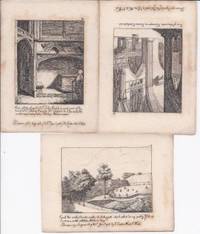
26786All 54 captioned as 'Engrav'd & Pub'd' by John Carter between January 1786 and January 1791 successively at Wood Street and College Street Westminster; and Hamilton Street Hyde Park Corner; from drawings made by him between 1766 and 1785. All 54 are printed on paper 12 x 9 cm. Each is captioned and numbered in roman numerals with the first as III and the last as XCVII. Carter published his 'Views of Ancient Buildings in England' between 1786 and 1793 and the six volumes contained a total of 120 views. Those LACKING from this collection in arabic numerals are 1 2 6-10 15 16 18 19 21 26 36-38 43 48 53 57-59 63-66 69-71 73 75 76 78 81-84 90-94 96 and 97-120. The 53 present are in fair condition on lightly-foxed paper with small pinholes in the margins of a few of the engravings not affecting image or text. Simply-executed and charming the images range from 'III View of the chapel of St. John Baptist and part of the tomb of Sr. Thomas Vaughan Kt. treasurer to Edward IV. in the east end of the Abbey Westminster.' to 'XCVII North view of the Gate of Bermodsey sic Monastry sic in the Borough Southwark.' The images are not confined to London. All 54 captioned as 'Engrav'd & Pub'd' by John Carter between January 1786 and January 1791, successively at Wood Street and Col unknown
19135Receipt of His Majesty's Exchequer London. 21 August 1716. 1p. 8vo. On aged and worn paper with vertical closed tear away from signature. Laid out in the usual style with printed text completed in manuscript. Recording payment of three pounds on an annuity. With signature of witness 'J Thomas'. [ Receipt of His Majesty's Exchequer, London. ] 21 August 1716. unknown
38857LONDON LAWFORD 1833. THIRD EDITION TWO VOLUMES. FINE BINDINGS BY A BINDER TO THE KING. FULL CRIMSON LEATHER RICH GILT DECORATION TO THE SPINES AND BOARDS A.E.G.WITH 280 FINE ENGRAVINGS A MEMOIR OF THE AUTHOR ARMORIAL BOOKPLATE. FRONTIS. OF NORTHCOTE TO VOLUME 1. FOXING TO THE FRONTIS. ONLY. CLEAN AND TIGHTLY BOUND. A VERY HANDSOME SET. LONDON, LAWFORD, 1833 hardcover
39764GENEVA HENRI. STEPHANUS 1560. 16mo CONTEMPORARY FULL LEATHER BINDING WITH COVERS DECORATED WITH GILT CENTRE OVAL ORNAMENT AND CORNER ORNAMENTS RAISED BANDS. TEXT IN LATIN AND GREEK 576 PAGES. PART 1. THE LEATHER NATURALLY WORN WITH SOME LOSS TO THE HEAD AND TAIL OF THE SPINE. CONTENTS CLEAN. FRONT HINGE WEAK. OVERALL VERY GOOD. SCARCE. GENEVA, HENRI. STEPHANUS, 1560 hardcover
19236On letterheads of 22 Carlton House Terrace S.W. London Between 30 March 1915 and 24 January 1916. Each of the six letters is 1p 4to. In good condition on lightly aged and worn paper. With the Society's stamps and annotations. On topics including the printed version of a paper given by Hadfield and the offer to the society of a paper by his friend 'Mr E. P. Reynolds of Bournemouth' whose father 'Mr E. Reynolds … was the mainspring of the Engineering side of Messrs Vickers Sheffield'. On 30 November 1915 he writes regarding 'Dr Dugald Clerk's recent excellent Address as Chairman' that he 'wrote Sir Philip Magnus on this same subject in reference to a letter he contributed to “The Times†… I think this country has done “more than its share†in the science of Metallurgy. Our leading men of science have been kind enough to say that the first great development in steel alloys sprang from my paper “Manganese steel†to the Institute of Civil Engineers in 1888 and the great French scientist Monsieur Floris Osmond a person friend of the late Sir William Roberts-Austen made the remarks given in the enclosed statement P.5694 not present which also includes the remarks of several other distinguished men regarding my research work yet I am certainly not a German.' Also present is a compliments slip with typed note by Hadfield and a typed copy of a note from Hadfield to Wood. On letterheads of 22 Carlton House Terrace, S.W. [ London ] Between 30 March 1915 and 24 January 1916. unknown
1882217 January 1744 / 1745. Place not stated. On one side of 11 x 15 cm slip of paper. On aged paper heavily worn at head and at one edge with some loss of text. The damage has been skilfully repaired. Reads: 'Jan. 17. 1744/5 <rec>eived then of <.>ackin Nilliam <.>ynn Bannet the following MS viz. Dares Phrygius & Tyssillons History of the Britions in Welsh Chronica Britonum in Welsh & the chartulary of the Abbey de Bello in Latin which I promise to restore on demand. Witness my hand Tho: Carte'. An attached note in a modern hand states that this item was 'found in Boyle's "Some considerations touching the usefulness of . natural philosophy." 1644'. 17 January 1744 / 1745. Place not stated. unknown
40196LONDON THE FOLIO SOCIETY 2011. LIMITED TO 1000 COPIES THIS BEING NUMBER 972. QUARTO FINELY BOUND IN FULL NIGERIAN GOATSKIN LEATHER BLOCKED WITH DESIGN BY THE ARTIST QUENTIN BLAKE. NUMBERED AND SIGNED BY QUENTIN BLAKE. WITH A SLIPCASE. A VERY FINE COPY. SCARCE. LONDON, THE FOLIO SOCIETY, 2011 hardcover
2656413 Holland Street Kensington and other London addresses. 1886 to 1912. The fourteen items are laid down on three pages on two leaves of grey paper removed from an album on the reverse of one leaf are two coloured coaching scenes by Randolph Caldecott one featuring a highwayman. The overall condition is fair with creasing and signs of age. The Autograph Letter Signed is from Crane to 'My dear Stanley Little'. 1p. landscape 8vo. With letterhead of Beaumont Lodge Shepherd's Bush featuring an illustration by Crane of a shepherd and sheep. 20 September 1892. He is sending a copy of his 'Claims of Decorative Art' and hopes that 'as one who has thought & written much on art' he will 'accept it as a contribution from my side the question or at least as "Friendship's Offering".' As an imperialist Little's politics were opposed to Crane's. He asks him to 'look for us at No 13 Holland St. Kensington when you are next in town'. In a postscript he states: 'The good wife is away in Essex with the two boys but returns at the week's end.' On the same page are six items with decorations apparently by Crane: first a label for 'The Pioneer' printed in sepia with space for 'Number Contents Price' showing a knight climbing up dense foliage to a languid lady; second a label or bookplate for the 'A E & C S Handicraft Design' with the name supported by two women in revolutionary caps each flanked by a cherub; third another example of the Beaumont Lodge letterhead ; fourth and fifth two copies of a strange tiny design of an African hunter with spear before a setting sun printed in negative on grey paper; sixth a tiny monogram perhaps 'L J S' made by a snake and printed in red. The next page carries a season ticket with design by Crane of two workmen shaking hands for the 1906 Arts & Crafts Exhibition Society at the Royal Academy made out in manuscript to 'The West Sussex Gazette'. The third page carries six items: first a printed handbill advertising 'The Leek Press Papers: No. I. The Relation of Art to Education and Social Life by Walter Crane Twenty-eight pages in wrapper.' With two vignettes the first of two country folk with ten geese; the second of a peacock. The reverse advertises a 'Catalogue of a Collection of Designs by Walter Crane A.R.W.S. with vignette of stork and lettering by Crane. Carries two close tears repaired with archival tape. Second printed in red an invitation card designed by Crane to the Old House 13 Holland St: 'Dame Walter Crane bids you welcome on New Year's Day 1912 in the evening at nine thirty'. Third Crane's autograph signature cut from the valediction to a letter: 'Every yours Walter Crane'. Fourth a handbill advertisement for 'The Fabian Society Session 1886-1887' with design by Crane of female forms representing Liberty Equality and Fraternity. The 'Executive' are named as Annie Besant Hubert Bland Edward R. Pease Frank Podmore G. Bernard Shaw Sidney Webb and Charlotte M. Wilson'. Fifth an invitation card printed in brown to the private view of the fifth Arts & Crafts Exhibition Society 3 October 1896 at the New Gallery 121 Regent Street. Made out to J. Stanley Little of the African Review. Featuring the same design as above of the two workers shaking hands. Sixth letterhead printed in red for 13 Holland Street Kensington W. Featuring a design of a crane by Crane. Heavily creased. SEE IMAGES. 13 Holland Street, Kensington, and other London addresses. 1886 to 1912. unknown
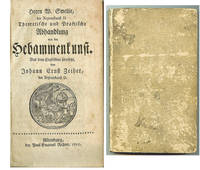
14877Altenburg Paul Emanuel Richter 1755. RARE: Antiquarian book in Old German Gothic Script. Hebammenkunst is Midwifery. Size: 7.00 x 4.00 inches approx. Not knowing German or the Gothic script it is difficult to know the exact translation of the title but it could be A Treatise on the Theory and Practice of Midwifery which is an antiquarian publication in English. Well used boards with background staining hardback name of a previous owner to front endpaper dated 1927 some browining but thoroughly readable engraved vignette to title page 492 numbered pages engraved embellishments all edge red full of character. Smellie William Theoretical and practical treatise on the art of midwifery. Translated from English by Johann Ernst Zeiher. VIII 492 pages . Altenburg PE Richter 1755. Extracted from the internet: 'First German edition of the classic work on obstetrics. -. "Smellie 1697-1763 contributed more to the fundamentals of obstetrics than virtually any individual in his Treatise 'he more accurately than any previous Described the mechanism of parturition writer stressing the importance of exact measurement of the pelvis Hey. Was the first to lay down rules regarding the safe use of forceps and personally Introduced the steel-lock the curved and the double forceps. He invented the Smellie maneuver 'to deliver breech cases. " Garrison / Morton 6154 the original-outputs. 1752 . - Smellie "is rightly considered the father of natural childbirth help . The op surgery he tried to limit as much as possible" Hirsch . ' . Altenburg, Paul Emanuel Richter, 1755, hardcover
179429828London: Anthy. Milteno 1794. St. Caecilia is seated at an organ with an open music book above the keyboard; two cherubs sing from a music book to her right. <br/><br/>The model for the painting was the singer/actress Mrs. Richard Brinsley Sheridan née Elizabeth Ann Linley 1754-1792 daughter of the composer and conductor Thomas Linley 1733-1795. <br/><br/>370 x 280 mm. Printed on wove paper.<br/><br/>Some wear; minor chips tears and soiling to edges with remnants of former mount to upper right edge; some creasing; old paper repairs to verso; trimmed to just within plate impression. Anthy. Milteno unknown books
1985mon0000141312English Heritage 1985-01-01. Paperback. Good. in x in x in. NOT ex-library. Clean copy in good condition. English Heritage paperback