2 159 résultats
Il Secretum o meglio De secreto conflictu curarum meorum, costituisce il testamento spirituale del Poeta.Tre libri corrispondenti ciascuno alle tre giornate di discussione che il poeta immagina di sostenere con sant'Agostino alla presenza muta di una figura di donna, la Verità. Opera originale latina tradotta e annotata da Enrico Carrara. Legatura editoriale, pp. 139, in 16°
In 8° (22,2x13 cm); 15, (1) pp. Senza brossura ma non slegato. Alcuni segni di matita nel margine bianco di alcune pagine e per il resto in buone condizioni. Dedica al Marchese Pietro Vassè Pietramellara. Prima rara edizione di questa componimento poetica in onore di Petrarca del noto politico, letterato bolognese, Francesco Tognetti.
3563232237.Ghardcover. Good. Access codes and supplements are not guaranteed with used items. May be an ex-library book. hardcover
1826008345Lipsia: Fleischer 1826. Un volume in 8vo grande 24 cm di XXIII pagine di introduzione di Adolfo Wagner una pagina incisa in antiporta da Raffaello Morghen con il ritratto dei quattro poeti erroneamente nel titolo si indicano quattro ritratti; 236 colonne VII pagine e 160 colonne VII pagine e 644 colonne XVI pagine e 256 colonne 88 ppnn. Qualche brunitura. Legatura coeva in cartone telato con tassello di titolo al dorso etichetta del legatore J. Muller. Fleischer unknown
In-8° grande, leg. in bross. edit., pp. 225(3). Con sei cartine ripiegate f. testo, e fotografie a tutte le pagine dispari. Leggere bruniture ed altre marginali tracce del tempo alla copertina. Per il resto bell'esemplare.
0428408435.Ghardcover. Good. Access codes and supplements are not guaranteed with used items. May be an ex-library book. hardcover
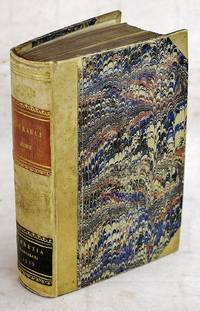
15392109100001Venetia : Stampato per Francesco Marcolino 1539. Hardcover. Very Good. Early Italian Emblem Book 2 volumes bound as one. Octavo 15 cm. Bound in later 1/2 vellum over marbled boards. Leather spine labels. Good binding and cover. 4 354 18 pages 180 leaves. Architectural title vignette with portrait of Petrarch. Engraved printer's device at end of first volume. Second volume has an engraved title with a portrait of Alunno. <br> Provenance: From Professor John MacQueen's library of Scotland. Includes related ephemera associated with Renaissance studies. "It is appropriate that Petrarch be printed in Italics a type invented in 1501 by the famous Venetian printer Aldus Manutius was said to have adopted Petrarch's own handwriting for . creating the new type." - Note inside front cover. <br> Refs: Fiske / Fowler 97; Ley 159-161; Brunet III 477. Venetia : Stampato per Francesco Marcolino hardcover
1545009633Vinegia: Gabriel Giolito de Ferrari 1545. Un volume in 8vo 15x22 cm di 8-197-7 carte- Bel frontespizio inciso con titolo incorniciato tra cariatidi e putti colonne floreali e colomba una piccola macchia. Capilettera incisi Ritratto di Petrarca e Laura alla carta aiii. Carta geografica incisa Descrittione del sito di Vauclusa a piena pagina. Sei graziose incisioni riquadrate di un terzo di pagina ad ogni inizio dei Trionfi. La numerazione dei fogli comincia con 3 uno sbaffo d'inchiostro al f.3 qualche brunitura e gore marginali da f.7 a 10 e 183-193; strappi ai margini bianchi di f. 222342 senza toccare il testo; piccolo foro a f. 91. Al foglio 137 da De l'empia Babilonia fino a che 'l sostiene versi biffati con inchiostro ma la lettura dello stampato resta possibile; piccola macchia al f. 138; al foglio 141 vecchio manoscritto incollato sopra le note con i versi da L'avara Babilonia ha colmo il sacco. fino a .e pien de l'opre antiche. Al retro del f. 170 tratti di penna nella parte bianca; al f. 177 piccolo strappo al margine bianco superiore. Legatura coeva in tutta pergamena rimontata modernamente con tassello al dorso. Tracce di antico ornamento dorato ai tagli. -Uno dei più interessanti Petrarca figurati del 500 in una copia che porta nelle sue pagine traccia delle polemiche che il testo ancora suscitava a metà del 500 con le sue accuse alla corruzione della corte pontificia le censure ai versi della empia Babilonia gli altri versi di accusa manoscritti. Bell'esemplare con le raffinate incisioni in ottima stampa. Gabriel Giolito de Ferrari unknown
156736032Domenico Farri Venetia 1567. 3rd edition. Hardback. Later decorated paper boards VG. xxiv32218pp small 8° pagination runs 1-161 but only the rectos are numbered giving 322 pages to the main text - Signatures running a1-b4 A-I8 K-T8 V-V8 X2-X7 Y-Y4 rebound early 20th century in paper covered boards without any blanks sheet A yellowed affecting the first 8 leaves occasional light marginal water staining not affecting the text printers woodcut device of Roman goddess Spes upon a winged globe with sunburst an attractive copy. This copy complete with the initial dialogue & index. Malipiero's famous interpretation or re-write of part of the Il Canzoniere of Petrach in which Malipiero changes what he saw as bawdy rhymes to verse where the the emphasis is on Godly love & not insane lust. Malipiero considered Petrach full of 'gli sconci e molto disordinati affetti e l'angosciose passioni de' miseri innamorati'. He also removed references to the papacy at Avignon & had Germany depicted as a new Babylon due to the influence of Luther. First published in 1536 the work went through eight editions by 1587. Domenico Farri, Venetia hardcover
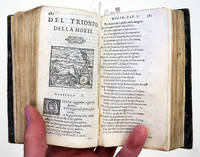
100695Venetia Nicolo Beuilacqua 1564. Kl.8° 490 m. vier Holzschnitt-Illustrationen zu den Trionfo d'amore T. della morte T. della fama und T. della divinità; 259 S. Älterer Privat-Ldr.-Bd m. Rückenschild Handschriftliches Titelblatt Seiten 239 -245 ebenfalls handschriftlich ersetzt berieben u. fingerfleckig Ecken bestossen am Fuss Buchblock etwas wasserrändig.Handwritten title page pages 239 -245 also replaced also handwritten rubbed and fingerstained corners bumped some waterstaining at foot of book block. 010 Venetia, Nicolo Beuilacqua, 1564 unknown
1701PG003<p>Com un Nuouo discorso sopra la qualità del suo amore: Et la coronatione fatta in Campidoglio de Roma & il suo Priuilegio. IN VENETIA Appresso Alessandro deÂ’ Vecchi. M. D. CVI. 1606</p>_x000d_<p>De 133x82 cm. com 48 350 10 págs.</p>_x000d_<p>Encadernação da época inteira em pergaminho flexÃvel e áspero de ambos os lados.</p>_x000d_<p>Ilustrado com gravura na folha de rosto retrato de Petrarca e Laura em xilogravura na quarta página preliminar não numerada 6 gravuras alegóricas/emblemata nos inÃcios dos triunfos capitulares decorativas cabeções xilogrados e flores de remate.</p>_x000d_<p>As ilustrações da obra são todas xilogravuras encontrando-se na folha de rosto uma vinheta alegórica representando o pecado original uma cobra enrolada numa macieira. As capitulares de cada parte ou capÃtulo são “falantes” isto é contêm figuras de animais entrelaçados nas letras começando por exemplo com a letra G com um gato e depois a letra S uma esfinge Sphinx a letra M com um macaco O de urso Oso etc. As vinhetas de cada um dos seis triunfos são de reduzidas dimensões.</p>_x000d_<p>A impressão é pouco cuidada apresentando caracteres pouco esmaltados vinhetas com elevado uso tipográfico e as numerações desencontradas e com algarismos trocados no entanto a colação encontra-se correcta.</p>_x000d_<p>Textos das folhas preliminares e do Ãndice em caracteres redondos corpo da obra todo em caracteres itálicos. </p>_x000d_<p>Este exemplar da obra <em>Il Petrarca nuouamente ridotto alla vera lettione</em> n. b. na base USTC procurar: IL PETRARCA NUOVAMENTE Ridotto alla vera Lettione apresenta os seguintes danos:</p>_x000d_<p>Manchas inscrições e traços de pena caneta de tinta da época grafitados da época em todas as margens da folha de rosto. Folha de guarda em branco com falta do canto superior direito. VestÃgios de uma leve mancha de humidade em todas as folhas. Canto inferior da dianteira das folhas com ponta afectada por corrosão ferrogálica. Leve trabalho de traça no pé das últimas páginas não numeradas. Forte trabalho de traça marginal nas páginas 133 a 192 sem afectar o texto. Fortes vestÃgios de páginas grafitadas no final do Triunfo da Fama páginas 314 e 315 e páginas 348 e 349 com leves rasgos. </p>_x000d_<p>As páginas preliminares sem numeração contêm dedicatória de Sennuccio Fiorentino ao Can della Scala retrato de Petrarca e Laura em xilogravura descrição do coroamento de Petrarca em Roma privilégio da Coroação de Petrarca por Orso Conde dalÂ’ Anguillara soneto de Varchi sobre Madama Laura e um Discurso sobre a qualidade do amor de Petrarca. As 10 páginas finais sem numeração incluem o Ãndice dos primeiros versos.</p>_x000d_<p>Edição muito rara que contém tal como outras edições anteriores a primeira parte do cancioneiro «Em vida de Laura» a segunda parte «Na morte de Laura» os Triunfos a partir da página 257 canções e sonetos do autor assim como poesias de outros autores.</p>_x000d_<p>Aqui colocamos o resumo exaustivo do conteúdo da obra: Prefácio de Senuccio Fiorentino sobre a coroação e o triunfo do poeta Petrarca nas primeiras 22 páginas não numeradas; Privilégio da Coroação de Petrarca por Orso conde de Angillara nas seguintes 7 páginas não numeradas; Soneto de Varchi no túmulo de Petrarca nas seguintes 3 páginas não numeradas; Discurso sobre a qualidade do amor em Petrarca nas seguintes 14 páginas não numeradas da autoria de Pietro Cresci e datado de Veneza 10 de Março de 1585; seguem-se os Sonetos e Canções «In vita di Madonna Laura» com a falta expressa dos sonetos CVI CVII e CVIII desde a página 1 até à página 185; de seguida da página 186 até à página 256 a segunda parte com os Sonetos e Canções «In Morte de M. Laura»; depois os 6 Triunfos de Petrarca encabeçados por 6 vinhetas xilográficas Triunfo do Amor pág. 257; Triunfo da Castidade pág. 281; Triunfo da Morte pág. 288; Triunfo da Fama pág. 301; Triunfo do Tempo pág. 316; e Triunfo da Divindade pág. 322.</p>_x000d_<p>Segue-se um capÃtulo de M. Francisco Petrarca em verso no qual se incluem as Canções del Medesimo pág. 333 e os Sonetos del Medesimo pág. 337; a partir da página 341 as dedicatórias em verso dirigidas a Petrarca por vários autores seus contemporâneos nomeadamente: Geri Gianfigliacci; Giovani de Dondi; Sennuccio; e Iacomo Colonna. Segue-se na página 244 as Canzone di M. Guido Cavalcanti; e na página 346 as Canzone di Dante. Finalmente a obra termina com a Canzon di M. Cino. O fim «Il Fine» é na página seguinte 350 seguindo-se o Ãndice da obra Tavola com 10 páginas não numeradas terminando com a palavra «Il Fine» e sem apresentar um cólofon de averbamento dos cadernos. A Tavola é um Ãndice alfabético referenciado pelo começo dos poemas e não pela sequência na obra ou pelos géneros nem pelos temas poéticos.</p>_x000d_<p>Colação e ficha bibliográfica da USTC:</p>_x000d_<p>USTC REFERENCE NO: 4034690 PRIMARY AUTHOR: Petrarca Francesco SHORT TITLE: Il Petrarca nuovamente ridotto alla vera lettione. Con un Nuovo discorso sopra la qualità del suo amore: et la coronatione fatta in Campidoglio di Roma & il suo Privilegio IMPRINT: Venezia appresso Alessandro Vecchi 1606 PLACE: Venezia DATE: 1606 FORMAT: 12o PP/FF: pp. 48 350 10 CITATION: LIBRARY COPIES: Châlons-en-Champagne Fr Bibliothèque municipale Trieste It Biblioteca civica Attilio Hortis</p>_x000d_<p>Outra edição referenciada no mesmo ano: Petrarca nuovamente ridotto alla vera lettione Autor Francesco Petrarca Editora Appresso Daniel Bissuccio 1606 Número de páginas 350 páginas</p>_x000d_<p><strong>O Autor</strong></p>_x000d_<p><strong>Francisco Petrarca 1304-1374</strong> pesquisador e filólogo divulgador e escritor é tido como o "pai do Humanismo" no entanto a sua fama deve-se principalmente a este seu romanceiro e aos seus poemas redigidos em lÃngua italiana. Petrarca é também considerado o inventor do soneto tipo de poema composto de 14 versos.</p>_x000d_<p>Pietro Bembo no século XVI criou o modelo para o italiano moderno com base no trabalho de Petrarca e também de Dante e Boccaccio.</p>_x000d_<p>Petrarca viajou intensamente pela Europa na qualidade de embaixador. Gostava de escrever cartas sendo Boccaccio um dos seus amigos mais notáveis. Durante as suas viagens coleccionou manuscritos latinos antigos e tornou-se um dos primeiros a redescobrir o conhecimento clássico de Roma e da Grécia Antiga.</p>_x000d_<p>Participou na primeira tradução latina de Homero e em 1345 descobriu pessoalmente uma colecção inédita de cartas de CÃcero. Na última parte da sua vida viajou bastante pelo norte da Itália.</p>_x000d_<p>Em 1367 Petrarca fixou-se em Pádua onde passou seus últimos anos em contemplação religiosa tendo vindo a falecer a 19 de Julho de 1374 em Veneza. Doou a sua notável Biblioteca de manuscritos à cidade de Veneza estando os mesmos actualmente integrados no núcleo da Biblioteca Marciana.</p>_x000d_<p>EN Dim.: 13.3x8.2 cm with 48 350 10 pp.</p>_x000d_<p>Binding: Contemporary full limp parchment.</p>_x000d_<p>Illustrated with an allegoric woodcut engraving depicting the original sin a snake around an apple tree; the portrait of Petrarch and Laura on the fourth preliminary unnumbered page; 6 allegoric figures at the beginning of the Triumphs; Head pieces and tail fleurons. The decorated capital letters of each part or chapter are historiated i.e. they have animal depicted on each letter starting for instance with the letter G with a <em>gato</em> Cat then the S with a Sphinx the letter M with a monkey O of <em>Oso</em> Bear etc.</p>_x000d_<p>The print is a bit careless with characters not being very sharp woodcut vignettes that have been used many times and mismatched numbering with the figures swapped however the collation is correct.</p>_x000d_<p>Text of the preliminary pages and index in round characters the body of the work all in italic characters. </p>_x000d_<p>This copy of the work <em>Il Petrarca nuouamente ridotto alla vera lettione</em> n.b. at the USTC database please search: IL PETRARCA NUOVAMENTE Ridotto alla vera Lettione presents the following damages:</p>_x000d_<p>Spots inscriptions and lines of quill contemporary graffiti along the margins of the title page. Blank endpaper missing the top right corner. Traces of moist stain on all pages; Bottom corner of the recto of all leaves affected by corrosion due to the iron Gall ink. Small bookworm traces at the bottom of the unnumbered last pages. Marginal wormholes on pages 133 through 192 not affecting text. Heavy graffiti at the end of the Triumph of Fame pages 312 and 315 and small tares on pages 348 and 349. </p>_x000d_<p>The unnumbered preliminary pages include Dedication by Sennuccio Fiorentino to Can della Scala; woodcut engraved portrait of Petrarch and Laura; description of the crowning of Petrarch in Rome; privilege of the Crowning of Petrarch by Orso Conde dalÂ’ Anguillara; sonnet of Varchi about Madama Laura; and a speech about the quality of PetrarchÂ’s love. The final tem unnumbered pages contain the index of the first poems.</p>_x000d_<p>This is a very rare edition that includes as usual the first part of the songbook “Life of Laura”; the second part “Death of Laura”; the Triumphs from page 257 on; songs and sonnets by the author as well as poetry by other authors.</p>_x000d_<p><strong>The Author</strong></p>_x000d_<p><strong>Francesco Petrarca 1304-1374</strong> researcher philologist promoter and writer is considered to be the father of Humanism; however his fame is owed mainly to this songbook and to his poems written in Italian. Petrarch is also considered to be the creator of the sonnet a poem with 14 verses.</p>_x000d_<p>Pietro Bembo in the 16th century created the model for the modern Italian language based on Petrarch"s work and also on those of Boccaccio and Dante.</p>_x000d_<p>Petrarch travelled all over Europe as Ambassador. He liked to write letters being Boccaccio one of his most famous friends. During his travels he collected ancient Latin manuscripts and became one of the first to rediscover the classic knowledge of Ancient Rome and Greece.</p>_x000d_<p>He participated on the first Latin translation of Homer and in 1345 he personally discovered an original collection of letters from Cicero.</p>_x000d_<p>Late in life he travelled all over the north of Italy. In 1367 he settled in Padua where he lived his final years in religious contemplation dying in Venice on July 19<sup>th</sup>. He donated his remarkable Library of manuscripts to the city of Venice which are now part of the collection of the Biblioteca Marciana National Library of St Mark"s.</p>_x000d_<p>Ref.: Collation and bibliographic description of USTC:</p>_x000d_<p>USTC REFERENCE NO: 4034690 PRIMARY AUTHOR: Petrarca Francesco SHORT TITLE: Il Petrarca nuovamente ridotto alla vera lettione. Con un Nuovo discorso sopra la qualità del suo amore: et la coronatione fatta in Campidoglio di Roma & il suo Privilegio IMPRINT: Venezia appresso Alessandro Vecchi 1606 PLACE: Venezia DATE: 1606 FORMAT: 12o PP/FF: pp. 48 350 10 CITATION: LIBRARY COPIES: Châlons-en-Champagne Fr Bibliothèque municipale Trieste It Biblioteca civica Attilio Hortis</p>_x000d_<p>Another edition referenced on the same year: <em>Petrarca nuovamente ridotto alla vera lettione</em>. Author: Francesco Petrarca. Editor: Appresso Daniel Bissuccio 1606. Number of pages: 350 pages.</p>_x000d_<p> </p> M-5-E-22 unknown
152832165Venegia: Maestro Bernardino de Vidali 1528. A very early Edition of the Vellutello Petrarca. With fine heraldic ownership label. Illustrated with the rare two page view of the Valchiusa. This copy with the Babylonian Sonnets 165 ff not censored and still included in the text. Rare thus. 4to mm. 190 x 140 handsomely bound in fine full vellum of the period. 11ff 185 ff 51 ff Del Triumpho pp. A contemporarily bound copy in a pleasing state of preservation generally crisp and clean throughout some interesting notes in very early hands to the pastedowns a few here and there in the margins of the text-block interesting notes concerning prohibition to the leaves that contain the Babylonian verses the back sometime strengthened the vellum binding strong and in good order. A FINE AND VERY EARLY PRINTING OF THE VELLUTELLO PETRARCA. The volume was dedicated to Carlo Grotta Chancellor to Cardinal Cristofor Madruzzo Principe Vescovo of Trent and organizer of the Council of Trent. This edition of Petrarca with the commentary of Vellutello is considered the most important. Especially important is the celebrated commentary on the Canzoniere out of the edition of 1525. Also important is the biography of the poet.<br> This copy contains the Babylonian Sonnets which were generally censored and seldom included in copies of Petrarca's writings. These Babylonian sonnets a group of three poems that criticized the Avignon Papacy were initially banned because they were included in a prohibited Protestant work. In 1557 Pier Paolo Vergerio wrote Alcuni importanti luochi an attack against the Church that emphasized those three sonnets from Petrarch. Many clerics denounced the greed and corruption of the Avignon papacy. In the 1340s Petrarch wrote “I am living in the Babylon of the West†comparing Avignon to the biblical city of vice and corruption. He went on to condemn the habits of prelates who feasted at “licentious banquets†and rode white horses “decked in gold fed on gold and soon to be shod in gold if the Lord does not check this slavish luxury†Petrarch in Tuchman p. 29. His disgust found fuller expression in several sonnets among them Sonnet 138 which he addressed to the papal court at Avignon: “O foundry of deceits cruel prison where good dies and evil is / created and nourished a hell for the living: it will be a great / miracle if Christ does not finally show his anger against you†<br> The Canzoniere poetic “songbook†is also known as the Rime Sparse “scattered rhymesâ€. The work is a series of erotic poems that Petrarch wrote in the Italian vernacular about his love for the mysterious beauty “Laura†whom he first encountered on April 6 1327 at the church of St. Clare. Apparently in 1348 Laura and Cardinal Colonna both succumbed to the Black Death the bubonic plague that was ravaging Europe. Petrarch himself escaped the plague though he recorded these devastating personal losses in the Canzoniere; Laura’s death in particular shaped the resolution of the sequence of poems. Tiring of Church politics Petrarch left Avignon in 1353 and spent his remaining years in various Italian provinces. He continued work on the Canzoniere sorting and arranging its poems until his death in 1374. Although Petrarch was best known among contemporaries for his Latin writings his vernacular works especially the Canzoniere are now regarded as his masterpieces. His exploration of the emotional states of love yearning and spiritual aspiration in this work would have a major influence on future generations of poets. Maestro Bernardino de Vidali hardcover
1573TNCC0066Domenico Nicolini 1573. Hardcover. Good. Italian text. Two Volumes in One also bound with "Tavola di Tutte"; Venice 1572. Marbled boards with leather spine and corners; edges worn with boards showing at corners; tiny chips in spine ends; 24mo just over 4 3/4" tall; pencil notation about book on free front endpaper; light foxing/discoloration to edges; interior is unmarked; 399 pages missing i Trionfi pages 400-544; followed by 'Tavola' 256 pages. Photos available upon request. Domenico Nicolini hardcover
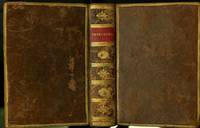
1553048658Venice: Gabriel Giolito 1553. Third Edition. Hardcover Full Leather. Very Good Condition. 19th century full leather rubbing at edges and hinges binding quite sound endpapers refreshed. Slight scattered foxing; browning to bottom of title and first few leaves in the preliminaries and final leaf two small temoin at end of book; an attractive copy with 6 woodcuts in the Trionfi and a full page map of Valclusa. 52 667 1. Printer's mark on verso of final page. <br /> <br /> Giolito published similar editions of Petrarch with commentary by Gesualdo first was 1533 and Vellutell first was 1538 in the 1540s and 50s with the same map and engravings. Adams P820 Mortimer 375 for the 1543 Vellutello ed. Size: Quarto 4to. Quantity Available: 1. Shipped Weight: Under 1 kilo. Category: Poetry; Antiquarian & Rare. Inventory No: 048658. Gabriel Giolito hardcover
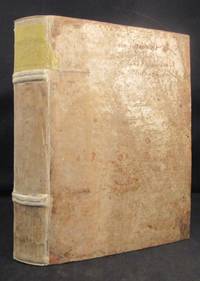
116371Venice Gio. Antonio Bertano 1584. 4to. 12 213 3 ll. Title within wood-cut frame and with 6 wood cut illustrations in the text. Foxing in the margins. Contemporary soft vellum later spine label and later end papers traces of removed ties. Old owner’s signature on the title page by I. Hagdorff. USTC 847907. EDIT16: CNCE 32899. Fine later edition of Petrarca’s work with the commentaries by the poet and scholar Alessandro Vellutello born 1473 first published in 1525. The wood-cut illustration are after the edition printed by Giolito in Venice 1547. Several editions were published during the 16th century. hardcover
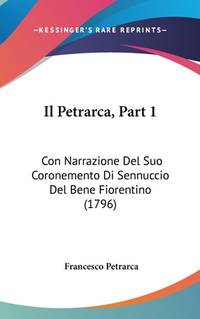
2009DADAX1104807432Kessinger Publishing 2009-07-17. hardcover. New. 6.00x0.75x9.00. Buy with confidence. Excellent Customer Service & Return policy. Kessinger Publishing hardcover
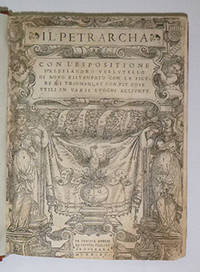
16-6295Vinegia Appresso Gabriel Giolito de Ferrari1545. 4to13.4 x 19cm.; later boards rebacked old ownership inscriptions title-page cropped a few headlines shaved occasional soiling damp-staining towards rear .Witht he map: Descrittione del sito di Valcusa.Adams P810; OCLC Number / Unique Identifier: 28777736:Contents:Sonetti e canzoni.Notes:Signatures: A-2C⸠²Dâ´Woodcuts: elaborate architectural title page featuring cherubs classical figures atop pedestals and printer's device; Giolito's device on verso of last leaf phoenix facing left towards blazing sun standing amidst flames atop a winged orb with printer's initials "GGF;" banner with motto "Semper eadem"; large head-piece on leaf 3 of first sequence featuring portraits of Laura and Petrarch adorning the side of Giolito's flaming urn device surmounted with phoenix and banner bearing printer's motto "Semper eadem"; large white historiated and smaller ornamental initials. Text illustrated with a full-page pictorial map on recto of leaf A8 with title "Descrittione del sito di Valclusa"; text of "I trionfi" illustrated with six woodcuts one at the head of each "trionfi"--Amore Castità Morte Fama Tempo and Divinità "Soggetto de' Triomphi del poeta": leaves 153v-197rPoetry printed in italic type; surrounded on two sides with commentary by Alessandro Vellutello printed in small roman typeIncludes index Vinegia, Appresso Gabriel Giolito de Ferrari,1545 hardcover
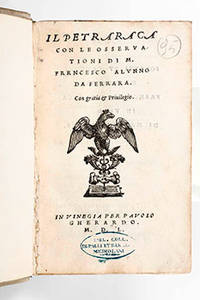
51-4754In Vinegia: Per Pavolo Gherardo Comin da Trino in fine 1550. 12mo. 10 x 15cm. 2 374 20pp. . Nineteenth qtr. vellum and marbled boards; light foxing;OCLC Number: 4333086Notes: Printer's device on t.p. and last leaf.On t.p. verso: Sonetti et canzoni di messer Francesco Petrarca in vita di Madonna Laura.Colophon: In Vinegia per Comin da Trino di Monferrato.The ed. by Alunno was originally published in Venice 1539. This later ed. appeared in 2 parts of which this is pt. 1. Cf. B. Gambi. Serie dei testi di lingua. No. 718. In Vinegia: Per Pavolo Gherardo (Comin da Trino, in fine), 1550 hardcover
1708JC001<p><strong>Et diligentemente corretto.</strong> In Venetia apresso Nicolò Beuilacqua. 1570.</p>_x000d_<p>In 12º 109 x 6 cm com 357 aliás 346 13 págs.</p>_x000d_<p>A colação apresenta um erro tipográfico na numeração entre as páginas 182 e 193.</p>_x000d_<p>Encadernação da época em pergaminho flexível com o título e o nome do autor manuscritos na lombada.</p>_x000d_<p>Edição em miniatura ilustrada com emblemática tendo uma vinheta na folha de rosto xilogravura alegórica com o mote «Superanda omnes fortuna» gravura com Petrarca e Laura no verso da folha de rosto tarjas decorativas xilográficas no início dos capítulos e capitulares decorativas no início do texto dos mesmos.</p>_x000d_<p>Apresenta 6 vinhetas alegóricas historiadas com 'emblemata' no início de cada capítulo na última parte da obra pág. 267 em diante representando respectivamente o Triunfo do Amor pág. 267 o Triunfo da Castidade pág. 289 o Triunfo da Morte pág.296 o Triunfo da Fama pág.309 o Triunfo do Tempo pág. 322 e o Triunfo da Divindade pág.328.</p>_x000d_<p>Exemplar com leves vestígios de tinta e humidade no exterior do corte das folhas e com breves sublinhados e anotações marginais da época no texto e no cólofon. De resto exemplar belo e bem preservado.</p>_x000d_<p>Rara edição em miniatura ilustrada com emblemática publicada no ano de 1570 verificando-se a existência no Museu Britânico de uma cópia on line Refª 240C72. No entanto quando comparada com a nossa a paginação e impressão a partir da página 320 exclusive são diferentes da nossa cópia. A partir desta página e até ao cólofon inclusive a referida cópia do Museu Britânico tem idêntico arranjo gráfico mas com numeração diferente e também diferentes vinhetas e capitulares que não pertencem à colação antecedente.</p>_x000d_<p>O nosso exemplar estará mais correcto na colação na impressão e na ilustração xilográfica.</p>_x000d_<p>Tal como noutras edições também esta edição contém a vida do poeta e o retrato de Petrarca e da Madona Laura em xilogravura e o cancioneiro «Em vida de Laura». Na segunda parte - «Na morte de Laura» - os triunfos canção e sonetos do autor assim como poesias de outros autores. Inclui ainda um discurso de Petrarca sobre a qualidade do amor. O índice encontra-se nas páginas finais não numeradas.</p>_x000d_<p>Notas sobre as edições:</p>_x000d_<p>Brunet não menciona esta edição. A primeira edição impressa de Petrarca foi publicada com o título Soneti Canzoni et Triomphi. Venetiis Vindelinus de Spira 1470. vide Brunet Vol IV 534.</p>_x000d_<p>Brunet menciona as seguintes edições na mesma época sendo anteriores a esta as edições de Veneza 'Il Petrarca di nuovo ristampato e diligentemente correcto'. Venegia Vicenzo Valgrizi 1558. Outra reimpressão de Valgrizi com os mesmos caracteres e no mesmo formato em 1559. Posteriores a esta edição a de Venetia appresso Domenico Nicolini 1572 e também a de 1573 vide Brunet Vol. IV 554.</p>_x000d_<p>Outras referências bibliográficas retiradas de OPAC SBN - Istituto centrale per il catalogo unico respeitantes a esta edição: Hortis 123 Pesante 1974 n. 1803; Sh. t. it. 505; Fowler p. 108.</p>_x000d_<p> </p>_x000d_<p>Nota sobre as bibliotecas nas quais se encontra esta edição num total de 11 cópias.</p>_x000d_<p>Em Itália existem apenas 5 exemplares:</p>_x000d_<p>Biblioteca civica Romolo Spezioli - Fermo - AP0012 SIPFM</p>_x000d_<p>Biblioteca comunale centrale - Milano MI0162 LO101</p>_x000d_<p>Biblioteca Civica di Padova PD0090 PUV55</p>_x000d_<p>Biblioteca civica Attilio Hortis - Trieste - TS0013 TSABC</p>_x000d_<p>Istituzione pubblica culturale Biblioteca civica Bertoliana - Vicenza -VI0096 VIABE</p>_x000d_<p>Em outros países:</p>_x000d_<p>Trinity College Cambridge G.25.58</p>_x000d_<p>British Library 11422.aa.14.</p>_x000d_<p>British Museum on line Ref. 240C72</p>_x000d_<p>Biblioteca Nacional de Espanha Madrid R/21368</p>_x000d_<p>Mèdiathèque Municipal d'Orleans Rès. D 13165</p>_x000d_<p>Biblioteca Publica del Estado Palma de Mallorca Espanha 11.690</p>_x000d_<p> </p>_x000d_<p>Notas sobre o impressor Niccolò Bevilacqua:</p>_x000d_<p>Nicolaus Bevilaqua ou Nicolaus Tridentinus foi um tipógrafo activo em Veneza de 1554 a 1572 e em Turim 1572 a 1573 nascido no segundo decénio de 1500.</p>_x000d_<p>Aprendeu a sua arte na tipografia e no atelier de Paulo Manuzio em Veneza. Desconhece-se quando abriu a sua tipografia. no entanto em 1549 tinha actividade em Santa Marina tendo ficado com a prensa e respectivos caracteres de Francesco Marcolini quando este cessou a sua actividade.</p>_x000d_<p>Em 1568 por insistência de Paulo Manuzio então director da Stamperia del Popolo Romano foi para Roma colaborar na preparação do novo breviário requerido pelo Papa Pio V mas não chegou a um acordo.</p>_x000d_<p>Trabalhou em colaboração com Francesco de Franceschi Gaspare Bindoni O Velho e Damiano Zenaro. Em 1572 transferiu-se para Turim chamado pelo Duque Emanuel Filiberto para instalar uma tipografia ducal.</p>_x000d_<p>No final de 1573 em Turim constitui-se a Compagnia della Stampa da qual faziam parte além de Bevilacqua o mesmo Emanuel Filiberto e Giovani Domenico Tarino. Em Maio de 1573 a nova tipografia iniciou a actividade mas Bevilacqua morreu em Agosto desse mesmo ano. Algumas edições de 1574 ainda foram publicadas com o seu nome.</p>_x000d_<p> </p>_x000d_<p>O Autor</p>_x000d_<p>Francisco Petrarca 1304-1374 pesquisador e filólogo divulgador e escritor é tido como o "pai do Humanismo" no entanto a sua fama deve-se principalmente ao seu romanceiro e aos seus poemas redigidos em língua italiana. Petrarca é também considerado o inventor do soneto tipo de poema composto de 14 versos.</p>_x000d_<p>Pietro Bembo no século XVI criou o modelo para o italiano moderno com base no trabalho de Petrarca e também de Dante e Boccaccio.</p>_x000d_<p>Petrarca viajou frequentemente por toda a Europa na qualidade de embaixador. Gostava de escrever cartas sendo Boccaccio um dos seus amigos mais notáveis. Durante as suas viagens coleccionou manuscritos latinos antigos e foi um dos primeiros a redescobrir o conhecimento clássico de Roma e da Grécia Antiga.</p>_x000d_<p>Participou na primeira tradução latina da obra de Homero e em 1345 descobriu pessoalmente uma colecção inédita de cartas de Cícero.</p>_x000d_<p>Em 1367 Petrarca fixou-se em Pádua onde passou seus últimos anos em contemplação religiosa tendo vindo a falecer a 19 de julho de 1374 em Veneza.</p>_x000d_<p>Doou a sua notável Biblioteca de manuscritos à cidade de Veneza estando os mesmos actualmente integrados no núcleo da Biblioteca Marciana.</p>_x000d_<p> </p>_x000d_<p>EN In 12º 10.9 x 6 cm with 357 i.e. 346 13 pp.</p>_x000d_<p>Collation presents a typographic mistake in the numbering between pages 182 and 193.</p>_x000d_<p>Binding: Contemporary flexible parchment with handwritten title and name of the author on spine.</p>_x000d_<p>Miniature edition illustrated with symbols with a vignette on the title page allegoric woodcut with the motto «Superanda omnes fortuna» etching portraying Petrarca and Laura on the back of the title page; decorative woodcuts on top of the beginning of each chapter and decorative capital letters starting the text of the chapters .</p>_x000d_<p>There are six allegoric vignettes with 'emblemata' at the beginning of each chapter on the last part of the work after page 267 depicting the Triumph of Love pp. 267; the Triumph of Chastity pp.289; the Triumph of Death pp. 296; the Triumph of Fame pp. 309; the Triumph of Time pp. 322; and the Triumph of Deity pp. 328.</p>_x000d_<p>Copy with slight traces of paint and moisture in the outer edge of the leaves. Some contemporary underlines and marginal notes both in text and the colophon. Otherwise a beautiful and well preserved copy.</p>_x000d_<p>There is a copy in the British Museum on line ref. 240C72 which however has different pagination and printing from page 320 on from our copy. From the mentioned page on and ending on the colophon the British Museum"s copy has a similar graphic layout but with different page numbers different vignettes and decorative capital letters which do not match the previous collation.</p>_x000d_<p>Our copy will thus be more accurate in what concerns collation printing and woodcut illustration.</p>_x000d_<p>This edition like others includes the life of the poet the woodcut portrait of Petrarca and Laura and the songbook «In vita de Madona Laura». In the second part - 'In the death of Laura' - the triumphs song and sonnets of the author as well as poetry from other authors. It also includes a speech of Petrarca on the quality of love. The index occupies the unnumbered pages.</p>_x000d_<p> </p>_x000d_<p>Notes on the editions:</p>_x000d_<p>BRUNET:</p>_x000d_<p>Brunet does not mention this edition.</p>_x000d_<p>The first printed edition of Petrarca was published under the title Soneti Canzoni et Triomphi. Venetiis Vindelinus de Spira 1470. cf. Brunet Vol IV 534.</p>_x000d_<p>Brunet mentions the following editions of that time being the Venice editions previous to ours 'Il Petrarca di nuovo ristampato e diligentemente correcto': Venegia Vicenzo Valgrizi 1558; another Valgrizi print with the same characters and format in 1559. Those published after 1970 are: the Venetia appresso Domenico Nicolini puvblished in 1572 and also the 1573 edition cf. Brunet Vol. IV 554.</p>_x000d_<p> </p>_x000d_<p>OTHER BIBLIOGRAPHIC REFERENCES from OPAC SBN - Istituto centrale per il catalogo unico concerning the present edition: Hortis 123 Pesante 1974 n. 1803; Sh. t. it. 505; Fowler p. 108.</p>_x000d_<p> </p>_x000d_<p>Libraries having this edition in a total of 11 copies:</p>_x000d_<p>In Italy only 5 copies:</p>_x000d_<p>Biblioteca civica Romolo Spezioli - Fermo - AP0012 SIPFM</p>_x000d_<p>Biblioteca comunale centrale - Milano MI0162 LO101</p>_x000d_<p>Biblioteca Civica di Padova PD0090 PUV55</p>_x000d_<p>Biblioteca civica Attilio Hortis - Trieste - TS0013 TSABC</p>_x000d_<p>Istituzione pubblica culturale Biblioteca civica Bertoliana - Vicenza -VI0096 VIABE</p>_x000d_<p>In other countries:</p>_x000d_<p>Trinity College Cambridge G.25.58</p>_x000d_<p>British Library 11422.aa.14.</p>_x000d_<p>British Museum on line Ref. 240C72</p>_x000d_<p>Biblioteca Nacional de Espanha Madrid R/21368</p>_x000d_<p>Mèdiathèque Municipal d'Orleans Rès. D 13165</p>_x000d_<p>Biblioteca Publica del Estado Palma de Mallorca Espanha 11.690</p>_x000d_<p> </p>_x000d_<p>Notes on the editor Niccolò Bevilacqua:</p>_x000d_<p>Nicolaus Bevilaqua aka Nicolaus Tridentinus born on the second decade of the 16<sup>th</sup> century was a printer working between 1554 and 1572 in Venice and later in Turin between 1572 and 1573.</p>_x000d_<p>He learned his art with Paulo Manuzio in Venice. There are no registries of the date he opened his own printing shop however in 1549 he was working in Santa Marina keeping the press and characters of Francesco Marcolini when he retired.</p>_x000d_<p>In 1568 instigated by Paulo Manuzio who was at the time Director of the Stamperia del Popolo Romano we travelled to Rome to cooperate in the preparation of the new breviary requested by Pope Pius V but ended up not reaching an agreement.</p>_x000d_<p>He worked with Francesco de Franceschi Gaspare Bindoni The Old and Damiano Zenaro. In 1572 he travelled to Turin by request of the Duque Emanuel Filiberto to install a ducal print house.</p>_x000d_<p>By the end of 1573 in Turim the Compagnia della Stampa is founded by Bevilacqua himself Emanuel Filiberto and Giovani Domenico Tarino. In May 1573 the new print house started its work but Bevilacqua died in August of that same year. Some 1574 editions were still published with his name.</p>_x000d_<p> </p>_x000d_<p>The author</p>_x000d_<p>Francisco Petrarca 1304-1374 researcher and philologist promoter and writer is considered to be the Father of Humanism however his fame is mainly due to his Songbook and his poems written in Italian. Petrarca is also considered to be the inventor of the sonnet a type of poem with 14 lines.</p>_x000d_<p>Pietro Bembo in the 16th century based his model of modern Italian on the works of Petrarca and also Dantes and Boccaccios.</p>_x000d_<p>Petrarca travelled all around Europe as an ambassador. He liked to write letters having Bocaccio as one of his most notable friends. During his travels he collected old Latin manuscripts and was one of the first to rediscover the classic knowledge of Ancient Rome and Ancient Greece.</p>_x000d_<p>He cooperated on the first Latin translation of Homers works and in 1345 he discovered a unique manuscript with Ciceros letters.</p>_x000d_<p>In 1367 he settled in Padua where he spent his last years in religious contemplation. He died in Venice on June 19<sup>th</sup> 1374.</p>_x000d_<p>His notorious manuscript library was donated to the city of Venice and nowadays belongs to the Biblioteca Marciana.</p>_x000d_<p> </p> M-10-E-28 unknown
1104750864.Gpaperback. Good. Access codes and supplements are not guaranteed with used items. May be an ex-library book. paperback
1166041522.Gpaperback. Good. Access codes and supplements are not guaranteed with used items. May be an ex-library book. paperback
1166092046.Ghardcover. Good. Access codes and supplements are not guaranteed with used items. May be an ex-library book. hardcover
1272369110.Gpaperback. Good. Access codes and supplements are not guaranteed with used items. May be an ex-library book. paperback