Victor HUGOBiblio.com
31 339 résultats
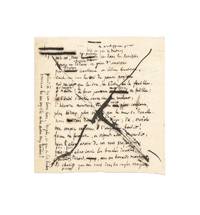
1859Hugo11<p><strong>HUGO Victor 1802-1885</strong></p><p>Draft of an autograph poem N.p.n.d Guernsey 1859 1 p. in-8° 140 x 145 cm Tiny ink corrosion spots</p><p><strong>Precious draft of a satiric poem openly against Napoleon III published in <em>Les Nouveaux Châtiments</em></strong></p><p><em>" Tu n'échapperas point. Fais ce que tu voudras. </em> <em>Fais-toi dans le prétoire et dans la sacristie. </em> <em>Chanter un Te Deum en guise d'amnistie</em> <em>Par Troplong courtisane et Sibour courtisan </em> <em>Chache-toi sous les Oui du pauvre paysan</em> <em>Qui ne sait que le soc la bêche et la faucille. </em> <strong><em>Qu'importe O traître ! à bout portant mon livre te fusille !</em></strong> <em>La vérité sinistre ouvre son feu roulant ; </em> <em>L'histoire montre ton nom noir plus croulant plus sanglant. </em> <em>Plus hideux plus criblé que le mur de Grenelle ;</em> <em>Nous mettons devant toi le siège va crénélé</em> <strong><em>Ton empire caverne ô l'empereur bandit !</em></strong> <em>Ferme ta forteresse et reprends toi c'est dit</em> <em>Nous l'allons écraser de nos vers projectiles. </em> <em>Fais en d'abord sortir les bouches inutiles</em> <em>Veuillot Jacquot Nisard tous ces bavard mangeurs. </em> <em>Si chétifs que ton vers dans ses ongles vengeurs</em> <em>Prend à regret leurs noms strophe et que tu les lâches. </em> <em>Trouvant les uns trop vils et les autres trop lâches ! "</em></p><p>After the first edition of <em>Les Châtiments</em> published in Geneva New York and in a redacted version in Brussels in 1853 Victor Hugo wrote this poem in Guernsey in 1859. It is openly addressed Napoleon III. The poem was first published in Paris in 1910 in the posthumous edition known as "de l'imprimerie nationale" produced by Ollendorff.</p><p>The aspect of the poem on this paper is almost that of a netting. Victor Hugo wrote it with a more applied spelling than that of his working drafts. However the text contains some corrections less than a dozen in total. It is however shorter than the final version counting only nineteen verses against twenty-eight. The nine additional verses will be interspersed between the first and second verses of this version. This poem also has significant variations from the published edition.</p><p><u>References:</u> <em>– Chantiers</em> des <em>Oeuvres complètes – </em>Laffont t. I p. 62 – Hugo. <em>Œuvres complètes</em>. Paris 1904-1952 volume XVIII</p>
187258439Michel Lévy frères | Paris 1872 | 11.50 x 18 cm | relié
185670986Hauteville House 11 et 13 mai 1856 | 14 x 21.50 cm | une feuille
19644512Amsterdam: n.p. 1964 1964. Paper scroll 2760x430mm with a facsimile translated into English of Huges's manifesto written while in prison for an expanded consciousness achieved through the control of blood to the brain. which gives the work its alternative name: The Mechanism of BrainBloodVolume BBV. The original manuscript of Homo Sapiens Correctus was written in Dutch in 1962. In 1964 a facsimile was issued in both Dutch and in an English translation. The text which is organised in nine sections with titles such as "Chemical" "Osmotical" "Brain Metabolism" is arranged around ten coloured diagrams showing how blood is distributed between the brain and the heart. Apart from the occasional chip and a few closed tears this copy is in very good condition with the illustrations especially clean and fresh. At the foot of the scroll is written: "Amsterdam Bart Huges. Made in prison. Copy rights fl.100.000-". Institutionally rare OCLC records only four cop ies of the version in English. And of those sold at auction in the last twenty years all but one have been in Dutch and it seems that the English version is considerably more scarce. Huges is probably the most celebrated enthusiast for trepanation a procedure which he performed on himself on 6th January 1965 using a dentist's drill. Huges's auto-surgery was a long time in the planning. As a medical student in the late 1950s and early 1960s he developed the idea that as humans walk upright blood drains out of the brain. Furthermore as we move from childhood to adulthood our cranial sutures close cutting down the flow of blood to the brain. Huges started to work on ways of recovering our childlike state. Drugs were a significant part of his method - he was an enthusiastic user of marijuana his daughter was called Maria Juana and LSD - and it was while on mescaline that he first understood how trepanation might work to reduce the volume of cerebrospinal fluid in the brain thus increasing the volume of brainblood. Homo Sapiens Correctus explores a number of alternatives to drilling a hole in his head "Physical" "Brain Metabolism" "Psychovitamins" which is just as well as it is a spectacularly gruesome procedure. But there is no doubt that Huges's principal contribution to the expansion of consciousness and the returning of our minds to their childlike states lies in his evangelical adoption of trepanation. Huges who was still a medical student at the time has said that he wrote this scroll to educate doctors about the benefits of the procedure. "I visited about twenty professors of psychiatry anthropology neuro-anatomy etc. and their reactions were without exception negative". So not a success medically but this extraordinary scroll has secured its place as a key work of the 1960s counterculture. Amsterdam: n.p. [1964] unknown
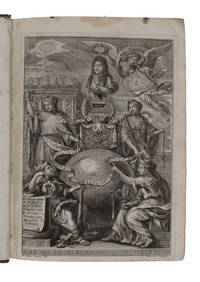
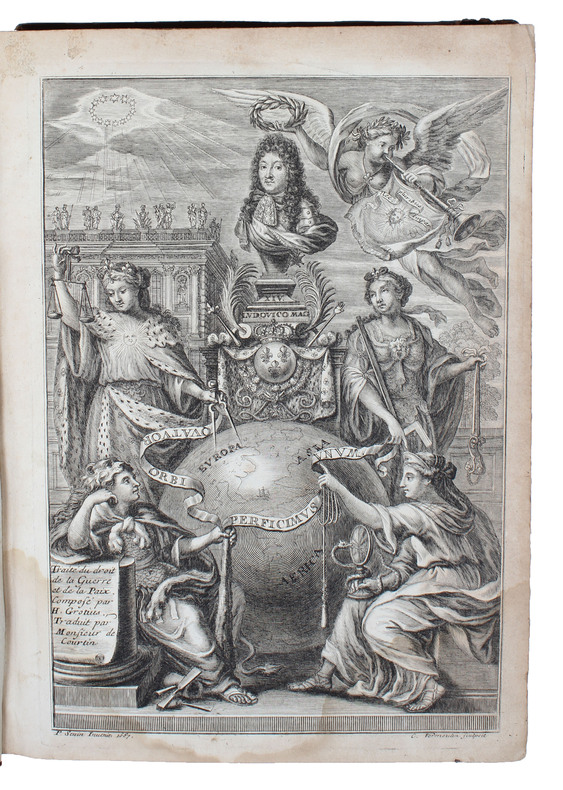
168760297Paris Arnould Seneuze 1687. 4to. Two contemporary uniform full calf bindings with five raised bands to richly gilt spines. Capitals and upper front hinge of volume one worn and boards with a few scrapes. Internally very nice and clean with just the occasional light brownspotting. Engraved frontispiece in vol. 1 engraved title-vignettes large engraved vignette to verso of title-page of vol. 1 engraved portrait in vol. 1 woodcut vignettes and initials. Printed on good paper and with wide margins. 48 621 3 pp. frontispiece and portrait; 4 197 3 pp. <br/><br/><em>The very rare first edition of the first French translation of Grotius' groundbreaking magnum opus "De Jure Belli ac Pacis" the founding work of international law. The profoundly influential masterpiece - written during the Thirty Years' War in the hope that rational human beings might be able to agree to legal limits on war's destruction - "made him famous throughout Europe. the questions which he put forward have come to be the basis of the ultimate view of land and society. This was the first attempt to lay down a principle of right and a basis for society and government outside Church or Scripture. Grotius's principle of an immutable law which God can no more alter than a mathematical axiom was the first expression of the "droit naturel" the natural law which exercised the great political theorists of the eighteenth century and is the foundation of modern international law." PMM 125. This magnum opus of legal philosophy played a tremendous role in French law and politics and in the entire development of international law in general. "It is on the DIB De Iure Bellis that the bulk of Grotius' reputation rests. It consists of an introduction and three books totaling more than 900 pages in translation. As with DIP the introduction or "Prolegomena" holds the greatest interest for philosophers for it is here that Grotius articulates and defends the philosophical foundations of the DIB. While philosophers are naturally attracted to the "Prolegomena" the body of the DIB is also redolent with themes of philosophical interest. Book One defines the concept of war argues for the legitimacy of war and identifies who may legitimately wage war. Book Two deals with the causes of war the origins of property the transfer of rights and more while Book Three is dedicated primarily to the rightful conduct of belligerents in war. After the initial publication in 1625 Grotius ushered several more editions to press during his life each time adding more references without substantially changing the arguments." SEP.Living in the times of the Eighty Years' War between Spain and the Netherlands and the Thirty Years' War between Catholic and Protestant European nations Catholic France being in the otherwise Protestant camp Grotius was deeply concerned with matters of conflicts between nations and religions. His magnum opus was a monumental effort to restrain such conflicts on the basis of a broad moral consensus. It was begun in prison and published during his exile in Paris. "In the dedication of his great work "De Jure Belli ac Pacis" to Louis XIII of France Grotius addresses the king as "everywhere known by the name Just no less than that of Louis . Just when you call back to life laws that are on the verge of burial and with all your strength set yourself against the trend of an age which is rushing headlong to destruction; . when you offer no violence to souls that hold views different from your own in matter of religion; . when by the exercise of your authority you lighten the burden of oppressed peoples."When writing this dedication and the Prolegomena to "De Jure Belli ac Pacis" originally published in Paris in 1625 Grotius was living in exile. Europe was war-torn and depression and suffering from hunger and cold prevailed in many regions justifying Grotius' description of international law as such: "in our day as in former times there is no lack of men who view this branch of law with contempt as having no reality outside of an empty name." The treaty of peace embodying many of the universal and permanent principles which Grotius abstracted "from every particular fact" in those dark days of the early part of the Thirty Years' War was not concluded till 23 years later. The year 1624 was in the negotiation of the treaty assumed to be the norm year for restoration of the "Status quo".The more than three centuries since Grotius wrote his magnum opus seem to bear witness to his views upon war peace in spite of the fact that many a state has not yet realized that the state is "Truly fortunate which has justice for its own boundary line." In 1625 Grotius famously stated: "there is no state so powerful that it may not sometime need the help of others outside itself either for the purposes of trade or even ward off the forces of many foreign nations united against it."Grotius's paramount influence upon international law is widely acknowledged worldwide. For instance since 1999 the American Society of International Law holds an annual series of Grotius Lectures. Because of his theological underpinning of free trade he is also considered an "economic theologist"."To those desirous of understanding the fundamental principles which have motivated some of the greatest statesmen of modern time and the bases upon which a state which is to remain essentially sound must rest a reading of Grotius' Prolegomena to the "Law of War and Peace" is commended." George Grafton Wilson: "Grotius: Law of War and Peace." p. 1. In: The American Journal of International Law vol. 35 nr. 2 1941. </em> hardcover
168760297Paris, Arnould Seneuze, 1687. 4to. Two contemporary uniform full calf bindings with five raised bands to richly gilt spines. Capitals and upper front hinge of volume one worn and boards with a few scrapes. Internally very nice and clean with just the occasional light brownspotting. Engraved frontispiece in vol. 1, engraved title-vignettes, large engraved vignette to verso of title-page of vol. 1, engraved portrait in vol. 1, woodcut vignettes and initials. Printed on good paper and with wide margins. (48), 621, (3) pp. + frontispiece and portrait" (4), 197, (3) pp.
1925140945709Boston: The Stratford Company 1925. First Edition. Near Fine/Near Fine. First edition first printing. Bound in publisher's original blue cloth with upper board ruled in blind and gilt lettering to the upper board and spine. Near Fine with darkening to the cloth at the joints and contents tanned but a very sharp copy. In a Near Fine unclipped dust jacket with light edge wear and light soiling slight tanning to the spine panel. A lovely example of a dust jacket that usually turns up much worse for wear. The Stratford Company unknown
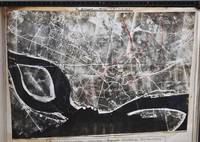
1918B045<p>A large photo album of 52 leaves with dipped in photos on each side. There is a total of ca. 394 pictures; 189 original photos 9 aerial photos 168 official buy photos and postcards 27 collotypes from a paper.</p><p>The size of the album is 32 x 41.5 cm.</p><p>The photos in this album are unique documents showing the unvarnished truth of war. An album that should have its place in a museum.</p><p>The album was collated by a young German soldier named Hans Hugo who was born in Roth a small Bavarian town near Nuremberg Germany. Later he opened a photo studio in Roth that existed until the 1960ies. Hans Hugo was at war from October 1916 until the end of WWI in 1918.</p><p>The photos are from Belgium France and the Baltics. There are some exciting outstandingly rare large original air reconnaissance serial Photos. The largest of them showing a battle field near Riga measures 25 x 47.8 cm. These photos are original contact prints that were used in the general staff for the planning of battels. They have an extremely fine resolution so that under a magnification glass small details on the ground can be identified. Only a few original prints like this one have survived and today they are the pride of museum archives.</p><p>There are photos from battle fields downed aircrafts destroyed tanks and so on. Some of them are of excessive cruelty showing killed soldiers. Such photos were absolutely illegal as they were not in line with the official propaganda.</p><p>Furthermore there are photos from parades for high ranking persons: Generals princes and last not least the emperor Kaiser Wilhem II himself. These are original private photos by Hugo or one of his friends. These are not official photos. They are unique.</p><p>At the last pages there are a number of photos showing Hans Hugo or his comrades. Some of them have very macabre comments naming the date and place where they were killed.</p> hardcover
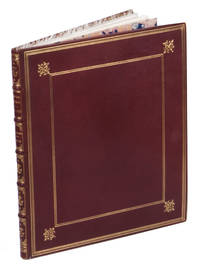
1885ABC_48556Paris 1885. 4to ca. 27 x 24.5 cm. J. Lemmonyer G. Richard and Cie E. Testard Contemporary gold-tooled red morocco with the title and author lettered in gold on the spine gold-tooled board edges and turn ins marbled end papers. Bound by the French bookbinder Louis Guétant 1848-1936 signed in the bottom turn in of the front board. With 30 full-page engravings on silk. 30 silk ll. Remarkable suite of plates for the plays of Victor Hugo 1802-1885 printed on silk and luxuriously bound. The engravings are beautifully drawn and capture the light in an entrancing way because of the sheen of the silk. The work starts with a portrait of Hugo by Achille Devéria 1800-1875 a painter and lithographer known for his portraits of famous authors. The other plates illustrate all 13 of Hugo's plays including his unfinished Les jumeaux and were made by various different artists.The plates were engraved for the "Edition nationale" a 43 volume work containing Hugo's complete oeuvre printed between 1885-1895. Five of the volumes were dedicated to his plays. This national edition was illustrated by some of the most important French artists of the time including Maurice Leloir 1853-1940 Adrien Moreau 1843-1906 and Georges Antoine Rochegrosse 1859-1938. The work was limited to a 1000 copies only available to subscribers. This included a luxury edition printed on Japanese paper which was limited to just 250 copies and came with an extra suite of plates printed on silk. The present work is most likely this extra suite of plates from the theatre volumes of the luxury edition.Victor Hugo was a French poet novelist and dramatist of the Romantic movement. He is considered one of the greatest and best-known French writers. His most well-known works are the novels Les Misérables 1862 and Notre-Dame de Paris 1831. He also earned respect as a campaigner for social causes such as the abolition of capital punishment.The present work comes from the library of Henry Baudet 1891-1921 a Dutch mathematician and chess player.With the bookplate of Henry Baudet mounted at the head of the front pastedown. The corners of the boards are very lightly scuffed the leather on the front and back is lightly scratched. The silk leaves are frayed at the head and foot margin not affecting the images the first engraving of the play Hernani has somewhat browned some engravings are slightly creased mostly in the margins. Otherwise in very good condition. ABE CAT Art History hardcover
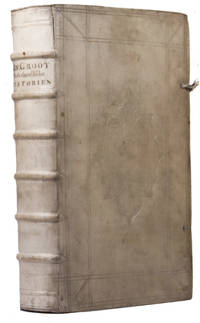
1681ABC_48018Amsterdam: the widow of Joannes van Someren Abraham Wolfgangk and Hendrik & Dirk Boom 1681. Contemporary blind-tooled vellum with the manuscript author and title on the spine a large ornament in the centre of both boards surrounded by two double fillet frames leather closing ties. Folio. With an engraved allegorical frontispiece by Abraham Bloteling after Zacharias Webber I 20 full-page engraved portraits and 27 double-page plates views and plans by Jan Luiken Coenraet Decker and Gilliam van der Gouwen a title page printed in red and black decorated woodcut initials and woodcut head- and tailpieces. 3 parts in 1 volume. First and only Dutch edition as well as the only illustrated edition of the main historical works by the famous Dutch jurist philosopher theologian and diplomat Hugo de Groot Hugo Grotius 1583-1645 also known as the "infant prodigy from Delft". Divided in three parts it covers the history of the Northern Low Countries from 1555 to 1609. Most important are the Annales et historiae de rebus Belgicis in the first part translated as Nederlandtsche jaerboeken en historien . as a contemporary history of the Dutch Revolt or the Eighty Years' War till the Truce in 1609. The work is copiously illustrated with beautiful large portraits of the most important political figures of the time as well as views and plans of important events and towns.Grotius began writing the work when he was just 18 on request of the States of Holland who asked him to compose a history of the revolutionary first years of the Dutch War of Independence. He wrote the Annales covering the years 1555-1588 in the years 1601-1612 using a language clearly inspired by the Latin historian Tacitus. The Historiae covering the years 1588-1609 here also included in the first part followed soon. His text however contained many stories and details which were considered controversial by the States of Holland so the Annales were not published before 1657. The work then became quite popular and was soon translated to French 1662 English 1665 and Dutch 1681. The present Dutch translation was made by Joan Goris dates unknown.The other two parts of the present work include translations of three other works by Grotius namely: 1 the first edition of Grollae obsidio 1629 the history of the siege of the fortified town "Grol" Groenlo by Prince Frederick Henry in 1627; 2 Liber de antiquitate Reipublicae Batavicae 1610 of which a Dutch translation had been published in the same year under the title Tractaet vande oudtheyt vande Batavische nu Hollandsche Republique and 3 perhaps - apart from De iure belli ac pacis 1625 - Grotius most famous work: Mare liberum The freedom of the seas 1609 of which a Dutch translation had appeared in 1614. On the basis of these last two books Grotius is considered as one of the founders of international and natural law. The Mare liberum includes reports and commentary on the Dutch East and West India trade companies as well as a 17th-century perspective on trade in the Americas from 1591-1609.With the armorial bookplate of the Dutch lawyer Wilhelm Cornelis Baert de Waarde 1864-1951 mounted on the recto of the first free flyleaf. The front joint is weakened at the head and tail lacking the bottom pair of closing ties. Otherwise in very good condition.l Klaversma/ Hannema 585 and 586; Sabin no. 28956; cf. Haitsma Mulier E.O.G. Grotius Hooft and the writing of history in the Dutch Republic in: A.C. Duke C.A. Tamse eds. Clios mirror. Historiography in Britain and the Netherlands VIII 1985 pp. 55-72; Heesakkers C.L. Grotius als geschiedschrijver in: Het Delfts orakel Hugo de Groot 1983 pp. 103-110. the widow of Joannes van Someren, Abraham Wolfgangk and Hendrik & Dirk Boom, hardcover
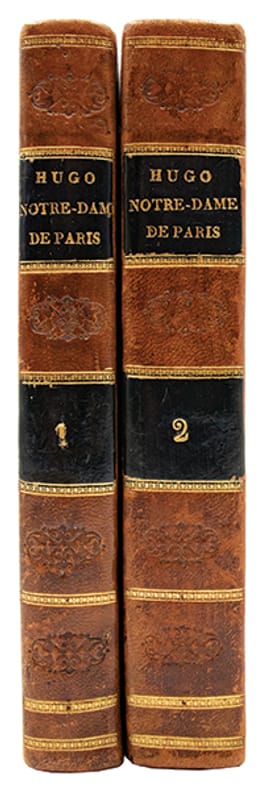
1831391781831 2 volumes in-8 (203 x 127 mm), demi-veau havane à petits coins de vélin, dos lisses ornés dun décor romantique de compartiments ornés dun fleuron à froid répété et dune roulette dorée en place des nerfs, pièces de titre et de tomaisons de veau noir, tranches mouchetées (reliure de lépoque), (8), 404 pages et (4), 536 pages. Paris, Charles Gosselin, 1831.
1926249499New York: Ernest Gee 1926. Large Paper One of 28 unnumbered copies. Engraved portrait by Gordon Ross titlepage engraving. vi 24 2 pp. 1 vols. 8vo 9.25 x 6.25 inches. Green paper boards white cloth spine paper label on front cover. Ross Gordon. Large Paper One of 28 unnumbered copies. Engraved portrait by Gordon Ross titlepage engraving. vi 24 2 pp. 1 vols. 8vo 9.25 x 6.25 inches. INSCRIBED LARGE PAPER. The original edition of this book was so rare that Mr. Gee the great sporting bookseller reprinted it for his friends.<br/>Frazier writes: "the book and its design paper binding and style are so obviously Derrydale in spirit and influence that one only to put it side by side with Connett's AMERICAN TROUT STREAMS by Henry Ingraham produced the following year to see how this book and the books of the Press came together. The question would be whether Ernest Gee had more influence on Connett in 1926 or whether Connett had more influence on Gee in this important year when together they formed the group that formed the press." Siegel clearly felt this was not a Derrydale because in the early days of the Press Connett used J.N. Johnston for the printing of the Press books and no connection can be established with August Becker who printed this work. <br/>In Ernest Gee's catalogue No. 10 printed around 1928 he lists this title in two areas. In one instance he states "A small privately printed edition." and in the other mention he declares "Edition limited to 330 copies" with no mention of a Deluxe state.<br/><br/>Inscribed on the front flyleaf "Mrs. Jackson A. Dykman/ With the best wishes from/ Ernest R. Gee/ New York. Dec 1926." Siegel p. 182; Frazier M-6-D; Biscotti Six Centuries of Foxhunting pp. 176-8 Ernest Gee unknown books
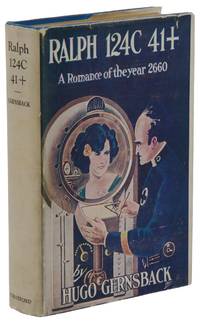
1925108026Boston: The Stratford Company 1925. First edition of "arguably the first major work of American science fiction" The Economist. Octavo original cloth. Signed by the author on the front free endpaper "With the compliments of the author H Gernsback 1925." Near fine in a very good dust jacket. Bookplate on the front pastedown. "In 1908 Gernsberg established 'Modern Electrics' a radio catalog that rapidly became a monthly magazine; one of its editorials was instrumental in establishing the Wireless Act of 1912. In April 1911 'Modern Electrics' began serializing Gernsback's Ralph 124C 41 written to exemplify his contention that fiction could serve to teach science. Thoroughly deficient as fiction the story nevertheless predicts radar microfilm and microfiche tape recorders television wireless transmission of power planet hormones and weather control" American National Biography. The Stratford Company hardcover books
1925108026Boston: The Stratford Company 1925. First edition of "arguably the first major work of American science fiction" The Economist. Octavo original cloth. Signed by the author on the front free endpaper "With the compliments of the author H Gernsback 1925." Near fine in a very good dust jacket. Bookplate on the front pastedown. In 1908 Gernsberg established 'Modern Electrics' a radio catalog that rapidly became a monthly magazine; one of its editorials was instrumental in establishing the Wireless Act of 1912. In April 1911 'Modern Electrics' began serializing Gernsback's Ralph 124C 41 written to exemplify his contention that fiction could serve to teach science. Thoroughly deficient as fiction the story nevertheless predicts radar microfilm and microfiche tape recorders television wireless transmission of power planet hormones and weather control" American National Biography. The Stratford Company hardcover
1834140940930Philadelphia: Carey Lea and Blanchard 1834. First American Edition. Near Fine. First American edition. Two volumes bound in publisher's original dram boards over blue cloth spine; title labels perished. Binding worn corners softened and contents foxed old tidemarks to bottom corner of several early pages. Chip to edge of first blank in Volume II. Lower third of rear free endpaper lacking in Volume I and rear blank near-completely missing from the second volume. Housed in a custom cloth chemise case. Carey, Lea and Blanchard unknown books
1862140083New York: Carleton Publisher 1862. First American edition and first edition in English of Victor Hugo's masterpiece. Octavo bound in contemporary three quarters calf over marbled boards gilt titles to the spine raised bands five volumes complete in one volume. Translated by Charles E. Wilbour. In near condition previous owners names. Uncommon in this condition. Victor Hugo’s “great novel has been hailed as a masterpiece of popular literature an epic poem in prose about God humanity and Hugo… Hugo hoped that Les Misérables would be one of if not the ‘principal summits’ of his body of works. Despite its length complexity and occasionally unbelievable plot and characterization it remains a masterpiece of popular literature. It anticipates Balzac in its realism but in its flights of imagination and lyricism its theme of redemption and its melding of myth and history it is uniquely Hugo†Dolbow 149 214. Charles E. Wilbour was hired by the Carleton Publishing Company to translate Hugo's grand masterpiece and he did so very quickly allowing the first American edition to be published within months of its French release. The intense advertising campaign waged by Carleton resulted in massive sales for Les Misérables solidifying Hugo's epic in second place behind only Uncle Tom's Cabin in pre-Civil War American book sales. Carleton, Publisher hardcover
1926251066n.p.: Privately Printed for Ernest R. Gee at the Press of August Becker Brooklyn 1926. Large Paper. One of 28 copies on Large Paper. Frontispiece portrait by Gordon Ross. Title-page vignette of a foxhound. vi 24 2 pp. 1 vols. 8vo. Original cloth-backed boards printed paper label on front cover. An immaculate copy in its original glassine dust jacket spine of which is partially gone. Bookplate. In custom quarter crimson and cloth slipcase with leather label on upper cover. Large Paper. One of 28 copies on Large Paper. Frontispiece portrait by Gordon Ross. Title-page vignette of a foxhound. vi 24 2 pp. 1 vols. 8vo. ONE OF 28 COPIES. Inscribed by Gee "To Mr. Wilson S. Mills / with the compliments of / Ernest R. Gee / New York / April 1945." <br/>While there is disagreement as to whether this volume is one of the Derrydale Press works Frazier states: "But the book and its design paper binding and style are so obviously Derrydale in spirit and influence that one has only to put itside by side with Connett's American Trout Streams.produced the same year 1926 or Connett's own Magic Hours produced the following year to see how this book and the books of the Press came together. The only question would be whether Ernest Gee had more influence on Connett in 1926 or whether Connett had more influence on Gee in this important year when together they formed the group that formed the press." Frazier<br/><br/>In Ernest Gee's catalogue No. 10 printed around 1928 he lists this title in two areas. In one instance he states "A small privately printed edition." and in the other mention he declares "Edition limited to 330 copies" with no mention of a Deluxe state. Frazier M-6-D; Siegel p. 182 note; Biscotti Six Centuries of Foxhunting pp. 176-8 Privately Printed for Ernest R. Gee [at the Press of August Becker, Brooklyn] unknown books
168751671Paris Arnould Seneuze 1687. 4to. Two contemporary uniform full calf bindings with five raised bands to richly gilt spines. All edges of boards gilt. Hinges and capitals worn with some loss but still tight. A damp stain to first and last leaves of both volumes affecting about 17 leaves in all mostly marginal. Otherwise a nice and clean copy with just the occassional brownspotting. Engraved frontispiece in vol. 1 engraved title-vignettes large engraved vignette to verso of title-page of vol. 1 engraved portrait in vol. 1 woodcut vignettes and initials. Printed on good paper and with wide margins. 48 621 3 pp. frontispiece and portrait; 4 197 3 pp. <br/><br/><em>The very rare first edition of the first French translation of Grotius' groundbreaking magnum opus "De Jure Belli ac Pacis" the founding work of international law. The profoundly influential masterpiece - written during the Thirty Years' War in the hope that rational human beings might be able to agree to legal limits on war's destruction - "made him famous throughout Europe. the questions which he put forward have come to be the basis of the ultimate view of land and society. This was the first attempt to lay down a principle of right and a basis for society and government outside Church or Scripture. Grotius's principle of an immutable law which God can no more alter than a mathematical axiom was the first expression of the "droit naturel" the natural law which exercised the great political theorists of the eighteenth century and is the foundation of modern international law." PMM 125. This magnum opus of legal philosophy played a tremendous role in French law and politics and in the entire development of international law in general. "It is on the DIB De Iure Bellis that the bulk of Grotius' reputation rests. It consists of an introduction and three books totaling more than 900 pages in translation. As with DIP the introduction or "Prolegomena" holds the greatest interest for philosophers for it is here that Grotius articulates and defends the philosophical foundations of the DIB. While philosophers are naturally attracted to the "Prolegomena" the body of the DIB is also redolent with themes of philosophical interest. Book One defines the concept of war argues for the legitimacy of war and identifies who may legitimately wage war. Book Two deals with the causes of war the origins of property the transfer of rights and more while Book Three is dedicated primarily to the rightful conduct of belligerents in war. After the initial publication in 1625 Grotius ushered several more editions to press during his life each time adding more references without substantially changing the arguments." SEP.Living in the times of the Eighty Years' War between Spain and the Netherlands and the Thirty Years' War between Catholic and Protestant European nations Catholic France being in the otherwise Protestant camp Grotius was deeply concerned with matters of conflicts between nations and religions. His magnum opus was a monumental effort to restrain such conflicts on the basis of a broad moral consensus. It was begun in prison and published during his exile in Paris. "In the dedication of his great work "De Jure Belli ac Pacis" to Louis XIII of France Grotius addresses the king as "everywhere known by the name Just no less than that of Louis . Just when you call back to life laws that are on the verge of burial and with all your strength set yourself against the trend of an age which is rushing headlong to destruction; . when you offer no violence to souls that hold views different from your own in matter of religion; . when by the exercise of your authority you lighten the burden of oppressed peoples."When writing this dedication and the Prolegomena to "De Jure Belli ac Pacis" originally published in Paris in 1625 Grotius was living in exile. Europe was war-torn and depression and suffering from hunger and cold prevailed in many regions justifying Grotius' description of international law as such: "in our day as in former times there is no lack of men who view this branch of law with contempt as having no reality outside of an empty name." The treaty of peace embodying many of the universal and permanent principles which Grotius abstracted "from every particular fact" in those dark days of the early part of the Thirty Years' War was not concluded till 23 years later. The year 1624 was in the negotiation of the treaty assumed to be the norm year for restoration of the "Status quo".The more than three centuries since Grotius wrote his magnum opus seem to bear witness to his views upon war peace in spite of the fact that many a state has not yet realized that the state is "Truly fortunate which has justice for its own boundary line." In 1625 Grotius famously stated: "there is no state so powerful that it may not sometime need the help of others outside itself either for the purposes of trade or even ward off the forces of many foreign nations united against it."Grotius's paramount influence upon international law is widely acknowledged worldwide. For instance since 1999 the American Society of International Law holds an annual series of Grotius Lectures. Because of his theological underpinning of free trade he is also considered an "economic theologist"."To those desirous of understanding the fundamental principles which have motivated some of the greatest statesmen of modern time and the bases upon which a state which is to remain essentially sound must rest a reading of Grotius' Prolegomena to the "Law of War and Peace" is commended." George Grafton Wilson: "Grotius: Law of War and Peace." p. 1. In: The American Journal of International Law vol. 35 nr. 2 1941. </em> hardcover
168751671Paris, Arnould Seneuze, 1687. 4to. Two contemporary uniform full calf bindings with five raised bands to richly gilt spines. All edges of boards gilt. Hinges and capitals worn, with some loss, but still tight. A damp stain to first and last leaves of both volumes (affecting about 17 leaves in all, mostly marginal). Otherwise a nice and clean copy with just the occassional brownspotting. Engraved frontispiece in vol. 1, engraved title-vignettes, large engraved vignette to verso of title-page of vol. 1, engraved portrait in vol. 1, woodcut vignettes and initials. Printed on good paper and with wide margins. (48), 621, (3) pp. + frontispiece and portrait" (4), 197, (3) pp.
19571839Louis Broder, Paris 1957. Collection "Miroir du poète" n° VI. Un volume in-12 carré (167 x 136 mm), en feuilles, 42 pages, sous couverture de papier japon à rabats titrée en rouge sur le premier plat. Chemise et étui de l'éditeur noir et gris titré en rouge sur le dos. Édition originale de ce recueil de 7 poèmes de Robert Desnos inédits en volume. 4 GRAVURES ORIGINALES À L'EAU-FORTE ET AQUATINTE EN COULEURS (150 x 120 mm). La typographie est dûe à l'imprimerie Union et le tirage de la gravure à Robert Dutrou. Édition : 120 exemplaires numérotés sur vélin de Rives BFK. Celui-ci, l'exemplaire n°2 est signé par André Masson au colophon. Il comporte UNE SUITE COMPLÈTE DES GRAVURES ET DE LA DÉCOMPOSITION DES COULEURS : chaque épreuve de l'état final est justifiée 5/7 et signée au crayon par l'artiste, chaque épreuve de la décomposition des couleurs est justifiée 5/7 et monogrammée au crayon par l'artiste. 16 planches signées au total. Sixième volume de la collection "Miroir du poète" qui en comporte 7. Un huitième volume prévu n'a jamais vu le jour, mais la maquette existe. Le volume en parfait état, l'emboîtage de même (Saphire-Cramer 42). ENGLISH : André Masson - Robert Desnos, : Mines de Rien, Collection Miroir du Poète VI, Louis Broder, Paris, 1957. 4 aquatints printed in colours, 1957, on BFK Rives, title, text, list of contents, justification and the set of four, the justification signed in pencil by André Masson. copy numbered on vélin de Rives paper, from the total edition of 130. This one, copy no. 2, includes A COMPLETE SUITE OF THE ENGRAVINGS AND DECOMPOSITION OF COLORS: each proof of the final state is justified 5/7 and signed in pencil by the artist, each proof of the decomposition of colors is justified 5/7 and monogrammed in pencil by the artist. There is 16 signed plates in total. The set is in mint++ condition in its original slipcase, perfect. overall S. 177 x 153mm. (Cramer 42).
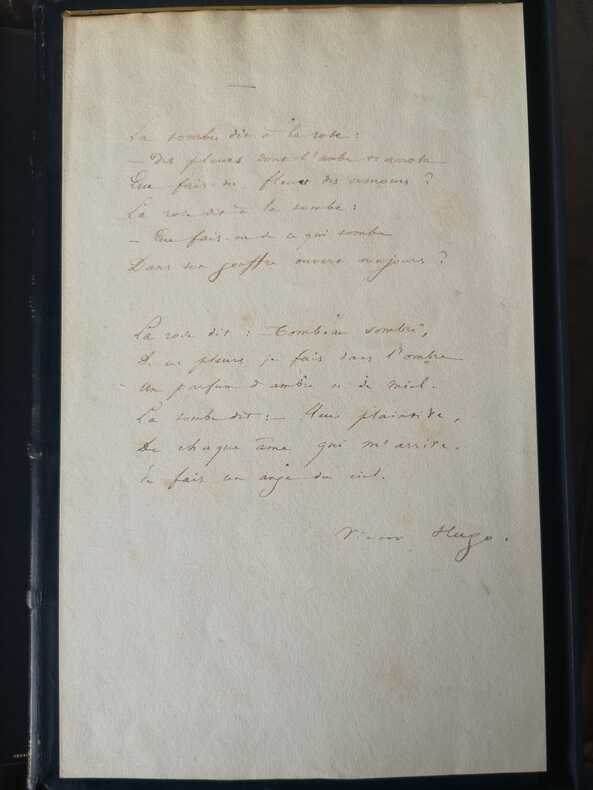
LRB_010HUGO (Victor). POÈME AUTOGRAPHE SIGNÉ. 1 page, 21,1 × 13 cm. Belle copie autographe signée de « la Tombe dit à la rose », trente-et-unième (et pénultième) poème des Voix intérieures. Il y est daté de juin 1837. « La tombe dit à la rose : — Des pleurs dont l’aube t’arrose Que fais-tu, fleur des amours ? La rose dit à la tombe : — Que fais-tu de ce qui tombe Dans ton gouffre ouvert toujours ? La rose dit : — Tombeau sombre, De ces pleurs je fais dans l’ombre Un parfum d’ambre et de miel. La tombe dit : — Fleur plaintive, De chaque âme qui m’arrive, Je fais un ange du ciel. Victor Hugo » Encre légèrement pâlie. Pâles rousseurs et légères traces de manipulations. (La photo accentue fortement tout cela.)
1967045010Boston: National Geographic Society 1967. 1st Edition 1st Printing. Hardcover. Near Fine/Very Good. 9 1/4" High. 204 Pp. Green Cloth Stamped In Black And Gilt. First Printing No Isbn. Signed By Jane Goodall And Hugo Van Lawick On The Preliminary Illustrated Page. Book Near Fine Trace Of Rubbing At Corners. Dj With Light Wear A Few Short Tears At Edges. <br/> <br/> National Geographic Society hardcover
1838HUGOVICT000576Richard Bentley London. 1838. Second edition in English from the sheets of the first edition translated with a sketch of the life and writings of the author by Frederic Shoberl. Issued as no. XXXII in the Standard Novels series. 12mo. pp xiv 466 2 Opinions on this Work. Frontispiece and extra engraved title page dated 1833. Vertical-ribbed burgundy cloth decorated in blind lettered in gilt.Signs of damp to margins of frontispiece and extra title-page. Cloth faded at spine and edges. Head and tail of spine a bit scuffed. Very good. Very scarce in the original cloth. Richard Bentley, London. hardcover
186277887Bruxelles Brussels: A. Lacroix Verboeckhoven & Cie 1862. Fine. A. Lacroix Verboeckhoven & Cie Bruxelles Brussels 1862 14.50 x 22 cm 10 volumes reliés Victor HUGO Les Misérables A. Lacroix & Verboeckhoven & Cie Bruxelles 1862 145x22cm 10 bound volumes. First edition without statement published concomitantly with the Pagnerre's Paris edition. Bound in half blue sheepskin spine in four compartments decorated with double gilt fillets blue paper plates marbled paste-down and endpapers mottled edges English bindings of the time. Scattered foxings title page of the third volume slightly and marginally soiled paper plates a little rubbed and a few tears on some edges some joints repaired. The first edition of Les Misérables was legally created by three different publishers Pagnerre in France Lacroix in Belgium and Steinacker in Germany under the aegis of the official publisher A. Lacroix Verboeckhoven & Cie. The question of the prevalence of one edition over the other has long stirred the bibliophilic world and bibliographers remain divided on this thorny issue. Carteret and Vicaire for example ensured that the Paris edition should be preferred whereas Vanderem and Clouzot placed the Belgian edition first. More than just a matter of chronology this bibliographical dispute reveals the complexity of the concept of the first edition and the symbolic importance its holds for literary history and in particular for this masterful work which is among the most important in world literature. Strangely without this question really being settled the Brussels edition is commonly described as pre-Paris whereas the Leipzig edition is simply ignored. Les Misérables would therefore be published on 30 or 31 March with Lacroix and 3 April with Pagnerre. The arguments of this Belgian precedence are however all refutable and from 1936 Georges Blaizot had demonstrated its fragility. The first argument is based on a letter by Victor Hugo addressed to Lacroix from 1865 and in which the poet himself called the Belgian edition princeps first: Typographiquement il faut se régler en tout sur l'édition belge princeps des Misérables en dilatant plutôt qu'en resserrant Typographically it is necessary to be totally attuned with the first Belgian edition of Les Misérables expanding rather than tightening he wrote on the subject of the Travailleurs de la mer which will be published in 1866. Yet Hugo's designation is by no means a bibliographical indication as Georges Blaizot explains denouncing the abusive interpretation of P. de Lacretelle and Dr Michaux: Le poète précise un point un seul très simple très clair très précis : l'édition belge princeps c'est-à-dire la première parue des éditions belges doit servir de type aux éditions futures. Il dit cela il dit bien cela il ne dit que cela. The poet specifies one point one very simple very clear very precise: the first Belgian edition i.e. the first published of the Belgian editions must serve as a type for future editions. He says that he says that clearly he says only that. Georges Blaizot in Le Bulletin du bibliophile et du bibliothécaire 1936. Indeed a more modern in-12 edition will follow the famous in-8 edition in October of the same year. The second argument is more significant. It is based on a letter by Adèle Hugo to her husband recounting the extraordinary affair of the French publication four days before the scheduled date. This letter will be partially reproduced in 1904 in the complete works published by Meurice and Simon with the supposed date of 31 March 1862. In it Adèle recounts the reasons for the French publishing haste: Auguste Vacquerie nous apprend que Les Misérables paraissent sous trois jours. Étonnement mêlé de satisfaction. Auguste me raconte qu'ils comptaient faire paraître Les Misérables le 7 avril ; que le matin Noël Parfait était accouru effaré chez Paul Meurice lui dire qu'il sortait de voir aux mains de Paul Siraudin un exemplaire des Misérables qu'i A. Lacroix, Verboeckhoven & Cie unknown
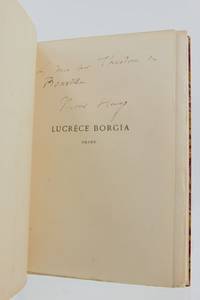
188175902Paris: Calmann Lévy 1881. Fine. Calmann Lévy Paris 1881 14 x 19.50 cm relié New edition one of 40 numbered copies on Whatman the only deluxe copies announced. Half red morocco binding spine with five raised bands date at foot marbled paper boards marbled endpapers and pastedowns original wrappers preserved top edge gilt on deckled edges binding signed by P. Goy & C. Vilaine. Precious signed autograph inscription from Victor Hugo: ""A mon cher Théodore de Banville. Victor Hugo."" ""To my dear Théodore de Banville. Victor Hugo."" Precious inscription from the master to one of the pillars of the Parnassian school. Calmann Lévy hardcover