109 124 résultats
18920001335MANKATO MANAWA KANSAS KS SEYMOUR WISCONSIN WI. Very Good. 1892. On offer is an archive of six 6 original manuscript diaries handwritten by Andrew C. Walch a newspaper man who worked mostly in Mankato Kansas in the 1890s. The diaries represent 1892 1893 1894 1895 1896 and 1897. The early diary begins with Andrew living in Seymour Wisconsin in the fall he moves to Mankato Kansas. The next four diaries 1893-1896 show him still in Mankato and finally in the 1897 diary he's in Manawa Wisconsin. Andrew is an unstinting diarist rarely failing to write and all the diaries are full save for 1897 which is about ¼ full. Historians and collectors of late 19th Century Kansas and journalism will find an open book in Walch. Here are snippets: "March 18th 1892 Seymour Wisconsin Got up at 4:45 a.m. Helped do the chores and then walked to town and took the train for Black Creek to attend District Lodge. At the depot Edith Standard met us and Charles and I went off with Alfred Holz. We saw John Heintz and his two pretty sisters. At 8:30 met Mr. Burgogne and we went to school until recess then went to lodge. I was appointed press reporter. At 5 o'clock Mary Tubbs Charles Flora Stevenson and I took in the town and at 6:56 took the train for home. Saw Mary to Merehl's store and then went to Mr. Conner's to practice for the church. Afterwards met Chief Fuller Bert Flint and Lafey Sherman and went home. Retired at 11 o'clock." "October 5th 1892 Seymour Wisconsin Got up at 8 o'clock. Went to call on Ella Raw Mrs. Flint and then home to dinner and at 11 o'clock after bidding al the folks "Good Bye" started on my journey. Arrived at Oshkosh at 4 o'clock and put up at the Tremont. Went to the city hall where the G. L. was being held and met all my Good Templar friends. In the evening took the R.W. G. L. degree with 23 others. Frank McKinny and I caught Ruth Willia and Myrtle Thresher and went for a walk and then took them home. Went back to the Tremont and wrote to mother and at 12:50 left for Chicago. Truth one." "November 1st 1893 Mankato Kansas on a trip Ft. Atkinson Wisconsin. Got up at 7:30 and Otto and I took in the town and the High School buildings and then drove over to Whitewater to see Emma Will and George. Took dinner with them and then we drove back to the Fort and at 2:30 took the train for Beloit arriving there at 7:00. Charles met me at the depot and we took in the town a little and went to the salvation army barracks and then went back to the house and had a chat with some of the college boys and Charles and I rolled in about 11:45." "November 13th 1893 Got up at 7 o'clock and after breakfast Charles and I went downtown and up to see the water works and at 10 o'clock I left for Chicago. Went immediately to Simmons and then went down on Wabash Ave. to see Dr. George Westcott. Had a good visit and went to supper with him and met Mrs. Westcott. About 9 'clock went back to Simmons and Maud was the only one home. Visited an hour and at 10:23 left for Mankato. The train was crowed and I had to spend the night in the smoker. Did not get much sleep." "July 15th 1894 Mankato Kansas Got up at 6 o'clock. At 8 Clifford and I stared for Esbon. Went to the U. B. Church and afterwards went out to White Mound and got the girls and drove to Burr Oak. We went to Roger's and had a fine time. About 8 o'clock we went downtown and had some cream and then started back to White Mound. Yum Yum. After bidding Minnie goodnight drove to Esbon where Clifford soon joined me and we rolled in at the Mallory House at 1:15 a.m." "July 4th 1895 Mankato Kansas Worked a little while in the a.m. at the office. Received a letter from mother. Took a bath and then went down and played tennis awhile. At 10 o'clock took Lillie Allen and we went to the picnic in Black's grove. A shower came up and we took refuge in Grundy's granary and had our lunch there. At 6 o'clock it cleared off and about 6:30 14 of us went to Montrose to see the fireworks. Left Montrose about 8:45 and got caught in a terrible storm but we were well protected and did not get wet. Arrived in Mankato at 11:15. Tony Chapman rolled in with me at 12 o'clock. All in all it was one of the most enjoyable fourths I ever spent.""June 27th 1896 Mankato Kansas Got up at 6 o'clock and walked up to Joe Harrison's and got my washing. Worked at the office in the forenoon and in the afternoon went to Concordia. Frank Thompson Bertha Fuson and Nettie Lindgrove were on the train going to Jewell. Lillian and Pearl Allen met me at the depot and I went up with them to supper and spent the evening. Met Billie O'Reilly and rolled in at the Barons House at 11:30. A man was shot on the pavement directly under my window about one o'clock but got away and no one knew how bad he was hurt." "August 24th 1896 Mankato Kansas Worked at the office. In the evening Clifford Lynn and I called on the girls at Dr. Spencer's and we all went to the depot to let the train in and then to the Medicine Show and afterwards for a walk. Viva and I went down to the house and hid the hammock and then went for a stroll and did not get back until 12 o'clock. Cliff and Mara had disappeared so we swung the hammock and had a time until 1 o'clock and I was about to leave when Cliff and Mara showed up. They had been eaves dropping on us. We all had a good laugh and then Cliff and I left." "December 27th 1897 Manawa Wisconsin Worked at the office. Went to Green Bay to attend the Masonic Installation of officers in the evening it being St. John's Day. Had a pleasant time and good supper. Prosser and Dittmer went down from Seymour. Nat Stewart's wife was on the train and Charles and I went over to supper with her. Rolled in at the Commercial Hotel at 12:30." BIO NOTES: Online research finds a biography on Andrew in "Pioneers of Little Wolf Wisconsin" and in part it says: "The first printing office in Manawa was located in a small building back of the old Central House Hotel that is now Peterson's Tavern. From here the Advocate office moved to rooms facing Second Street in the First National Bank which today is the Eastling Building. Mr. Andrew C. Walch came to Manawa from Mankato Kansas in 1896 to take over the Advocate. He began his career in the newspaper field while still a student at Seymour High School. After graduation in 1890 with the first class to finish four years of study at Seymour High School Mr. Walch went to Mankato Kansas where he helped an uncle put out a weekly newspaper continuing there until he purchased The Advocate. Following the Christmas rush of 1898 Mr. Walch locked his print shop and returned to Kansas where he was married on December 27 to Lillian Allen daughter of the Reverend and Mrs. E. W. Allen. Mr. and Mrs. Walch established their home in Manawa and observed their Golden Wedding Anniversary here in 1948. Three years prior to this Mr. Walch had marked his 50th year in newspaper publishing. Around 1915 The Advocate office was moved from the bank building to its present location on Union Street. This building had previously housed a general store and at one time the Diehl sisters operated a millinery store and dress making shop there. For a number of years Mr. Walch was assisted in the business by his eldest son Allen "Pete" Walch. Later the ownership passed to another son James Walch who continued as editor and publisher until February 1956 when he sold the business to Francis Byers of Marion plus other stockholders who formed a corporation." Adding further depth to this broad look at Kansas in the 1890s we find numerous newspaper clippings between the pages. Each diary other then the early one is a nice "Standard" diary hard cover and a good size measuring about 4" x 6 ¾". The 1892 diary has a soft cover and is in good shape measuring about 3 ½" x 5 ¾". Overall VG.; Manuscript; 12mo - over 6¾" - 7¾" tall; KANSAS NEWSPAPERMAN NEWSPAPERS JOURNALISM JOURNALIST PRESS REPORTER MANAWA THE ADVOCATE PEOPLES PARTY POPULIST REVOLT MANKATO SEYMOUR WISCONSIN HANDWRITTEN MANUSCRIPT DOCUMENT LETTER AUTOGRAPH DIARY JOURNAL LOG KEEPSAKE WRITER HAND WRITTEN DOCUMENTS SIGNED LETTERS MANUSCRIPTS HISTORICAL HOLOGRAPH WRITERS DIARIES JOURNALS LOGS AUTOGRAPHS PERSONAL MEMOIR MEMORIAL PERSONAL HISTORY AMERICANA Archive Lot antiquité contrat vélin document manuscrit papier Antike Brief Pergament Dokument Manuskript Papier oggetto d'antiquariato atto velina documento manoscritto carta antigüedad hecho vitela documento manuscrito Papel . hardcover
19090009189AT SEA. Good. 1909. On offer is a super 2-volume diary of a young boy who would go on to play a leading role in one of the largest naval battles in World War II. Written in a very legible hand the diary of 14 year old Carlos Wilhelm Wieber later Rear Admiral Wieber is a detailed 113-page description of a 1909 cruise with his parents from Manila to Europe via Japan China southeast Asia and the Middle East. It is an utterly fascinating read too as this is an unusual glimpse into the early life of one who would 34 years later return to Philippine waters as commanding officer of the aircraft carrier USS Essex. Under his command Essex played a pivotal role in the Battle of Leyte Gulf winning him the Navy Cross for extraordinary heroism in combat. Wieber's day-to-day descriptions offer an intimate look into the life and times of well-off and/or well placed members of American and European society. Replete with observations on people he saw or met places visited and experiences this is a 14 year old boy's clear-eyed account of all he encountered. The books are in excellent condition the handwriting clear and legible with grammar and language that belies the youth of the writer. Included is a newspaper clipping from the Singapore Free Press dated November 25 1909 recounting the arrival of his ship the steamer Prinzess Alice which many had given up for lost in a typhoon. The reverse of the large clipping has snippets of information from 'Help Wanted' and commercial items. Business cards for Chinese guides in Canton include one with a recommendation from HRH the Duke of Connaught Queen Victoria's grandson. There is an undated but likely WWII photograph of Wieber with 2 other officers beside a bomber. There is also a watercolour postcard of a cruise ship of the Nord Deutsher Lloyd line - a large German shipping line that later became today's Hapag-Lloyd AG. Taken together this is a fascinating glimpse into a world that was soon to change irrevocably. Overall G.; Manuscript; 8vo - over 7¾" - 9¾" tall; KEYWORDS: HISTORY OF CARLOS WILHEM WIEBER RADM HAPAG- CARLOS WILHEM WIEBER USS ESSEX BATTLE OF LEYTE GULF PRINZESS ALICE HRH DUKE OF CONNAUGHT LLOYD AG WWII WW2 NAVAL NAUTICAL MARINE TRAVEL DIARIES MEN'S STUDIES AMERICANA HANDWRITTEN MANUSCRIPT DOCUMENT LETTER AUTOGRAPH WRITER HAND WRITTEN DOCUMENTS SIGNED LETTERS MANUSCRIPTS HISTORICAL HOLOGRAPH KEEPSAKE WRITERS AUTOGRAPHS PERSONAL MEMOIR MEMORIAL ARCHIVE DIARY DIARIES JOURNAL LOG ANTIQUITÉ CONTRAT VÉLIN DOCUMENT MANUSCRIT PAPIER ANTIKE BRIEF PERGAMENT DOKUMENT MANUSKRIPT PAPIER OGGETTO DANTIQUARIATO ATTO VELINA DOCUMENTO MANUSCRITTO CARTA ANTIGÜEDAD HECHO VITELA DOCUMENTO MANUSCRITO PAPEL . unknown
18520001960CAMBRIDGE MASSACHUSETTS MASS MA. Very Good. 1852. On offer is a superb original historically significant 1852 manuscript diary handwritten by John Downes of Cambridge Massachusetts as evidenced by his two signatures. While we cannot confirm ownership we believe the author is Commodore John Downes a famed American naval officer with a storied career who lived from 1786 to 1854. The writer's preoccupation with the weather the wind direction and other comments give us no pause to suggest this ownership but a local historian or researcher should have little problem confirming. The diary was created on blank pages sandwiched among and in-between two 1852 Farmer's Almanacs which in turn are laid into a hard bound covers by bookseller Kidder & Cheever of Boston. Bound in between the two almanacs are a number of pages used by Downes to record almost on a daily basis his thoughts events weather politics ornithology etc. There are over 55 well filled pages handwritten in a tiny very legible manner using the pages to maximum ability. Historians and collectors of the pre Civil War period will be hard pressed to find a more erudite observer and commenter on the era's politics philosophy and current events. In fact Downes is very opinionated passionate man and right from the beginning of the writing he affirms his indignation of women's bloomer and a professor 'trying to tell Americans what is what'. 'All being most of the materials for an American Revolution'. Downes begins the 1852 year by writing "Janry 1852- New Years Day. Very warm for the season. Yesterday closed with a rainy evening and we had heavy showers through the night. The Year 1852 commences with a French Revolution on its hands. What else it may pick up on its way toward Doomsday remains mostly hidden; but we shall see quite fast enough. Already on hand we have Prof. Kossuth who is endeavoring to enlighten the benighted people of these Unites States on what is what and other interesting particulars. We have Free Soilers and Abolitionists and Bloomers and Woman's-Right-ers and some other small materials for an American Revolution if the talent were equal to the will but happily they are not world- compellers they move not mountains nor man but themselves. Thermometer at bedtime 33 deg. He continues on with various snippets throughout the year including in part "January A woodpecker I saw this morning is beyond my present learning. It was not the Red-headed for his head was not red but black as a newly caught fugitive slave our harbors are being blocked with frost our marine is being stripped of spars and rigging and brought ashore and harnessed to horses. Describes snow and the various adorned sleighs We saw one this afternoon in its semblance of a long black hull with "bright" varnished sides; and called the "Constitution" another fitted out as the "May Flower" both freighted down to the benches we saw another which was fashioned something after the manner of a swan. I should judge the Captain and crew of this craft might count up to about sixty individuals reminisces about what sleighing was like 40 years before then gives a creative discourse of tavern and drink vs. church Went to Boston to attend Dr. A. B. Gould's lecture before the Lowell Institute thermometer bulb broke because of cold this evening we go to the Opera where Madam Anna Thillon is turning the heads of all Boston saw Madam Thillon in the Black Domino. It is difficult to imagine the sad work a more beautiful woman would make amongst the youngsters -- oldsters too for that matter went sleighing past West Cambridge to Lexington and saw the monument erected on the spot where the first business were given when we fell out with John Bull nearly 80 years ago finest sleigh ride we had for the last 20 years Dined at Middlefield's and had a first rate old fashioned boiled Indian suet pudding; the first for many years saw several heavy avalanches of snow passing through Washington St. met an old friend Thomas Comer the musician. Shook hands and talked to him of old times his hair gray but otherwise he is not a day older than he was 20 years ago. Besides his profession as composer and musician he was an actor of much more than ordinary merit. I have never seen his equal in the character of the mock prince Dandini in Cinderella. Passed the evening at Mrs. Uphams where we had music and dancing but the dancing may I never set eyes on that abominable dog = polka again Went to Boston bought Dean's New England Farmer not with any intention of digging an existence from the bowels of the earth but that I love to read of matters of husbandry rain has prevented our attending a Bissextile dancing party at Groton this evening Spent weekend between Groton and Worcester with Dr. Green Not at all pleased with the Lawrence Academy Administration. This administration seems to have discovered a fearful clement of sin in the practice of dancing by young people at the juvenile gatherings called Balls the young folks are were admonished to remain at home on the evening of the party given by the ladies of Groton with Mrs. Governor Boutwell as lady patroness on pain of the administration and heaven's serious disapprobation and of everlasting expulsion from the Lawrence Academy and of ditto damnation Attended Prof. Pierce's lecture on mechanics at the college this afternoon. Went to Boston saw my friend Charles Bradlee Bradlee was a Boston music publisher who was the first to copyright in 1835 the "A-B-C" song that everyone today knows as the song to teach kids the alphabet the first time for twelve years April A furious northeast rain storm commenced last night. Wind blowing a hurricane. The storm has continued with unrelenting fury from yesterday until this morning. Last night we had lightening and thunder. The papers speak of many shipwrecks on the coast Most of the inhabitants of the city of Cambridge have gone in to Boston today to partake of the Lajos Kossuth foolery that is going on there. The Freesoilers have got him and are striving with their whole soul to make a political honest penny out of him May Had a call from my friend Obadiah Rich Boston Silversmith. It is 12 years since I have seen him. Found him nearly blind June 21 News comes from Baltimore that Genl. Scott has been nominated by the Whig party as its candidate for the Presidency of these United States. O Trumpery! O Moses Class day at the College dancing shouting and banners and instruments of music and noise. Uproarious cheering for President Sparks for the Professors each by name for tutors each by name for Daniel Webster louder yet and for everybody and everything loudest of all. Attended Mrs. Spark's levee quite a brilliant affair Beauties from all points of the compass Commencement Day at Harvard University. Did not attend the commencement exercises Mrs. President Sparks party in the evening on presenting ourselves she drew his wife's arm within her own walked to the tables and presented her with refreshments with her own hands and with her own easy irresistible manners. I have never seen my little wife more graceful and beautiful and I considered her fully entitled to the attentions she received Worked hard at occultations all day; from anxiety to get them done seasonably for the U.S. Nautical Almanac July 16 attended the meeting of our scientific club in the evening. Most of the talking performed by Prof. Agassiz who stoutly maintained that all the varieties of the human race white black red brown etc. cannot owe their origin to one common stock. Pity that some of our abolitionists could not have been present and have shown him his errors . throughout New England and from out West we have complaints of a very severe drought many factories stopped for want of water storm telegraph wires are down everywhere unless the thirsty earth drank up the rain as it fell we shall have no end to the account of mills and bridges destroyed Aug. 3 took a walk to Fresh Pond. Saw the two young grizzly bears there Aug 20 Spent the evening at Dr. Gould's with Capt. Davis Prof. William Chauvenet and Prof. Cornelius Felton Sept. 15 Streets all mud so that the sheep and cattle on their way to Brighton to be butchered have not the most delightful walking Oct 1 Bought of Drake a copy of the first English edition of Don Quixote. Date 1620 Oct 29 Daniel Webster was buried at Marshfield on the 20 October 1852. His funeral was attended by several thousands of people. He died on the morning of the 24th and was 70 years old Nov. 8 Lucy Chase called this morning with Mrs. Bigelow. She gave me a kiss on parting which I shall not forget soon Lucy was an abolitionist and Freedman's teacher This month December so far has given us an uninterrupted season of warm Indian summer weather our windows are open and our thermometers makes nothing of getting as high as 65 or 70 degrees Lilacs are coming into leaf again What man made global warming in 1852 too Our fellow subjects in the Southern and Western parts of our Union have not been so fortunate. Prof. Winlock from Kentucky tells me that they have had winter there these four weeks the folks in Siberia saw a total eclipse of the sun. It is feared several gongs were broken on the occasion The Quebec Gazette says the sleighs are out and the mail steamers have gone into winter quarters the skating club has commenced operations by erecting a skating saloon on the Queen's Wharf. But whenever it comes a lady's turn to sprawl herself and her petticoats all prone upon the ice with their heels gesticulating at the clouds; it is to be hoped that the gentlemen skaters have the good manners to look the other way. Unless indeed that Bloomerism has become an accepted revelation with the blue-nose sisterhood; in which case there will be no danger; and the gentlemen may look on and laugh gives a long and sarcastic rendition of a penance service he attended at church Went to Boston and procured $100 for Lottie. She calls it pin money. I can't for the life of me imagine what a lady can do with so many pins . "The second almanac gives a printed reference to a Pro. Miller's death on Dec. 29 1849. Downes concludes that this is Rev. William Miller who founded the Millerite movement present day Seventh Adventists and the reference rankles Downes. He pens on the same page "And who the deuce is Pro. Miller Or is it Prophet Miller the true Millerite Messiah that our learned editor considers worthy of mention. Where is the apostle of Peace Johnny = missionary and Col. Pluck We would like to see mention of them!" The covers of the book are G to VG the inside almanacs and pages in F to VF condition. ; Manuscript; 12mo - over 6¾" - 7¾" tall; KEYWORDS: HISTORY OF JOHN DOWNES CAMBRIDGE MASSACHUSETTS CHARLES BRADLEE FREE SOILERS ABOLITIONISTS WOMAN'S-RIGHT-ERS GENDER STUDIES PRE SUFFRAGE SUFFRAGE LAJOS KOSSUTH OCCULTATIONS ASTROLOGY ASTRONOMY OCCULT HARVARD UNIVERSITY PRE CIVIL WAR POLITICS CURRENT EVENTS ANTEBELLUM NEW ENGLAND AMERICANA HANDWRITTEN MANUSCRIPT AUTOGRAPHED AUTHORS MANUSCRIPT DOCUMENT LETTER AUTOGRAPH KEEPSAKE WRITER HAND WRITTEN DOCUMENTS SIGNED LETTERS MANUSCRIPTS HISTORICAL HOLOGRAPH WRITERS AUTOGRAPHS PERSONAL MEMOIR MEMORIAL PERSONAL HISTORY ARCHIVE DIARY DIARIES antiquité contrat vélin document manuscrit papier Antike Brief Pergament Dokument Manuskript Papier oggetto d'antiquariato atto velina documento manoscritto carta antigüedad hecho vitela documento manuscrito Papel . unknown
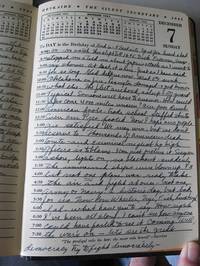
19410002332USS RANGER et al. Good. 1941. On offer is a super group of eight 8 original manuscript diaries and notebook handwritten by Lieutenant Henry Cabell Maddux Jr. while serving on the noted American warship the U.S.S. Ranger the first U.S. Navy ship specifically designed and built as an aircraft carrier. Henry proves to be a sporadic writer. Long pauses and then full and well filled pages of his doings duties but most importantly his observations of the war both predictive and specific. Historians and researchers of WWII and the actions of the US Navy will find an unusual author and commentator in Lt. Maddux. He frequently comments negatively on the methodology and philosophy behind the American war effort and the orders he and his superior officers are required to implement or not. We note a passage commenting on the Navy's desire to fight and the Army holding it back. We also note what we feel are perhaps very insightful but near seditious comments regarding Pearl Harbor: "Ensign stopped me and told me about Japan's attack as I went to my shower. At last it is here. Just as I have said for so long. God help us now. West Va. sunk Oklahoma on fire Lexington damaged and God knows what else. The fleet anchored asleep and off guard. Typical. Someone will have to answer. How could Japs come 4000 miles unseen Our poor dumb American fools - trade school stuffed shirts. Even our President fooled. Now I hope our people are satisfied. We may win but we don't deserve to. Thousands of Americans dead tonite and criminal neglect by high officers is to blame. I can just picture it. Everyone ashore lights on no blackout - suddenly the unmanned ships were blown up. I bet not one plane was ready to take the air and fight at once - not one Army or Navy. A historic day but bad for us. Now Mr. Wheeler Nye Fish Lindbergh et al - what have you to say. How right I have been all along. I can't see how anyone could have failed to see it coming. Well the war's on - let's see the great democracy try to fight democratically." Of the eight books there is: One book is of a technical nature: lists of those on watch duty sailors personnel in watch groups etc. notes from discussions regarding effective use of torpedoes perhaps half filled; then; 1941 March 27 to Dec 31st; 1942 three books the first Jan 1 to April 20th the second blank until June 25th filled near fully through September 30th the third book beginning October 2nd to November 23rd though missing a few days in November. We note the last 2-3 words of his last entry were removed. 1944 Jan 1 to Dec 31st; 1945 two books the first May 9th to October 12th; the second Jan 1 to May 8th. We can find no explanation for Lieutenant's propensity for using multiple books for some years. There are many bit of ephemera tucked in: letters chits and even pages used for diary entries when the book was not at hand. The Lieutenant was a fairly consistent though sporadic with in the books proper writing near daily though the entries tend to jump around the individual volumes and were sometimes written on loose sheets of paper then tucked in. As typical with WWII diaries there are entries about Pearl Harbor and the start of the war the atomic bombing of Japan and the end of the war in Europe and Japan though we find only a few notes and a few oblique references regarding the USS Ranger's most notable actions in the Algeria-Morocco landings and actions off Casablanca both in November 1942 and the Norway raid in October 1943. For of the books are largish 7¾ inch tall the others about 6 inches tall. All are page a day style. Overall G.; Manuscript; 8vo - over 7¾" - 9¾" tall; KEYWORDS: HISTORY OF USS RANGER CV-4 UNITED STATES NAVY LIEUTENANT HENRY CABELL MADDUX JR. USN WWII WORLD WAR II WW2 WORLD WAR 2 UNITED STATES NAVY NAVAL BATTLESHIPS DESTROYERS AIRCRAFT CARRIERS WAR AT SEA NAVY OFFICERS MARINE MARINERS NAUTICALAMERICANAHANDWRITTEN MANUSCRIPT AUTOGRAPHED AUTHORS DOCUMENT LETTER AUTOGRAPH KEEPSAKE WRITER HAND WRITTEN DOCUMENTS SIGNED LETTERS MANUSCRIPTS HISTORICAL HOLOGRAPH WRITERS AUTOGRAPHS PERSONAL MEMOIR MEMORIAL PERSONAL HISTORY ARCHIVE DIARY DIARIES JOURNAL LOG PRIMARY SOURCE FIRST HAND ACCOUNT SOCIAL HISTORY PERSONAL STORIES LIVING HISTORY ANTIQUITÉ CONTRAT VÉLIN DOCUMENT MANUSCRIT PAPIER ANTIKE BRIEF PERGAMENT DOKUMENT MANUSKRIPT PAPIER OGGETTO D'ANTIQUARIATO ATTO VELINA DOCUMENTO MANOSCRITTO CARTA ANTIGÜEDAD HECHO VITELA DOCUMENTO MANUSCRITO PAPELBIOGRAPHY BIOGRAPHICAL AUTOBIOGRAPHICAL AUTOBIOGRAPHY PERSONAL NARRATIVES . unknown
18800008123SOUTH DARTMOUTH MASSACHUSETTS. Good. 1880. On offer is a very unique and rare diary collection spanning nearly fifty years. There are 8 diaries plus 1 leather wallet. The diaries were written between 1880 and 1929. The diary measurements pages and degree of completeness are as follows: diary 1880 measures 4.75 x 3.0 has 365 pages and is 100% complete; 1882 - 4.0 x 3.0 365 pages15% complete; 1923 - 4.0 x 2.5 52 pages 40% complete; 1924 - 4.0 x 2.5 52 pages 20% complete; 1926 - 5.0 x 3.0 92 pages 100% complete 1927 - 6.0 x 3.0 60 pages 100% complete 1928 - 4.75 x 3.0 92 pages 100% complete; 1929 measures 4.75 x 3.0 60 page 100% complete. The leather wallet is worn but complete. In its four sections is a collection of newspaper clippings dating back. The covers are in good condition. The oldest diaries show a bit more wear. The pages are all intact and the bindings are good. The handwriting is tight but legible. The collection is rounded out by a leather wallet measuring 4.5 inches by 3 inches. The wallet is worn but all sections are intact. It contains a number of newspaper clippings dating back well over a century. This collection of diaries belonged to Michael Baker of South Dartmouth MA. Baker was born on Dec. 10th 1862. The 1870's census shows Michael Baker 7 years old "at sea" with his father Michael Baker Sr. The family is one of the oldest "Cape Cod families" and his father who died at 92 after an active life mostly spent at sea was well known as a captain in the coastwise trade. Michael A. Baker like his father and most of his brothers chose the sea as an occupation. He first shipped out at 17 and after finally becoming a master mariner or Captain he commanded whaling ships for the next twenty years. Michael Jr's uncle was George Orlando Baker and a famous captain in his own right. During the Civil War George's whaling ship was captured by the famed Confederate commerce raider Shenendoah and sunk. Baker had other uncles who were also noted sailors. Baker himself did not seek a career at sea. His diaries indicate that he spent his life in South Dartmouth much of it working for the Town of South Dartmouth. In the first diary Michael is still at school. His entries are typically short and focus on the things a teenager at that time would be interested in. Dances were high on that list: "Went to school. Pleasant day. It began to rain toward evening. There is a dance up to the hall by Ashley" Jan 15 1880; "Cold. I am going to the surprise party down to Em's" Feb 4 1880. He references other family members as one would expect: "Windy. Capt Charles is coming over I expect tomorrow" Aug 3 1880. Charles Baker was a whaling captain and one of Michael's uncles "Windy. Ed Thompson had my boat to go fishing. Have been to work on my potatoes. Got them nearly all dug" Aug 20 1880. "Windy day. Did not go to school. But went fishing" Sept. 21 1880. It's interesting to note that the memoranda pages contain a number of good examples of mirror writing the text including his name and address and some notes. The second diary contains far few entries. However there are several of note: ". Have had report from the James Arnold Capt Chase is in command now tho he had some trouble with his crew at first as they decried duty but is all right now. ." Jan 3 1883. The James Arnold was a whaling vessel out of New Bedford MA. She was laid down at New Bedford MA in 1852. At the time of this diary entry the Arnold had sailed on Oct 9th with Thomas Wilson as Captain On Oct 29th the log reads that J.E. Chase took over as Master on Oct 29th. The owner-agent was Taber Gordon & Co. There is an interesting note that was certainly added at a later date. Written in ink the context suggests it was added by another writer: "Your grandfather Chase was sent out to take the ship away from Capt Wilson who misbehaved. Capt Josiah Chase - my father". Casual research has not uncovered a connection between Michael Baker and Josiah Chase. Interestingly Charles Chase's name is one of the 'mirror writing' entries in the 1880 diary. The next diary is forty one years later. Baker is now 61 years old. Entries include a number of references to meetings at the Town Hall. He also refers to 'May'. He married May on Apr 9th 1887. As will become clear in the 1926 diary Baker is in fact working for the Town of South Dartmouth as Town Clerk. "Hot water boiler started breaking had to have a new one. I got a letter from Baxter regarding Police" Mar 17 1923; "Christmas. All the children here to dinner and a Christmas tree in the evening. We all enjoyed it" Dec 25 1923; "Pleasant Wind North Went with Board to look over street lights asked for" Apr 13 1924; The 1926 diary contains an entry that confirms that Baker is the Town Clerk for South Dartmouth: "To city with Board to consult with Prescott about bridge. To T Hall in afternoon. Trying to clean up my as Clerk so I can leave the job with a clean slate. May went to Boston" Mar 20 1926; ". Went to Town Hall and to the Almshouse to take inventory in the afternoon. case against the town for damage and was awarded $19100.00" Jan 7 1926. The remaining three diaries are chock full of the details of his daily life. The leather wallet contains quite a number of newspaper clippings. Many refer to relatives and to aspects of the whaling industry. In particular there are news stories about the seizure in 1892 of the Cape Horn Pigeon a New Bedford whaling ship. The Cape Horn Pigeon was for a period of time captained by George O. Baker. The Cape Horn Pigeon was illegally seized by Russian authorities in the Sea of Okhotsk and although released became the subject of an international dispute between the government of the United States and Russia In fact George O Baker was selected to travel to The Hague to testify as an expert on the value of the whale oil and whalebone that were lost as a result of the seizure. Stories from these clippings also include rescuing prisoners who had escaped from a Siberian Prison Camp. For a historian the diaries provide a great deal of information from several perspectives. Baker comes from a seafaring family and the references he makes when he is younger serve as cross-references to logbooks and other historical documents. The later diaries paint a picture of a man towards the end of his career working for the community and the many tasks he carries out. For a genealogist his mentioning of so many people by full name makes it easier to follow up on those links and establish connections in this 350 year old community. In all of his diaries he notes the weather each day - data that a geographer or environment researcher would find valuable as climate is looked at over a longer period of time. The newspaper clippings provide a fascinating glimpse into the world of the whaling ships.; Manuscript; 32mo - over 4" - 5" tall; KEYWORDS: HISTORY OF 19TH CENTURY 20TH CENTURY 1880s 1920s GILDED AGE PROGRESSIVE ERA UNITED STATES FARM COAST NEW ENGLAND BRISTOL COUNTY MICHAEL BAKER; SOUTH DARTMOUTH MA; NEW BEDFORD MA; NEW ENGLAND WHALING FLEET; WHALING SHIP JAMES ARNOLD; BARK CAPE HORN PIGEON; GEORGE O BAKER; JOSIAH E. CHASE NEW ENGLAND SAILORS YOUTH SOCIAL LIFE IN 1880S MIRROR WRITING TOWN OF SOUTH DARTMOUTH IN 1920S SIBERIAN PRISON CAMP SEAFARING FAMILIES OF NEW ENGLAND BRISTOL COUNTY GENEALOGY SOCIAL LIFE IN NEW ENGLAND AMERICANA HANDWRITTEN MANUSCRIPT DOCUMENT LETTER AUTOGRAPH WRITER HAND WRITTEN DOCUMENTS SIGNED LETTERS MANUSCRIPTS DIARY DIARIES JOURNALS PERSONAL HISTORY SOCIAL HISTORY HISTORICAL HOLOGRAPH WRITERS AUTOGRAPHS PERSONAL MEMOIR MEMORIAL ANTIQUITÉ CONTRAT VÉLIN DOCUMENT MANUSCRIT PAPIER ANTIKE BRIEF PERGAMENT DOKUMENT MANUSKRIPT PAPIER OGGETTO D'ANTIQUARIATO ATTO VELINA DOCUMENTO MANOSCRITTO CARTA ANTIGÜEDAD HECHO VITELA DOCUMENTO MANUSCRITO PAPEL . hardcover
19310008036CHICAGO ILLINOIS IL UK BRITAIN. Good. 1931. On offer is a superb group including 2 five-year diaries and a collection of papers that provide and incredible window into life in America in the decade immediately preceding WWII. The 2 diaries measure 5 inches by 4 inches and 5 1/2 inches by 4 1/2 inches respectively. They each contain 365 pages and are 100% complete. The first diary has damage to the cover - specifically it has come detached and partially torn. The second diary's leather cover is worn. All pages though are intact and attached. Included with the diaries are dozens of loose papers notes photographs and memorabilia. These round out the picture painted in the diaries. Ruth Gilbert McClain lived in Chicago IL. Born in 1914 she is 17 when she begins her 10 years of diary entries. She was a journalist who worked for several newspapers in both the United States and the United Kingdom. She was married to Patrick Dolan an American who worked in broadcast media WBBM Radio see Oct 6 1939. Casual research does not turn up any biographical data but there are many context clues within the diaries and accompanying papers. The diaries span the years 1931 through 1940 in 2 five-year volumes. In the first volume she is still a journalism student at the University of Illinois. The diary is filled with references to school assignments and her busy social life. "My paper went to the printers intact - but oh did I get 'squelched' by Miss Russell. She pains me." Jan 8 1931. She details many many dates and social events that she attends: "Went to Worlds Fair. Tried to get a job at Libbys through W.F. personnel office - no luck . " June 6 1934. She finished her studies in June 1935 and notes her graduation: "GRADUATION very impressive and now I have my BSc with honors ." June10 1935. The diary ends with several interesting events - on Dec 9th 1935 she meets President Roosevelt. She also meets another journalist: "Met a cute man - PAT DOLAN born in Ireland and educated in Ireland."Nov 20 1935. Notwithstanding her comments about other romantic interests she will end up marrying Pat Dolan. Her second diary is much more work-focused. On Oct 5th 1936 she notes President Roosevelt dedicating a bridge. Other world events are noted as well: "Hindenburg exploded 36 dead ." May 6 1937 "First day of NAZI TIMES story ." Sept 9 1937 "Assigned to the Ada Szceythsiski murder trial- Glad but worries me . "Jan 24 1938. She travels extensively and in 1937 finds herself in England. Her papers contain a separate loose-leaf account of her trip on the passenger liner MV Georgic. She doesn't waste any time upon arrival: "LONDON Arrived at dawn! . Chamberlain's address WAR saw Buckingham Palace & Whitehall" Sept 27 1938 "Got a job 9 guineas $47.25 at the Daily Mirror and Sunday Pictorial ."Oct 5 1938 She notes the build-up to war being declared in 1939 culminating with: "GB declared war at 5 am Chicago time - F rance at 11 am CT - fighting only along French border and in Poland Bremen captured by British Chamberlain King Daladier FDR spoke" Sept 3 1939. She has travelled extensively in Europe including the UK Ireland the Netherlands Paris etc. In addition to the diaries there is a collection of papers that include telegrams from her husband cards and notes from friends loose-leaf journals photographs newspaper clippings ticket stubs and much more. This collection is truly a time capsule. It is written by a well-educated woman with a good eye for detail and an excellent manner of communicating. For a historian this is a treasure trove especially the time she spent in Europe on the eve of WWII. Whether places of interest major events or commentary on life as she sees and experiences it these diaries and papers are an outstanding resource. They would be valuable in a Women's Studies program as they show a clear contrast with the more traditional roles that women assumed in the early 20th century.; Manuscript; 24mo - over 5" - 5¾" tall; KEYWORDS: HISTORY OF 20TH CENTURY 1930S U.S. BRITAIN RUTH GILBERT MCCLAIN; PATRICK DOLAN; CHICAGO ILLINOIS AMERICAN; CHICAGO HERALD; DAILY MIRROR; WBBM RADIO; WORLD WAR II; CHICAGO WORLD FAIR; HINDENBURG UNIVERSITY OF ILLINOIS AT URBANA-CHAMPAIGN JOURNALISM FEMALE JOURNALISTS WOMEN STUDIES AMERICANA HANDWRITTEN MANUSCRIPT DOCUMENT LETTER AUTOGRAPH WRITER HAND WRITTEN DOCUMENTS SIGNED LETTERS MANUSCRIPTS DIARY DIARIES JOURNALS PERSONAL HISTORY SOCIAL HISTORY HISTORICAL HOLOGRAPH WRITERS AUTOGRAPHS PERSONAL MEMOIR MEMORIAL ANTIQUITÉ CONTRAT VÉLIN DOCUMENT MANUSCRIT PAPIER ANTIKE BRIEF PERGAMENT DOKUMENT MANUSKRIPT PAPIER OGGETTO D'ANTIQUARIATO ATTO VELINA DOCUMENTO MANOSCRITTO CARTA ANTIGÜEDAD HECHO VITELA DOCUMENTO MANUSCRITO PAPEL . hardcover
19090008191BRITAIN - IRELAND - SCOTLAND ERIE PENNSYLVANIA. Fair. 1909. On offer is a fascinating original manuscript travel diary handwritten by a leading figure working with orphaned and homeless children in the early years of the 20th Century. Measuring 6.5 inches by 4 inches the diary contains 192 pages and is 100% complete. The spine of the book has been damaged. The cover shows some wear at the corners but is intact as are all pages within. The handwriting is legible. This travel diary was written by Sarah A. Reed from Erie PA. Reed was the president of an association that helped orphaned and homeless children for 45 years in Pennsylvania. The Children's Center was founded in 1871 in Erie Pennsylvania by a group of women interested in helping orphaned and homeless children. Sarah A. Reed was an original member of this group who founded "The Association for Improving the Conditions of the Poor and a Home for the Friendless". Miss Reed served as President for 45 years from 1889 to her death in 1934. Her contributions to the agency's early development were so substantial that in 1935 the Center was renamed in her honor. She played a very significant role in the community life of Erie. So great was her impact that there is a children's center in Erie named for her today.This travel journal is actually a handwritten copy made by Reed for her travelling companion Emma Sargent. There is a dedication page written by Sarah that states: "This copy of my record of our trip of 1909 made for my dear friend and companion no the entire journey Emma Sargent: We only wish history like this would repeat itself. Sarah A. Reed". The travel diary written in 1909 describes their trip to Ireland England and Scotland. The diary covers the period July 31 to Oct 3 1909. They leave the Pennsylvania Railroad Station and later transfer baggage aboard the Steamship "Haverford". The diary is filled with details of life aboard ship during the passage as well as their journeys through the countries. "Winthrop Emma & I leave at 6:30 am and out into Broad at P.R.R. station for out breakfast after which we are out the dock we attended to leaving out baggage and have it put on the steamer Steamship "Haverford" than we went on board and inspected our state room. We found everything clean and bright and we things were put up we went on deck with people" July 31; A perfect day ending in a glorious sunset and long bright twilight. Emma and I got our things in order for landing and made farewell visits with friends all are soon to leave at noon our ship entered the Irish Channel. The views all the way out interesting. At 9:30 the ship stopped and a tender came along side Mr W. and all on board and our friends the Reynolds came with us and were off for Ireland. Flood lights Made disembarking look lovely as we landed at the dock and went through customs than we went to Queens Hotel and all in good order" August 10. She notes not only the various sights but also the intensely local experiences. For someone in her role this must have been especially moving: "Dublin made a fine show as our train neared the station we found the station crowded with people and they had come forward to show their sympathy for the family of a Miss Nicholes who had lost her life in Bantry Bay trying to save young girl who had fallen into the water. We stood in silence with the many friends as the flower covered casket was carried to near the entrance near the Shelbourne Hotel where we had engaged a room." August 16. Leaving Ireland they journeyed to Glasgow Scotland before heading south to England: "Went on board the steamer at 10 am and had our farewell look of the coast of Ireland through a misty rain but before land the sun came out and in two hours time we landed at Sturagus Scotland and went from the steamer to a small train that carried us to Glasgow. The train ran though a fair country of hills". Aug 16; "We were off early and welcomed the sun and the promise of a fine day. After breakfast we paid our bill and took out bags to the station before we started out on our sight seeing tour of York. We went first to the sight of a lovely garden which stands in the ruins of St Mary's Abbey. A pleasant soft voiced English woman admitted us and gave us a flower from the garden" Aug 27. Once in England they spent an extensive amount of time visiting historical sites. They spend a considerable amount of time at Oxford. Later Reed and Sargent toured London and their diary is full of details about the historical sites they visited such as various Abbey's and the Tower of London. "A beautiful day sun and shine and clear air ! We got up early and packed some before breakfast we left our hotel at 9:20 am took a tube car and laded near Westminster where we met Mr. & Mrs. Van Renslar and we all attended services in Westminster Abbey. The service in the grand hall was most impressive. After leaving the Abbey we walked though Old St. Margarets looking a the many old and quaint monuments also the beautiful memorial given by Americans in memory of Sir Walter Raleigh" Sept 5. On Sept 26th they boarded their ship in the pouring rain for their return voyage to America. This travel diary is a wonderful look back at a time that seems somewhat frozen in amber. The British Empire was at its height and the world was yet to experience the ravages of world war and a grinding depression. The diary gives a very good description of this time especially of London. For a student of women's studies the diary paints a picture of two well-educated and adventurous women travelling on their own to explore the greater world. Without a doubt this was the attitude that she brought to her very important social work in Erie PA.; Manuscript; 16mo - over 5¾" - 6¾" tall; KEYWORDS: HISTORY OF; UNITED STATES; IRELAND; ENGLAND; SCOTLAND; DUBLIN; GLASGOW; EARLY 20TH CENTURY; 1900s; SARAH A REED; ERIE PA; SARAH A REED CHILDREN'S CENTER; EMMA SARGENT; PENNSYLVANIA; ERIE PA; ASSOCIATION FOR IMPROVING THE CONDITIONS OF THE POOR; NOTED RESIDENTS OF ERIE PA; TRAVEL; JOURNALS; AMERICAN TRAVELERS IN EUROPE; STEAMSHIP "HAVERFORD"; OCEAN TRAVEL; TRANSATLANTIC JOURNEYS IN THE EARLY 20TH CENTURY; PASSENGER SHIPS IN 1900S; STEAMERS; SIGHTSEEING TOURS IN ENGLAND IN THE EARLY 20TH CENTURY; BRITISH EMPIRE IN THE EARLY 20TH CENTURY; WOMEN'S STUDIES AMERICANA HANDWRITTEN MANUSCRIPT DOCUMENT LETTER AUTOGRAPH WRITER HAND WRITTEN DOCUMENTS SIGNED LETTERS MANUSCRIPTS DIARY DIARIES JOURNALS PERSONAL HISTORY SOCIAL HISTORY HISTORICAL HOLOGRAPH WRITERS AUTOGRAPHS PERSONAL MEMOIR MEMORIAL ANTIQUITÉ CONTRAT VÉLIN DOCUMENT MANUSCRIT PAPIER ANTIKE BRIEF PERGAMENT DOKUMENT MANUSKRIPT PAPIER OGGETTO D'ANTIQUARIATO ATTO VELINA DOCUMENTO MANOSCRITTO CARTA ANTIGÜEDAD HECHO VITELA DOCUMENTO MANUSCRITO PAPEL . unknown
19190002209TIENTSIN CHINA. Good. 1919. On offer is a super original manuscript relic of one young unidentified wealthy American girl's trip and times living in China for over a year during a hugely critical juncture in China's history in the early 20th Century. Mere months after as one online source provides: 'The May Fourth Movement Wusì Yùndòng was an anti-imperialist cultural and political movement growing out of student demonstrations in Beijing on May 4 1919 protesting the Chinese government's weak response to the Treaty of Versailles especially allowing Japan to receive territories in Shandong which had been surrendered by Germany after the Siege of Tsingtao. These demonstrations sparked national protests and marked the upsurge of Chinese nationalism a shift towards political mobilization and away from cultural activities and a move towards a populist base rather than intellectual elites. Many political and social leaders of the next decades emerged at this time. The term "May Fourth Movement" in a broader sense often refers to the period during 1915-1921 more often called the New Culture Movement'. Using a 5 year diary the author does not follow convention by beginning in July 1919 to the year's end doubles back and writes full pages or half pages later for 1920. While unknown she leaves many clues and is no doubt part of the extended American Diplomatic family in China at the time she leaves her home of New York August 28 1919 traveling through Chicago Wyoming Nevada and the Rocky Mountains before stopping in San Francisco California where she is hosted by friends our author discovers that there is "no place as beautiful as USA". Obviously from a well-connected and wealthy family the author experiences California and her first ride on an airplane before setting sail for Asia September 10 1919. She reaches Tokyo in late September travels through Shimonoseki and stops for a few days in Seoul and Antung Korea. Finally in October she reaches Munkden Mancurhia and then her final destination of Tientsin China. The author doesn't just gloss over the cities she explores: she writes in depth describing the culture and visuals she experiences in delightful detail. For example her Memoranda about Korea: "big straw hats mean mourning for parents white costumes and white straw hats mourning for emperor little black hats set high on head sign of caste. Women very neat - blue and pink dresses. Red flowers growing on roofs of houses. Clothes look like cross between kimono and Chinese dress. Antung on Yalu River - border between Korea and Manchuria. Mounds for graves." Once settled in with friends in Tientsin the girl quickly becomes involved in a very active social life with fellow Americans and Brits living near her. She lives her youth to the fullest. Every night is a party and every day a new friend a new man a new adventure. Many of these adventures take place after midnight at her crew's favourite spot the Astor House. Astor House was known at the time as "the prime venue for all diplomatic activity in Tianjin Tienstin" leading to the educated guess that our author had diplomatic connections in America. As great as her descriptive detail is about her travels and life in Asia in 1919-1920 her emotional entries about her young enthralling social life are just as captivating as she swings from devastation to elation in a sentence: "Disgusted with the single boys at Astor House - all with women - married women. Met Lieut Williams - wonderful dancer". She has the opportunity to meet exciting Americans as well as locals such as her encounter on October 13: Two China-men came to tea - one was Chef Eunich of Empress Dowager's harem". On October 22 she begins working in what she only describes as "the office". Her schedule at the office seems pretty relaxed as the majority of her entries focus on her leisure activities. She loves to visit the race track and bet on horses she is an avid horseback rider goes bowling takes tea with a variety of friends and young men swims and plays tennis all summer and of course she dances the night away in venues such as Empire Astor House the Grand Hotel de Pekin on a long weekend trip to Peking and the Anglo-American-Chinese Club. She has many suitors but connects with a man named Sokall who is present in her life until she departs China Sokall has competition as she spends a great deal of time with Soda dates Todd in the summer and writes passionately angry letters to Mac!. After a whirlwind year in China she sadly packs her bags and departs on October 1st 2020. About her departure she writes: "Train time. Sokall .all went down to see me off left at 12:15. Had a compartment alone Got to feeling blue. Wrote letters. Read "My China Days" Sokall gave me. He also gave me some gold buttons. The Davys were awfully nice to me. Arrived Mukden at 7:10. Kirk met me. Went to Yamato Hotel. Had dinner and a bath. Train left at 9". Things begin looking up when she meets her new suitor Colonel Arion on the ship on October 20.: "Met Col Arion. Played tournament with him. Sat out on deck talking and dancing with him until 1:30. He's a peach. Danced with him. Dances divinely". After a stopover together in Honolulu we discover that the Colonel will follow her back to New York: "the Colonel and I arranged about our transportation - he's going with me. Had lunch alone with him. Did an errand for him while he interviewed people." Together they travel through San Francisco Omaha and Chicago finally reaching New York on November 2 1920. Real life quickly resumes for our author whose writing clearly indicates that her heart is still in China. However she must now introduce the Colonel to her parents hunt for a job first casually then more seriously when she finds she has gone broke! and attend the theatre. The diary ends on New Year's Eve as our author prepares to ring in 1921. It ends with talk of China. "After dinner the Moore's Ethelyn's mother and CM came up and watched the old year out. Cocktails and champagne and talked of China code". Included tucked in is a small photo that may be the author and her mother but we can only speculate. Fascinating on so many levels: exotic extended travel to Asia meeting and making friends men and experiences a culture entirely foreign to her yet one that she is able to embrace and bring home with her to life in New York City the retelling of her travels make for super reading and a significant historical record of a significant time in China's history. Overall VG.; Manuscript; 24mo - over 5" - 5¾" tall; KEYWORDS: HISTORY OF TIENTSIN CHINA TRAVEL DIPLOMACY DIPLOMATIC MISSIONS DEBUTANTE GRAND TOURS ASIA THE ORIENT THE FAR EAST PRE COMMUNIST CHINA MAY FOURTH MOVEMENT NEW CULTURE MOVEMENT P WUSÌ YÙNDÒNG SHANDONGTHE SIEGE OF TSINGTAO AMERICANS ABROAD AMERICANS TRAVELLING IN CHINA EARLY 20TH CENTURY TIENTSIN THE MIDDLE KINGDOM AMERICANAHANDWRITTEN MANUSCRIPT AUTOGRAPHED AUTHORS DOCUMENT LETTER AUTOGRAPH KEEPSAKE WRITER HAND WRITTEN DOCUMENTS SIGNED LETTERS MANUSCRIPTS HISTORICAL HOLOGRAPH WRITERS AUTOGRAPHS PERSONAL MEMOIR MEMORIAL PERSONAL HISTORY ARCHIVE DIARY DIARIES JOURNAL LOG PRIMARY SOURCE FIRST HAND ACCOUNT SOCIAL HISTORY PERSONAL STORIES LIVING HISTORY ANTIQUITÉ CONTRAT VÉLIN DOCUMENT MANUSCRIT PAPIER ANTIKE BRIEF PERGAMENT DOKUMENT MANUSKRIPT PAPIER OGGETTO D'ANTIQUARIATO ATTO VELINA DOCUMENTO MANOSCRITTO CARTA ANTIGÜEDAD HECHO VITELA DOCUMENTO MANUSCRITO PAPELBIOGRAPHY BIOGRAPHICAL AUTOBIOGRAPHICAL AUTOBIOGRAPHY PERSONAL NARRATIVES . hardcover
19110007029WEST INDIES TRINIDAD CUBA COLUMBIA VENEZUELA PANAM. Good. 1911. On offer is a very unique superb pair 2 of original manuscript travel diaries that commence in February of 1911. Of particular fascination is the fact that the books appear to be written by traveling spouses so finely tuned a couple that at first the one book seems to be a transcription of the other but soon their interests diverge and uniquely one reads two versions of the same tour of the "West Indies". Our authors are not unidentified but assuredly from the United States. He leaves with his wife from New York Feb 16 1911 by steamer than down the Atlantic to Florida. From Florida they proceed to Cuba Venezuela Colombia Puerto Rico Jamaica Panama Trinidad Barbados Martinique and Bermuda. The first book the husband's a simple thickish flip style lined pad is well filled with about 175 pages of copious writings. The second the wife's is a red leather diary with about 80 pages. The pair offer a great deal of fascinating content about the trip such as visiting markets in Trinidad the Negro women buying produce for their white bosses Negro Police in Kingston ethnographic descriptions of native people from barefoot children women with nose rings grave rites in Cuba native fishermen and write in great detail about the scenery monuments etc. There is a tour of cabaña fortress in Cuba active volcanoes in Martinique touring the rebuilt city of Kingston Jamaica after a massive earthquake listening to a confederate civil war veteran onboard the steamer give a lecture about the civil war. Here are some snippets and only a fraction of their Caribbean and Central American tour writings: Feb 16 1911 NY - Florida - Cuba excerpt Saturday morning went aboard the steamer " Aron" about eleven sailed out of NY harbor a little late about two thirty with the orchestra playing the Star Spangled Banner. It was cloudy but the water was smooth you would hardly realize you were moving. We were happily surprised to find four steamer letters and four packages awaiting us. It made us feel we were not without friends tho none were present to take our hand and say goodbye. We were finally started the bugle sounded to announce that lunch was served we watched as the pilot leave the boat - We have a fine orchestra aboard that gives us concerts morning afternoon and evening in the ladies social hall we have the use of the library my first book is the " Call of Dan Matthews". Feb 22 1911 Havana Cuba Arrived at Havana about six this morning Feb 22nd we found George Washington's pictures at the head of the stairs surrounded by the American flag & decorated flowers we thought it a very pretty complement for a British ship to pay him. We anchored outside and a tender came ashore to inspect us. We were told to go into the dining saloon for inspection of course it was only a formality we simply passed before him. Next we drove to the cemetery this we found very interesting. Here we were told how they bury their dead. The grave is about 7 ft deep and all committed here the casket - without outside box is deposited than lime is thrown over it and a little earth after this the grave is covered with a heavy white stone with handles and tightly sealed. This is left undisturbed for some years this it is opened the bones taken out & deposited in a small casket a small cemented receiving vault which sometimes is built at the head of the grave. A guide & myself went out into the country passed the water works insane asylum etc when about a mile from the asylum we had an experience our gasoline gave out & we sit in the road one hour while our chauffeur went back to the asylum to replenish. Feb 27 1893 Puerto Rico It is customary for families here to take their wash to the river it being Sunday we saw a good deal of this. There were large companies of them and they seemed to be having a happy time. Our guide told us they beat the clothes with a stick. I remarked that it would be quite an undertaking for the families high up on the mountain to bring their clothes to the river. He informed us they did not wash very often. We saw entire plantations of sugar cane large coconut groves bananas etc. When we reached the end of the line about 1 o'clock we were served with ham sandwiches oranges cake and lemonade from the boat. Feb 28 1911 Puerto - Rico Organized sports began today consisting of curling - shuffle board pillow fights - cock fights etc- they are quite interesting & amusing it is lovey warm today girls in swimming suits dancing on deck in the sunshine. We left Santiago about 4 pm for Jamaica as we to sailing out of the harbor we one of the wrecks of the Spanish fleet. March 2 1911 Jamaica We took a special trolly to the Constant Springs Hotel where we found carriages waiting to take us to Stoney Hill. It was a delightful ride we met a great many natives carrying heavy loads of produce apparently very easy on their heads many of them had donkeys also heavily loaded which they were leading or driving. The natives were a variety of bright colors were barefooted & occasionally we saw some of the woman smoking cigarettes or pipes. March 5 1911 Panama Arrived at the isthmus of Panama this morning both Carlton and I regret exceedingly that we must see this interesting place today of at all. After breakfast - Sunday morning we left Colon on special train for Panama to see the much talked of canal our first stop was at Galoon we had some minutes here to get out & see the locks there are to be is triple flight locks arranged in Janio at the Southern extremity of Galum. March 7 1911 Cartagena Colombia March 7 arrived at Cartagena this am this is an old city walled Spanish city with a population of 27000 was founded by Spanish in 1533. I saw nothing attractive it is a very dirty city squalor and flies everywhere street scenes were amusing nude children colored women sitting on the street with a little tray of vegetables for sale. A fat black woman frying cakes on a charcoal stone etc. It was hot on land & delightful to return to the Aron. March 11 1911 Trinidad We were told the stores would close at noon or one o'clock so we spent the morning at the stores going through the market etc - The market was thronged by colored women buying their supplies the various kinds of meat and vegetables were sold by colored people some of the women were very much decked out with jewelry bracelets to their elbows earrings all around the ears. A ring a nose stud in the nose to me was so disgusting Chet wondered way we saw no white people at the market we were told it would not do for white people to go to the market they all send their cooks. Overall G.; Manuscript; 16mo - over 5¾" - 6¾" tall; KEYWORDS: HISTORY OF; TRAVEL LATIN AMERICA CARIBBEAN CUBA VENEZUELA COLOMBIA PUERTO RICO NEGRO POLICE COLORFUL MARKETS VOLCANOES WEST INDIES TRINIDAD PANAMA CENTRAL AMERICA SOUTH AMERICAN HANDWRITTEN MANUSCRIPT DOCUMENT LETTER AUTOGRAPH WRITER HAND WRITTEN DOCUMENTS SIGNED LETTERS MANUSCRIPTS DIARY DIARIES JOURNALS PERSONAL HISTORY SOCIAL HISTORY HISTORICAL HOLOGRAPH WRITERS AUTOGRAPHS PERSONAL MEMOIR MEMORIAL ANTIQUITÉ CONTRAT VÉLIN DOCUMENT MANUSCRIT PAPIER ANTIKE BRIEF PERGAMENT DOKUMENT MANUSKRIPT PAPIER OGGETTO D'ANTIQUARIATO ATTO VELINA DOCUMENTO MANOSCRITTO CARTA ANTIGÜEDAD HECHO VITELA DOCUMENTO MANUSCRITO PAPEL . hardcover
1862000754EGREMONT MASSACHUSETTS MA. Good. 1862. On offer is an original superb relic of the Civil War and an incredibly detailed historical document with a riveting narrative being the journal of William. B. Stark beginning with his enlistment July 21st 1862 until April 13th 1865 when he relates the details of Appomattox and Lee's surrender and the jubilation of the troops. Thusly his entire tour in the Civil War. Stark was from Egremont Massachusetts near the New York state border in western Massachusetts. Mr. Stark served in the 34th Regiment Infantry Massachusetts Volunteers. This is one of the most detailed writings of one man's service we have ever read. Stark took copious notes and left no details unmentioned from a detailed listing of every battle and engagement his fellow soldiers officers kit and clothing foods eaten etc. etc. He never fails to mention names and Mr. Stark to history's benefit writes profusely. There is tremendous battle content with detailed explanations of terrain weather and conditions. He describes the mood of the men the affect of the conditions and writes very well too. One online source relates the following of this famed company of volunteers: 34th Regiment Infantry Organized at Worcester August 1 1862. Moved to Washington D.C. August 15-17. Attached to Military District of Washington and Alexandria to February 1863. Tyler's Brigade District of Alexandria 22nd Army Corps Dept. of Washington to April 1863. 2nd Brigade DeRussy's Division Defenses South of the Potomac 22nd Army Corps to June 1863. Martindale's Command Garrison of Washington 22nd Army Corps to July 1863. 1st Brigade Maryland Heights Division Dept. of West Virginia to December 1863. 1st Brigade 1st Division Dept. of West Virginia to January 1864. Unattached 1st Division West Virginia to April 1864. 2nd Brigade 1st Infantry Division West Virginia to June 1864. 1st Brigade 1st Infantry Division West Virginia to December 1864. 1st Brigade Independent Division 24th Army Corps Army of the James to June 1865. SERVICE.--At Arlington Heights Va. until August 22 1862. Moved to Alexandria Va. August 22 and duty on line of Orange & Alexandria Railroad until September 10. At Fort Lyon Defenses of Washington D.C. September 15 1862 to June 2 1863. Provost and guard duty in Washington until July 9. Moved to Maryland Heights July 9. Occupation of Harper's Ferry W. Va. July 14. Duty at Harper's Ferry and Bolivar until December 10. Action at Berryville. October 18. Raid to Harrisonburg December 10-24. At Harper's Ferry until February 1 1864. Operations in Hampshire and Hardy Counties W. Va. January 27-February 7. Moved to Cumberland Md. February 15. Return to Harper's Ferry thence moved to Monocacy Md. March 5 to Martinsburg W. Va. March 7 and to Harper's Ferry April 2. Moved to Martinsburg W. Va. April 17. Sigel's Expedition from Martinsburg to New Market April 13-May 16. Rude's Hill May 14. New Market May 14-15. Advance to Staunton May 24-June 5. Piedmont Mount Crawford June 5. Occupation of Staunton June 6. Hunter's Raid on Lynchburg June --. Lynchburg June 17-18. Retreat to the Gaul June 18-29. Moved to the Shenandoah Valley July 5-17. Snicker's Ferry July 17-18. Kernstown or Winchester July 23-24. Martinsburg July 25. Sheridan's Shenandoah Valley Campaign August to December. Berryville September 3. Battle of Opequan Winchester September 19. Fisher's Hill September 22. Cedar Creek October 13. Battle of Cedar Creek October 19. Duty at Kernstown until December. Moved to Washington D.C. thence to Bermuda Hundred Va. December 19-23. Siege operations against Richmond and Petersburg December 25 1864 to April 2 1865. In trenches north of the James before Richmond until March 1865. Appomattox Campaign March 28-April 9. Assault on and fall of Petersburg April 2. Pursuit of Lee April 3-9. Rice's Station April 6. Appomattox Court House April 9. Surrender of Lee and his army. March to Lynchburg April 12-15 thence to Farmville and Burkesville Junction April 15-19 and to Richmond April 22-25. Duty there until June. Mustered out June 16 1865. Regiment lost during service 7 Officers and 128 Enlisted men killed and mortally wounded and 2 Officers and 132 Enlisted men by disease. Total 269. The original handwritten diary has been lost but this is a very old typewritten transcript undoubtedly typed up by a family member from Stark's diary and then mimeographed. Extensive research can find no evidence that this was ever published or made public in any way save for an annotation that Stark's commentary was partially used regarding his chilling telling of the Battle of Hanging Rock. The old mimeos are in a three-ring binder. Some of the holes on a number of pages are torn but is otherwise in very good condition. There are 131 numbered pages and the work is complete. ; Transcript; 4to - over 9¾" - 12" tall; TRANSCRIPT MANUSCRIPT DOCUMENT LETTER AUTOGRAPH WRITER DOCUMENTS SIGNED LETTERS MANUSCRIPTS HISTORICAL HOLOGRAPH WRITERS PERSONAL PERSONAL HISTORY MEMOIR MEMORIAL DIARY JOURNAL DIARIES JOURNALS LOG LOGS KEEPSAKE AMERICANA Civil War War Between the States VIRGINIA APPOMATTOX HANGING ROCK MASSACHUSETTS PETERSBURG GENERAL LEE SHENANDOAH SNICKER'S FERRY HARPER'S FERRY LYNCHBURG . hardcover
In-4 (mm. 326x220), 2 volumi, p. pergamena antica, titolo oro su tassello al dorso, tagli marmorizzati, pp.num. (20),432; (2),866 (numeraz. continua), inclusi: la bella antiporta figurata inc. in rame da Giuseppe Iuster su disegno di G.A. Lazari e il ritratto dell'A., l'abate Giustiniani, racchiuso in una cornice di fronde, contornato dai ritratti in medaglione dei più illustri Giustiniani, pure inc. in rame da Iuster; testo su due colonne con la raffigurazione di oltre 200 stemmi, croci, emblemi e insegne nobiliari. Dei due frontespizi il primo ha il titolo in rosso e nero ed entrambi portano una vignetta xilografata: vi è raffigurata la Minerva con l’elmo in testa che siede appoggiata a un albero con scudo e lancia; ai suoi piedi una civetta; in alto la scritta “La Minerva”. I volumi sono ornati da grandi iniziali figurate a vignetta e finali, inc. su legno, e sono illustrati nel t. anche da 34 magnifiche tavole che raffigurano abiti da cerimonia di cavalieri, tutte inc. in rame. Di ogni ordine viene illustrata l'impresa, racchiusa in pregevole grande cornice figurata, inc. su legno. Nell'opera: "Insegne, Croci, Stendardi, Habiti capitolari, ò di Ceremonia, Statuti, e Constituzioni di cadaun'Ordine - Guerre Campali, e Navali, Azioni, Fatti celebri, & Imprese de Cavalieri; Confederazioni, Trattati, Paci, & avvenimenti per difesa del nome Christiano, e propagazione della Fede Cattolica - Serie di tutti i Prencipi Gran Maestri. Ordini di Dame, e degl'Infedeli &c. con le loro divise". Il Giustiniani aveva già stampato in un vol. le "Historie cronologiche della vera origine di tutti gli ordini equestri, e religioni cavalleresche", Venezia, 1672. Questa nuova edizione, notevolmente ampliata sia per il testo che per la parte iconografica, tratta anche l'origine di tutti gli ordini militari. "Prima edizione" Cfr. Brunet,II,1618 - Graesse.III,90 - Cicogna "Bibliogr. Veneziana", cita quest'opera a p. 229 e 315. Solo qualche lieviss. uniforme arross. nel 1° vol.; antico restauro per strappo margin. su 4 pagg. e su 5 per piccola manc., atrimenti esemplare ben conservato.
Very Good Arabic Original brown half leather bindings in Egyptian style, raised six bands to spine, title gilt on the second, volume nos on fourth, and alphabetical with the historical content of the volumes on sixth compartments and "Mahmoud Al-Tawawî" name. Minor foxing on some pages. Overall a very good set. Roy. 8vo. (24 x 17 cm). In Arabic. 14 books are complete set in 7 volumes. Extremely rare first printed edition of the most comprehensive and complete corpus on Baghdad city, which includes Al-Baghdadi's first-hand account of the collection of hadiths, biographies, and his travels in the 11th century Baghdad in traditional "al-râwî" style. Al-Baghdadi is known as a Muslim traveler in the pursuit of knowledge who compiled hadiths and traveled to many Islamic cities. He was born on the 24th ?jumada II, 392 (1002) at Darzidjan, a large village on the west bank of the Tigris below Baghdad. The son of a khatib [i.e. preacher], he began his studies very early and spent his youth traveling in search of ?adith. In this way, he visited Basra, Nishapur, I?fahân, Hamadân, and Damascus. Finally settling in Baghdâd, he held the office of a kha?îb and this was the origin of the name al-Khatîb al-Bag_dadi. After completing his education, he spent more than twenty years of his time writing "Tarikh Baghdad". He finished his corpus in 444 AH [1052-53]. He was a fellow student of Rîsürrüesâ Ibn al-Muslima who was the vizier of the Abbasid caliph Kâim-Biemrillâh. The vizier took Khatib, whom he appreciated in the science of hadith, under his patronage. The Abbasid caliph, therefore, ordered Khatib to be given permission to take hadith lessons from him. Khatib started to narrate hadiths from "Tarikh Baghdad" to his students here in his house near the Nizâmiya Madrasa, on the other hand, he started to read the books for which he had permission to narrate from many teachers, also write the books he planned. Several years after, the Turkish commander Besasiri (?-1060), who was a supporter of the Fatimid Caliph Mustansir-Billâh, entered Baghdad with the encouragement of the Fatimid caliph, deposed the caliph, and killed Ibn al-Muslima. Some members of the Hanbali sect, who had a grudge against Khatib because of what they wrote against some Hanbalis in Tarikh Baghdad, started to disturb him by taking the opportunity to kill the vizier. Therefore, he had to flee to Damascus. In his masterpiece, Khatibi, in addition to his account and descriptions of the city during his time in Baghdad, 7831 figures of people in total who lived or came in Baghdad before 450 (1058), statesmen such as caliphs, viziers, commanders, poets, judges, and other professions. This is an alphabetical work giving information about biographies of these figures, but it starts with the name "Muhammad" referring to the Muslim prophet. The first volume is about the establishment of Baghdad in the pre-Islamic period, its conquest by the Muslims, and its history. This masterpiece of him, published in fourteen volumes, is the most comprehensive corpus written on Baghdad in the Islamic world including the city's topography, history, et alli. Brockelmann, GAL, I, 401; Suppl., I, 563.; H. Gibb, "Islamic Biographical Literature".; F. Rosenthal, A History of Muslim Historiography, Leiden 1968, p. 14, 43. Only one set in OCLC in BnF (Bibliothèque nationale de France): 1198963531.
18990001426BALLYMONEY IRELAND SALT LAKE CITY. Very Good. 1899. Full-Leather. On offer is the extraordinary manuscript vade mecum - a catchall diary journal genealogical record and history of a very large successful family most of whom are renowned doctors hunters and military men from Ireland. Handwritten by David Moore Lindsay in 1899 this leather notebook is jammed with family trees autographs including clip signatures notes on his Black Watch service secret societies of which he is addressed as Sir David was a highly placed Knight of the Red Cross Knight Templar Knight of Malta of the Order of St. John of Jerusalem etc. the family's Norman connections Mount Royal Quebec connections plus when discoverer of the North Pole Admiral Peary died he wrote two pages of his memories of Peary and his colleague Stefansson whom Lindsay both knew well. Dr. Lindsay is an amazing man: traveller explorer big game hunter successful soldier renowned ophthalmologist and superbly detailing his life and times. In many ways this is also a biographical mine of information of famed General Sam Steele of Canada as a goodly percentage of the 150 odd pages of the journal are dedicated to. Collectors and researchers would be hard pressed to find a more balanced picture of a post Victorian gentleman's life with as rich and broad a background as interesting as Lindsay's. Littered with ephemera news clippings charts diagrams photos postcards including an enlistment card for E J Steele April 03 1883 a Grand Trunk Railway ticket Scotland 1927 licence to kill game a 1926 Denver & Rio Grande Western Railway pass a tribute to General Sam Steele of the Lord Strathcona Horse Regiment of Canada. As a Major he distinguished himself when Louis Riel attempted his second rebellion related through Lindsay's wife plus much much more. The premium leather book 7 x 4 x 1.5 inches is 90% full and overall VG.; Manuscript; 12mo - over 6¾" - 7¾" tall; KEYWORDS: TRAVEL CANADIANA SALT LAKE CITY PEARY ARCTIC EXPLORER NORTH POLE HANDWRITTEN MANUSCRIPT DOCUMENT LETTER AUTOGRAPH DIARY JOURNAL LOG KEEPSAKE WRITER HAND WRITTEN DOCUMENTS SIGNED LETTERS MANUSCRIPTS HISTORICAL HOLOGRAPH WRITERS DIARIES JOURNALS LOGS AUTOGRAPHS PERSONAL MEMOIR MEMORIAL PERSONAL HISTORY AMERICANA NAVY NAVAL MARITIME NEWFOUNDLAND LABRADOR ATLANTIC CANADA BAY OF BULLS BRIGGANTINE MUTINY MUTINOUS TRIAL LEGAL antiquité contrat vélin document manuscrit papier Antike Brief Pergament Dokument Manuskript Papier oggetto d'antiquariato atto velina documento manoscritto carta antigüedad hecho vitela documento manuscrito Papel Granhill Ballymoney Ireland Ophthalmology ophthalmologist Steele Knight of the Red Cross Knight Templar Knight of Malta of the Order of St. John of Jerusalem Admiral Peary Lord Strathcona Horse General Sam Steele Louis Riel . hardcover
19170001731THE ENGLISH CHANNEL TO THE WEST INDIES . Good. 1917. On offer is a sensational archive of three 3 original World War I 1917 1918 and still serving his country 1920 manuscript diaries handwritten by Marine Marconi Operator E. Cyril Smith making for a fascinating historic first hand account of the dangers of the British Navy in the 'Great War' and also insight of a young man's experience serving in the convoys. Smith has even been torpedoed and rescued after hours in the water. He describes rescue and other brave and fearsome adventures. July 26th 1918 mentions receiving news of torpedoing of H.M.T. Barunga and S.S. Carpathia Titanic's rescuer. Here are snippets: 1917 HMT Crispin SOS call from SS Arrino; Sinking of SS Gamma by German submarine shellfire; SOS from SS Saturnia; SOS from SS araguaya; Passed ships lifeboats with people in it Air raid on Calais; SOS from SS bandoeng; SOS from SS Laconia Submarine attack on HMT Baron Napier; SOS from SS Kurdistan; SOS from SS Borderet Torpedoed and damaged March 29th; Appointed to HMT Ardgair HMT Crispin sunk 3 days later Joins SS Inca1918 News of torpedoing of SS Tuscania; News of sinking of SS Aurania; Submarine bombardment of Dover Gun platform washed away in gale; Convoy in Gales for a week including constant contact with HMS Knight Templar Convoy attacked by submarines; SOS from SS Helaon ; Another convoy this time with HMS Discoverer and S Highland Rover Submarines sighted 20 July News of torpedoing of HMT Barunod and SS Carpathia and US Cruiser News of Torpedoing of HMHS Warilda Hospital Ship; Report of Sinking of Light Ship Diamond Shoals In convoy with HMS Gloucestershire Other ships mentioned in convoy SS War Bee SS Flavia SS Manchester SS Dorringo de Larrinsou SS Barrister SOS from SS Helenus SS Flavia torpedoed destroyers counter attack submarine with depth charges; Back on shore from convoy Didn't kiss May but did kiss Alice my word she's the better one of the two. Policeman calls to see why he has not serving with the colours. 2 days later reads calling up papers. At RAF or Army West Sandling camp - pneumonia recovers. 28 Oct - Passed Out. Relapsed into pneumonia so not allowed to leave camp 11 Nov Armistice signed1920 Appointed SS Thorpe SOS from Belgian Schooner Anna of Nieuport SOS from SS Wellington off Lizard Atlantic voyage Collision with SS Prospero in fog off Owers light vessel Ashore in London Someone fraudulently claims his pay Working on soldiers exhibition Central Hall opened by Bonar Law visited y Lloyd George Joins SS Dunery Dunerie Ship leaking badly - Azores. It should be noted that the 1920 diary is incredibly interesting as he is still in radio service but many of the notes in the diary catalogue a list of ailments and physical and mental concerns we assume related to his service record. Mr. Smith has indeed sacrificed for his country. Overall the 3 diaries are G.; Manuscript; 32mo - over 4" - 5" tall; KEYWORDS: HISTORY OF E. CYRIL SMITH WWI WORLD WAR I WW1 THE GREAT WAR ROYAL NAVY MARCONI RADIO MARCONI RADIO OPERATORS BRITISH NAVY NAUTICAL MARINE NAVAL NAUTICALHANDWRITTEN MANUSCRIPT DOCUMENT LETTER AUTOGRAPH DIARY JOURNAL LOG KEEPSAKE WRITER HAND WRITTEN DOCUMENTS SIGNED LETTERS MANUSCRIPTS PHOTO ALBUM PHOTOGRAPHIC ALBUM HISTORICAL HOLOGRAPH WRITERS HANDSCHRIFT HANDGESCHRIEBEN MANUSKRIPT DIARIES JOURNALS LOGS AUTOGRAPHS PERSONAL MEMOIR MEMORIAL PERSONAL HISTORY antiquité contrat vélin document manuscrit papier Antike Brief Pergament Dokument Manuskript Papier oggetto d'antiquariato atto velina documento manoscritto carta antigüedad hecho vitela documento manuscrito Papel . unknown
19140010044Amherst Massachusetts. Good with no dust jacket. 1914. Hardcover. Offering a 1914 handwritten personal diary by Earle Sumner Draper who would go on to have a major impact on urban planning in the United States. At the time of writing Draper was a 21-year-old Massachusetts Agricultural College later called UMass Amherst student. The book offers an excellent glimpse of what life as a landscape architecture student in the 1940s looked like. Drapers days are filled with studying socializing and extracurriculars. Up at 8: 30 went into Boston -- around looking for a summer job in . offices. Fair luck. Dinner at N. S. Hotel. Took Susie out to the Harvard game. An awful game -- we lost 18-3. Took the 6: 10 out to Harrys and studied in evening. Bed at 10: 30 PM February 11. Up at 5: 45 and studied Hort. Waited. Worked all morning with Harrison on topo work. Cut Math. Learned more about topo than I ever knew before. Cut drill was excused. Tennis practice in doubles. Supper. Worked on Frat ball game. Studied L . 10 all evening May 20. Started work on design for Mrs. Haights Rose Garden. No letter from N yet. Somewhat worried. Read Kenyon . on Design in library in evening September 17. Working on design for Ellwood. Played tag football. Attended Senate Hash House Investigation meeting with Kenny. Wrote up Ent roster. Trouble getting Feb 12 date for hockey filled November 17. Draper was born in Massachusetts in 1893. In 1915 he earned his B. S. In landscape architecture from Massachusetts Agricultural College now the University of Massachusetts. After graduating he went to Charlotte North Carolina to work on the Myers Park subdivision and eventually established his own firm specializing in upper-class residential neighborhoods and mill towns. He later moved to Washington DC and became the director of land planning and housing for the Tennessee Valley Authority TVA and then director of regional planning studies. In 1940 he became assistant administrator of the Federal Housing Administration and was later appointed as its acting commissioner. Earle Draper is the man who coined the phrase urban sprawl which is used to describe uncontrolled suburban growth with little to no regard for planning. His collected papers can be found at the University of North Carolina and Cornell University. Drapers diary provides an excellent window into the education and formation of one of Americas most important planners. Details: Size 4.75" x 3"Number of pages: 122100% completeOverall condition: goodBinding: cracked along inside front cover Handwriting: legible; Manuscripts; 4.75" x 3"; 122 pages . hardcover
19470008065NEW YORK NY LOS ANGELES CA. Good. 1947. On offer is an absolutely fascinating collection of letters written in the immediate post-war years in New Your City. The collection contains 142 pages. The letters are of varying sizes. Most are handwritten and the writing is legible. Several are typed. The letters are in good condition. The letters are mostly written by a young Jewish girl named Estelle Mandelbaum who lives in the Bronx. The letters were written between 1947 and 1950. Context indicates that she is a young woman and the letters span high school completion and studies at Brooklyn College. Most of the letters are written by Estelle to her boyfriend a young man names Lenny Pitt who has moved to Los Angeles to attend California College. Several letters are also correspondence between Lenny and another friend Jerry Mintz. Research suggests Lenny Pitt may very well be Leonard Pitt noted historian and author and as such these letters make for a rare and fascinating look into the formative late teenage years of this noted academic. The letters are funny sometimes insightful profane and very much stream-of consciousness narrative. "Dearest Estelle - Hello. I wish I could explain how elevated I feel before my feelings run out. . I wish you were here. Or me in New York. I miss you. I don't know what love is. I'm too afraid to think logically about it or to let myself fall in love. I miss you though. I would want to be married to you at this moment." undated letter from Lenny to Estelle: "Most important is that I have needed you more strongly sanely and deeply since I have gone to school than ever before. Emotionally. Right now I have just finished reading some love poetry that I connected with you and they have made me sick with need for you physically for the first time." undated letter from Estelle to Lenny. Much of the writing has that earnest quality that comes from first exposures to ideas and attitudes in a College setting. ". I'm glad you finally recognized that you must become independent from your family. It's more important than anything you've said so far. We were discussing middle class parental attitudes towards children in English a few months ago. And it made me see a lot of the fragments I had discovered in a sensible pattern. It made the desire for separation from them logical to me and I realized it was right and necessary for me if I didn't want to cripple myself completely. It's a little comical that I actually felt guilty for not loving my parents after their suffering sacrifice and work . But actually it's the child who sacrifices to the parents and is tricked and shamed into it usually ." undated letter from Estelle to Lenny. One of the letters paints a disturbing picture of the racial discrimination that Black Americans faced and another passage immediately calls to mind the antics of Corporal Klinger in M.A.S.H. In that exchange between Jerry Mintz and his friend Lenny Jerry writes: ". This Miami is a stinking corrupt stupid hole. In order to work at Miami Beach the negroes have to get a special police permit - with their picture on it - a blood test - nobody says 'negro. They're not allowed to live here. In the liquor stores and bars in the negro section they keep stocks of cheap calico dresses and pairs of old shoes. The colored kids come in and they get a couple of pieces of the shit. This is so parents won't spend any money for clothes for them and will spend their money for drinks. Very disgusting low place. I took a leave of absence in the middle of the term in school - but I'll go back - if the fucking army doesn't grab me first. I'm finding ways to get out - rabbinical student - bed pisser -sleep walker ." undated letter between Jerry and Lenny. The letters pull back the curtains on the secret life of a young Jewish girl who is full of hope and promise despite the demons she must tackle daily that are attributed to her mother who would curse her out in "Jewish".; Manuscript; 12mo - over 6¾" - 7¾" tall; KEYWORDS: HISTORY OF 1940s 1950s 20TH CENTURY POST-WAR AMERICA LENNY LEONARD PITT UNITED STATES NEW YORK CITY IN 1950; BROOKLYN COLLEGE; CALIFORNIA COLLEGE; FLORIDA; PSYCHOLOGY IN 1950; RACE RELATIONS IN MIAMI 1950; GROWING UP IN POST WAR AMERICA WOMEN'S HISTORY YOUNG PEOPLE POSTWAR JEWISH YOUTH PARENT-CHILDREN RELATIONSHIP AMERICANA HANDWRITTEN MANUSCRIPT DOCUMENT LETTER AUTOGRAPH WRITER HAND WRITTEN DOCUMENTS SIGNED LETTERS MANUSCRIPTS DIARY DIARIES JOURNALS PERSONAL HISTORY SOCIAL HISTORY HISTORICAL HOLOGRAPH WRITERS AUTOGRAPHS PERSONAL MEMOIR MEMORIAL ANTIQUITÉ CONTRAT VÉLIN DOCUMENT MANUSCRIT PAPIER ANTIKE BRIEF PERGAMENT DOKUMENT MANUSKRIPT PAPIER OGGETTO D'ANTIQUARIATO ATTO VELINA DOCUMENTO MANOSCRITTO CARTA ANTIGÜEDAD HECHO VITELA DOCUMENTO MANUSCRITO PAPEL . hardcover
19000009181ABOARD THE USS CINCINNATI SOUTHPORT N. CAROLINA 1900. On offer are two exceptional and detailed logbooks and journals from Harry Phelps a Lieutenant then Commodore in the United States Navy around the turn of the 20th century. The first book dates from 1900 and covers the period from October 1900 to November 1902. The second diary covers the period from 1916 to 1918 although the cover says 1906. The two diaries are filled to the brim with writing about his life career and day-to-day activities. His writing is very simple stating in a matter-of-fact way the details of his day. For example: Saturday October 13th 1900. We line out at half past seven have breakfast soon after eight and I go to the office by nine and am busy until noon when I go up to luncheon on my while. It is raining so I go back by the cars. I got to the carpenters shop to fix some shelving and work in the office from two to four when I walk home. I put up two shelves in our room and then shave and dress for dinner. After that I have a smoke and just before eight go with Ely to the National Theater to see Lord and Lady Algy which is very good in general. Home at half past eleven. I make some cocoa and we have supper and a smoke and turn in at half past twelve. At the time of the first book Phelps is living in Washington D.C. and working at the Judge Advocate Generals Office. He spends most days working there though he does not go into specifics of the work he is doing there. He is also quite fond of spending time on the weekends at a carpentry shop where he fixes clocks builds furniture and reads the paper. It seems to be his weekend get away. At the end of 1901 Phelps travels to New York to recommission the USS Cincinnati after extensive repairs were done on it at the New York Navy Yard. We go to the commandants and repast and I meet the clipper M. Jean.and go over to the C dock where the ship is then secured and go on board and at two-forty-five we put the Cincinnati in commission. I go up in the yard to get some instruments and things return by four and look up the dynamo rooms and some other things and at half past five go over to the Columbia. Each page consists of two long columns for the day however Phelps does not abide by the dates in the diary but instead crosses them out and writes the dates himself. In February the ship goes out to sea: I line out at quarter past seven reach the ship by eight have breakfast and then write until half past nine.after breakfast I read a bit and play cards until half past four when I get word we're going to sea so I get out the charts and instruments. At half past five I go shower by six have dinner and then sit and talk with my medic until eleven oclock when I turn in. From May 1902-January 1903 the USS Cincinnati protected American citizens and property in the Caribbean during political disturbances at Haiti Santo Domingo and Panama and brought relief supplies to Martinique after the devastating eruption of Mount Pelee. On the way down to the Caribbean the USS Cincinnati passes a ship carrying Prince Henry of Prussia: .shave and dress have chow and then go to quarters at nine and give a salute as the President passes with Prince Henry to the launch of the yacht. The event that Prince Henry is going to attend is the launching of Kaiser Wilhelm II's new yacht "Meteor III" christened by Miss Alice Roosevelt at Shooters Island in New York City. On the way down the Cincinnati stops at the Port of Charleston: I turn out at seven oclock and find Easter Sunday a beautiful day.have chow and at half past eight we get underway and start into the Port of Charleston with a pilot anchoring at ten oclock. I am busy until noon getting various papers up and cleaning away the electric plant up at which I finish after breakfast. He spends about a week and a half in Charleston doing various activities reading writing playing cards visiting with people he knows in the city etc. The ship makes stops in Haiti St. Vincent and the Grenadines St. Lucia Martinique Santo Domingo and Panama. In Martinique Phelps observes: We approach the island at Chateau Belair then we close around the north east and south coast to port. The whole northern part is completely devastated by the volcanic eruption towns and in fact the entire country being completely buried by the mud and ashes. After breakfast I have a smoke lie down until four fix up some notices to mariners and then go on deck. We are under way at five and stand out around the western side of the Island. I get a departure at six.I go up and change the course a bit and pilot the ship to an anchorage off Port Castries where we anchor at eleven oclock. By the middle of June 1902 the ship is patrolling off the coast of Venezuela and Curacao then it heads back towards the end of the year to patrol more of the Caribbean islands such as Haiti. The first journal ends in San Juan Puerto Rico on November 27th 1902. Though the cover of the 2nd book states 1906. next book starts on March 28 1916 in Southport North Carolina. Phelps is by this time retired from the Navy and his life is considerably more consistent. His days consist of reading the paper visiting his daughter playing cards with friends going to the movies working on his home and other rather normal activities of a retired older man. The days are still written in an almost identical style to the ones from 10 years before. A typical day reads similar to this: Monday April 10 1916. I turn out at eight oclock make fire and read a bit then put fibre seat in one of our chairs.by noon play some cards and at noon go for the mail and return for dinner read until half past three start pump on small latch and go to post office return and secure pump and talk until five.have supper.read a bit go to the movies with My Marnie stop by Jimis.read to half past eleven and turn in at twelve oclock. The book goes until October 22 1918. Phelps would die at the end of 1919 in an automobile accident. Both books are in good condition. The front cover from both of the books is detached. The 1902 book is missing its spine leather while the 1916 book has one with significant wear. The pages within both books are still in good condition showing only limited foxing or age-toning. The handwriting is legible and easily readable in black ink throughout both books only occasionally showing fading or bleeding through the other side. In the first possibly Phelps has written in the coordinates next to different dates that the USS Cincinnati was at sea. It provides some very interesting contexts to the words written during those days. Background: USS Cincinnati C-7 was a protected cruiser and the lead ship of the Cincinnati-class cruiser for the United States Navy. She was launched on 10 November 1892 by New York Navy Yard; sponsored by Miss S. Mosby; and commissioned on 16 June 1894 Captain Henry Glass in command. She was the second ship to be named after Cincinnati Ohio. From May 1902-January 1903 Cincinnati protected American citizens and property in the Caribbean during political disturbances at Haiti Santo Domingo and Panama and brought relief supplies to Martinique after the devastating eruption of Mount Pelee; Harry Phelps was an officer in the United States Navy and a member of the United States Naval Academy Class of 1880. The Harry Phelps Papers span Phelps' thirty-six year naval career covering from 1877 to 1913 and consist primarily of letters written by Phelps to his mother encompassing Phelps' time as a midshipman at the United States Naval Academy his work with various survey teams and his time at the Judge Advocate General office in Washington D.C.; From the Wilmington Morning Star: News has reached the city of the death in Norfolk of Commodore Harry Phelps well known here and in Southport. Commodore Phelps from what can be learned was killed in an automobile accident. His remains were sent to Oregon for interment'. His widow Mrs. Mamie Phelps was prior to her marriage Miss Mamie Thompson of Southport. OVERALL: VG. Very Good. Folio - over 12" - 15" tall. Manuscript. hardcover
19680009187IRAN. Good. 1968. On offer is a fascinating original manuscript diary handwritten by an American medical doctor of Iranian origin from Wilmington North Carolina containing a powerful account of the 1968 earthquake aftermath in Iran and his participation in relief efforts. The Dasht-e Bayaz and Ferdows earthquake occurred in August 1968 causing massive destruction and killing between 7000 and 12000 people. The doctor whose name is unknown but who likely worked in Wilmington's Cape Fear Hospital flew to Teheran on the 10th of September to join efforts organized by the Red Lion and Sun Society then a member of the International Red Cross organization. Until that date the diary contains only scarce records made by different hands probably by his wife and child but the pages covering his trip to Iran are densely filled. After spending about two days in Teheran with his family and solving organizational issues he flew to the earthquake-stricken provinces where he worked in Mashhad Torbat-Hydarieh Kakh Bidokht Juimand assisting local hospital staff treating patients: On September 23rd "visited almost all patients most from disaster" 2 days later "afternoon headed west and saw the terrible site of total disaster in Kakh. Stench of dead flesh under ruins was nauseating". He shortly describes his interactions with doctors and officials and provides details of the surgeries that vary from orthopaedic surgeries to ruptured liver repair uterus reconstruction and delivering babies. It is touching to see when several days after the surgeries he returns to the records about his patients who had poor prognosis and proudly adds "saved life" or "excellent results". His mission was probably interrupted when he took ill with Hepatitis: "jaundiced - yellow as an autumn leaf". Hard mission also takes its toll he complains on not being able to sleep "reminiscent of previous accidents miseries". He leaves Iran on October 21 has several connecting flights including in Tel-Aviv where he closely misses a serious fire at the airport the last entry is made on October 25th 25 minutes before landing in Wilmington. In his account he mentions several people from Wilmington including Doctor Albert Warshawer and nurse Mary Lambert from the Fear Hope Hospital and doctors and administrators in Iran and Pakistan including Dr. Qureshi Dr. Radpour and Dr. Parviz Adle. Book condition: Good ; cover mainly spine is slightly worn a small stain on the back cover. Language: English with few words in Farsi probably some names of Iranians he worked with and of places. Additional materials: an article cut from a newspaper in Farsi. ; Manuscript; 8vo - over 7¾" - 9¾" tall; KEYWORDS: HISTORY OF IRAN EARTHQUAKE DASHT-E BAYAZ AND FERDOWS EARTHQUAKE NATURAL DISASTERS CATASTROPHES DISASTER RELIEF TRAUMA SURGERY EMERGENCY MEDICINE HOSPITALS IN SHAH IRAN RED LION AND SUN SOCIETY COMBINED MILITARY HOSPITALS WILMINGTON NC NORTH CAROLINA DOCTORS TEHERAN MASHAD JUIMAND KAKH BIDOKHT BABAKHANI OSKUI GANABAD TARBAD FERDOWS TORBAT-E HYDARIEH DR. IRAJ BASHIRI DR. ABOL HASSEN SHEIBAN 20TH CENTURY DIARY CAPE FEAR HOSPITAL FEAR HOPE HOSPITAL PERSIA PRE ISLAMIC REPUBLIC HANDWRITTEN MANUSCRIPT DOCUMENT LETTER AUTOGRAPH WRITER HAND WRITTEN DOCUMENTS SIGNED LETTERS MANUSCRIPTS HISTORICAL HOLOGRAPH KEEPSAKE WRITERS AUTOGRAPHS PERSONAL MEMOIR MEMORIAL ARCHIVE DIARY DIARIES JOURNAL LOG ANTIQUITÉ CONTRAT VÉLIN DOCUMENT MANUSCRIT PAPIER ANTIKE BRIEF PERGAMENT DOKUMENT MANUSKRIPT PAPIER OGGETTO DANTIQUARIATO ATTO VELINA DOCUMENTO MANUSCRITTO CARTA ANTIGÜEDAD HECHO VITELA DOCUMENTO MANUSCRITO PAPEL . unknown
19080009072NATCHEZ MISSISSIPPI MI OSCEOLA ARKANSAS AK. Good. 1908. On offer is a super original diary and manuscript relic of a Mississippi man named Volney Fowler consisting of entries for the years 1908 1909 and 1916. Fowler seems to be an Surveyor working with a small company in Natchez Mississippi offering researchers and historians an interesting perspective of life in the Deep South. Throughout the diary and throughout all years of writing Fowler writes of receiving calls from many different people in town to survey various plots of land as well as reports from his boss Forest and a coworker and brother Orrick For example: April 6 1909. While at breakfast at Osceola a phone message came from Foresh for me to return home immediately to survey ____ place for Farrar. So when cars came at Lake Bruen I returned home.I did not wish to leave Osceola on Tuesday and would not have come away if Farrar had not got Mr. Ratcliffe to phone me to come to survey. In between reports of his work in Natchez Fowler writes of day-to-day occurrences and activities such as watching movies he is especially moved by Birth of a Nation by D.W. Griffith vacationing in Osceola Arkansas. As well Fowler is very interested in astrology and the diary is filled with many instances of astrological movements in the sky: Jupiter enters Leo. Mars enters Leo.; Venus enters Gemini; Venus conj. with moon in Cancer. In addition the verso and recto of the cover are filled with Fowlers writing on the stars and astrological movements in the year 1908. Precession of equinoxes has caused vernal equinox to leave Aries and become Pisces.; Mars enters Leo 13 Sept.; Mercury in Taurus Aug. 20th in Cancer.; At the end of 1909 Fowler writes of the long sickness and death of wife: Dr. Chamberlain is treating my wife for Angina Pectoris - which is inflammation of the chest.wife rested Tolerably last night. We think she is a trifle better at Sunrise.Dr. Beekman called 8 1/2 clock A.M. About 9 1/2 clock AM it began to appear that end was a matter of short time. Mrs. Baker came and was helpful and so Mr.s. Stamply. About 12 1/2 Clock Winnie began to show that she knew she was losing her best friend - Ida and children arrived after dark.Mamma his wife died at Eleven clock this night.My wifes funeral took place this evening at 4 clock. Our boys brought a lot yesterday in city cemetery. His entries for the year 1909 end after the death of his wife. The book is about 390 pages of which there is writing in 370 or so. The cover is in fair shape. The front cover is almost wholly detached. The spine and front cover show discoloration tears and signs of wear and age. The pages and writing are still in good shape. Fowlers handwriting is easy to read even when slightly faded or written in pencil. There are only a few entries in 1916 at the very beginning of the diary. They stop after the middle of the month in January. The entries for 1909 end after the death of Fowlers wife while the entries for 1908 continue throughout the year. This diary is a very interesting look into the life of a deep south surveyor living through the ups and downs of life. Excerpts of text: January 21 1908. I surveyed 2 lots for Jeter and dix for Hall-Fletcher women - all on Holden Lane - Gus Peale drove one home after dark.; August 14 1908. Race riot in Springfield Ill.; December 30 1908. Mississippi whiskey dealing stops to-night. Orrick setn map and wrote Mrs. Austin Smith. Orrick says Sleihenrock ____ him to share his office with him - but O has too good an office in ___ to quit it. Sleihenrock thinks Orrick be reelected City Engineer next Monday; January 30 1909. Harry Marks trustee ____ in default of payment by J.C. Jenkins.Spent 5 days this week surveying for Miss Johnston near Church Hill. He reported to her this morn. He found field notes in Fayette which old C. W. Babbitt failed to find. He surveyed to ____ out land he been claiming. Bt. dime tobacco Mon morn. Lasted this eve. One week less two a day.; February 8th 1909. I took my map copied for Lamar Lamberk to him and he said mine was a wonderfully good copy. Told him I charge $2.50 which he said he would collect from the Lawyer. Orrick staying out some troubles in his Clark & Miller Survey.I had a letter in my pocket then from Fulton Staling that chase was not with us.I told him I thought of writing a history of Adams Troop. J.J.L. asked me to come stay in office with Lamar tomorrow while he served as Election inspector - Told him I would.; January 1st 1909. I shall try to keep this Diary for year 1909. It has served its ___ out for 1909 - but left room for 1909 also. State-wide prohibition stopped all saloons yesterday and ____ seems in mourning.; August 14 1908. I mapped the four lots surveyed for S.L. yesterday eve. Went to his store 4 to 5 oclock ____ reported. Satisfied and paid $3.00.My cousin Rule Stamply telephoned she call her tomorrow.; May 6 1916. Birth of a Nation to be at Baker Grand to which I have a free ticket from Ladies Daughters of Confeds - Clansman by Rev. Thom Dixon - 18000 persons - 3000 persons.; Manuscript; 12mo - over 6¾" - 7¾" tall; KEYWORDS: HISTORY OF VOLNEY FOWLER NATCHEZ MISSISSIPPI OSCEOLA ARKANSAS LAND SURVEYOR CITY ENGINEER ASTROLOGY ASTROLOGICAL MOVEMENT OF THE STARS DEATH OF HIS WIFE ANGINA PECTORIS DEEP SOUTH PRE WORLD WAR 1 ERA SOUTHERN DEMOCRAT AMERICANA HANDWRITTEN MANUSCRIPT DOCUMENT LETTER AUTOGRAPH WRITER HAND WRITTEN DOCUMENTS SIGNED LETTERS MANUSCRIPTS HISTORICAL HOLOGRAPH WRITERS AUTOGRAPHS PERSONAL MEMOIR MEMORIAL ANTIQUITÉ CONTRAT VÉLIN DOCUMENT MANUSCRIT PAPIER ANTIKE BRIEF PERGAMENT DOKUMENT MANUSKRIPT PAPIER OGGETTO DANTIQUARIATO ATTO VELINA DOCUMENTO MANUSCRITTO CARTA ANTIGÜEDAD HECHO VITELA DOCUMENTO MANUSCRITO PAPEL MANUSCRITO PAPEL . unknown
16999138London: Henry Bonwicke 1699. Second Edition . Half-Leather. Good/Issued Without d/j. 8vo - over 7¾" - 9¾" tall. xvi 240 xxii 216 pp. 2 vols. in one 2nd London Edition frontis 6 folding plates Niagara Falls a buffalo 2 ships Murder of La Salle the Savage Iroquois Taking of Quebec 2 folding maps. Defects: inner hinges sl. cracked but solid bookplate of Edward N. Crane couple of small tears to the frontis p. f.f.e.p. barely attached 1st fold. map has some professionally repaired tears on the creases as does the 2nd fold. map however they also have some unrepaied tears on the creases where it attaches to the p. half-leather bound w/raised bands on the spine & gold foil stamping marbeled boards marbeled endpapers a Victorian era binding. Title continued: Also the Manners Customs and Languages of the several Native Indians; And the Advantage of Commerce with those different Nations. With a Continuation Giving an Account of the Attempts of the Sieur de la Salle upon the Mines of St. Barbe &c. The Taking of Quebec by the English; with the Advantages of a Shorter Cut to China and Japan. Half-leather bound hardcover book in good to v.g. cond. text is clean. <br/> <br/> Henry Bonwicke hardcover
19820001789BELLFLOWER CALIFORNIA LOS ANGELES CA. Very Good. 1982. On offer is a fascinating manuscript relic of many years study of Indian literature history philosophy and all matters spiritual and New Age thought being a journal dated 1982 handwritten by Indologist Ruth Reyna Ph.d. dedicated to her Grandson. Dr. Reyna used the book as a collection of specific quotes or writings she had written over a four decade period. This passage gives the gist of it: 'My special diary tintinnabulations of the mind refers to soft ringing in the ear which heralds my innermost thoughts'. There are approximately 90 pages of writings and notes including a retrospective diary section. The earliest quotes appear from 1957 through the 1980s with a few later to 1993 in a weaker hand. Many of the later entries deal with her declining health with some very intimate entries dealing with her mortality. Reyna was noted for having deciphered some old Sanskrit documents that detailed ancient flying machines how to build them etc. She is mentioned in David Hatcher-Childress' books. Overall VG.; Manuscript; 12mo - over 6¾" - 7¾" tall; KEYWORDS: HISTORY OF INDOLOGIST RUTH REYNA SPIRITUALITY HINDUISM BUDDHISM ANCIENT HISTORY FORBIDDEN KNOWLEDGE HISTORY REWRITTEN TINTINNABULATIONS DAVID HATCHER-CHILDRESS SANSKRIT KAALA CHAKRA VEDIC THOUGHT SHAKUNA VIMANA SUNDARA VIMANA RUKMA VIMANA TRIPURA VIMANA ASTROLOGY ASTROLOGICAL GENDER STUDIES SOCIAL STUDIES WOMEN STUDIES SUFFRAGE ASTROMANCY CELESTIAL BODIES ASTRONOMY HOROSCOPE CHARTS FORECASTING HOROSCOPY DIVINATION OCCULT SORCERY HANDWRITTEN MANUSCRIPT DOCUMENT LETTER AUTOGRAPH DIARY JOURNAL LOG KEEPSAKE WRITER HAND WRITTEN DOCUMENTS SIGNED LETTERS MANUSCRIPTS HISTORICAL HOLOGRAPH WRITERS DIARIES JOURNALS LOGS AUTOGRAPHS PERSONAL MEMOIR MEMORIAL PERSONAL HISTORY AMERICANA ANTIQUITÉ CONTRAT VÉLIN DOCUMENT MANUSCRIT PAPIER ANTIKE BRIEF PERGAMENT DOKUMENT MANUSKRIPT PAPIER OGGETTO D'ANTIQUARIATO ATTO VELINA DOCUMENTO MANOSCRITTO CARTA ANTIGÜEDAD HECHO VITELA DOCUMENTO MANUSCRITO PAPELPARAPSYCHOLOGY PSYCHICAL RESEARCH PSYCHIC PHENOMENA HERMETIC MAGIC CHALADEAN DEMONOLOGY NEO-PLATONIC . unknown
18950008049BOSTON MASSACHUSETTS. Good. 1895. On offer is a rare collection of police patrol notebooks belonging to the City of Boston Police Department. Dated 1895 1897 and 1899 they give a detailed look at life on the streets of Boston at the turn of the 19th century. There are 3 volumes. The first is embossed with "Property of the City of Boston Police Department" and covers the calendar year 1895. It measures 6 inches by 31/2 inches and contains 365 dated pages plus memoranda pages. The daily pages are 100% complete. The second book has a printed title page identifying it as the "Diary For Police Department of the City of Boston" and covers the time period July 1 1897 to December 31 1897. It measures 7 inches by 4 inches and has 92 dated pages plus memoranda pages and is 100% complete. The third volume spans October 24 1898 through July 3 1900. It measures 7 inches by 4 inches has 66 pages and is 75% complete. All are in very good condition. The first notebook carries an inscription by the officer it belonged to - Hayden J. Ringer a Sergeant with the 21st Division. City of Boston records confirm his position with the Police Department noting he was promoted to Sergeant in 1894. The other 2 do not have an officer or owner's name. However a researcher could surmise for the similarities in language grammar and writing style of these 2 volumes that they belong to Ringer as well. The notebooks detail the nitty-gritty life on the streets of Boston at the end of the 19th century. Crimes range from the petty - public drunkenness to the more serious crimes of break and enter horse stealing assault and murder. Stolen horse reports are common clearly a forerunner to auto thefts today There is some unintentional humour in some of the entries: "Strayed or stolen a brown horse . attached to a democrat wagon." June 19 1895. In another incident someone stole a horse that was blind. He notes fires being called in from Police Call Boxes that are scattered around the city. He also records special functions where he commanded a larger group of officers - for example on July 4th Independence Day celebrations where he led 30 officers to a park. Street patrolling often took him into various establishments: "Went into the Silver Grill at 10:45 PM Came out at 11:00 PM There was about 225 persons in there everything was quiet" Mar 30 1895. 1897 sees thing continuing in the same vein. He notes his daily duty times and often refers to other officers men and Divisions. A great deal of the entries refer to daily deployments: "In charge of Station from 6 PM to 1 AM 2nd Platoon Aug 6 1897 "On duty from 1 til 8 AM. In charge of 2nd Platoon 14 men. Lieut Brickley in charge of Station." Aug 27 1897 "July 1st saw a long entry relating to a man found beaten who later died. The assailant was detained and later charged with murder." One thing that is noticeable is the drop-off in stolen horse incidents. In 1899 he appears on duty in civilian clothes often. In many ways these volumes are reminiscent of the landmark sociology study STREET CORNER SOCIETY about life in a very poor Boston neighbourhood Whyte 1943. Life on Boston's streets is observed and reported on from a very specific although certainly street level perspective. This is an outstanding collection for an urban historian or sociologist. A historian interested in policing at the turn of the 19th century; Manuscript; 16mo - over 5¾" - 6¾" tall; KEYWORDS: HISTORY OF 19TH CENTURY 1890S 1900S UNITED STATES MASSACHUSETTS CITY OF BOSTON; BOSTON POLICE DEPARTMENT; BOSTON IN THE LATE 19TH CENTURY; STREET CORNER SOCIETY; POLICING IN LATE 19TH CENTURY AMERICA CRIME LAW ENFORCEMENT STREET PATROLLING POLICE OFFICERS PATROL NOTEBOOKS POLICE NOTEBOOKS STREET CRIME CRIMINALITY LAW ENFORCEMENT AMERICANA HANDWRITTEN MANUSCRIPT DOCUMENT LETTER AUTOGRAPH WRITER HAND WRITTEN DOCUMENTS SIGNED LETTERS MANUSCRIPTS DIARY DIARIES JOURNALS PERSONAL HISTORY SOCIAL HISTORY HISTORICAL HOLOGRAPH WRITERS AUTOGRAPHS PERSONAL MEMOIR MEMORIAL ANTIQUITÉ CONTRAT VÉLIN DOCUMENT MANUSCRIT PAPIER ANTIKE BRIEF PERGAMENT DOKUMENT MANUSKRIPT PAPIER OGGETTO D'ANTIQUARIATO ATTO VELINA DOCUMENTO MANOSCRITTO CARTA ANTIGÜEDAD HECHO VITELA DOCUMENTO MANUSCRITO PAPEL . hardcover
19090007000SAN DIEGO CALIFORNIA. Good. 1909. On offer is a super group of four 4 original manuscript diaries with entries dated 1909 - 1927 handwritten by a recent British immigrant to San Diego California. While the first three books are lesser and sporadically written they along with the full 4th book covering 1918 - 1927 make for an excellent detailed account of life San Diego in the early 20th Century. From references to community happenings such as a new post office opening to prices for various goods and services to one of the many earth tremors that afflict this area it offers a social historian a valuable window into the city's early life. Chock full of details of the writer's daily life casual research suggests that the writer is John Shippam who along with some family members emigrated from England in 1904 or 1905. This is supported by entries that refer to 'Cecil' his brother and 'Delia' his sister who accompanied him to The United States. There is also a reference to sending pictures back to England. Death records in San Diego CA record the burial of John E. Shippam born 1851 and deceased 1927 Included in the 1914 diary is a typed note to "Mr. Shippam". Three diaries are by North British Mercantile Insurance Company of the type printed for use by their sales people. The 4th diary is a generic diary with blank pages. The 1909 diary has only a few entries. The longest is a cash account entry detailing the seeding and planting of potatoes and beans. The diary measures 5 1/2 in by 3 in. It is in very good condition. It contains only 3 or 4 entries - some in a form of shorthand. The 1913 diary contains many more entries. Most revolve around daily work - farming in some cases and general labour in others. His June 1st entry possibly situates his brother: Cecil and I walk to San Miquel. Total of 8 miles . June 1 1914. Sold Cockerels as fryers June 3 2014. P 1914planted 4 rows of Kentucky Wonder beans . June 4. Mending fences at June 5 1914. An interesting entry is Aug 7th where he notes . Posted photos to England Aug 7 1914 A curious entry describes an altercation with police: Myself and Delia taken to the Detective's office by Detective Burwell. Delia snatched from me in the room taking me unawares into another room and cross-questioned most illegally and cruelly room being locked by a little mite of an apology for a 'woman' unfit for any other post . All because of complaint that our children draw a handcart Oct 1st 1914. The 1914 diary is about 50% completed. Entries continue around farming and general labour with entries also noting other pertinent events - Paid County Tax 2nd instalment $6.30 Mar 12 1914 It is in this volume we first encounter Jane Shippam who research shows is John Shippam's wife. Jane at Farnhams local dentist to have cast of palate taken Teeth to be made for $14.50 Apr 10 Included in the diary are 21 clipping from death notices in the local paper. They are variously dated in the early 1920's. Many of these people emigrated from the United Kingdom and once could surmise that they were known to each other. The 4th diary is 100% complete. It spans the years 1918 until 1927. The pages are bland and entries are dated as they are made. The book measures 4 1/2 in by 3 in and is in reasonable condition all pages are intact. Although densely packed with entries there is not necessarily an entry for each day. Much more detail about day-to-day life is included Delia took car out for first time. She toured the neighbourhood running 4 miles. I was in car with her. She managed well June 26 1921 This morning took our goat Goldie up to Mr. Fevros buck and paid $1.00 leaving her there. Took her away - no effect . Goldie crying so took her up to Fevros again - she mated Sept 26 - Oct 3 1921 Jane and Delia visited Dr. Wilship in consultation of Jane's illness. Diagnosis - neuritis. Bottle of and advice to keep quiet Mar 22 1922 New directory for 1923 just out. Gives estimated population of San Diego as 116876 being 8 124 short of a quarter million Aug 30 1923 A couple of minutes before 11pm was awakened by quite a heavy lurch of the house by earthquake tremor Sept 29 1924 ; Manuscript; 32mo - over 4" - 5" tall; KEYWORDS: HISTORY OF JOHN ELLIS SHIPPAM SAN DIEGO CALIFORNIA SOUTHWESTERN USA WEST COAST BRITISH IMMIGRANTS WHO SETTLED IN SAN DIEGO ENGLISH IMMIGRANTS WWI WW1 WORLD WAR ONE ERA AMERICANA HANDWRITTEN MANUSCRIPT DOCUMENT LETTER AUTOGRAPH WRITER HAND WRITTEN DOCUMENTS SIGNED LETTERS MANUSCRIPTS DIARY DIARIES JOURNALS PERSONAL HISTORY SOCIAL HISTORY HISTORICAL HOLOGRAPH WRITERS AUTOGRAPHS PERSONAL MEMOIR MEMORIAL ANTIQUITÉ CONTRAT VÉLIN DOCUMENT MANUSCRIT PAPIER ANTIKE BRIEF PERGAMENT DOKUMENT MANUSKRIPT PAPIER OGGETTO D'ANTIQUARIATO ATTO VELINA DOCUMENTO MANOSCRITTO CARTA ANTIGÜEDAD HECHO VITELA DOCUMENTO MANUSCRITO PAPEL . unknown
0012277Ann Arbor Michigan University OF Michigan Michigan Medical School. Fair with no dust jacket. Hardcover. On offer is a terrific jam-packed manuscript journal filled with hundreds of pages of notes kept by a diligent medical student at the University of Michigan detailing months of lectures given by two of the medical schools renowned professors Dr. Abram Sager 1810-1877 and Dr. Alonzo B. Palmer 1815-1887. In this excellent manuscript the medical student has filled approximately 291 pages plus the front and back covers with notes from lectures they attended between November 1868 and mid-January 1869. More than half of the book is filled with notes from lectures given by medical school Dean and Professor of Obstetrics Dr. Sager. The rest of the book is chock-full of notes from the lectures on general medicine and hygiene given by Dr. Alonzo B. Palmer. To learn more about Sager Palmer and the University of Michigan Medical Department of the late 1800s see BIO NOTES following the listing. While we do not know who the student note-taker is we suspect it may be Dr. Charles Tanner Bennett who graduated from the U of Michigan medical school in 1871. There is a signature that we think could possibly be C. Bennett in the front of the book. Our medical student has recorded about two months of lectures from obstetrics and pathology medicine and hygiene. The lectures given by Dr. Sager are about pregnancy labor birth postpartum newborn care and obstetrical complications. The lectures given by Dr. Palmer are from his Pathology Practice of Medicine and Hygiene course. The Hygiene course was eliminated in April 1869 so this student would have been in the last class to receive these lectures assuming it was a full-year course. A sampling of topics covered in the obstetrics lectures include signs of pregnancy superfetation syncope in pregnancy Phthisis pulmonalis apoplexy movements of the fetus in utero extrauterine gestation fetal assessment parturition conduct of labor dystocia rheumatism of the uterus fecal obstruction deformities of the pelvis uterine rupture monstrosity postmortem and so many more. The medicine and hygiene lectures cover many topics including superexcitation with change of function inflammations healthy nutrition tuberculosis fevers. Malaria cholera typhoid yellow fever influenza diphtheria and much more. Notes on each large topic contain sub-topics discussion on diagnosis and intervention. Interventions include a variety of treatments from medicines to nutrition. There are a few medical recipes in the book such as the ingredients for hydrocephaloid: Brandy ammonia wine quinia quinine extract. There is a partially removed page at the back of the book that lists the three reasons why alcohol should be used in the treatment of ailments. An excerpt: .Whenever the nervous system is exhausting itself by an acuity in exception of other functions. When it will enable a person to digest more food than without it . This manuscript of medical notes provides exciting insight into the lecture style and topics covered by two of the University of Michigans pioneering medical faculty. This book would be an excellent addition to the collection of anyone interested in 19th century American medical education obstetrics general medicine and infectious disease. It is also a valuable piece of University of Michigans history. BIO NOTES: Dr. Abram Sager 1810-1877 was born in New York State. He had a background in botany and zoology having graduated from Castleton Medical College. He began his time at the University of Michigan in 1842 teaching botany and zoology. In 1847 Sager and his colleagues Dr. Zina Pitcher and Dr. Silas H. Douglass worked together to establish the Medical Department at the University of Michigan The department welcomed its first students in the Fall of 1849. Dr. Sager was assigned to the schools department of Obstetrics and Diseases of Women and Children. He acted as both professor and Chair of the department. Dr. Sager was also the elected Dean and Secretary of the U of Michigan Medical School from 1868-1875. He resigned as Dean and became Emeritus Professor due to ill health. Dr. Sager was married to Sarah E. Dwight 1818-1893 of Detroit and together they had eight children. Dr. Alonzo Benjamin Palmer 1815-1887 was born in Ostego county New York. He taught Medicine and Pathology at the University of Michigans Medical Department beginning in 1852. In 1864 he was appointed Professor of Pathology Practice of Medicine and Hygiene. The course in hygiene was discontinued in April 1869. From 1869 to 1880 Palmers title was that of Professor of Pathology and Practice of Medicine. Dr. Palmer was Dean of the Medical Department beginning after Dr. Sagers departure from 1875-1879 and 1880-1887. Notably Dr. Palmer was the Dean who oversaw the admission of women into the U of Michigan Medical Department in 1870. As well as his impressive career at the U of Michigan Palmer was also president of the Michigan Medical Society and an instructor at both Berkshire Medical College and Bowdoin. Dr. Palmer was married twice to Caroline Wright 1821-1846 and to Love Maria Root 1837-1901. He does not appear to have had any children. The hardcover book 8x6 inches. It contains 141 pages of obstetrics lectures and 150 pages of medicine and hygiene lectures plus notes on some additional endpages and on the inside covers. There are about 5 pages that have been intentionally ripped by the student no missing content and one page at the end of the book appears to have been torn out altogether. While showing typical signs of age and wear the binding is loose but intact all pages are accounted for and the covers are fading but intact. The spine is chipping significantly but is holding up. Overall Fair to Good.; Manuscripts; 8vo 8" - 9" tall; 292 pages . hardcover
2010009268CHICAGO ILL.: CHASEART CO. OVERSEAS ORDERS WILL REQUIRE SUBSTANTIAL ADDITIONAL POSTAGE. . Fine. Hardcover. First Edition. 2010. CHASEART CO. hardcover