29 774 résultats
12mo; 261 pages; Part of the Jewish Community Series. Includes index. Heavy edgewear to spine & corners, inside clean & tight. Good condition (Comhist1-4)
Very Good Hebrew Contemporary 1/4 leather bdg. Demy 8vo. (21 x 14 cm). In Hebrew with interspersed with Arabic; a preface in French. [xvi], 144 p. Goldenthal was an Austrian Orientalist; born at Brody, Galicia, April 16, 1815; died at Vienna Dec. 28, 1868; educated at the University of Leipsic. In June, 1843, he became principal of the Jewish school at Kishinef, Bessarabia, and held the office for some years. He was appointed professor of rabbinical and Oriental languages at the University of Vienna in Sept. 1849, and held the chair until his death. Upon the nomination of Hammer-Purgstall, he was elected a corresponding member of the Vienna Academy of Sciences, and member of the Asiatic Societies of Germany, of Paris, and of London. His chief literary activity consisted in editing the following manuscripts: "Mozene ?ede?," a treatise on philosóphical ethics by Al-Ghazali, translated into Hebrew by Abraham ibn ?asdai, with an introduction on the lives and works of Al-Ghazali and Ibn ?asdai, 1838. "Bi'ur ibn Roshd," Todrosi's Hebrew translation of Averroes' commentary on Aristotle's "Rhetorica," with a historical and philosophical introduction, 1842. "Mesharet Mosheh," commentary by Kalonymus on Maimonides' system of Divine Providence, with his explanation of Ps. xix. and xxxvii., 1845. "Maftea?," methodology of the Talmud by Nissim ben Jacob of Kairwan, with an introduction, notes, and references, 1847. "Mi?dash Me'a?," Moses Rieti's didactic poem on ancient philosophy and the history of Jewish literature, with an Italian and Hebrew preface, 1851 (see "Allg. Zeit. des Jud." 1859, p. 124). Goldenthal further published a catalog of Hebrew manuscripts in the Imperial Library of Vienna, 1854, and an Arabic grammar in Hebrew for the use of the Oriental Jews, with a French preface, 1857. Volume i. of the "Denkschriften" of the Vienna Academy of Sciences contains his "Beiträge zu einem Sprachvergleichenden Rabbinisch-Philosophischen Wörterbuche." He issued "Das Neue Zion," a monthly periodical, Leipsic, Nisan, 1845, of which only one number appeared. Another periodical which he edited, "Das Morgenland," was also short-lived. (Jewish Encyclopedia). In his Hebrew preface, Goldenthal notes that knowledge of Arabic is particularly important for Talmudists, illustrating his point by a passage from Rabbenu Nissim's commentary to Tractate Shabbat found in a manuscript in the Palatine Library of Vienna. (Source: K&C). First Edition. OCLC 40972030.; Friedberg M-2669.
[IN GERMAN]. VOLUME II ONLY. 255x180 mm. xxiv+683 pages. Gilt hardcover. Cover slightly yellowing. Cover corners slightly bumped and rubbed. Spine slightly yellowing and rubbed. Ex libris copy with the usual markings. Else in good condition. PLEASE NOTE: This item is overweight. We may ask for extra shipping costs.
IN HEBREW. 28.5x21 cm. 605 pages. Gilt hardcover. Spine is slightly faded, scuffed and dirty. Cover is slightly dirty. Corners of book are slightly scuffed. Rear white page and inner cover are slightly dirty. Small library sticker on front page. Pages are yellowing. Else in good condition. PLEASE NOTE: This item is overweight. We may ask for extra shipping costs.
Inscribed 5 X 3 ½ inch photograph of Jonas Javna. Inscribes, to my dear teacher and friend Rev. Jacob Schwartz with best wishes/Cantor Jonas Javna. Javna was Cantor and Cantor Emeritus at Temple Israel of the City of New York. He worked at the La Puma Opera Company as lead vocalist in many productions. Jacob Schwartz served as cantor at Bnai Jeshurun, the third oldest Ashkenazi synagogue in the United States, from 1914 to 1953, working alongside Rabbi Israel Goldstein for nearly 40 years. He also served as president of the Jewish Ministers Cantors Association of America and was founder of the Institute of Hazanuth. In about very good condition. (Music-7-11)
Loose pages. 4to. [4] pages. 28 cm. First edition. WW I period institutional form for applicants for overseas service with the Jewish Welfare Board, United States Army and Navy. Date lists 191_. Two page form with 28 questions to be filled out; with accompanying two page medical examiners form for applicant. Asks if applicants can pay their own expenses abroad, any German or Austrian ancestry, passport application before or since August 1, 1914, etc. Subjects: Jewish Welfare Board Institutional Forms Overseas Applicants. World War 1 Jewish Welfare Board. Lightly aged, tri fold lines, otherwise fresh and clean. Very good condition. (AMR-46-32) xx
1st Japanese Edition. Original Paper Wrappers. Volume 1: 209 pages ; 19 cm. IN Japanese. Smuggled out of the ghetto and carefully preserved in a kerosene can on a farm outside Warsaw, Chaim Kaplans diary, originally recorded in beautiful, disciplined Hebrew script, is a detailed eyewitness report of the Nazi occupation of Warsaw and a unique account of the destruction of the Jewish communities of Poland. Scroll of Agony begins on September 1, 1939, as the author, a respected educator, describes the Nazi blitzkrieg that stunned the world. It ends in August 1942, when Kaplan realized that the Nazi noose was around his neck. Kaplans remarkably objective account of the politics of occupation depicts a world of starvation and forced labor, of capricious death and planned mass murder. Yet his orderly script also conveys a world in which the struggle for survival included spiritual resistance: conducting services behind drawn shades, struggling to keep the schools open, and holding on to the rich fabric of communal life in defiance of the strongest force of dehumanization that the world has ever seen. (US Holocaust Museum Library) OCLC lists 3 copies worldwide (U Illinois, Waseda Univ. Library, National Diet Library) . Very good+ condition. (holo2-131-7)
1st Japanese Edition. Original Paper Wrappers. Volume 1: 209 pages ; 19 cm. Smuggled out of the ghetto and carefully preserved in a kerosene can on a farm outside Warsaw, Chaim Kaplans diary, originally recorded in beautiful, disciplined Hebrew script, is a detailed eyewitness report of the Nazi occupation of Warsaw and a unique account of the destruction of the Jewish communities of Poland. Scroll of Agony begins on September 1, 1939, as the author, a respected educator, describes the Nazi blitzkrieg that stunned the world. It ends in August 1942, when Kaplan realized that the Nazi noose was around his neck. Kaplans remarkably objective account of the politics of occupation depicts a world of starvation and forced labor, of capricious death and planned mass murder. Yet his orderly script also conveys a world in which the struggle for survival included spiritual resistance: conducting services behind drawn shades, struggling to keep the schools open, and holding on to the rich fabric of communal life in defiance of the strongest force of dehumanization that the world has ever seen. (US Holocaust Museum Library) OCLC lists 3 copies worldwide (U Illinois, Waseda Univ. Library, National Diet Library) . Very good+ condition. (holo2-131-7a)
(FT) Hardcover with dustjacket, 8vo, 353 pages, in Yiddish, title on back cover: Comunidades Judias Desaparecidos, series Dos Poylishe Yidntum Band 170, A survey of Jewish settlement in eastern Europe by region, from the time of the Khazars on (NYBC, 2012) , ending with their destruction in the Holocaust. Dustcover worn but still good, overall very good condition in Good Jacket. (HOLO2-89-76)
Publishers cloth. 8vo. 188 pages. 24 cm. First edition. In Yiddish. Bibliotek fun Yivo. Added english title page: A Centenary of Abraham Goldfaden. Contains writings by various authors on Goldfaden and the Yiddish Theatre in Lemberg, his activities in Paris, Goldfadens unpublished letters, poems, etc. Avrom Goldfaden (18401908) , playwright, theater director, poet, and impresario; considered the Father of Yiddish Theater. Avrom Goldfadns productions emerged during the period of the Haskalah movement in Russia and the cultural-nationalistic activities of East European minorities. The first director to create a viable Jewish national theater, Goldfadn built up an audience and initiated its members into Western aesthetics, secularism, and a modern Jewish consciousness. (YIVO Encyclopedia) Subjects: Goldfaden, Abraham, 1840-1908. Yiddish Theatre. Bibliography. OCLC lists 27 copies worldwide. Outer edges of cloth rubbed, otherwise fresh. Very good condition. (YID-16-32)
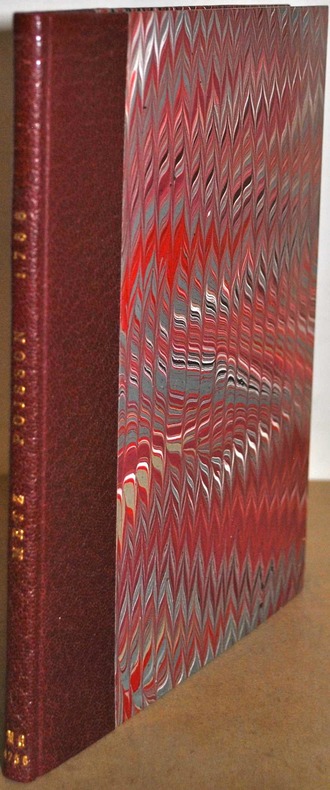
175611024A Metz, Chez Joseph Collignon, 1756. In-4 de 7 pp., demi-maroquin lie-de-vin à la Bradel (reliure moderne).
Original Wraps. 8vo. 36 pages. 24 cm. First edition. Monthly Periodical. Hebrew Union College Monthly, Volume IX, Number 7, June 1923. Contains 'Kaufmann Kohler' by Henry Englander (an address delivered at Hebrew Union College in celebration of Dr. Kohler's eightieth birthday, May 12, 1923) , 'An Eightieth Birthday' by Annette Kohn (poem dedicated to Dr. Kohler on his birthday) , 'The Vanguard' by Dr. Kaufmann Kohler, 'Resolutions in honor of Dr. Kaufmann Kohler' by Julian Morgenstern and Henry Englander, amongst other articles and sermons. Contains a photograph of Dr. And Mrs. Kohler on pg 34. Subjects: Judaism - Periodicals. Judaism. Hebrew Union College-Jewish Institute of Religion - Periodicals. OCLC lists 19 copies. Wraps lightly bumped at edges, otherwise clean and fresh. Very good condition. (AMR-46-2)
19377299NLondon, Hinrichsen Edition (mit Verlagsmarke von C. F. Peters, Frankfurt a.M.), 1937. (VNr. H. E. 140), Oktav, 8 Seiten Ohne Umschlag
First edition. Original paper. 4to, 3,1,2, 8 pages [total of 14 mostly single-sided pages]; 35.5cm. A total of 4 Mimeograph publications on Poale Zion letterhead. In English. DP/Early Statehood-era public position papers on issues of the day in the first years of the Jewish state for use in the Jewish press. Eg.: "It is becoming increasingly clear that for our organnzation to play its historic role in the building of the State of Israel and the shaping of the Jewish national future, it must become a more potent force in AMerican Jewish life....It is practically impossible for any organization to occupy a position of prominence in AMerican Jewish affairs without association with some defense agency" (p. 1 of No. 10). Baruch Zuckerman, president of the Labor Zionist Organization of America, was a leading American-Israeli zionist, one of the leading proponents of Yad Vashem, editor of Yiddishe Kempfer, and a leading figure in the Farband and Histadrut campaigns (Wikipedia, 2016) . Dr. Berl Frymer was a prominent Labor Zionist as well, holding a variety of leadership positions. SUBJECT(S) : Labor Zionism, Politics. OCLC lists no holdings. Slight toning. Minimal markings and tears. Library stamp. creases from mailing. Very good condition. (zion-12-11A)
194133388Ohne Ort, um 1941. 57 x 60 cm. [4 Warenabbildungen]
Original Poster. 1 print. 84 x 56 cm. Lithograph, color. Poster showing a soldier reaching out above the chaos of battle. Civilians, when we go through this we need all the help and comfort you can give - The Jewish Welfare Board. United War Work Campaign - Week of November 11, 1918. The National Jewish Welfare Board, founded on April 9, 1917, played a central role in providing for both the spiritual and material needs of Jewish troops in World War I. Later renamed the Jewish Welfare Board, this organization trained both rabbis and lay leaders to serve as aids for the Jewish military. The Jewish Welfare Board supplied soldiers with kosher food, Passover meals, holiday services, and trans-denominational prayer books. Important Jewish leaders such as Dr. Cyrus Adler expedited these efforts. The Jewish Welfare Board also organized secular activities for the soldiers. By 1918, the Board extended its effort to the Jewish troops overseas. This classic poster shows a soldier who implores civilians to help with the war. Subjects: National Jewish Welfare Board - 1910-1920. World War, 1914-1918 - Economic & industrial aspects - United States. War bonds & funds 1910-1920. Soldiers - 1910-1920. Lithographs Color 1910-1920. War posters - American - 1910-1920. Original Poster. Copies held at the Library of Congress and Temple. Edge wear; slight tear to center, previously repaired with tape, otherwise clean and fresh. Good + condition. (AMR-46-44)
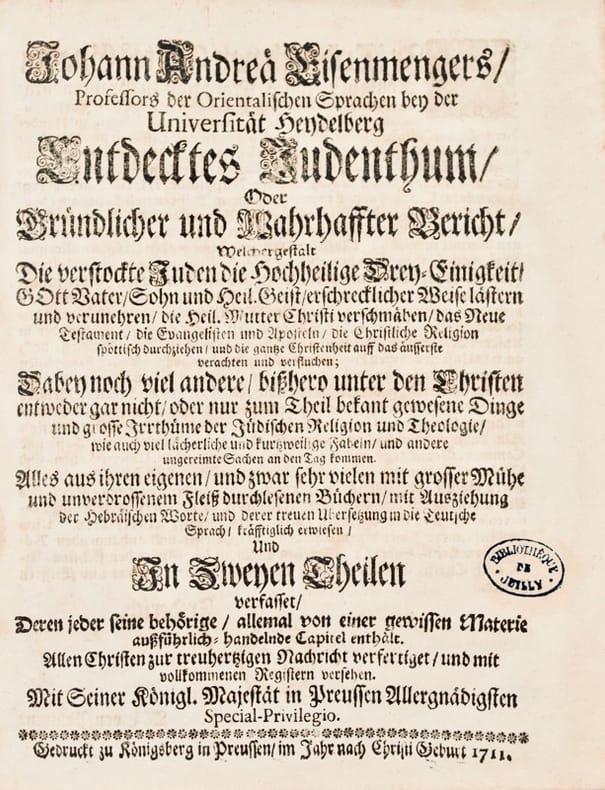
171141528Königsberg, , 1711. 2 parties en 2 vol. in-8 carré (17,5 x 21,5 cm) de (20)-1016-(1) pp. ; (4)-1111-(2) pp., caractères hébraïques et gothiques, veau brun, dos orné à nerfs, pièce de titre en maroquin rouge (reliure de l'époque).
No Date [1934]. [2] typewritten pages, 30cm x 21 cm. 2-page membership list from the first full-year of Hitlers full power in Germany, showing approximately 75 current members with city and address. Agudath Israel was founded in Kattowitz, German Empire (now Katowice, Poland), in 1912, with the purpose of providing an umbrella organization for observant Jews who opposed the Zionist movement. In Erez Israel, Agudat Yisrael was established as a branch of this movement, to provide opposition to the organized Jewish community (the "Yishuv"). One of its most authoritative spokesmen against the formation of a Jewish State, the Dutch poet Jacob Israël de Haan, was assassinated by the Haganah in 1924. In the wake of the Holocaust, anti-Zionist rabbis who led Agudat Israel recognized the great utility of a Jewish state, and it became non-Zionist, rather than anti-Zionist. It did not actively participate in the creation of Israel, but it ceased its opposition to it. In 1933, it entered into an agreement with the Jewish Agency, according to which Agudat Yisrael would receive 6.5% of the immigration permits. Eventually, at the eve of the Israeli Declaration of Independence (1948), Agudat Yisrael yielded to pressure from the Zionist movement, and has been a participant in most governments since that time. age staining, few tears, very brittle. (Holo2-146-8)
No Date. 1st Edition. 14 ½ X 22 Inch Lithograph Print. Signed and Numbered 62/260. Michoel Muchnik is a Jewish artist associated with the Chabad-Lubavitch Hasidic movement. Muchnik resides in Crown Heights, Brooklyn; his art is noted for their joyful, story book renderings of Jewish and Hasidic themes in water colors and acrylics, and for original lithographs. (Wikipedia, 2017) A nice example of Munchniks style. Some foxing. Does not come framed. Very good- condition. (PAINT-1-18)
Hand-Colored Lithograph. Blue Frame. 16 X 20 inches. An early 20th century hand-colored Hungarian Shiviti lithograph. The same lithograph (a blue copy that is not hand-colored) belonged to Emmanuel Mané-Katz, who had a large collection of Jewish ritual art, and is held by the Mané-Katz Museum in Haifa. [See http: //www.museumsinisrael. Gov. Il/en/items/Pages/ItemCard. Aspx? IdItem=ICMS-MKM-3068]
The Central Information Bureau for Jewish War Sufferers in the Far East was founded in 1917 by The Hebrew Sheltering and Immigrant Aid Society (HIAS) to deal with the problems of refugees attempting to reach America via the Far East. The main office was established in Harbin. The Bureau changed its official name to The Far Eastern Jewish Central Information Bureau in 1923 and took its cable address "Daljewcib", which became the organization name in everyday use. The organization was instrumental to rescue efforts through Shanghai. Not in OCLC. Very good condition with prominent Daljewcib stamp. (HOLO2-142-3)
Very Good Turkish, Ottoman (1500-1928) Original manuscript of a Rusdiye school (school's name is not described) regulations about French. 31x24 cm. In Ottoman script. 1 p. Full text. After 'Nizâmnâme' title, below, regulation articles. 1-) Üçüncü sinif talebesi Fransizca tekellüm etmeye mecburdur. [i.e. A third-year student is obliged to speak French]. 2-) Fransizca konusmak saat (12)den (4)e çar-yek (çeyrek -quarter-) kalaya kadar olan zamanlardan maada her zaman mecburîdir. [i.e. Speaking in French is always obligatory, just except for the time of 12:00 to 15:45]. 3-) Tekellüm, ikinci sinifdan yukari olan talebe ile mecburîdir. [i.e. Speaking French is compulsory with students who are older than Second Year]. 4-) Her (5) kelime için (10) para alinir. [i.e. 10 liras will be taken for every 5 words]. [.] And there are six articles more on regulation paper related to French language. It's complete, after articles it's seen 'Heyet-i idâre' [i.e. Board of directors]: "Müdür: (126) Abdürrahim; Kasadar: (54) Desil (?) Efendiler; Yazicilar: (There is minor tear affected this chapter) (9) Said, (115) Adnan Efendilerdir.". This is a rare manuscript paper on Turkish / Ottoman history of education in French.
1st Edition. 10 X 13 inch Copper Etching with Colored Outline. In French. Title translates into English as, Map of the Holy Land of the Twelve Tribes Of Israel. Rigobert Bonne (17271794) was one of the most important cartographers of the late 18th century In 1773 Bonne succeeded Jacques Nicolas Bellin as Royal Cartographer to France in the office of the Hydrographer at the Depôt de la Marine. Working in his official capacity, Bonne compiled some of the most detailed and accurate maps of the period. Bonnes work represents an important step in the evolution of the cartographic ideology away from the decorative work of the 17th and early 18th century towards a more detail oriented and practical aesthetic. With regard to the rendering of terrain Bonne maps bear many stylistic similarities to those of his predecessor, Bellin. However, Bonne maps generally abandon such common 18th century decorative features such as hand coloring, elaborate decorative cartouches, and compass roses While mostly focusing on coastal regions, the work of Bonne is highly regarded for its detail, historical importance, and overall aesthetic appeal. (Wikipedia, 2017) This map depicts the important settlements, as well as the regions of the twelve tribes. The Mediterranean coast reaches from Gaza in the south to Sidon in the north. Map spills over
156422993Venedig, Alvise Bragadini, 1564. (416) Bll. Hebräische Type, 4 Spalten. Mit Holzschnittdruckermarke am Titel. Lederband des 17. Jhs. auf 6 Doppelbünden mit Rückenvergoldung sowie goldgepr. Deckelfileten und Jesuiten-Supralibros. Dreiseitiger Farbschnitt. Folio.
Very Good Turkish Original 9 photographs. All photo sizes: 18x13 cm. A very good photograph collection. A photograph collection showing the Independenta's burning after the explosion in 1979, Haydarpasa Port offshore. The photos are taken from the land. MT Independenta was a large Romanian crude oil carrier. She collided in 1979 with a Greek freighter at the southern entrance of the Bosphorus, Turkey, and exploded. She caught fire and was grounded. Almost all of the tanker's crew members died. The wreck of the Independenta burned for weeks, causing heavy air and sea pollution in the Istanbul area and the Sea of Marmara. By mid-November 1979, the Independen?a, carrying 94,000 tons (714,760 barrels) of crude oil from Es Sider, Libya to Constan?a, Romania dropped anchor about 4 nautical miles off the Haydarpasa Breakwater at the southern entrance of the Istanbul Strait. She was waiting for a maritime pilot for the guidance of her 19th passage through the strait. The Greek cargo ship M/V Evriali (10,000 DWT) was transporting 7,400 tons of steel from Mariupol, Ukraine (formerly Zhdanov) to Italy, and had already passed the strait southwards. Early in the morning of 15 November at 04:35, Evriali collided with Independenta hitting the Romanian ship between the number 3 and 4 tanks, on the starboard side. The Turkish pilot that helped Evriali navigate the strait, Dincer Sumerkan, got off the Greek ship earlier, instructing them to follow a course at 260 degrees right, however, the Greek cargo ship took a course of 160 degrees left. The sparks from the collision at 04:35 caused a big explosion on Independenta followed 3 minutes later by another explosion. A third explosion occurred at 04:47. The Independenta ran aground half a mile off the Port of Haydarpasa. 43 members of the tanker's crew lost their lives; only 3 survived the catastrophic accident. Almost all the victims lost their lives in the water when burning oil on the surface was driven towards the shore by the wind; the sailors who survived had jumped on the other side of the ship, against the wind, being later rescued by boats. The Turkish Navy immediately attempted to extinguish the fire. However, these efforts had to be abandoned due to the intensity of the fire. The Director of the Sea of Marmara District took over the spill on 19 November, and the Navy withdrew. The Greek captain of the Evriali, Alekos Adamopulos (29 years old at that time), was sentenced to 20 months in jail. The difference of time between his arrest and the 20 months, was converted into an $850 fine. The Istanbul Strait remained closed for weeks. The wreck affected the area for some years until it was broken up and salvaged to a shipyard in Tuzla. (Wikipedia).