692 527 résultats
8 vols. 1mo and folio. With 7 (of 8) engraved frontispieces (lacking that of volume 4), 4 engraved dedications, 117 engraved maps on 61 leaves, 7 engraved plates and 502 engravings in text. Further with 127 (of 128) title-pages (including a general title-page, a title-page to 7 (of 8) volumes, lacking that of volume 4, and 118 for the separate works). Volume 1-3 & 5-8: contemporary mottled calf, gold-tooled spine and board edges; volume 4: modern calf. Large paper copy of the so-called "folio-edition" (although here mostly printed as 1mo) of Van der Aa's voluminous collection of important voyages to the East and West Indies and other countries, undertaken by all European countries, other than the Dutch. Including voyages by Acosta, Balbi, Cabot, Cavendish, Chester, Columbus, Cortes, Coutinho, Da Cunha, Drake, Evesko, Frobisher, Gallonye, Da Gama, Garay, Garcia, Gilbert, Jenkinson, Harcourt, Herberer, Magallanes, Mildenhal and Cartwright, Mouette, Petelin and Andrasko, Raleigh, Saris, De Soto, etc. - The work is falsely attributed on the title-page to Johan Lodewijk Gottfried, by Van der Aa, most likely because he made good money publishing Gottfried's "Chronicle" in 1702. In reality Gottfried had nothing to do with the present work. The work was edited and co-published by Pieter van der Aa, known for his ambitious projects. Where other publishers were primarily concerned about the profits, Van der Aa wanted to publish outstanding books. For the present series of travels he either reused and revised older Dutch translations or had the original accounts translated for the first time into Dutch. In 1706 he already started publishing the translated voyages both in small (8vo) and large instalments (folio or 1mo), and a year later he published a 28-volume set of the 8vo editions. The folio editions were afterwards issued and divided in four large collections of two volumes each. The present issue, is a reissue of these four collections with their own independent title-pages and frontispieces, and ads a new general title-page and list of subscribers. - While all sets seem to be described as "folio" the present set is printed mainly as 1mo, with some occasional quires in folio. And as the large editions of the two volume sets were available on normal paper (80 guilders) and on large paper (100 guilders; Hoftijzer, p. 43), it seems very likely the present set is one printed on large paper. All leaves are unwatermarked and the 1mo leaves are only slightly trimmed (measuring 396 x 238 mm with the tranchefiles often still visible) the folio leaves are trimmed more and don't have visible tranchefiles. The fourth volume is from a different set which is trimmed down much more, but also combines both 1mo and folio leaves. - Some occasional spots, a couple minor restorations and a few wormholes; a very good set, but with the fourth volume from a different and heavily trimmed set (though printed on the same large paper), in a modern binding and lacking the frontispiece and the title-page to the volume. The seven volumes with contemporary bindings slightly worn along the extremities and with some minor wear on the sides, but otherwise very good. Cordier (Sinica) 1942f. Muller, America 1889. Sabin 3 (note). Tiele, Bibl. 10. For Van der Aa: P.G. Hoftijzer, Pieter van der Aa (1659-1733), Leids drukker en boekverkoper (1999).
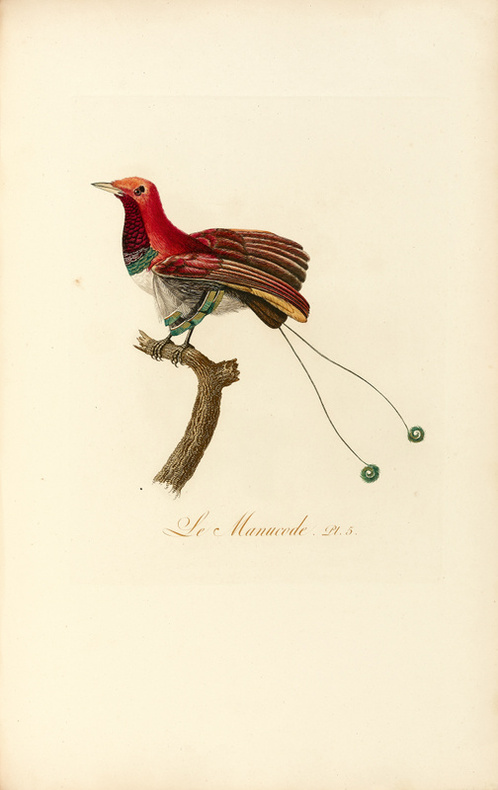
LCS-18107"One of the most beautiful books of its era" (Fine Bird Books). Paris, Desray, 1802. 5 parties réunies en 2 grands volumes in-folio de : I/ (2) ff., x pp., 128, 70 planches numérotées à pleine page, 8 pp., 6 planches numérotées à pleine page, 28 pp., 9 planches numérotées à pleine page ; II/ (2) ff., 128 pp., 89 planches numérotées à pleine page (numérotées 88 car il y a une 26 bis), 40 pp., 16 planches numérotées à pleine page dont une sur double page (n°14). Soit au total 190 planches. Qs. légères piqûres sans gravité. Demi-chagrin rouge à coins, dos à nerfs ornés. Reliure de l’époque. 505 x 333 mm.
A set of nine volumes, 8vo and 4to. A rare survival: an ensemble of books, mainly medical, formerly in the library of Sultan Abdul Hamid II of the Ottoman Empire, whose famous collection was dispersed following his deposition in 1909. - Of the nine volumes in the present collection, more than half a devoted to medicine. They include a rare account of Turkish military and civil hospitals by the French physician Paul Aubry (1887), constituting an exceptional documentation of health care infrastructure in the Ottoman world. Further, there is a detailed account of the outbreak of the plague in the Levant by the Swedish polymath Jacques Graberg (1841), also describing the situation in Tangier in 1818 and 1819, which the author had witnessed himself. Finally, the collection comprises three rare volumes from the Ottoman Turkish translation of Adolf von Strümpell's medical textbook on internal diseases (1888-91), here focusing on diseases of the heart and the arteries, diseases of the brain, and diseases of the kidneys and bladder. - Additional volumes discuss the political and religious history of Japan, or the Greek Ten Thousand and their march to the Battle of Cunaxa and back in 401 BC. Other titles are more immediately connected with Turkey, giving a capsule history of the Ottoman Empire in French and Turkish verse, or and extremely rare political analysis of the Turkey's position in the critical months preceding the outbreak of the Russo-Turkish War of 1877/78. - The volumes bear the requisite traces of the Sultan's library marks. All are presentation volumes inscribed to the Sultan by the author (some even inscribed in Turkish and Arabic), or are bound in special presentation bindings, or the in Sultan's personal library bindings with his tughra on the covers. - Sultan Abdul Hamid (Abdülhamid) II (1842-1918) was the last Sultan of the Ottoman Empire to exert effective contol over the fracturing state and also remembered as a poet, translator and one of the dynasty's greatest bibliophiles. While his passion for books is memorialized by the many precious donations he gave to libraries all over the world and which mostly have remained intact to this day (including the 400-volume "Abdul-Hamid II Collection of Books and Serials" gifted to the Library of Congress), his own library was dispersed in the years following his deposition: books were removed to other palaces and even sold to Western collectors; the greatest part of his collection is today preserved in the Chester Beatty Library in Dublin. - Detailed catalogue available upon request.
8vo. IX, (1), 502, 32 pp. With half title, folding lithographed diagram and publisher's adverts at end dated June 1859. 20th century blue half morocco binding with cloth covers, gilt rules, marbled flyleaves. Top edge gilt. Almost unobtainly rare revised issue of the first edition, or rather the intermediary stage to the first issue of the second edition, called by Darwin himself "only a reprint [with] a few important corrections". Published in January 1860, this is the only known copy to retain the year "1859" on the title-page, the original two quotations opposite (while the second edition is usually marked by having three), and the 32 pages of ads at the end, dated "June 1859" (usually lacking in the second edition). Alterations between the first and second editions are minor, though it is notable that Darwin corrected the misprint "speceies" on page 20 and shortened the "whale-bear" story on page 184. - Immediately recognized as revolutionary and controversial, the "Origin's" small first edition of only 1250 copies sold out on the first day, and by the late autumn of 1859 the publisher Murray was asking Darwin to begin revising at once for a new edition. This was to become the second edition (never so called on the title-page), of which a few copies were printed that retain the date "1859". Freeman knows of only two, at Yale and the University of Southern California, LA, both of which, however, already have three instead of two quotations opposite the title: "The existence of such copies has long been known to the trade, although, from their extreme rarity, few booksellers can ever have seen one" (p. 77). Freeman clarifies that while there is "only one issue of the first edition" of the "Origin of Species", "the text being identical in all copies" (p. 75), it was "customary, for many years, for anyone offering a copy of the first edition to describe it as 'first edition, first issue'", and he admits that "the book-sellers were, in a purist sense, right; the new printing was from standing type of the first edition, although with a considerable number of resettings" (p. 77). By this standard, the present specimen is clearly one of the second edition. Yet Freeman, from his evidence, considered "the presence of two quotations only, from Whewell and Bacon, on the verso of the half-title leaf", to be "diagnostic" of the first edition. Unknown to Darwin's bibliographer, the present revised version sits between the first edition and the first issue of the second, exhibiting characteristic features of both. Only a tiny number of copies of this proto-first issue of the second edition can have been produced: it appears a unique variant of what has always been considered the "rara avis" of Darwin bibliography. - Lower and right edges untrimmed, a very short tear in the diagram's first fold; an old repaired tear to the gutter of the following leaf and some very light foxing to the margin of the preceding one. Otherwise an impeccable copy, bound in the mid-20th century for the American petroleum geologist Dr. Edgar Wesley Owen (1896-1981) with a posthumous exlibris ticket loosely inserted. PMM 344. Dibner Heralds (1980) 199. Eimas Heirs 1724. Garrison/Morton (1991) 220. Grolier/Horblit, Science, 23b. Grolier, Medicine, 70B. Norman 593. Sparrow, Milestones 49. Waller 10786. Freeman p. 77 and cf. nos. 373 & 375.
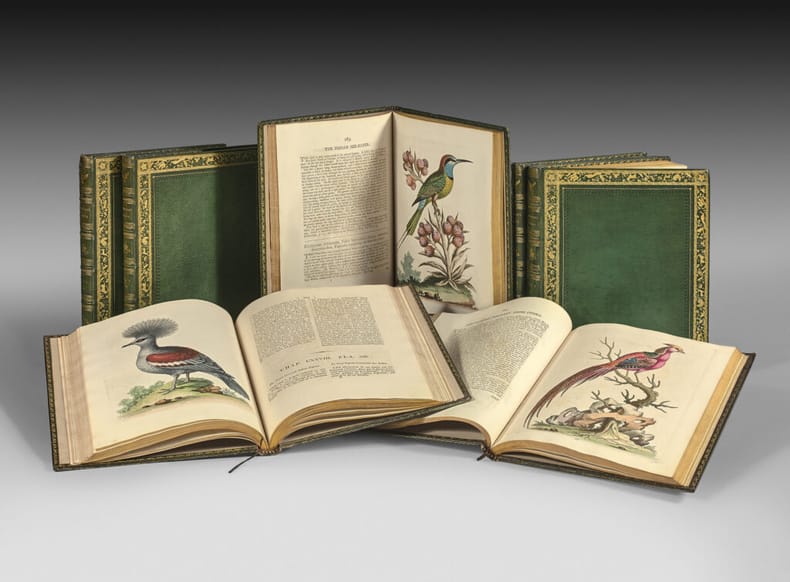
LCS-17932L’illustration superbe se compose de 362 planches à pleine page représentant des oiseaux d’espèces variées. London, Will. Gardiner, Robinsons, Paternoster-Row, 1802-1806.7 volumes grand in-4 de : I/ xxiii pp. dont 1 portrait de l’auteur non relié gravé par Miller d’après Dandridg,, 52 pp. accompagnées de 52 pl. en couleurs numérotées 1 à 52 ; II/ iv pp., pp. 53 à 126, pl. numérotées 53 à 105 ; III/ (2) ff., pp. 106 à 157, pl. numérotées 106 à 157 ; IV/ (1) f., pp. 158 à 210 puis 218 à 249, pl. num. 158 à 210 ; V/ (2) ff., xxxv pp., 108 pp., pl. num. 211 à 260 ; VI/ (4) ff., 220 pp., pl. num. 261 à 310 ; VII/ (3) ff., vii pp. de préface, pp. 221 à 347, pl. 311 à 362. Quelques rares rousseurs et taches. Soit un total de 362 planches à pleine page en couleurs.Reliés en plein maroquin vert à grain long, filet doré et large roulette dorée composée de multiples animaux encadrant les plats, dos à nerfs ornés d’oiseaux différents dans chacun des caissons, coupes décorées, roulette intérieure dorée ornée d’oiseaux, tranches dorées. Superbe reliure de l’époque.293 x 228 mm.
Three vellum membranes. Later endorsements, a few early ink marginal markings and underlinings, substantial fragment of Great Seal in white wax pendant on original vellum tag, ink somewhat faded on first membrane, some light staining, seal discoloured and worn. Framed and glazed. An indenture detailing the exchange of lands between the crown and Thomas, 4th Duke of Norfolk, signed three times by the Queen, recording that the Duke will "sell geve and graunte unto our Soveraigne Ladie the Quene All those his Mannors & Lordshippes of Chesworth and Sedgewicke [...] in the County of Sussex [...] also all that mannor Lordshipp and Forest of St Leonard and all ground and Soyle of the same Forest And also all those his Parkes of Bewbushe and Shelley", and related lands and rights, in exchange for lands in royal gift including the "Celle of Sainte Leonard in her county of Norfolk" and associated lands and buildings "neare unto the Citie of Norwich", Norfolk lands formerly of Wymondham Abbey, lands in Essex (Wigborough, Saltcote, Tollesbury) that were formerly "assigned to the late Ladie Anne of Cleves" and also lands in "Pitchesey" (Pitsea) in the same county, the manor of Dowdike in Lincolnshire (previously of Crowland Abbey), and lands of Newenham Abbey in Devon. The indenture then lists the extensive debts of the Duke to the crown, further detailing that a portion of this debt is discharged by the value of the woodland hereby sold to the crown, and commands the exchequer to produce a new bond for the residue of the debt, being a mere £1823 15s. 5 3/4d. Signed by the Queen at the head of each membrane, additionally signed at the foot by the Lord Treasurer William Paulet, Marquess of Winchester ("Winchester"), the under-treasurer Richard Sackville, and the Chancellor of the Exchequer Walter Mildmay. - Thomas Howard, 4th Duke of Norfolk (1538-72), was the head of the powerful Howard family. He was a Privy Councillor, had commanded English forces in Scotland at the beginning of Elizabeth's reign, and was one of the greatest land-owners in the land, with estates centred on Norfolk. The agreement with the crown that is formalized in this document saw enormous tracts of land near Horsham in Sussex - including the 12 square miles of St Leonard's forest - conveyed to the crown. Norfolk gained considerable land in return, primarily former monastic land scattered across four counties, but - and this was probably of greater importance to him - he also saw his overall debt to the crown, which had been more that £6500, reduced by some £4680. The counterpart of this indenture remains in the Exchequer (The National Archives, E 211/39). Less than ten years after this agreement was made, Norfolk was executed for treason for conspiring with Mary, Queen of Scots. His son and heir, Philip, Earl of Arundel, was permitted to inherit most of his estates.
Chiefly 12mo. Altogether 10 pages on 9 ff. Series of nine letters, notes and cards (all in Gujarati), eight to Jamnabehn and one to Yashwant Prasad, comprising two autograph letters signed, three autograph cards signed, and four cards signed in pencil, discussing Gandhi's diet and health, refusing the offer of a blanket ("one that I have is enough"), and expressing his concern about Yashwant Prasad's heart condition: "Don’t worry about me. I take all the precautions necessary. God is there to take care of all of us. Before the Almighty we are helpless, worrying causes unnecessary problems [...]" (transl.). Jamnabehn, a member of the extended Gandhi clan, was an active weaver of khadi on the charkha and worked alongside Dadabhai Naroji's grandchildren Perin Ben Captain and Khrushed Behn. Most of these letters date from 1926, when Gandhi was living in self-imposed withdrawal from the public world at Sabarmati and experimenting with a diet of fruit. - Small burn holes to two letters, nicks and tears at edges; browned.
Arabic manuscript on paper with somewhat wavy laid lines only (335 x 239 mm; text area 263 x 176 mm), 544 ff., written in a tidy nasta'liq, 35 lines to the page, text frame of red and blue rules, important words and phrases in red or in larger naskhi; chapter headings repeated in margins in a bold calligraphic script, several marginal annotations in various contemporary and later hands. Early 20th century brown roan preserving covers of contemporary morocco binding blind-stamped with a single tool to form a central motif of three interlocking lozenges, smaller lozenges above and below, blind-stamped corner-pieces. Very rare Arabic translation of Al-Jurjani's important medical compendium, the first major medical text written in the Persian language. - Al-Jurjani (d. 1136) "went to live in Khwarizm in 504/1110 and became attached to the Khwarizmshahs Kutb al-Din Muhammad, to whom he dedicated his 'Dhakirah', and Atsiz b. Muhammad [...] His 'Dhakirah Khwarizmshahi', probably the first medical Encyclopaedia written in Persian and containing about 450,000 words, is one of the most important works of its kind; it also exists in an Arabic version, and was translated into Turkish and (in an abbreviated form) into Hebrew" (Encyclopaedia of Islam). - Modelled on the Qanun of Ibn Sina (Avicenna), the "Dhakirah" is divided into ten books, covering: definition and utility of medicine, and the structure and powers of the human body; health and disease, in general, including causes and symptoms of disease, and accidents of the body; the preservation of health; diagnosis, crisis and prognosis; fevers and their treatment; local diseases and their treatment; tumours, ulcers and so forth; the care of the external parts of the body (hair, skin, nails, and so on); poisons and antidotes; and simple and compound drugs. - Binding stained and rubbed. Various seal impressions (some erased) on first and second leaves and at end of text. Paper shows some splashes, soiling and staining, first leaf re-attached and with loss of one or two words on verso (sense recoverable), margins of last few leaves strengthened, but generally in good, sound condition. Provenance: Abdul-Malik bin Mahmud al-Mausuli al-tabib ("the physician"), with his ownership inscription dated 5 Rajab 913 AH (10 Nov. 1507) at the Mu'ayiddi hospital in Mosul; the distinguished German ophthalmologist and Arabist Max Meyerhof (1874-1945), with his bookplate on the front pastedown. GAL I, 487 & S I, 889. Cf. Keshavarz, A descriptive and analytical catalogue of Persian manuscripts in the library of the Wellcome Institute for the History of Medicine, pp. 52-54 & p. 149. Fihrist records no copies of the Arabic translation.
Oblong folio. With 18 tinted chalk lithographs by L. Ekeman-Allesson after R. Kuntz. With lith. title, lith. dedication and 3 ff. of letterpress text. Stored in a modern half morocco leather case. First and only edition. Commissioned by the Board of the Württemberg Stud, the first Arabian stud in Europe, this almost unobtainable series of large format plates shows the Stud's full-blooded Arabian horses with decorative oriental backgrounds. The plates constitute extremely early examples of chalk lithographs (listed individually by Winkler, Frühzeit der dt. Lithographie, 180, 57). Kuntz (1797-1848) was known for his "excellent depictions of horses" (cf. Thieme/B.); throughout his brief career he studied thoroughbreds in England, Hungary, and Paris as well as in Germany. In 1832 he became Painter to the Court of Karlsruhe, Baden; he suffered a stroke in 1846 and died in the newly-founded Illenau mental hospital. - Of the utmost rarity, no copy of the complete series with all three issues as present here traceable in auction records. Nissen 2327. Thieme/B. X, 444 & XXII, 116. Winkler, Die Frühzeit der dt. Lithographie 180.57.
Folio (210 x 308 mm). 60 pp. With 27 engraved and etched plates (some double-page). Contemporary speckled sheep. Marbled pastedowns. First and only edition, printed at the second printing press established in Istanbul. "A rare and very interesting work outlining the military reforms and the regulations for the New Troops established by Selim III in 1796/97" (Blackmer). The author, Mahmoud Ra'if, was a member of the reform movement instigated in Turkey by Sultan Selim III, who tried to change the traditional political structures of the Ottoman Empire and replace them with a political state that owed much to his youthful contact with Europe, and more particularly, the influence of the French Revolution. After his succession in 1789, Selim took steps to establish a new state under the Nizam-Jedid ("new order") regulations - from which the present work derives - underpinning his state with the formation of a new army and military infrastructure. Among the moves towards "Europeanisation" were the installation of printing presses at the military engineering school (where the present work, the first from the press in roman types, was printed), and the establishment of Ottoman embassies in the capitals of Europe, including London, where Mahmoud Ra'if served as secretary to the Ottoman Ambassador in the mid 1790s. As outsiders feared, the very reforms which are the subject of his work led to Selim's murder in 1808, while the author himself was "cut to pieces" by the enraged Janissaries whose elite position had been threatened. "The establishment of these troops - the Nizam-Jedid - and the jealousy which this aroused was one of the main factors leading to the revolt of the Janissaries in 1808 which cost Selim, and later the author of this work, their lives" (Blackmer). - Binding very slightly worn, interior clean and flawless throughout. Provenance: armorial bookplate of the Swedish diplomat Johan Henrik Tawast (1763-1841), who was seconded to Constantinople in 1812-13 to help negotiate the Russian-Turkish peace treaty of Bucharest; his autograph note "Scutari, 9 janvier 1813. 16 piastres, 20 pares" inscribed to front pastedown. Latterly in the collection of Thomas Fremantle, 3rd Baron Cottesloe (1862-1956), commander of the Territorial Army and president of the Society for Army History Research. Atabey 752. Blackmer 1060.
8vo (130 x 218 mm). Arabic manuscript on paper. (375) pp., 19 lines per extensum. Written in neat black naskh, emphases picked out in red; catchwords. With numerous tables and diagrams, one in red and black. Contemporary brown leather binding with stamped ornaments. A 16th century commentary (sharh), profusely illustrated with diagrams, on Naziraddin al-Tusi's "at-Tadhkira an-Nasiriya", a general outline of astronomy, originally written in Persian. Composed by the Persian Sunni scholar Nizamaddin ibn Muhamad an-Nisapuri (d. 1328/29), who was known as a mathematician, astronomer, jurist, Qur'an exegete, and poet. His teacher Qutb al-Din al-Shirazi had himself been a student of al-Tusi's. An-Nisapuri wrote the present commentary in 711 H (1311 CE). - Binding rather rubbed. Marginal notes throughout; colophon with partial date "14 Jumada II". Scattered minor wormholes, but overall in good condition. GAL I, 511, VI, 40 b.
1 volume of text (4to) and 3 vols. of plates (large folio). Text: 1 bl. f., title leaf, viii, 296 pp., 1 bl. f. With 34 lithogr. plates (all with tissue guards) and 73 text illustrations. Half morocco with giltstamped title to gilt spine. Spine rebacked. Plate volumes all with half title, title, list of contents and a total of 200 engraved plates (130 of which are chromolithographs and 48 tinted lithographs). Plate volumes bound uniformly with text volume in giltstamped half morocco with cloth covers. Very scarce first edition of this splendid, unsurpassed standard work on Islamic art. Prisse d'Avennes spent many years in Egypt after 1826, first as an engineer in the service of Mehmet Ali. After 1836 he explored Egypt disguised as an Arab and using the name Edris Effendi; during this period he carried out archaeological excavations in the valley of the Nile. In 1860, Prisse d'Avennes returned to France with a wealth of documentation and drawings, which he subsequently had reproduced by specially trained draughtsmen and published in this monumental set. "'Arab Art', however, is more than a monument to the author's tenacity, skill, and devotion. For the historian of architecture, it is a precise source, a unique documentary record [...] On an entirely different level, Prisse d'Avennes has provided today's architects, designers, artists, and illustrators with some of the finest examples of measured drawings, pattern details, and illustrations of selected aspects of the built environment of a medieval Islamic city. But 'Arab Art' is not merely an exercise in architectural description. Prisse d'Avennes writes about and records in the plates art forms ranging from elaborately decorated tiles to carpets and fabrics, to Korans and illuminated manuscripts. His text examines how these objects were made and the way they were used, and describes the value placed on them by contemporary society. The result is that his book offers invaluable glimpses of aspects of Arab life as they were viewed by a sympathetic West European" (preface to the 1963 London edition). - Beautiful, complete set (the last copy sold at auction was incomplete). Text and plates uncommonly clean and in an excellent state of preservation throughout, in contrast to the known copies in libraries and in institutional possession. Ibrahim-Hilmy II, 138-140.
Folio (382 x 522 mm). (6), 60 pp. With mounted chromolithographed additional decorative title heightened with gold, tinted lithographed portrait, and 30 hand-coloured lithographs. Numerous wood-engraved illustrations in the text. Contemp. red half morocco with giltstamped cover and spine title. All edges gilt. Marbled endpapers. Modern calf-backed marbled boards, spine gilt with morocco label. First edition. Only a small portion of the press run - as the present copy - was coloured by hand, providing the utmost detail and atmosphere to the splendid plates showing bedouins, horses, local life and costumes. One of the most sought-after and earliest publications by Prisse d'Avennes, who spent many years in Egypt after 1826, first as an engineer in the service of Mehmet Ali. After 1836 he explored Egypt disguised as an Arab, using the name Edris Effendi; during this period he carried out archaeological excavations in the valley of the Nile. In 1848 he first published his "Oriental Album". This unusual visual collection of "characters, costumes and modes of life in the valley of the Nile" is augmented by a commentary by the renowned orientalist and Egyptologist James Augustus St. John. - The frontispiece portrait depicts the artist's friend George Lloyd in the robes of a sheikh reclining with a hookah, and camels in the background. Lloyd, a botanist accompanying the expedition, accidentally shot himself whilst cleaning a rifle. - Final plate with a few minor repairs to margins; final leaf creased and with marginal repairs. One or two other minor marginal defects. - While normal copies of the first edition regularly appear in the trade or at auctions, the present coloured de luxe issue with all the plates is quite rare. The Atabey copy fetched £36,000 (Sotheby's, May 29, 2002, lot 975); the Longleat copy commanded $59,200 (Christie's, June 13, lot 110) that same year. Atabey 1001. Blackmer 1357. Lipperheide Ma 30. Colas 2427. Hiler 772. Brunet IV, 885. Graesse V, 449. Cf. Heritage Library, Islamic Treasures, s. v. "Art" (illustration). Not in Cook (Egyptological Libr.), Fumagalli (Bibliogr. Etiopica), Gay, Abbey.
Various sizes (folio, 4to, 8vo). A total of 460 typescript and 177 manuscript pp. (9 of which comprise merely 2 lines) in 26 fascicles, assembled as 11 portfolios. With a few newspaper clippings as well as 1 photograph each of Hagia Sophia and the gate of Dolmabahce Palace, mounted on cardboard as postcards. A highly important and extensive archive from the secret personal papers of General Auguste Sarrou, France's chief spymaster in the Levant and Turkey during the critical period between 1917 and 1923, when the Near and Middle East were completely re-ordered following the demise of the Ottoman Empire. It features numerous "top secret" spy reports, correspondence and dossiers of political analysis, providing stellar insights into France's central role in shaping the destiny of Syria, Lebanon and Turkey, working to counteract the forces unleashed by Lawrence of Arabia during the Arab Revolt. - The present archive consists of dozens of classified intelligence reports, political masterplans and field notes. Most of the documents are typescripts or carbon copies of typescripts (many written by Sarrou), intended for distribution amongst only the most senior French military and political officials. The documents span Sarrou’s entire career, dating from 1908 to the 1960s, although the bulk of the documents concern the critical period from 1917 to 1923. It includes a typescript copy of Sarrou’s autobiography, written at the end of his 60-year-long career in espionage and diplomacy in Turkey, the Balkans and the Middle East; a series of papers relating to Sarrou’s time serving as a gendarme in Macedonia in the decade prior to World War I, when he notably befriended many leaders of "Young Turks"; and a further series of papers outline his secret "Mission d’Orient", a grand operation to support French ambitions in Syria, Lebanon and Anatolia. Furthermore, a series of highly important and secret analytical reports written by Sarrou provide a "game plan" for how France was to rule Syria and Lebanon (importantly, the Quay d’Orsay largely followed Sarrou’s advice as matters unfolded). Notable is Sarrou’s brutally unflattering assessment of Emir Faisal, Lawrence of Arabia’s old comrade. Additionally, there is an intriguing manuscript report of a meeting held between Arab intellectuals and Djemal Pasha, the Ottoman War Minister, the day before the fall of Damascus, as well as a series of fascinating reports concerning the 1921 attempt on the life of General Henri Gouraud, the French High Commissioner for Syria and Lebanon. Another series of 25 typescript "Secret" intelligence reports compiled by the Service des informations de la Marine dans le Levant (S.I.L.) in Port Said in 1918 and 1919 contain fascinating raw field intelligence on Anti-French elements throughout the Middle East, as well as the efforts of French assets to counteract these forces through counterespionage and propaganda. A diverse collection of typescript and manuscript research documents, as well as correspondence from key assets, assembled by Sarrou from 1919 to 1922, is supplemented by a series of highly insightful typescript reports, written by Sarrou to advise the French government on the situation in Turkey from 1921 to 1931, covering the rise of Atatürk’s new republic and French efforts to gain influence in Ankara. Finally, there is a collection of letters, documents and postcards from Sarrou’s mid to later career, from the late 1920s until his retirement in the mid-1960s. - Many of the elements of the present archive are likely unique survivors, while a couple examples of some of the typescripts may exist in various French official archives. A detailed list is available upon request.
Folio (208 x 310 mm). Latin ms. and illustrations on paper. 184 ff. with gilt-raised title-page and a total of 292 watercolour and gouache plant illustrations (1 double-page), captioned and numbered 1-290 by a contemporary hand (nos. 45 and 149 assigned twice). 19th century green half cloth over marbled boards. Stored in custom-made half morocco case. Unique, museum-quality manuscript herbal, previously unknown to research, compiled for the Memmingen pharmacist Wolfgang Schötz by an unidentified but obviously professionally trained artist. The nearly 300 watercolours and gouaches, all impressively accomplished, show the principal Central European medicinal, poisonous, spice and ornamental plants as they were to be found in the gardens, meadows and forests of the free imperial city of Memmingen: hollyhock, tarragon, snow pea, prunella, dandelion, spiked rampion (phyteuma spicatum), swallow-wort (asclepias vincetoxicum), echium, caper spurge (euphorbia lathyris), white bryony (wild hop, Bryonia alba), staghorn sumac (Rhus typhina), poppy (papaver rhoeas), banewort (atropa belladonna), foxglove (digitalis), hemlock (Conium maculatum), as well as splendid tulips, irises and martagon lilies, Jacob's ladder (polemonium), rose, chrysanthemum, gentian, daffodil, barberry, etc. The shapes of the leaves and blossoms, often also of the roots and bulbs are rendered with extreme precision; occasionally, the illustration is enlivened with beetles, caterpillars and other insects, drawn with similarly meticulous realism. The Latin and German captions are apparently by two different writers; some of the Latin annotations may be in Schötz's own hand. The quality of the draughtsmanship and colouring approaches that of the roughly contemporaneous studies by Nicolas Robert, whose documentation of the plants in the French royal gardens, commissioned by the court of Versailles, were famous even then and remain so to this day. - The pharmacist Wolfgang Schötz (Schütz) also served as judge in the municipal court of his native Memmingen. Correspondence in his hand with the German physician and alchemist Johann Joachim Becker (1635-82) has survived in the latter scholar's posthumous papers in Rostock. Schötz was considered "the largest and strongest man" in town; when he died in 1695, ten men were needed to bear his mortal remains to the graveyard (cf. J. F. Unold, Geschichte der Stadt Memmingen [1826], p. 292). - Title-page somewhat duststained and rubbed. Leaves numbered 1-183 in pencil in the later 19th century, probably during rebinding; a few leaves transposed. A few edge flaws (some with early repairs); edges somewhat fingerstained and dampstained throughout with a larger dampstain near the end, but illustrations preserved in brilliant original colour. A masterpiece of botanical illustration.
8vo. 1 page. In blue and red crayon. A humorous correspondence with his daughter Svetlana, giving her the desired permission to invite two classmates for the weekend: "For Secretary Number 1 Mr Stalin / Decree Number 2 / I order you to permit me to invite two boys and a girl from my class this weekend (12/3/37). / Insurgent - Svetlanka Stalina [stamp] / Signed / I submit myself / Secretary to Svetlanka - insurgent / Stalin". Very well preserved document of Stalin's private family life, pervaded by the formulae of party bureaucracy.
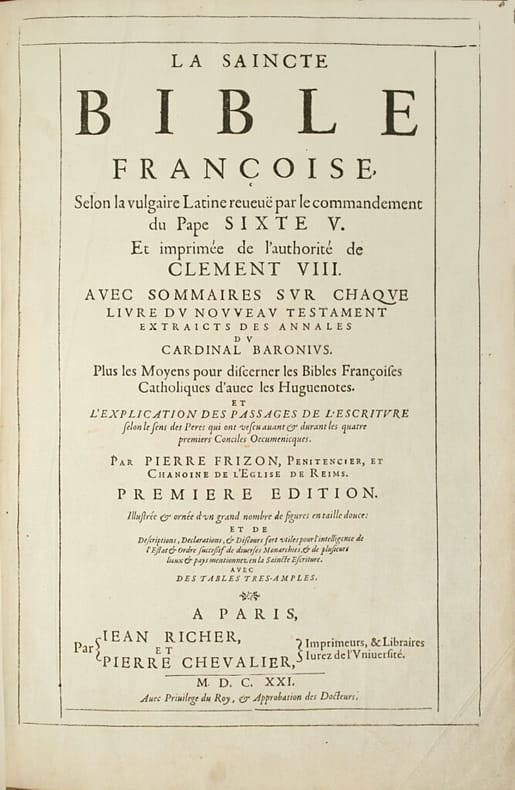
LCS-18148Précieux et extraordinaire exemplaire de la première édition de la bible de Frizon censurée par la Sorbonne, dédicacée au roi Louis XIII et reliée à l'époque en maroquin rouge doublé de maroquin rouge pour le Grand Dauphin (1661-1711). Paris, Jean Richer et Pierre Chevalier, 1621 [Suivi de :] – Frizon, Pierre. Moyens pour discerner les bibles françoises catholiques d'avec Les Huguenotes. Paris, Jean Richer, 1621. 2 tomes en 3 volumes in-folio à 2 colonnes de : I/ (6) ff. dont 1 frontispice, 583 pp., 28 gravures dans le texte ; II/ (2) ff., 508 pp., 21 gravures dans le texte; III/ pp. 509 à 863, 1 f. numéroté 864, 3 pp. numérotées 510 à 512, 90 pp., (27) ff., 21 gravures dans le texte, 2 gravures au titre, 1 carte. Ainsi complet. Reliure du dix-septième siècle en maroquin rouge ; double encadrement de trois filets dorés sur les plats avec fleurs-de-lys aux angles, dos à nerfs fleurdelisés, doublures de maroquin rouge à dentelle dorée et cadre central de trois filets dorés avec fleurs-de-lys aux angles, gardes de papier marbré, tranches dorées sur marbrure. Reliure royale réalisée vers l’année 1678 en maroquin doublé de maroquin.
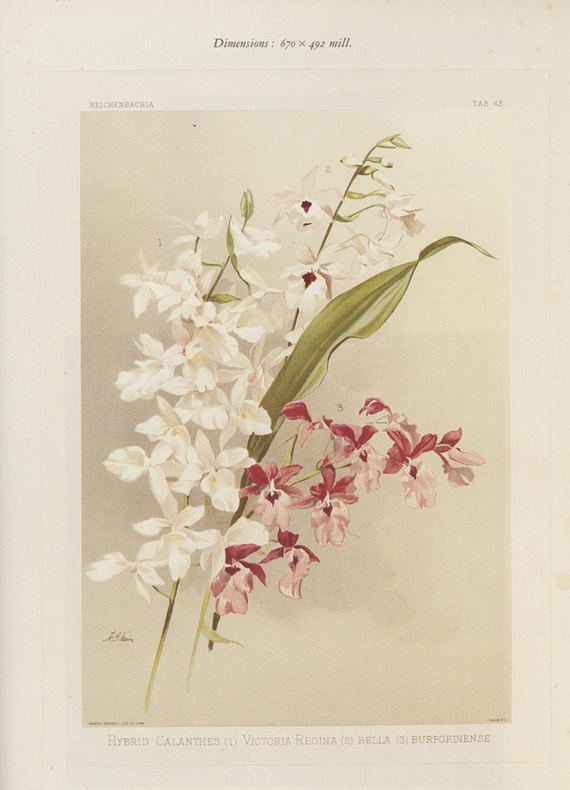
LCS-16949Le plus beau des ouvrages consacrés aux orchidées, orné de 192 chromolithographies rehaussées à la main, imprimé à seulement 100 exemplaires. Londres, J. French pour H. Sotheran et F Sander, 1886-1888-1894-1895.2 séries en 4 volumes impérial folio. Infimes rousseurs. Demi-peau de truie fauve à coins, tranche supérieure dorée. 670 x 492 mm.
76 volumes, mostly offprints or articles removed from journals, bound in private wrappers or in the original printed wrappers. Mostly 8vo but including a few specimens in small folio. An ensemble of 82 works from the library of Sigmund Freud, comprising roughly half of the known corpus now in private hands. In his census, the medical historian Gerhard Fichtner established the number of works from Freud's former library now in private ownership at only 166 works, or some 4 percent of his former collection of 3725 titles, the vast majority of which (more than 3,400 books) are today preserved by the Freud Museum in London and the Health Sciences Library in New York. Regarding the privately owned works, "it is noteworthy that Freud (during both the Viennese and London time) bestowed upon Eva Rosenfeld, a friend of Anna Freud, 25 important early items from his library. Amongst the privately owned volumes are also some that surfaced in recent years in the second-hand market. They are predominantly offprints, whose dedications show they once belonged to Freud's library and, as a rule, carry the partially erased stamp of the Psychoanalytic Ambulatorium Vienna. They must have arrived long before Freud's emigration in this library, which was seized and destroyed by the Nazis. Did the erasure of the stamp help to save these items, or did it disguise unauthorized possession? They come from the estate of a German analyst" (Davies/Fichtner, pp. 17f.). Indeed, the nature of some of these erasures - rather constituting overpastings with near-contemporary typed transcriptions of those parts of the text obscured by the stamp (as in David Baumgart's article on Spinoza's image in German and Jewish thought) - would strongly suggest the former reason: such an overpasting would arguably have sufficed to conceal the items' provenance from a cursory examination in 1938, but would not at all be helpful to a collector wishing to obscure a third party's title. - The present ensemble includes articles by 40 different authors from a range of disciplines, including Hugo Bergmann, Eugen Bleuler, Carl Clemen, Josef Friedjung, Heinrich Gomperz, Gustav Hans Graber, Jakob Kläsi, Otto Pötzl, and Isidor Sadger. Two specimens preserve the author's inscription to Freud (by Pötzl); others contain autograph corrections by the author (Sadger). Eighteen items show traces of a removed stamp or inscription. Paper often brittle; some wrappers a little rubbed or chipped, but on the whole very well preserved. Acquired from a Belgian private collection. Detailed list available on request. Cf. Davies/Fichtner (eds.), Freud's Library. A Comprehensive Catalogue (Tübingen/London, 2006).
Folio (200 x 306 mm). 2 pp. on a bifolium (written cross- and lengthways, over 700 words in total) with frequent autograph corrections. Laid down on card for reinforcement in the 18th century. To Richard Norton, a leading parliamentarian who had served as a colonel of cavalry in the first civil war and had returned as member of parliament for Hampshire in 1645, seeking to expedite the marriage of his son Richard Cromwell to Dorothy Maijor (1627-76), as the country descended into the Second Civil War. - Dorothy was the daughter of Richard Maijor, an obscure member of the Hampshire gentry. It was probably Norton who had introduced Cromwell to Maijor, and he subsequently served as intermediary in the negotiations, which began in February 1648 and were not concluded until May the following year. Although Cromwell is known to have expressed doubts about the "godliness" of an alternative, more lucrative match, monetary concerns were evidently central to his consideration of Dorothy's own suitability. Cromwell's detailed discussion of such matters offers a fascinating insight into both his financial and domestic arrangements: - "Mr Maior desired 400£ p anum of inheritance lyinge in Cambridge shire and Norfolke to bee presently settled and to be for maintenance, wherein I desired to be advised by my wife [...] Having beene enformed by Mr Robinson that Mr Maior did upon a former match offer to settle the mannor wherein hee lived, and to give 2000£ in monie, I did insist upon that, and doe desire itt may not be with difficulty, the monie I shall neede for my two little wenches, and thereby I shall free my sonn from beinge charge with them. Mr Maior parts with nothing in present but that monie, saving thir board, wch I should not bee unwilling to give them to enyoy the comfort of their society [...] Truly the land to bee settled both what the Parliament gives mee, and my owne, is very little lesse than 3000£ per anum all thinges considered. If I bee rightly enformed. And a lawyer of Lincolns Inn having searched all the Marquess of Worcesters writings wch were taken att Ragland and sent for by the Parliament and this gentleman appointed by the committee to search the sayd writings, assures mee, there is noe scruple concerning the title, and itt soe fell out that this gentleman whoe searched was my owne lawyer, a very godly able man, and my deere friend, wch I reckon noe smale mercy, hee is alsoe possest of the the writings for mee". - His son's marriage to Dorothy produced four children who survived into adulthood, but ended unhappily, as Richard went into semi-voluntary exile on the continent in 1660 following the Restoration, after which the couple did not see each other again. The "two little wenches" are Cromwell's daughters Mary and Frances, who by their own respective marriages later became Countess Fauconberg and Lady Russell. Cromwell was close to Norton and dubbed him "Idle Dick", deploying the nickname towards the end of the letter in a moment of friendly humour ("I know thou art an idle fellow, but prithee neglect mee not now"). - Primary source material for Cromwell's activities during the chaotic spring of 1648 is rare: parliamentary diaries for the period are fragmentary, and Cromwell's whereabouts "are not generally known" (ODNB). Charles made his first attempt at escape from Carisbrooke Castle on 20 March, and the rapid spread of royalist uprisings will have required Cromwell to travel swiftly and widely across the country. In May he fought his first battle in full command, at Preston, during which the invading Scottish force was decisively defeated. By January 1649, having outmanoeuvred Fairfax to see through the trial and execution of the king, he was the single most powerful figure in England. - Old folds; 18th century manuscript docket. Published in: Thomas Carlyle (ed.), Oliver Cromwell's Letters and Speeches I (1845), p. 302.
8vo (155 x 204 mm). Ottoman manuscript on laid paper. 134 pp. on 68 ff., written space ca. 90 x 140-145 mm. 15 lines, per extensum, written in a heavily Persian-influenced naskh style in black ink, gilt ("taddib") section titles, rubricated and sometimes written in gilt for emphasis, no catchwords, but extensively vocalized Turkish text with Arabic diacritics. Gilt gadval borders around introductory double page, remainder of text within double red rules. Frequent marginalia and occasional glosses, with some prayers and charms. Early full leather binding with fore-edge flap, spine and flap hinges reinforced with later leather. Complete Ottoman medical manuscript, copied by the scribe Celalu'd-din Mehmud al-'Ala'i in 1408 CE, still during the lifetime of the book's author, the Anatolian religious scholar and physician Haci Pasha (known in the Arabic tradition as Haggi Basha Galalu'd-Din al-Hidr bin 'Ali bin al-Hattab al-Aydini). - The introduction (1v-2r) sets out the work's content and structure, presented, with Arabic technical terms adopted into Turkish, as a compendium ("muhtasar") and facilitation ("teshil") of medical knowledge, offering a discussion of definitions, medical practices, the administration of solids and liquids, and a description of diseases with their symptoms and related therapies. The following sections treat dietary matters including regimens for exercise ("hereket"), meals ("gazalar"), hot baths ("hammamlar") and vomiting ("istifrag"), as well as self-medication (4v-15v), fevers ("buhran", 16r-17r), and the therapeutic and prophylactic properties of various foods (17v-26r). The third and by far the most extensive section (26r-67r) provides definitions and summary descriptions of the most common ailments with their aetiologies (proceeding from symptomological analysis, "alamet") and treatments. A single final page (67v) entitled "Kitabu'l-Ihtilac" ("Book of attraction or palpitations") contains apotropaic phrases to be pronounced over the patient and a short poem in 11 couplets, followed by the four-line colophon (68r). - Haci Pasha was a famous 14th century physician from Anatolia who moved to Cairo, then the thriving capital of Mamluk Egypt, to refine his medical knowledge during what is today regarded as the beginning of the most famous period of Ottoman medicine. The present treatise enjoyed significant success for many decades and directly influenced the work of one of the most renowned Ottoman physicians of the 15th century, Serefeddin Sabuncuoglu (1385-1468), who composed the first surgical atlas in Ottoman Turkish. - Margins somewhat fingerstained in places with a light waterstain throughout, but generally very well preserved.
A total of 19 pp. Folio and (large) 4to. In German and English. Highly political letters written during Trotsky's exile to his confidant Albert Glotzer, who, together with James P. Cannon and Max Shachtman, had founded the Trotskyist movement in the USA. Beginning shortly after Glotzer's extensive visit with Trotsky in Prinkipo, they mainly discuss the problems of concentrating the forces of the International Left Opposition against Stalin in Europe and America, the tactics in dealing with moderate parties and groups (the so-called "Centrists"), and the fragmentation tendencies among the American comrades; the final letter concerns the question of a Jewish state to be founded in Palestine.
1493700DBNürnberg, Anton Koberger, 23. Dezember 1493. Folio (44,5 x 32 cm). (10), 286, (1) Bl. Mit 1980 teils wiederholten Holzschnitten von Michael Wohlgemuth, Wilhelm Pleydenwurff u. a. (einige Holzschnitte koloriert). Späterer Halblederband auf Holzdeckeln mit 2 Metallschliessen (neu aufgebunden mit erneuerten Vorsätzen).
1790ST19326Amsterdam: H. Keyzer H. Gartman en W. Vermandel 1790. 555 x 345 mm. 21 7/8 x 13 3/4". 2 p.l. 62 folding plates. <br/> Attractive late 19th or early 20th century retrospective polished brown calf by L. Guétant stamp-signed in gilt on tail of spine double gilt-ruled border floral cornerpieces raised bands spine panels with scrolling floral borders and central flower ornament gilt titling. With title vignette and 62 ENGRAVED FOLDING PLATES ALL WITH BEAUTIFUL HAND COLORING AND HIGHLIGHTED WITH GOLD depicting Bible scenes from the Old and New Testament 61 of which are by Jan Luyken. A Large Paper Copy. For earlier editions: Graesse IV p. 308; Brunet III 1245-46; Klaversma & Hannema 159-164. Light rubbing to joints and edges boards just a little marked trivial foxing and faint spots here and there but A REMARKABLY FINE COPY the binding lustrous and showing little wear the paper extremely bright and fresh the margins immense and the paint and gold unusually vibrant.<br/> <br/> The marvelous illustrations of Dutch engraver and poet Jan Luyken comprise this collection of "remarkable stories" from the Bible each depicted with panoramic grandeur and enhanced with a wide range of finely applied colors and gold. Luyken 1649-1712 had written and illustrated erotic poetry as a young man but later became a devout Pietist after reading the works of German mystic Jakob Böhme. He became a member of the Baptist Church in 1673 and thereafter devoted his talents to producing religious works. The vast scenes here are notable in their scale detail and animation. There are a number of battle scenes from the Old Testament as well as dramatic depictions of the plagues and a fascinating episode from the histories of Josephus depicting Herod's soldiers being lowered down the side of a cliff in large boxes suspended from chains in order to attack the thieves hiding in caverns on the cliffside. There is a majestic portrayal of the Queen of Sheba arriving at the court of Solomon a peaceful scene of Adam naming the beasts in the Garden of Eden and a festive celebration of the Feast of Tabernacles. New Testament scenes include a terrifying final judgment a blinding conversion of St. Paul and scenes from that Apostle's travels. The engravings have one common trait: they are heavily populated whether by men or beasts and one of Luyken's special gifts is to render every person in the crowd as an individual with his own concerns and reactions to the events at hand. The engravings while already greatly pleasing in black and white are even more stirring and memorable when seen in the full color and gold used here. Expansive tableaus are given greater definition and clarity and events such as Noah’s flood and the destruction of Sodom and Gomorrah are rendered even more successful in expressing the awesome powers of the Almighty. The illustrations are quite definitely Protestant in point of view: there are no depictions of the Virgin Mary not even a Nativity scene. Except for engravings of the Annunciation to the Shepherds and the Massacre of the Holy Innocents the illustrations focus on Jesus as an adult and on the work of his Apostles spreading the gospel. There were earlier editions containing Luyken's 62 large plates which originally appeared without text as here in 1708 and they appeared again with a text in Dutch in 1729 and in French in 1732. Copies of these editions appear with some regularity in the marketplace but are usually not colored and are often found incomplete or with other major condition issues. We can trace no record in RBH or OCLC of a copy of our 1790 edition and we can find nothing that compares with the quality of coloring and grand height attained by the monumental margins seen here. H. Keyzer, H. Gartman en W. Vermandel unknown
LCS-1864073Edition originale extrêmement rare de cet ouvrage, complet des deux parties et de 200 belles planches gravées et finement rehaussées. 2 ouvrages en 2 volumes grand in-folio de : I/ (1) titre, 100 planches hors texte à pleine page, (1) f. de table, (1) titre, pl. 101 à 200, (1) f. de table ; II/ (2) ff., 25 planches accompagnées de leur texte explicatif, (2) ff., 9 planches. Premier volume en demi-maroquin rouge à encadrement, dos à nerfs orné d’entrenerfs mosaïqués en maroquin vert, pièces de titre et de tomaison de maroquin vert, encadrement de frises et filets dorés sur les bandes de maroquin bordant les plats, coupes décorées, guirlande dorée sur les chasses ; second volume dans une reliure homogène, demi-maroquin à coins, dos à nerfs orné d’entrenerfs en maroquin vert, pièce de titre et de tomaison en maroquin vert. Reliures homogènes de l’époque. 425 x 273 mm.