692 527 résultats
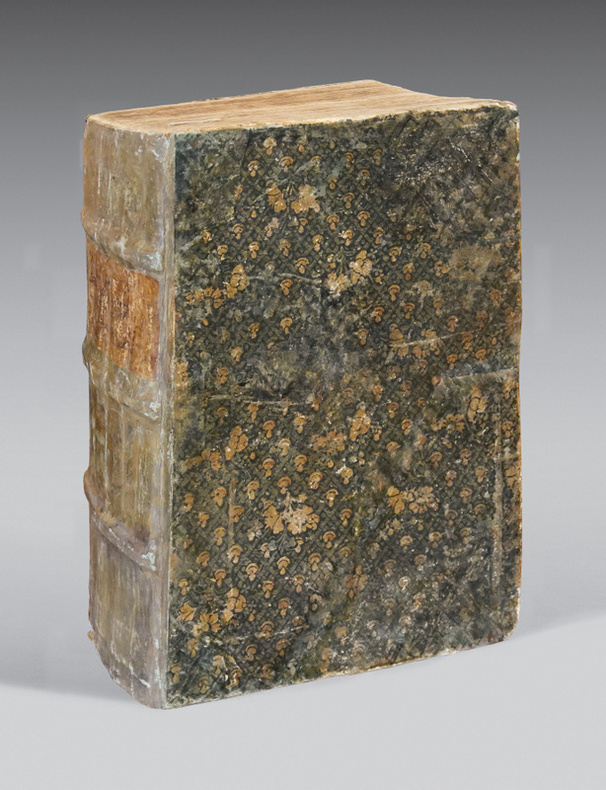
Folio (420 x 280 mm). (4), 101, (1) ff. Later calf with gold- and blind-tooling. First edition of a work on poisons, compiled by Sante Arduino (or Ardoini) of Pesaro. "[T]he elaborate compendium on poisons in eight books which Sante Ardoini of Pesaro compiled in the years, 1424-1426, from Greek, Arabic and Latin works on medicine and nature, and which was printed at Venice in 1492, and at Basel in 1518 and 1562 [...] Although Ardoini quotes previous authors at great length, his work is no mere compilation, since he does not hesitate to disagree with such medical authorities of Peter of Abano and Gentile da Foligno, and refers to his own medical experience or observation of nature at Venice and to what fisherman or collectors of herbs have told him. He also seems to have known Arabic, and his occasional practice of giving the names of herbs in several Italian dialects is of some linguistic value" (Thorndike). Arduino makes extensive use of the works by Avicenna (Ibn Sina), who "held a high place in Western European medical studies, ranking together with Hippocrates and Galen as an acknowledged authority" (Weisser). Among the numerous other sources he used are Galen, Avenzoar (Ibn Zuhr), Rasis (al-Razi), Andromachus, Albucasis (Al-Zahrawi), Serapion the Younger and Dioscorides. - A very good copy, with only a few marginal waterstains. Binding slightly rubbed along the extremities and with a few scratches on boards. Hain-Copinger 1554. Goff A-950. Ohly-Sack 233. Walsh 2186. Proctor 4963. BMC V, 403. GW 2318. Thorndike III, 545. ISTC ia00950000.
Large 8vo (146 x 238 mm). Arabic manuscript on polished oriental paper. 865 pp. (paginated in a later hand), 25 lines, per extensum. Black ink with red underlinings and emphases. With numerous diagrams in the text. Contemporary blindstamped full calf, restored and spine rebacked. A rare, complete, and well-preserved late 16th century manuscript of Al-Birjandi's "Sharh al-Tadhkirah", a commentary on the "Tadhkira", the memoir of the Persian polymath at-Tusi (1201-74). As consistent with the Islamic tradition of commentary, Al-Birjandi provides explanations for the reader and provides alternative views while assessing the viewpoints of predecessors. - Abd Ali ibn Muhammad ibn Husayn Birjandi (d. 1528) was a prominent Persian astronomer, mathematician and physicist from Birjand. A pupil of Mansur ibn Muin al-Din al-Kashi, of the Ulugh Beg Observatory, he anticipated notions later developed by Galileo Galilei in the West. - Copied by the scribe Abd al-Wahhab bin Mawlana Baha al-Din. Somewhat browned throughout; some waterstaining to lower half, more pronounced near the end of the volume. The text illustrations show sections, celestial spheres and other astronomical and mathematical diagrams. Old waqf stamp to first leaf. Restored binding uses original cover material.
60 photographs on albumen paper, measuring 28 x 22 cm each, signed and captioned in the plate, numbered 1 through 68. Contemporary green half calf with gilt spine and title "Égypte & Nubie", initialed "B.C.D." on first plate. Large and beautiful photographs by Bechard: excellent vintage prints, mostly in superior condition. They represent the popular Egyptian and Nubian types, frequently in close-ups. Nissan N. Perez states that this part of the work of a photographer specializing in views of sites and monuments "has escaped general attention" (cf. Focus East, p. 123, reproducing the photograph of water carriers resting). Includes: a scribe; a sheikh reading the Qur'an, merchants and grocers, a group of ulemas (religious scholars) reading the Qur'an, an Arab drawing water, whirling dervishes, Arab peasants (a fellah carrying water), a sheikh going to the mosque, a game of Mangala, water carriers, mat manufacturers, Sheikh Sadad, a descendant of Mohammed, a falconer, washerwomen, an Arabic singer, a young fellah, a Darabouka player, labourers, a public fountain, a beggar, Arabs at prayer, Arabic coffee, etc. - Béchard was active between 1869 and ca. 1890. "His work is distinguished by the superb quality of his prints and the generally spectacular presentation of even the most common sites, such as the pyramids. His studies of people and costumes are even more interesting and point to a very personal involvement of the photographer in the life and customs of the country. His cityscapes and urban scenes were mostly taken from unusual angles in an attempt to cope with the narrow and confined spaces" (Nissan N. Perez). - Binding repaired in places.
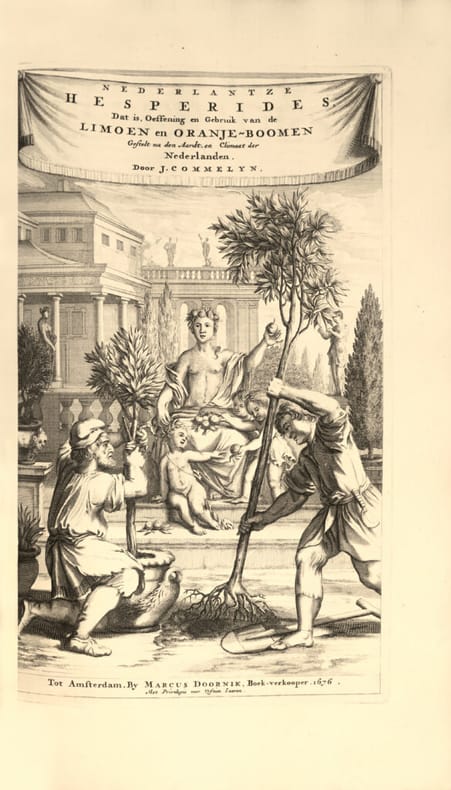
LCS-18440En séduisantes reliure hollandaise de l’époque au chiffre couronné. Amsterdam, Marcus Doornick, [1676]. - [Relié avec :] Commelyn, Johannes. Nederlantze hesperides, Dat is, Oeffening en Gebruik van de Limoen en Oranje-Boomen Geftelt na den Aardt, en Climaat der Nederlanden. Amsterdam, Marcus Doornick, 1676. 2 ouvrages en 1 volume in-folio de: I/ 1 frontispice, (2) ff., 144 pp. (1) f., pp. 145 à 224, 31 planches hors-texte dont 4 remontées; II/ 1 frontispice, (2) ff., 47 pp., (2) pp., 26 planches hors-texte. Veau fauve moucheté, double encadrement de filet or, large chiffre couronné frappé à froid sur les plats, dos à nerfs ornés de fleurons dorés, pièce de titre de maroquin rouge, tanches jaspées. Reliure hollandaise de l’époque. 358 x 215 mm.
LCS-785Très rare édition originale de cet ouvrage « précieux pour l’histoire de Mexico ». Mexico, 1637. Mexico, Francisco Salbago, 1637. 4 parties reliées en 1 volume in-folio de (2) ff., 31 ff., 41 ff. (chiffrés par erreur 42), 41 ff. chiffrés 1 à 28 puis 29 à 39 (les ff. 17-18 sont répétés), (1) f., 11 ff. Exemplaire complet. Relié en veau brun, dos lisse orné, gardes renouvelées, tranches rouges. Charnières frottées. Reliure de l’époque.278 x 196 mm.
LCS-18075Paris, 1821-1825. Paris, Lefèvre, 1821-1825. 30 volumes in-8. Un portrait de Cicéron en frontispice. Maroquin rouge à long grain de Simier, trois volumes (1-2 et 30) signés « Simier. R. du roi », plats ornés d’un riche encadrement composé de filets dorés et de roulettes dorées et à froid avec fleurons d’angle, aux armes de Marie-Caroline de Bourbon-Sicile, Duchesse de Berry (1798-1870) au centre des plats, (Olivier 2554 fer n° 2), dos à nerfs abondamment ornés de motifs dorés et à froid, roulette dorée sur les coupes, grecque intérieure dorée, tranches dorées. Reliures armoriées de l’époque signées de Simier, relieur du roi. 223 x 140 mm.
Large folio. 12 leaves (22 x 16 inches), each containing a large mounted albumen photograph (ca. 12 x 10 inches) with descriptive letterpress beneath. Original leather-backed marbled boards with gilt-lettered roan label on front cover and leaf of printed introductory text mounted to inside front board. Skilfully rebacked and recornered. Small, unobtrusive 19th century embossed library stamp at lower right blank corner of each mount, minor wear at board extremities and chipping at edge of front endpaper, else an unusually clean and nice copy, with the photographic plates in perfect condition. An extremely rare photographic work, unrecorded in the major scholarly studies of early photography in the Holy Land. - According to the introductory text, "In the winter of 1859 the King of Prussia sent an artist to the Holy Land to procure views for his portfolio. Having reached Jerusalem, whilst the Royal commission was being executed, I was so fortunate as to secure (through the courtesy of Right Reverend Samuel Gobat, of the Anglican and Prussian mission) fine impressions from the most valuable of these negatives [...] they are now published, at the request of many persons [...]". Eccleston was an Anglican minister in Newark, New Jersey. - A gilt frame surrounds each photograph, beneath which is the title of the plate and two columns of letterpress text within a decorative type-ornament border. The titles of the plates are: Garden of Gethsemane; Damascus Gate; Jew's Waling Place; Church of Holy Sepulchre; Mosk El-Aksa / Solomon's Bridge; Valley of the Son of Hinnom; St. Stephen's Gate; Golden Gate; Top View of Jerusalem; Bethany; Via Dolorosa and Ecce Homo Arch; Mount Moriah and the Mosque of Omar. - We have been unable to identify the photographer, as the work is unrecorded by the leading authorities on early photography in the Holy Land, and the photographs themselves do not appear in any of the other known photographic albums of the period. Both Eyal Onne, "Photographic Heritage of the Holy Land 1839-1914" (Manchester 1980), and Yeshayahu Nir, "The Bible and the Image" (Philadelphia 1985), record in considerable detail the early missions to the Holy Land and the photographers who either accompanied these missions or who were living in the Holy Land and were retained by the missions. In neither work is the king of Prussia's mission recorded, nor is "Jerusalem Photographic Album" recorded in either bibliography of early photographic works on the Holy Land. Similarly, the recent book, "Revealing the Holy Land: The Photographic Exploration of Palestine" by Kathleen Stewart Howe (1997) records neither Eccleston's book nor these photographs. - Though seemingly unknown to scholars working in the field, two copies of Eccleston's book are indeed known: the NUC and RLIN both record one copy, at Yale, and OCLC locates a second copy at the University of Texas. Our copy was given by Eccleston, probably soon after publication, to his local library company; in the 1880s the library company was absorbed by a newly-created public library, from which it was purchased.
Engraved map on two sheets, joined. 440 x 600 mm. Framed (84:67,5 cm). Rare. Based on the large mural map of Giacomo Gastaldi in the Palazzo Ducale in Venice, in 1550, considered the culmination of his work on the cartography of Africa through the 1540s. (The mural was subsequently lost to overpainting.) Shows the continent with southern Europe and Arabia; large strapwork dedication cartouche to Thomaso Ravenna at lower left; compass rose centre right. Trimmed to the outer neat lines; some wear and repairs to old folds, with loss of a few letters of the dedication. Two small areas of sea supplied in pen facsimile. Faint spotting, a pale uneven wash. Tibbetts p. 47, 31. Not in Sultan bin M. Al-Qasimi, The Gulf in Historic Maps (1st or 2nd ed.).
Oblong large folio (570 x 419 mm). Lithographed illustrated title, 2 ff. of text, 16 mostly coloured lithogr. plates showing horses (c. 33 x 45 cm, paper dimensions c. 40 x 55 cm; some with borders), 5 (instead of 6) ff. of descriptive letterpress text (the missing page supplied in ink). Contemporary half calf with giltstamped spine label. Extremely rare and early series of lithographs. The large and appealingly coloured plates depict important stallions and mares from the famous Danish Royal Stud at Frederiksborg (Pegasus, Flink, Zephir, Palnatoke, and Velskat, among others). All horses are branded with a monogram and often also with the crown. The publication was originally planned to comprise 12 issues of 4 plates each but no more than the first four were produced. - Two plates are trimmed and mounted on different backing paper (one with a repaired tear). Text shows foxing, but plates are generally clean. Binding somewhat rubbed and bumped at extremeties, with damage to spine. Nissen 1499. Not in Schwerdt or Mennessier de la Lance.
LCS-18010Édition originale ornée de 141 bois gravés entièrement coloriés à la main en 1522, dont le portrait à pleine page de Geyler, 40 bois à pleine page et 100 bois dans le texte. Strasbourg , J. Schott, 1522. In-folio, car. goth., 35 ff. (sur 37) ornés de 6 grands bois à pleine page; 118 ff. ornés d’1 bois gravé à pleine page ; (28) ff. (sur 29) ornés de 18 grands bois à pleine page ; 110 ff. ornés de 6 grands bois à pleine page ; 41 ff. (sur 42, manque le f. 38) ornés de 9 bois à pleine page. Port. sur bois au titre, attribué à Wechtelin. [Postille sur les quatre évangiles pour toute l’année, le carême et les fêtes de quelques saints.] Manque les feuillets xv-xvi de la 1ere partie, a1 de la 3e partie, xxxviii, soit 332 feuillets sur 336. Principales déchirures : page de titre de la 2e partie déchirée, une demi-page de texte manquante au feuillet lxiii, déchirure avec manque aux ff. C6 et E2 partie 2. Demi-vélin à nerfs, plats cartonnés décorés. Reliure de l’époque. 282 x 192 mm.
Folio (310 x 220 mm). (46) ff., one final blank. Rubricated in red throughout and about half of the spaces left for initials filled in red by hand. 19th century red sheepskin, marbled sides. First edition of the popular "Imago mundi" of Honorius Augustodunensis (1080-1154), an incunabular encyclopaedia of popular cosmology and geography combined with a chronicle of world history, containing references to Arabia, Syria, Palestine, and the Saracens and thus providing one of the earliest mentions of Arabia ever printed. The monk Honorius takes the river Nile as the boundary between Africa and Asia (naming the latter continent in its entirety "India"). Arabia is described in the subsection on Mesopotamia. The description of this country, found along the Tigris and the Euphrates, also includes an account of the Kingdom of Sheba, home of the Queen of Sheba, and is said to be inhabited by the Moabites, Syrians, Saracens and others. After Mesopotamia we find Syria, including Phoenicia, which is followed by sections on Palestine and Egypt. - The "Imago mundi", which by scholarly consent was not published after 5 February 1473, exemplified the picture of Africa and the Orient prevalent in the West ca. 1100, which were perceived as lands full of marvels. It is one of the five earliest books printed by the great and prolific Nuremberg printer Anton Koberger. - Binding slightly rubbed; a few early manuscript annotations by a near-contemporary humanist in the margins. From the library of the Frankfurt physician Georg Franz Burkhard Kloß (1787-1854), also a noted historian of freemasonry, with his bookplate on pastedown; additional bookplate of Jean R. Perrette. Lacking the second of the two last blank leaves. A few wormholes, a couple of leaves attached to stubs, but otherwise in very good condition. Hain 8800. Goff H-323. GW 12942. BMC II, 411. Proctor 1974. Panzer II, 234.342. ISTC IH00323000. Not in Atabey or Blackmer.
8vo (145 x 204 mm). Two treatises bound together: the first in Persian with occasional captions in Arabic, the second in Arabic. Manuscript on polished paper. 45 ff., 18-22 lines. Nastaliq and naskh script in black and red, written space ruled in red and blue, with numerous charts in red, blue, and black and chart headers in blue woodblock print. Folio 10 features moveable slips to complement a chart. 19th century full leather over wooden boards, covers decorated with lacquered gold leaf and illustrated with an astrolabe quadrant; top edge of upper cover recessed at the centre; a flower-shaped inlay to the upper cover is lost. Finely rendered and beautifully bound work on astronomy and timekeeping by Haji Mirza Muhammad Karim Khan-i-Kirmani (1810-73). Karmani was a Shaykhi-Shia scholar, a distant cousin to Fath 'Ali Shah Qajar (1769-1834), and a 19th century polymath with mastery of a whole field of Islamic and philosophical sciences, including alchemy, medicine, optics and music. - The first treatise presented here is "Khulasa al-taqwim", a calendar summary in the form of tables for ikhtiyarat, or selections: it thus guides the reader through the selection of auspicious moments in a given day, the station of the moon and the zodiac in the heavens, and describes the solar and lunar calendars, the hours of the day and night, and knowledge of horoscopes. - The second is "Risala al-Mizan", which focuses on the use and construction of astrolabes. Karmani had a particularly keen interest in the engineering behind the astrolabe, a distinctly Muslim invention which is perhaps the greatest technical triumph of the mediaeval world. Indeed, Karmani went on to invent his own version of the astrolabe. Both calendrical knowledge and astrolabe engineering require keen mathematical and geometric knowledge, the study of which is aided by the numerous and often complex charts made available to the reader throughout. One such chart features two movable slips, still fully intact and functional, which practitioners may slide up and down to match up with the chart and aid their calculations. The binding on this volume is particularly striking, as it is illustrated with diagrams of astrolabe quadrants on a field of glittering copper leaf. - Light wear to covers, slightly delicate binding. A well-preserved and uncommonly early copy of Kirmani's astronomical writings. The only comparable manuscript copy to have appeared on the market is a later specimen in a very similar binding, dating from 1312 H/1895 CE, which sold at Christie's (Art of the Islamic and Indian Worlds Sale, 27 April 2017, lot 16), commanding £21,250.
Large folio. 2 vols. in one. (26), VIII, 132 pp. (4), XX, 144 pp. With coloured engraved title-page (dated 1754), large engraved vignette by Andreas Hoffer after Gottfried Eichler, and 91 (1 folding) coloured or colour-printed engravings by Knorr, J. A. Eisenmann, A. Hoffer and others. Contemporary calfskin binding gilt. First edition of this monumental work of natural history, one of the most splendid zoological works ever produced in Nuremberg. Begun by Knorr as early as 1751, it was continued by his heirs after his death in 1761. The book describes items from the great contemporary natural history collections, including the magnificent white falcon (with hood) from the collection of the famous physician and botanist Christoph Jakob Trew. The illustrations, occasionally printed in colours but mostly hand-coloured in radiant hues, depict birds, exotic mammals, fishes, corals, butterflies and other insects. - Occasional insignificant waterstaining to the wide blank margins of the text; a few plates show unobtrusive fingerstaining. A beautiful, very wide-margined copy in excellent state of preservation, printed on good, strong paper. Plates show clean, distinct colours and superior contrast. Nissen, ZBI 2227. Horn/Schenkling 12038. Hagen I, 426. Dean I, 696. Graesse IV, 35.
Imperial folio (420 x 596 mm). (8), 87, (1) pp. With large lithographed title vignette and coat of arms of Wilhelm II on dedication leaf. 69 lithographed plates, maps and plans after Laborde and Linant de Bellefonds, mostly mounted on India paper (3 of which folding or double-page and 1 coloured). Period-style half calf with gilt title to spine. First edition of "an important work" (Blackmer), complete with all the magnificent views in large folio format. All subsequent editions, including the English one, were published in octavo and retained only a few plates of the original edition, all in considerably reduced format. Laborde made the journey to Petra with the engineer Linant de Bellefonds in 1828, travelling from Suez via St. Catherine's and through Wadi al-Araba to Akabah. Although Burckhardt, Irby and Mangles had explored Petra before Laborde, he was the first to make detailed drawings of the area. Dedicated to the Elector Wilhelm II of Hesse (1777-1847). - Slight browning and foxing, occasional waterstaining and tears to folds; a small tear in the map repaired, but in all a good, wide-margined copy. Rare: the last complete copy came up for auction in 2009 (Christie's, 3 June, lot 120: £23,750). Blackmer 929. Gay 929. Henze III, 101. Brunet III, 714. Vicaire IV, 758f. Nissen ZBI, 2335. Not in Atabey. Cf. Macro, Bibliography of the Arabian Peninsula, 1386 (2nd ed. only). Howgego 335, L2 (1830-33 ed.).
8vo. 13 pp. on blue squared paper, written on rectos only. A long, unpublished manuscript recounting the horrors of the "Semaine sanglante" of May 21st through 28th, 1871, which saw the defeat and collapse of the revolutionary government of Paris. Originally drafted as a preface to a never-published sequel volume to Lachâtre's 1870 "Nouvelle encyclopédie nationale", what the author conceived as an apology for the book's long delay constitutes a powerful first-hand account of the "Bloody Week" and of his own persecution. The manuscript is written in a scribal hand but is extensively revised in Lachâtre's own, characteristically graceful handwriting, showing his deletions, insertions and various textual changes on almost every page. Lachâtre describes the Communards' heroic resistance, in which women fought on the barricades alongside their husbands, brothers and sons against the vastly more numerous and better equipped army. He deplores the atrocities which the Communards, too, committed in their desperation (such as the execution of no fewer than 123 clergymen and gendarmes who had been taken hostage), but his emphasis is clearly on the indiscriminate, ruthless cruelty with which the invading soldiers slaughtered men, women and children, the decrepit and infants alike, if they suspected them of any connection at all with the Commune: "Les Versaillais massacrent, fusillent, percent de leurs sabres - baïonnettes et par milliers tous ceux qui leur tombent sous leur main, innocents ou coupables, hommes et femmes, enfants et vieillards; la vapeur du sang les énivre, la soif de la vengeance les pousse à chercher de nouvelles victimes; ils parcourent les rues, envahissent les maisons, fouillent les demeures des citoyens, arrachent de leur lit les malades, tuent tous ceux qu'ils soupçonnent avoir été partisans de la Commune [...] Ceux là sont conduits par files innombrables, prisonniers de tous les âges, hommes et femmes, des mères tenant de petits enfants par la main, quelques unes allaitant un nouveau-né; ces longues files de victimes enchaînées vont s'engouffrer dans les cours des casernes dont les portes se referment avec un bruit lugubre, et où toutes sont massacrées, toutes, jusqu'à la dernière!!!" - Lachâtre himself barely escaped into hiding before a platoon of soldiers arrived looking for him and his associate Félix Pyat (1810-89), with whom he had published the radical papers "Le Combat" and "Le Vengeur": "Se décida à abondonner la place, laissant chez lui deux femmes, deux jeunes filles dont une de dix ans à peine, son enfant. Dans la maison se trouvait également le caissier de la librairie, M. Profilet, vieillard inoffensif, qui jamais ne s’était occupé de politique [...] On était au mercredi, 22 mai! Vers les deux heures de l’après-midi, moins d’une demi-heure après le départ du citoyen Maurice La Châtre, la maison est envahie par une troupe de soldats [...] Après une heure de mortelles angoisses pour le pauvre caissier, il est lui-même emmené prisonnier! Mr. Profilet était porteur d’une montre en or avec sa chaîne, et d’une somme de 400 fr en pièces d’or, quand il fut enlevé de sa maison… Où fut-il conduit par les soldats de 55e de ligne? Quel a été le sort réservé à ce vieillard inoffensif, absolument innocent de tout acte insurrectionnel? C’est ce que ni sa famille, ni ses amis n’ont jamais su! [...] Nous vous devions le récit de ces évènements, chers lecteurs [...] A vous, aimables lectrices, à vous, chers lecteurs, amis connus et inconnus, l’auteur adresse de la terre d’exil de salut fraternel". - Slight paper flaws to bottom edge of the final leaf, otherwise very well preserved. At the head of the first page, Lachâtre has inscribed the manuscript to his longtime collaborator Félix Pyat: "Maurice LaChâtre à Félix Pyat". A diplomatic transcription of the full text is available upon request.
8vo. 9 ff., each measuring c. 120 x 90 mm, carefully mounted under mattes bound in calf the late 19th century (with a description of the contents added at the end). In slipcase. A collection of devotional miniatures of outstanding quality, with dedications to countess Maria Anna von Callenberg, née countess Thurn-Valsassina (1721-86), first lady-in-waiting to Empress Elizabeth Christina, mother of Maria Theresa and since 1757 married to general Karl Kurt Reinicke, count Callenberg. Five of the nine miniatures are by daughters of Maria Theresa and Emperor Francis I (thus uniting five out of eight princesses that survived infancy), one by a sister of Maria Theresa, another by the youngest sister of Francis I, yet another by the Imperial couble's daughter-in-law, and one by an unidentified writer. A scholarly study of the album, published in 1999 (cf. the sources below), praises the "outstanding graphic quality" of the miniatures, arguing that they must have been created by "professionally trained artists" (cf. Feldhaus, p. 19). - All inscriptions are in French or German; they include: 1) St. Cajetan (S. Cajetanus Thieneus), 3-line inscription signed by Archduchess Maria Amalia, Duchess of Parma (1746-1804), dated 1769. - 2) Charles Borromeo (S. Carolus Borromaeus), 6-line inscription signed by Archduchess Maria Anna (1718-1744), sister of Maria Theresa, dated 1743. - 3) St. Jerome (S. Hieronimus), 6-line inscription signed by Archduchess Maria Josepha (1751-67), dated 1767. - 4) Mother of Sorrows (Mater Dolorosa), 4-line inscription signed by Princess Anne Charlotte of Lorraine (1714-73), youngest sister of Emperor Francis I; undated. - 5) The Virgin and Child ("Du Königin des guten Raths bitt für uns"), 5-line inscription signed by Maria Theresa's eldest daughter, Archduchess Maria Anna (1738-89), dated 1757. - 6) King Stephen I of Hungary (S. Stephanus Rex Hung.), 5-line inscription signed by Maria Luisa of Spain (1745-1792), Grand Duchess of Tuscany and later Empress as the spouse of Leopold II; dated 1770. - 7) St. Expeditus (S. Expeditus), signed by Archduchess Maria Elisabeth (1743-1808), undated. - 8) St. Aloysius Gonzaga (S. Aloysius Gonzaga S. I.), 3-line inscription signed by Archduchess Marie Antoinette ("Auspice Deo. En regardant cette image souvenez vous toujours chère Callenberg de Votre très affectioner Antoine Archiduchesse"), dated 29 March 1770, but a month before her fateful departure for France. - 9) Man of Sorrows (Wahre Abbildung des schmerzhaften Heilands auf dem S. Stephansfriedhof), 2-line inscription, undated and unsigned, ascribed to Charlotte von Reischach, lady-in-waiting, by the included index (4to, 4 pp.). - Provenance: count Carl Callenberg (d. 1820), son of the recipient of these dedications; by descent to her daughter Henriette, the last countess of Callenberg (1764-1835), married in 1787 to count Johann Mittrowsky (1757-99), army surgeon to count Lássy's Infantry Regiment; by descent to the counts Mittrowsky; later in the library of the Austrian collector and Keeper of the Purse, count Franz Folliot de Crenneville-Poutet (1815-88), with his collection stamp on fol. 1; sold through the Vienna art trade to a Rhenish private collection in 1969. Irmgard Feldhaus, Gemalte Andachtsbilder aus dem Österreichischen Kaiserhaus aus den Jahren 1743-1770, in: Arbeitskreis Bild, Druck, Papier: Tagungsband Kassel 1998. Ed. by Christa Pieske et al. (Münster, Waxmann, 1999), pp. 13-28.
4to (145 x 198 mm). (34) ff. Half calf over marbled overs (ca. 1900) with gold-tooled red label to gilt spine. All edges sprinkled red. Almost unobtainably rare first edition of this digest of medical prescriptions, taken from the works of the highly-regarded Arabic physician Mesue the Younger (also known as Masawaih al-Mardini), including "a kind of general manual for apothecaries and perfumers" (Duveen). All recipes are in Italian, while the main title and the headings are in Latin. Bibliographers are not agreed on the book's place or date of publication: GW locates it merely in Italy, ca. 1495, whereas Copinger believes it was printed in Venice, by an unidentified printer, in or around 1500. The British Museum Short-Title Catalogue suggests Sigismund Mayr in Naples as the printer and 1510 as possible year of publication, while the British Library's catalogue now appears to prefer Venice and 1505 as tentative place and year. Klebs notes that the collection constitutes a "rifacimento" of the Italian edition of Mesue's "Opera medicinalia", published in Venice on 12 December 1493. - Contemporary ink ownership to title-page. A restored tear in the final leaf (not affecting the text), some brown specks on the title-page and an insignificant waterstain along the lower edge of the final gathering, but altogether in excellent condition. Rebound in a pretty half-calf binding around the turn of the century. Only two copies in libraries internationally (British Library and Univ. of Wisconsin, formerly the Duveen copy). That in the British Library is incomplete, lacking the final leaf (falsely described by Copinger as having a final blank leaf, which is in fact the endpaper). Copinger 4011. GW M23031. Klebs 228 (note). Proctor 7427. ISTC im00521400. USTC 842290. BM-STC Italian 739. Duveen 651. Edit 16, CNCE 50479.
Folio (295 x 220 mm). 1 ½ pp. on bifolium. With integral address leaf. Hitherto unknown letter in Italian to the Venetian consul resident in Alexandria, Biagio Dolfin, reporting on the situation of the spice and wine trade. Part of the correspondence between two influential Venetian merchants and trade officials in Egypt, this letter is an illuminating document of the vast Venetian trading network and of the intricacies of trade between the Islamic and Christian worlds. It also highlights the importance of Mecca in the pepper trade via the red sea: "2[mil]a sarano alla Mecha oltra le altre cosse ai tempi scuto fera manda dalla Mecha alla zornada satende ritorno di messo [...]". While spice imports via Mecca and Baghdad (curiously here called Babylon) went ahead more or less according to schedule, the Venetian wine exports to Egypt met greater challenges. Michiel relays a conversation with the nâz'ir al-khâs's (the Sultan's private treasurer) concerning a wine consignment that had been confiscated by Mamluk authorities in the port of Damietta: "I have been in touch with Nadrachas, complaining of what was done at Damietta. He answered me that he was sorry, but nothing can be discussed about wines anywhere. And note this: I replied, there are no wines, but there are things to eat. He said if they belonged to Venetians, he would look after them" (transl.). - The official prohibition on any discussion of the incident and Michiel's attempt to declare the shipment as foodstuff speaks of the criticality of the matter. Wine was tolerated in trade cities like Alexandria but was strictly outlawed in Cairo and other places of worship. The Venetians were permitted to import food and wine free of duty for private use, but as they "imported so much wine that they could hardly declare it to be for their own consumption" and the business was lucrative, problems frequently arose (Christ, p. 169). Since the taxation and regulation of wine imports could not be handled officially due to religious interdictions, the fate of the cargo remains open. The wine might have been poured away so as to suppress illegal trade, embezzled, or even discreetly returned to the Venetians. - The Patrician Angelo Michiel was one of the most senior and important merchants in Alexandria, presiding over the "Council of Twelve" governing the Venetian community in the city. In the summer of 1419 he was officially tasked with a mission to Cairo to gather information regarding the spice trade on behalf of the newly appointed consul Biagio Dolfin (ca. 1370-1420). This intelligence was crucial for the delicate timing of the Venetian imports via the port of Alexandria every autumn. A vast correspondence of at least 31 letters exchanged between 9 August and 26 September 1419 could be reconstructed from the few surviving letters and receipts. The letter at hand, mentioned in a letter from 15 September, adds to only six other preserved letters from the correspondence and has never been published (Christ, pp. 300). - Traces of folds, some browning, stained on the lower right. Three minor and one deeper tear (touching the text) on the lower border. Transcribed in full with English translation. - Provenance: Argyll Etkin Ltd., 48 Conduit St., London (1992), purchased from Christie's Zurich, 17/18 April 1985. G. Christ, Trading Conflicts: Venetian Merchants and Mamluk Officials in Late Medieval Alexandria (Leiden & Boston: Brill, 2012). S. Conermann, Everything is on the Move: The Mamluk Empire as a Node in (Trans-)Regional Networks (V&R unipress, 2014).
(Oblong) 8vo. Altogether 73¾ pp. on 22 bifolia and 1 single sheet. 11 letters in pencil; 2 on mourning paper. 6 with engraved or printed letterhead. With one autograph envelope. Amicable correspondence with her good friend Jessie Lennox (1830-1933), one of the original "Nightingale Nurses" who trained at the Florence Nightingale School at St. Thomas's Hospital in London in the 1860s. Written in the fondest terms and taking great interest in her work, Florence Nightingale rejoices at the progress already made in the nursing profession, asks for advice and discusses at length, over several letters, the ideal role of the matron she wishes to appoint to take over the care of some 500 poor boys in an "industrial boys home". The matron, she writes, should embody the practicalities of a trained nurse with a mother's care for her charges, with an emphasis on good diet, warm clothing and good shoes. She cites the story of Ella Pirrie, the Lady Superintendent of the Union Infirmary at Belfast, who persuaded a child struck dumb to speak by adopting this gentle approach when harsher means had failed. She asks Lennox's advice in drawing up a set of requirements to put forward as clearly as possible to the "man committee": "This [...] is a difficulty because the man-Committee does not seem to think a woman has any business in the Barrack huts at all [...] In fact I do not expect to get her at all [...]" (11 April 1887). Her frustration with such committees is evident, even for an influential person such as herself, but she recognizes the enormous progress that has already been made in changing the status of nursing into a highly trained respectable profession. She goes on to discuss the tasks of the district nurse and her ability to become a role model: "The work of the District Nurses is truly not only to nurse, but to teach the families how to nurse […] to know to what charity or authority to apply, to get flannels, sick comforts, food & stimulants, where ordered - sick appliances, bedding, warm clothing, where imperatively needed [...] do not you think that these things had better not be given by the District Nurse herself. For where alms-giving, clothes-giving [...] is practiced by the nurse, real nursing flies out of the window [...] if the nurse has really that influence which she ought to have in the Patient's family, do they not become ashamed of letting her see the man or the woman drunk again? And does not that exercise a reforming influence? [...]" (23 May 1889). - The collection includes a facsimile letter dated May 1900 addressed to all her nurses ("My dear children") in which she recognizes her role as the Mother of Nursing and speaks of advances in medicine and the professionalisation of nursing, ending however with a swipe at the suffragists: "You have called me your mother-chief, it is an honour to me & a great honour, to call you my children [...] Woman was the home drudge. Now she is the teacher. Let her not forfeit it by being the arrogant - the 'Equal with men' [...]". - Enclosed is an ALS by Jessie Lennox to Dr Lilias Maclay (b.1893), discussing a letter Lennox gave to Maclay seven years after the death of Florence Nightingale: "This one was written when Miss Florence Nightingale was quite an old lady, when her hand was not very steady. The writing in the early ones is much stronger [...] her body is at rest but her work is still very much with us [...]" (Edinburgh, 21 Dec. 1917). With autograph envelope. Maclay had enrolled at Glasgow University to study for a medical degree in 1912, passing the course with first class certificates in clinical surgery. During WWI she served with the Royal Army Medical Corps in Egypt and is one of the few females featured in the University's Roll of Honour. After her marriage to John Edmund Hamilton in 1926 she practised as a doctor in Glasgow and Edinburgh. - Further includes a typescript solicitor's letter, confirming that a total of 16 letters by Florence Nightingale were bequeathed to Dr Maclay after Lennox's death in 1933. - An extraordinarily well-preserved set.
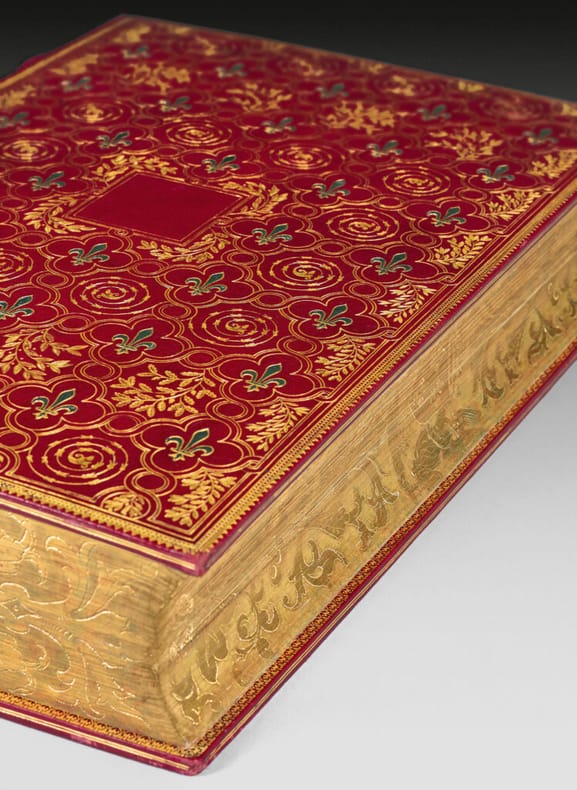
LCS-18623Outre leur remarquable intérêt iconographique, les grandes Chroniques de France présentent un intérêt capital pour l'histoire littéraire, linguistique et fondatrice de la nation française. Paris, G. Eustace / F. Regnault, 1514 : Le premier (second, tiers) volume des grans chroniqs de France. Nouuellement imprimees à Paris. Auecques plusieurs incidences suruenues durant les regnes des trefchreftiens roys de France tant es royaumes dytallie Dalmaigne Dāgleterre Despaigne Hongrie Jherusalem Escoce Turquie Flandres et autres lieux circonuoisins. Auecques La Cronique frere Robert Gaguin contenue a la cronique Martinienne. Ilz se vendent a paris en la rue neufue noftre dame a lenfeigne de agnus dei. (In fine vol III:) Imprimees a paris Lan mil cinq cens et quatorze le premier iour de octobre pour guillaume eustace libraire du Roy... In-folio. I/ (6) ff., 206 ff. chiff. 204; II/ (8) ff., 189 ff. chiff. 199 ; III/ (12) ff., 276 ff. Bâtarde, à double colonne de 50 lignes à la page et titre courant. Maroquin rouge, plats entièrement ornés d'un riche décor à la fanfare composé de compartiments quadrilobés répartis régulièrement, chacun orné d'une fleur de lys de maroquin bleu, compartiment central carré vide, doublure de maroquin bleu entièrement ornée d’un semé de fleurs de lys dorées, au centre l’écu royal aux fleurs de lys de maroquin rouge, tranches dorées sur marbrure et richement ciselées. Lortic. 304 x 204 mm.
Double Crown folio (48 x 36.5 cm). [37] ff. including title-leaf and 7 blanks, plus 16 loosely inserted ff. Album containing 42 pencil and other drawings (a few partly coloured) and 3 squeezes, some on the album leaves and some loosely inserted, mostly of ancient Egyptian and Nubian architecture, sculpture, bas-reliefs and hieroglyphic inscriptions, but also with a few botanical drawings and landscapes with buildings. Most have English-language captions in brown ink and are signed and dated 1838 to 1839. New black half morocco, on recessed cords, title and double fillets in gold on spine, using mid-19th-century marbled paper for the sides (blue-green Spanish-marble with black and white veins). An album of drawings (and squeezes of bas reliefs) made by William Robertson on a journey from Cairo in December 1838 down the Nile into Nubia, reaching as far south as the present-day Egyptian-Sudanese border region, including the temples of Abu Simbel, in January 1839, then returning via Philae, Karnak and other sites to Thebes in February 1839. They give very detailed views of numerous buildings, sculptures, bas-reliefs and hieroglyphic inscriptions, as well as more distant views of landscapes with buildings and three botanical drawings. While Robertson made most of his drawings on site, he drew the Temple at Luxor after a drawing by Achille Émile Prisse d'Avennes (1807-1879) who began exploring and drawing the ancient Egyptian sites in 1836 and published many of his drawings in 1847. The squeezes of bas-reliefs are of special interest, for they preserve a very precise record of the original with little influence from personal interpretation: the paper was wetted, pressed into the relief and allowed to dry. In addition to the three clear squeezes, a couple of the drawings also seem to have been made on flattened squeezes (some of those that survive as squeezes also have some lines drawn over them them). Since many of the ancient Egyptian sites have been looted and damaged over the years, these early drawings and squeezes provide an important record of what was there in 1838/39 and how it was situated, before the first photographs were made. The building of the old Aswan dam in 1902 caused frequent flooding and damage at the site of Philae, now an island, and most of its treasures were removed before completion of the new Aswan dam in 1970. The album has no true title-page, but the leaf before the first drawing has a slip pasted to it giving the name of the artist, dated from Cairo, December 1838. We have not identified the artist. The clergyman and historian William Robertson and his son of the same name died before 1838 and the archaeologist William Robertson Smith was not born until 1846. Thieme & Becker notes two artists named William Robertson, active two or three decades before and after the present drawings, but provides so little information that we cannot link them to either. He may possibly be the Irish-born London architect William Robertson (1770-1850), who took an early interest in Egyptian revival, but he would have been nearly seventy when these drawings were made. The loosely inserted drawings and squeezes are made on at least 8 different paper stocks, wove and laid, one of the wove stocks machine-made (the "watermark" left by the papermaking machine's belt seam appears in one sheet). A few of the original album leaves are now detached and may have been removed by the artist himself. The squeezes have inevitably been flattened in the album, but they still show the contours of the original bas-reliefs very clearly. One inserted drawing is severely foxed and one inserted floor plan is rather dirty, but in general the drawings are in very good condition. A detailed graphic record of ancient Egyptian art, architecture and hieroglyphic inscriptions, made before many of the worst depredations.
Folio (335 x 432 mm). 3 ff. of letterpress matter (half-title, title and list of plates). With 40 mounted calotypes. Contemporary marbled half morocco on five raised bands with giltstamped spine title; marbled endpapers. Second, "better known" (Parr/Badger) edition of this pioneering work, first published in 1854: only the plate volume with the 40 magnificent calotypes, wanting the separately published 90 pages of text. - Wishing to support L. F. J. Caignant de Saulcy in the controversy concerning the dating of the wall of Jerusalem that followed his journey to the Dead Sea, Auguste Salzmann set out for the Holy Land on 12 December 1853. With the help of his assistant Durheim, he prepared some two hundred waxed-paper negatives of the Jerusalem monuments during his four-month stay. While his findings were first published in a monumental volume in 1854 (the copy of the Duke de Luynes commanded 463,500 Euros at Sotheby's Paris in 2013), the present reduced edition, with prints by Blanquart-Evrard, is better known. "It was an expensive book, a livraison, or fasicle of three prints costing 24 gold francs. A single print was 10 francs [...] Salzmann was acutely attentive to both patina and pattern in attempting to define the architectural strata of a city in which building was built upon building, thus leaving a vertical record of the various cultures that had occupied the city and left their remains on the foundations built by earlier conquerors [...] Salzmann himself described his pictures as having 'a conclusive brutality', but to modern eyes their poetic aspect seems paramount. It would appear that Salzmann was at one and the same time both expert and layman, dispassionate observer and enthusiast. His pictures have this dual quality, flickering rapidly between documentary and poetry. This, one might suggest, is the ideal goal for any photographer". - Binding slightly rubbed and chafed in places. Marginal foxing throughout, affecting only a few photographs; insignificant waterstain to edge; old ownerships erased from title, leaving slight traces. Parr/Badger, The Photobook I, 25. Tobler 181f. Röhricht 440f. Baier, Geschichte der Fotografie 452f. Gernsheim, History of Photography 186. Witkin/London, Photograph Collector's Guide 86f.
2 vols. of text (4to) and one volume of plates (folio, 284 x 378 mm). Text: XXIII, (1), 228, (2) pp. With 3 genealogical tables and 2 folding maps. XVIII, 397, (1) pp. Half calf with gilt-stamped morocco label to spine. Atlas: 4 chromolithogr. plates (conjoined as 2), 6 (1 double-sized) toned lithogr. plates, and 65 mounted photographs on a total of 40 plates; 1 letterpress leaf of contents. Cloth portfolio with gilt cover title. Remarkable set, rarely encountered complete with the plates volume. The Dutch orientalist Snouck spent a year in Mecca and Jeddah during 1884/85 and was married to a Mecca woman. He was the first non-Muslim to visit the city outside the annual pilgrimage. The photographs, taken by himself and an Arabic physician, are among the earliest to show Mecca and its pilgrims. - Very nicely rebound, in matching period style portfolio and half calf. An unusually crisp and clean copy throughout: text volumes spotless; the plates with the vintage photographs, much sought after as the earliest photographic documents of the city, its dignitaries and its pilgrims, are backed on thin linen and preserved in perfect condition. Macro 1239 (omitting mention of the Atlas). Henze V, 177. Dinse 443.
4to (175 x 263 mm). Black-brown ink on paper. 1 p. with integral address panel to verso. Stored in custom-made half morocco case. An early 15th century letter from a Venetian merchant based at Homs, a strategic trade centre of the ancient China Silk Road, to his brother Donato Soranzo (Donatus Supantius) in Tripoli, followed by a post-scriptum message from Marco Polo, probably a descendant of the famous traveller. - Both the letter and post-scriptum concern goods to be shipped to Tripoli (and thence to Venice): "cotoni de Hama" (cotton from the namesake Syrian city), silk (also with arabesque patterns), and a specific pigment for cloth-dying, "lume di rocca," produced in the Syrian town of Edessa. An important terminus of the Ancient China Silk Road, Homs is the only natural gateway from the Mediterranean coast to the interior. Homs was the third Syrian station on the Silk Road, after Dura Europos and Palmyra. Homs was particularly well known for silk and wool weaving, especially the alaja, which was mottled muslin run through with gold threads and used in feminine apparel. This silk was exported as far as the Ottoman capital Istanbul. - The addressee, Donato Soranzo, was one of the Serenissima's most important merchants of his time. Established in 1400, the "fraterna Soranzo", an association between four brothers of whim he was the eldest, was heavily involved in the cotton trade between Venice and Syria. Their ledgers, preserved in Venice, are famous for being the earliest recorded instances of the double-entry bookkeeping system. The author of the letter calls Donato his "dear brother" and signs himself "Lorenzo, your kinsman". He was Lorenzo Soranzo, the youngest. - A Marco Polo, probably a great-nephew of the namesake traveller, is recorded among the Venetian merchants based in Hama, doing business with the Soranzos. He was probably Marco, son of Maffeo, son of Marcolino, of the San Giovanni Grisostomo branch of the Polo family - the last male heir, who died circa 1417. - A handful of scattered small holes affecting a few letters, traces of horizontal and vertical folds. Slight soiling to verso, minimal toning, otherwise in very good condition. A remarkable ephemeral witness to the commercial pre-eminence of Venice circa 1400, and its connection to the ongoing silk and textiles trade of the Ancient China Silk Road. Cf. Jong-Kuk Nam, Le commerce du coton en Méditerranée à la fin du Moyen Age (Leiden, 2007). M. Ryabova, "The Account Books of the Soranzo Fraterna (Venice 1406-1434)", in: Accounting Historians Journal 45 (2018), 1-27. A. C. Moule & P. Pellicot, The Description of the World (London, 1938).
8vo. 15 black and white photographs captioned in white, plus one repeat in a smaller print. Original board album, acquired from "M. Arthur, Beyrouth". Paper label to upper cover: "Arab Types. Syria". Small but fascinating collection of portrait photographs showing Arabian nobles as well as commoners, all captioned and the subject often identified by name and tribe. The photos, many of which are executed as highly expressive profile studies, were taken and assembled by Lt. Col. Walter Francis Stirling (1880-1958), Chief of Staff to T. E. Lawrence. While the present photographs were taken during his time with Lawrence, whom Stirling revered, it is not his British comrades but rather the striking features of the sheikhs and bedouins on which this collection is focused. Among the images are "Sheik Gawaileh of Nejd, one of Lawrence's Bodyguard", and "Sheikh Hamondi, Friend of Lawrence"; others are more ominously identified as "Yezidi Shepherd, Devil worshipper" or "Bad type of Hadadiyim Tribesman". Of many noble tribesmen here depicted, such as Fauraz ibn Sha'laan, Emir of the Ruwalla, or Sheikh Daham al-Hadi, Paramount Sheikh of the Shammar tribe, these probably constitute the only photographic record. - Stirling was trained at Sandhurst and served in the Transvaal operation during the Boer War before being seconded to the Egyptian Army in 1906. He spent five years patrolling with an Arab battalion on the Eritrean and Abyssinian borders. Throughout WWI he served at Gallipoli and the Palestinian campaign until he was appointed chief staff officer to Lawrence of Arabia, who called him "Stirling the imperturbable". In 1937, Stirling would reflect on his famous wartime comrade: "From then [early 1918] throughout the final phase of the Arab revolt on till the capture of Damascus, I worked, travelled, and fought alongside Lawrence [...] We sensed that we were serving with a man immeasurably our superior [...] In my considered opinion, Lawrence was the greatest genius whom England has produced in the last two centuries [...] If ever a genius, a scholar, an artist, and an imp of Shaitan were rolled into one personality, it was Lawrence." In 1919 Stirling became advisor to Emir Feisal and Deputy Political Officer in Cairo, then acting governor of Sinai and Governor of the Jaffa district in Palestine before moving to Albania in 1923 to take up a position advising and assisting in the reorganisation of the Albanian Ministry of the Interior.