119 839 résultats
3 vols., 8vo., First Edition, with plates and maps; handsomely bound in full crushed morocco (blue/red/green respectively), sides with gilt frame borders, backs with raised bands, second and fourth compartments lettered and ruled in gilt, all other compartments tooled in gilt, gilt tops, hand-made endpapers, ribbon markers, an elegant set ideal as gift or for presentation. A PRESENTATION SET FROM THE AUTHOR TO SIR ARCHIBALD JAMES, WITH THE FORMER'S WARM SIGNED HOLOGRAPH INSCRIPTION ON TITLE OF FIRST VOLUME. James has subsequently annotated the title with two or three notes. A UNIQUE SET OF A SCARCE AND IMPORTANT BIOGRAPHY WITH OUTSTANDING PROVENANCE.
P., Grancher, 1994. In-8 broché, 250 pages, avec quelques illustrations.
186058334(London, War Office, 1860-70). All of the large maps are lithographed (one signed ""lith. James Ferguson"") with positions in colour. The measures given are paper sizes, comprising: 1. Movements of the two Armies after the Repulse of Marshal Massena's Attack upon the Position of Busaco. (68 x 82 cm.).- 2. Battle of Talevera de la Reyna fought on the 27th & 28th July 1809. (113 x 68 cm.). - 3. Battle of Busaco. General Position of the French and allied Armies on the 26th September 1810. (68 x 100 cm.). - 4-6. Battle of Fuentes D'Onoro, Fought on the 3rd and 5th May 1811. Map 1-3., each (68 x 100 cm.). - 7-15. all with the heading title Massena's Retreat No. 1-3 and 5-10 each around (51 x 67 cm.). At end one untitled map. Some foldings strenghtened with tape.
186058334London War Office 1860-70. All of the large maps are lithographed one signed "lith. James Ferguson" with positions in colour. The measures given are paper sizes comprising: 1. Movements of the two Armies after the Repulse of Marshal Massena's Attack upon the Position of Busaco. 68 x 82 cm.- 2. Battle of Talevera de la Reyna fought on the 27th & 28th July 1809. 113 x 68 cm. - 3. Battle of Busaco. General Position of the French and allied Armies on the 26th September 1810. 68 x 100 cm. - 4-6. Battle of Fuentes D'Onoro Fought on the 3rd and 5th May 1811. Map 1-3. each 68 x 100 cm. - 7-15. all with the heading title Massena's Retreat No. 1-3 and 5-10 each around 51 x 67 cm. At end one untitled map. Some foldings strenghtened with tape. <br/><br/><em>We have been unable to decide whether these maps are a part of a series or just published separately.The Peninsular War was a military conflict between Napoleon's empire and Bourbon Spain for control of the Iberian Peninsula during the Napoleonic Wars. The war began when the French and Spanish armies invaded and occupied Portugal in 1807 and escalated in 1808 when France turned on Spain previously its ally. The war on the peninsula lasted until the Sixth Coalition defeated Napoleon in 1814 and is regarded as one of the first wars of national liberation significant for the emergence of large-scale guerrilla warfare. </em> unknown
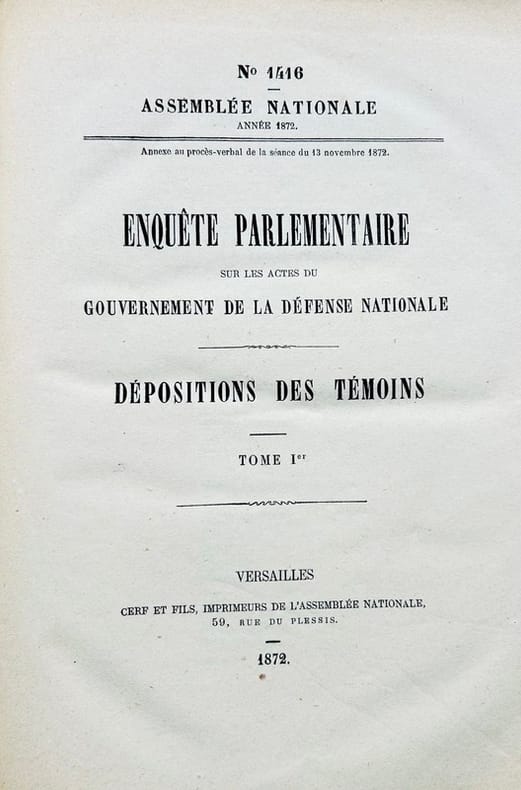
18724217Versailles, Cerf et Fils, 1872. 16 vol. in-4, demi-toile verte, pièces et de titre et de tomaison en chagrin brun (reliure ancienne).
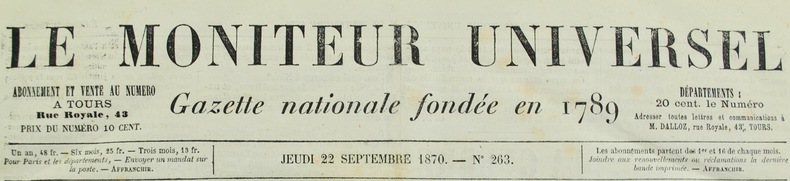
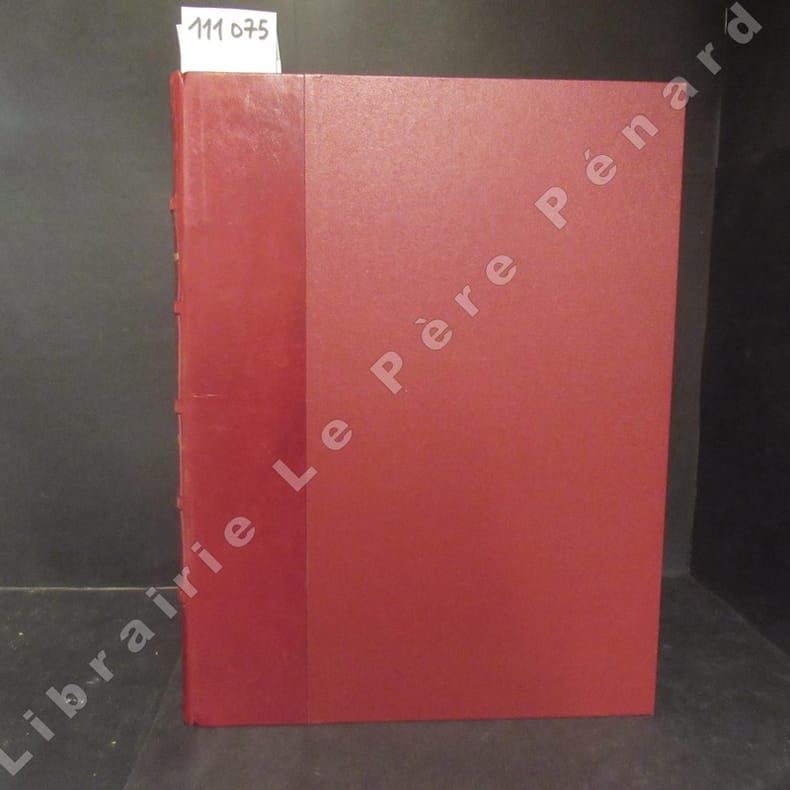
18702923Tours ; Bordeaux, Imprimerie Mame ; Imprimerie Crugy, 1870-1871. 170 livraisons (n°262 du 21 septembre 1870 jusqu'au n° 340 du 12 décembre 1870 puis à Bordeaux du n°341 du 13 décembre 1870 au n°74 du 15 mars 1871) reliées en 1 vol. in-folio, demi-basane rouge, dos lisse orné (reliure de l'époque).
1st Edition. 4to. Later Blue Boards with Original Wrappers bound inside for each issue. A full run of the first 3 years of The Jewish Tribune, from the year 1933 to 1936. 36 issues in total running about 1100 pages. Note that though these are consecutive they are marked as Volumes 1, 2, and 6. Includes a 1934 article titled, The Holocaust in Germany, " an EXTREMELY early use of this term to describe the growing attacks on the Jews of Germany by the Nazis. This rare run of the first three years of Bombays first Zionist periodical is inscribed by Joseph Sargon, who worked as managing editor of the Jewish Tribune during the publication of these issues. Born and educated in Bombay, Mr. Sargon came to the United States in 1939 (land lived in Brookline) after serving as managing editor of the Bombay Jewish Tribune for 13 years. During his world travels, he interviewed and wrote articles about Mahatma Gandhi, Pandit Nehru and other figures. (Boston Globe, 1990) The Bombay Tribune was established by the nephews of Nissim Elias Benjamin Ezra. N. E. B. Ezra, was a Baghdadi Jewish publisher and Zionist based in Shanghai. He founded the Shanghai Zionist Association in 1903 and its official newspaper, Israel's Messenger, one of China's oldest and most sophisticated Jewish periodicals Influenced by Ezra, his nephews started the newspaper Jewish Tribune in Bombay, India. (Wikipeida, 2017) These 36 issues of the Tribune include the 1st appearance of many articles and editorials from some of the leading Jewish thinkers from across the world including: NEB Ezra, Bernard S. Deutsch, Rabbi Julius J. Price, Haham Moses Gaster, Emanuel Neumann, Israel Cohen, Khan Bahadur Jackson B. Israel, Jl Magnes, Samuel Magnus, David Sassoon, Rabbi Leo Jung, Jl Landau, Rabbi Schlesinger, Laszlo Schwartz, Louis Golding, Jh Hertz (Then Chief Rabbi Of British Empire) , Jacob De Haas, Rabbi D. De Sola Pool, Edward Jacobs, Mrs. Israel Davidson, Lily Tobias, H. Pereira Mendez, Rabbi Benjamin Ouziel, and Cyrus Adler. Includes a few early reporting articles about Nazi Anti-Semitism, early reporting on the 1934 Nepal-Bihar Earthquake, and a few articles about Mahatma Gandhi, among other topics of Jewish and Zionist interest. Period Advertisements throughout. OCLC lists 12 copies worldwide. Ex-library with Jewish Institutional Bookplate and Usual Markings. Inscribed by Sargon on the Front-End Page. Also includes Sargons Personal Bookplate/Nametag. Damp Stains throughout and pages are wavy. Some edgewear. Overall in good condition. (SEF-55-8B)
1834002750Paris, Vimont, 1834
In-4°, 84pp, frontespizio con marca editoriale e motto In te Domino speravi non confundar in aeternum, capolettera xilografico. Il coinvolgimento del card. Bellarmino nella polemica inerente alla guerra dell’interdetto si evidenzia in questo scritto, in cui il Cardinale confuta le tesi sostenute in due libretti contro il Breve di papa Paolo V sopra la censura. Rari commenti manoscritti al margine della prime carte. In-4°, 84pp, title page with printers mark and motto In te Domino speravi non confundar in aeternum, wood engraved initial. The involvement of card. Bellarmino in the controversy inherent to the guerra dell’interdetto is highlighted in this writing, in which the Cardinal refutes the theses supported in two booklets against the Breve of Pope Paul V on censorship. Rare handwritten comments in the margin of the first leaves.
1797bn1577A Paris, de l'imprimerie de la République Relié 1797 In-4 relié pleine basane d'époque, dos à 5 nerfs, xii et 403 pages, 9 magnifiques planches dépliantes dont une très grande montrant un vaisseaux de profile, ouvrage référencé au numéro 1322 dans la bibliographie de Jean Polak, cet ouvrage contient le détail des différents roles selon la situation, essentiel pour comprendre l'organisation d'un navire et le nombre d'hommes essentiels à chaque manoeuvre, les plans de la disposition des hamacs sont impressionants, 363 hamacs dans la première batterie !!! An VI ; coins, coiffes et mors usés. Livraison a domicile (La Poste) ou en Mondial Relay sur simple demande.
1944117202Montrouge Atelier Robert Doisneau 1944 1 vol. en feuilles Tirage argentique d’époque, 21 x 18 cm, tampon rouge du photographe au verso. Ce bel instantanée d'une célèbre série prise à la Préfecture de Police de Paris est reproduit p. 26 de l'album "Paris libéré" préfacé par Mauriac (Flammarion, 1944). (Musée Carnavalet - Histoire de Paris, réf. PH9803). Titulaire d'une accréditation pour suivre l’insurrection et l’avancée des troupes alliées, le photographe est au plus près des événements pour en saisir toute la gravité. Epreuve originale, en parfaite condition.
bf5526Clarté, Edité par Clarté. 16 rue Jacques Callot, Paris (6°) Coups de coeur de Bernard, Sélection Abraxas-libris "Album au format italien de 27,5 cm x 25cm, agrafé, cordelette rouge. Edition originale et premier tirage des illustrations de Lucien Laforge, un des 400 exemplaires de luxe sur papier rouge mat spécial des papeteries Barthélémy, seuls grands papiers annoncés. Imprimé à la grande imprimerie ""Perfecta"", 8 rue Neuve-Popincourt, Paris (XI°) Rare album antimilitariste, sur grand papier qui décrit les gens de l'arrière, ceux des estaminets, ceux de la rue, les prostituées, les curées, les politiques ceux qui y échappe. Tout ce beau monde est décrit sans retenue. Une charge antimilitariste et pacifique, graphique et rouge !!! ; bel exemplaire avec quelques traces d'usages sans aucune gravité. Livraison a domicile (La Poste) ou en Mondial Relay sur simple demande."
19441110751944 Janvier à Août 1944 - N° 5260/5261 à 5292/5293 - 102e année - Imprimerie de L'Illustration, Bobigny - Revue hebdomadaire illustrée - Grand in-4, demi basane rouge - Dos 5 nerfs avec titre et années en doré - p. 1 à 301 + quelques pages de publicités non paginées - Très nombreuses illustrations et reproductions photographiques en N&B avec quelques planches en couleurs hors texte - Complet, comprenant les numéros rares 5278/5279 (6 et 13 mai 1944 : Le Salon et le Maréchal à Paris) - 5290/5291 (dernier avec le bandeau rouge) puis 5292/5293 où la mention de Jacques de Lesdain comme rédacteur disparaît - Relié avec les premières de couverture et quelques pages de publicités
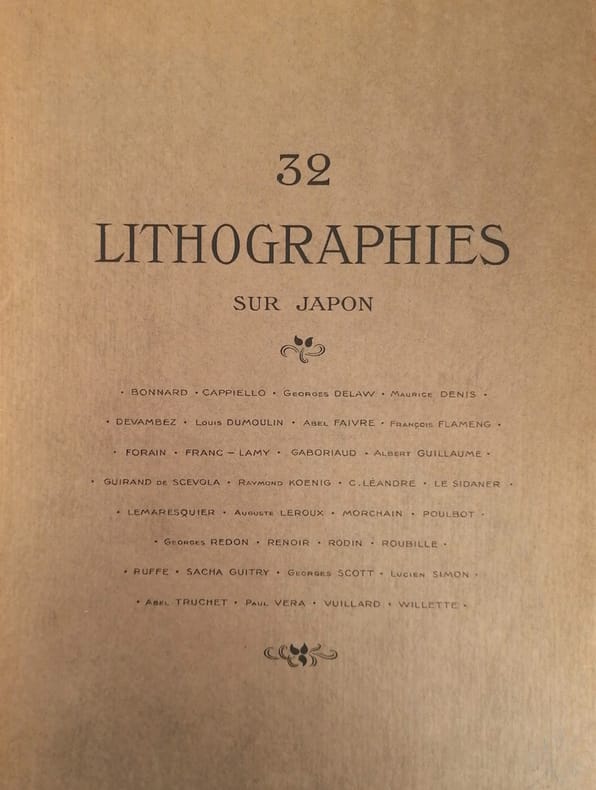
1916108641Sans lieu ni date 1916 1 vol. en feuilles petit in-4 de 1 feuillet de présentation et 32 planches lithographiées en noir sous chemise imprimée à rabats. Tirage unique à 250 exemplaires, celui-ci justifié à la main 250/250 en bas de chaque feuille. Publiée par Mme Étienne Clémentel, épouse du ministre des Postes et Télégraphes, cette luxueuse collection a pour but de financer les secours aux orphelins de guerre du personnel des P.T.T. Notre exemplaire est enrichi d'un envoi autographe de Mme Clémentel au journaliste et critique d'art Roger Miles "... très reconnaissante de son aimable collaboration..." Sont réunies des lithographies de P. Bonnard, L. Cappiello, G. Delaw, M. Denis, A. Devambez, L. Dumoulin, A. Faivre, F. Flameng, J.-L. Forain, Franc-Lamy, J. Gaboriaud, A. Guillaume, Guirand de Scévola, R. Koenig, C. Léandre, H. Le Sidaner, Ch. Lemaresquier, A. Leroux, P. Morchain, F. Poulbot, G. Redon, A. Renoir, A. Rodin, A. Roubille, L.H. Ruffe, Sacha Guitry, G. Scott, L. Simon, A. Truchet, P. Vera, E. Vuillard et A. Willette. Album rare qui manque à la Bibliothèque nationale de France.
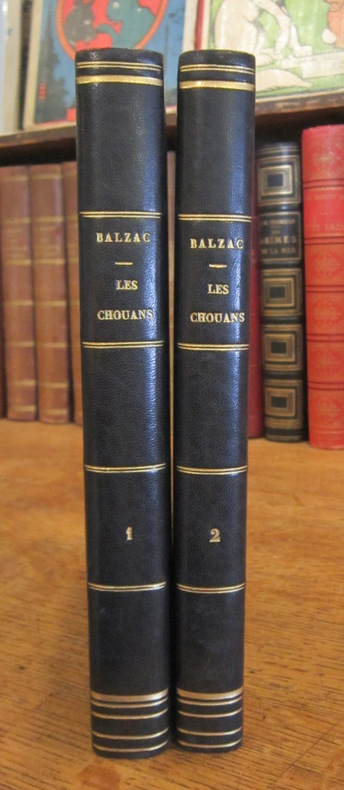
188442252Bruxelles, Edouard Maheu, 1884. In-8 de (16)-XXII-232 pp., demi-chagrin brun à coins, dos orné à nerfs, filet doré sur les plats, tête dorée, non rogné (reliure de l'époque).
[Figurato Cavalleria-Rarissimo] (cm. 21,5) bella legatura recente in mz. marocchino scuro, angoli, nervi e titolo in oro al dorso.-- cc. 112 nn. Carattere rotondo testo a due colonne, grande xilografia al frontis e 41 vignette nel testo. L' opera termina con "il fine" a carta 112 bianca al verso. Edizione assolutamente rarissima e di difficile identificazione. secondo Iccu, nessuna copia nelle biblioteche italiane; è vagamente ricordata da Graesse, Brunet e Haym. Essling la descrive compiutamente e cita l' unico esemplare conosciuto della biblioteca Melziana, e la data dopo il 1528 mentre Radaeli la ritiene anteriore. La più antica è del 1483 e fino al 1536 si contano ben 14 edizioni, tutte rare o rarissime (Harris "Sanudo" III 34/5). La bella xilografia al frontis, che rappresenta Carlo Magno e i baroni, è tratta dal "Guerino" del 1522. Il poema di argomento cavalleresco, in dieci ottave per pagina, narra la guerra di Troia e da taluni è attribuito al fiorentino Jacopo Carlo. Vecchio piccolo restauro al margine bianco del frontis e all' angolo alto di 11 carte in fine, purtroppo con perdita di molte parole soprattutto alle ultime 5 carte. Antica annotazione manoscritta in basso al frontis intorno all' autore e alle varie edizioni; al verso bianco dell' ultima carta lunga nota manoscritta coeva in 14 righe con chiara grafia. Peraltro esemplare molto bello fresco e nitido di un libro di grande fascino e indiscussa rarità. assolutamente completo. Raccomandiamo una attenta analisi sulle referenze qui di seguito elencate: * Catalogo Hoepli 1922 "Cento libri preziosi" n° 98; * Radaeli A. "Cento romanzi cavallereschi" Hoepli 1940 n° 153; * Catalogo della Biblioteca di G. Cavalieri 1908 n° 1727; * Haym p. 201/7; * Graesse VII 206; * Brunet V 965; * Sander 7382 in nota; * Essling 1643.[f42] Libro
1917RO20040595"CHEZ L'AUTEUR. 1916-1917. In-12. Broché. Etat d'usage, Couv. convenable, Dos satisfaisant, Intérieur frais. Nombreuses photos originales de portraits et d'artillerie lourde en noir et blanc. Diplôme et médaille (à titre posthume) encadrés sous verre, et inscrit sur le Livre d'Or des ""Soldats de Verdun"". Nombreuses lettres manuscrites originales. Carte dépliante en couleurs du Nouveau Plan de Paris avec toutes les lignes du Métropolitain et du Nord-Sud (Chez Taride et en état d'usage) gravée par Demersseman. Tampon du Capitaine Commandant Le Croupe, du 86è Régiment d'Artillerie Lourde, Section Transport. Caisse de rangement personnelle du Capitaine Berthoumieux, avec nom et régiment imprimé sur le devant. Dimensions : Longueur 70 cm, Hauteur : 24 cm et Profondeur : 30 cm; avec des lanières, en cuir, de fermeture. Accompagné d'un trousseau de 7 clefs de l'époque, dont certaines rouillées. Ce lot est constitué essentiellement de pièces et d'ouvrages originaux.. . . . Classification Dewey : 940.3-Première Guerre mondiale 1914-1918"
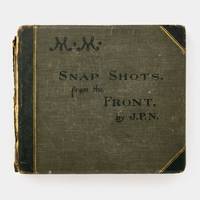
1941174371Palestine Egypt and Sudan: 1941-43. With camels and camera in the desert theatre A visual record of the Second World War in the Middle East with superb snapshots of Indian Army personnel members of the camel corps in Egypt and Sudan and the Sudanese household cavalry. Also included is a range of scenic views and images of everyday life. Warner's squadron served in the Middle East 1941-2 and was posted to North Africa in 1943. His most important photographs concern his service and those with whom he served. Alongside photographing military personnel he records their training and excursions and in one image a group of RAF men Warner perhaps among them pose on top of a car belonging to the Palestine Police Force. Eight photographs show the funeral of a British sergeant while one commercial image pictures Winston Churchill visiting soldiers at Tel El Kebir on 9 August 1942. Scenic and tourist views of Palestine show Warner's seaside billet in Haifa a coffee house and street in Acre and Mt Carmel as well as the Sea of Galilee Lake Tiberias and the atmospheric River Nile. The squadron's transfer to Africa is made via troop train. Aerial photographs of Khartoum are positioned alongside snaps of a sandstorm and by the White Nile Bridge he snaps an RAF hydroplane. In North Africa he mingles with soldiers of the Sudan Defence Force and members of the Khartoum police band. The album closes with a trip along the road to the Congo and time spent on duty at Juba. Landscape quarto commercial album. Original blue roan boards black cloth backstrip 17 black card leaves fixed with metal posts 160 mounted gelatin silver photographs snapshot- to postcard-sized and nearly all amateur manuscript captions on laid-down slips; 4 gelatin silver photographs loosely inserted including 3 snapshots and 163 x 215 mm formal portrait of compiler's class at RAF NCO Training School Hereford. Light toning and silver mirroring some images still with strong tones: very good. hardcover
432 pages. Index. Biographical Notes. List of Abbreviations. Chart. Tables. Fourteen reproductions of black and white photos in text. Color map of Canada, Alaska and Greenland stored in back pocket. Describes in detail how Canada and the United States joined to thwart the Axis threat and stresses the very significant work of the Permanent Joint Board on Defense, Canada-United States. Inside front board a 9.25" x 6.25" typed presentation letter, dated 16 February 1960, to Lieutenant General Samuel Findlay Clark, Canadian Army, is signed by L.L. Lemnitzer, Chief of Staff of the United States Army. Letter was originally glued inside front board but is now loose. Yellow glue discoloration to perimeter of letter and front fixed endpaper. Light wear and no markings to this extraordinary association copy. Book
363 pages. Signed and inscribed by author atop half-title page. Text in French. First edition of what was printed in English in 1935 with the title Black Hand Over Europe. "... An appalling expose of the situation of the national minorities in the Balkans and in Central Europe (which) tried heroically to call to the attention of the French people the dangers to which France and all Europe were exposing themselves should France continue to finance and support the criminal and ambitious political parties of the Little Entente, and especially of Yugoslavia... The book is prohibited in the Little Entente, Greece and Turkey, and in Yugoslavia; any government official or employee apprehended reading the book is given five years of hard labour." - from Translator's note to the English Edition. "Two months after the publication of my book the Supreme Court of Belgrade sentenced me by default to twenty years of hard labour and the White Hand (the Panserb terrorist and military organization) sentenced me to death." - from Author's Preface to the English Edition. Prior owner's name and date pencilled atop title page. Average wear. Binding intact. A sound copy of this important work. Book
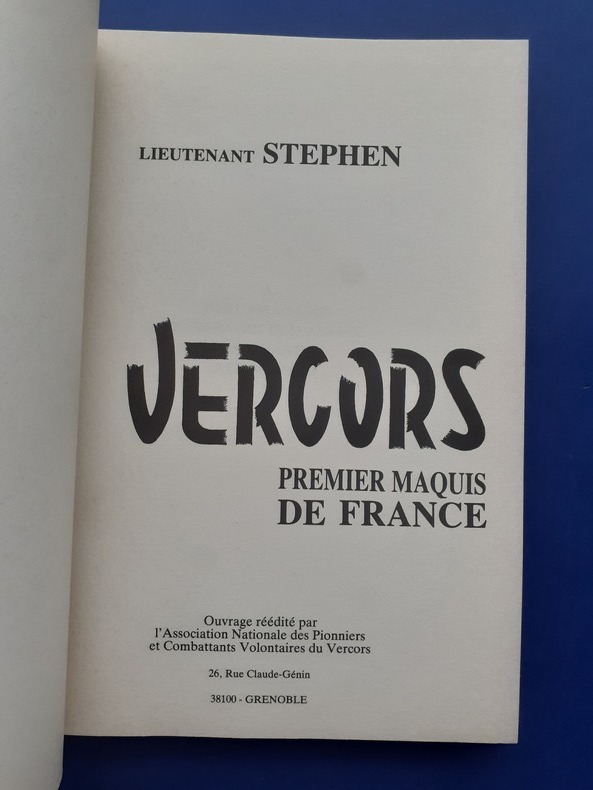
1985CC078Association Nationale des Pionniers et Combattants Volontaires du Vercors, à Grenoble, 1985 In-8° de 178 pp., Un mince cahier de photos en noir et blanc in-texte
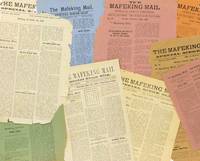
1899142162Mafeking: Townshend & Son 1899. Mafeking Townshend & Son 1899 and 1900. 111 issues various sizes see below printed on paper of many different colours and of varying quality often poor with 43 printed as a broadsheet the balance printed recto and verso with three early numbers folded and issued as bifolia. Unbound as issued; some loss primarily owing to the poor quality of some of the paper; however these extraordinary artefacts produced under siege conditions are of the utmost rarity in any condition. All issues in this run are now housed in individual Mylar pockets sealed on two sides only for easy access. A detailed list including the number date colour of paper length and condition of each issue is included with the lot. Dr Robin Pelteret has published his impressive research notes on 'The Mafeking Mail Special Siege Slips' online. He sets the scene: 'Mafeking lies 1392 kilometres north of Cape Town and 298 kilometres west of Johannesburg. It was first settled in the early 1850s. From the early 1860s it became a centre of squabbling and outright fighting between the Transvaal Republic the Baralong the Goshen Republic the British South Africa Company and the British Empire. <p>By the outbreak of the Anglo-Boer War it was a robust "dorp" with some 1500 European citizens a group of Indian and oriental background and 5000 Baralong. It was a major rail junction with a station and railway workshops; a significant commercial centre and boasted a number of substantial buildings including two schools two churches a Standard Bank a Masonic Lodge a newspaper building a public library the Victoria Hospital and St Joseph's Convent Irish Sisters of Mercy. <p>The Siege of Mafeking was conducted between 14 October 1899 and 17 May 1900 that is 217 days and began 3 days after the declaration of war by the Transvaal Republic. It involved British and Colonial Forces under the command of Brevet-Colonel Robert Stephenson Smythe Baden-Powell the besieged and Boer Forces ab initio under the command General Piet Arnoldus Cronje and later Kommandant Sarel Eloff the besiegers'. <p>The precursor to the siege issues of 'The Mafeking Mail' was the 'Mafeking Mail and Protectorate Guardian' in its infancy when the siege was imposed. Number 22 the last full edition was published on Saturday 14 October 1899 the first day of the siege; a Special Siege Edition Number 23 was dated Saturday 21 October 1899 but headed 'reprinted on 23 October 1899'. <p>On 1 November 1899 a fortnight after the beginning of the siege the first of the famous siege issues was published 'Issued Daily Shells Permitting. Only Terms One Shilling Per Week Payable in Advance'. <p>'They were to be numbered 1 to 152 of which 143 minus Numbers 45 and 56 appeared during the actual siege. The newspaper contained snippets of information - both parochial and national General Orders and advertisements. Actually we have found them to be far more dramatic and engaging than this bland description implies especially reading these issues that were purchased day by day during the siege and have survived to this day. However we digress . In Mafeking there was to exist a fragile peace between the publisher and editor of the "Mafeking Mail Special Siege Slip" G.H.N. Whales and the military authorities. Whales was somewhat acerbic of tongue. He once publicly thanked the press censor for saving his life a boer shell having destroyed his editorial chair whilst he was submitting his newspaper copy for military scrutiny elsewhere in the village. He was to be briefly imprisoned on one occasion for publishing querulous criticism on the conduct of the siege and the restrictions put on the availability of news. In protest he was known to publish empty columns No. 47 and indeed cancelled one whole edition No. 45 as visible disregard and mute testimony to the censor's liberal use of a blue pencil.' <p>Dr Pelteret has established 'there are three different printings which appeared as four "editions"'. He surmises that by the time Number 6 came to press 'the commercial value to the printers of "The Mafeking Mail Siege Slips" had been discerned . and a substantial "overrun" allowed and set aside for later sale'. Indeed in Number 151 dated 30 May 1900 'there was an offer to make up sets at 30/- each of the Nos. 1-147 for "delivery July next" . They were issued soon after the lifting of the siege . cardboard-bound into two books of differing sizes and held together with metal staples'. <p>The current run comprises Numbers 1 and 2 both second issue 'on sale soon after 22 November 1899' 6 with the word 'Only' in the masthead 7-8 10-60 but 45 and 56 were not published 62-68 70 77-79 83-84 97-98 100 102 104 106 107-109 111-127 129-141 and 144-148. Sizes vary considerably: the first 30 or so are approximately 380 × 255 mm; most of the last 40 or so are approximately 340 × 200 mm; for the rest they range from one issue at 255 × 155 mm to several at 375 × 500 mm. There are easily ten different colours of paper often acidic and now prone to brittleness; a handful have peen printed on recycled ledger paper pre-printed with columns in red or blue. <p>'Petticoat in Mafeking. The Letters of Ada Cock' edited and published by John F. Midgley Kommetjie 1974 contains 57 letters now extensively annotated written during the siege. The letters 'were addressed to her elder sister Emily Empy Fuller née Franklin. Emily's husband Harry James Fuller was the owner of the cattle ranch "Oaklands" which was situated a few miles outside of Mafeking and was managed by his brother-in-law Willie Cock Ada's husband. Under the threat of possibly hostilities Willie and his wife moved into Mafeking and its environs with all their stock at the beginning of October 1899. They also took with them four young children Eileen Tooky Liell Vaughan and Baby Ada' introduction page 1. In the earliest surviving letter dated 12 October Ada writes that 'Willie . will . join the B.R. Bechuanaland Rifles' page 23. The basic pencil drawings of several cannon one labelled a '9PR' on the partially blank verso of Number 21 Wednesday 29 November and the blank verso of Number 22 Thursday 30 November are possibly in his hand. <p>Provenance: William and Ada Cock; by descent through their son Alfred Vaughan Cock to their great-grandson the vendor. 111 items. Townshend & Son unknown
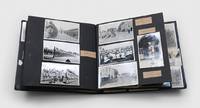
135819First Edition. Hardcover. Very Good. An album 209 × 236 mm containing 199 gelatin silver photographs loosely inserted behind window mounts visible image size 51 × 77 mm four to a page on both sides of 25 card leaves; almost all of them have a small printed caption numbered 1-200 neatly trimmed and mounted on slips of paper loosely inserted in a small window below each photograph. One caption is in pencil a handful don't have captions; some have additional information supplied in pencil; there are numerous dates from Number 1 to 156 5 February to 13 October 1900 and Number 191 is dated 3 January 1901. Nine photographs between numbers 9 and 44 are out of order but all are present; number 111 is the only blank space in the album. Contemporary half leather and cloth worn at the corners with the spine broken and lacking sections; album broken near the centre damaging two window mounts easily repaired; all blemishes are confined to the album and the contents are in excellent condition. The album was compiled by a Dundee volunteer 8934 Private James Proctor Norwell 1st Volunteer Battalion Royal Highlanders Black Watch; the commanding officer was 7727 Lieutenant Alistair Valentine. The first dozen starting with '1. Cleaning Rifles. Perth Ranges' in the snow were taken before Cape Town was reached. The rest were taken in the field; apart from photographs of Indigenous people mainly Basutos and rough camp life there are many graphic images of battle and its aftermath: '15. Cronje's Guns captured at Paardeberg'; '18. An Officer's Funeral'; '33. Group of 1st Section two members of which have since died'; '40. Stretcher Bearers ready for Service'; '61. Preparing for Action - pipes and drums to the rear'; '64. Bringing in Boer Prisoners'; '68. Hector Macdonald giving Orders to carry the Position at Retief's Nek'; '73. Sniping from behind Ant Heap'; '104. Lieutenant Valentine's Mess Room Valentine Kop'; '117. Bringing the Guns into Action Retief's Nek'; '120. Resting after taking Honing Kop'; '124. The Fate of a Spy' and '168. His Last Day' both gallows scenes; '126. Kaffir Prisoners'; '130. Boer Commando in Kroonstadt'; '137. Lieutenant Smith - wounded at Retrief's sic Nek'; '153. Hector and his Staff entering Heilbron'; '159. Boer Prisoners at Schoolhouse De Aar'; '184. One of the 1st V.B.R.H. after 13 months' campaign'; and '192. Cookhouse and Mess Room Swaartlaagte'. Two on the last page are captioned 'St. Vincent - on our way home'. hardcover