119 774 résultats
1917120706Mogilev: c.1917. The final Russian offensive of the war A firsthand account of this pivotal moment in the war written by Lieutenant-Colonel George Maitland Edwards while he was staff officer and Russian translator to General Charles St Leger Barter. Edwards recounts his displeasure with the Russian army and its poor discipline. The only other copy we have traced is held by the IWM although theirs is only 65 pages long and we have been unable to trace a published edition. Edwards 1882-1946 first went to Russia in the pre-war period where he worked in mining in Siberia and the Urals. In 1914 he joined the Royal Artillery and served in France and Gallipoli in charge of 254 Tunnelling Company. In 1917 he was sent to Russia with General Barter British Military Representative to the Headquarters of the Russian Armies in the Field to inspect the state of the front line. Edwards recounts multiple instances of poor discipline among Russian troops such as on 1 July when Russian soldiers dove into the German trenches "like rabbits" p. 17 instead of continuing on. He recalls his shock at the lack of communication between artillery and infantry as well as his bemusement at an attempt to fight off German planes in Bac u he described as "the very poorest shooting at aeroplanes I have ever witnessed" p. 49. He attributes this to poor leadership and Kerensky's abolition of the death penalty. Nevertheless he compliments the actions of the 8th Army despite being disheartened by the overall failure of the offensive. The work also includes a gelatin silver photograph of a British general relaxing with Russian troops. We have been unable to trace a published edition of this account. Folio 326 x 199 mm ff. 71. Carbon copy typescript on rectos only occasional contemporary typescript corrections sepia gelatin silver photograph 40 x 58 mm mounted on verso of p. 14. Recent red quarter leatherette spine gilt-lettered direct low bands ruled in gilt red cloth boards top edge gilt others untrimmed. Boards a little soiled and marked extremities slightly rubbed contents bright with minor foxing to endpapers first leaf chipped at foot in gutter: a very good example. hardcover
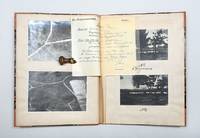
1917152534Ukraine: Vermessungs-Abteilung 22 1917. A masterclass in inter-arms co-operation" - the German assault on the Toboly Bridgehead Remarkable visual record that documents with a combination of forensic exactitude and stark realism the capture of the Toboly bridgehead on the Stokhid River Ukraine in April 1917 significant for the innovative fire plan utilized by Colonel George Bruchmuller "an outstanding artillery co-ordinator" Clarke p. 50. Rare: we have not been able to trace another copy institutionally or on auction records. The Stokhid River was the demarcation line between the Austro-Hungarian and Russian fronts. "The attack on the Toboly bridgehead by the 1 st Landwehr Div of the German Army in March 1917 was supported by 300 pieces of artillery and 100 Minenwerfers short range mortars; by comparison the average German division at Verdun was supported by 94 guns and 60 trench mortars. Barrages were also shorter and more intense - 5hrs 15min at Toboly compared to the 24 hours at Verdun. In a complex fire plan field guns field howitzers and Minenwerfers delivered the rolling barrage directly to the front of the advancing infantry. Heavy guns and howitzers provided both CB Counter Battery fire on the Russian artillery and a box barrage to seal off the objectives from reinforcement. The keys to Col Bruchmuller's success were the effective use of neutralization; surprise; inter-arms co-operation; and massed firepower under centralized command. When assessing Bruchmuller's reputation it is important to stress that he was not doing much that the Allied armies were not already doing on the Western Front. In the East however it was revolutionary and his efforts to ensure that the infantry understood how to make the most of the support they would receive were a masterclass in inter-arms co-operation" ibid. pp. 50-1. Gas was also a key factor in the German attack as was the use of portable flamethrowers in particular by companies of the Garde-Reserve-Pionier-Regiment "whose two-man flamethrower teams were attached to units as necessary to provide specialist fire support for specific operations" Stone p. 432. Of the images assembled here 2 show mines being exploded while others taken after the battle show blast craters; a further 8 aerial photographs with contemporary annotations on the back were taken by artillery reconnaissance unit Flieger-Abteilungen A 283 which was based at Brest-Litovsk. Others show the effect of Minenwerfer fire on barbed wire entanglements and trenches; some 25 prints show Russian dead killed by mortars Minenwerfer gas and flamethrowers; 10 show Russian armaments and trench systems German soldiers posing with battlefield "loot" hand grenades and ammunition and captured artillery; the concluding 10 images particularly well-detailed are of Russian prisoners of which the Germans claimed there were 10000. A stub-mounted printed slip notes that 4 aerial photographs were taken from a height of 100 feet by Lt. Ferdinand Schmid of Fliegerkompagnie 27 of the Austro-Hungarian air force fatally wounded over Toboly. This also gives an explanation of the plates numbered 578-81 which show the battlefield and German infantry advancing; a glassine overlay shows how the plates should be arranged to give a wider perspective of the area of operations. Provenance: although unmarked as such from the library of Reinhart Freiherr Bachofen von Echt 1877-1947 author of several works on hunting; he served with the Austro-Hungarian army on the Eastern Front during the First World War. Produced in very small numbers and printed "in the field" this outstanding survival serves as an important primary source and a doleful testament to a signal German victory on the Eastern Front. Quarto 324 x 245 mm 16 leaves. Printed title page 84 original albumen prints varying between 120 x 165 mm and 60 x 90 mm mounted on paper leaves showing scenes at the Front a number with pencilled annotations on verso; another print reproducing a Russian propaganda card "Willst du Frieden haben ! Da hast du nimm!" Do you want peace! You'll have to take it! picturing the Kaiser being shown the "fig" sign; another reproducing battle reports from the German High Command. Contemporary moderate brown half cloth Papier Tourniquet pattern marbled sides. Some toning and light creasing to title page overall in very good condition. Dale Clarke World War I Battlefield Artillery Tactics 2014; David Stone The Kaiser's Army: The German Army in World War One 2014. hardcover
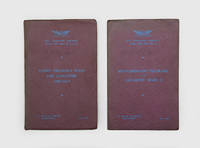
1943183794Manchester: A. V. Roe & Co. Limited May 1943. Owned by two active pilots Presumed first editions number 911 of an unknown distribution. They were issued to Sergeant Desmond Howard Hughes 1923-1943 of 115 Squadron RAFVR on 26 July 1943 and have his signature and annotations. Just four months later he was lost with his Lancaster Mk II DS782 KO-K while on a raid the largest so far sent to Berlin. Following Hughes's death these copies passed to Flying Officer Alfred Paul Mellows 1922-1997 of 169 Squadron RAFVR with his signature to both front wrappers. Mellows flew over 50 operations during the war while piloting a Mosquito and was awarded the Distinguished Flying Cross on 20 March 1945. According to the citation shared with Flight Lieutenant Leonard Drew "these officers have completed a large number of sorties in the capacity of navigator and pilot of aircraft respectively. They have also shot down 2 enemy aircraft. The second of these was destroyed one night in Feb. 1945. On this occasion the attack was pressed home from such close range that when the enemy aircraft exploded in the air their own aircraft was damaged. Nevertheless Flight Lieutenant Mellows flew it back to base. Both he and his fellow crew have always displayed the greatest keenness for operations" London Gazette p. 1595. He was part of the crew that won a rowing silver in the 1948 Olympic Games. We have traced just four copies of the main volume at the Australian War Memorial the Ingenium Library the British Library and the National Aerospace Library. We have traced no copies of the supplementary volume. 2 works octavo. Half-tone photographic plate with captioned overlay 19 folding diagrams and tables diagrams and tables in text; Notes interleaved with blanks as issued. Original purple paper wrappers wire-stitched as issued Notes glued into wrappers wrappers lettered in blue front wrappers stamped with Avro logo in blue. Light abrasions to wrappers creased and nicked at edges a little toning and foxing to contents small stub tears to some folding diagrams Supplementary Figure 7 tipped in: a very good set. "Supplement to the London Gazette 23 March 1945" The London Gazette. unknown
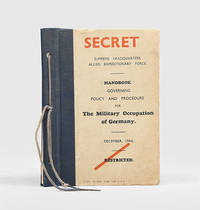
1944152575Perhaps Versailles: Supreme Headquarters Allied Expeditionary Force December 1944. The Allies prepare to take over Germany First edition initially classified "restricted" but subsequently stamped as "secret" on the front cover. Chapter VI concerns the control disarmament and disbandment of "para-military and police organizations" including the SS and other forces of the Nazi Party. It outlines Allied plans to ban the wearing of Nazi insignia detain implicated personnel and co-opt commanders of military districts Wehrkreis to take over the administration of liberated concentration camps and preserve vital evidence. Other chapters address the disarmament of Wehrmacht forces the seizure of communications infrastructure and relations with civilians as well as intelligence work the broader preservation of German state and army documents and the repatriation of Allied POWs. The two maps record the proposed division of Berlin into three international zones and the boundaries of the Wehrkreis. Chapter XIII correctly anticipates that the Nazi leadership will fight on even amid a hopeless situation and stresses the importance of capitalizing on any brief window between the final collapse of Hitler's regime and the emergence of an organized resistance to occupation. Distribution was ultimately intended to be as follows: "Army down to lieutenant-colonel's commands; Navy down to Commanders in Command on shore and all Commanding Officers of Men of War under the orders of the Supreme Commander; Air Forces down to Unit Commanders of the occupying Air Forces and of the air disarmament organization" p. 1. A revised edition appeared in April 1945. Octavo. With 2 folding colour maps at rear. Original black half cloth boards tied through punch holes with black cord as issued front cover lettered in black and red. Light wear and bumping brown mark at head of title page a little creasing to second map: very good. hardcover
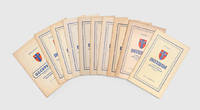
1945162758Europe: Printing and Stationery Services 21 Army Group later British Army of the Rhine 1945-46. An informative classified military publication First and only editions classified "secret" up to Issue 12 of Interim and "confidential" thereafter. The scope encompasses conditions in Germany and broader current affairs discussion of military strategy and tactics in the war and findings from the interrogation of German prisoners or seized enemy documents. The volumes of Interim include numbers 5 13 August 1945 6 27 August 1945 8 24 September 1945 10 22 October 1945 11 5 November 1945 12 19 November 1945 14 17 December 1945 17 5 February 1946 and 19 4 March 1946. The earliest two were issued in the name of Montgomery's 21st Army Group before its reorganization as the British Army of the Rhine in August 1945. The issue of Occupation is dated 1 May 1946. The Australian War Memorial Library appears to have a complete run of both titles in total 23 issues published between June 1945 and July 1945. One or more issues are also held by the German Army's Militärgeschichtliches Forschungsamt at Potsdam the Konrad-Adenauer-Stiftung and Edinburgh University Library. 10 issues octavo. With 13 maps 11 folding. Original buff card wrappers wire-stitched as issued front covers lettered in blue and with army group badge in red and blue. A little toned and creased more so to one issue: a very good collection. unknown
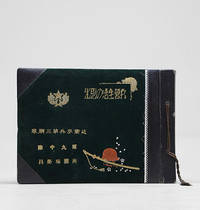
194098081Japan: 1940. Superb personal photo album portraying the training of a Japanese infantry officer cadet at the junior division of the Rikugun Yonen Gakko - Imperial Japanese Army Academy - at Asaka in Saitama province at the outset of World War II. Images show his family and friends; his well-appointed room with stacked arms; group portraits of cadets; the buildings on campus and locally interiors of a mess hall lecture theatre and of a barrack-room; parades and drill on the drill square; training exercises with firehoses and with howitzers and attack training under live fire with smoke drifting across the parade ground; jukenjitsu or kendo-style bayonet training; sumo wrestling and a traditional dance performance. A highly evocative visual document which is further enhanced by the fact that is has the marks of having been captured and passed as legitimate "loot" with the ink-stamp "Examined in the field. passed by Joint Intelligence". It was taken by U.S. Marine Sergeant Michael Kolesar of Ironwood Michigan serving with A Co. 6th Tank Battalion 6th Marine Division and has his ownership inscription to the front free endpaper datelined Okinawa April 1945. The 6th Marine Division was the only U.S. Marine Division formed and disbanded overseas never setting foot as a Division in the United States. It was formed on Guadalcanal in the Solomon Islands in September 1944 composed of the 4th 22nd and 29th Marines and assorted Engineering Medical Tank Headquarters and service battalions. They landed on Okinawa 1 April 1945 as part of III Amphibious Corps swept through the northern Ishikawa Isthmus and then engaged in heavy fighting against the Shuri Line located in hills honeycombed with caves and passages across the southern Coastline fighting for over a week and then advanced through Naha. Kolesar's tank battalion was involved in the campaign through Naha and then the Oroku peninsula sustaining heavy losses. For its part in an operation which came to be known as the "Typhoon of Steel" for the sheer intensity of the fighting the 6th received a Presidential Unit Citation for "extraordinary heroism in action". The Division was prepared for the invasion of Japan which never took place so they were sent to Tsingtao China in October 1945 disbanding in April 1946. Kolesar was evidently back home before the unit reached China the Ironwood Daily Globe of 24 October 1945 recording his presentation of a Japanese rifle that he had brought back as a trophy to the local Conservation Club he evidently retained possession of this attractive and fascinating album. Landscape quarto 215 x 282 mm. Title page with "calligraphic inscription" extolling the five codes of the Imperial Precepts to Soldiers and Sailors - Loyalty Propriety Valour Fai8thfulness and Righteousness and Valour - 75 original photographs of various formats - ranging from 100 x 70 mm to 115 x 155 mm - neatly mounted on 48 black card leaves tissue-guards remaining intact and to verso of the free endpapers some with carefully written captions in Japanese on shaped paper labels beneath. Original silk cord-backed album of black half morocco-grain cloth bottle green velvet boards the front deeply stamped with title in gilt together with Japanese Army Cadet insignia of a star within wreath and motif of a steel helmet in red with gilt katana in a flurry of cherry blossom petals. A little rubbed at the extremities but overall very good. hardcover
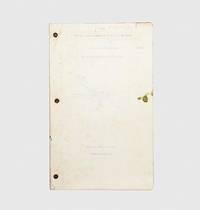
1944190894Likely London: c. 1944. The largest airborne landing in military history Classified "secret" with a contemporary red pencil notation on the cover page recording this as the copy of Headquarters Royal Artillery. This report written in terse style appears to predate the longer 47-page official report issued by Major-General Roy Urquhart commander of the 1st Airborne Division during Market Garden in January 1945. We have traced no other copies. The contents are divided into three sections dealing with planning and execution observations for future reference and comments on air support. Compared to the Urquhart report significant space is devoted to organizational and practical failures in communication including delays in using a common slidex insufficient sharing of call signs and codes and frequencies not being checked leading to different set operators employing frequencies too close. The diagrams record the Royal Artillery communications structure and the wireless network used during the first lift. A laid-down label on the cover page states that the document has not been approved by the Major General Royal Artillery 21st Army Group at the time Major-General Meade Edward Dennis 18931963 - further evidence that the text is an early evaluation of the 1st Airborne Division's part in the operation. Together 22 sheets of duplicated typescript 330 x 205 mm each printed one side only two full-page diagrams on similar sheets folding sketch map cover page with laid-down label all fixed with three metal butterfly pins. A few contemporary annotations. Housed in contemporary manilla folder pencil annotation on front. General creasing a few stains and marks final sheet detached from pins: very good. Imperial War Museum "The Story of Operation 'Market Garden' in Photos". unknown
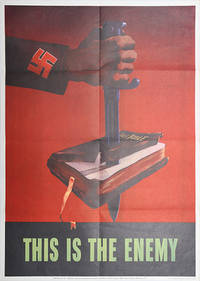
1943175357Washington DC: Office of War Information 1943. Deliver us from evil One of the most striking American wartime propaganda posters depicting a Nazi fist stabbing through the Bible against a vivid red background. "This is the Enemy" was the slogan of various American posters focusing on the evils of Nazi ideology and actions here presenting their attack on freedom of religion and their threat to Christian civilization. The artist Barbara Marks was a Californian art student. The Office of War Information solicited entries from the public for poster designs and received over 2000. Her original slogan was "deliver us from evil". Offset lithograph 710 x 560 mm. Light creases where formerly folded and a couple of tiny chips at intersections. A near-fine copy. unknown
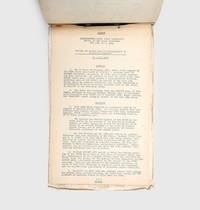
1945190883East of the Rhine: Headquarters XVIII Corps Airborne Office of the Corps Commander APO 109 U.S. Army; Reproduced by 3060 Engr. Topo. Co. Corps around late April 1945. The last airborne operation of the Second World War Copy number 70 of an unstated but presumably small distribution classified "secret". As part of the advance on Germany Varsity saw American British and Canadian troops parachute onto the eastern bank of the Rhine and establish a deep bridgehead for a larger-scale Allied crossing of the river. The contents dated 25 Aprill 1945 comprise a 12-page report and shorter summary both issued in the name of Major-General Matthew Ridgway commander of XVIII corps from August 1944. These detail the planning and active phrases of the operation attributing Varsity's success not to "the remarkable circumstance of having events develop according to schedule but rather by the thousands of individuals who through bold and aggressive action by tireless and intelligent efforts caused those events to occur. It may well serve as a model for future airborne operations" pp. 11-12. The full report is appended with a troop list correct as of 25 March 1945 and the seven large maps record the overall objectives of the operation and the situation at the close of each day. We have traced copy 60 at the HQ Donovan Research Library Fort Benning Georgia. Quarto 350 x 220 mm. With 9 leaves of duplicated typescript all but one printed both sides wire-stitched top-left; 7 folding colour plans. All bound through punch-holes between manila card cover as issued front cover lettered in black corps insignia in blue. Folder with some wear and marking leaves evenly browned plans well-preserved: a very good copy. unknown
1919nc1418Corrard Pierre Modes et manières d'aujourd'hui, Sélection Abraxas-libris Inconnu 1919 "Magnifique exemplaire de cette chemise de la collection ""Modes et manières d'aujourd'hui"", la publication du meilleur de la mode du début du XXe siècle, par les artistes l'ayant faite, au plus haut de leur art. Le projet est porté par Pierre Corrard, écrivain et éditeur de grand talent. Afin d'accompagner la révolution artistique et vestimentaire des années folles, il publie, en 1912, une première chemise, avec des illustrations de Georges Lepape. Devant l'accueil fait à cette première publication, il décide, chaque année, de proposer une chemise identique, avec des auteurs et des artistes différents. En 1919, donc, il demande à A. E. Marty de réaliser un volume couvrant à la fois le retour des soldats et la folie, immédiatement postérieure, qui va animer les arts sous toutes leurs formes : ce sont les fameuses Années Folles. Cette chemise se présente comme toutes les autres de la série : sous un cartonnage fort, dont le premier plat est frappé des seuls titres et années, avec, en son centre, une illustration couleurs, les planches prennent place dans un ensemble de quatre rabats fait du même papier que celui illustrant la contre garde, et dont le motif a été dessiné par l'artiste réalisant les 12 planches intérieures. L'ouvrage, en feuilles, débute par une page de titre reprenant l'illustration de couverture. Puis viennent les pages proposant le texte, et, après le colophon, les 12 planches illustrées. Un soin tout particulier est apporté à la réalisation de ces planches, de la gravure au passage des pochoirs. La provenance de notre exemplaire est exceptionnelle: il provient directement de la famille Corrard. Stocké dans leur résidence, notre exemplaire est dans un état strictement parfait, tel que sorti de chez l'imprimeur. Il est même encore sous son papier cristal d'origine, intouché. Il est bien complet des rubans et des rabats de chemise (qui, hélas, très fragiles, manquent ou sont très abîmés sur les exemplaires courants). Les nôtres sont intacts, parfaits et magnifiques. Bien qu'il date de plus de 100 ans, il est proprement comme neuf, mise à part l'évolution du papier. Notre exemplaire est un des 271 exemplaires numérotés sur Japon des Manufactures de Shidzuoka (sur un tirage total à 300 exemplaires). Livraison a domicile (La Poste) ou en Mondial Relay sur simple demande."
1886PHO-10791886-1899 , à Paris , Imprimerie nationale , 6 volumes grand in-4°(326x265mm) TOME 1 , X-707pp, TOME 2 ,II-864 pp., TOME 3 , X-868 pages , TOME 4 , XII-719 pp ,TOME 5 , VI-721 pages , complément T5 , II-260-397-1f (table), relié demi maroquin vert époque , dos à nerfs avec auteur, titre et tomaison avec le très rare complément imprimé en 1899 et qui manque toujours (brochage éditeur, déchirure sans manque à la couverture), illustré de 5 frontispice, 14 planches, 1 carte dépliante et de nombreux fac similés. Petits frottements à la reliure , début de fente (tome 3), bel ensemble en très bon état avec la mention manuscrit de l'auteur "à mr Bertoux ,en souvenir" , Ex-libris du château de Varvasse, ayant appartenu à Valéry Giscard d'Estaing .
Original Wraps. 4to (large) . 48 pages. 30 cm. First edition. In French. Rare extremely early (1945) illustrated French Exposition of Nazi Crimes. Catalogue, in magazine format, of Nazi crimes; illustrated throughout; with testimony, articles, and prefatory declarations by P. Teitgen, Bidault, Soustelle, and Frenay, denouncing the Nazi Crimes. Illustrated throughout; emphasizes the crimes of Vichy as well. Publié à l'occasion de l'exposition 'Crimes hitlériens'-Déclarations, articles, souvenirs. Sections as follows: l'allemagne et le nazisme, l'ordre hitlérien (congrès de Nuremberg, charnier de Belsen) Mensonges et pattes de velours, le vol de la terre, la guerre biologique, avec une composition de Paul Colin, pleine page, SS et gestapo, Buchenwald, témoignages de ceux qui "en" sont revenus, camp de femmes , l'homme cobaye, bloc 46, le criminel de guerre. [Published on the occasion of the exhibition 'Crimes hitlériens' Declarations, articles, memories. Sections as follows: Germany and Nazism, Hitler's order (the Nuremberg Congress, the grave of Belsen) Lies and velvet paws, theft of land, biological warfare, with a composition of Paul Colin, full screen, SS and Gestapo, Buchenwald, testimonies of those who survived, the women's camp, the pig man, block 46, the war criminal. ]Subjects: Guerre mondiale 1939-1945. Atrocités allemandes. OCLC lists only one copy worldwide (Nanterre) , located in France. Scarce. Damage to lower left coner, no loss of text, otherwise, Very Good Condition. (HOLO2-117-4)
1st edition. Original paper wrappers, 12mo, 32 pages, chiefly photographic illustrations. 16 cm. Exhibition of Photographic Images of German Concentration Camps and Destroyed Arnhem. Catalog for the exhibition, with 24 pages of full-page photos, plus 8 pages of photo descriptions. Text in Dutch. On page 10 is the famous and controversial photo of the Nobel Laureate Elie Wiesel in Buchenwald (first published in the "New York Times" on May 6, 1945 with the caption "Crowded Bunks in the Prison Camp at Buchenwald" taken inside Block 56 by Private H. Miller of the Civil Affairs Branch of the U. S. Army Signal Corps on April 16, 1945.) . In the year following the defeat of the Nazis, exhibitions of photos showing the horrors of the Concentration Camps were a way to show the people of Europe what had been done by the Germans and their allies, and, eventually, to build support for the idea of War Crimes trials. Foto's ... Afgestaan door de U. S. I. S. (United States Information Service, Photographic Section, Amsterdam) en Jan Schiet, fotograaf, Amsterdam. Despite the title, there are no pictures nor text referring to Arnhem in the bookonly from the concentration camps. The Arnhem material may have appeared only in the exhibition itself. OCLC lists only 4 copies worldwide, all in the Netherlands (Sept 2015) . Blue wrappers are sunned with some spotting, spine repaired, otherwise Very Good Condition. Rare and important. (holo2-126-33A) xx
1st edition. Original paper wrappers, 12mo, 32 pages, chiefly photographic illustrations. 16 cm. Exhibition of Photographic Images of German Concentration Camps and Destroyed Arnhem. Catalog for the exhibition, with 24 pages of full-page photos, plus 8 pages of photo descriptions. Text in Dutch. On page 10 is the famous and controversial photo of the Nobel Laureate Elie Wiesel in Buchenwald (first published in the "New York Times" on May 6, 1945 with the caption "Crowded Bunks in the Prison Camp at Buchenwald" taken inside Block 56 by Private H. Miller of the Civil Affairs Branch of the U. S. Army Signal Corps on April 16, 1945.) . In the year following the defeat of the Nazis, exhibitions of photos showing the horrors of the Concentration Camps were a way to show the people of Europe what had been done by the Germans and their allies, and, eventually, to build support for the idea of War Crimes trials. Foto's ... Afgestaan door de U. S. I. S. (United States Information Service, Photographic Section, Amsterdam) en Jan Schiet, fotograaf, Amsterdam. Despite the title, there are no pictures nor text referring to Arnhem in the bookonly from the concentration camps. The Arnhem material may have appeared only in the exhibition itself. OCLC lists only 4 copies worldwide, all in the Netherlands (Sept 2015) . Blue wrappers are sunned with some spotting, otherwise Very Good Condition. Rare and important. (holo2-126-33) xx
1936AG-10072<p><b>The Policy of Anti-Japan and Save the Nation by Chen Shaoyu Wang Ming </b><b>抗日救国政ç–</b><b></b><br /></p><p>Printed in Soviet Union 1936. <b>FIRST EDITION.</b> this text was originally from two essays about the new policy of China Communist Party for the <i>Soviet Union Communist Central Magazine</i> in Bolshevik and <i>Communist International Executive Committee Magazine</i> the author demonstrated the new policy of united front in his essay. 16mo 109 pp. printed title wrappers <i>slight crease to the cover slight chips to the spine near fine condition.</i></p><p>抗日救国政ç–</p><p>1936年在è‹è”å°åˆ·ï¼Œç¬¬ä¸€ç‰ˆï¼Œæœ¬ä¹¦æ˜¯ä½œè€…å‘布尔塞维克è‹è”共产ä¸å¤®æ‚志和共产国际执行委员会æ‚å¿—å‘表的两篇关于统一战线的论文。å°çš®ç¨å¾®æŠ˜ç—•å’Œç ´æŸï¼Œå…¶ä»–å“相éžå¸¸å¥½ã€‚</p> Soviet Union paperback
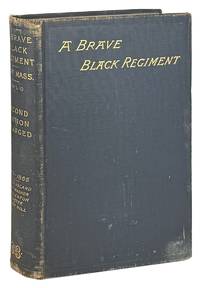
189448036Boston: The Boston Book Company 1894. Very Good -. Boston: The Boston Book Company 1894. Second Edition Revised and Corrected with Appendix upon Treatment of Colored Prisoners of War. Octavo; publisher's black cloth boards stamped in gilt; dark topstain; xvi 452pp.; frontispiece with tissue guard; photographs; nine maps five single-page and two folding all present though Charleston map at page 224 detached. Ex-library though with minimal external markings: discard stamps to edges of text block and preliminaries and institutional bookplate to front free endpaper. Boards worn with chipping and minor fraying to edges; binding sound; gift inscription in pencil to front pastedown from a Major D.T. Remington dated 1909. Pages toned but unmarked; a Good to Very Good copy. <br /> <br /> The expanded edition of an important regimental history of one of the first African American regiments raised after the Emancipation Proclamation--the unit's brave charge at Fort Wagner the same year was a Confederate victory but the boldness and valor of the Union soldiers prompted wide-spread Black enlistment a key tactical advantage for the North. Depicted in the 1989 film Glory; both the first and this expanded edition uncommon in retail. . The Boston Book Company unknown
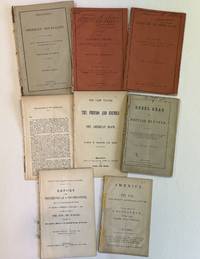
186441261Boston: Little Brown and Company 1864. 1. Bemis George: PRECEDENTS OF AMERICAN NEUTRALITY IN REPLY TO THE SPEECH OF SIR ROUNDELL PALMER ATTORNEY-GENERAL OF ENGLAND IN THE BRITISH HOUSE OF COMMONS MAY 13 1864. Boston: Little Brown. 1864. viii 83 1 blank pp. Disbound original printed front wrapper. Clean text. Good. <br /> <br /> England's reception and fitting out of Confederate privateers is inconsistent with its professed neutrality. The U.S. a neutral in earlier European wars prohibited such collaboration in American ports. <br /> FIRST EDITION. Sabin 4626. Bartlett 394. II DAB 174. Not in Harv. Law Cat. Marke.<br /> <br /> 2. Cordner Rev. John: CANADA AND THE UNITED STATES: AN ADDRESS ON THE AMERICAN CONFLICT DELIVERED AT MONTREAL ON THURSDAY EVENING DECEMBER 22 1864. Manchester: A. Ireland and Co. 1865. Original printed wrappers spine wear. ix 1 blank 30 pp. Disbound else Very Good.<br /> <br /> Published by the antislavery Union and Emancipation Society the pamphlet demonstrates that "the supposed hostile designs of the United States upon Canada" is merely an attempt to turn British sentiment against the Union. The rear wrapper is a two-column list of the officers of the Society including a two-column list of more than one hundred fifty Vice Presidents.<br /> Sabin 16762 Montreal printing only. Not in Bartlett.<br /> <br /> 3. Free Man's Aid Society: THE FRIENDS OF THE FREED-MEN. London: 1864. 7 1 pp. Caption title as issued. Disbound else Very Good.<br /> <br /> This rare pamphlet was written by John Curwen Secretary to the Free Man's Aid Society. He lauds the abolitionists- - British and American-- who aid the Union cause recognizing "instinctively that this must become an anti-slavery war." They have enlisted in fighting regiments organized the education of freedmen at Port Royal. The pamphlet describes the freedmen's schools the freed children's eagerness to learn and the observations of the teachers some of whom were women. <br /> OCLC 644153331 1- U Manchester as of August 2025.<br /> <br /> 4. Massie James W.: THE CASE STATED: THE FRIENDS AND ENEMIES OF THE AMERICAN SLAVE. Manchester: Union and Emancipation Society. 1863. 8pp. Disbound. Good.<br /> <br /> England's Union and Emancipation Society was committed to the abolition of Slavery. "What darker or more dreary calamity could threaten any nation or people on earth than the successful establishment of a Republic whose corner-stone shall be 'that the negro is not equal to the white man and that slavery- subordination to the superior race- is his natural and normal condition'."<br /> Bartlett 3040. Sabin 46186 note. Not in LCP or Dumond.<br /> <br /> 5. Owls-Glass pseud.: REBEL BRAG AND BRITISH BLUSTER; A RECORD OF UNFULFILLED PROPHECIES BAFFLED SCHEMES AND DISAPPOINTED HOPES WITH ECHOES OF VERY INSIGNIFICANT THUNDER VERY PLEASANT TO READ AND INSTRUCTIVE TO ALL WHO ARE CAPABLE OF LEARNING. New York: American News Co. 1865. Original printed wrappers the rear wrapper advertising 'The Martyr's Monument.' vi 7-111 1 blank pp. Clean text. Disbound else Very Good.<br /> <br /> Sabin and the Library Company suggest Richard Grant White as the author. The book "a curious study" of British elite opinion is a commentary on articles from British intellectuals which had supported the Confederacy. The author's close examination of British public opinion is a scathing condemnation of British turpitude. <br /> These were "undeniably able and dextrous writers and politicians who to please the public for whom they wrote and spoke opposed ridiculed and contemned our people and our government during the tremendous struggle for the worthy and honorable existence of our country. It would not be very easy for us to forget these efforts of our inimical kinsfolk or indeed desirable that we should lose sight of so instructive a warning. . ." <br /> Sabin 68317. LCP 11149. Bartlett 4012.<br /> <br /> 6. Potter Thomas Bayley: UNION AND EMANCIPATION SOCIETY. REPORT OF THE PROCEEDINGS AT A CONVERSAZIONE HELD IN THE MANCHESTER ATHENAEUM ON MONDAY EVENING FEBRUARY 1 1864 TO RECEIVE THE REPORT OF THE REV. DR. MASSIE RESPECTING HIS ANTI-SLAVERY MISSION TO THE AMERICAN CLERGY AND CHURCHES. Manchester: Alexander Ireland. 1864. 33 3 pp. Disbound without wraps Clean text. Good.<br /> <br /> Potter was the President of the Society a British organization based in Manchester and supporting the North in its war against Slavery. The pamphlet reports on "a very interesting conversazione" concerning Dr. Massie's trip to America. <br /> He met with President Lincoln "a man of integrity whose word is to be believed whenever he speaks. I came away with the conviction that he is the friend of the negro and the man of colour and that he has a firm resolution that whatever power he has shall be constitutionally exerted for the emancipation of every slave in the United States." Massie also met with Seward "again and again" and with Chase and other civil and military leaders all of whom favorably impressed him.<br /> "The day is not far off when the coloured regiments of America will be the safeguard of her negro freedom and the security for all the freedom that belongs to men of whatever colour" <br /> Not in LCP Bartlett Dumond Monaghan or Sabin. OCLC notes about fifteen institutional holdings.<br /> <br /> 7. Siemms F. D.: AMERICA. THE WAR: PAST PRESENT AND PROBABLE FUTURE. BEING THE SUBSTANCE OF A DISCOURSE DELIVERED AT THE CONCERT HALL LIVERPOOL. BY F. D. SIEMMS A NATIVE OF LIVERPOOL WHO SERVED AS AN OFFICER IN THE ARMY OF THE SOUTHERN CONFEDERACY FROM THE COMMENCEMENT OF HOSTILITIES TO A VERY RECENT PERIOD BEING AN EMBODIMENT OF HIS EXPERIENCES AND OBSERVATIONS DURING A PERIOD OF EIGHTEEN MONTHS AS AN OFFICER OF ARTILLERY. Liverpool 1864. 24pp. Disbound with wrapper remnants along spine. Good.<br /> <br /> Siemms says "Without any previous intention of being a soldier either in the army of the North or South yet I found myself one fine day an officer in the army of the Southern Confederacy." He gives some details of his unit's movements and briefly discusses different engagements while noting his frustration at the North's exaggeration in reporting its successes. His war experience was brief: "My military life ended" when he was taken prisoner "at Bull's run" and held as a prisoner until the British flag brought his release. <br /> Presenting himself as something of an expert he says "the negroes are far better off than a certain class of poor people in many European countries." He says 'Uncle Tom's Cabin' is filled with exaggeration and "downright untruths." He exposes "the false pretence that the North was fighting for liberty" and says the press has greatly exaggerated the North's progress in the field.<br /> Frederick David Samson Siemms 1844-1907 was born in England but it is unclear how he ended up in the United States or fighting for the Confederate Army. His military records show that he enlisted on May 13 1861 at the age of 17 years for a period of 12 months as a private with 1st Artillery Virginia Confederate with Capt. Johnson H. Sands' Company Co. B Henrico Artillery Virginia Light Artillery. His occupation was dentist and optician. Company muster rolls show he was discharged on July 20 1862. Military records of Frederick D. Siemms Fold3 website; Soldier and Sailor's Database at National Park Service website; The Commercial Gazette of London June 4 1890 Page 6. <br /> OCLC 4844821 1- U Rochester as of March 2025. Not in Bartlett or Sabin.<br /> <br /> 8. Smith Goldwin: ENGLAND AND AMERICA: A LECTURE DELIVERED BY GOLDWIN SMITH BEFORE THE BOSTON FRATERNITY DURING HIS RECENT VISIT TO THE UNITED STATES. . . Manchester: A. Ireland and Co. 1865. x 36 pp. Disbound original printed front wrapper. "With Thomas B. Potters Complts" written on front wrapper. Good.<br /> <br /> An odd combination of sympathies Smith supported the Union opposed imperialism and woman suffrage and disliked Jews. His lecture was first published in The Atlantic and was also printed in Boston. <br /> Sabin 82678. Bartlett 4507. Little, Brown and Company unknown
186663182Fort Douglas Utah: n.p. 1866. Photograph. Good. Mounted albumen print 7 3/4 x 5 1/4" on mount 9 1/2 x 7 1/2". In an original period frame 14 3/4 x 12 3/4". In pen to bottom margin of mount: "Head Quarters First Mich Veteran Cavalry Fort Douglas Utah Winter 1865 6." The subjects are dressed in their Civil War uniforms. The military band is on the left. Some light moisture damage to right side affecting just under one third of the photograph. Nice mounted photograph in original period frame. n.p. unknown
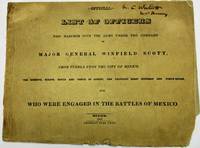
184835450Mexico: American Star Print. 1848. Oblong 4to. 24pp. Errata slip pasted to verso of title page listing "Names Accidentally Omitted" including that of 2d Lt. G.B. McClellan. Map entitled 'Battles of Mexico. Made by Major Turnbull Captain McClellan." Slip laid in concerning "1st Lieut. Andrew I. Williamson 3d Infantry." Original printed wrappers stitched as issued. Persistent chip at blank lower corner of all leaves but text unaffected. Very Good. Contemporary ownership inscription "Geo. C. Westcott U.S. Army" on front wrapper.<br /> <br /> "Printed on the occupying army's own press" Howes. The text lists in tabular format officers' "names and corps" dates "when and where employed" and a column of "Remarks" with information on the officer's fate: sick "mortally wounded" "seriously wounded" during August and September 1847. <br /> Many noted officers later served in the Civil War such as Robt. E. Lee "wounded at Chapultepec" Grant Beauregard Gordon Ewell Pemberton Buckner Longstreet Winder Magruder Pillow future President Franklin Pierce. The inside back cover has an "extract" of Scott's report summarizing his losses and the extent of his victory over the opposing Mexican army.<br /> This copy belonged to Brevet Captain George Clinton Westcott who "joined his regiment at Vera Cruz under the command of General Scott. He remained with that division of the army and participated in the subsequent battles occurring on the march to Mexico; and at Chepultepec although then belonging to the staff he volunteered as one of the forlorn hope in the attack on that citadel and was brevetted a captain for his gallant and distinguished conduct." CHARLOTTE S. WESTCOTT 33d Cong. 1st Sess. HR Rep. 162. 1854. His entry in this book is with his comrades of the 2d Infantry: "With stormers on the 13th Sept. Wounded at Contreras."<br /> Howes S243'aa'. 106 Eberstadt 212. Sabin 56771. American Star Print. unknown
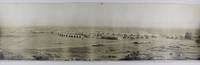
19171993Chicago: Mayhart Studio 1917. Very good. Large panoramic photograph 8 x 90.5 inches. Rolled. Light wear at edges with a couple of small chips and very short closed tears along top edge. minor dust soiling and toning. A fabulous and extremely long panoramic photograph measuring approximately 7.5 feet in length that depicts Camp Bowie in Fort Worth during October 1917. At this time the camp was still under construction but also housed an entire infantry division in training for World War I. Ongoing construction efforts are clearly evident as piles of lumber in various states of organization occupy the field in the center foreground. Already completed barracks and other out buildings occupy the right of the image and thousands of army tents sweep into the background of the center and left portions of the image. A group of standard houses likely for officers and their families is located at the lower left of the image. The photographers Mayhart Studio of Chicago were responsible for a number of military and patriotic views during the United States' involvement in the Great War including the well-known "Living Flag" image of thousands of servicemen composing an American flag.<br /> <br /> "Construction of Camp Bowie began on July 18 1917. The camp in the Arlington Heights neighborhood about three miles west of downtown Fort Worth was established by the United States War Department to give training to the Thirty-sixth Infantry Division. Local officials expected financial gain and urged that the camp be located at Fort Worth. Including the adjacent rifle range and trench system the site encompassed 2186 acres. Camp Bowie's greatest average monthly strength was recorded in October 1917 as 30901. For about five months after the departure of the Thirty-sixth for France in July 1918 the camp functioned as an infantry replacement and training facility with monthly population ranging from 4164 to 10527. Shortly after the Armistice on November 11 1918 Camp Bowie was designated a demobilization center. By May 31 1919 it had discharged 31584 men. The heaviest traffic occurred in June when it processed thousands of combat veterans of the Thirty-sixth and Ninetieth Texas-Oklahoma divisions. The demobilization having been concluded Camp Bowie was closed on August 15 1919" -- Handbook of Texas Online.<br /> <br /> A quite remarkable photographic document of this short-lived World War I-era army camp in Fort Worth whose grounds and surrounding neighborhood are now touted by the municipal tourism office as "the city's premier commerce corridor." We locate no other examples of this excellent and large panorama. Mayhart Studio unknown
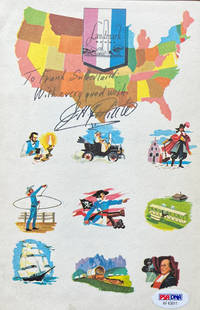
195360459New York: Random House c. 1953 1960. 8vo. 4 186 pp. plus 2 pp. publisher’s ads. With numerous photo plates. Beige-coloured publisher’s cloth decorated & lettered in brown & rust colour-illustrated endpapers w/ d.j. cover art of B-25 Mitchell Bomber dropping bombs on Japanese flag scuffing & edgewear head & foot of spine minor shelfwear still NF/VG copy inscribed to Frank Sutherland by General J.ames H.arold Doolittle on ffep. w/ discrete COA label at lower front corner and laid-in. Fourteenth printing inscribed by Jimmy Doolittle 1896-1993 of Landmark Books No. 35 and listing to “From Pearl Harbor to Okinawa†in ads at rear. Conceived originally in January 1942 just one month after the devastating Japanese attacks on Pearl Harbor was quickly organized with tests of B-25 B-26 and B-23 Bombers on the USS Hornet CV-8 and the Mitchell proved it could take off easily but not land. Colonel Jimmy Harold Doolittle who was involved in the original planning agreed to lead the task force launched from about 600 miles East of Tokyo drawing 16 B-25 Mitchell bombers from the USAAF 17th Bombardment Group. The Japanese were taken by surprise with the use of long-range US Army bombers and after dropping their loads of high explosive and incendiaries flew on to ditch and crash in China with 1 landing intact at Vladivostock. The raid although having little actual impact on the Japanese War effort proved decisive in changing the course of World War II and affected Imperial Japanese War planning by encouraging their fateful and decisive loss later at the Battle of Midway. Doolittle received the Congressional Medal of Honor for the raid and was a renowned test pilot flight instructor aided in the development of horizontal and directional gyroscopes and later was commander of the North African Strategic Air Forces the 15th Air Force in the Mediterranean and later the 8th Air Force. Random House, hardcover
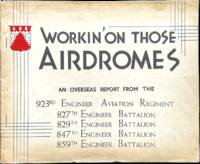
194577632923rd Engineer Aviation Regiment IX Engineer Command 1945. Wraps. The 923rd Engineer Aviation Regiment was a segregated African American unit activated August 1 1942 at Eglin Field Florida under the command of Colonel I.D. Brent. Sent to the United Kingdom to construct vital airfields for the American strategic bomber offensive the regiment arrived on August 14 1943 establishing its headquarters at Eye Suffolk. The 827th 829th 847th and 859th Engineer Aviation Battalions were joined to the regiment giving it a total of approximately 3200 black enlisted men and 130 largely white officers and making it the largest African American unit stationed in the United Kingdom during World War II.<br /> <br /> According to this unit history "The two greatest accomplishments of the men of this Regiment were the construction of Eye and Debach airdromes in England. The men of this organization worked long hours learned new trades and skills and gave up much treasured off-duty time to meet the exacting completion dates which were imposed upon us. On D-Day 6 June 1944 the first flight of Liberators took off from Debach; these planes together with those from Eye which had already been bombing Germany for several days dropped many hundreds of tons of bombs on the invasion beaches of Northern France in support of the invading Armies."<br /> <br /> Following the successful Allied invastion the 923rd built airfields in France for the First Tactical Air Force supporting the 7th Army and the First French Army advancing from the south. "In one case the Battalions joined together for the quick construction of a field for French fighter-bombers at Luxeuil finishing the runway in record time just as the first planes arrived. Later we maintained and built new facilities for Ninth Air Force fields. After V-E Day the Regiment took its part in the Occupational Air Force Program and completed two of the first fields which are to be used in policing Germany and enforcing the peace which we have won."<br /> <br /> This visual record of the 923rd Engineers includes images of the regiment's activities throughout the war. A photograph of the regiment drilling on Organization Day September 21 1944 is captioned: "the largest assemblage of colored troops in the ETO." There are also snapshots of boxer Joe Louis visiting the troops and a rehearsal by the famous U.S. Army Negro Chorus which was comprised of 200 members of the 923rd Engineers who performed at the Royal Albert Hall in September 1943 with tenor Roland Hayes and the London Symphony Orchestra and subsequently went on tour to Liverpool Manchester Glasgow and Edinburgh. The images are accompanied by a brief unit history a detailed description of the Eye and Debach airdromes a list of the airfields constructed improved or maintained by the 923rd Engineers and an "In Memoriam" listing the names of those who had died in service during the war.<br /> <br /> Oblong quarto: 41 p. with numerous photographic illustrations. Regimental insignia is reproduced in color on two pages and on the wrappers. Bound with staples in the original printed paper wrappers which are a bit edgeworn with some some general toning. Scarce OCLC locates only three holdings: University of Illinois U.S. Army Service Academy Missouri and U.S. Army War College. 923rd Engineer Aviation Regiment IX Engineer Command unknown
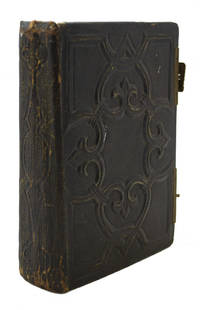
186168366Carte-de-Visite Album of 30 Union Civil War Generals Including Ulysses S. Grant CIVIL WAR. GRANT Ulysses S. Carte-de-Visite Album of 30 Union Civil War Generals. United States: Mathew Brady et al. n.d.c.a. 1861-1865. Small octavo album containing 30 individual carte-de-visites of Union generals in the Civil War. 5 3/4 x 4 1/2 inches; 140 x 110 mm. Each mounted within a decorative stiff card frame with gilt border. With 15 leaves and each leaf has a slot for two photographs. Most photos with a publisherÃs imprint on the back and the name of the general also penciled on the back. Album is contemporary embossed Morocco with two brass clasps. One clasp is broken. Gilt dentelles. Some pages have been reattached at margin but all are present. Some chipping and wear to head and tale of the spine but overall very good. A very nice assemblage of vintage photographs of officers from the Union. The carte-de-visites are as follows with a note on their publisher and condition if other than very good: 1. Winfield Scott D. Appleton. 2. George McClellan Charles Taber 3. Ambrose Burnside Appleton. 4. Michael Corcoran E. Anthony. 5. Silas Casey Charles D. Fredricks. 6. Nathaniel Banks Appleton. Slightly faded. 7. Ulysses S. Grant E. Anthony. 8. Henry Halleck Appleton. 9. Ethan A. Hitchcock Appleton. 10. Nathaniel Lyon Appleton. 11. John Pope E. Anthony from Brady's National Portrait Gallery. 12. Franz Siegel Appleton Faded. 13. Robert Anderson Appleton. Bottom of mount chipped. 14. John Wool Appleton. 15. William Sprague Charles D. Fredricks. 16. Group photo of 12 generals Unknown maker. Faded. 17. Max Weber Appleton. 18. Frederick W. Lander Appleton. Lightly faded. 19. Jesse L. Reno Unknown maker. 20. James Shields Appleton. 21. Unknown sitter Beers & Mansfield written on back. 22. Winfield Scott Hancock E. Anthony for Matthew Brady. 23. Thomas Francis Meagher Appleton Bottom of mount chipped. 24. Henry Washington Benham E. Anthony for Matthew Brady. 25. George Meade E & H.T. Anthony for Matthew Brady. 26. Egbert Ludovicus Viele Appleton. 27. Adam J. Slemmer Appleton. 28. Daniel Butterfield E. Anthony for Matthew Brady. 29.Charles D. Jameson E. Anthony for Matthew Brady.Red mark at bottom of photo on mount. 30. Edwin Vose Sumner Charles D. Fredricks. HBS 68366. $2000 Mathew Brady, et al. unknown books
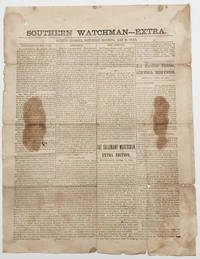
1865WRCAM53477Athens Ga 1865. Broadside 15 1/2 x 11 3/4 inches. Minor edge wear some toning and spotting two small dark stains old folds. Overall good condition. An interesting broadside newspaper extra concerning the Union occupation of Athens Georgia at the end of the Civil War. The paper was printed nearly a month after the Army of Northern Virginia surrendered and ten days or so after Gen. Joseph Johnston surrendered to Sherman the Confederate forces active in the Carolinas Georgia and Florida. The first two columns include passages on "Teachings of the War" "Armistice" and "Good Advice." Each of these articles struggle to find meaning in the end of the recent conflagration providing an important glimpse into the minds of the Southern sympathizers. The third column begins: <br> <br> "New Arrival! The Federal forces under command of Brig. Genl. Palmer entered our place on the 4th inst. The conduct of the troops since their occupation of the town has been good and reflects great credit upon Genl. Palmer as a strict disciplinarian. We hope that our citizens will endeavor by kind and courteous treatment toward the soldiery to encourage a continuance of the protection which they seem willing to afford." <br> <br> The editors of the SOUTHERN WATCHMAN argue for peaceful acceptance of the Reconstructionist Union forces and mince no words in their harangue on other Southern newspapers calling for the continuation of the War: <br> <br> "Below we give extracts from the SALISBURY WATCHMAN and CAROLINA SPARTAN - two papers that have from the beginning of the war advocated the policy of fighting on until the last man and dollar were exhausted and by their vile traitorous and insidious words exerted a strong influence over the minds of the South and thousands of widows and orphans who are now suffering every privation and horror connected with the war can attribute them to the false and unscrupulous arguments set forth and spread out in these papers. It is an easy thing and one that requires but little valor or manly spirit to cry out 'War to the last!' when comfortably ensconced at home surrounded by every luxury and comfort that civil life affords and where no Yankee bullets can reach. Such has been the position of those who govern the Southern press who keeping their devoted carcasses at a respectable distance in the rear still cry out for more lives to sacrifice and more money to squander to enable them to secure a foundation for their weak and rotten Confederacy to stand upon." <br> <br> The paper then quotes a long passage from each of these other newspapers. The editors of the SALISBURY WATCHMAN call for armed resistance before reporting that they themselves are preparing to "leave you for some spot on earth where Yankees cannot come." The CAROLINA SPARTAN incites the people to lay their lives "on the altar of Southern independence" before insisting in the last sentence that "we advise our friends to refrain from hostilities." <br> <br> A rare broadside relating to the delicate psychological condition and tenuous state of feelings among groups of Southerners who have been forced to realize that the fight for the Confederacy is over and they have lost. unknown books
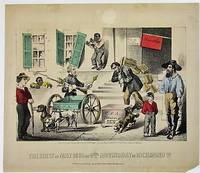
186534176New York: Published by H. & W. Voight. Lith. by Kimmel & Forster 254 & 256 Canal St. 1865. Broadside illustration 9" x 10-3/8". Brightly colored mildly toned. Small spot at top blank margin. Upper margin of blank verso shows remnants from former taping. Lower blank forecorner chipped. Very Good. <br/><br/> "From building inscribed 'To let Apply Lincoln & Co.' Southerners at whom Negro thumbs his nose are moving 'C.S.A. Treasury' etc." Weitenkampf. Anticipating the end of the Civil War in Richmond the cartoon depicts Robert E. Lee collecting swords for placement in a cart drawn by two skeletal dogs Treasury Secretary Trenholm hauling away worthless Confederate bonds and a "Sheriff Sale" sign on the building. Bystanders look on. A dog urinates on a box entitled "C.S.A. Treasury. Waster Paper." <br/> Despite the title's date the cartoon was probably issued before May 1 that date being the artist's prediction of the time of the Confederacy's collapse. The reference to Lincoln & Co. suggests the President was still alive. <br/>Weitenkampf 148 recording a 1905 reproduction only. Not in Reilly. OCLC 191119865 4- AAS Clements U VA Williams as of October 2019. Also located at the Library of Congress Boston Public Library Lincoln Financial Foundation Collection. Published by H. & W. Voight. Lith. by Kimmel & Forster, 254 & 256 Canal St. unknown books