CIVIL WARABAA
119 774 résultats
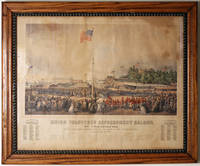
186122953<p>Showing Union troops arriving in Philadelphia from New Jersey via ferry and marching in formation towards the Union Volunteer Refreshment Saloon cheered on by Philadelphians. Text at the bottom lists members of the committee and men willing to accept donations for the saloon. This image became a choice souvenir for soldiers passing through Philadelphia.</p> <b>CIVIL WAR.</b>Print. <i>Union Volunteers Refreshment Saloon of Philadelphia</i>. James Queen delineator and lithographer. Philadelphia: Thomas Sinclair 1861. In period frame 35 x 29 in. <p><b>Historical Background</b></p><p>The Union Volunteer Refreshment Saloon was organized in South Philadelphia in 1861 by grocer Barzilla S. Brown. He began informally distributing food to Union troops traveling through Philadelphia an important rail and steamer hub. The relief effort became official on May 27 1861. The saloon provided soldiers with food drink stamps and paper and offered traveling troops a place to rest. This initial effort differed in some ways from the later Sanitary Fairs that contributed to the care of sick and wounded soldiers. At this point the civilian members were catering to the needs of healthy new recruits.</p><p>In September the Refreshment Saloon added a hospital to aid sick and wounded troops. The saloon supported itself through donations of food clothing cash and later through admission cost to view the Confederate navy vessel <i>Ram</i> which was captured in 1863. After providing social and medical services for four years the saloon closed in late 1865.</p><p><b>James Fuller Queen</b> 1820-1886 apprenticed to learn lithographic draftsmanship. He drew a large variety of lithographs for large printing houses of Wagner & McGuigan Thomas Sinclair and P. S. Duval. He drew views of buildings cities scenic attractions newsworthy events portraits sheet music covers diplomas illustrations for magazines and other images. He also became an outstanding chromolithographer. His view of the "Union Volunteer Refreshment Saloon" is one of Queen's most complex works and perhaps the one for which he is best known. He later drew the United States Sanitary Commission Fair in Philadelphia.</p><p><b>Thomas S. Sinclair</b> c. 1805-1881 was born in the Orkney Islands of Scotland and studied lithography in Edinburgh and other cities. He started his own printing firm in Philadelphia in 1838. He was among the first in Philadelphia to experiment with color lithography. From 1854 to 1859 his brother joined him in the firm of Thomas Sinclair & Co. Later his son worked with him in Thomas Sinclair & Son. He published three different hand-colored lithographs by Queen of Brown's Refreshment Saloon and its friendly rival William M. Cooper's Cooper Shop Volunteer Refreshment Saloon in 1861.</p> Thomas Sinclair books
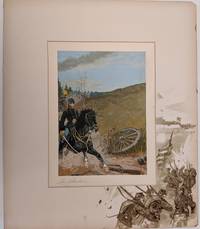
1887692New York: Koch Sons & Co. 1887. Folio. 480 x 405 mm. 19 x 16 inches. Printed index of plates followed by 12 chromolithographic images after original drawings by L. K. Harlow. Each image is mounted to a cardboard mat 11 of which have lithographic vignettes in the lower corner of the mat. Each image is preceded by a tissue with the title of plate printed; some of the tissues are creased and chipped at the out edges. Each plate is signed by Harlow in pencil and a few are signed in the plate; the images are clean and bright but the mats show some toning and a few have minor chips to the edges.  The folio plates are housed in a folding portfolio the spine and flaps are worn and probably should be discarded. Deluxe Edition numbered "79". Sold by Subscription Only. Scarce portfolio of Civil War paintings by the noted Boston artist Louis Kinney Harlow.  Harlow was noted for his water color illustrations that were used to illustrate scores of books and which keep the printer Louis Prang very busy in the 1880's and 1890's. Fielding writes "In 1880 he opened his studio in Boston. Since that time he has been much sought after by publishers of fine books his illustrations having color brilliancy." The plates in this portfolio depict aspects of army life and battle scenes including Grant at Vicksburg Sherman on his march and Sheridan at the Battle of Cedar Creek Each is finely designed and colored and each is signed in pencil in the lower margin. The color plates were printed by Koch and Sons and demonstrate the technical skills of the printer and his attention to detail and color registration. Copies of this portfolio were scarce in the trade. NUC lists only the Boston Public Copy and OCLC adds seven others all in American libraries. Mantle Fielding Dictionary of American Painters p. 158. . Koch, Sons, & Co. unknown books
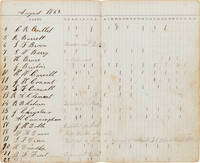
1862WRCAM55597Various locations mostly Louisiana 1862. 120pp. Contemporary sheep later leatherette backstrip title stamped in dark brown on front board reading "GUARD BOOK D. CO. 12TH. REG. MAINE." Some edge wear mild chipping and light scuffing to boards. Front hinge detached spine cracked. Occasional thumb-soiling to text. Still very good. A manuscript record book documenting an entire year of guard duty worked by various members of Company D 12th Maine Infantry Regiment Volunteers during the early part of the Civil War. The majority of time recorded in this book emanates from Louisiana while the 12th Maine Regiment was attached to Butler's Expeditionary Corps from January to March 1862. On their way to Louisiana the regiment travelled on the Steamship Constitution to Ship Island Mississippi serving there until May 4 1862. The Regiment then traveled to New Orleans for guard duty at the U.S. Mint until October 1862. While in New Orleans the Regiment took part in the expedition to Pass Manchaca from June 16 to 20 and the expedition to Ponchatoula from September 13 to 18. In October the Regiment moved slightly north to Camp Parapet in Shrewsbury Louisiana and served there until November 19 1862; the record book ends here. <br> <br> Each two-page opening of the ledger is pre- printed with a large column on the left for names and thirty-one numbered smaller columns for marking days served on guard duty. Most days have just one or two tick marks for any particular soldier indicating just one or two men were on active patrol mostly privates but also sergeants corporals musicians wagoners and others. The number of guard shifts worked by the regiment increased dramatically in May 1862 when they arrived at the U.S. Mint in New Orleans before falling off again the next month presumably after some relief arrived. In addition to guard duty service notations indicate reasons for absences such as "died at" "sick" "in confinement" "permanent detail" "enlisted for cook" "light duty" "in the woods" and "hospital." Notations from February 1862 indicate that James H. Andrews died onboard the Constitution on February 14 and two other soldiers caught sickness at Fortress Monroe. Another entry shows that S.G. Tracy "Died at Ship Island 12 of April 1862." Later in July Capt. H.W. Dunn is detailed for daily duty at the "Reding Press" in New Orleans. In August G.F. Drown is "Detailed as Nurse in General Hospital St. James Hotel N.O." <br> <br> Material from the Trans-Mississippi West is rare this early in the Civil War and also usually not as thorough as the present record book documents an entire year of service. A unique record of Civil War service for a peripatetic Maine volunteer infantry regiment serving in the Bayou State. hardcover books
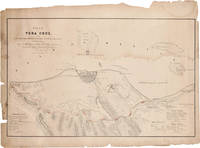
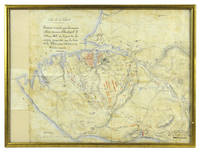
1847WRCAM48455Washington D.C. 1847. Engraved map 16 x 25 1/4 inches with hand- coloring on a 19 1/2 x 27 inch sheet. Worn around the edges with chips and loss not affecting the map imagery itself. Two closed tears in the left edge do intrude into the map. Paper tanned upper portion stained. About good. A scarce and detailed map of the Siege of Vera Cruz a turning point in the Mexican- American War. Winfield Scott with ten thousand American troops and a siege train landed on the beach near Vera Cruz on March 9 1847. The American forces outnumbered the Mexican defenders of the city by a two-to-one margin and the American guns were especially devastating. The city's castle was undamaged but the terrified citizenry implored Gen. Juan Morales to capitulate which was done at the end of March. The map notes American casualties as twelve killed and sixty-one wounded the actual numbers were slightly higher; the casualty rate among Mexican soldiers and civilians outnumbered that of the Americans. Vera Cruz would become an important port base for the American forces. This map shows the coastline from the road to Jalapa to the landing point of the American troops. The city and its main defenses are shown in detail and the headquarters of American commanders Scott Worth Patterson and Twigg are also shown. The Line of Investment is colored in red as is the location of the American hospital. Text on the map describes the make-up of the divisions led by Patterson Worth and Twigg. This map was drawn by George B. McClellan then a captain under Winfield Scott and a participant in the battle some fifteen years before he achieved notoriety as a commander in the Civil War and as the Democratic nominee for president in 1864. OCLC records some sixteen institutional copies but in our experience this map is scarce in the market. unknown books
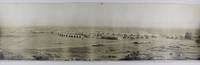
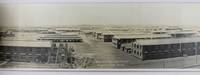
19171993Chicago: Mayhart Studio 1917. Very good. Large panoramic photograph 8 x 90.5 inches. Rolled. Light wear at edges with a couple of small chips and very short closed tears along top edge. minor dust soiling and toning. A fabulous and extremely long panoramic photograph measuring approximately 7.5 feet in length that depicts Camp Bowie in Fort Worth during October 1917. At this time the camp was still under construction but also housed an entire infantry division in training for World War I. Ongoing construction efforts are clearly evident as piles of lumber in various states of organization occupy the field in the center foreground. Already completed barracks and other out buildings occupy the right of the image and thousands of army tents sweep into the background of the center and left portions of the image. A group of standard houses likely for officers and their families is located at the lower left of the image. The photographers Mayhart Studio of Chicago were responsible for a number of military and patriotic views during the United States' involvement in the Great War including the well-known "Living Flag" image of thousands of servicemen composing an American flag.<br/><br/>"Construction of Camp Bowie began on July 18 1917. The camp in the Arlington Heights neighborhood about three miles west of downtown Fort Worth was established by the United States War Department to give training to the Thirty-sixth Infantry Division. Local officials expected financial gain and urged that the camp be located at Fort Worth. Including the adjacent rifle range and trench system the site encompassed 2186 acres. Camp Bowie's greatest average monthly strength was recorded in October 1917 as 30901. For about five months after the departure of the Thirty-sixth for France in July 1918 the camp functioned as an infantry replacement and training facility with monthly population ranging from 4164 to 10527. Shortly after the Armistice on November 11 1918 Camp Bowie was designated a demobilization center. By May 31 1919 it had discharged 31584 men. The heaviest traffic occurred in June when it processed thousands of combat veterans of the Thirty-sixth and Ninetieth Texas-Oklahoma divisions. The demobilization having been concluded Camp Bowie was closed on August 15 1919" -- Handbook of Texas Online.<br/><br/>A quite remarkable photographic document of this short-lived World War I-era army camp in Fort Worth whose grounds and surrounding neighborhood are now touted by the municipal tourism office as "the city's premier commerce corridor." We locate no other examples of this excellent and large panorama. Mayhart Studio unknown books
19171992San Antonio 1917. Very good. Large panoramic photograph 8 x 92 inches. Rolled. Minor wear at edges with one very short closed tear at top edge. Light blemish in negative at center of image. Light dust soiling and toning. An outstanding and extremely long panoramic photograph measuring well over 7.5 feet in length that depicts Camp Travis in San Antonio following its recent opening. Although the camp was open and housing an entire division-in-training at the time of this image the camp was still under construction as evidenced by the organized piles of lumber at the far right of the image and the incomplete barracks building in the center foreground. The panorama nevertheless gives a sense of the scope and size of the training camp with barracks and outbuildings stretching almost as far as the eye can see in the center and left sections of the photograph. Structures are more sparse in the right-hand side of the image both because they as yet unbuilt and because some of the training fields were located in this part of the camp. The photographers Mayhart Studio of Chicago were responsible for a number of military and patriotic views during the United States' involvement in the Great War including the well-known "Living Flag" image of thousands of servicemen composing an American flag. <br/><br/>"On July 15 1917 after its selection as the training site for the Ninetieth Texas-Oklahoma Division of the army Camp Wilson was renamed Camp Travis in honor of Alamo hero William B. Travis. The camp was ready for occupancy on August 25 1917. Additional land was subsequently acquired for vital training facilities and numerous structures were erected by the soldier welfare agencies. Camp Travis comprised 18290 acres of which 5730 were on the main campsite adjoining Fort Sam Houston. The Ninetieth Division was organized at Camp Travis in September and October of 1917. During the summer of 1918 Camp Travis served as an induction and replacement center with an average strength in July of about 34000 White and Black troops. On December 3 Camp Travis was named as a demobilization center. The facility was also designated a local recruiting station and a regional recruit depot in March 1919. Some 62500 troops were discharged at Camp Travis in about eight months. The camp then became the home station of the Second Division. Its service as a separate entity was terminated however upon its absorption by Fort Sam Houston in 1922" -- Handbook of Texas Online.<br/><br/>A quite fascinating view of this enormous World War I-era training camp in San Antonio now a part of the even larger Fort Sam Houston military base on the east side of the city. We locate no other copies of this large and remarkable panorama. unknown books
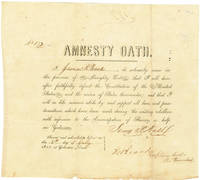
1865WRCAM55643Galveston 1865. Partially-printed document 8 1/4 x 9 1/2 inches completed in manuscript. Three vertical folds. Minor toning foxing soiling and edge wear. Very good. A rare Civil War amnesty oath attested to and signed by James P. Nash in Galveston on July 8 1865. The partially-printed document is signed by him twice and also dated and signed by the Captain and Provost Marshal Harry Beard. The oath reads in full: <br> <br> "Amnesty Oath. I JAMES P. NASH do solemnly swear in the presence of Almighty God that I will hereafter faithfully defend the Constitution of the United States and the union of States there=under; and that I will in like manner abide by and support all laws and proclamations which have been made during the existing rebellion with reference to the Emancipation of Slavery; so help me God. JAMES P. NASH. Sworn and subscribed to before me this 8th day of JULY 1865 at Galveston Texas. H. BEARD Captain and Provost Marshal." The signer of the Amnesty Oath James P. Nash was likely the same James P. Nash who was an early educator and professor in Galveston. <br> <br> This 1865 amnesty oath appears to exist in two states: one blank below the line "1865 at Galveston Texas" and one with a dotted line added above the printed words "Captain and Provost Marshal." The present example is the former and likely first state of the document before the dotted line and "Captain and Provost Marshal" were added later. <br> <br> Amnesty oaths are scarce in the market; this one is especially interesting for its association with an early Galveston educator. unknown books
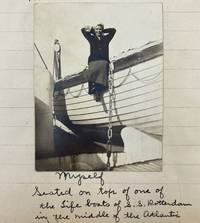
19141820Various places in Germany mostly Darmstadt as well as England Holland the Atlantic Ocean New York and Allentown 1914. Good plus. 144pp. with ten original photographs and printed document mounted at rear. Quarto commercial journal. Black cloth boards edges dyed red. Spine perished boards attached with amateur tape repairs. Text block solid. Minor offsetting from photographs; a bit of soiling to first leaf; light even tanning. Accomplished for the most part in highly legible hand; approximately 17500 words in total. A remarkable manuscript travel journal that documents the European trip of a 22-year-old Pennsylvania woman its interruption by the outbreak of World War I her subsequent stranding in Germany and her trials in securing passage back to the United States. Anna F. Weil b. about 1892 the daughter of an Allentown grocer John Weil departed New York on June 29 1914 aboard the S.S. Rotterdam a 3400 passenger luxury cruise liner operated by the Holland America Line. She arrived in Rotterdam Germany on July 9th and proceeded to connect with family and sightsee in Germany and the Netherlands with plans to proceed to Switzerland and Germany which were cut short by the declaration of war between Germany and England:<br/><br/>"Wed. July 29. To-day war was declared I have many postal cards written to send to American but was told not to send them as they would not reach their destination so all communication with outside countries is cut off. The harbor is closed and no ships can leave or enter German ports. The English cut the German cable a few days ago before war was declared so now we can't even send a telegram from Germany." p.68<br/><br/>At first the war is present in daily life but still seems some distance from it:<br/><br/>"On Sunday Aug. 23. I saw the first wounded French soldiers saw a wagon full but there were well treated by the Germans and the people expressed pity for them as they were a sad looking party. We were at Frankenstein's Castle a ruin on the mountain which can be seen way in the distance from Darmstadt. It was a very nice ramble through the woods and part of the castle is used as a restaurant where we had some thing to eat and drink before resuming our ramble in and about the castle. When at the top of the town it was nice to look over the tops of the trees over the fields and see the villages and the city away off in the distance." <br/><br/>The reality of the situation however quickly becomes more evident and more pressing:<br/><br/>"Aug. 28. Friday. Received a letter from Angeline dated July the 23d. also one from Frank dated August the 4th. Saw hundreds and hundreds of horses which are taken and sent to battle with the men. Saw many companies leaving it was a beautiful sight to see them march as one man. As they passed through the streets the women came and greeted them and gave them flowers. Horses wagons men every thing was covered with the acorn leaves the German emblem of victory and as the women gave the flowers they were placed among the acorn leaves and so they left their homes families and country with flowers and song and their flags waving high above them. It was a beautiful and inspiring sight to see them go but to think of their return made one's heart grow sad. One company that I saw Company 115 had but 30 men left after the battle the rest were dead or wounded."<br/><br/>Throughout the account her German heritage shapes a favorable view of the Germans in the war:<br/><br/>"In Belgium the Germans were very much ill treated they had to flee the country in 1 hours notice and leave every thing back Elizabeth Buehler and her brother as well as other Germans who were living in Belgium in the city of Antwerp had to flee for their lives and all their belongings were taken from them they arrived in Darmstadt with nothing but what they had on their bodies. When the war first broke out the Russians who were in Germany threw bombs and tried various ways of doing mischief. So all were given a chance to leave and got to their own country. Those who refused and did any mischief were taken into custody and placed under guard until the war is over. Those who did any wrong were sentenced to death were shot. This was at least more human that the way some of the Belgians and Russians treated and mutilated the Germans when they had done no wrong and deserved no punishment. War is war and there are rules which we cannot change and are considered honest in warfare but I don't think it right to torture or mutilate a wounded soldier whether friend or foe."<br/><br/>She remained with family at an estate on Dieburger Strasse in Darmstadt Germany until she was able to secure an emergency passport from the American Consul in Frankfurt on September 15th. The return passage was fraught as Holland America misplaced her reservation the ship was delayed and she was forced to find temporary lodgings in Rotterdam when she arrived on October 1st:<br/><br/>"When we got there the proprietor said all was taken this made the porter cross and he said he would find some kind of place for us but we were not going to take any kind of a make shift so we turned and hurried back to the station the porter took hold of my arm and tried to detain us but I broke loose and Mrs. Kramer and I ran as fast as could when we reached the station we were just in time to catch the other four who were driving away in carriages. The eldest one saw us running and stopped the team and waited for us. We got in and such a time till we found lodgings. Every thing was taken which was due to so many Americans and fleeing Belgians. We succeeded in finding a place at 2.30 am where all six of us stayed. Then there was trouble with the driver and one of the Americans went out and called a police-man and settled the trouble and we retired at 3am."<br/><br/>She eventually landed back in The States after a return trip that saw rough seas and an intense scrutiny of passengers upon landing in New York:<br/><br/>"At Staten Island the doctor came to our ship with a yacht flying the yellow flag. Here we stopped for some time the mail ship came and all mail bags were given over to this ship. Then another yacht crowded with American custom officers arrived on the scene and boarded our ship. Then we all had a hurried lunch as there was no time for supper. All had to go on deck until the dining room was in readiness for the officers. It was dark by this time and the ship under way again. When all was ready we had to stand in line with our yellow tickets. Only a few at a time were allowed to enter the dining-room. When once inside we had to look about for the table bearing the number of our ticket. Here we were interviewed by the officer at that table. Some people had a great deal of trouble and were sent from one table to another. Others were refused admission into the United Sates and some had to go to Ellis Island."<br/><br/>The rear pages of the journal are illustrated by 10 mounted original photographs of her initial journey family some sightseeing and her return passage; also tipped in are her emergency passport and a typed letter from the American consul. Overall the journal is a detailed and eventful original woman's travel manuscript as well as a rich primary record of an American civilian caught in Europe during the outbreak of the Great War. A partial transcription with additional excerpts is available upon request. unknown books
Together 27 vols., 8vo., First Edition, with 2 large folding charts; original printed wrappers, one or two backstrips scuffed at head and tail else a remarkably well-preserved, bright, clean set. The extended set comprises: Part 1: 20 Nov 1945 to 1 Dec 1945 (1946); Part 2: 3 Dec 1945 to 14 Dec 1945 (1946); Part 3: 17 Dec 1945 to 4 Jan 1946 (1946); Part 4: 7 Jan 1946 to 19 Jan 1946 (1946); Part 5: 21 Jan 1946 to 1 Feb 1946 (1946); Part 6: 2 Feb 1946 to 13 Feb 1946 (1947); Part 7: 14 Feb 1946 to 26 Feb 1946 (1947); Part 8: 27 Feb 1946 to 11 March 1946 (1947); Part 9: 12 March 1946 to 22 March 1946 (1947); Part 10: 23 March 1946 to 3 April 1946 (1947); Part 11: 4 April 1946 to 15 April 1946 (1947); Part 12: 16 April 1946 to 1 May 1946 (1947); Part 13: 2 May 1946 to 13 May 1946 (1947); Part 14: 14 May 1946 to 24 May 1946 (1947); Part 15: 27 May 1946 to 6 June 1946 (1948); Part 16: 7 June 1946 to 19 June 1946 (1948); Part 17: 20 June 1946 to 1 July 1946 (1948); Part 18: 2 July 1946 to 15 July 1946 (1948); Part 19: 16 July 1946 to 27 July 1946 (1949); Part 20: 29 July 1946 to 8 August 1946 (1949); Part 21: 9 August 1946 to 21 August 1946 (1949); Part 22: 22 August 1946 to 31 August 1946; 30 Sept 1946 and 1 October 1946 (1950); Part 23: Index (1951). WITH Opening Speeches of the Chief Prosecutors (1946); Speeches of the Prosecutors against the Indicted Organisations (1946); Speeches of the Chief Prosecutors against the Individual Defendants (1946); Judgement of the International Military Tribunal (with the Dissenting Opinion of the Soviet Member) (1946). Volume 1 includes the folding chart of the organisation of the NSDAP; Volume 3 contains the folding chart of the organisation of the SS. EXTENDED SETS ARE EXCEEDINGLY SCARCE.
1614LRB170909Dans une reliure hollandaise pastiche de belle facture avec lacets en cuir mégis, 26 libelles en parfait état, complets, série homogène de 1614. Nombreuses marques de libraires, tous de Paris. In-12° parchemin
201192142Images Publishing Dist Ac. New. 2011. Hardcover. 1864703830 . FREE UPGRADE to Courier/Priority Shipping Upon Request - IN STOCK AND IMMEDIATELY AVAILABLE FOR SHIPMENT - Flawless copy brand new pristine never opened -- 240 pages; 400 illustrations in color. Description: "Millions of pilgrims flock to Fatima in Portugal every year. A new church building was needed to accommodate up to 9000 people. The Most Holy Trinity Church was completed in 2007 for use at Sunday mass. The challenge was to create a building that despite its size would blend unobtrusively into the historical site offering the possibility to be used for other cultural or religious purposes too. Features essays project descriptions and photography by Fernando Guerra that brings the project to life." -- with a bonus offer-- . Images Publishing Dist Ac hardcover
2015111338Hatje Cantz. New. 2015. Hardcover. 3775738991 . FREE UPGRADE to Courier/Priority Shipping Upon Request - IN STOCK AND IMMEDIATELY AVAILABLE FOR SHIPMENT - Flawless copy brand new pristine never opened - -- with a bonus offer-- . Hatje Cantz hardcover
200223954Bloomington Indiana U.S.A.: Authorhouse. New. 2002. Paperback. 1403381291 . FREE UPGRADE to Courier/Priority Shipping Upon Request - IN STOCK AND IMMEDIATELY AVAILABLE FOR SHIPMENT - --Flawless -- with a bonus offer-- . Authorhouse paperback
196882266Galleries. As New. 1968. Paperback. FREE UPGRADE to Courier/Priority Shipping Upon Request - IN STOCK AND IMMEDIATELY AVAILABLE FOR SHIPMENT - AS NEW THE TEXT BLOCK IS PRISTINE CLEAN UNMARKED AND IN EXCELLENT CONDITION - - 48 pages 46 illus. 1 in color. -- with a bonus offer-- . Galleries paperback
2015111525Birkhäuser. New. 2015. Paperback. 3038216607 . FREE UPGRADE to Courier/Priority Shipping Upon Request - IN STOCK AND IMMEDIATELY AVAILABLE FOR SHIPMENT - Flawless copy brand new pristine never opened - -- with a bonus offer-- . Birkhäuser paperback
200789894University of New Mexico Press. New. 2007. Hardcover. 082634139X . FREE UPGRADE to Courier/Priority Shipping Upon Request - IN STOCK AND IMMEDIATELY AVAILABLE FOR SHIPMENT - Flawless copy brand new pristine never opened -- 152 pp. ; 73 illus. -- with a bonus offer-- . University of New Mexico Press hardcover
2015112189Museu d'Art Contemporani de Barcelona MACBA. New. 2015. Paperback. 8492505524 . FREE UPGRADE to Courier/Priority Shipping Upon Request - IN STOCK AND IMMEDIATELY AVAILABLE FOR SHIPMENT - Flawless copy brand new pristine never opened - Text in English and Spanish. -- with a bonus offer-- . Museu d'Art Contemporani de Barcelona (MACBA) paperback
87596August 1855. . Manuscript map in watercolour and ink on linen 41 x 54 cm framed. Some spotting.<br /> Manuscript plan on linen of the siege of Sebastopol: a fine and unusual map drawn by Sergeant Neubourg according to the instructions of Captain Koch of the French First Foreign Infantry Regiment. It shows the location of the allied troops on the banks of the Chernaya River near the city of Sebastopol which was besieged by the allies from September 1854 until the end of August 1855. The capture of the Redan Redoubt one of two key strong-points in the defences of Sebastopol by French troops including the Legion prompted the Russian evacuation and surrender of the city in August 1855 after an eleven month siege. This was the final episode in the Crimean War which ended officially in February 1856. Despite being heavily involved in the fighting more legionnaires succumbed to the deprivations of camp life notably the bitter cold than died in battle.<br /> August, 1855. unknown
189910825New York and Albany: Wynkoop Hallenbeck Crawford Co 1899. Hard Cover. Very Good binding. Octavo. 116 pp. frontis plates ports folding table. First edition. Signed and inscribed by Stonebraker. In publisher's cloth with title in red on the front cover; more than three dozen inserted illustrations are present as called for as well as the folding genealogical table at the rear. Binding is a trifle edgeworn and moderately soiled; gentle fold to the bottom corner of much of the textblock; a very nice copy. <br /> <br /> An exceptional copy of a rare Confederate memoir. This copy inscribed by Stonebraker to L. Victor Baughman. Stonebraker was a member of Co. C First Maryland Cavalry; Baughman served in Co. D of that regiment. CWB I 164; Dornbusch II 522. Wynkoop Hallenbeck Crawford Co unknown
190210674Anniston AL: Norwood 1902. Hard Cover. Good binding. Octavo. 2 89. 1 pp. First edition. In original cloth with title in gilt on the front cover. Binding is worn at the head of the spine with small loss to cloth; likewise the bottom corner of the front board is worn; binding is generally darkened and somewhat soiled; a solid copy with light to moderate foxing/toning to the contents. Despite its faults this is a better copy than one usually sees. Laid in is a tattered reproduction of: "Pages from History & The Men from Pickens County Who Wore the Gray" compiled by Mrs. T. R. Spell Jr. with a short history of Pickens County veterans in attendance at past U.C.V. events the roll of Company B and a list of those killed and wounded from J. H. Pepper's diary about the Battle of Vicksburg<br /> <br /> The diary was largely taken directly from Captain Elbert D. Willett's daybook while in the war. His son Joseph Jackson Willett edited this book and remarks on its merits in a short preface: "It is not expected or contended this book will shed any additional light on that momentous struggle known as the War between the States about which so many volumes have been written . . . . but that diary now well thumb worn which faithfully records the movements engagements and casualties of Company B and the 40th Alabama Regiment C.S.A. Willett's notes have the advantage however of being written at the same time yes on the same day the narrated facts occurred. No matter how long the march or how fierce the battle the author of the diary on each day recorded the doings of Company B." An interesting contemporary account which given the immediacy with which events were recorded probably does "shed additional light" contrary to J. J. Willett's suggestion to the contrary. The final 5 pages are taken from the diary of J. H. Curry. Additionally several pages of rosters are included. Rare in commerce. Howes W-437 "aa"; Dornbusch II AL-76; Wright W-685. Norwood unknown
Very Good Turkish, Ottoman (1500-1928) Fine brown quarter leather bdg., brown boards with decorative embossing. Roy. 8vo. (24 x 17 cm). In Ottoman script (Old Turkish with Arabic script). 176 p., 33 unnumbered b/w plates of views of the Middle Eastern cities, Kaiser and queen's portraits, ills. of their maritime voyages, a general view of Beirut, a panorama of Jerusalem (in two pages), The Government House and Lake Tiberia in Beirut, a general view of Jaffa, churches and castles and Masjid-i Aksa of Jerusalem, Idlib, the interior of the Umayyad Mosque in Jerusalem, The Government House of Jaffa, Beirut - Damascus railways, street views and architectural buildings from Damascus, the market place of Jaffa, Bethlehem and the church, views of Trablus-Sam [i.e. Tripolis], ruins of Baalbek, and other numerous b/w photos, published for only this book. Slight stains on pages, a modern repair on a leaf with tape, otherwise a very good copy. Bound together with "Eski Sevda" which is a compilation of Turkish tales. First and only edition of this richly illustrated scarce and uncommon book was printed for the German Emperor Wilhelm II and his wife Augusta Victoria, the commemoration of the construction of Alman Çesmesi [i.e. German Fountain] in Constantinople, and the first anniversary of the Wilhelm II's travel to the Ottoman Empire in 1898. The fountain's design was drawn by the architect Spitta and constructed by the architect Schoele with the German architect Carlitzik and Italian architect Joseph Anthony, working on the project. The fountain was built in Germany and then transported piece by piece to Istanbul, reassembled in its current site, and officially opened on January 27, 1901, on the birthday of German Emperor Wilhelm II. Wilhelm II's voyage to the Levant in 1898 was a state visit that the German Emperor undertook in the Ottoman Empire between 25 October and 12 November 1898. The Kaiser started his journey to the Ottoman Eyalets with Istanbul on 16 October 1898; then he went by yacht to Haifa on 25 October. After visiting Jerusalem and Bethlehem, the Kaiser went back to Jaffa to embark on Beirut, where he took the train passing Aley and Zahlé to reach Damascus on 7 November. This book is richly illustrated including many views of the cities of this voyage's destinations like Jerusalem, Damascus, Beirut (Beirut), Jafa, Baalbek, etc. On 10 November, Wilhelm went to visit Baalbek before heading to Beirut to board his ship back home on 12 November. His visit spurred interest in the German Templer colonies in Palestine. One of the Kaiser's traveling companions, Colonel Joseph von Ellrichshausen, initiated the formation of a society for the advancement of the German settlements in Palestine, named the Gesellschaft Zur Förderung der Deutschen Ansiedlungen in Palästina, in Stuttgart. It enabled the settlers to acquire land for new settlements by offering them low-interest loans. A subsequent second wave of German settlers founded Wilhelma (named after the Kaiser, now called Bnei Atarot) in 1902 near Lod, Walhalla (1903) near the original Jaffa colony, followed by Bethlehem of Galilee (1906). The German Settlement Society successfully encouraged some of the Templars to return to the official, national Protestant Church. The non-Templar colony of Waldheim (now Alonei Abba) was subsequently founded next to Bethlehem of Galilee in 1907 by proselytized Templers now affiliated with the Old-Prussian State Church. The visit resulted in the highest-profile political event in the life of Theodor Herzl, considered the founder of Zionism. Through the efforts of William Hechler, via Frederick I, Grand Duke of Baden, Herzl publicly met Wilhelm II three times during the voyage, once in Istanbul (on 15 October 1898) and twice in Palestine (29 October and 2 November). The meetings significantly advanced Herzl's and Zionism's legitimacy in Jewish and world opinion. (Wikipedia). Only one copy in OCLC (Library of Congress. Karl Süssheim Collection, no. 1300) 900684728. Özege 7023
Very Good Turkish, Ottoman (1500-1928) Collection includes six postcards by him sent to Mehmed RAsih Bey, Âli Türkgeldi (Sofia, Bulgaria), Satvet Lütfi Tozan, one newspaper clipping about Gerede, eight autograph letters signed 'Hüsrev' sent to Satvet Lütfi Tozan, (1889-1975), Âli Türkgeldi, 1867-1935) and beside ones which came from them to him. Some letters are more than one page. Full text. In Ottoman script. Items dated from 1920 to 1929/30 on letters and postcards. All in one envelope with Ottoman script autograph notes and name of Hüsrev Gerede on it. Letters and other material include mostly important diplomatic contents and early Republican Turkish historical info. These material is not published. Gerede was a Turkish career officer, who served in the Ottoman Army and the Turkish Army. He was also a politician and diplomat of the Republic of Turkey. He has Medal of Independence with Red-Green Ribbon.
D17848Album 60 pp recto and verso "Autographs and Sketches" stamped in gilt to front cover with approx. 35 gelatin silver prints laid in and letters maps diagrams postcards and foreign press clippings tipped in label "J.M. de Beaufort / Author Soldier War Correspondent late with the Belgian Army" attached to front cover de Beaufort's business card taped to inner front cover photographs laid in to front and back covers. Many pages loose or stained some loss to three leaves edgewear and toning throughout. Covers worn with tape remnants. Sold as is. <br/><br/>Belgium circa October-December 1914. At that point the Belgian Army had only recently entered the war and was being routed by the German Army's superior numbers. Belgium's high command cleverly devised a plan to flood the vicinity of Furnes to keep the Germans at bay. There are several fairly detailed hand-drawn diagrams in pen colored pencil and pencil of the flooding plan. The photographs in the journal mainly depict Belgian and French soldiers; de Beaufort is visible in several. One image shows two unexploded bombs with "aeroplane bombs" written on its verso in pencil beside de Beaufort's note about how they landed close to his room in Furnes. Other photographs show bombed-out buildings. There are cartoonsmostly anti-Germandrawn at various points throughout. De Beaufort also known as Count de Beaufort was quite an elusive figure. His real name was Uilenbroek and he was a Dutchman thought to have been a deserter. He came to Chicago in 1909 married a steel magnate's daughter and entered show business. By 1912 he was divorced and took up newspaper work; he became known as the "Dude Reporter." See American Cinematographers in the Great War 1914-1918 2015. <br /> unknown
194456291Detroit MI: Progressive Welder Sales Co. ca. 1944-1945. Thick 4to. 10 x 11.75 x 2 in. 88 pp unpaginated. mylar leaves each w/ black paper insert with 83 silver gelatin photos all sized 8 x 10 in. inserted into glassine sleeves nearly all w/ typed captions affixed to lower margin of image and/or negative numbers w/in image at lower margin. Original U.S. Army Brown pebbled cloth patented Burco Prong Binder prong screw posts at gutter marbins rounded corners stamping on front cover & spine minor rubbing shelfwear light rubbing still retaining the original black flexible board flyleaves VG copy. An exceedingly scarce photographic sample album for the groundbreaking and innovative Progressive Welder Sales Co. during World War II. The company was founded in 1935 by Johnson b. 1896 noted Chrysler engineer and trouble-shooter who invented the first multiple-point spot welders for use in auto production who quickly began developing and creating resistance welder machines which redefined fabrication techniques to meet wartime production demands. These extraordinary photographs show the jigs and machinists creating the necessary welding equipment in constructing tanks tank gun turrets extra belly tanks for aircraft and the necessary machined parts. Also shown are the checking fixtures designed and built for the various manufacturers producing the Fairchild C-82 Packet a twin-engine twin-boom cargo aircraft used by the USAAF during World War II which was also designed as cargo carrier troop transport dropping parachute troops and glider towing. Also shown are mount welding fixtures for the Glenn L. Martin version of the B-29 Superfortress jigs and equipment to properly and quickly manufacture B-29 wings B-24 Liberator Wings drilling gauges for Curtiss fighter planes along with the many fabricated fixtures and welding equipment designed for Chevrolet’s St. Louis plant producing DUKW Amphibious transports Duck’s used heavily on the D-Day beaches of Normandy and in the Pacific theatre on Saipan and Guam. Fred Johnson and his company invented scissors-type welding guns rotisserie jigs for turning pieces under manufacture and his multi-spot welder machines were combination hybrid presses and fixtures which sped up aircraft production in World War II by unparalleled amounts. Progressive Welder Sales Co. was very active during World War II often producing these massive thick sales albums featuring their latest innovations on resistance welding technology all of the factory fixtures they were producing and how they could speed up production but we can find no institutional listings of other survivors. In 1950 Progressive Welder Sales Co. was converted over into the innovative and groundbreaking Creative Industries of Detroit which launched itself into national consciousness by building President Truman’s Lincoln Cosmo and would go onto build the concept cars such as the FX-Atmos Mercury XM-800 Dodge Granada Packard Balboa Ford Mystere Corvette Corvair Dodge Charger 500 and the Plymouth Superbird. No copies located in Worldcat; See: Leon Dixon Creative Industries of Detroit: The Untold Story of Detroit’s Secret Concept Car Builder 2017 pp. 16-30. Progressive Welder Sales Co., hardcover
1917MILI0388(1914-1917). 4°, in drei Lnbdn. mit Deckel u. Rückenvergldg., gemust. Vors., Besitzerstemp., sehr guter Zustand. Die Tägliche Ausgabe beginnend am 26. Oktober 1914 einschließlich der Ergänzungsdrucke (Vorgeschichte des Krieges, die die amtlichen Nachrichten von dem Attentat in Sarajevo bis zum Tage der Kriegserklärung an Serbien enthält. Die täglichen Nachrichten vom Tage der Kriegserklärung an Serbien bis zum täglichen Erscheinen des "Feldblattes"). Von Ausg. Nr. 1 - Nr. 970, Mittwoch, 27. Juni 1917. [2 Warenabbildungen]