119 774 résultats
In- 8 oblungo (mm 245 x 205), frontespizio, pp. 118 di testo e 40 tavole litografiche a colori (la n.39 dell'assedio di Peschiera non è mancante ma inserita come vignetta al frontespizio) e 2 carte delle battaglie di Magenta e Solferino comprese nel testo. Legatura mezza pelle, titolo e fregi oro al dorso.Titolo litografato a colori con vignetta, seguono la Prefazione, "Proclama di Napoleone III" stampato con caratteri oro su fondo blu. Testo descrittivo racchiuso entro cornice litografica (impressa in verde, blu, rosso, marrone) con motivi militareschi. Nell'indice dei ritratti al n.12 è indicato il Gen. Castelborgo, mentre al suo posto è presente il ritratto del Gen. Mollard. Edizione originale completa delle 62 incisioni (40 a colori, 20 ritratti su fondo ocra e 2 carte geografiche in b/n). Le belle tavole furono disegnate dal Bossoli ed eseguite in litografia da vari autori. Il ticinese Carlo Bossoli (1815-1884) pittore, disegnatore e litografo, fu inviato a seguito dell'esercito sardo nella guerra del 1859 e documentò con grande realismo gli episodi bellici. Il testo si basa sulle lettere dell'ungherese Nandor Eber, corrispondente per il Times. Questa importante raccolta di stampe a colori era stata pubblicata l'anno precedente a Londra con il titolo The war in Italy. Il successo di questo primo volume portò l'editore alla pubblicazione di una seconda parte, dedicata alle imprese di Garibaldi nelle due Sicilie e dell'Armata Piemontese di Vittorio Emanuele nelle Romagne e nel Napoletano.Qualche segno del tempo alla legatura, qualche macchietta e piccola arrossatura su alcune tavole, nel complesso ben conservato. . Abbey, J.R. Travel, 177 .
In Anversa, appresso Gioachimo Trognaesio, 1611, in-folio, legatura settecentesca in piena pergamena, pp. [12], 221, [7], le ultime due carte bianche. Con frontepiszio inciso (preceduto da frontespizio tipografico non recante data o editore) e 16 illustrazioni calcografiche su 15 tavole ripiegate f.t. Colophon in fine: Antverpiae, apud Ioachimum Trognaesium, 1611. Alcune carte piuttosto brunite per diversa qualità della carta. Prima edizione di quella che viene considerata una delle più belle opere sull'arte militare del Seicento. Ex-libris Conte di Torino.
15 vols., 8vo., First Edition, (for individual volume see below); cloth, gilt backs, a very good, bright, clean set in the dustwrapper (for individual dustwrapper see below). The series comprises: 'The Dark Lantern', 'Donkey Boy', Young Phillip Maddison', 'How Dear Is Life', A Fox Under My Cloak', 'The Golden Virgin', 'Love And The Loveless', 'A Test To Destruction', 'The Innocent Moon', 'It Was The Nightingale', 'The Power Of The Dead', 'The Phoenix Generation', 'A Solitary War', 'Lucifer Before Sunrise' and 'The Gale Of The World'. The first seven dustwrappers were designed and illustrated by Broom Lynne. Individual volumes as follows: The Dark Lantern (1951), inscription on front free endpaper, top mildly spotted, price-clipped dustwrapper lightly browned; Donkey Boy (1952), some very faint offsetting from fold-ins to free endpapers, unclipped dustwrapper lightly chafed without material loss at head and tail of backstrip and with one short closed tear; Young Phillip Maddison (1953), some very light offsetting from fold-ins to free endpapers, unclipped dustwrapper, very lightly sunned at backstrip, mildly spotted on (predominantly white) rear panel); How Dear Is Life (1954), mild offsetting from fold-ins to free endpapers, top dust-soiled, boards browned at extreme tops edges and head and tail of backstrip, unclipped dustwrapper, lightly chafed with very minor loss at head and tail of backstrip, lightly age-soiled; A Fox Under My Cloak (1955), mild offsetting from fold-ins to free endpapers, unclipped dustwrapper, very lightly sunned at backstrip, very lightly spotted on (predominantly white) rear panel; The Golden Virgin (1957), neat contemporary signature on front free endpaper, joints lightly rubbed, backstrip chafed at extreme head and tail, unclipped dustwrapper, very lightly browned at backstrip; Love And The Loveless (1958), backstrip lightly browned at extreme head and tail, unclipped dustwrapper, lightly sunned at backstrip, lightly browned on (predominantly white) rear panel; A Test To Destruction (1960), unclipped dustwrapper, moderately sunned at backstrip (red lettering just legible), mildly browned on front and rear panels; The Innocent Moon (1961), some light offsetting from fold-ins to free endpaper, top faintly spotted, unclipped dustwrapper, some light dust-soiling on (predominantly white) rear panel; It Was The Nightingale (1962), fore-edge lightly dust-soiled, unclipped dustwrapper, lightly sunned at backstrip, lightly browned on (predominantly white) rear panel; The Power Of The Dead (1963), unclipped dustwrapper, lightly chafed without material loss at head and tail of backstrip, lightly browned on (predominantly white) rear panel; The Phoenix Generation (1965), unclipped dustwrapper, browned at fold-ins, moderately browned at backstrip; A Solitary War (1966), unclipped dustwrapper, lightly browned on (predominantly white) rear panel; Lucifer Before Sunrise (1967), unclipped dustwrapper; The Gale of the World (1969), unclipped dustwrapper, lightly browned on (predominantly white ) rear panel. These individual descriptions are rigorous; the actual set is probably a good deal better than it sounds. Complete sets are scarce. Matthews A36 (set); A37, A38, A40, A41, A42, A43, A45, A48, A50, A51, A52, A53, A54, A55, A56 (individual volumes).
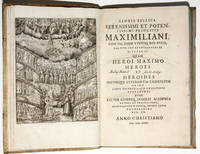
16235340Ingolstadii: Ex officina typographica G. Haenlini 1623. Hardcover. Near Fine. 4to 27 x 17.5 cm. 17 ff. 388 pp. recte 386 7 ff. with misnumbered pages at pp. 203-06 243-46 and 260-71 1 full-page engraving 20 x 15.5 the platemark. Bound in contemporary blind-stamped pigskin raised bands boards beveled somewhat scuffed clasps missing. Blue edges small hole repaired on half title and engraving ownership inscription of Andechs Abbey on title page minor browning in some quires. An excellent and unsophisticated copy. First edition of a rare volume of prose and verse glorifying the military exploits of the Prince-Elector Kurfürst of Bavaria Maximilian I 1572-1651 by members of the University of Ingolstadt as compiled by the Jesuit philosopher-theologian Georg Stengel 1584-1651. The Gloria Bellica is an important witness to the intertwining of princely power university politics and religious sectarianism at the onset of the Thirty Years War 1618-48. Published in the year of Maximilian's elevation to Prince-Elector 1623 the book seems to have been an attempt by faculty at Ingolstadt to secure his favor. The increasingly Jesuitical university would be frequently imperiled during the flux of the war and quickly identified Maximilian himself educated by Jesuits as an important military protector. Maximilian's central role in the German Catholic League had been essential in checking the power of the Protestant Union. The volume is especially notable for its full-page prefatory engraving executed by the Augsburg artist Daniel Manasser a highly detailed and elaborate allegory charting Maximilian's martial rise and the praise conferred on him from various secular and sacred sources. Merchants clerics Liberal Arts herself and a throng of lesser citizens crowd together to salute Maximilian as he rides upward on the back of Pegasus toward the Olympian gods reclining in the empyrean; the demigod Hercules mediates between heaven and earth while battling Nessus and the Lernaean Hydra. Flanking Maximilian's ascent are 8 groups from whom he receives "Gloria": his enemies his commanders and soldiers muses and scientists hometown Bavaria the Catholic League the Holy Roman Emperor Ferdinand I the pope and church and indeed Mary Christ and the saints. The text of the Gloria Bellica is arranged as a fuller version of this scheme with 20 chapters each detailing a source Maximilian's glory. OCLC identifies U.S. copies at Harvard Trinity CT Georgetown and Chicago. VD 17 23:231047E; De Backer/S. and VII 1550 32; Lentner 3774; Pfister I 4297; Mario Praz Studies in Seventeenth-Century Imagery Rome: Edizioni di Storia e Letteratura 1975 pp. 503-04. <br/> <br/> Ex officina typographica G. Haenlini hardcover
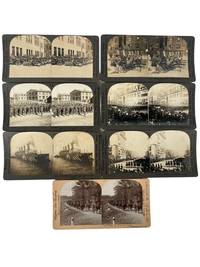
1918205021918. Buffalo Soldier regiments depicted in stereoview photographs from the World War I era document African American cavalrymen and infantry units serving in segregated formations of the United States Army during the early twentieth century. These images record soldiers from several historically significant Black military units including the 9th U.S. Cavalry the 10th Cavalry and the 369th Infantry Regiment. African American soldiers served in large numbers during World War I despite segregation in the armed forces and the war marked a turning point in public recognition of Black military service. The photographs capture cavalry movement machine gun training and celebratory returns from the European front preserving visual evidence of the military presence and public visibility of Buffalo Soldiers during the conflict.<br /> <br /> Archive consists of seven stereoview photographs published by the Keystone View Company during the World War I period. The views depict soldiers from the 9th U.S. Cavalry the 8th Regiment of Colored Troops the 10th Cavalry the Chicago Regiment of Colored Troops and the 15th Regiment of the 369th Infantry. Two stereoviews show Black machine gun companies operating Lewis guns one of the principal light machine guns used on the Western Front during the war. Another view shows Troop K of the 10th Cavalry moving on horseback at Camp Chickamauga in Georgia. Additional stereoviews depict African American soldiers returning from European service and marching in public celebrations including scenes of troops parading along major boulevards such as Fifth Avenue in New York.<br /> <br /> The Buffalo Soldier regiments had already established a long military record before the First World War. Units such as the 10th Cavalry formed part of the segregated Regular Army created after the Civil War and served in campaigns across the western United States during the Indian Wars later participating in the Spanish American War the Philippine American War and operations during the Mexican Revolution. World War I marked one of the final periods in which cavalry units remained visible in American military organization as mechanized armor and motorized vehicles soon replaced mounted troops. At the same time Black soldiers who returned from service were celebrated in wartime parades yet continued to face segregation and racial discrimination within American society. Stereoview cards remain well preserved with light age wear typical of early twentieth century photographic prints. Very good condition overall and a visually compelling record of Buffalo Soldiers during the World War I era. unknown
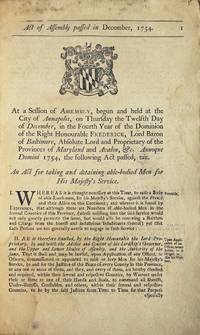
1755319725Annapolis: Jonas Green 1755. 2pp. Bound with: Acts of the province of Maryland made and passed at a session of Assembly begun and held at the city of Annapolis on Saturday the twenty-second day of February in the fourth year of the dominion of the Right Honourable Frederick Lord Baron of Baltimore absolute lord and proprietary of the provinces of Maryland and Avalon &c. Annoque Domini 1755. Published by authority. 8pp. Folio. Period wrappers restitched some losses to the blue sugar paper old repairs at head of each leaf with minor losses old dampstaining. 2pp. Bound with: Acts of the province of Maryland made and passed at a session of Assembly begun and held at the city of Annapolis on Saturday the twenty-second day of February in the fourth year of the dominion of the Right Honourable Frederick Lord Baron of Baltimore absolute lord and proprietary of the provinces of Maryland and Avalon &c. Annoque Domini 1755. Published by authority. 8pp. Folio. Recruiting for Braddock's Campaign. Passed in December 1754 "to raise a Body of able Land-men for his Majesty's Service against the French and their Allies on this Continent" this separately-printed session law essentially authorizes a draft system for forcing "all and every able-bodied Freeman who live idle and do not follow or exercise some lawful Calling" to be enlisted as soldiers. Given the timing it is believed that the troops being raised were intended for service on the Braddock expedition against Fort Duquesne.<br/><br/>Bound together with the above is a second session printing of Maryland laws including acts relating to the French and Indian War: "An Act to Prevent the People of this Province from Supplying the French or their Indian Allies with Ammunition Warlike Stores or Provisions of any Kind" and "An Act for Regulating the Rates of Carriage and Quartering Soldiers in Public Houses within this Province for His Majesty's Service." Also included are acts on currency courts and tobacco.<br/><br/>Both session printings are rare with ESTC recording only five copies in four institutions and eight copies in six institutions respectively. Bristol B1727 and Evans 7458; Wroth 179 and 180; ESTC W33246 and W7078 Jonas Green unknown books
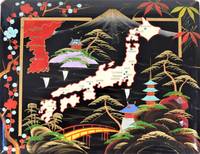
1953191711953. Benford Johnnie. Korean War photo album documenting early integrated U.S. Army service during the final phase of the Korean War assembled between 1953 and 1955. The photographs record the experience of a Black soldier from Chicago serving in one of the first generations of racially integrated American military units following the federal desegregation of the armed forces ordered by President Harry S. Truman in 1948. The album follows Benford and fellow soldiers from training in the United States to overseas service in Japan and Korea. Numerous captions identify individual soldiers and locations providing unusually detailed documentation of daily life among racially diverse troops serving together during a transitional period in American military and civil rights history.<br /> <br /> Photographic album compiled by Johnnie Benford containing aprox 120 photographs taken between approximately 1953 and 1955 during Korean War service. Images begin at Fort Riley Kansas where soldiers in the newly integrated Army appear in training exercises with artillery mortars rifles ammunition belts and gas masks. Later photographs show the unit in Yokohama Japan during a period of rest and staging prior to deployment to Korea. The final portion of the album documents service on the northeastern Korean front near Yang-Gun village where Benford and fellow soldiers appear traveling by jeep and moving on foot through rugged terrain. Several photographs were taken on Koje Island the site of a large United Nations prisoner of war camp that operated from 1951 to 1953 and became internationally known after a North Korean prisoner uprising resulted in the temporary capture of the American camp commander. Nearly all photographs are captioned with names and locations and the archive also retains Benford's Selective Service identification cards.<br /> <br /> The Korean War occurred during the first decade after the formal desegregation of the U.S. armed forces and marked one of the earliest large scale tests of integrated military units. By the early 1950s the Army was gradually implementing racial integration across training installations and overseas commands bringing together white Black and Latino soldiers in units that would previously have been segregated during World War II. This album documents that transformation at ground level capturing a cohort of soldiers training traveling and serving together in the years immediately following the policy change. The images also provide geographic documentation of key wartime locations including Fort Riley Yokohama Koje Island and the northeastern Korean front near battlefields such as Bloody Ridge and Heartbreak Ridge. Album contains 116 black and white silver gelatin photographs and four color photographs mounted on 17 pages most measuring approximately 3.5 x 3.5 inches with sizes ranging from about 2 x 2.25 inches to 10 x 8 inches. Hard shell cover illustrated with a map of Japan and the Korean Peninsula. Front cover detached and lacking rear cover minor chipping at page margins and several photographs loose. Photographs themselves remain clear with strong contrast. Overall condition very good. unknown
16235340Ingolstadii: Ex officina typographica G. Haenlini 1623. Hardcover. Near Fine. 4to 27 x 17.5 cm. 17 ff. 388 pp. recte 386 7 ff. with misnumbered pages at pp. 203-06 243-46 and 260-71 1 full-page engraving 20 x 15.5 the platemark. Bound in contemporary blind-stamped pigskin raised bands boards beveled somewhat scuffed clasps missing. Blue edges small hole repaired on half title and engraving ownership inscription of Andechs Abbey on title page minor browning in some quires. An excellent and unsophisticated copy. First edition of a rare volume of prose and verse glorifying the military exploits of the Prince-Elector Kurfürst of Bavaria Maximilian I 1572-1651 by members of the University of Ingolstadt as compiled by the Jesuit philosopher-theologian Georg Stengel 1584-1651. The Gloria Bellica is an important witness to the intertwining of princely power university politics and religious sectarianism at the onset of the Thirty Years War 1618-48. Published in the year of Maximilian's elevation to Prince-Elector 1623 the book seems to have been an attempt by faculty at Ingolstadt to secure his favor. The increasingly Jesuitical university would be frequently imperiled during the flux of the war and quickly identified Maximilian himself educated by Jesuits as an important military protector. Maximilian's central role in the German Catholic League had been essential in checking the power of the Protestant Union. The volume is especially notable for its full-page prefatory engraving executed by the Augsburg artist Daniel Manasser a highly detailed and elaborate allegory charting Maximilian's martial rise and the praise conferred on him from various secular and sacred sources. Merchants clerics Liberal Arts herself and a throng of lesser citizens crowd together to salute Maximilian as he rides upward on the back of Pegasus toward the Olympian gods reclining in the empyrean; the demigod Hercules mediates between heaven and earth while battling Nessus and the Lernaean Hydra. Flanking Maximilian's ascent are 8 groups from whom he receives "Gloria": his enemies his commanders and soldiers muses and scientists hometown Bavaria the Catholic League the Holy Roman Emperor Ferdinand I the pope and church and indeed Mary Christ and the saints. The text of the Gloria Bellica is arranged as a fuller version of this scheme with 20 chapters each detailing a source Maximilian's glory. OCLC identifies U.S. copies at Harvard Trinity CT Georgetown and Chicago. VD 17 23:231047E; De Backer/S. and VII 1550 32; Lentner 3774; Pfister I 4297; Mario Praz Studies in Seventeenth-Century Imagery Rome: Edizioni di Storia e Letteratura 1975 pp. 503-04. <br/> <br/> Ex officina typographica G. Haenlini hardcover books
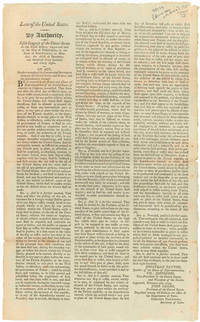
1799WRCAM48177Philadelphia 1799. Broadside 13 1/2 x 8 1/4 inches printed in three columns. Docketed in ink on verso. Three horizontal folds. Some light edge wear small separations at edges of folds not affecting text. Very good. Rare congressional act extending the suspension of trade with France during the so- called "Quasi-War" of the late 1790s and adding a provision allowing the U.S. Navy to inspect and seize American ships that are violating the embargo. This act was approved February 9 1799 and extends the provisions of the law first approved on June 13 1798. It is signed in type at the end by President Adams Vice President Jefferson and Speaker of the House Jonathan Dayton. The Quasi-War was an undeclared conflict between the United States and France during the Adams administration in the late 1790s manifested mostly in naval engagements between the two nations. The war was the outgrowth of deteriorating Franco-American relations which had been weakened earlier in the decade by the Genêt Affair and the XYZ Affair and it wreaked havoc on commerce between the two nations. One of the main weapons wielded by Adams was to ban American commerce from France and French dependencies accomplished by the congressional act of 1798 and extended by the present law. The law forbids American ships from trading with France or with French dependencies including in the West Indies and goes on to bar French commerce and French ships from American ports. Significantly this act goes beyond the provisions of the 1798 law by permitting United States Navy vessels to inspect and potentially seize American vessels that have traded with France or with French dependencies. <br> <br> This broadside format is unusual for the printing of a law and indicates that it was meant to be displayed in ports and customs officers for the attention of ships' masters who may have been unaware of the embargo law or willfully violating it. ESTC locates only three copies at Oxford the British National Archives and the American Antiquarian Society. Rare. EVANS 36522. ESTC W42364. OCLC 80514531. unknown books
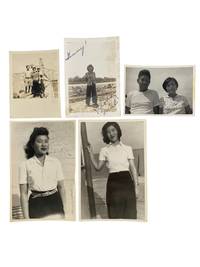
1944218451944. Japanese American WWII Internment Japanese American photograph archive circa 1930s to 1940s records civilian identity and interpersonal life across the World War II era including one photograph with a note on verso tied directly to incarceration at the Rohwer Relocation Center in Arkansas. Named individuals preserved through handwritten inscriptions establish the archive as a record of the mid 19th century Nisei experience. This evocative photographic archive captures fragments of Japanese American civilian life both prior to and during World War II incarceration. <br /> <br /> Archive consists of 17 silver gelatin photographs measuring approximately 2.5 x 3 inches to 4 x 6 inches. Subjects include individual portraits paired figures and small group scenes photographed outdoors. One image dated July 1 1944 bears the verso inscription "Jaden: Rohwer Relocation" and front inscription "Ginny! - Aloha Mich" identifying a woman confined at Rohwer a War Relocation Authority camp that held over 8000 Japanese Americans during the war. Additional photographs include two separately identified women The remaining images include two separate portraits of young women confidently posed outdoors. The women are dressed in fashionable WWII-era separates - fitted short-sleeved blouses tucked into dark skirts both with their names penned en verso; "Mae West Sasano" and "Yasuko." Another is a snapshot of a male grouping on what appears to be a construction site and en verso is written "31" possibly indicating a year. Japanese Americans played a significant role in helping build infrastructure such as canals bridges and roads particularly in the West. Lastly a snapshot of a casual intimate outdoor portrait of a man and woman seated side-by-side. Together these images provide a poignant humanizing counterpoint to official narratives of incarceration emphasizing style resilience and familial bonds. The inclusion of both prewar and internment-era materials adds depth and rarity to the grouping situating it as a valuable resource for researchers of Japanese American history internment documentation and the broader landscape of W.W.II homefront experiences.<br /> <br /> This archive photographs foreground continuity in social interaction dress and personal identity across prewar and wartime conditions while retaining a direct link to the history of forced removal through the Rohwer inscription. Light wear to edges minor surface handling and occasional corner softening; inscriptions clear. Overall in very good condition. The grouping provides a concise body of primary material for examining Japanese American identity spanning wartime incarceration and postwar reintegration into American society. unknown
3 vols., 8vo., First Edition, on laid paper; handsomely bound in uniform burgundy full crushed morocco, sides with gilt frame borders, backs with raised bands, second and fourth compartments lettered and ruled in gilt, all other compartments tooled in gilt, gilt tops, hand-made endpapers, ribbon markers, a most attractive set ideal as a gift or for presentation. Elegant set of first editions of Sassoon's 'fictitious' autobiography in which his story is told by 'George Sherston'.
17368673Amsterdam, J. Wetstein et G. Smith, 1736. 2 volumes in-4, frontispice, [14]-LXXV-[1]-696; [4]-848 pages, plein veau fauve, dos à nerfs ornés de filets et fleurons dorés, pièces de titre et tomaison en maroquin rouge, double filet doré sur les coupes, roulette dorée intérieure. Epidermures et petit manque de peau sur un plat, coiffe inférieure du second volume abîmée, hormis une pâle trace d'humidité aux 30 derniers feuillets du premier volume, intérieur en parfaite condition.
1648304145np 1648. Sole edition. 4 ll. Collation: A4. 4to. Green half morocco by Riviere spine gilt some spotting. Sole edition. 4 ll. Collation: A4. 4to. "And would you know what here is meant / By Monster 'Tis our Parliament."<br /> ESTC lists seven other copies of this scathing anti-Cromwellian work though no other parts are traced. Wing S 2321; ESTC R204781. Provenance: Samuel Christie-Miller 1873 purchase note on flyleaf with cost of binding; Britwell Court Sotheby's 4 April 1924 lot 814; Fairfax of Cameron bookplate; Robert S. Pirie bookplate unknown
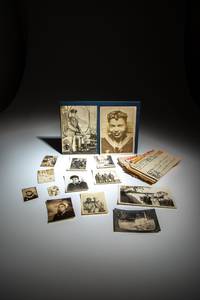
194514125Pacific Theater 1945. Handwritten Letters. Paper. Very good. Series of photographs and handwritten letters from Private First Class Henry B. Ferguson an African American solider serving in the 742nd Anti-Aircraft Artillery Battalion in the South Pacific during World War II to Miss Elizabeth Webb of Bradenton. Series of photographs and handwritten letters from Private First Class Henry B. Ferguson an African American solider serving in the 742nd Anti-Aircraft Artillery Battalion in the South Pacific during World War II to Miss Elizabeth Webb of Bradenton Florida. Twenty-four letters ranging from September 1944 to April 1946. Handwritten on various forms of stationery including thin blue paper and the War & Navy Department's V-Mail Service. All envelopes torn along one edge faint wear to corners. Twenty-one photographs of various African American servicemen in multiple locations throughout the Pacific some with photo album page remnants remaining on verso. Faint wear to corners a few with handwritten inscriptions. Ferguson's letters primarily center around his loving and longing for Miss Webb which are only heightened by the intensity of the weather and his work. He often writes of either the "rainy season" the battalion is stuck in or how impactful the heat is. On February 10th 1945 he writes "Everybody in the States seems to be suffering from the cold weather and im sitting down with my shirt off getting a back massage from the heat rash." In July 1945 he wrote "It really looks like i'll be here another year dear. I expect to be in the Philippines in the next month." It is unclear exactly when Ferguson departs the Philippines and returns to the United States but the final letter from early 1946 shows his return address in Brooklyn New York. Private First Class Henry B. Ferguson 1922-2001 served in the 742nd Anti-Aircraft Artillery AAA Gun Battalion in World War II. Throughout Ferguson's enlistment which began December 5 1942 the Battalion traveled to New Hebrides Oct. 1943-May 1944 Cape Gloucester May 1944-Nov. 1944 Finschhafen Nov. 1944-Aug. 1945 and Luzon Aug. 1945 - discharge. The 742nd AAA Gun Battalion participated in the major battles of the South Pacific including the Guadalcanal campaign the Battle of Cape Gloucester within Operation Cartwheel and the Battle of Luzon at the end of the Philippines campaign. In 1947 PFC Ferguson married the recipient of these letters Miss Elizabeth Webb and had one daughter. unknown
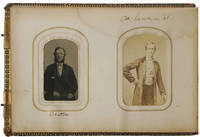
1860CAT0140Massachusetts 1860. 9 x 6 inches. Polished calf decorative covers. Nineteen pages with 55 Carte-de-Visite portraits. Good. A carte-de-visite portrait album kept by Billings during the Civil War. Notation before index reads: “This album was sent me at my order from Philadelphia and was received while our army lay at Brandy Station in the winter of 1863-1864. I think! Many of the pictures I carried with me throughout nearly my whole term of service. This is true of these on the first 17 pages. The others have been inserted since the war.†<br /> <br /> A particularly noteworthy artifact. Hardtack and Coffee is one of few books on soldiers’ everyday life and this album would have been quite significant for Billings. He discusses photographs twice in the book as being among the dearest objects soldiers kept with them. Per Billings’ own note on the endpapers there are seventeen portraits present that he personally kept with him during the first part of the war before adding them to this album in 1863. These include: his parents several cousins and various acquaintances. The remainder of the portraits were added later. Notable subjects include two portraits of Billings himself and two portraits of his future wife Mary Phillips Cotton Whitney. <br /> <br /> Unfortunately portraits of Billings' compatriots are missing. Several portraits of members of the Massachusetts 10th were removed in the 1980s by an unknown person and framed with the subjects’ identities and the photos removals noted on the mounts. Several other pages lack portraits though it is unclear whether or not each space in the album was originally filled. The photographs that remain are in very good condition. The album itself is worn with tears and chips to spine and general wear. First leaf repaired with crude tape. Still a significant piece despite the flaws. unknown
186538207Washington D.C. 1865. Letterpress broadside. 24 x 8 1/2 inches. Expert restoration on verso. An unusual broadside Civil War peace proposal.<br/> <br/>A little-known but highly eccentric character Evans first made a name for himself in 1818 when he walked from New Hampshire to Detroit in the middle of winter no less backtracked to Pittsburgh and continued his walk all the way to New Orleans publishing a narrative of his pedestrian journey the following year. After a failed Congressional run in New Hampshire and a failed attempt to become secretary of the Senate he ended up practicing law in Washington. In the midst of the Civil War Evans published a series of broadside letters all known in but few examples and likely printed in small quantities. In one in which excoriated the south for their role in the war he explained that he issued his missives as broadsides since his letters had no chance of publication in the already crowded pages of the newspaper press. The present broadside by Evans suggests a 20-point proposal for peace between the North and South including the abolition of slavery the federal assumption of Confederate debt universal amnesty restoration of all confiscated property the annexation of Mexico the expulsion of the Russians from the Pacific Northwest the seizing of the Hudson's Bay and Arctic fur trade from the British inviting Canada to become part of the United States the unification of Central America and the building of a trans-Darien canal the nationalization of the mining industry universal temperance fair pay charity from the rich and more. The broadside letter concludes: "Unhappy -- deeply unhappy am I in what I am now going to say -- tears of pity grief and shame for the whole country coursing down my cheeks: -- I solemnly declare that I have no doubt and never had that the longer the South holds out the nearer she will be so absolute annihilation ." We locate only four examples extant Boston Aethenaeum American Antiquarian Society Harvard and Minnesota Historical Society. unknown books
15978BUFFALO SOLDIER Pair of Real Photo postcards of 24th U.S. Infantry musicians in camp. Photographs 3-1/2" x 5-1/2" inches Pine Camp Fort Drum NY c. 1910. Infantryman Joseph Lee identifies himself in these photos. He was part of the 24th during their Houston Mutiny in which many members of the regiment were court martialed after famously coming to the defense of a black woman harassed by local police. <br/><br/>Photos depict members of an original Buffalo Soldier regiment dating from its time at Pine Camp NY later Fort Drum. One captioned in negative "The Famous 24th Inft. Band Pine Camp" shows ~30 uniformed soldiers with instruments. The other uncaptioned showing 7 soldiers; most in white robes with "USA" on the collar perhaps a regimental choir. Both were sent by Joseph Lee 1879- ~1940 Arkansas native enlisted as a musician in the 24th 1903-1919. Both inscribed and addressed one stamped neither postmarked; minimal wear. Lee has apparently self-identified with an arrow in each. This regiment was involved in the dramatic Houston Mutiny of 1917 beginning when a soldier was arrested for aiding a black woman. In the end 19 soldiers were executed and nearly 50 received life sentences but Lee remained with the regiment until his honorable discharge. unknown books
1648304145np 1648. Sole edition. 4 ll. Collation: A4. 4to. Green half morocco by Riviere spine gilt some spotting. Sole edition. 4 ll. Collation: A4. 4to. "And would you know what here is meant / By Monster 'Tis our Parliament."<br/>ESTC lists seven other copies of this scathing anti-Cromwellian work though no other parts are traced. Wing S 2321; ESTC R204781. Provenance: Samuel Christie-Miller 1873 purchase note on flyleaf with cost of binding; Britwell Court Sotheby's 4 April 1924 lot 814; Fairfax of Cameron bookplate; Robert S. Pirie bookplate unknown books
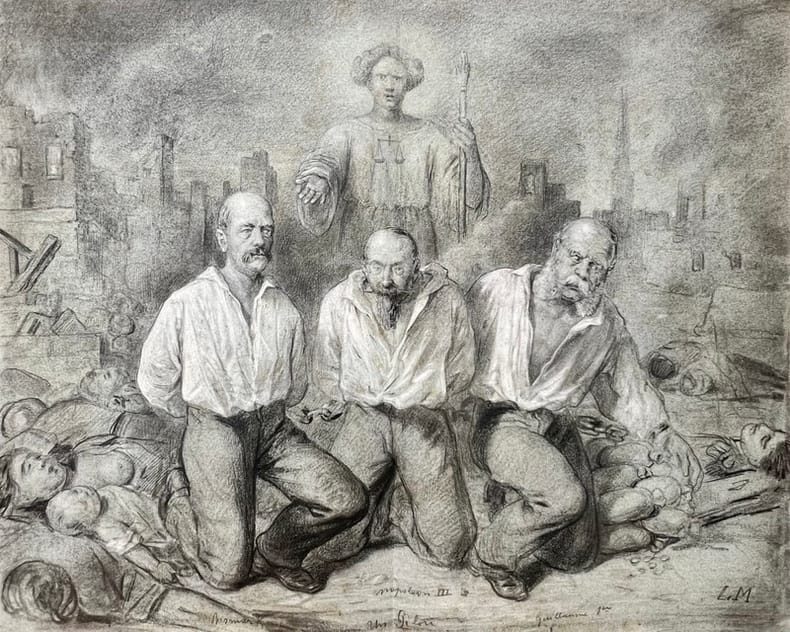
187044548, , (1870). Dessin au fusain avec rehauts sur papier bleuté (51,5 x 41,5 cm).
1st edition, Later cloth with original wrappers bound in, 4to, approximately 200 leaves. 28 1/2cm. "Published ... Under the auspices of the American Jewish congress. "-- Foreword. Collection of detailed reports on the Jewish persuctions as of late 1941 throughout Europe, and organized by region, with anecdotal as well as statistical evidence and sources cited. The report came out just 2 months before the notorious Wansee Conference where German extermination policy became official, and the reports here, in detail and in in broad brush stroakes, reflect the quickly deteriorating situation for Jews under German occupation. For example from the Polish section: We must declare at the very outset that words are powerless to portray the agony and suffering of Polish Jewry in the 80 days of Germany role. The hell-like reality of the Polish Jews, a hell-like reality which has already lasted more than 80o days, and where literally every minute, every second demands Jewish victims, without a stop, without any interruption, and the hand of the torturer and murderer, the robber and offender is still unwearied, --this reality is not to he described in words. Let the reader multiply what is described tenfold, twentyfold, and he will perhaps come near to an idea of the life of our brothers under the German lash (p. POL-9) Sections include: Greater Germany, Rumania, Hungary, Italy, Czechoslovakia, Poland, Denmark, Norway, Belgium, Luxemburg, Holland, France, Yugoslavia, Bulgaria, Greece, Finland, Nazi-Soviet War Area, Refugees, Relief, & Conclusions. Prepared by the Institute of Jewish Affairs ; submitted to the Inter-American Jewish Conference, November 23-24-25, 1941, Baltimore, Md. Includes refugee and relief activity at conclusion, and 2 pages of corrections and addenda at rear. Even at this date, of course, the nature of the what was to be the total devastation was not yet clear. Very Good Condition. Rare. With original hole punches, as issued. Ex-library, but only one stamp on original pages, to blank rear of title page. Other markings are only to later-added endpapers and binding, not to any original pages, Very Good Condition thus. An important collection of evidence from the period. (Holo2-120-27)
1st edition. Original paper wrappers. 4to, approximately 200 leaves. 28 1/2cm. "Published ... Under the auspices of the American Jewish congress. "-- Foreword. Collection of detailed reports on the Jewish persuctions as of late 1941 throughout Europe, and organized by region, with anecdotal as well as statistical evidence and sources cited. The report came out just 2 months before the notorious Wansee Conference where German extermination policy became official, and the reports here, in detail and in in broad brush stroakes, reflect the quickly deteriorating situation for Jews under German occupation. For example from the Polish section: We must declare at the very outset that words are powerless to portray the agony and suffering of Polish Jewry in the 80 days of Germany role. The hell-like reality of the Polish Jews, a hell-like reality which has already lasted more than 80o days, and where literally every minute, every second demands Jewish victims, without a stop, without any interruption, and the hand of the torturer and murderer, the robber and offender is still unwearied, --this reality is not to he described in words. Let the reader multiply what is described tenfold, twentyfold, and he will perhaps come near to an idea of the life of our brothers under the German lash (p. POL-9) Sections include: Greater Germany, Rumania, Hungary, Italy, Czechoslovakia, Poland, Denmark, Norway, Belgium, Luxemburg, Holland, France, Yugoslavia, Bulgaria, Greece, Finland, Nazi-Soviet War Area, Refugees, Relief, & Conclusions. Prepared by the Institute of Jewish Affairs ; submitted to the Inter-American Jewish Conference, November 23-24-25, 1941, Baltimore, Md. Includes refugee and relief activity at conclusion, and 2 pages of corrections and addenda at rear. Even at this date, of course, the nature of the what was to be the total devastation was not yet clear. Very Good Condition. Rare. With original hole punches, as issued. Markings on endpaper, title page, and back wrapper. Very Good Condition thus. An important collection of evidence from the period. (Holo2-120-27A)
1914259L’annonce d’un des grands boulversements du siècle. Entoilée, bon état. en feuille bon Paris 1914 700 x 500
Signed and inscribed by author upon front free endpaper. xxx, 750 pages. Footnotes. Index. Five-page reading list of War Guilt publications. Black and white frontispiece photo plate of Wilson and Poincare in Paris. "It is the purpose of the writer to arouse interest in the subject and to create a general conviction that there is here a major international problem, the nature and importance of which are scarcely realized by even the average educated American." - from Preface. "The only way to assess the blame for the World War is to know all the evidence and to put off war spectacles. Professor Barnes is one of the few men who have done both." - George Peabody Gooch, University of London. Barnes spent much of his life robustly challenging commonly held historic views. Unmarked with average wear. Binding intact. Dust jacket not included. A sound copy. [Stimely p. 3) Book
in-4 (mm 318x230) pp. 131, (1); pp. 78; leg. mezza pergamena, titolo oro su tassello al dorso. La prima opera è illustrata da 1 carta geografica su doppio foglio "Guerra nel Mar Baltico", 1 "Pianta militare di Cronstadt" e 13 vedute litografiche di V. Stranski: Capo Kullen, Cronstadt, Nuovo Osservatorio di Cronstadt, Cristianstadt, Pietroburgo, Reval, Abo, Abo veduta dal ponte, Isole Aland, Sveaborg, Gustavsvern, Barosund, Nargen. Nella seconda opera sono presenti 2 carte geografiche: "Guerra d'Oriente-Mar Nero" e "Guerra d'Oriente-Crimea"; 1 pianta militare di Sebastopoli e 10 tavole di vedute litografiche: Gallipoli, Varna, Kustungi, Odessa, Batum, Trebisonda, Sinope, Scutari, Sukhum Kalè, Anapa. Prima edizione di questa descrizione delle città che si affacciano sulle coste del Mar Baltico (Finlandia, Svezia, Stati baltici e Russia), pubblicata nel 1854 nel contesto della guerra di Crimea (da ottobre 1853 a febbraio 1856). Tutte le litografie, eccetto la mappa, sono firmate da V. Stranski e stampate da Colombo Coen. Buon esemplare con qualche macchietta rossa e lieve arrossatura. Uncommon set of two historical works related to the war in the Black Sea and in the Baltic Sea. . .
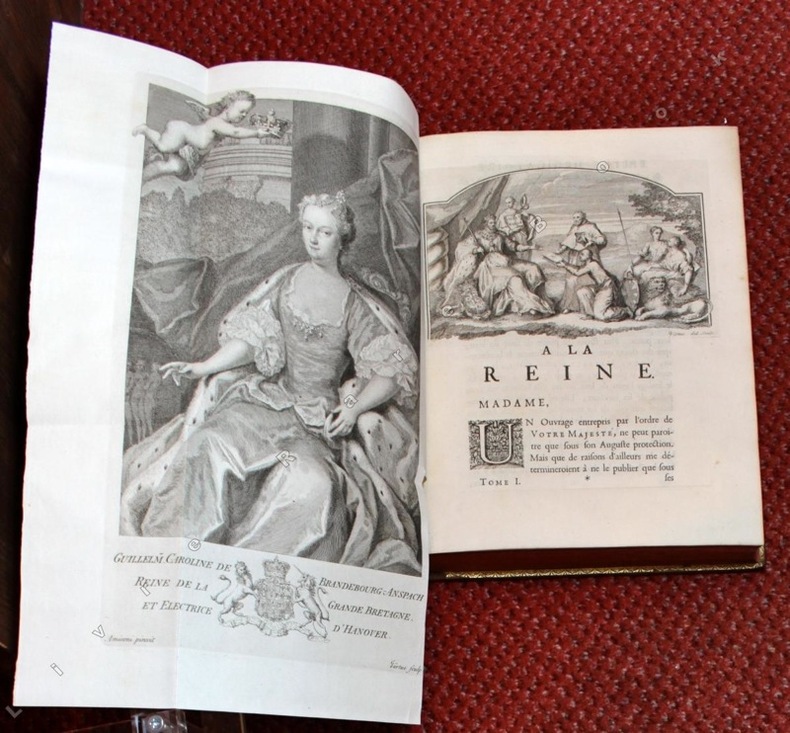
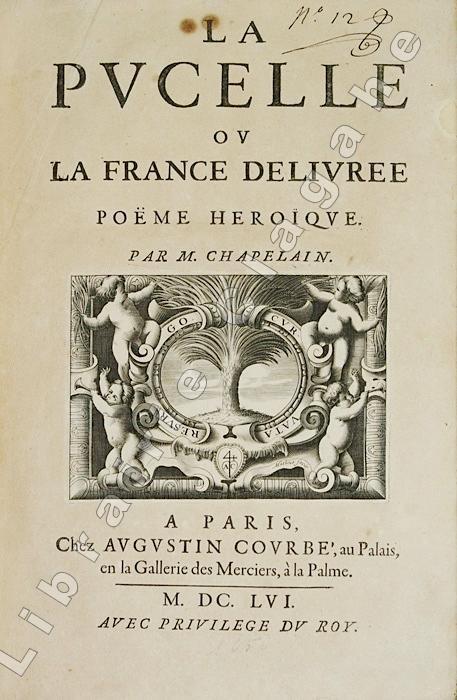
17788Paris, Augustin Courbé (imprimerie Jean Roger), 1656 ; in folio, basane havane, dos refait et plats d'époque conservés, fleurons dorés à l'ancienne ; 1blanc, frontispice, titre ; (6) ff. , portrait de l'auteur, (16) ff. , 522 pp. , (6) ff.