1 575 résultats
18611683936th Cong. 2nd Sess.: HED47. 1861. 56pp disbound. Minor foxing. Very Good. HED47. unknown books
18392072925th Cong. 3d Sess.: HD94. 1839. 60pp. Caption title as issued. Disbound. Light scattered foxing. Very Good. HD94. unknown books
194646302Camp Cooke CA 1946. 1st printing of the divers issues. Printed self-wrappers. Modest wear with the occasional chip/short split along a fold. Age-toning to paper. Folded into quarters. Overall Very Good. 30 issues 2 duplicates ~ 4 pages each 8 columns per page. Illustrated with half-tone b/w photographic images. Comics ~ 3 strips p. 4. 22" x 17-1/2" <br/><br/>In 1941 the United States Army sought more and better training centers for the rapid development of its armored and infantry forces. In March 1941 the Army acquired approximately 86000 acres of open ranch lands along the Central Coast of California between Lompoc and Santa Maria. Most of the land was purchased. Smaller parcels were obtained either by lease license or as easements. With its flat plateau surrounding hills numerous canyons and relative remoteness from populated areas the Army was convinced it had found the ideal training location. Construction of the Army camp began in September 1941. Although its completion was still months away the Army activated the camp on 5 October and named it Camp Cooke in honor of Major General Phillip St. George Cooke a decorated cavalry officer whose career spanned 50 years 1827 - 1873. Although the construction of Camp Cooke continued well into 1942 troop training did not wait. The 5th Armored Division rolled into camp in February and March and the steady roar of its tanks and artillery soon became part of the daily scene. From then until the end of the war other armored and infantry divisions kept up the din before they too left for overseas duty. Besides the 5th Division the 6th 11th 13th and 20th Armored Divisions as well as the 86th and 97th Infantry Divisions and the 2d Filipino Infantry Regiment were all stationed at Cooke at varying times during the war. Also trained at Cooke were an assortment of anti-aircraft artillery combat engineer ordnance and hospital units. Over 400 separate and distinct outfits passed through Camp Cooke. A maximum security army disciplinary barracks was constructed on post property in 1946. Confined to the facility were military prisoners from throughout the Army. When Camp Cooke closed in June 1946 From August 1950 to February 1953 Camp Cooke served as a training installation for units slated for combat in Korea and as a summer training base for many other reserve units. On 1 February 1953 the camp was again inactivated. The disciplinary barracks meanwhile was transferred to the U.S. Bureau of Prisons to house civilian offenders in August 1959. Today it is known as the United States Penitentiary Lompoc. Wiki An invaluable source for local history at the end of World War II. the copy has the usual camp activities but also includes such informative pieces as "Camp Cooke History . Here's Chapter 2" Vol V - Number 3 March 29 1946. unknown books
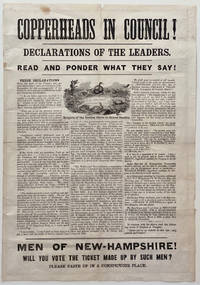
1863List1004New Hampshire: Printer Unknown 1863. First Edition. Printed broadside 16 ½ x 11 ½ inches archivally mounted and matted. A very good copy with some light toning small closed tear at upper margin light foxing at upper margin very tiny spot of loss to illustration at fold. Franklin Pierce remained politically active upon his return to New Hampshire following his presidency advocating for the Democratic cause and generally opposing the Civil War and Lincoln's policies. This scarce pro-Union anti-slavery broadside printed for the 1863 New Hampshire elections which happened March 12 takes aim at Pierce and his fellow Democrats repeating the unfounded claim first made in 1862 by William Seward that Pierce belonged to the secret Knights of the Golden Circle the secret society formed with the goal of forming a new territory out of the CSA Mexico Central America and the Caribbean. There was never evidence that Pierce had any involvement in the KGC though the society had members in southern parts of some Union states such as Indiana Ohio Illinois and Missouri.<br /> <br /> The broadside printed for the March 12 elections quotes heavily from Pierce as well as the other Democrat candidates and party officials who were either running for office in New Hampshire or involved in politics a group which included Ira Eastman John Goerge Josiah Minot Thomas Treadwell Daniel Marcy William Burns and George Stevens. The broadside includes an engraving of coiled snakes each with these politicians named and the caption "et id omne genus." Eastman the Democratic candidate for governor won the popular vote but lacked the constitutional majority necessary for election. Marcy was successful in his bid for the First District. "Men of New Hampshire!" the broadside asks: "Will you Vote the Ticket Made up by Such Men" with the final line imploring to "Please paste up in a Conspicuous Place." <br /> <br /> Overall an uncommon survival from the 1863 elections. A very good copy with some light toning small closed tear at upper magin light foxing at upper margin very tiny spot of loss to illustration at fold. Quite scarce with OCLC locating two copies only at the Huntington Library and the New York Historical Society. Printer Unknown unknown books
186126345Washington: Bureau of Topographical Engineers 1861. Sun printed i.e. photozincographed map after the original manuscript routes of railroads and canals hand-coloured 44 x 51 1/2 inches dissected into 24 sections and linen-backed as issued. Manuscript annotations in pencil by J. J. Young. Modern blue morocco-backed box. Provenance: Descendants of Amiel Weeks Whipple. Incredible Civil War map of Virginia produced by the Corps of Topographical Engineers for use by Union officers in the field.<br/> <br/>A highly important military map of Northern Virginia made for the use of the Union Army in the early days of the Civil War by an important military cartographer. The present map depicts Virginia as far north as Fredericksburg as far south as the North Carolina border and as far west as Charlottesville with detail including towns roads waterways and railroads. A statement on the map cites the U.S. Coast surveys and the Boye map of Virginia as sources in addition to surveys conducted by the Corps of Topographical Engineers. The map was completed within a month of the first major battle of the war the Battle of Bull Run fought on July 21 1861. The failure of the Union forces there made it clear that the war was not going to be resolved easily and quickly. Although not named as the cartographer the present map can be attributed to Amiel Weeks Whipple. During the 1850s Whipple became one of the most accomplished surveyors in the Corps of Topographical Engineers leading explorations for the transcontinental railroad. Captain Whipple was immediately ordered to report to the Chief of Topographical Engineers in Washington. There was then a dearth of maps giving any but the most meagre of information concerning the State of Virginia and to him as Chief of Topographical Engineers of the defenses of Washington South of the Potomac was entrusted the very challenging duty of making armed reconnaissances to collect the topographical details required. It was hazardous work in a country thickly wooded in places where small bodies of men could be concealed with absolute impunity; and the first skirmishes of the war such as that at Fairfax Court House were fought during its continuance. The work however was successfully and very quickly done and reliable maps were soon in possession of the Union commanders" Stoddard. Attribution of this map to Whipple can also be determined by a very similar map though focussed on Fairfax Loudoun and Prince William Counties which identifies Whipple as the source for the manuscript drawn by Civil Engineer J. J. Young see Stephenson 536.6. That map is in essence the companion to the present map i.e. showing the northern regions of Virginia not shown on this map. The handwriting of the manuscript used for that map and the present map are identical suggesting both to have been drawn by Young. Interestingly the present map includes pencil annotations again in the same hand see for example the naming of the branches of the Elizabeth River near Norfolk. That this map was done specifically for use in the field is suggested by the hurried process of its production. Rather than taking the time to have the map lithographed or engraved a sun print process was used to duplicate the original manuscript. Sun prints also called photozincography were developed in Great Britain in the mid-19th century to reproduce maps created during the Ordnance Survey. In this photographic process a negative is made of the original using a wet plate collodion method which is then exposed onto a thin sheet coated with a saturated potassium bichromate solution and transferred to a zinc plate coated in ink and put through a press. The present copy descended in the family of Whipple and includes a manuscript presentation below the cartouche "To accompany letter to / dated Bureau of Topogl. Eng.s Augt 1861." The name of the recipient is not filled in suggesting that Whipple kept this copy for himself. The map is very rare with OCLC citing but three known examples.<br/> <br/>Stephenson Civil War Maps 451.6; Francis R. Stoddard "Amiel Weeks Whipple" in Chronicles of Oklahoma vol. 28 Autumn 1950. Bureau of Topographical Engineers unknown books
18856799Washington: Signal Office 1885. 8vo. 11 1 blank pp. <br><br>United States of America: War Department. Signal Service Notes No. XXII. Stitched; in original printed wrappers. Some chipping. Signal Office unknown books
1863WRCAM26245London: Printed by Harrison and Sons 1863. No. 2 1863: 17pp. No. 14 1864: 37pp. Gathered signatures stitched separately. Overall very good partially untrimmed. The Confederacy wanted Britain's recognition as a separate and independent country. Britain which relied heavily on Southern cotton naturally favored the Confederacy secretly helping to arm warships but was reluctant to grant official recognition. James Mason was selected as the Confederate representative to England and his mission was clear. These documents reflect his attempts to secure recognition for the Confederacy as well as other concerns. <br> <br> NORTH AMERICA. No. 2. 1863. CORRESPONDENCE WITH MR. MASON RESPECTING THE BLOCKADE AND RECOGNITION OF THE CONFEDERATE STATES. Contains much information on ships entered and cleared at blockaded ports as well as a letter subtly asking the British government to please continue trade despite the blockade. Also has copies of correspondence between Mason and Earl Russell in which Mason openly tries to convince Russell to recognize the Confederacy Russell seems unreceptive refusing personal interviews and writing terse responses. <br> <br> NORTH AMERICA. No. 14. 1864. CORRESPONDENCE WITH MR. MASON COMMISSIONER OF THE SO-STYLED CONFEDERATE STATES OF AMERICA. Correspondence about various matters: sinking of a steamer in British waters removal of British consuls etc. An extract from the Richmond Whig shows the frustration felt by the Confederacy: "to be sure we know that we have no national existence outside of our own fond imaginations and that in the eyes of Great Britain we are still part and parcel of the United States and destined for all she cares to remain so forever." Printed by Harrison and Sons unknown books
1816WRCAM26298Washington: Printed by William A. Davis 1816. 50pp. plus fold-out chart. Dbd. Good. Correspondence on the specific points of the convention from the American diplomats Henry Clay John Quincy Adams and Albert Gallatin to James Monroe Secretary of State; copies of the convention agreement; chart of "Duties of Customs Paid to Great Britain in 1797 and 1815." SHAW & SHOEMAKER 39362. Printed by William A. Davis unknown books
1864WRCAM15984London 1864. 32pp. Printed self-wrappers. Some wear to extremities pages loose else very good. An interesting British document reprinting communications between the Secretary of the Admiralty Mr. Hammond and members of Parliament on what to do regarding the Confederate prize-vessel Tuscaloosa originally the American vessel Conrad while docked at the Cape of Good Hope. Ultimately the Duke of Newcastle instructed the Governor of the Cape to restore the Tuscaloosa to the Confederate lieutenant who last commanded her. A controversial decision considering the British government's failure to officially recognize the Confederate States of America. An intriguing example of British sympathy for the Confederate cause. unknown books
000443Madison Wisconsin US Armed Forces Institute 1942. Two volumes. Wrappers. Light soiling and edge wear. This is EM 773 by John J. W. Neuner. Many charts and graphs several are fold-out. Reprint edition. Madison, Wisconsin US Armed Forces Institute (1942). unknown books
1739606731739. Relates to Events in the Americas Anglo-Spanish War. Cotejo de la Conducta de S.M. Con la de el Rey Britanico Assi en la Acaecido Antes de la Convencion de 14. de Enero de Este Anno de 1739 Como en lo Obrado Despues Hasta la Publicacion de Represalias y Declaracion de Guerra: Con Licencia en Madrid. His Catholick Majesty's Conduct Compared With That of His Britannick Majesty As Well With Regard To What Happened Before the Convention of the 14th of January of This Year 1739 As to What Has Been Done Since Untill the Publication of Reprisals and Declaration of War: Printed by Authority at Madrid by Antonio Marin. London: Printed for T. Cooper 1739. 63 pp. Spanish text with English translation on facing leaves. Octavo 8" x 5". Later quarter morocco over textured paper boards gilt title to spine. Some rubbing to joints corners lightly bumped hinges just starting at ends. Discoloration to free endpapers light toning to text somewhat heavier in a few places. Early owner signature Eyre to head of title page interior otherwise clean. $1250. Only edition. A legalistic analysis of Spanish claims advanced during the Anglo-Spanish War 1739-1748. Also known as the War of Jenkins' Ear after the conflict's flashpoint it related to Great Britain's exclusive right granted by the Treaty of Utrecht at the end of the War of the Spanish Succession 1713 to ply the slave trade and sell other goods in Spain's American colonies. This war was eventually subsumed into the War of the Austrian Succession 1742-1748. The signature in this copy may be that of Sir James Eyre 1734-1799 the notable judge later chief justice of the Court of Common Pleas. Sabin A Dictionary of Books Relating to America 17026. unknown books
191917671New York: Bureau of Memorial Buildings of War Camp Community Service 1919. Small 8vo. 39 pp.; illus. <br><br>Bulletin number five: Existing public auditoriums. Original wrappers. Fine. Bureau of Memorial Buildings of War Camp Community Service unknown books
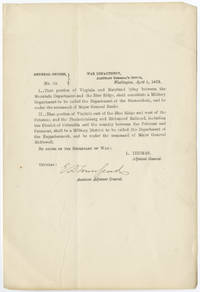
186222956Washington DC 1862. No binding. Fine. Printed Document Signed ""General Orders No. 34."" War Department Adjutant General's Office Washington D.C. April 4 1862. 1 p. 5 x 7 1/2 in. Excerpt"" I. That portion of Virginia and Maryland lying between the Mountain Department and the Blue Ridge shall constitute a Military Department to be called the Department of the Shenandoah and will be under the command of Major General Banks."" II. That portion of Virginia east of the Blue Ridge and west of the Potomac and the Fredericksburg and Richmond Railroad including the District of Columbia and the country between the Potomac and Patuxent shall be a Military District to be called the Department of the Rappahannock and be under the command of Major General McDowell.""Historical BackgroundEdward Davis Townsend 1817-1893 was a Union officer from Massachusetts. He graduated from the United States Military Academy at West Point in 1837. In 1861 he was promoted to the rank of colonel and appointed chief of staff to Lieutenant General Winfield Scott. Townsend became assistant adjutant general of the army and served in that position until the end of the war. He was brevetted brigadier general in September 1864 and major general in March 1865 for ""meritorious faithful and distinguished services in the adjutant generals department during the rebellion.""During the war Townsend was the principal executive officer of the War Department and was more intimate with Abraham Lincoln and Secretary Stanton than any other military official. He originated the plan of a U.S. military prison and established the prison at Fort Leavenworth Kansas. Townsend was appointed Adjutant General of the U.S. Army in 1869 and served in that capacity until he retired in 1880. unknown books
182873669Wash D. C.: GPO. Very Good. 1828. Softcover. Letter from the Secretary of War transmitting the information required by a resolution of the House of Representatives of the 15th inst. in relation to the number of Creek Indians which have removed west of the Mississippi And the expense attending the same. 4 pages; This is the original government document from 1828 and was removed from a larger bound volume; some foxing. . GPO paperback books
1939289674Rome: Tumminellil & C. 1939. hardcover. fine. Profusely illustrated with photos maps plans & ads. 2 volumes. Folios recently bound in full kelly green crushed morocco. Rome: Tumminellil & C. 21 October 1939 - 30 January 1943. Fine.<br/><br/> An almost complete file of this ephemeral weekly journal documenting the war in Europe.<br/><br/> Tumminellil & C. unknown books
200220111NY: Oxford University Press. Fine in Fine dust jacket. 2002. Hardcover. 0195135210 . Second printing. Fine in a fine dust jacket. . Oxford University Press hardcover books
1846WRCAM46339Monterey 1846. Broadside 12 1/4 x 8 1/2 inches. Old fold lines. Minor wear. Near fine. In a cloth clamshell case. American forces under the overall command of Gen. Zachary Taylor fought for control of the important city of Monterrey Mexico during September 22-28 1846 in one of the most important battles of the Mexican- American War. The Mexican forces under Gen. Ampudia trapped in the city plaza and bombarded with artillery decided to negotiate and Taylor agreed to a controversial armistice lasting eight weeks. The occupation of the city was disrupted by the behavior of the American troops especially the Texans who were as a result sent back north. On October 5 a Mexican lancer was shot by an American soldier - without provocation - while riding through the streets. Taylor was forced to ask for instructions on how to try the man only to find that no American laws applied and that he could only discharge the man and send him home. With the present decree the U.S. Army tried to establish some legal principles for ruling the city in this period. All rights enjoyed by citizens under Mexican law are to be retained including commercial laws for dealing with foreign merchants excepting supplies purchased for the use of the army; additionally no payments can benefit the government of Mexico and every supplier of the army must be registered. hardcover books
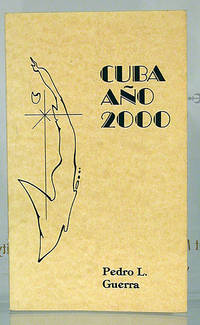
198789904Miami: Editorial Arcos 1987. Paperback. 92p. text in Spanish very good small paperback in manila pictorial wraps. Essay on the island's future by a Miami exile. Editorial Arcos paperback books
194430468New York: Harper & Brothers 1944. FIRST EDITION. Fine book in a fine dust jacket. <br/><br/> Harper & Brothers unknown books
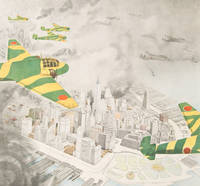
1943260152Tokyo: Dai Nihon Kaiyo Bijutsu Kyokai Greater Japan Pacific Art Association 1943. 35 mounted color plates with captioned tissue-guards. 1 vols. Oblong folio. Publisher's blue cloth boards printed paper label on cover. Fine. 35 mounted color plates with captioned tissue-guards. 1 vols. Oblong folio. The Japanese Bomb Lower Manhattan. "The purpose to publish this book is nothing but to let the people in Japan understand well the bravery and activity of the Japanese Navy. Every picture contained in this book signifies how vigorous and brave our Navy is fighting a desperate battle in the Pacific ." translated from the Preface. An imposing and colorful work of WWII propaganda by Imperial Japan illustrating events both true and wished-for. In the former category are the bombing of Pearl Harbor the sinking of the British Prince of Wales and Repulse at the Battle off Molaya the Japanese occupation of Singapore the Japanese assault on Wake Island showing captured Allied soldiers stripped to their briefs and waving a white flag and the Japanese landing on the Alaskan Aleutian Islands. In the latter category a Japanese plan to attack New York City showing Japanese bombers assaulting lower Manhattan. Dai Nihon Kaiyo Bijutsu Kyokai [Greater Japan Pacific Art Association] unknown books
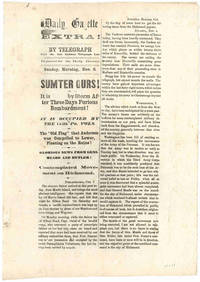
1863WRCAM45995N.p. but possibly Williamsport Pa 1863. Broadside 10 1/4 x 7 1/2 inches. Minor wear and soiling. One small tear in left margin. Very good plus. A vivid Civil War broadside showing the immediacy of the news from the front as well as how garbled or false information was disseminated. The headlines further trumpet: "It is occupied by the 144th Pa. Vols. - The 'Old Flag' that Anderson was compelled to lower floating on the ruins! - Glorious news from Gens. Meade and Butler! - Contemplated movement on Richmond." Despite resumption of a terrific bombardment of Fort Sumter on October 26 the fort did not fall to Federal forces. Thousands of rounds were dropped on the fort but it stayed in Confederate hands another sixteen months until evacuated on February 13 1865. It certainly was not occupied by the 144th Pennsylvania Volunteers and Major Anderson's "Old Flag" did not fly over the fort until two hours before the death of Abraham Lincoln on April 15 1865. The whole second column of text concerns events in the Western Theater Georgia Tennessee and Alabama and the progress of the Army of the Potomac in Virginia: <br> <br> ".General Meade was on the march for the city of Richmond under circumstances which rendered it almost certain that he would capture it. The report of the evacuation of Richmond.is of course all bosh.The details of the great movement now being executed I am not allowed to telegraph you.the objective point of the combined command is the city of Richmond." unknown books
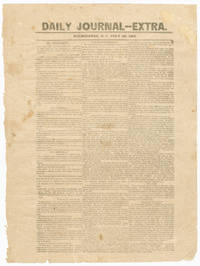
1862WRCAM56479Wilmington N.C. 1862. Broadside 15 1/4 x 11 inches printed in three columns. Moderate toning and foxing. Four-inch closed vertical tear at bottom edge no loss of paper. Very good. A Confederate newspaper extra reporting the failure of the Union's initial Peninsular campaign around Independence Day in 1862. From March to around the time of this newspaper extra General George McClellan launched an offensive campaign against northern Virginia which was intended to capture the Confederate capital of Richmond. Facing a series of crafty Confederate generals including John B. Magruder Joseph E. Johnston J.E.B. Stuart Stonewall Jackson and Robert E. Lee McClellan's tactics proved fruitless in capturing Richmond and he was eventually recalled by President Lincoln to prepare for the Second Battle of Bull Run the next month. This newspaper extra issued by the Wilmington North Carolina DAILY JOURNAL reports the "Yankees in Full Retreat" after receiving news from "a couple of free negroes" that McClellan's forces were headed north. There are also reports of deserters from McClellan's army being captured detailed passages on the path of the Union army's retreat and reports on the movements of other military units. In addition the text relates news on Confederate attempts to gain "early recognition of the Southern Confederacy" from European powers noting that Confederate diplomat John Slidell had "indicated the immediate prospect of recognition by the French Government." There are also passages covering Confederate wounded captured Union soldiers from the 7th Indiana the Confederate government's support "in comfortable quarters of some eleven hundred lazy runaway negroes" and more much of which is reported from other sources. No copies of this extra reported in OCLC. A rare Confederate newspaper extra recording mostly positive results for the Confederacy during a particularly good summer for the southern cause. unknown books
1862280305Richmond: Richmond Examiner 1862. unbound. very good. 2 pages of text on a single sheet 23 inches x 16 inches. Folded down the center and twice across the sheet. Richmond: Richmond Examiner 1862. Very good<br/><br/> On the front page is an extensive article on the Confiscation Act of 1862 and its passage by Congress. Included in the article is the text of Abraham Lincoln's Message on the act's constitutionality. The Confiscation Act gave legal authority to courts to implement the legal seizure of land and property from citizens who aided the Confederacy. Also in the act was a clause allowing emancipation of slaves in the Confederacy that lived in areas of Union occupation. Most of the rest of the text on both pages are small articles on Civil War battles and political news in the Confederacy. The publisher of the Richmond Examiner became anti-Jefferson Davis' political and military actions as the Civil War progressed.<br/><br/> Richmond Examiner unknown books
200416013Urbana: University of Illinois Press 2004. First Edition. Octavo. Cloth boards; dustjacket; 227pp; illus. Fine and unmarked in unworn jacket; near-new. University of Illinois Press unknown books
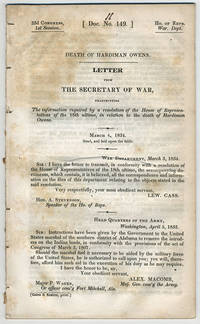
183424368Washington: Gales & Seaton pr. 1834. 8vo. 30 pp. <br><br>Hardiman Owens was => an intruder on the Creek Nation's land in Alabama. Soldiers were sent to remove him; a confrontation occurred and Owens was killed by a bullet from a soldier's musket. The soldier was indicted for willful murder and other soldiers were indicted for lesser crimes. => The legal wrangling over jurisdiction was tangled. One of the U.S. officials on the spot to help was => Francis Scott Key and two of the documents printed here were written by him.<br>Â Â Â Â Drop-title. At head of title: 23rd Congress 1st session. Doc. No. 149. Ho. of Reps. War Dept. <br>Â Â Â Â <br>Â Â Â Â Not in American Imprints . Removed from a nonce volume. Light foxing. Gales & Seaton, pr. unknown books