La Sala JennyABAA
1 575 résultats
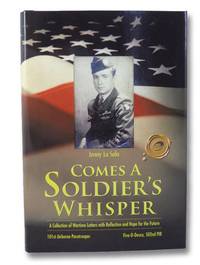
20132026300Trafford Publishing 2013. First Edition. Hard Cover. Fine/Fine. First edition. Brand new from author. 2013 Hard Cover. xviii 237 pp. Endorsement by Tom Brokaw printed on rear jacket panel. 'My silk is my silent weapon'. said this 101st Airborne paratrooper of the 5-0-Deuce as he later reflected on his jumps into Normandy in June 1944 and in the liberation of Holland in September 1944. Readers will embark on a heartwarming poignant and inspirational journey in this collection of literary works written by the author Trafford Publishing hardcover books
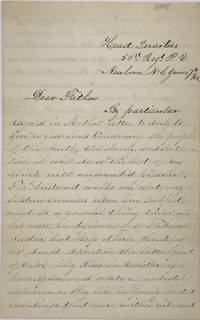
186264415Newbern sic NC 1862. 8vo. Five pages approximately 400 words in part: "The Aristocrat walks very erect very seldom converses upon any subject and as a general thing turns up his nose in defiance of a Federal Soldier but keeps docile thinking no doubt discretion the better part of valor. They dress in varieties of homespun and create a fantastic appearance they live in poorly erected buildings that have neither witnessed lime nor paint for a century but as a general thing splendidly furnished . they are a valorous people but deficient in pride. The poorer class display remarkable qualities of lamentable ignorance they are eager to converse and are poorly educated . this class is principally engaged in fishing they not having gifted sense enough to learn a trade. The land here is in my opinion completely wore out it is poorly manured . there is no lime put on it as that is a scarce article . there are no cellars to their houses . the buildings are generally raised a few feet from the ground by placing a few bricks under each corner. Crops raised here are of the poorest sort cotton in particular." Clifton born in Allentown Pennsylvania served as an enlisted soldier in the 51st Pennsylvania Volunteers participating in the capture of New Bern in March 1862 and other unit campaigns as a part of the Army of the Potomac in Virginia; he died in Easton Pennsylvania. Ink faded in a few places but the text is quite legible and provides an interesting description of New Bern and its inhabitants from the perspective of an enlisted garrisoned Union soldier. Folded as for mailing. 10795. <br/><br/> unknown books
539578vo. 8 pages approximately 1750 words. "There has been very heavy cannonading all day above here. I should judge it may pssibly be as far off as Centerville actually Manassas although the report is that they are fighting at the chain bridge . I saw a long line of troops passing on the west boundary of our farm & thought they must be forming into lines of battle O the cannonading is truly awful just now . the battle is so furiously raging constant roar of heavy guns still . if they have any reflection they must feel that they are marching on to sure death . I expect Pope is battling with the rebels. Jackson is between him and us . "August 31 You doubtless have hear the news the glorious news that the enemy are driven & that Jackson & his army are taken. I do hope it's so . later Sept. 7 "startling news this morning of the rebels having taken Frederick & crossed the river in large numbers . believe me if worse comes to worst I could use a gun in the cause with a good heart . I do wish we had a Jackson in our army; he has brains & activity both." For the pair <br/><br/> unknown books
186263800Raleigh NC 1862. Folio. One page countersigned by Pulaski Cowper the governor's private secretary. Henry Clark 1808-1874 a native of Tarboro gradated from U.N.C. in 1826 and read law before taking over the management of his father's plantation and other business affairs in the early 1830s entering politics with election to the state senate in 1850 rising to the speakership and taking over as governor when John Ellis died in 1861 preparing the state for war during his year in office Zebulon Vance became governor in September 1862. Pulaski Cowper 1832-1901 a native of Murfreesboro graduated from U.N.C. read law and practiced with Thomas Bragg and served as Bragg's private secretary when he was elected governor in 1855 returning to that position when Clark assumed the post in 1861. Andrew A. Hill a native of Iredell County and a student as the war began served as commander of Co. G 7th N.C. leading it through battles in 1862 and 1863 until wounded twice during Pickett's Charge at Gettysburg never fully recovering and being discharged on permanent disability in early 1865. Very good. Folded. 10313. <br/><br/> unknown books
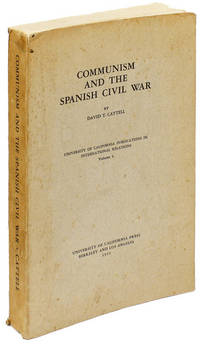
195516509Berkeley: University of California Press 1955. First Edition. Octavo. Original printed buff wrappers softcover; 290pp. Includes bibliography. Scattered foxing to covers; text generally clean and tight with two brief instances of ink marginalia; about Very Good overall. Scholarly study of the role of the Kremlin in the Spanish Civil War. Reissued in a trade edition in 1965; the present edition somewhat uncommon. University of California Press unknown books
16296EAST GERMANY. Die Kaserne. Bonn: Verlag „Ganz offene Worte" 1957-1963. 26 issues of an East German propaganda magazine. 1957 Heft 3; 1958 Heft 1-5; 1960 Heft 7; 1961 Heft 4-10 12; 1962 Heft 1-7 9-11; 1963 Heft 2. 7 ½ x 5 ½ in. Three smaller format. Staplebound. All have color covers and illustrations throughout. "Die Kaserne" was an East German magazine targeted specifically for young men in the West German military; the main object of the magazine was a disinformation campaign aimed at creating distrust of the West.<br/><br/>Kaserne English translation Barracks was created with the goal of creating dissent within the West German military by targeting conscripts. Some articles explicitly question the validity of required military conscription service which the West instituted in 1956; while others expose Nazi histories of West German leaders such as ambassadors; and many issues have strong criticisms for BRD politicians one even calls Willy Brandt who later became Chancellor of West Germany an American boot-licker Stiefelputzer. Most of the content was not overtly controversial and sought to establish common ground with low-ranking drafted soldiers. The issues are filled with jokes about military life and references to shared German culture i.e. Goethe They also feature notable East Germans such as cosmonaut Yuri Gagarin and include stories about the high quality of life for workers women and families. Appealing to their target audience of young men over a dozen of the issues feature models or pinup girls on the covers.<br/><br/>Rather than try to explicitly convert soldier to full East German ideology the objective of these magazines was to create loyal readers who would disrupt overall West German military strategy. In the ideal situation this would be the first step in converting these Bundeswehr soldiers to East German political ideology and possibly becoming a Communist spy.<br/>Pristine information cards in several issues encourage readers to subscribe to the free publication and to share copies with their fellow West German soldiers. Light reading wear. All in very good condition. unknown books
1942WRCAM54825Washington D.C.: Washington Photo Co. 1942. Panoramic photograph 32 1/2 x 10 1/2 inches. Black-and-white photograph with captions printed below the image. Mild toning and fading. Three one-inch tears and two three- inch creases starting to split not affecting image; moderate insect damage to upper left and rear where rolled photo had been exposed; several small holes and two small rust stains not affecting image. Still good. A panoramic photo of one of the first African- American training units formed at Camp Lee now Fort Lee Virginia in late 1941. The recruits are divided by platoon and accompanied by their predominantly white officers with names of all printed below. More than two hundred trainees are shown and named. The 9th Quartermaster Training Regiment was the first African-American training unit to form at Camp Lee in late 1941 just before the Japanese attack on Pearl Harbor. The soldiers in this photograph likely entered the army in early 1942 and were nearing the end of their training when the image was taken. They soon would be deployed overseas or around the United States working to store transport and distribute food fuel clothing and ammunition necessary to supply the army's combat divisions. Camp Lee was established during World War I as a training site and during World War II was expanded to provide training for quartermasters and related support specialists. Although some black soldiers saw combat during World War II the vast majority were assigned to all-black quartermaster and engineer units providing logistical support and distributing supplies and ammunition to troops around the world. President Truman finally desegregated the armed forces in 1948 with Executive Order 9981 and the last all-black unit was disbanded in 1954. <br> <br> African-American World War II Army panoramas are scarce in the marketplace. Washington Photo Co. hardcover books
1850241569New York: F.J. Dow & Co. 139 Nassau St 1850. First edition. Illustrated with 15 beautiful engravings. 128 pp. 1 vols. 8vo. Original red cloth gilt spine spine chipped. Bookplate internally fine. First edition. Illustrated with 15 beautiful engravings. 128 pp. 1 vols. 8vo. Howes M564 F.J. Dow & Co., 139 Nassau St unknown books
539608vo. 7 pages approximately 1100 words. "We are feeling very anxious at present about affairs at Richmond. We can get nothing definite in regard to the fighting . they must prepare for a long and bloody war . later we hear the rebels are moving upon Pope with their whole army." Folded for mailing. Very good. For the pair <br/><br/> unknown books
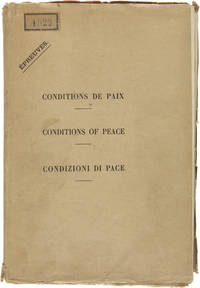
1919WRCAM35473N.p. but likely Paris 1919. Four versions of the text separately paginated and grouped together printed in English French and Italian two versions. Folio. Gathered signatures loosely inserted into printed wrappers as issued the four sections laid into a general printed wrapper. Moderate edge wear. Near fine. Germany's great ally in World War I was the Austro-Hungarian empire which in 1919 was broken apart and made into the separate states of Austria and Hungary birthing as well several other nations in Eastern Europe. The new state of Austria signed the Treaty of Saint Germain making peace with the victorious Allies on September 10 1919. Present here are preliminary printings in English French and Italian actually two Italian versions of that treaty indicated as such by the printed words "proof" "epreuves" and "bozza" on the respective treaties. The articles three versions of the treaty are not numbered sequentially but rather are numbered discreetly within parts and the pagination is not continuous between the parts. The second Italian version present here however does number the articles a total of 371 and the pages a total of 177 continuously though there is no printed date for the signing of the treaty indicating that it is also a preliminary proof printing though made later than the other three. Several of the most important parts of the treaty - those dealing with financial reparations for example - are blank here indicating that these proof versions were printed before those matters were completely settled. <br> <br> The conclusion of the Great War split apart the Austro-Hungarian Empire. In the Treaty of Saint-Germain the newly-created state of Austria recognized the independence of Hungary Czechoslovakia Poland and Yugoslavia and also had to cede much land to Italy and Bukovina to Romania. Austria also had to agree never to compromise its independence and was therefore forbidden from entering into any alliance with Germany. Austria was also forced to admit its complicity with Germany in waging the war and was saddled with reparations payments. Austria's army was limited to 30000 and other articles of the treaty addressed political and economic issues. The text of the treaty also contained the League of Nations Covenant and therefore was never ratified by the United States Senate. <br> <br> A very rare and interesting version of an important treaty ending the First World War here in a very small printing likely made only for participants in the peace conference. unknown books
1954302567New York Crown Publishers Inc. 1954. 1954. First edition. 8vo. Illustrated with 100 b/w photographs and facsimiles; endpaper maps by Alfred P. Jancovic. Bibliography. Dust jacket unclipped; slight rubbing. Very Good. 326 pages. No signatures or bookplates. 1st Edition. Hardcover. Very Good/Very Good. New York, Crown Publishers, Inc. [1954]. hardcover books
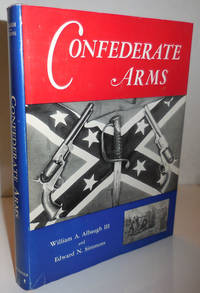
195726295Harrisburg: The Stackpole Co 1957. First edition. Hardcover. Near Fine/very good. 4to. 278 pp. An extensive guide to almost everything the Confederate soldier used carried handled or treasured in his long march from Manassas to Appomattox. A near fine copy in very good clipped dustwrapper. Illustrated with numerous black and white photographs. A large and heavy book. The Stackpole Co hardcover books
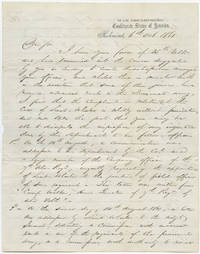
186123285<p>Writing as acting Confederate Secretary of War Judah P. Benjamin denies Major General Braxton Bragg the possibility of a transfer to a more active post. Instead Benjamin gives Bragg additional responsibilities including defending Alabama. Bragg must have become tired of inaction as three days after Benjamin wrote this letter Bragg ordered the Confederate assault on Fort Pickens at the Battle of Santa Rosa Island.</p> <b>JUDAH P. BENJAMIN. CIVIL WAR.</b>Autograph Letter Signed as acting Secretary of War to Braxton Bragg. Richmond Va. October 6 1861. 4 pp. 7¾ x 10 in. On War Department letterhead.<p><b>Transcript</b></p><p><i>"I have your favor of 25th Ulto and have examined into the causes suggested by you as tending to create dissatisfaction amongst your officers and whilst there is much truth in the assertion that some of your juniors have received advanced rank in the Provincial army I find that this complaint in relation to the case of Lieut. Wheeler is wholly without foundation and will state the facts that you may be able to dissipate the impression of any injustice done by the department to his fellow-officers.</i></p><p><i>1st on the 14th August a communication was addressed to this department by the Col. and a large number of the Company officers of the 7th Ala. Regt. urgently requesting the appointment of Lieut. Wheeler to the position of filed officer of the same regiment. This letter was written from "Camp Walker Head Quarters of the 7th Regt. of Ala. Vols."</i></p><p><i>2d on the same day 14th August 1861 a letter was addressed by Lieut. Wheeler to the Adjt. General soliciting a commission with increased rank as are of the regiments of the provisional army or a commission with authority to raise a battalion or regiment for the War. This letter was endorsed with a very earnest recommendation that the appointment should be made signed by Col Wood of the 7th Ala Regt. commanding 2d Brigade and was forwarded by <u>yourself</u> with a <u>'full and cordial endorsement of Lt Wheeler's application'</u>and it was in consequence of these endorsements and recommendations that my predecessor yielded to the solicitation of the officers of the 19th Ala Regt. and appointed Lieut. Wheeler their Colonel. I enclose you copies of the papers as a duty to my predecessor whose action on the subject is somewhat impugned by your letter of 25 Ulto.</i></p><p><i>And now my dear sir having disposed of this matter let me say that the noble and self-sacrificing spirit displayed by yourself and the gallant spirits that are now chafing in the hateful inaction on the sands of Pensacola harbor are fully appreciated and elicit the most heart-felt approval and admiration not only of the President Jefferson Davis but of every member of the administration. We are as anxious as you can possibly be to relieve you from a position to which the fortune of war has condemned you and we look forward as impatiently as you can to some opportunity of testifying our sense of what is due to you all. But all our deliberation results in this that to remove you as we know is your earnest desire to some field of more active operation would have the most disastrous effect on the morale of the army under your command whilst for your officers we can do nothing for the moment under the legislation as it now exists; but we shall none the less hold them in remembrance for the marks of approval as soon as it shall be possible to transfer them to other fields of duty; and I will further say that whenever you feel you can spare any of your officers and desire him rewards I will find the means to place him in some desirable post and with increased rank in the provisional army.</i></p><p><i>In the mean time the President in conversing with me on the subject of own position has suggested that it might be a partial relief to the tedium of your constant vigil to extend your command and make it embrace the coast of Alabama thus giving you an additional chance for an actual fight in the event of a descent by the enemy and you will accordingly find that a general order has been issued making of your command a department and placing the coast defences of Alabama under your control. I think you will thus have an increased chance for actual combat."</i></p><p><b>Historical Background</b></p><p>Santa Rosa Island blocked the mouth of Pensacola harbor and the Union Fort Pickens effectively eliminated any strategic value of the Confederate capture of Pensacola's naval shipyard and nearby railroad. Three weeks prior to this letter Union forces raided the captured shipyard and burned the schooner <i>Judah</i> to prevent its putting to sea as a privateer. As evidenced in this letter Confederate Major General Braxton Bragg was <i>"chafing in the hateful inaction on the sands of Pensacola harbor"</i>cut off from using his newfound assets to their fullest benefit. As Benjamin was writing this letter denying Bragg's transfer request Bragg himself must have been planning the retaliatory raid against Fort Pickens. The battle which took place on October 9 1861 was inconclusive with both sides claiming victory in the Florida's first land action of the war.</p><p>Known as "the brains of the Confederacy" <b>Judah Benjamin</b>1811-1834 served in the Louisiana state legislature and U.S. Senate before joining Jefferson Davis's cabinet first as Attorney General then Secretary of War and finally as Secretary of State. A New Orleans lawyer Davis had given Benjamin the post of attorney general until deciding he needed him in a more important role. In September 1861 he was moved to the War Department. His closeness to Davis—and his Jewish faith—attracted resentment from jealous rivals. With the loss of Roanoke Island in 1862 along with Grant's capture of Forts Henry and Donelson critics demanded Benjamin's blood. Davis responded by promoting him to Secretary of State a post he held until the collapse of the Confederacy. Initially part of Davis's contingent when the Confederate president fled Richmond in women's clothing Benjamin escaped to England where he thrived as a lawyer and was named to the Queen's council. He retired in 1883.</p><p><b>Braxton Bragg</b> 1817-1876 was a career military officer first in the U.S. Army and later in the Confederate Army. He attained the rank of full General in the Confederate Army one of only seven in the Confederacy. He fought at the Battles of Shiloh Chickamauga and Chattanooga among others and in 1864 became Jefferson Davis's military adviser.</p><p><b>Condition</b></p><p>Very good. Some separation at folds. One and one-quarter inch tear at the upper edge of page three. Minor paper loss along the main vertical fold. Areas light toning.</p> books
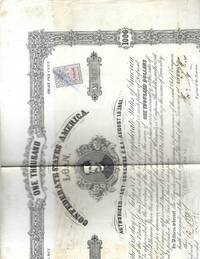
16794Confederate States of America $ 1000 loan Bond with Coupons Richmond 1862. Original Loan with 23 coupons first 8/1865 With elaborate engraving and ornate boders Richmond October 1862. When the Civil War broke out the newly-formed Confederate States of America needed to create a monetary system to finance the government and the war effort. To raise money to finance its government the Confederate States of America issued bonds. This bond dates from late in the Civil War when printing too much paper money had created rampant inflation. The Confederacy began issuing bonds. After the Confederacy's defeat the U.S. government refused to cover Confederate debts making the bonds worthless as debt instruments or market securities. its bonds had no value and this bankrupted many confederate families. Over the following decades most of the worthless bonds were destroyed. Very good example complete with fully attached redemption coupons in very good condition. unknown books
19616536Albuquerque. Horn and wallace. 1961. Bound in gilt titled cloth. 8vo. This volume designed and directed by Jack Rittenhouse of the Stagecoach Press. All type and plates were destroyed after the printing of 1000 volumes of which only 900 were for sale. Illustrated with a frontis map and various and various maps en texte. A Fine copy in a Good only heavily chipped dustwrapper. Horn and wallace. hardcover books
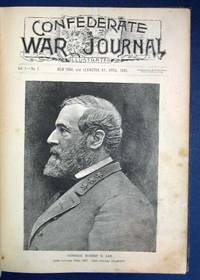
189424807.2New York 1894. 1st appearance. Printed wrappers with woodcut portrait of Joseph E. Brown to front wrapper. Abt VG wrappers detached/minor chipping & staining/staples a bit rusted. Pp 177 - 192. Index to Volume I laid-in. Illustrated. 4to. 11" x 8" <br/><br/> unknown books
189424807.1New York 1894. 1st appearance. Printed wrappers with woodcut portrait of George W. Johnson to front wrapper. VG age toning to wrappers/staples a bit rusted/large chip from bottom edge of front wrapper. Pp 161 - 176. Illustrated. 4to. 11" x 8" <br/><br/> unknown books
189324807New York 1893. 1st bound volume. Original publisher's grey cloth lettered in gilt to front board professionally restored. Abt VG pos & notes to ffep/a few leaves with paper restoration to edges. Lacks cover illustration for No. 7 & 8. Xerox facsimiles laid-in. 192 pp. Illustrated. 4to. 11" x 8" <br/><br/> hardcover books
18611020198vo original printed wrappers folding map 71 8 ad pp. Partially disbound top of front wrapper missing a few chips rear wrapper and spine significantly damaged old tape repair to spine map detached with significant tears and splits at folds but complete normal aging. Despite the somewhat significant imperfections the text and ad pages are in very good condition. This is the first Congressional Directory to appear during the Civil War. The large folding map shows some of the early battles of the war. It lists key committees and membership and also indicates diplomatic assignments to other countries. books
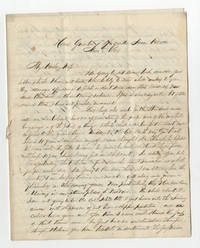
186423878<p>"<i>Just make up your mind that negro nature & human white nature are very near alike.</i>"</p><p>"<i>Every now & then it is proclaimed with great joy that Mr So & so some northern nabob or speculator has purchased some rebel plantation & prepares to work the same. … It's of more consequence locally & nationally thus the negro should buy & toil as he surely will on his acre of land than that princely men in Illinois should have inserted his loose change in a southern plantation.</i>"</p><p>Connecticut native William H. Noble writing to his wife responds to rumors of the fountain of youth vilifies northerner plantation renters who continued the Southern system as new feudal barons and calls for the redistribution of plantations to former slaves to ensure national stability. Jacksonville Florida was occupied and then abandoned by the Union four times. The result was a broken skeletal city at the Civil War's conclusion.</p><p>Noble reflects on how the African Americans' freedom will change Southern and national life and that regardless of race he believed human nature was the same. Further the former slaves needed an interest in and responsibility for their own advancement. Presaging Booker T. Washington he thinks developing industry more important than carpetbaggers coming south offering education. With a detailed sketch of headquarters in Jacksonville including tents stables and the brigade flagstaff.</p> <b>CIVIL WAR. WILLIAM H. NOBLE.</b>Autograph Letter Signed to his wife Jacksonville Fla. April 8 1864. 16 pp. 8 x 10 in. on 4 folding sheets stitched together.<p><b>Excerpts</b></p><p>"<i>An artillery officer told me yesterday that there is a spot down the coast somewhere at which people never die. I am going to live down there. I want to see how this country I am helping to save and remake gets along and grows & flourishes in the coming years.</i></p><p>"<i>The truth is there are but very few men as old as I really am in point of years in the army and I have no doubt I look old to them. But I am not in point of the elements of youth & age & their manifestations more than half the years…. <b>I think very likely however that the change in the Status of the negro will show that race to occupy the place now accorded to the Irish and push up the Irish girls a peg or two. That is just what the Irish did for the American help. When I was young there were no Irish field or house servitors. All were Yankeys.</b></i></p><p><b><i> Well the irish are dreadfully down on the negroes. American laborers used to be very hard on the Irish. But</i></b><i><b> God works wonders in spite of mans blindness</b> <b>and I have no doubt in more ways than one he will do so with the Negro. But I see but very few contrabands. My Regiment has never yet penetrated into a virgin Ethiopian place. In fact wherever we have been the yanks have one time & another been before us and culled them out for soldiers or Sambo has taken his chance and gone north.</b></i></p><p><i> The fact is the quicker Sambo learns to take care of himself and is made so to do the better. But it wont by apprenticeing him to some one who only cares to get the most possible out of him. Forcing him to work for set wages to remain in a fixed place & to toil for a man who buys of the government his industry is but a mockery of Freedom. Sambo has the same right & must be treated like any other human & not as if his skin hid under its somber hue a different nature or a soul governed by different impulses passions & motives.</i></p><p><i> <b>Who cares whether the world has cotton princes or not. Let the production run out if need be. Don't bother yourself about obtuse fancies on the negro question & his industry. Take no thought about large Estates going to waste & without culture.</b> <b>Have no anxiety but that human nature & niger nature will work out its own salvation if you give it a chance. Sambo wont work if you feed him a plumb pudding and send down a lot of infatuated people who should make little nigs. fully acquainted with general geography the distribution of offices universal History in 24 lessons</b>.</i>"Additional excerpts below</p><p><b>Historical Background</b></p><p>Jacksonville Florida suffered mightily as it changed hands several times during the Civil War. With the Union Navy blockading the port for most of the war the army alternately occupied and abandoned the city deeming its defense too costly and non-essential. Despite the blockade the city remained a key Confederate supply point becoming the "breadbasket" of the Confederacy and shipping large quantities of pork beef molasses corn potatoes and other supplies to troops via rail. In an attempt to take the railroads and stop the flow of foodstuffs and supplies on February 7 1864 Union soldiers occupied Jacksonville for a fourth time. Politically Lincoln hoped to establish a Unionist government after cutting the Confederate supply lines. He even sent John Hay one of his personal secretaries as his representative. But Union troops suffered a devastating loss 45 miles away at the Battle of Olustee on February 20 and veteran soldiers on both sides remarked that they had never experienced such terrible fighting.</p><p>As the Union forces were still retreating the 54th Massachusetts US Colored Troops USCT was ordered to march back to a broken-down train carrying wounded Union soldiers. When the USCT troops arrived the men attached ropes to the engine and cars and manually pulled the train approximately three miles to camp where horses then helped pull the train the ten miles back to Jacksonville.</p><p><b>Additional Excerpts </b>Full Transcript Available</p><p>"<i>…<b>Just make up your mind that negro nature & human white nature are very near alike.</b> Find out its appetites & fancies & give them play. <b>The negro has toiled as the chattel & possession of some body who </b></i><6><b><i>owned him & his toil & the soil on which he lived. He has never known the manhood & the anchorage which comes of the ownership deep down & high as heaven of a little piece of Gods footstool.</i></b><i>He longs for this purchase next after the freedom for himself & his household. Till he has this he does not feel himself fastened any where but still a moveable whom the whim of the white man may tote about. <b>But once let him have his little fast anchored piece of mother Earth and you will find him planting therein his faith not only in being free but in the reality of that freedom which has no seeming substance for him but in calling a little piece of land his own & the home of him & his.</b> When he has got the time he will toil to get that which he also covets the beasts to help his tillage. The negro saves they are found to get & keep money. At Hilton Head they have more cash than any body else. Let him plant it in a home.</i>"</p><p> "<i>What are you keeping these immense plantations leased out to farmers to whom you have the impudence & effrontery to lease freed men whom you would fasten to the soil. The terrible horror is manifested lest Estates should go uncultivated. <b>Every now & then it is proclaimed with great joy that Mr So & so some northern nabob or speculator has purchased some rebel plantation & prepares to work the same. You had proclaimed a more welcome fact if you could tell me that you had cut up our Rebel hosts plantations & that his chattels had bought it in pieces with cash or with </b></i><b><7><i> the right of prescription which they proposed to make secure & perfect by their toil & its products. </i></b><i><b>It's of more consequence locally & nationally thus the negro should buy & toil as he surely will on his acre of land than that princely men in Illinois should have inserted his loose change in a southern plantation.</b> As an item of national health as an element of Public currency the latter has to my mind much the less significance. <b>Give me the divided & subdivided proprietorship of the soil as the best element of national strength and the surest index of national happiness & prosperity. The small proprietors of the lands make no rebellions they are looking for no exclusive privileges. They have no schemes to enhance the importance & consequence of a big landed aristocracy.</b></i></p><p> "<i>Then <b>cut up their big possessions. Parcel out the sugar & the cotton land into small proprietorships. Let the poor white man or the poor negro have the chance. If they cannot pay to day let them have the chance to earn their living & the money to do so at a more convenient season.</b> Confiscate every rebel Estate down to a certain amount to be reserved for him & his family Declare forfeited the possesses of every one who cant prove his loyalty especially of all who have aided and abetted the Rebellion turning only a small proportional account for the innocent of his own household. <b>Render no man but a willful arrant rebel in arms homeless.</b> But open up his rich possessions to the part of the white & the negro in such limited quantities as the </i><i>population</i> <i>& the desire to purchase seem to demand</i></p><p> "<b><i>The Ethiopian will then see in the ownership of the soil his interest in the government & the reality of freedom which without this is only in airy theory & which this makes solid and practical.</i></b></p><p> "<i>You need not trouble yourself then about what to do with the freedmen. They will take care of themselves exceptions there will be. <b>Poor miserable lazy wretches there will be wearing both white & black skins. These can be taken care of by wise laws if found necessary.</b></i></p><p> "<i>But enough if you will watch you will find among wise men there is a great deal of tomfoolery & very little common sense when you try to render their wisdom practical. Genl </i>George Henry <i>Gordon told me he had known of all men first class legislators & lawyers come out & utterly break down in the care of a Regiment. They were <u>old</u> dogs & could not learn new tricks. They had a great deal of uncommon but a very little common sense</i>."</p><p><b>William H. Noble </b>1813-1894 was born in Connecticut and graduated from Yale University with a law degree in 1836. He established a practice in Bridgeport and helped the city secure its charter. He served as state's attorney in the late 1840s and when his father died he entered into an agreement with P. T. Barnum to develop land in East Bridgeport that Noble had inherited. A conservative Democrat but strong Unionist Noble obtained a commission as colonel of the 17th Connecticut Infantry on July 23 1862. He led his regiment in the Battle of Chancellorsville where his horse was killed under him and he was severely wounded. Before completely recuperating at Bridgeport Noble rejoined his regiment and led it at the Battle of Gettysburg and later in the sieges of Fort Wagner and Fort Sumter. In February 1864 the regiment transferred to Jacksonville Florida where Noble served as commander of the first brigade of Adelbert Ames's division. On December 24 1864 Noble was captured while traveling between Jacksonville and St. Augustine Florida and sent to the prisoner-of-war camp at Andersonville Georgia where he was the highest ranking officer. Exchanged early in 1865 he returned to the service before mustering out in July 1865. After the war General Ulysses S. Grant brevetted Noble as a brigadier general. Returning to his law practice Noble lived in Bridgeport until his death. In 1870 his family had an African American domestic servant named Anthony Seymour b. 1835 who was born in South Carolina and had likely been a slave.</p><p><b>Harriet J. Brooks Noble</b> 1818-1901 was born in Bridgeport Connecticut. She married William H. Noble in October 1839. They had five children born between 1840 and 1859.</p><p><b>Condition</b></p><p>Fine.</p> books
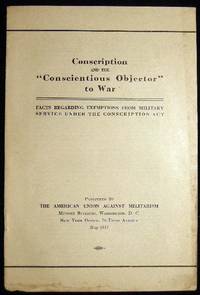
191722167Washington D.C: The American Union Against Militarism 1917. 13 pages; Chairman of the Union was Lillian D. Wald 1867 - 1940 the organization ".which fought against preparedness and for a peaceful solution to international disputes." ANB; the pamphlet giving pointers on how the law will operate advice to objectors legal aid constitutionality; with references; approx. 6" x 9" size; stapled printed paper self-wraps; light wear dustiness; old discoloration at very bottom edge; in very good condition and interesting early 20th century anti-war pacifist ephemera. . First Edition. Soft Cover. Very Good. The American Union Against Militarism Paperback books
1740WRCAM41547London: W. Webb 1740. 428pp. Modern marbled boards gilt leather label on cover. Bookplate of Alberto Parreño on front pastedown. Minor soiling. Very good. A later issue of this edition published shortly after the beginning of the War of Jenkins' Ear. Sir Robert Walpole's lengthy diplomatic efforts eventually came to naught and he bowed to popular sentiment in October of 1839 and commenced the War of Jenkins' Ear. "Includes several references to naval actions & commerce in the West Indies" - EUROPEAN AMERICANA. ESTC calls for an added postscript with this issue though SABIN and EUROPEAN AMERICANA make no such differentiation. Only four copies of this issue located in ESTC. EUROPEAN AMERICANA 740/76. SABIN 15994. ESTC T2956. W. Webb hardcover books
1944WRCAM41429Mios Woendi 1944. Three pages of typed index followed by sixty- two photographs each 5 x 6 1/2 inches. Photographs numbered in lower right corner corresponding to index and backed by linen. Oblong 12mo. Original Plexiglas binding brad bound with a cover reading: "Construction Photographs 55th Seabee's." The photographs are clean and clear. Near fine. A very interesting album of photographs documenting the construction of the U.S. Navy Base on the tiny island of Mios Woendi during World War II. Located in the Dutch East Indies near Indonesia Mios Woendi was an important base for American PT boats and for larger ships as well. The photographs in this album show the construction of the base by the U.S. Navy construction battalion known as the "Seabees." The photographs give aerial views of the island the dense foliage the Seabee's camp and dozens of detailed views of all stages of the construction of the base. Also dozens of PT boats - this could be "McHale's Navy." Likely produced in a very small number for military authorities and participants in the construction. We are unable to locate any other copies. unknown books
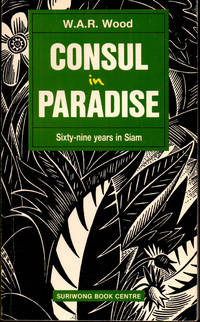
199128192Chiang Mai: Trasvin Publications 1991. Paperback. Very good. 175pp. internally fine with clean text that has no underlining highlighting or notes. <br/><br/> Trasvin Publications paperback books
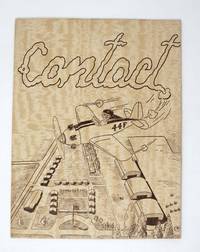
194444721Ryan Field Hemet California: 5th A.A.F.F.T.D. 1944. 1st Printing. Light brown paper wrappers printed in dark brown stapled. Now housed in an archival mylar sleeve. General signs of use. VG - VG. Unpaginated though 44 pp. Illustrated with drawings & photographs. 1--3/4" x 8-1/2" <br/><br/>Not found on OCLC though the CSL has an issue featuring class 42-J. 5th A.A.F.F.T.D. unknown books