SCHRANZ (J.), SABATIER (J.-B.), BAYOT (A.)Livre Rare Book
30 333 résultats
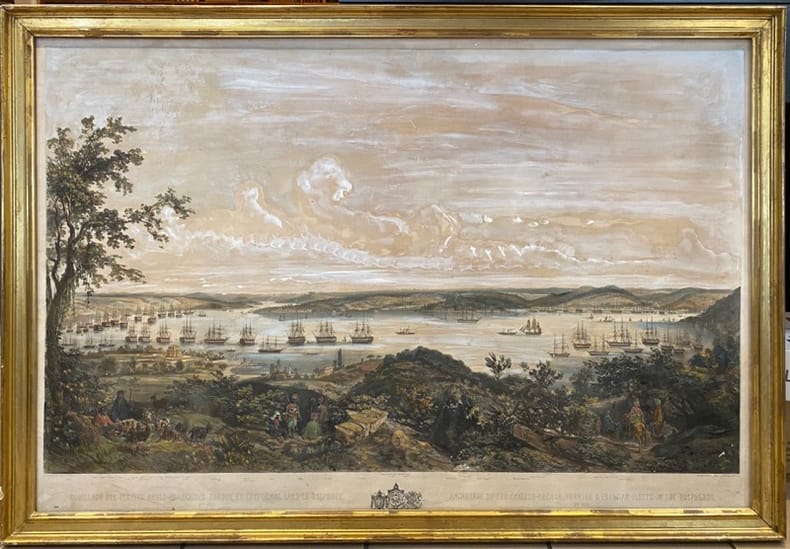
210664A Constantinople, A. Percheron et J. Schranz, Paris, Imp. de Jacomme & Cie, (1854) 89 x 129 cm, lithographie en deux tons, mise en coloris de l'époque, en feuille, sous cadre doré ancien. Sans verre.
1916000483<p>Istanbul: TanÄ«n 1916.<br />Book. As new. Hardcover. 8vo over 7¾–9¾ in.<br />An official report issued by the Ottoman Fourth Army under Jamal Pasha concerning the proceedings of the Supreme Court Martial Tribunal convened at Ê¿Ä€liyah Aley Lebanon established to prosecute alleged Arab separatists and Pan-Arabist movements in Syria and Egypt during the First World War.<br />The report claims that the names of prominent Arab nationalists were discovered by the Ottoman authorities among documents seized from the French Embassy in Beirut reportedly placed under the safekeeping of the American Embassy following the outbreak of war. These documents formed the evidentiary basis for the tribunal's investigations.<br />125 pages of Arabic text accompanied by over 50 facsimile plates issued as a supplement reproducing original documents and correspondence between the accused Arab nationalists and other related parties examined by the tribunal.<br />Preserved in a modern hardcover binding.<br />A significant and controversial contemporary Ottoman publication providing rare primary documentation on wartime military justice Arab nationalist movements and Ottoman intelligence practices during the final years of the empire.</p><p>An important Arabic political and legal work presenting the Arabic version of La Vérité sur la Question Syrienne addressing the investigations and proceedings of the Ottoman Martial Law Tribunal DÄ«wÄn al-Ḥarb al-Ê¿UrfÄ« convened in Ê¿Ä€liyah Aley during the First World War.<br />The work constitutes a contemporary defense and documentary clarification of political accusations brought against Syrian and Lebanese figures shedding light on:<br />Ottoman wartime judicial procedures<br />political repression and accusations of separatism<br />and the broader Syrian Question in the late Ottoman period.<br />As the original Arabic edition this publication is a key primary source for the study of Ottoman military justice Arab political movements and Syro-Lebanese intellectual history during the final years of Ottoman rule.<br />A scarce and historically significant work particularly sought after in collections relating to the Arab provinces of the Ottoman Empire World War I Middle Eastern politics and constitutional and legal history.</p> Tanine hardcover
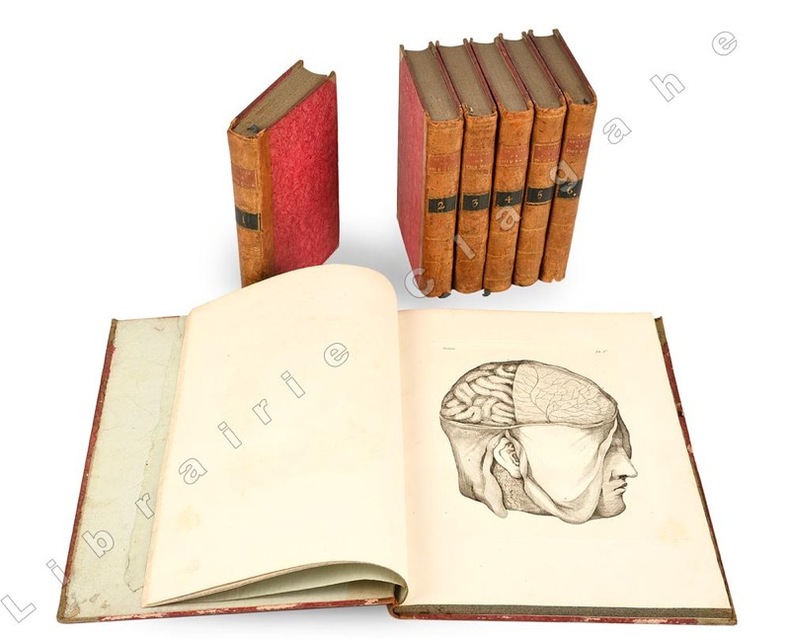
180521362Paris, L. Duprat-Duverger, imprimerie de Baudouin, an XIII-1805 ; 6 tomes in-8 et Atlas grand in-4° (338 mm), demi-veau fauve et petits coins de vélin, pièces de titre décorées rouge-orangé et de tomaison décorées vert-empire, plat de papier rouge à l’époque, tranches mouchetées (reliure de l’époque); XI, 88, 332 pp., frontispice de Girodet, gravé par Robert De Launay, [1] f. serpente imprimée de l’explication de l’estampe ; [2] ff. (Table et Errata) ; 446 pp., [1] f. (Errata) ; 444 ; 410 ; 372 ; 372; 360 pp. ; Atlas : [1] f. Titre, IV pl. pour les Mémoires ; 35 planches sur le cerveau (XXXII et II bis, V bis et XXIIbis), dont 8 doubles.
1794199<p>CONVENTION NATIONALE. COMITÉ MILITAIRE. REGLEMENT POUR L'ORDRE DU TRAVAIL ET LA POLICE INTÉRIEURE DU COMITÉ MILITAIRE. ARÊTÉS DU COMITÉ MILITAIRE IMPRIMÉS En vertu de l'article 31 du décret du 7 Fructidor l'an deuxième de la République française une et indivisible. Extrait du registre des procès-verbaux des séances. A PARIS DE L'IMPRIMERIE NATIONALE. Brumaire l'an III. 1794 In-8vo. 32 pages. Disbound trimmed resewn using original sewing stations. Two copies were located at the Bibliothèque Nationale de France and the British Library respectively. Condition is good.</p><p>Sixteen members of the Comité Militaire established in this operational manual the details of the organization of la police intérieure including arms military hospitals oversight training of troops establishment of the hierarchy of the gendarmerie nationale artillery fortifications frontier security military buildings housing and equipping troops convoys relays equipping horsemen and surveillance of the armed forces in Paris.</p><p>A chronology follows the details of the legislative proceedings about the organization of troops police and military tribunals as well as for the gendarmerie required by the department of Paris; also the provisioning of the corps-de-gardes of Paris and the extensive legislative summaries concerning the force armée of Paris and the military transports. </p>The manual is signed by Gossuin president Dubois-Crancé secrétaire. DE L’IMPRIMERIE NATIONALE books
17932201040008Philadelphia: : Printed by E. Oswald no. 156 Market-Street south between Fourth and Fifth-Streets. M DCC XCIII 1793. Hardcover. Good. Von Steuben's Revolutionary War Manual on Drill was written at George Washington's urging. It remained an important guide for the American military through the War of 1812 Rebound in early 20th century 1/2 cloth over marbled boards. Hardcover. Good binding and cover. Foxing. 48 p. ; 22 cm. 8vo. <br> Evans 26358. ESTC W21724. <br> Prepared by Friedrich von Steuben in 1779 as inspector general of the Continental Army; adopted nationally by the Uniform Militia Act of 1792. 'Washington asked Steuben to serve temporarily as inspector general and to begin his duties by instructing the soldiers in the long-neglected subjects of discipline and drill. To the amazement of the Americans who were unaccustomed to officers acting as drillmasters Steuben initially formed a model company which he personally instructed with the aid of a translator. By April Steuben had acquired four assistant inspectors and had extended drill instruction to the whole army. Lacking adequate drill manuals Steuben wrote daily lessons in which he greatly simplified and softened Prussian methods to fit the immediate needs and free-spirited ways of the American soldiers . The transformation that Steuben wrought in the training of the Continental army greatly impressed Washington and other observers. In May 1778 Congress acting at Washington's recommendation officially appointed Steuben inspector general of the army with the rank and pay of major general.' ANB online. Philadelphia: : Printed by E. Oswald, no. 156, Market-Street, south, between Fourth and Fifth-Streets., M, DCC, XCIII hardcover
63833G.S.I. T. Headquarters Ninth Army February 1942. FIRST EDITION. 8vo. 24 x 17 cm. pp.vi Title and Contents plus pp.ii Errata plus iii-xv The Bedouins of Northern Arabia by Lt. Col. J.B. Glubb and pp.186. Original blue printed paper wrappers rubber stamped 102 and in red "This Document will be kept under lock and key when not in actual use". Ownership inscription of "P.M. Holt/28.0.59/Hastings" A fascinating handbook on the tribal peoples of Syria with a remarkable folding map of 'The Arab Tribes in Syria' a French map overprinted with the tribes' names and their Summer and Winter locations. The handbook was compiled by the British 'Ninth Army' which occupied Syria and Lebanon after the allied defeat of Vichy France in 1941. An official publication it was issued for a limited readership: "This document is the property of H.B.M. Government and is issued for the information of officers and responsible officials." Most surviving copies show signs of official ownership and this is no different with sporadic manuscript annotations updating the intelligence. Uncommon. LibraryHub lists three holdings in the UK at SOAS the British Museum and Oxford. OCLC adds six holdings at the American University in Beirut Princeton Duke University NYU Abu Dhabi Monash University and Keio University. Peter Malcolm Holt 1918 -2006 eminent historian of the Middle East and Sudan and a founding editor of the Cambridge History of Islam. G.S.I. (T). Headquarters, Ninth Army, February, 1942. unknown
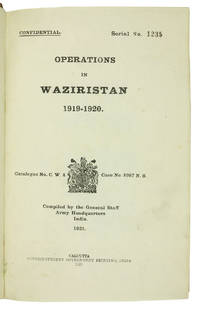
1921ABC_45215Calcutta: Superintendent of Government Printing 1921. Contemporary half calf green cloth sides gold-stamped red spine labels. 8vo. With frontispiece 31 plates 7 maps 3 in pocket on inside of back board and 8 panoramas mostly folding. First edition of the British-Indian armys official account of the 1919-20 Waziristan campaign marked "Confidential" on the title-page. The operations followed unrest that arose in the aftermath of the Third Anglo-Afghan War; they were conducted in the mountainous region of Waziristan now in Pakistan by British and Indian forces against the fiercely independent Waziri and Mahsud tribesmen that inhabited it. Since the 1870s the British government agencies were assiduous in compiling internally published histories of their military frontier operations with the intention of providing a "valuable guide" to such British commanders and policymakers as "might have future dealings with these turbulent neighbours" as the Punjab Government phrased it in 1866.The title-page reports the catalogue number and location of what may be the original report: Catalogue no. C.W. 4 - Case no. 8987 N.S..Serial No. 1235 stamped on the title-page. Occasional light marginal staining. A few edge flaws consistent with army use repaired by a contemporary owner. Otherwise in very good condition.l WorldCat 11497145. Superintendent of Government Printing, hardcover
241398A Kralovelhoya, [Paris, Cailleau], 1780 2 volumes in-8, (2)-224 pp. et (1)-148 pp., 2 tableaux sur une même feuille repliée et 20 planches dont 18 repliées, demi-veau havane clair à coins, dos à nerfs orné, pièces de titre et de tomaison de maroquin vert et brun (reliure vers 1820).
182439395ABLondon, Robert Jennings, 1824. EA. First edition. 3 Bde. Folio. Mit 3 gest. Titelbl., 81 Tafeln (davon 70 handkol., 25 Tafeln m. Gold), 27 kol. Initialen u. 3 tls. kol. Bleistiftzeichnungen. Rot. Halbleder. Vergold. Rückentitel, Rücken-und Deckelvergold. Kopfgoldschnitt. Red half calf. Gilt title on spine, gilt images on back and boards. Top edge gilt. Etw. ber. u. best., Rü. aufgehellt. Tls. stockfl. 3 Exlibris. Schöne dekorative Ausgabe. Slightly rubbed and bumped. Partly foxed. 3 exlibris. Very nice copy.
1943005853Tunisia: British Eighth Army 28 April 1943. Leaflet. This compelling Second World War artifact is an original message from General Bernard Law Montgomery to his Eighth Army troops on 28 April 1943 during the final Allied effort to expel Axis forces from North Africa. This printed message is not only a remarkable survivor but is signed by Montgomery B. L. Montgomery just below his printed name. While the signature is undated it seems almost certainly to have been signed in situ; Montgomery was created Viscount Montgomery of Alamein in January 1946 and thereafter routinely signed Montgomery of Alamein. <br /> <br />The leaflet measures 8 x 10 inches 20.3 x 25.4 cm printed in black on a single side of thin acidic stock. Condition shows wear expected for an original piece of North African theatre ephemera. A single vertical crease and two horizontal creases testify that the leaflet was folded notionally to fit in a soldiers pocket. The folds and edges show wear and fractional chipping there is overall soiling particularly to the blank verso and a central rectangle of the printed and signed recto is differentially toned indicating that it was once framed and thereby exposed to sun. Nonetheless like the solder to whom it once belonged and the General who authored and signed it this copy survived. <br /> <br />Montgomerys EIGHTH ARMY Personal Message from the Commander specifies that it is To be read out to all troops and consists of eight numbered points. The first three points encapsulate recent Eighth Army objectives and accomplishments. Points 4-7 are a spur to action with a specific repeated exhortation to KEEP UP THE PRESSURE!. The final point 8 is Good luck to each one of you. You can rest assured that I am watching over the battle carefully and together we will finish the job. Montgomerys signature is faded but still clear below his printed name at the lower right and the leaflet is printed 28.4.43 Tunisia. at the lower left. Operation Vulcan which began on 22 April 1943 was among the final Allied initiatives to overcome the last Axis North Africa defenses. By 13 May 1943 British Middle East Commander-in-Chief Harold Alexander sent Churchill the message the Tunisian campaign is over We are masters of the North African shores. Churchill THoF p.780 <br /> <br />Nearly two and a half millennia after Thucydides discussed the unpredictable role of chance in war Bernard Law Montgomery 1886-1976 and the Eighth Army found one another in North Africa. In July 1942 British troops checked Rommels forces in the First Battle of El Alamein but Allied momentum stalled. Churchill flew to Cairo on 1 August to assess command replacing Middle East Commander-in-Chief Claude Auchinleck with General Alexander and appointing General Gott to command the Eighth Army. When Gott was killed on 7 August flying back to Cairo Churchill acceded to General Montgomery in Gotts stead. Montgomery seized command two days earlier than authorized by his C-in-C and began an historic transformation of a beaten body of men into the legendary Eighth Army that fought its way from Alamein to Tunisia between August 1942 and May 1943. North Africa and the Eighth Army proved the perfect milieu for Montgomerys messianic vitality and vanity. Montgomerys political ineptitude and diplomatic limitations earned him significant postwar hostility and criticism but did not prevent his becoming widely regarded as the outstanding British field commander of the twentieth century. As this Personal Message testifies Above all Montgomery understood soldiers hearts and minds thousands of miles from home in a citizen army The men of the Eighth Army wanted to know what they were required to do Montgomery gave them an immediate answer. ODNB Montgomery later said the intent of his Personal Messages was to define the common objective and thereby foster unity of purpose.I like to think that these messages did much to foster the spirit and the will-to-win El Alamein to the River Sangro <br/><br/> British Eighth Army unknown
1851STLD0090München, Cotta (1851). Quer-Folio, 1 lithogr. Titel, 24 lithogr. Taf. m. Textblättern, OHLn., stärker berieb., Ecken u. Kanten berieben, vord. Deckel fleckig. Blätter leicht stockfleckig, Textbll. tlw. zerknittert, randrissig u. staubrandig. Die Abbildungen zeigen Szenen aus dem italienischen Aufstand gegen die Habsburger: Reitergefechte, Straßenkämpfe, Belagerungen in norditalienischen Städten. Lipperheide Qc 20.
194728740Washington DC: United States Army Air Forces. Very Good. ca.1947. First Edition. Hardcover. no dust jacket probably as issued light external soiling a little darkening to the spine. charts maps A massive catalog of all and I do mean all the photo-technical data related to the photography both still and motion picture both black & white and color of "Operation Crossroads" the first two post-World War II nuclear bomb tests conducted at Bikini Atoll in the South Pacific in July 1946. The first test took place on July 1 and was nicknamed "Able Day"; the second on July 25 was "Baker Day." The names were directly taken from the first two letters of the Joint Army/Navy Phonetic Alphabet. The stated purpose of the tests was to assess the level of damage that the massive explosions would inflict on naval vessels of various kinds that were stationed in the vicinity; all humans were evacuated from the ships although a large number of small animals were placed on board thousands of rats; hundreds of goats pigs and mice; and even a few dozen guinea pigs in order to measure the effects on them of the radiation emitting from the blasts. Short version: not good. The two tests were designed to measure the effects of two different kinds of explosions: the Able bomb was an "air burst" detonated 520 above the surface; the Baker bomb was suspended beneath a landing craft and detonated 80 feet underwater. The stated purpose of this catalog was "to provide a systematically-combined record of photography available from the two operations for study measurement and analysis purposes." The bulk of its 756 pages is devoted to reproductions of the three data sheets that documented each roll of film that was shot: 1 the "Film Data Sheet" giving the technical specs of the camera and a summary of its coverage; 2 the "Time and Position Data Sheet" with detailed data on each individual exposure; and 3 the "Aircraft Track and Position Chart" a map of Bikini Atoll with the positions of each camera-carrying aircraft plotted thereon. Those aircraft by the way were essentially drones operated by radio remote control and the cameras were automatic so that no humans needed to be too close to the blasts. There are also at the beginning of both the Able and Baker sections abstracts of the contents of each roll of film. Example: "This roll shows phenomena from fireball through development of mushroom cloud in a series of exposures made in rapid succession 3 per second." Although the volume itself was apparently not classified neither was it a U.S. Government Printing Office issue intended for wide circulation; it's stated in a couple of places that "a limited number of additional copies of this publication are available" and informs the reader where to procure them. Its obvious purpose was to facilitate the users' ability to locate the film footage or still photography needed for purposes of their own analysis and it's likely that a certain level of security clearance was required. There is however this note among the introductory matter: "All data and sheets pertaining to Able Day Sortie H and bomb carrying aircraft have been deleted from this catalog and will be found in a classified addendum." Keeping wraps on info about the plane that actually dropped the Able bomb I can understand but I wonder what the deal was with "Sortie H" A small amount of the film footage documented here was incorporated into the official U.S. Government documentary film of the events called "Operation Crossroads: Able and Baker Day Tests Bikini Atoll Summer 1946" released in 1949. One would hope that all this photography has been preserved in the National Archives -- maybe even the stuff from the mysterious "Sortie H." The present volume is quite rare with OCLC recording just three copies: at the Smithsonian Institution in Washington DC; the Air University Library at Maxwell AFB in Montgomery Alabama; and at the Phillips Research Site Technical Library which was merged in 1997 into the Air Force Research Laboratory at Wright-Patterson AFB in Ohio the OCLC link however is dead -- the latter two of which I suspect are not readily if at all accessible by the public. NOTE by the way that there is no actual photography reproduced in this book: it's strictly a non-visual catalog. . United States Army Air Forces hardcover
220742Paris, Pierre Gandouin, Julien-Michel Gandouin, Pierre-François Giffart, 1727-1730 6 vol. + 1 vol. de supplément in-4, avec quelques figures dans le texte, des vignettes en-tête et 127 planches hors texte (un portrait-frontispice, 3 cartes à double page, et 123 vues), veau brun marbré, dos à nerfs fleuronnés, tranches rouges (reliure de l'époque). Epidermures (parfois fortes) et petites galeries vers sur les plats, pièces de tomaison frottées. Quelques mouillures angulaires.
200801720Paris, Imprimerie de C.L.F. PANCKOUCKE rue des Poitevins, n°14, 1828-1831 ; in-8, demi-basane vert ornée plat marbré (très bon état). Les 34 volumes. Série complète rare de ces 34 volumes - seconde édition et seconde publication ornées de Cartes et de cent cinquante-deux portraits-depuis les temps les plus reculés jusques et compris la bataille de Navarin, depuis l’an162 de la fondation de Rome jusqu’au règne de Clovis -tome 2,3,4,5 et 6 : depuis les gaulois jusqu’en 1792-1792-1793-1793-1794-1794-1795-1795-1796-1796-1796-1797-1798-1798-1799-1799-1800-1800-1801-1801-1803-1803-1805-1805-1806-1807-1808-1809-1809-1810-1811-1812-1813-1814-1815-appendices - tables du temple de la gloire-table du temple dictionnaire géographique-couronne poétique- guerre d’Espagne de 1823.
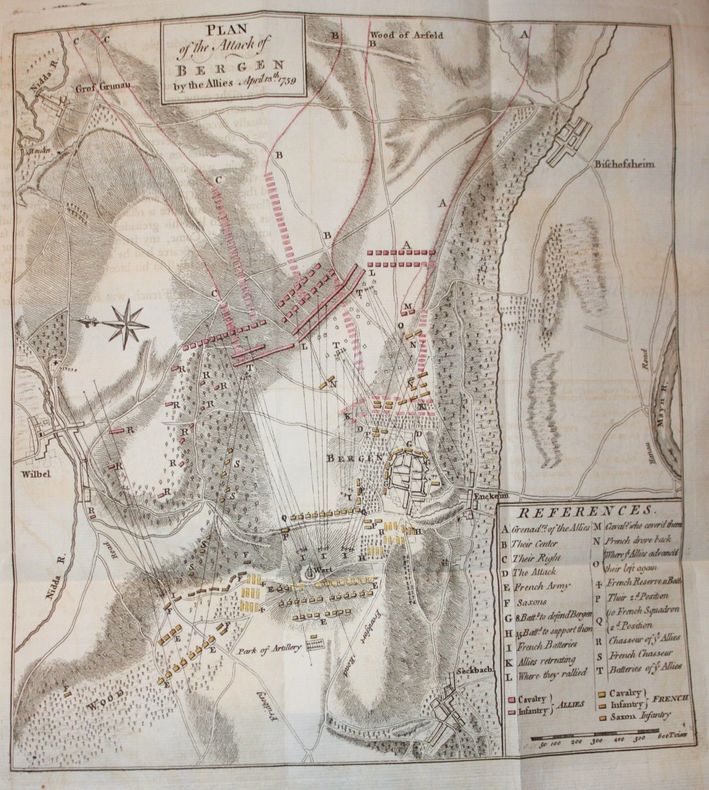
1764AMO-1480THE OPERATIONS OF THE ALLIED ARMY, UNDER THE COMMAND OF HIS SERENE HIGHNESS PRINCE FERDINAND, DUKE OF BRUNSWIC AND LUNEBERG, during the greatest Part of SIX CAMPAIGNS, beginning in the year 1757, and ending in the Year 1762. By an officer, who served in the British Forces. Illustrated with Maps and Plans. London, Printed for T. Jefferys, Geographer to the King, M. DCC.LXIV. [1764] 1 volume in-4 (25,5 x 21 cm) de 2 feuillets non chiffrés (titre et Advertisement by the Publisher placement des cartes et errata), 288 pages chiffrées (erreur de pagination) et 10 feuillets non chiffrés d'index topographique. 12 cartes et plans dépliants (sur 13 - la carte de la bataille de Minden a été arrachée). Une grande carte est déchirée coupée en deux morceaux. Petites déchirures à quelques cartes (plis, bords). La plupart des cartes sont de grande dimension (notamment les 4 cartes reliés à la fin du volume). Reliure de l'époque plein veau brun, dos orné de fleurons dorés (reliure anglaise) usagée. Le premier plat est presque détaché, le deuxième plat se détache, manque aux coiffes et aux coins, l'intérieur du volume est frais avec quelques rousseurs sans gravité. FIRST PRINTING. ÉDITION ORIGINALE. Provenance : George S. Bailey, 1843 et L. George P. Bailey (ex libris manuscrit répété et calligraphié avec note autographe). A noter également 3 petites notes manuscrites en anglais et signées B. H. (écrites par quelqu'un qui a pris part aux batailles). Cet important ouvrage, des plus rares, contient le récit militaire des six campagnes menées par le Duc Ferdinand, de 1758 à 1762. Batailles de Crevelt, Bergen, Minden, Warburg, Vellinghausen, Wilhelmstall, Hesse, etc.
222998S.l., s.d. (1796) in-folio, [468] pp. n. ch., couvertes d'une écriture moyenne, régulière, assez lisible (environ 40/45 lignes par page), vélin souple, dos lisse muet, tranches marbrées (reliure moderne). Gardes refaites.
244716S.l. [Naples], décembre 1789, in-folio, [26] ff. n. ch., couverts d'une écriture cursive, mais régulière et lisible (environ 40 lignes par page), avec 5 planches aquarellées en dépliant "in fine" regroupant 21 figures (costumes, insignes, ornements, armes), broche sous couverture à rubans, chiffra AS peint sur la première couverture, le tout dans double emboîtage moderne demi-chagrin marine, dos lisse orné de filets dorés, pièce de titre du même contrecollée sur le plat supérieur.
209829S.l., s.d. (1813) in-12, [13] ff. n. ch., couverts d'une écriture moyenne et lisible (environ 20/25 lignes par page), 2 ff. vierges, en feuilles.
217794(ca 1780) 67 x 163 cm, Encadré de bois noir et doré (encadrement moderne). Quelques restaurations au papier mais bon état général.
176512Vienne, P. Kaeser, s.d. (1869) in-4, titre en caractères latins et 45 planches lithographiées et coloriées, le tout contrecollé sur du carton souple monté sur onglets, demi-chagrin maroquiné cerise, dos à nerfs, double filet à froid sur les plats (rel. de la fin du XIXe s.). Dos uniformément insolé, mais bon exemplaire.
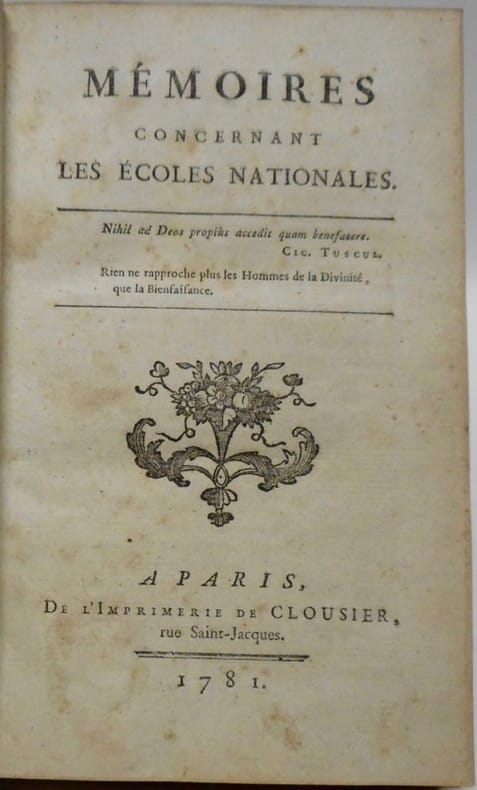
224240Paris, Imprimerie de Clousier, 1781-[1783] 9 (sur 18) parties en un vol. in-8, pagination multiple, maroquin vieux-rouge, dos lisse cloisonné et fleuronné, pièce de titre verte, encadrement de triple filet doré sur les plats, armes au centre, simple filet doré sur les coupes, tranches dorées, guirlande dorée en encadrement sur les contreplats (reliure de l'époque).
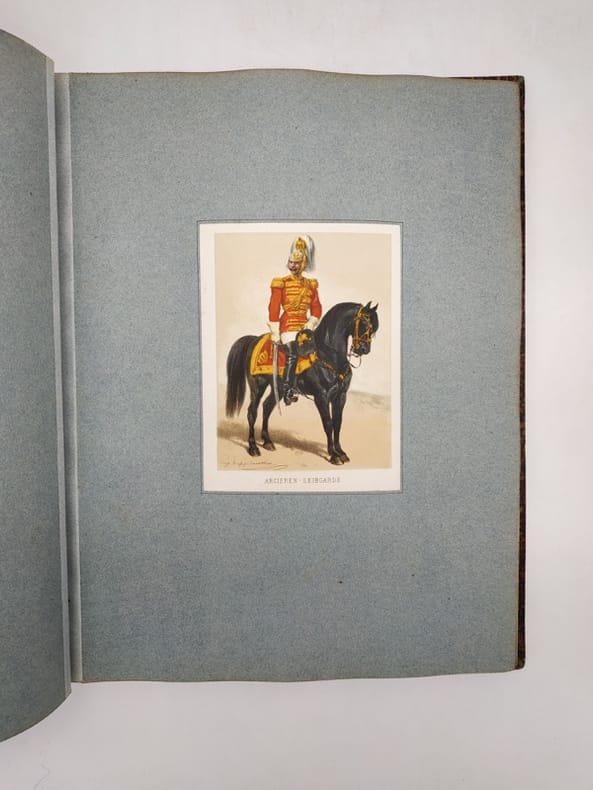
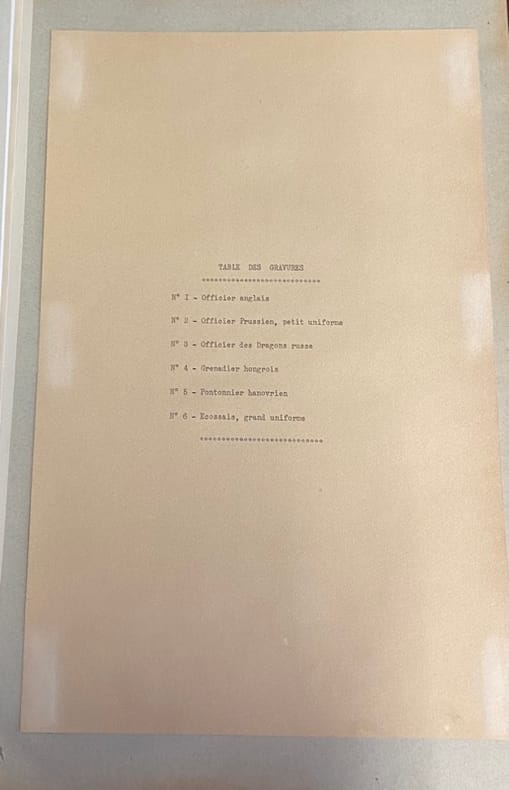
226443Paris, Jean, s.d. (1815) in-folio (49 x 33 cm), [2] ff. dactylographiés (titre et liste des planches), et 6 planches gravées et coloriées (42 x 26 cm), le tout contrecollé sur papier fort monté sur onglets, demi-chagrin aubergine à coins, dos à nerfs fleuronné, tête dorée (rel. de la fin du XIXe siècle). Epidermures au dos et sur les plats.
4911Four vols. 8vo orig. polished mottled green calf a little rubbed single gilt fillet round sides flat spine gilt orange leather lettering piece on spine crown stamped in gilt at head of spine Vol. I orig. fine brown sheep maroquiné single gilt fillet round sides flat spine gilt orange leather lettering piece on spine crowns stamped in gilt at head & foot of spine a.e.g. Vol III orig. boards Vols. II & IV. Munich: 1832-33-48-72.<br/> <br/> The first catalogue issued with its three supplements of the maps and plans in the Bavarian Army Library founded in 1822. This was one of the most important collections of maps of the period. <br/> <br/> Very fine and pretty set from the Wittelsbach library of the dukes and kings of Bavaria. unknown
4911Four vols. 8vo orig. polished mottled green calf a little rubbed single gilt fillet round sides flat spine gilt orange leather lettering piece on spine crown stamped in gilt at head of spine Vol. I orig. fine brown sheep maroquiné single gilt fillet round sides flat spine gilt orange leather lettering piece on spine crowns stamped in gilt at head & foot of spine a.e.g. Vol III orig. boards Vols. II & IV. Munich: 1832-33-48-72. The first catalogue issued with its three supplements of the maps and plans in the Bavarian Army Library founded in 1822. This was one of the most important collections of maps of the period. Very fine and pretty set from the Wittelsbach library of the dukes and kings of Bavaria. hardcover books
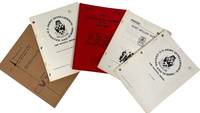
229591974. Cold War U.S. Defense Official U.S. Army intelligence and doctrinal publications on Soviet equipment and artillery produced at key Cold War moments when Soviet conventional forces missile technology and weapons systems were undergoing rapid modernization. These publications illustrate how American military institutions trained analysts and officers to identify Warsaw Pact weapons systems and to interpret Soviet organizational doctrine at a time when NATO planners were assessing conventional force balances and missile developments across Europe.<br /> <br /> Archive of 5 manuals from the 1970s-80s. Ranging from the immediate post-Vietnam period through the Reagan-era reintensification of U.S.-Soviet strategic competition these manuals document how American military institutions trained analysts intelligence officers and commanders to identify classify and counter Soviet equipment from tanks and artillery to missiles and aircraft using standardized imagery technical profiles and organizational analysis. Collectively the materials illustrate the evolution of U.S. threat perception as it moved from broad equipment identification toward increasingly specialized assessments of missile systems and advanced weapons platforms. Archive includes:<br /> 1 U.S. Army Missile Command. Technical Report RD-SS-86-10. Redstone Arsenal Alabama: U.S. Army Missile Command September 1986. Produced at Redstone Arsenal during the late Cold War missile buildup this technical report represents a shift toward highly specialized analysis of weapons and rocketry. This book demonstrates rigorous mathematical treatment of Rhode's theory of monopulse radar a foundational signal-processing method that enabled precise real-time tracking and guidance of missiles and aircraft during the Cold War.<br /> <br /> 2 U.S. Army Intelligence Center and School. Communist Weapons and Equipment Handbook. Fort Huachuca Arizona: USAICS January 1976. This handbook SupR 66152 explicitly marked as superseding earlier editions from 1971 and 1972 reflects the institutional updating of intelligence curricula in response to changing Communist bloc arsenals. Intended for classroom and field use it consolidates identification criteria hazards to identification and dichotomous keys revealing how U.S. intelligence sought to systematize recognition of Warsaw Pact weaponry during a period of détente.<br /> <br /> 3 Department of the Army Combined Arms Combat Developments Activity CACDA. Organization and Equipment of the Soviet Army. Fort Leavenworth Kansas: Headquarters Department of the Army 31 July 1978. Issued as Handbook HB 550-2 and distributed under special controls this striking red-covered manual analyzes Soviet ground force organization and equipment at a moment when NATO planners were reassessing conventional force balances in Europe. The text stresses its role in simulations and training exercises linking Soviet organizational structure directly to anticipated battlefield employment.<br /> <br /> 4 Department of the Army Soviet Artillery Doctrine. RB 30-3. Fort Leavenworth Kansas May 1976. This handbook corrects and updates specific technical and identification details within Organization and Equipment of the Soviet Army highlighting the dynamic nature of Cold War intelligence production and the continual need to revise assessments as new information about Soviet systems emerged.<br /> <br /> 5 U.S. Army Intelligence Center and School. Soviet Equipment. Fort Huachuca Arizona: USAICS March 1974. Issued as Supplemental Reading SupR 62810 this manual was designed as a study aid for intelligence students learning to identify Soviet equipment through imagery. The preface emphasizes mastery of visual recognition skills prior to classroom instruction with appendices organized by equipment type; tactical vehicles tanks artillery rocket launchers antiaircraft systems aircraft and electronic equipment; underscoring the centrality of imagery intelligence IMINT during the Cold War.<br /> Each manual shows light to moderate handling wear consistent with training and professional use including staple binding punched holes for binders minor edge wear toning and occasional marks; all text remains legible and intact. Overall very good condition. Together this archive offers a revealing primary-source record of how the U.S. Army studied taught and revised its understanding of Soviet equipment and missile capabilities across three decisive Cold War decades making it particularly relevant for collections focused on military intelligence history missile development and U.S.-Soviet strategic rivalry. unknown