STENDHAL. (HENRY BEYLE, DIT. 1783-1842).Livre Rare Book

30 332 résultats
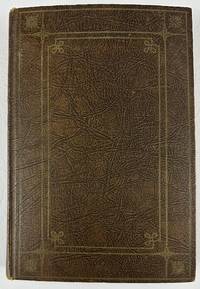
19651854BOULOURIS. EDITIONS DU BANIYAN. 1965. GRAND IN-4 (38 X 29 X 5 CENTIMETRES ENVIRON) DE 289 PAGES, RELIURE D’EPOQUE 1/2 CHAGRIN ROUGE MAROQUINE A COINS, DOS A QUATRE NERFS RICHEMENT ORNE D’UN DECOR NAPOLEONIEN DE GRECQUES ET FLEURONS DORES AUX GRANDES ARMES IMPERIALES ET AUX SEMIS D’ABEILLES, COUVERTURE CREME ILLUSTREE D'UNE VIGNETTE AUX GRANDES ARMES IMPERIALES EN VERT ET DOS CONSERVES (AD. LAVAUX RELIEUR). ILLUSTRE DE 131 COMPOSITIONS MISES EN COULEURS AU POCHOIR PAR EDMOND VAIREL, DONT LE FRONTISPICE, 14 HORS TEXTE, UNE PLANCHE DOUBLE, 10 EN-TETES, 88 LETTRINES ET 17 CULS-DE-LAMPE. PREMIER TIRAGE LIMITE A 1100 EXEMPLAIRES NUMEROTES, DONT 20 HORS COMMERCE. UN DES 840 EXEMPLAIRES SUR VELIN CUVE DE LANA, CELUI-CI PORTANT LE NUMERO 261(MONOD. 10451). BEL EXEMPLAIRE, RARE DANS CE TYPE DE RELIURE.
176263A Paris, Chez Magimel, an IX-1801 in-4, 269 pp., 2 tableaux dépliants, grande carte dépliante, demi-basane blonde à coins, dos lisse orné, tr. marbrées (rel. de l'époque). Dos légt passé.
76086aafBâle - Zurich, Manissadjian & Co., Chromotypie par Froese & Co, s.d., vers 1910, in-folio, 17 feuilles de papier épais avec 16 planches en couleurs (chromolithogr.), texte au versos, pages de garde spéciales ‘enfants avec un drapeau suisse’, pts. fentes à l’int. dans les charnières, reliure en demi-toile de l’éditeur, plat devant illustré en couleurs, frotté aux bords, coiffes légèrement touchées, exemplaire néanmoins en très bon état.
19449019469n.p. 1944. Hardcover. Very good. Bound in the publisher's original black cloth with spines and covers stamped in gilt. Cloth is worn at the extremities and gilt has faded from the spine on some volumes but is still legible. Volume 1 covers primary operations for the period and contains introduction reorganization of the first army plans operations conclusions and 10 fold-out situation maps. Volumes 2 - 7 contain annexes 1 - 20. All volumes have map illustrated endpapers and additional fold-out maps charts and illustrations throughout the set. Ex-library with the usual markings. Stamped withdrawn from Fort Monmouth New Jersey. <br/><br/> n.p. hardcover
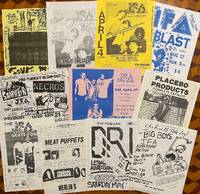
4311Very good. A quantity of eight flyers promoting JFA concerts in Phoenix Los Angeles and elsewhere between 1982 and 1986 photomechanically reproduced on 8.5" x 11" sheets of white pink or yellow paper. PLUS: "JFA Songbook" see below. Overall the material is very clean having been stored in a filing cabinet free from light and handling for forty years. PLUS: five newspaper skateboard mags 1977-1980 newsprint folded for many years and toned. PLUS: two surfer mags 1973-1974 newsprint toned. A FINE AND EARLY ARCHIVE OF SKATE PUNK FLYERS DOCUMENTING THE ROLE OF THE BAND JODY FOSTER'S ARMY JFA AND THEIR CONTEMPORARIES IN THE SKATE CULTURE IN THE EARLY 1980s. SEVERAL FLYERS ARE ICONIC AND ARE NOW UNFINDABLE IN FRESH MUSEUM QUALITY AS HERE HAVING BEEN STORED IN A FILING CABINET FOR EXACTLY FORTY YEARS TO WHICH IS ADDED A SMALL QUANTITY OF NEWSPRINT SKATEBOARD MAGS 1977-1980 AND RELATED EPHEMERA. <br /> <br /> Two cultural phenomena of the 1970s and 80s continue to exert a tremendous impact on the youth of twenty-first century: skateboarding particularly skate-punk and hip-hop both of which began as expressions of disaffected "outsiders" who were unwilling or unable to participate in mainstream America and did so in a completely DYI manner. Today both phenomena have been co-opted and commercialized worldwide particularly in terms of music linguistics fashion art and culture. We are able to offer a small but very interesting "time capsule" of the former. <br /> <br /> Concerning skate-punk band JFA: "With roots in the Arizona and Southern California skateboard scenes JFA was formed in 1981 nineteen days after the failed attempted assassination of Ronald Reagan by John Hinckley Jr. an obsessed fan of Jodie Foster. The original lineup of vocalist Brian Brannon guitarist Don "Redondo" Pendleton bassist Michael Cornelius and drummer Mike 'Bam-Bam' Sversvold developed a faster more focused sound that combined the nascent hardcore of Black Flag and The Germs with the twangy guitar that defined The Ventures and Dick Dale. With lyrics and imagery steeped in the lifestyle JFA appealed to skaters who saw themselves taking surf culture to the streets." johnson rare books and archives from whom we acquired the present collection. <br /> <br /> HIGHLIGHTS OF THE COLLECTION: <br /> <br /> Flyer of the very important May 18 1984 concert with skate punk pioneers The Big Boys Austin TX at the Stardust Ballroom in Hollywood. Billed as "L.A.'s First All Skate Gig!" and sponsored by Powell & Peralta Tracker and other skateboard manufacturers it also included performances by JFA Aggression Faction Ill Repute and Tales of Terror. We know it was a great show because we were there. ~ May 26 1986 flyer for DRI Dirty Rotten Imbeciles et al. in Dallas and on the other side JFA et al. ~ Aug. 17 1982 flyer for Meat Puppets "new album due anytime now from SST Records" and JFA in Tempe AZ ~ Catalogue of Placebo Products / Placebo Records JFA label 4 pp. ~ Promotional flyer for JFA skateboard two shapes three sizes generally 10.5" x 30.5" ~ Calendar for Sept. 1986 punk rock shows at the Downtown Danceteria in Minneapolis MN promoting shows by the Circle Jerks Liveskull and others ~ Nov. 21 1983 flyer for Samhain JFA Necros et al. at Stardust Ballroom Hollywood ~ 3 flyers from JFA 1986 "Fifth Anniversary" tour including Denver ~ "The JFA Songbook" zine together 8 ff. stapled as issued containing "Lyrics to all known and remembered ballads" interspersed with photocopy cuttings and drawings. A worn copy of this item sold on for $139 Dec. 12 2022. <br /> <br /> PROVENANCE: Archive of Richard Bishop guitarist of the Sun City Girls Phoenix AZ an experimental rock band. Statement by Bishop "Each one was collected before the date of the show and have been in a filing cabinet ever since." <br /> <br /> ADDED: Seabreeze: Voice of the Western Surfing Association. San Diego CA 1973-1974. Together two issues newsprint: Nov. / Dec. 1973 vol. 1 no. 6 30 2 pp. July / Aug. 1974 vol. 2 no.1 pp. 3-32 lacking front cover thin vertical portion of spine area on p. 3 very lightly abraded. IN THIS INNOCUOUS 1974 SURFING NEWSPRINT TRADE MAGAZINE IS A VERY EARLY ADVERTISEMENT FOR BAHNE SKATEBOARDS TOGETHER WITH CADILLAC URETHANE WHEELS WHICH REVOLUTIONIZED SKATEBOARD TECHNOLOGY. Frank Nasworthy is notable in the history of skateboarding for introducing polyurethane wheel technology to the sport in the early 1970s. Due to the infancy of skateboarding at this time Nasworthy sold his wheels directly to surf shops along the coast of California and placed some tentative advertisements featuring a young Gregg Weaver in surfing magazines. In 1973 or 1974 Nasworthy licensed his wheels to Bahne and Co. of Encinitas California and Bahne skateboards were packaged with Cadillac wheels. SEE: Ken Harrison "Birthplace of skateboarding: Encinitas and Carlsbad; Forget about Santa Monica" 2019 online. <br /> <br /> ADDED: Assorted cheap skateboard publications 1977-1980 including Skateworld Journal vol. 1 no. 1 1977 with O.G. Dogtowner Marty Grimes on the front cover inside: an ad declares "Profit from the coming boom in Skateparks!" ~ Zero Gravity 1977 with George Orton on the front cover in color and other photos we've never seen being a veritable time capsule of early vertical skateboarding ~ Skat'n News vol. 1 no. 10 1979 with photos from Reseda SkaterCross skatepark some news items circled in pen ~ Skat'n News vol. 2 no 1 1980 "Special Issue" primarily with photos and typewritten captions some news items circled in pen ~ Skat'n News vol. 2 no. 8 1980 with Eric Grisham on the cover and many other excellent photos of the Reseda contest. Plus: The Argonaut Marina Del Rey CA 1981 with Christian Hosoi on the cover and an article on the closing of the Marina Del Rey skatepark. Plus: 5 pieces of related ephemera including two copies of the CHIP Skateboarders' Safety Handbook. unknown
18632604050021United States Army 1863. First Edition. Manuscripts & Paper Collectibles. Very Good. Signed. Large two sided document. Printed with manuscript names filled in. The first name listed is Colonel Eli Long. This document shows the Colonel Captains Sergeants Lieutenants and the privates. This document shows the pay from October 31st 1863 to December 31st 1863. <br> According to NPS: "On February 23 1863 Long was appointed colonel of the 4th Ohio Cavalry a regiment which recently had surrendered to the Confederate raider Brigadier General John Hunt Morgan. Long improved the morale of the regiment and led it in the Tullahoma Campaign. He commanded the regiment's brigade the 2nd Brigade 2nd Division Cavalry Corps of the Department of the Cumberland between March 1863 and August 20 1864 including service at the Battle of Chickamauga. Long was wounded in the left side at the Battle of Farmington Tennessee October 7 1863. He was distinguished in the Atlanta Campaign where he suffered a head wound at the Battle of Jonesboro Georgia August 20 1864 and wounds in the right arm and right thigh at the Battle of Lovejoy's Station Georgia August 21 1864. Long received brevet grade appointments as major lieutenant colonel and colonel in the Regular Army of the United States for "gallant and meritorious services" at the Battle of Farmington and Battle of Fort Sanders Knoxville in Tennessee and Battle of Lovejoy's Station in Georgia respectively. Between November 16 1864 and April 2 1865 Long commanded the 2nd Division of the Cavalry Corps of the Military Division of Mississippi under Major General James H. Wilson. On April 2 1865 during Wilson’s Raid Long was severely wounded in the head at the Battle of Selma Alabama. During that battle he led the 2nd Division in a charge upon the entrenchments that resulted in the capture of that town. During the Civil War Long was wounded five times and also cited for gallantry five times. On January 13 1866 President Andrew Johnson nominated Long for appointment to the brevet grade of major general of volunteers United States Army unknown
Very Good Turkish, Ottoman (1500-1928) Original red cloth bdg. Bilingual titles on two boards and title pages in French and Ottoman script. Slight age-related toning to pages, the Ottoman face of cloth is stained. Spine restored skillfully. 4to. (28 x 20 cm). Text entirely in Ottoman Turkish. 2 volumes set: ([4], 92 p., 19 color plts.; 52 p., 8 color plts. -of which five illustrate the symbols and flags of the different companies of janissaries and two depict the Grand Vizier and the Capudan Pacha-). All plates are complete. Hegira 1325 = Gregorian 1909. Rare first edition of the early uniform book of the Ottoman army with the most attractive color plates ever and extremely rare with its complete plates. The artist of the plates was Hüsnü Tengüz (1876-1950), one of the most famous Turkish painters. He was assigned to the Military Museum Commission by Mahmut Sevket Pasha in 1908-1909, and after 1910, he was appointed as the painter of the Naval Museum, until 1917. "Premiere Partie 1326 jusqu'a 1826 avec 247 gravures coloriees. Par Mahmoud Chevket Pacha General Divisionnaire Inspecteur general des 1er, 2me et 3me Ordous. Prix 20 Piastres". In this work by Mahmud Shevket Pasha, who was the Ottoman Grand Vizier and the Commander of the Movement Army, dealing with the Ottoman military organization together with military clothing and uniforms; the clothes of the soldiers belonging to these organizations are exhibited together on their exquisitely beautiful plates. The descriptions of the pictures cover all the military classes serving in the Ottoman army. The two parts refer to the two periods of Turkish military organization: Pt. One (figures 1-48) depicts the Ottoman court functionaries, Pt. Two (figures 1-58) the new army. Özege 16005.; Atabey 238.; Not in BLC. GL (Part One only); OCLC: 16110303, 27957549, Not in Blackmer. Bebek 134.
19972403210016TVA 1997. Interior is excellent. in metal spiral binding with plastic cover TVA unknown
194639921Washington DC: GPO 1946. First Edition. First Printing. good. 526 total 3-vol. set illus. many fold-out maps stamped "Restricted" on front board. Dornbusch #306. Primary report volume xvii 95 pages and two volumes of annexes 1-8 222 pages 9-14 209 pages. GPO unknown
2083002116207134bottom margin Army Reserve Academy N.A. Soft Cover. Fine. The book is in fine condition. (bottom margin) Army Reserve Academy paperback
19872091502135705346Army School History Compilation Committee 1987. Soft Cover. Fine. The book is in fine condition. Army School History Compilation Committee paperback
110814Edité par Militar, Kunst, Verlag "Mars" (éditeurs d'art militaire "Mars") - Sans date - In Folio, feuillets libres dans emboîtage rouge décoré - 32 planches, complet selon la Table des matières et numéros des tables (voir photos) + documents hors-texte
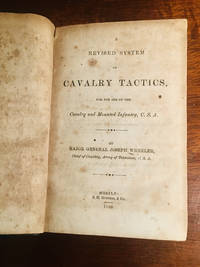
18631214<p>Rare Confederate Imprint:</p><p>24 mo. 5 1/2 by 3 3/4 inches 1 preliminary leaf ii </p><p>Three parts in one volume: "Cavalry Tactics For Single Line Formation" 220 pages</p><p>"Evolutions of a Regiment" 104 pages</p><p>"Skirmish Drill for Mounted Troops" 47 pages</p><p>"Bugle Signals" pages 97-108 among them: "To Arms" "The Charge" "Reveille" "Retreat" "Dinner Call" and "Tattoo" all with musical notation</p><p>"Table of Contents" plus Index and "Skirmish Drill For Mounted Troops" xiv pages</p><p>38 plates some folded: diagrams tables and charts.</p><p>Good condition collated perfect in green paper covered boards old blue cloth re-backing with worn black paper label mild foxing to some pages – not affecting contents.</p><p>"Fighting Joe" Wheeler was a cavalry general in the Confederate States Army. He was the senior cavalry general in the Army of Tennessee and fought in most of its battles in the Western Theater.</p><p>He earned his nickname on the Western frontier where he distinguished himself in skirmishes against Native Americans.</p> S. H. Goetzel, & Co. hardcover
1908819801908. U.S. ARMY. The Uniform of the Army of the United States. October 1 1908. Compiled by the Authority of the Secretary of War Under the Supervision of Brigadier General J.B. Aleshire Quartermaster General U.S.A. Washington DC: The Eichert Lith. Co. and A.B. Graham Co. Lith. 1908. 1st ed. Portfolio of 126 chromolithographic plates all issued chromolithographic title plate 1 plate of text. Orig. 3/4 red leather portfolio marbled endpapers red leather label on front board. Top left and bottom right corners from title page are chipped else very good or better. An extremely scarce collection of prints showing all uniform parts of the time from full dress uniforms to sock and underwear. Rank insignia brass collar and sleeve insignia hats cords shoes dress and field uniforms etc. Eighteen of the plates were deleted prior to issue because their subjects had become obsolete. "The decision to proceed with the present publication was dictated by two major considerations: the unquestioned position of Henry Alexander Ogden as a military artist and the inaccessibility of the original work to collectors and historians." Ogden had prepared for the office of the Quartermaster General 70 paintings depicting official army uniforms from 1776 to 1907. Forty-four of these represented the more colorful uniforms in use from 1776 to 1888. "In 1890 the Quartermaster General published these 44 paintings together with a text covering the history and regulations. At the same time the plates were privately published along with an illuminating text by Henry Loomis Nelson. It is the latter edition that forms the basis for the present publication. Ogden rendered greater service to historians of the American Army uniform than any man in history" Publisher's Note. unknown
194612885Various locations 1946. 58 leaves illustrated with 114 photographs generally two per page tipped in on rectos. Octavo. Contemporary plain paper photograph album bound in brown textured cloth with decorative stamping on spine and front board. Minor wear. Internally quite clean. Very good plus. A tidy and informative collection of photographs memorializing the wartime stateside training of numerous women serving in Company 7 of the Women's Army Auxiliary Corps. The photographs are largely individual and group portraits of the women training at various locations throughout the country including Fort Oglethorpe in Georgia as well as Alpine Texas; Fort Devens in Massachusetts; Des Moines Iowa; and Mapleton Maine. The album is partially annotated with manuscript captions on many of the margins or on the verso many dated and identifying the women in the images or the location. The women identified in the captions include Corporal Kaiser Elaine Flaherty Lt. Tapajina Lt. Haggard Private Rosalyn Caley T-4 Ethel O'Brian Capt. Lawson Sgt. Boomer Florence McClure and Capt. Chapman providing a valuable record of the women serving in the WAAC at this time. One group shot of WAACs at Fort Devens is captioned on the verso with the last names of all ten women and a few other portraits are captioned the same way White Melin Phillips etc. A handful of the images picture the women in the midst of training including images of a retreat parade raising the American flag working in the barracks and climbing a rope ladder. The album was apparently compiled by a WAAC named Almena L. Belyea according to a laid-in note from a former owner of the album. Almena L. Belyea 1902-1963 served in the WAAC as a Technician Fifth Grade during the war. Afterwards she apparently never married and lived a quiet life in Maine where she is buried in Presque Isle. unknown
19458784Headquarters-U.S. Army Air Forces. Revised May 1945. Punch and clipbound in stylized titled coloured pictorial wrappers. Small 4to. Classified "Restricted" and marked as such on each page. Introduction by General Hap Arnold Commanding General of the Army Air Forces Profusely illustrated with photographs drawings schematics diagrams some fold-out cutaways etc. Arguably the most famous aircraft of the Second World War the Boeing B-17 Flying Fortress was the spearhead of the American daylight bombing offensive in Europe from beginning to end as well as serving in every other theatre of war. No single aircraft type contributed more to the defeat of the Luftwaffe which enabled tangible expression to be given to the controversial U. S. policy for the strategic assault of Germany by day in the face of formidable political argument as well as desperate enemy opposition. Few other aircraft of the war gained the universal affection of their aircrew over so long an operational periods did the B-17 Green . This manual served the dual purpose of training checklist and working handbook for B-17 pilot airplane commanders. Graphically intensive the manual covers all aspects of the Flying Fortress from operational duties and command to construction flight navigation weaponry emergencies etc. A very rare highly prized memento of aviation and military. history Owners ink signature to front cover. Ink stamp of Salem Army Airdrome HQ dated 1945 to title Page and inside rear cover. Usual rust offset from metal binding pins to front and rear inside covers.Binding pin protruding slightly onto front cover. Mild sporadic soiling to rear cover.Light wear to edges. A crisp bright Very Good copy of this original rare relic of Aviation History. Headquarters-U.S. Army Air Forces. unknown
19458784Headquarters-U.S. Army Air Forces. Revised May 1945. Punch and clipbound in stylized titled coloured pictorial wrappers. Small 4to. Classified "Restricted" and marked as such on each page. Introduction by General Hap Arnold Commanding General of the Army Air Forces Profusely illustrated with photographs drawings schematics diagrams some fold-out cutaways etc. Arguably the most famous aircraft of the Second World War the Boeing B-17 Flying Fortress was the spearhead of the American daylight bombing offensive in Europe from beginning to end as well as serving in every other theatre of war. No single aircraft type contributed more to the defeat of the Luftwaffe which enabled tangible expression to be given to the controversial U. S. policy for the strategic assault of Germany by day in the face of formidable political argument as well as desperate enemy opposition. Few other aircraft of the war gained the universal affection of their aircrew over so long an operational periods did the B-17 Green . This manual served the dual purpose of training checklist and working handbook for B-17 pilot airplane commanders. Graphically intensive the manual covers all aspects of the Flying Fortress from operational duties and command to construction flight navigation weaponry emergencies etc. A very rare highly prized memento of aviation and military. history Owners ink signature to front cover. Ink stamp of Salem Army Airdrome HQ dated 1945 to title Page and inside rear cover. Usual rust offset from metal binding pins to front and rear inside covers.Binding pin protruding slightly onto front cover. Mild sporadic soiling to rear cover.Light wear to edges. A crisp bright Very Good copy of this original rare relic of Aviation History. Headquarters-U.S. Army Air Forces. unknown books
1747D4268Paris 1747. Very Good. Large format calligraphic manuscript on paper in French. Paris: c.1747. Large folio 490 x 330mm. 101 leaves. Written in brown ink in a cursive hand under calligraphic headings. Original vellum stained green gilt-lettered title to morocco label on spine REGIE DES VIVRES 1741 1742 1743 COMPTE DE M PASQUIE ; small split to the head of the spine corners slightly bumped lacking ties overall in very attractive condition. <br/><br/>This attractive manuscript details in fine calligraphy the staffing and accounts of the Army of Bohemia composed of French Bavarian and Saxon troops from 1741 to 1743. This time encompassed the occupation of Prague by Charles Elector of Bavaria who had raised a claim to the Bohemian throne at the outset of the Wars of the Austrian Succession. This war was a conflict that embroiled most of Europe and spilled over into America with the Anglo-Spanish War of Jenkins Ear. It is of great interest both for the high quality of the penmanship and for the historical interest of the contents which exhaustively details the staffing and provisioning of the Army of Bohemia. The account appears to have been prepared as a memorandum for François Pasquier principal clerk to the Army of Bohemia assimilating information on the regiments wartime expenses. hardcover books
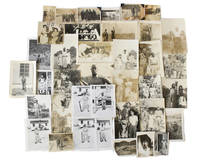
1940186881940. African American MilitarySegregation African American soldiers' photograph archive from the 1940s and 1950s documenting Black military service in the Philippines and Korea during the transition from segregated World War II units to the early implementation of desegregation under President Harry S. Truman's 1948 Executive Order 9981. 38 images showing African American servicemen stationed in Southeast Asia and East Asia at a time when U.S. global military invention was further complicated by racial segregation and gradual integration. The archive reflects the lived experience of Black soldiers deployed abroad in the immediate postwar period illustrating their service within the American imperial presence in the Philippines following its 1946 independence and during the outbreak of the Korean War in 1950.<br /> <br /> Archive of thirty-eight vernacular silver gelatin black and white photographs with sepia tone 1940s to 1950s most measuring approximately 5 x 3 inches with minor size variation. The majority of images depict African American soldiers in what appear to be predominantly all-Black units consistent with pre-1948 segregation policies while one snapshot shows a racially mixed unit encamped in snow likely Korea suggestive of early desegregation implementation. Several photographs portray soldiers stationed in the Philippines amid dense jungle foliage and village settings socializing with local residents and posing with women; one captioned image identifies three well-dressed soldiers as "Kee" of Youngstown "Haynes" of Philadelphia and "Borom" of Gary Indiana pictured with three Asian women. Additional images include formal and informal portraits soldiers standing guard on base with helmet and rifle and scenes of leisure and camaraderie that complicate narratives of isolation and discrimination.<br /> <br /> The archive spans the crucial transitional years between World War II segregation Philippine independence in 1946 and the Korean War era when approximately 600000 African Americans served in the armed forces and the implementation of Executive Order 9981 unfolded unevenly across units. The photographs track gradual emergence of integrated units mirroring broader civil rights struggles unfolding on the American home front. They also document the role of Black soldiers on U.S. military bases in the Philippines and in early Cold War Asia offering material evidence of African American participation in postwar American global intervention. Minor edge wear and occasional slight bends with light surface handling visible on several prints; images remain clear and well defined. Overall condition very good. A substantial visual record of African American military life abroad during the pivotal transition from segregation to integration in the United States Army. unknown
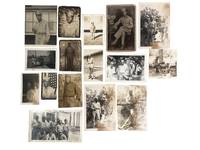
1942231081942. African American Military Archive of 16 original vernacular photographs depicting African American servicemen in the U.S. armed forces from World War II through the Korean War including studio portraits candid camp scenes and informal snapshots several with manuscript captions and identifications en versos. The group documents Black military life under segregation. Identified individuals include "Sgt. Darnell Givens U.S. Army / Indiaana" and "Pvt. Solomon Johnson . Co A 276 QM Bn Camp Stoneman / Pittsburg Calif / To Judy Johnson" situating part of the archive within Quartermaster Corps service-one of the primary branches in which Black soldiers were assigned. A group portrait captioned "The P.O. staff" here understood to denote "Petty Officer staff" suggests a naval or naval-adjacent administrative unit broadening the archive's scope beyond a single branch and reflecting the varied roles Black servicemen occupied across the armed forces. The images collectively support research into African American military participation and the lived experience of Black servicemen prior to and during early desegregation efforts following 1948.<br /> <br /> Arphive of 16 silver gelatin photographs various sizes ranging approximately from snapshot to larger studio formats depicting individual and group portraits and informal camp scenes. Several images show soldiers in uniform posed in studio settings with painted backdrops while others document outdoor environments including barracks areas wooded camps and roadside settings with military vehicles. A group photograph titled in manuscript "The P.O. staff" shows a cohort of Black soldiers gathered outside a building indicating a group of petty officers in a Black unit. Additional images depict a soldier operating a typewriter at a field desk dated "1940" men gathered around cooking equipment and a civilian scene with a woman posed beside a uniformed serviceman and automobile suggesting furlough or home-front interaction. One portrait captioned en recto "To Betty With Love / "Korea" 53-54" and en verso "With Lots of Love Always / Joe" and another with an extended caption reading in part "I am sending you this to let you see how they turn out" give insight in soldier's personal lives while abroad.<br /> <br /> The archive documents African American servicemen during a period when the U.S. military remained institutionally segregated with Black soldiers frequently assigned to support roles such as logistics transport and supply as reflected in the Quartermaster identification. The presence of named individuals and unit references provides a basis for further archival and genealogical research while the combination of formal portraits and candid scenes offers insight into self-representation camaraderie and everyday military life. Emphasis on leisure portraiture and technical work such as typing and communications underscores the range of responsibilities and identities within segregated service structures. Moderate edge wear creasing emulsion loss and staining visible across several photographs with some images exhibiting significant surface damage; overall condition good. A cohesive and research-relevant visual record of Black military life spanning World War II through the early Cold War period. unknown
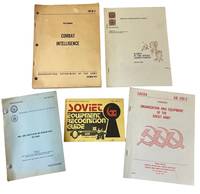
235111973. Cold War U.S. military instruction archive of government-produced manuals and intelligence studies showing how the Army trained soldiers to recognize enemy weapons report battlefield information and classify Soviet military power. The archive includes a U.S. Army field manual which explains how battlefield reports became military intelligence. The Soviet weapons guide was produced to teach soldiers how to identify AKM rifles RPG-7 launchers Sagger missiles SA-7 antiaircraft missiles mortars and antitank guns in the field. Major Mitzi D. Leibst's DIA study Women in the Soviet Armed Forces broadens the archive from weapons to manpower showing how U.S. intelligence counted Soviet women's military service as part of the enemy's total fighting capacity.<br /> <br /> Five U.S. Army and Defense Intelligence Agency manuals and studies on combat intelligence Soviet equipment recognition small arms identification Soviet force organization and women in the Soviet armed forces. Washington D.C.; Fort Monroe Virginia; Charlottesville Virginia; Fort Leavenworth Kansas; Department of the Army Defense Intelligence Agency U.S. Army Training and Doctrine Command U.S. Army Foreign Science and Technology Center and Combined Arms Combat Developments Activity 1973 to 1978.<br /> <br /> 1 United States Department of the Army. FM 30-5 Combat Intelligence. Washington D.C.: Headquarters Department of the Army 30 October 1973. Chapters cover intelligence functions collection processing dissemination order of battle counterintelligence maps and aerial imagery. Approximately 200 pages.<br /> <br /> 2 United States Army Training and Doctrine Command. TC 30-3 Soviet Equipment Recognition Guide. Fort Monroe Virginia: U.S. Army Training and Doctrine Command 11 April 1975. A soldier's pocket-style recognition guide using photographs cartoons role labels and specifications to teach Soviet weapons identification. 50 pages. <br /> <br /> 3 Johnson Harold E. Small Arms Identification and Operation Guide Free World. DST-1110H-163-76. Washington D.C.: Defense Intelligence Agency December 1976. A DIA intelligence product prepared by the U.S. Army Foreign Science and Technology Center and approved for public release with an August 1976 information cutoff. 316 pages.<br /> <br /> 4 Leibst Mitzi D. Women in the Soviet Armed Forces. DDI-1100-109-76. Washington D.C.: Defense Intelligence Agency March 1976. Prepared for the Ground Forces/MBFR Branch Soviet/Warsaw Pact Division the study identifies gaps in data on Soviet women's strength service and quality of service while compiling law history and personnel evidence. 19 Pages.<br /> <br /> 5 United States Army Combined Arms Combat Developments Activity. HB 550-2 Organization and Equipment of the Soviet Army. Fort Leavenworth Kansas: Threats Division Concepts Doctrine and Literature Directorate Combined Arms Combat Developments Activity 31 July 1978. Prepared to assist battle simulations and standardize Soviet-type organizational and equipment data. Approximately 60 pages.<br /> <br /> The archive records the practical underside of Cold War intelligence where enemy knowledge moved into manuals for soldiers analysts and training commands. Its strongest pairing is the DIA women's study and the Soviet Equipment Recognition Guide: one expands Soviet force analysis into gender law and manpower while the other teaches ordinary soldiers to identify enemy weapons in the field. Wrappers show toning handling wear staining creasing staple wear punch holes and light soil; interiors remain legible with tables captions illustrations photographs and institutional markings intact. Overall in good condition. The group preserves how U.S. military institutions taught personnel to recognize report and classify Soviet military power during the Cold War. unknown
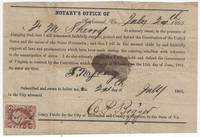
1890010590Virginia 1890. Unbound. Very good. This lot consists of three items related to former Confederate Army Captain F. M. Sherry: </p> <br /> <br /> <p style="margin-left:5%; margin-right:10%;">“An 1865 Richmond Loyalty Oath Certificate. The certificate is dated 24 July 1865 and measures 6.25†x 4.25â€. It is franked with a 5-cent Internal Revenue Certificate stamp Scott #R24. In signing the document Sherry swore that he would<br /> <br /> <p style="margin-left:10%; margin-right:10%;">““Henceforth faithfully support protect and defend the Constitution of the United States and the union of the States thereunder; and that he will . . . abide by and faithfully support all laws and proclamations which have been made during the existing rebellion with reference to the emancipation of slaves. . .â€<br /> <br /> <p style="margin-left:10%; margin-right:10%;">He also swore that he would<br /> <br /> <p style="margin-left:10%; margin-right:10%;">“Uphold and defend the Government of Virginia as restored by the Convention which assembled at Wheeling on the 11th day of June 1861.â€<br /> <br /> <p style="margin-left:10%; margin-right:10%;">The oath was countersigned by C. P. Bigger “Notary Public for the City of Richmond and County of Henrico in the State of Va.â€<br /> <br /> <p style="margin-left:5%; margin-right:10%;">An 1890 “Grand Monument†certificate - The certificate is dated 29 September 1890 and measures 9.25†x 5.75â€. The certificate which bears a serial number No. 761 was issued by the Confederate Soldiers and Sailors Monument Association of Richmond Virgina recognizing his contribution of ten dollars <br /> <br /> <p style="margin-left:10%; margin-right:10%;">“To the fund for the erection of a Grand Monument to the memory of the Soldiers and Sailors of the Confederate Army and Navy on Libby’s Hill Marshall Park Richmond VA. / D. C. Richardson President / Carlton McCarthy Secretary / Wm. H. Cullingworth Treasurerâ€<br /> <br /> <p style="margin-left:10%; margin-right:10%;">The monument certificate is enclosed in a very scarce advertising cover for the Old Dominion Building & Loan Association that features a ‘picture frame collar’ surrounding the 2-cent Washington stamp Scott #220 that was used for postage. It bears a Richmond duplex postmark. F. M. Sherry a Richmond citizen served as Captain in the Confederate Army specifically in the defense of his city while assigned to George Washington Custis Lee’s Brigade and later within the Richmond Local Defense Troops during the final collapse of the Confederacy.</p> <br /> <br /> <p>By December 1863 it had become clear that the Union which had already occupied wide swaths of the Confederacy needed to plan for the likely reintegration into the Union of former members of its armed forces. On the 8th of that month President Lincoln drafted an Oath of Allegiance which if signed by a former rebel would restore their U. S. citizenship and allow them to vote in elections. Following the war his draft was variously modified into loyalty oaths by the reconstituted governments of the Southern states. The document in this lot is Virginia’s version.<br /> <br /> <p>The Confederate Monument Association was formed in 1888 to raise a memorial to the Confederate veterans of the Civil War. The monument which featured a Confederate soldier standing atop a Corinthian column was designed by Wilfred Cutshaw to resemble Pompey’s Pillar in Egypt. It was built at a cost of $30000 and remained in place at the intersection of North 29th Street and Libby Terrace until Democratic Mayor of Richmond Levar Stoney used “emergency powers†citing public safety concerns regarding the ongoing nationwide protests and riots that occurred at the height of the “cancel culture†frenzy that followed the death of George Floyd to order the removal of all Confederate monuments from the city in 2020. <br /> <br /> <p>For more information see “F. M. Sherry†at the American Civil War Research Database President Lincoln’s “Proclamation of Amnesty and Reconstruction†at the Freedmen and Southern Society Project website and Mayor Stoney’s official decree ordering the removal of Richmond’s Confederate monuments available online at YouTube.<br /> <br /> <p>Very scarce Virginia Reconstruction era documents. At the time of listing no other examples of them are available for sale in the trade. The Rare Book Hub shows none have appeared at public auction. OCLC shows no Richmond loyalty certificates are held by institutions; however it is likely some are contained within four other personal papers collections at the University of Virginia. It also shows no monument association donation certificates are held by institutions although it is almost certain that at least one is within the association’s papers collection which is held by the Virginia Historical Society. unknown
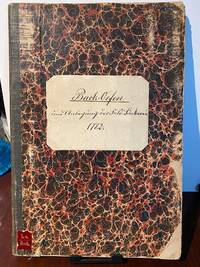
17821054<b>BAKING MANUSCRIPT GERMAN MILITARY. </b><i>Back-oefen und Anlagung der feld=Bacherey. 1782. </i>Original Manuscript. Folio old marbled boards edges worn cloth back pp. 53. N.p. Germany or Austria 1782. German military back-oven regulations. <br /> hardcover
53654Partly printed form 8 1/2 x 14 inches completed in a clerical hand and signed by McPherson; the form was printed for the Mobile & Ohio Railroad the notation for the "Memphis & Charleston R.R." added in manuscript and was also signed by a foreman and seven laborers for completed work. An Ohio native McPherson finished first in West Point's class of 1853 and served in the Corps of Engineers until the outbreak of war. His meteoric rise took him from lieutenant of engineers in August 1861 to the command of a division in October 1862; along the way he served as Grant's chief engineer superintendent of railroads in West Tennessee and as a brigade commander. He commanded a corps at Vicksburg and Sherman's Army of the Tennessee in the Atlanta campaign where he was killed 22 July 1864. "Sherman's tears rolled through his beard and down on the floor when he viewed the body of his friend laid upon a door torn from its hinges and improvised as a bier" Generals in Blue. No Union general was more beloved by his troops. War era autograph material by McPherson is uncommon. Folded. Very good. <br/><br/> unknown books
1943277008Kamnik district Slovenia: Tehnika RK VI 1943. 30pp. 8vo mimeographed text with images original tan wrappers with mimeographed cover.<br/><br/> This rare surviving pamphlet from World War II was produced by the Yugoslav Partisans the most accomplished armed resistance movement against the Axis occupation of Europe. Starting out as a guerilla group the Partisans soon created a complete underground society based on Communist principles including schools government and medical institutions financial systems and publishing presses. This pamphlet produced by one such press likely hidden in the mountains or forests of Slovenia addresses an emergent need in such a new clandestine society: that for maps. It proceeds in logical order: geographical vocabulary instructions for making field maps and later more sophisticated and symbolic drafting techniques. Within this technical know-how it also communicates tactical military advice that the Partisan guerillas employed in their battles with Axis armies. This tactical quality of the publication is most in evidence in the pamphlets many striking diagrams which demonstrate the importance of visual knowledge in situations of survival.<BR><BR>This pamphlet was one of many Partisan publications designed to educate protect and encourage members of the movement. It is particularly fascinating for its simple means of production since the secrecy of Partisan operations limited them to mechanical methods such as mimeographs--in witness here--as well as heliotypes linocuts and typewriting. Given its fragility the pamphlet is in excellent condition with clean text. Slight stains and some very small tears in margins. As one of the few Partisan publications on cartography this pamphlet is a rare and fascinating record of the World War II resistance.<br/><br/> Tehnika RK VI unknown books