86 428 résultats
19 issues of the New-York Daily Tribune, each within a separate acid-free folder, stored together in a custom-made portfolio (48 x 62 cms). A remarkable ensemble of 19 complete issues of the "Tribune", containing a total of 24 news summaries submitted by the paper's London-based correspondent, Karl Marx (sometimes co-written with Engels), including a dozen rare signed contributions. Marx had first met Charles Anderson Dana, the managing editor of Horace Greeley's powerful Republican newspaper "New-York Daily Tribune", in 1848, and three years later, Dana invited Marx, by then an exile in Britain, to join the paper as foreign correspondent. The arrangement provided Marx with much-needed income during a period of his life in which Engels could only provide limited financial support. It would also prove the philosopher's longest-lasting stable employment: between 1852 and 1862, Marx contributed some five hundred articles tackling an abundance of topics, from issues of class and the state to world affairs. The present articles, focusing on the European political upheavals of the time, are mostly written by Marx alone, and some in collaboration with Engels (while another was authored by Engels only). They span the months of January-April 1853 (9), April-November 1854 (7), December 1857 (1), and January-February 1859 (2), including: A Reply to Kossuth's "Secretary" (4 Jan. 1853); Political Prospects - Commercial Prosperity - Case of Starvation (2 Feb. 1853); Elections - Financial Clouds - The Duchess of Sutherland and Slavery (9 Feb. 1853); Capital Punishment - Mr. Cobden's Pamphlets - Regulations of the Bank of England (18 Feb. 1853); Defense - Finances - Decrease of the Aristocracy - Politics (23 Feb. 1853); Italian Insurrection - British Politics (25 Feb. 1853); The Attack on Francis Joseph - The Milan Riot - British Politics - Disraeli's Speech - Napoleon's Will (8 March 1853); Parliamentary Debates - The Clergy - Starvation (15 March 1853); British Politics - Disraeli - The Refugees - Mazzini in London - Turkey (7 April 1853); The European War - The War Debate in Parliament (17 April 1854); The bombardment of Odessa (16 May 1854); State of the Russian War (8 July 1854), The Details of the Insurrection at Madrid - The Austro-Prussian Summons - The New Austrian Loan - Wallachia (21 July 1854); The Spanish Revolution - Greece and Turkey (4 Aug. 1854), The War Debates in Parliament (7 Aug. 1854), The Campaign in the Crimea (27 Nov. 1854), Trade Crisis in England (15 Dec. 1857), On Italian unity (24 Jan. 1859), The Money Panic in Europe, Affairs in Prussia (1 Feb. 1859). - "Writing for the Tribune afforded Marx (and to some extent Engels, who worked in a few articles of his own) the unique opportunity to comment on world politics for a mass audience. Never before and never after had they so wide a readership as journalists: during the decade of the 1850s, the Tribune's circulation approached 150,000 copies, dwarfing even the Times [... Many of] the articles appeared unsigned, often as leaders or editorials. Flattering though it must have been that one of the world's foremost newspapers had - albeit temporarily - decided to adopt as its own Marx's views on European politics, the downside was that the journalism still published under Marx's name was of an increasingly inconsequential nature, until his name entirely disappeared from the news columns in April 1855 [...] The American public's interest in Marx's commentary on the international scene was subject to the fluctuations of U.S. attention to European affairs more generally: at its height during the Crimean War, it fully evaporated when the Civil War at home grabbed the headlines" (cf. Neuhaus). - A few tears to edges and corners professionally restored; very well preserved without loss to text. Marx's articles not affected by damage well-legible throughout. Extremely rare: a fine survival. Cf. M. Neuhaus, Marx als Europakorrespondent der New-York Tribune, in: Z. Zeitschrift Marxistische Erneuerung 88 (2011).
Small folio (210 x 280 mm). (8), 444, (48) pp. With separate engraved title page, engraved portrait fater the preliminaries and full-page woodcut on p. 59. Contemporary limp vellum with remains of ties. First edition, very rarely seen in trade or auction and only 4 copies recorded in the US according to OCLC. - "Cette biographie est un des livres classiques de la langue portugaise" (Brunet). Includes an account of the battles at Ormuz between the Turks and the Arabs. Dom João de Castro (1500-48) was a naval officer and later Viceroy of Portuguese India. In 1538 he embarked on his first voyage to India, arriving at Goa and immediately proceeding to the defense of Diu. Castro was responsible for the overthrow of Mahmud, King of Gujarat whose interests threatened Portuguese control of the Goan coast. His voyages frequently took him to the coasts of Arabia, and his present biography contains many details about the Peninsula, especially about Aden and the sea route to Mecca. Castro died in Goa in 1548 and was initially buried there, but his remains were later exhumed and transferred to Portugal. - Contemporary ink ownership to printed title. Binding loosened in places, still a good, wide-margined copy. Atabey 462. Brunet I, 263. Graesse I, 118. Pinto de Mattos p.23 ("os exemplares desta edio, so raros e estimados").
8vo (20 x 13.5 cm). 36 pp. With a small decoration on the front wrapper. Set in Cyrillic types, with some Cyrillic headings in a sans-serif and others (and the 2-word title on the wrappers) in a face with rounded swellings at the terminals. Stapled with a single staple in the publisher's original red paper wrappers, with the only title-page printed letterpress on the front wrapper. Only recorded copy of the first Russian edition of Marx's and Engels's Communist Manifesto to be published in Georgia. Marx and Engels published the first edition at London in February 1848, just as the Revolution of 1848 was erupting in France and before it spread to the German states in March, under the title "Manifest der kommunistischen Partei". Few works have ever had such an enormous influence on the course of world history. A Georgian-language edition had appeared at Tiflis in 1905, but in the wake of the Menshevik Revolution of February 1917 the mostly Russian soldiers in Tiflis favoured Lenin's Bolsheviks over the ruling Mensheviks. The present Russian edition no doubt served to stoke support for the Bolsheviks in Tiflis, either leading up to or directly in the wake of Lenin's Russian Revolution of October 1917: it was published by the Bolshevik newspaper "Kavkazskii Rabochii" (the Caucasian worker), which began publication in March 1917, ceased in December 1917 and whose printing press was destroyed in February 1918. Although the Bolsheviks failed to gain control of Georgia at this time, the importance of Georgia in revolutionary Russia is symbolized by a Georgian Bolshevik who would have been 38 and living in Tiflis when this translation was published, Joseph Stalin. - The order of the words in the title differs from most earlier editions, matching that of the 1906 Saint Petersburg and 1917 Vladivostok editions, no doubt reflecting the new wording that Marx and Engels themselves had introduced with their definitive German edition of 1872. The present edition includes Russian translations of their new preface from that edition, as well as Engels's prefaces to the 1883 and 1890 editions. It ends with the famous words: "soglasheniem rabochih partchii vseh stran" (Workers of the world, unite!). - This edition collates: [A]18 = 18 ff., and is printed on machine-made wove paper. Slightly browned, with a waterstain around the fold of the wrappers. which caused the red to bleed onto the gutter margin of the first and last page of the text, and with the staple very slightly corroded, discolouring the paper around it, but otherwise in very good condition. Unique first edition of the Russian-language Communist Manifesto to be published in Georgia. This edition not in Andréas, Le Manifeste communiste (1963); WorldCat; etc. Cf. PMM 326 (1848 ed.).
Small 8vo. 64 ff. (final page counted as p. 65). Publisher's blindstamped green cloth. First edition in Esperanto, translated by the American Esperantist and socialist Arthur Baker based on Engels's English text, which is printed on opposite pages. In Zamenhof's constructed language, introduced only in 1887, the famous sixty-year-old pamphlet begins with the words "Fantomo vizitadas Europon - la fantomo de la Komunismo", ending with: "Laboristoj de ciuj lanoj, unuigu!". - Spine sunned in places, otherwise fine. Andréas 477-478 (5 copies only). Not in Adams, Radical Literature in America, or in Marx-Engels Erstdrucke. Cf. PMM 326.
8vo. XXXI, (1), 816 pp. Publisher's ochre cloth with giltstamped spine title. The first American edition (second issue): a stereotyped re-issue by Appleton, with new title page, of the 1887 first English edition, translated from the 1883 third German edition by Samuel Moore and Marx's son-in-law, Edward Aveling, with new editorial revisions by Engels. The posthumous second (1885) and third volume (1894) of "Das Kapital" would not appear in English until Kerr's 1906-1909 edition. - Binding rubbed and bumped. Title and half-title loose and severely chipped, table of contents loosened. Withdrawn from the Massachsetts State Library with their shelfmark, drystamp and de-accessioning stamp. Adams, Radical Literature in America, p. 53. Cf. Marx-Engels Erstdrucke 33 (1887 ed.). PMM 359.
8vo. XXXI, (1), 816 pp. Publisher's ochre cloth with giltstamped spine title. The first American edition (second issue): a stereotyped re-issue by Appleton, with new title page, of the 1887 first English edition, translated from the 1883 third German edition by Samuel Moore and Marx's son-in-law, Edward Aveling, with new editorial revisions by Engels. The posthumous second (1885) and third volume (1894) of "Das Kapital" would not appear in English until Kerr's 1906-1909 edition. - Cloth shows slight chafing to extremeties; a few pages buckled at fore-edge. Ownership of the contemporary American woodworker and labour activist John Shpis from Denver, Colorado, stamped above Editor's Preface and at the end of the text. Adams, Radical Literature in America, p. 53. Cf. Marx-Engels Erstdrucke 33 (1887 ed.). PMM 359.
8vo. XII, (2), 264 pp. Contemporary moirée cloth, spine lettered in gilt. Preserved in a modern slipcase. First edition. - The principal work of Wilhelm Weitling, who counts (together with Moses Hess) as one of the earliest communist agitators in Germany and its first leader of proletarian birth. The book has been identified as the catechism of German socialist workers before Marx and was praised by the latter as the "incomparable and brilliant début of the German working man". Weitling preached a Christian utopian socialism, by his own testimony derived from the New Testament and fashioned after the ideas of Fourier and Cabet. In his view, private property was unproblematic in a world with an abundance of unoccupied land, but in modern society individual property had become an injustice and the cause of misery to the people. Individual property therefore should be replaced by collective ownership, and though he hoped for a peaceful transition, Weitling foresaw that revolutionary violence might be inevitable. - Weitling was the illegitimate son of a French father and a German maidservant. He was apprenticed as a tailor in his native Magdeburg before travelling through Germany and settling in Paris in the 1830s. There he became acquainted with French socialist agitation and joined the revolutionary "Bund der Gerechten" (League of the Just). He moved to Switzerland in 1841 but was soon imprisoned and expelled, and spent the rest of his untiring life in Germany, England and America, where he continued his communist agitation among German immigrants in New York and founded the failed "Communia" colony in Wisconsin. Weitling exposed his ideas in three important works: his first printed publication, "Die Menschheit, wie sie ist und sein soll" (a brief pamphlet published in Paris in 1838), the present book, and "Das Evangelium eines armen Sünders" in 1845. The present work is considered the most complete exposition of his socialist thoughts and plans. It was issued privately in Vevey near Lausanne, and the publication (by the local printer Michod) was financed by funds collected from German comrades in France and Switzerland. A second edition appeared at Vevey in 1845, and a third in Hamburg in 1849. - Faint traces of a bookplate removed from the pastedown; minimal wear to lower corners. A very attractive copy, clean and without any browning. Stammhammer I, 261. Quack IV, 312-328. Not in Kress, Goldsmiths' or Einaudi. GBV locates 3 copies in German libraries; OCLC locates 4 copies in US libraries.
Large 8vo. xviii, 506, (52) pp. Publisher's maroon buckram, gilt lettered to the spine, black ruled and lettered to the upper board, patterned endpapers. First American printing. The first volume of Karl Marx's groundbreaking work was published in German in 1867 with a second edition in 1873. The author died before the third edition could be issued with Engels stepping in to bring it to completion in 1883 using Marx's notes for his extensive revisions for the earlier first French edition. Engels compiled and edited Volumes II and III from Marx's papers and these appeared in 1885 and 1894. In this period Engels was also able to oversee this translation of the first part, its first appearance in the English language. The translation was carried out by Moore, well connected in British socialist circles, he translated the Communist Manifesto a year later under Engels editorship. He was ably assisted by Aveling - the partner of Eleanor Marx, the youngest daughter of the author, who was also enlisted to check the quotations used in the work. The first edition with an American imprint appeared in 1889, published by Appleton though it was printed at Aberdeen University Press from Swan Sonnenschein's first edition, itself printed in Perth, so this particular edition is the first to have been printed in the US. Interestingly, Engels in his preface writes of Marx intending for there to be an American edition in his lifetime, but that nothing came of it "for want of a fit and proper translator". - A couple of chips and neat repair to the front endpaper, very good. Not in Adams, Radical Literature in America, or in Marx-Engels Erstdrucke. Cf. PMM 359.
Small folio (224 x 298 mm). Contemporary buckram boards; each issue ca. 12-18 pp. Eleven consecutive issues of this extremely scarce Menshevik periodical published in Switzerland (in total, sixteen issues appeared). An important resource on the eventful year 1905, which saw both the Russo-Japanese War and the revolutionary upheaval in Russia, the journal contains politial articles, news reports, as well as original poetry by Russian political emigres, but also updates submitted by Russian revolutionary committees in the Russian Empire. The "Sotsial'demokrat" was edited by Fyodor Ilyich Gurvich (1871-1947, pseudonym "Dan"), a leading Menshevik theorist. In 1917, Gurvich joined the Petrograd Soviet; in 1922 he was expelled from the Soviet Union. - Occasional stains and light discolorations; a few issues somewhat resized to lower edge; some issues still partly uncut. From the famous collection of the Marxist bibliophile and scholar Chimen Abramsky (1916-2010), who fled to London from the Soviet Union in the early 1930s and became a leading specialist in both Judaica and socialist thinking. His enormous collection, parts of which were auctioned after his death, has recently been commemorated in his son's biography, "The House of Twenty Thousand Books" (2014).
8vo. XXXII, 104 pp. Contemporary green cloth with goltstamped title to upper cover and spine. First edition of the manifesto of Utopian Socialism. Parts II to VII would not appear until 1842-44. - Inscribed by the author to Queen Mary II of Portugal on the front flyleaf: "To Her Majesty / the Queen of Portugal / Presented by the Author". The engraved arms of the Portuguese royal family on front pastedown. Uncut as issued, a very pretty copy. Williams 47. Kress C 4213. Goldsmiths' 29743. Stammhammer I, 164 ("1820" in error).
8vo. (4), 127, (1) pp. Original printed wrappers. The first edition of Stalin's second book; extremely rare. It is widely known that Stalin's role in the party during pre-Revolutionary times was mostly practical: assigned to supply money for the cause by way of expropriations, he became a well-known figure around 1905, and later, during the Civil War, a commander of the Red Army and a party leader. Very little was known of Stalin's political views before Lenin's death in 1924. While Stalin was always regarded as the loyal executor, unlike all other key Bolshevist figures he had not published any significant works - merely occasional articles in which he did not give away a clear position. Stalin became the People's Commissar for the nationalities in 1917 when the position was created. The committee survived until 1924, when the USSR was formed. The present book should be regarded as a collection of his essays on the subject of the national question. One of the principal ideas here advanced by Stalin was that the marginal areas of the Russian Empire should not be separated. He argues that all nations should join in the fight for the world revolution while the colonies of the British Empire ought to be liberated. On this point he contradicts Lenin, who at that time was prepared to grant sovereignty to some nations such as Finland. It is worth noting the author's name on the title page: Stalin used various worknames within and outside the party, largely due to the illicit nature of his pre-revolutionary activity (research has found him to have used nearly 30 party bynames at the time). In this brochure his name is given as "Stalin (Koba-Dzhugashvili)", citing his two most popular worknames and his real Georgian surname which he would not use in later years, and no more books appeared under it. At the time, Stalin was already vying for the party leadership with Trotsky, Kamenev, Zinoviev and others, and he may have felt it necessary to declare himself. - Slight paper loss to title page, meticulously restored with matching paper, with part of a single letter nearly imperceptibly supplied. Otherwise fine. Mostly uncut, untrimmed copy as issued.
8vo. VIII, 108 pp. Original printed wrappers bound within later half calf over marbled boards with giltstamped title to spine. Marbled endpapers. First edition. Rare political pamphlet wherein Lenin "went further than he had ever before in defending his belief" (Bergmann). In this vituperative attack on his opponents, Lenin proclaims the necessity of "a party that centralized authority and practised conspiracy" in order to resist the repression of the tsars while simultaneously instilling political consciousness in the Russian proletariat. As opposed to his enemies, he considers Jacobinism a virtue rather than a flaw. - A few pages slightly creased. Stamp of the Slavonic Library in Prague to verso of title-page. Old handwritten shelfmark to front wrapper. Lenin, Collected Works IX, 15-140. Bergman, The French Revolutionary Tradition in Russian and Soviet Politics, 106. OCLC 1242399474.
8vo. 13, (1) pp., final blank. Original printed wrappers. Extremely rare pamphlet by Lenin concerning the party's historic split into Bolshevik and Menshevik factions, titled in German: "Parteibeho[e]rden gegen die Partei" (the Russian title translates as: "Declaration and documents concerning the schism between central institutions and party"). The pamphlet was printed in January 1905 by the Russian Social Democatic Workers' Party. - In this harsh and bilious text Lenin criticizes three party members, Glebov-Avilov, Valentin, and Nikitich, whom he accuses of double-dealing and anti-Bolshevik agitation. All three were members of the Central Committee, as was Lenin himself. Although Bolsheviks and Mensheviks formally constituted two different parties in 1905, they were in fact still close, and what Lenin calls the three members' "treason" was merely their sympathy and agitation for the Mensheviks. Unlike Lenin, most Bolshevik leaders were still prepared to co-operate with their former allies and even harboured hopes for reunification. Lenin's views of the time, as evidenced in this brochure, held a fringe position even within his own faction. His text, however, was widely distributed among the local committees and helped Lenin achieve increasing popularity. A suggestion voiced by "Vpered" that the work be translated into all European languages as soon as possible never materialized. - From the collection of Marcel Bekus with his small oval stamp on the reverse of the title page. Binding loosened; upper cover and title page loose. A few pencil notes to wrappers, but well-preserved. OCLC 85287907.
8vo. VI, (2), 191, (1) pp. Modern half calf with marbled covers and edges. First edition of Marx's longest polemical work, aimed against the polical writer and democrat of 1848, the naturalist Karl Vogt (1817-95). A member of the German pre-parliament on the extreme left, Vogt had become professor of geology in Geneva in 1852 (he later also held the chair of zoology). The libel suit which he brought against the Augsburg "Allgemeine Zeitung" was tried at the Augsburg district court on 24 October 1859. "An important historical document, and a classic example of irreconcilable political controversy" (cf. Sauer & Auvermann V, 2340). A new and improved edition was published in Moscow in 1941 by the Marx-Engels-Lenin-Institute. Some browning as common; occasional edge chipping due to paper, but a good copy from the estate of the Frankfurt lawyer Wilhelm A. Schaaf (1929-2015). Marx-Engels Erstdrucke 26. Stammhammer I, 145, 22.
8vo. VI, (2), 191, (1) pp. Contemporary half cloth with marbled boards and ms. spine label; upper cover of the original printed wrappers bound within. In custom-made slip case. First edition of Marx's longest polemical work, which he took the best part of a year away from the writing of "Das Kapital" to complete. Levelled at the polical writer and democrat of 1848, Karl Vogt (1817-95), the book is an answer to the slanders against himself, Engels and their supporters which had appeared in Vogt's 1859 pamphlet, "Mein Prozess gegen die Allgemeine Zeitung". A former member of the German pre-parliament, Vogt had become professor of geology in Geneva in 1852. When in June 1859 the "Augsburger Allgemeine Zeitung" circulated the rumour that he was a paid agent of Napoleon III, Vogt suspected, not without justification, that Marx's circle was behind the report. Vogt sued the paper for libel, and the suit was tried at the Augsburg district court on 24 October 1859. No proof of the accusation was produced, and the charge was ultimately dismissed on technical grounds. Vogt exploited his moral victory by publishing the shorthand report of the court proceedings, bolstered with copious documents, so as to expose the communists as traitors and conspirators. Although Marx was already weary of the affair, he picked up the gauntlet: in this rebuttal of nearly two hundred pages, he answered "Vogt line for line and charge for charge [...] Marx spares neither wit nor invective in demolishing his opponent" (R. A. Archer, in the preface to his 1982 English translation). A fine example of Marx's talent for merciless satire as well as of his often prolix attention to detail, the book had little or no public effect: even when in 1871 the Paris Commune raided the government archives and produced proof that Vogt indeed had been in the pay of the Bonapartists, Marx's vindication escaped general notice. "An important historical document, and a classic example of irreconcilable political controversy" (cf. Sauer & Auvermann V, 2340). - A good, largely unbrowned, unstained copy preserving the original wrapper cover. Contemporary blue library stamp (Rehdiger-Stadtbibliothek in Breslau) on reverse of title page. Marx-Engels Erstdrucke 26. Stammhammer I, 145, 22. Draper ST/M 51. Rubel 567.
8vo. VIII, 172 pp. Original printed wrappers, bound within later full cloth with giltstamped title-label to spine. First edition of "One Step Forward, Two Steps Back", Lenin's controversial study of the minutes and resolutions of the Second Party Congress. It discusses the speeches of each of the delegates and the political groupings at the Congress, and of the Central Committee and Party Council documents. The book evoked fury among the Mensheviks: Plekhanov demanded that the Central Committee disavow it, and the conciliators on the Central Committee tried to prevent its publication and circulation. Although published abroad, the essay circulated widely among advanced workers in Russia. Copies of the book were found during arrests and house-searches in Moscow, St. Petersburg, Riga, Saratov, Tula, Orel, Ufa, Perm, Kostroma Shchigri, Shavli (Kovno Gubernia), and elsewhere. - In addition to the Russian title, the present copy bears the title in German: "Ein Schritt vorwärts, zwei Schritt rückwärts. (Über die Krise in unserer Partei)". - Stamp of the Central Committee to front wrapper and title-page. Tiny marginal tear to front wrapper and title-page, otherwise in excellent condition. Lenin, Collected Works VII (1964), 203-425. OCLC 1033848318.
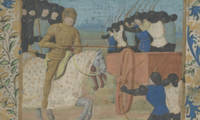
1450258541450. <blockquote><p>The sole known surviving piece of a once vast and grand 15th century ""Faits des Romans"" doubtless for a noble patron of enormous wealth.</p><p> </p><p>The artist is a follower of the Coëtivy Master</p></blockquote><p><strong>The twin nostalgias of Europe— one for the powerful all-encompassing Roman Empire the other for connecting with the mysterious pre-Roman peoples— combine in this 15th century French illumination of Caesar’s final and questionably successful encounter with the Britons led by Cassivellaunus. While Caesar won this battle his dream of a conquered and Roman Britain would not be realized within his lifetime. His legacy however was studied admired and immortalized far after his fatal betrayal by Brutus. This illustration captures this historic moment of Caesar’s triumph the beginning of the end for the Britons and the cultural legacy as viewed during the waning of the Middle Ages.</strong></p><p><a href=""https://cdn.raabcollection.com/wp-content/uploads/20231204135204/A-2.jpg""><img class=""alignnone size-post-window wp-image-25868"" src=""https://cdn.raabcollection.com/wp-content/uploads/20231204135204/A-2-1600x632.jpg"" alt="""" width=""1600"" height=""632"" /></a></p><p>In the nineteenth century European medievalists began shoring up their nations’ relationships with medieval literature to try to create firm claims of their peoples’ innate heroic attributes their noble histories their glorious pasts. This led for example to the French identifying themselves with the Chanson de Roland and the English lionizing King Arthur. But the desire to have these medieval roots overshadowed the more complicated histories: the Chanson de Roland though composed in French is about an emperor best known by his French name Charlemagne but who was born in Aachen Germany and is buried there. The first legends of King Arthur from the 9th century reflecting a much earlier time came from Wales a nation suppressed by the English and the major inventions in the narrative like the love story of Guinevere and Lancelot and the Round Table were invented in France. Though English storytellers engaged with Arthur and his knights it wasn’t until Thomas Malory in the 15th century that Arthur became English.</p><p>During the Middle Ages Rome was the empire to draw connections to for auctoritas. This is why the empire established by Charlemagne became known as the Holy Roman Empire. Though the term was not in use until the 13th century the Emperors were instilled with translation imperii-- a transfer of rule directly inherited from the historic emperors of Rome.</p><p>One aspect of Rome that was particularly admired in the Middle Ages was the conquering and bringing into Civilization of the barbarians north of the Alps and west of the Rhine that includes Caesar's foray into England and his confrontation with Cassivellanus. Cassivellaunus was likely the chief of the Catuvellauni of Hertfordshire whose tribal name translates to ‘war-chiefs’. In British accounts he appears in Welsh literature ranging from Geoffrey of Monmouth’s chronicle about the history of the Kings of Britain in both Latin Historia regum Britanniae and Welsh Brut y Brenhinedd to the more folkloric-based Trioedd Ynys Prydein The Triads the second branch of the Mabinogi and Cyfranc Lludd a Llefelys The Adventure of Lludd and Llefelys. The British chieftain even appears briefly in the Greek Stratagemata by Polyaenus. The Latin literature of course written by the winners includes Julius Caesar’s own Commentary de Bello Gallico Commentary on the Gallic War.</p><p>During the account of his second campaign in Britain from Gaul in 54 BCE after a failed first a year earlier Caesar writes that Cassivellaunus was a rabble-rouser conquering the Trinovantes the most powerful British tribe perhaps how the tribe received their appellation of ‘war-chiefs’. Though his location was betrayed by the Cenimagni Segontiaci Ancalites Bibroci and Cassi who had surrendered to Caesar Cassivellaunus gathered the forces of the Kentish kings Cinetorix Varvilius Taximagulus and Segovax. The tribes retreated to higher ground when they saw the sheer masses of Romans that Caesar had brought to avert the same failure of preparedness he suffered the year before. The legions established their military camp on the beaches and sought out the Britons. As they searched their party was harassed by Britons on chariots; it was chariots which had given the edge to the British during Caesar’s first invasion. About 12 miles away he encountered Cassivellaunus’ forces at a hillfort at the River Stour. A storm destroyed Caesar’s fleet of ships and the repair gave the Britons time to regroup and rally behind Cassivellaunus.</p><p>Previously the Britons operated as independent tribes; under Cassivellaunus these tribes became an army growing with more tribes coming to support Cassivellaunus. Their knowledge of the land and their use of chariots created a powerful enemy against Caesar’s army which was not used to fighting such a chaotic force. Had the Britons continued this strategy history might have played out differently; however they appeared to try to meet the Romans head-on in large-scale battle a tactic at which the Romans were well-practiced and deadly.</p><p>Cassivellaunus’s attempt to attack a foraging party as had been done to the Briton’s success in 55 BCE was the beginning of the end for the Britons now. Though he had unified some of the tribes the Trinovantes remained staunchly against Cassivellaunus since he murdered their king. The murdered king’s son bargained with Caesar— his tribe would support Rome and Rome would defend the tribe from any retribution. This gave the Romans a newfound understanding of the land and the warfare tactics of the Britons. Once again the tribes were divided which inclined them to making alliances with Rome. The final two-fronted battle between the Romans and Britons saw British defeat. It is this routing of the British charioteers that the French illuminator included in this illustration of the Faits de Romains some 1500 years later.</p><p>The Britons essentially defeated Caesar sent Commius the King of the conquered Atrebates to negotiate peace. Cassivellaunus agreed to paying tribute. In writing up the terms Caesar used specific legal terms which would eventually make Britain a province of Rome. But this would not come to pass before Caesar’s untimely death on the Roman Senate floor nearly a decade later. It would be another century before Britain came truly under Roman rule.</p><p>In 13th century medieval writers began to compile works by Caesar Lucan Suetonius and Sallust retelling Caesar’s life in the format of a chanson des geste a song of deeds— the same genre as the Chanson de Roland. The text which is listed under many names but most commonly Faits des Romans grew very popular from 14th century onwards with over 50 manuscripts now recorded – these usually grand commissions for noble reading with many miniatures set into the text columns opening significant chapters of which this extract serves as an example.</p><p>This miniature depicts the great scene introduced above: Caesar's confrontation with the Cassivellanus during the former's great invasion of Britain.</p><p><strong>Caesar routing the chariot-mounted forces of the British cheiftain Cassivellanus miniature on a cutting from an illuminated manuscript of the Faits des Romains</strong></p><p>France most probably Paris mid-15th century. The illuminator represented the two armies in armor contemporary with his own time— the armor of chivalric knights— rather than the Roman legion outfits of Caesar’s time and blue-painted leather-clad attire of the Britons. Differentiation between the Britons and the Romans is made by the Britons wearing blue and white tunics over their armor and using bows while the Romans have pikes and silver armor without tunics with the exception of a figure who may be Commius a Celt-turned-Roman-ally.</p><p>An historic cutting of an illumination on verso and 16 lines of one of two original columns of text on recto. 128x98mm in total. Text column of 102mm on verso. Written in Middle French in a Gothic bâtarde script with minimal abbreviations for legibility. Some oxidation from the silver-gilt on the illustration have bled through to the text side but still legible. Illumination is flanked on both sides by blue and gold acanthus leaves and green-leaved penwork-foliage. Illuminator applied silver to highlight the armour of the armies and gold touches to illuminate Caesar himself.</p><p>The artist is a follower of the Coëtivy Master worked in Paris c. 1450-85 and shares that artist’s simple but delicate facial modelling as well as his love of finely depicted drapery.</p><p>What remains of the text here allows us to see that this miniature came from a very grand manuscript almost certainly produced at vast expense for an important noble patron. Its text was clearly in two columns like many grand copies of the text with column-wide miniatures set at the head of crucial chapters. Examination of other copies of the text shows that about 3700 characters of text are missing between the foot of the miniature on the recto and the first partial line of text on the verso here. With an approximate average line length of 41 characters here this allows us to predict that the miniature here most probably sat in the inner column of the recto and thus some 90 lines of text are missing between its foot and the first line of text on the other side. Allowing for two columns this indicates that each column had 45 lines plus the 12 lines on the verso of this fragment allowing us to predict that the text on each page of the parent manuscript was approximately 57 lines in height. This is more than the 50 lines in some of the grandest surviving manuscripts such as BnF Fr. 64 made in the fifteenth century for an unknown noble patron. In addition as the cutting here gives us measurements for the column width 95mm. and the line height 5mm. we can further calculate that the parent codex of this cutting had a text block of approximately 285 by 220mm. the last 9595mm. plus 30mm. for an approximate gutter measurement. BnF Fr. 64 has a text block that measures 278 by 200mm. and a complete size including borders of 430 by 315mm - comparable to the copy from the library of the Comte d'Angouleme Fr. 250: 420 by 317mm. but far smaller than that made for a member of the De Fou family and later taken into the fine library of Cardinal Richelieu Fr. 23084: 345 by 245mm. and with only one miniature. The parent codex of the present miniature must have been on the same scale as Fr. 64 and 250 if not slightly larger. It was a vast codex produced on a scale to impress through its sheer opulence doubtless for a noble patron of enormous wealth.</p><p><img class=""alignnone wp-image-25018 size-post-window"" src=""https://cdn.raabcollection.com/wp-content/uploads/20231204144051/Folder-site-11-1600x1327.jpg"" alt="""" width=""1600"" height=""1327"" /></p> hardcover
8vo. 8 SS. Geheftet. Sehr selten, in Deutschland nur im Bundesarchiv und in der Friedrich-Ebert-Stiftung nachweisbar (dort mit Verfasserzuschreibung). August Becker (1812-71, genannt "Der rote August"), ein Freund Georg Büchners und an der Verbreitung des "Hessischen Landboten" beteiligt, war 1835-39 in Haft, ging dann in die Schweiz und schloss sich dort Wilhelm Weitling an. "[Er] war neben und nach Weitling die Hauptpersönlichkeit des deutschen religiösen Frühsozialismus im Vormärz [...] Später rückte er etwas von Weitling ab und wurde 1844 in Lausanne, wo er seit einem Jahre lebte, ein begeisterter Jünger und Freund des wunderlichen Kuhlmann" (Keller, Die politischen Verlagsanstalten in der Schweiz, S. 154f.) Die vorliegende Schrift unter dem Motto "Laßt uns Menschen werden, um das Glück aller zu schaffen", beginnt: "Warum bin ich Communist? (Nach Cabet: Ich bin Communist!) Communismus ist die Lehre der Gemeinschaft, nach dem natürlichen Rechte der Gleichheit, aus der man ein Ungeheuer machen will, - und was ist sie?" (S. 3). Cabets "Comment je suis communiste" erschien erstmals 1840. Schweizer Bibliotheken datieren wohl deshalb "Was ist ein Communist?" auf ca. 1840 und weisen die Schrift unter Vorbehalt Christian Albrecht (1799-1844) zu. Dieser allerdings war, so Keller, "ein geisteskranker, freundlicher, alter Mann, der das Kommen des tausendjährigen Reiches und des neuen Jerusalems predigte, als Bettler und Flüchtling seine Werke in einem blauen Schnupftuch an einem Stocke über der Achsel tragend" (S. 142). - Etwas knittrig, Titel mit alter Signatur. Stammhammer I, 259.
149153<p><b>Two fundamental works of Canon Law </b><b>in one single volume in a fine contemporary binding.</b></p><p><b>Fully rubricated im red and blue both volumes not in BMC - Only 4 copies in USA libraries.</b></p><p>Pope Bonfacius VIII Benedetto Gaetano. <i>Liber sextus Decretalium</i>With: Johannes Andreae. <i>Super arboribus consanguinitatis et affinitatis.</i> Strasbourg: Johann Reinhard Grüninger 14 February 1491. </p><p>Bound with: </p><p>Pope Clemens V Raimundus Bertrandi del Goth. <b><i>Constitutiones.</i></b> Strasbourg: Johann Reinhard Grüninger 19 March 1491. </p><p>Two works in one volume royal folio 408 x 279mm Contemporary blindstamped leather over wooden boards vol. I ff. 98 vol. II ff. 53 of 54 lacking final blank. Signature: Vol. I aâ¸bcâ¶dâ¸eâ¶fâ¸ghâ¶iâ¸klâ¶m–o⸠Vol. II: Aâ¸B–Eâ¶FGâ¸Hâ¶</p><p>Nice incunable edition by the renowned Strasburg Printer Johann Reinhard Grüninger printed in red and black rubricated in red and blue</p><p>The <i>Liber Sextus Decretalium</i> part of the <i>Corpus Juris Canonici</i> is a collection of regulations of canon law promulgated with the bull <i>Sacrosanctae</i> on 3 March 1298 by Pope Boniface VIII to integrate the <i>Liber Extra</i> the <i>Decretalium</i> by Pope Gregorius IX with the new canonical norms issued by 1234.</p><p>It was initially intended as an appendix to the same <i>Liber Extra</i> by Gregorio IX but it is better considered a real collection by itself divided into five books based on the example already provided by the <i>Quinque compilationes antiquae </i>the anthologies grouping the decretals issued in the period following the issuing of the <i>Decretum Gratiani</i> composed in order by Bernardo Balbi Giovanni di Wales Innocent IV Giovanni Teutonico and Tancredi from Bologna.</p><p> At the end of the work it appears for the first time in a canonical compilation the <i>De Regulis Iuris</i> in imitation of the Digest written by the jurist Dino del Mugello.</p><p>The work is then followed by the fundamental treatise on family by Giovanni De Andrea the <b><i>Super arboribus consanguinitatis et affinitatis.</i></b></p><p>The<i> Constitutiones </i>by Pope Clemens V or <i>Constitutiones Clementinæ</i> not officially known as <i>Liber Septimus</i> but so designated by historians and canonists of the Middle Ages were officially promulgated by Clement V in a consistory held at Monteaux near Carpentras southern France on 21 March 1314 and sent to the University of Orléans and the Sorbonne in Paris.</p><p>The death of Clement V occurring on 20 April of the same year gave rise to certain doubts as to the legal force of the compilation. Consequently John XXII by his Bull <i>Quoniam nulla</i> of 25 October 1317 promulgated it again as obligatory without making any changes in it. Johannes Andreæ compiled its commentary or <i>Glossa Ordinaria</i>. It was not an exclusive collection and did not abrogate the previously existing laws not incorporated in it</p><p>Johannes Grüninger 1455–1533 was a German printer mainly based in Strasburg whose career spanned from 1482–1533 and produced up to 500 publications. Grüninger was one of the single most prolific printers of Strasbourg printing up to 80 books a year. While a great deal of his publications was Catholic he managed to print a great variety of works ranging from humanist to scientific texts. His work was equally representative of both Latin and the vernacular; about 39% of his works were printed in Latin and the remaining 61% in German</p><p>Conditions: Small tear to a1 of first work professionally restored on verso without loss some small wormholes and faint marginal staining original clasps missing binding lightly rubbed a few splits in leather but in general a fine copy internally very clean and perfectly preserved of an interesting and rare edition of a precious collection of two among the most important and well-known legal work of that time.</p><p>Provenance: Heinrich Sedelhammer from Manching Bavaria a student at Ingolstadt University; inscription dated 1553 – Johannes Pfrontner from Füssen a student at Ingolstadt University; partially erased inscription – Georg Hennschberger inscription dated 1623 – Cuno Hernndl inscription dated 1630 – Dingolfing Franciscan Monastery inscription. </p><p>Bibliography: This copy of the <i>Liber sextus Decretalium </i>is the variant with the red printing on leaves 45 and 46; HC 3617 5444; GW 4887 7107; neither work is in BMC; BSB-Ink B-727 C-458; ISTC ib01005000 ic00735000; Goff B-1005 C-735.</p> Johann Reinhard Grüninger hardcover
8vo (218 x 148 mm). 148 pp. Original printed wrappers. First and only issue of the extremely scarce journal (only one issue appeared), which presents the results of the Zimmerwald Conference on September 5-8, 1915. The journal represents the views of the "Zimmerwald-Left", a coalition of revolutionary socialists who forcefully disagreed with the social democrats around Kautsky in their approach to the war. While the German Social Democrats had voted for war credits in 1914 and spoke out in favor of defending the fatherland, the socialist revolutionaries argued placing the solidary of the international proletariat over national interests and called for the dissolution of the Second International. The issue contains articles by numerous members of the Organizing Committee of the foreign secretariate of the Russian Socialist Revolutionary Party, such as A. Martynov and Iurii Larin. It also reproduces the full manifesto that was approved by the participants, and into which Lenin inserted several key demands of revolutionary, anti-militarist socialism, followed by the signature of Lenin and other members of the various national delegations. - Rare; we are unable to locate auction records either in Russia or the West. - Light wear to spine extremities; still very good. Not in the Souvarine and Bernshtein catalog (Dekker & Nordemann BV, 1980).
382, XXVIII pp. Twelve leaves of illustrations. Contemporary quarter calf with gilt title to spine (original wrappers not preserved). 8vo. A rare publication commemorating key milestones and figures of the Russian revolutionary movement. The print run was largely confiscated and destroyed by the Tsarist police, leaving only the few copies which had already been distributed. The reason is quite clear: aside from events such as the zemstvo reform of 1864 and the founding of the State Duma, the almanac also lists the dates of major terrorist attacks, assassinations, as well as mass uprisings, in addition to the publishing dates of important revolutionary journals, and the decisive trials or executions of early revolutionary martyrs. These are arranged in order, from January 1 through December 31, and range from the early 19th century through 1906. Many of the entries are by noted writers and activists, such as the expressionist Leonid Andreev, the realist Aleksandr Kuprin, or the future critic and Soviet cultural commissar Anatoly Lunacharsky. The book reproduces photographs of many relatively little-known terrorists, and is especially noteworthy for the lovingly executed calendar leaf illustrations for each month, which were executed in black and red by such noted artists as Mstislav Dobuzhinsky, Boris Anisfel'd, Ivan Bilibin, Boris Kustodiev, Eugene Lanceray, and Zinovii Grzhebin. The book was reprinted in 1917 as "Kalendar' russkoi revoliutsii" and appears equally uncommon as such. The Bernstein-Souvarine catalog lists only the 1917 re-edition (no. 131), but not this first edition. KVK and OCLC locate copies at Berkeley, Cambridge, Chicago, Hoover, Library of Congress, Madison-Wisconsin, Syracuse, as well as the German State Libraries in Berlin and Munich. - Binding gently rubbed; a few pages lightly finger-soiled; private bookplate; about very good.
[92 pp.] 175:113 mm. Handwritten brochure, quires (sections) sewn together. Paper with watermarks (Uglich manufacture #6), ink. Foxing, quires are separated from each other, a tear and soiling of the last page. The text of the brochure is translated from the eighth edition (Gotha: F. A. Perthes, 1885) as it stated on the first page. The brochure contains nine chapters. Every leaf is numbered starting from the first chapter (44 numbered pages). With introduction to the first and the second editions. This manuscript book was created by Russian underground Marxists as they tried to spread their ideas. This kind of books were banned in the country at the time and a person cought distributing them would had faced arrest. This is an interesting historical evidence of the most revolutionary time in Russian history. The Quintessence of Socialism by a German economist Albert Schäffle (1831-1903) was mostly interpreted as an unbiased presentation of socialism but outside of Germany it was used as a basic introduction to socialism. It was a strictly scientific yet popular and easy to understand account of socialism. Among other things the author analyzes socialist idea of the public organization of production and the role of collective property in the process of production and sharing. It's not surprising that the book attracted a lot of attention of Social Democrats because Schäffle based a lot of his brief exposition of socialist economics on the theories of Marx. He concentrated solely upon economic theory and inadvertently emasculated Marxism of its political and truly revolutionary implications. Marx responded negatively to Schäffle's work claiming he had never built a socialist system in his works and called Schäffle's views on socialism fantasies but these fantasies became very popular among certain groups of revolutionaries including Narodnaya Volya in Russia. Schäffle's book was widely read by interested Social Democrats cannot be doubted, for it was admirably brief, clearly written, and easily available. Obviuosly the Social Democrats could not accept Schäffle without some modifications. Nevertheless, some of them imbibed a sufficient dosage to set up a tension within the movement between the traditional democratic-political principles and what they took to be their socialist-economic principles as defined by Schäffle. For example, a member of Land and Liberty group (Zemlya i Volya) Osip Aptekman wrote in his memoirs: ''[...] Marx's Zur Kritik and The Quintessence of Socialism by Schäffle were going the rounds. Plekhanov importuned me to scrutinize these two books. I constantly read it outloud and translated while Plekhanov was catching it on the fly and capturing it in his memory'' (Aptekman, O. Obshchestvo Zemlya i Volya of 1870s). First Russian translation was published in Geneva in 1881 (from the 7th German edition). In 1906 were published first Russian editions in Odessa and St. Petersburg.
Folio (260 x 336 mm). X, 242, (2) pp. With 74 numbered plates: 33 mounted albumen prints, 40 lithographed plates, and a folding chromolithographed map. 29 additional albumen prints mounted on 13 unnumbered sheets. Contemporary half calf over cloth boards with giltstamped spine and spine-title. Marbled pastedowns. Top edge gilt. First edition, rare. Comprehensive study of antiquities of western India by the leading 19th century archaeologist in this field. This seminal work is particularly interesting due to the large number of excellent original albumen prints of the most prominent excavation sites, including the Junagadh Caves, rock excavations in the Uparkot, the great cave at Talaja, the Temple of Neminatha, and Maiji Sahiba's tomb. The final leaf of text lists 29 "extra Photographs illustrative of this Report [which] are not published, but the negatives are deposited at the India Office." The present copy includes this additional suite of images. In addition, numerous lithographed plates display coins, inscriptions, excavation plans, and floor plans of temples, as well as drawings of architectural details such as pillars and capitals. - Extremities rubbed; slight damage to cloth of upper cover. Interior occasionally browned and somewhat foxed. Rarely seen at auction. OCLC 247845228.
12mo. 92 pp., 2 blank leaves. Original printed wrappers bound within later half calf over marbled boards with giltstamped spine title. First edition of Lenin's popular pamphlet explaining the agrarian programme to a peasant audience. Outlining the Party's goals in seven brief chapters, the brochure describes the class struggle in the countryside on the basis of concrete data regarding the four strata of the village population (landlords, peasant bourgeoisie, middle peasants, and semi-proletarians together with proletarians). A draft programme of the Social-Democratic Party with an introduction by Lenin was appended to the pamphlet, which was very widely distributed. It was transported illegally to Russia from abroad, dispatched to various towns and from there distributed among the villages. During the period from May 1903 to December 1905 alone, the pamphlet was supplied to about 75 towns and villages. It was studied in illegal Social-Democratic and workers' circles, penetrated into the army and navy, and was read by students in secondary schools and universities. In 1904 the pamphlet was republished by the Central Committee of the abroad, and saw several reprints in Russia as well. - Stamp of the Central Committee of the Social Democratic Workers' Party of Russia to front wrapper, title-page, and p. 7. In near mint condition. Lenin, Collected Works VI, 361-432. OCLC 166070576.
Large 8vo. 685, (1) pp. In: "Biblioteca dell'Economista", Third Series, vol. 9, pt. 2. [Entire volume: (4), 903, (1) pp.]. Bound in later half calf with gilt spine and marbled covers. First Italian translation of Marx's landmark work, constituting what is arguably the greatest revolutionary work of the 19th century. Originally published in German in 1867, it was only this first part that appeared during Marx's lifetime. In Italy the book proved immensely influential in both communist and fascist circles: Antonio Gramsci, founding member and sometime leader of the Communist Party of Italy (PCI), based much of his theoretical and practical work on the present translation of "Das Kapital", while Ezra Pound read this Italian translation (which is among the most heavily annotated volumes in his personal library), and his horror at Marx's accounts of the exploitation of labour eventually developed into sympathy for fascism, based on Mussolini's socialist roots (cf. L. Rainey, A Poem Containing History: Textual Studies in The Cantos [1997], p. 125). - The translation was prepared in nine instalments, beginning in 1882, but was not published until 1886. Oddly, it remained relatively unknown: "It was difficult in Italy during that period to obtain Marx's works. With the exception of Cafiero's hard-to-find summary and some other summarizing pamphlets published by another Southern scholar, Pasquale Martiguetti of Benevento, those Italians who sought to consult Marx were forced (unless they could read the original German) to have recourse to the French translation of the first volume of 'Capital', published in 1875. Still, in 1887 Filippo Turati could complain that Marx's and Engels's writings either were defective or else unavailable in Italian versions. True, in 1886 Boccardo had published in the 'Biblioteca dell'Economista', an Italian translation of 'Capital', but this was inaccessible to those of modest means" (P. Piccone, Italian Marxism [1983], p. 65, translating from R. Michels, Storia Critica del Movimento Socialista Italiano [1921], p. 135). - Evenly browned throughout with very occasional minor brown spots, otherwise a very fine and clean copy. Andréas 154. Einaudi (not numbered, between no. 3769 and 3770). Cf. Mattioli 2287 (a 1916 reprint). Rubel 633. Marx-Engels Erstdrucke 32f. PMM 359.