86 422 résultats
14 x 11,1 cm. Silver print. Mounted on cardboard. Early American reproduction of one of the four iconic photos of Marx from 1875 that the photographer John Mayall jr. (1842-91) had made in rapid sequence in his London studio. On 25 August 1875, Mayall wrote to Marx that he had mailed him some of the prints the previous day, and the remainder would follow in the course of the week. - Mayall was the son of the photographic pioneer John Jabez Edwin Mayall (1813-1901), who in 1860 took the first carte-de-visite photographs of Queen Victoria. The renowned Mayall studio had produced a fine portrait of Marx as early as 1872 (it was used as a frontispiece in the first livraison of the first French edition of "Das Kapital"). - With the sitter's name, in pencil, on mount recto, and the "Culver Pictures" stamp, labels, and barcodes, on mount verso.
Folio (340 x 488 mm). (6), (124 instead of 125) ff. (= printed title within woodcut border; engraved portrait of Ferdinand II of Tyrol, Archduke of Austria; 3 ff. of preface; dedication to Emperor Rudolf II; 124 engraved portraits by Domenicus Custos after Giovanni Fontana with letterpress text on the verso within woodcut borders). Later marbled calf, spine gilt in compartments. Edges goffered and gilt. First edition; much rarer than the second, German edition, which appeared in 1603. Ostensibly a series of portraits of military nobles from the 15th and 16th centuries from all across Europe (including the Muslim statesmen Sultan Soliman and Sokollu Mehmed Pasha), this is in fact a magnificent catalogue of the collection of arms and armour owned by Archduke Ferdinand (1529-95) at Schloss Ambras near Innsbruck, which had been collected by previous generations of Habsburg rulers and greatly expanded by Ferdinand with the help of his secretary, Schrenck von Notzing, who edited the work at the commission of his lord. It is considered the world's first illustrated museum catalogue, most notable for the representation of the military costumes of some of the protagonists. - All portraits are engraved within splendid, richly decorated architectural borders; even the biographical text is enclosed within a four-part woodcut border. - Binding slightly rubbed in places. A few edge tears repaired throughout; wants the portrait of Hildebrand de Madrutsch. Includes the printed dedication leaf to Emperor Rudolf II, not cited by Colas or Lipperheide. Provenance: monastery of Weingarten, near Regensburg (dissolved in 1803), ink inscription on title-page dated 1659; stamp of the Königliche Handbibliothek (royal library) in Stuttgart of Wilhelm I of Württemberg. Latterly in the collection of Thomas Fremantle, 3rd Baron Cottesloe (1862-1956), commander of the Territorial Army and president of the Society for Army History Research. Cockle 928. VD 17, 23:230480V. BL (German books) S 1339. Hiler 787. Colas 2690. Brunet V, 224. Vinet 2046. Hollstein (German) VI, 182. Pelc, Illustrium Imagines, 140. Cf. Lipperheide Ci 1 (dt. Ausgabe). Waldner, Tiroler Buchdr. 252, 100. Durstmüller I, 68 ("Paurs sog. Österreichisches Ehrenwerk - eine meisterhafte Leistung in gemischter Technik").
8vo. 56 pp. Original wrappers, printed red. First original edition of the conference publication, "The Capitalist World and the Communist International - Manifesto of the 2nd Congress of the 3rd Communist International". Two years after the end of the First World War, and only one after the Comintern had been founded, the Second Congress of the Communist International, representing thirty-five countries, met at Petrograd (St. Petersburg, soon to be renamed Leningrad) on 17 July 1920, continuing its sessions in Moscow to August 7. "Its purpose was to form a clear idea regarding the international situation, to cast a retrospective glance over the road already traveled, and to establish the milestone of further struggle. The World Congress of the Communist International unanimously addresses this manifesto to the workingmen and women of the whole world with the profound conviction that its aims are just and its methods correct" (preface to the American edition, published the same year). Owing to the ad-hoc nature of the 1919 founding convention, the 1920 Second World Congress of the Comintern has been regarded as the first authentic international meeting of the new organization's members and supporters. The gathering is also significant for the participation of Lenin, who took a more active part than any other member, preparing a host of key documents and actively helping to chart the course of the conference. The list of signatories at the end, from 33 countries, is headed by the Russians Lenin, Zinoviev, Bukharin, and Trotsky. The American delegation includes John Reed, author of "Ten Days that Shook the World", only months from his death. The English delegation includes Sylvia Pankhurst, the daughter of Emmeline Pankhurst and like her a prominent suffragist (though, unlike her, a communist). The signing Chinese delegate was Lao Hsiu-chao, who was born in China in 1892 but lived in Russia from age five. "[A]fter the Chinese communist victory in 1949 he held various diplomatic posts in the new regime. In 1954 he was a member of the Chinese People's Political Consultative Conference and in the early 1960s was adviser to the judicial section of the Chinese ministry of foreign affairs" (Lazitch/D., Biographical Dictionary of the Comintern [1973], p. 211). - Browned throughout, with some waterstaining to margins. Still a good copy of a rare work. OCLC 45500838.
8vo. 13, (1) pp., final blank. Original printed wrappers. Extremely rare pamphlet by Lenin concerning the party's historic split into Bolshevik and Menshevik factions, titled in German: "Parteibeho[e]rden gegen die Partei" (the Russian title translates as: "Declaration and documents concerning the schism between central institutions and party"). The pamphlet was printed in January 1905 by the Russian Social Democatic Workers' Party. - In this harsh and bilious text Lenin criticizes three party members, Glebov-Avilov, Valentin, and Nikitich, whom he accuses of double-dealing and anti-Bolshevik agitation. All three were members of the Central Committee, as was Lenin himself. Although Bolsheviks and Mensheviks formally constituted two different parties in 1905, they were in fact still close, and what Lenin calls the three members' "treason" was merely their sympathy and agitation for the Mensheviks. Unlike Lenin, most Bolshevik leaders were still prepared to co-operate with their former allies and even harboured hopes for reunification. Lenin's views of the time, as evidenced in this brochure, held a fringe position even within his own faction. His text, however, was widely distributed among the local committees and helped Lenin achieve increasing popularity. A suggestion voiced by "Vpered" that the work be translated into all European languages as soon as possible never materialized. OCLC 85287907.
Large 8vo. 2 vols. in one. (2), 474, VII, (1) pp. (4), 363, (1) pp. Contemporary black half calf with giltstamped spine. Very rare first Danish edition of "Das Kapital", translated from the German edition published in Hamburg 1883 and 1885. Issued as vols. 4 and 5 of the "Socialistisk Bibliotek" published by the Danish Social-Democratic Workers' Party in 1886-87. - Binding slightly bumped at extremeties but a very well preserved volume. Not in Marx-Engels Erstdrucke. Cf. PMM 359.
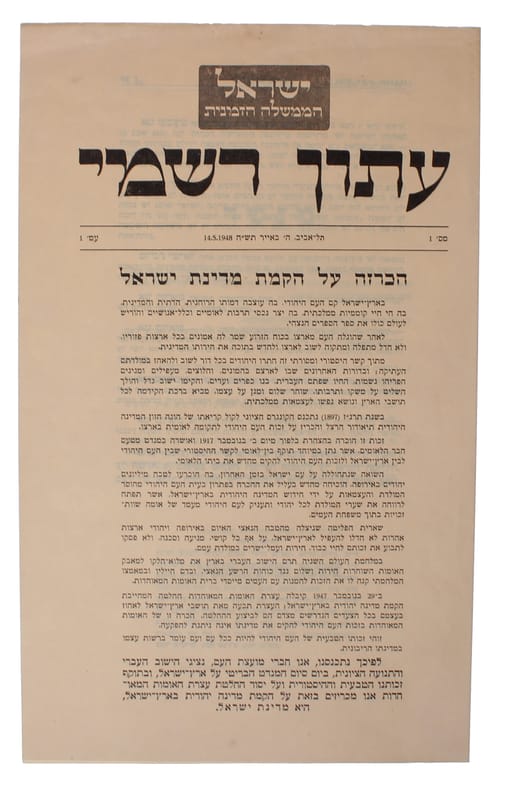
194860258Tel Aviv, 14 May 1948. Folio. (4) pp. Unbound as issued. In near perfect condition.
Tel Aviv, 14 May 1948. Folio. (4) pp. Unbound as issued. In near perfect condition.
1720135019Leipzig: in der Missisippischen Staats-Druckerey 1720. John Law and the Mississippi Company Rare first edition of this anonymous account of the State of France under Louis XIV and under the Regent who "under the clever guidance of Mr. Law has to the amazement of all fortunately improved it" our translation. Dedicated to "Mons. Law" who "der Welt bey anderthalb Jahren so viel zu reden gemacht hat" the stubbornly anonymous author he signs himself so gives an account of the rise and decline of France under Louis XIV the state of France following his death its subsequent recovery under the Prince Regent and an account of Law's activities and Mississippi Company. Bound after this work is a copy of the life of Cardinal Giulio Alberoni prime minister of Anjou a German translation apparently from the Italian published in 1718. The work is attributed in WorldCat to Jean Rousset de Missy. Octavo 163 x 100 mm. With engraved portrait frontispiece of John Law. Bound with another work in contemporary speckled paste paper boards paper spine label lettered in manuscript. Housed in a dark brown flat-back cloth box by the Chelsea Bindery. Spine ends joints and corners rubbed with some flaking of sprinkled paper coverning paper stock lightly browned with occasional spotting; a very good copy. Alden 720/58; Goldsmiths' 5608; Kress 3185; Sabin 39308. hardcover
167254537Londini Scanorum (Lund), Adami Junghaus - Vitus Haberegger, 1672. 4to. Contemporary full calf with double blindstamped borders to boards. Spine restored and hinges weak. Otherwise very nice. Title-page dusty and with a little weakness in the paper, presumably from a removed book-plate on the blank part of verso. Last secion of leaves with some light worming to upper blank margin, far from affecting text. All in all a very nice and clean copy with unusually good margins. Old owner's name to top of title-page. Title-page printed in red/black. (20), 1227,(9) pp.
Londini Scanorum (Lund), Adami Junghaus - Vitus Haberegger, 1672. 4to. Contemporary full calf with double blindstamped borders to boards. Spine restored and hinges weak. Otherwise very nice. Title-page dusty and with a little weakness in the paper, presumably from a removed book-plate on the blank part of verso. Last secion of leaves with some light worming to upper blank margin, far from affecting text. All in all a very nice and clean copy with unusually good margins. Old owner's name to top of title-page. Title-page printed in red/black. (20), 1227,(9) pp.
172520771Amsterdam 1725. Folio. 15 3/8 x 9 3/4 inches. Title printed in red and black. Folding engraved frontispiece engraved list of plates within a decorative surround 72 engraved plates maps and broadsides on 73 leaves 5 of the single-page plates cut to the edge of the image and mounted as issued 45 double-page 19 folding and including 10 which combine both engraving and letterpress text one plate loosely inserted 2 with sections of blank margins torn away some other clean tears occasionally affecting the image area. Contemporary Dutch speckled calf spine in eight compartments with raised bands red morocco lettering-piece in the second compartment repeat decoration in gilt in the others joints slightly split extremities scuffed<br/> <br/>A very rare collection of contemporary satirical prints relating to the financial exploits of John Law and his infamous Mississippi Bubble.<br/> <br/>John Law bap. 21 April 1671 - 21 March 1729 was a Scottish economist who believed that money was only a means of exchange that did not constitute wealth in itself and that national wealth depended on trade. He is said to be the father of finance responsible for the adoption or use of paper money or bills in the world today. Law was a gambler and a brilliant mental calculator and was known to win card games by mentally calculating the odds. An expert in statistics he was the originator of economic theories including two major ideas: The Scarcity Theory of Value and the Real bills doctrine. The present work records the economic crisis precipitated by Law. The crisis had its origins in the decision of the French regent Philippe d'Orléans to appoint John Law the Controller General of Finances for France. In May 1716 the Banque Générale Privée which developed the use of paper money was set up by Law. It was a private bank but three quarters of the capital consisted of government bills and government accepted notes. In August 1717 he bought the Mississippi Company to help the French colony in Louisiana. In 1717 he also brokered the sale of Thomas Pitt's diamond to the regent Philippe d'Orléans. In the same year Law floated the Mississippi Company as a joint stock trading company called the Compagnie d'Occident which was granted a trade monopoly of the West Indies and North America. The bank became the Banque Royale in 1718 meaning the notes were guaranteed by the king. The Company absorbed the Compagnie des Indes Orientales Compagnie de Chine and other rival trading companies and became the Compagnie Perpetuelle des Indes on 23 May 1719 with a monopoly of commerce on all the seas. The system however encouraged speculation in shares in The Company of the Indies the shares becoming a sort of paper currency. In 1720 the bank and company were united and Law was appointed Controller General of Finances to attract capital. Law's pioneering note-issuing bank was extremely successful until it collapsed and caused an economic crisis in France and across Europe. Law exaggerated the wealth of Louisiana with an effective marketing scheme which led to wild speculation on the shares of the company in 1719. In February 1720 it was valued for a very high future cash flow at 10000 livres. Shares rose from 500 livres in 1719 to as much as 15000 livres in the first half of 1720 but by the summer of 1720 there was a sudden decline in confidence leading to a 97 percent decline in market capitalization by 1721. Predictably the bubble burst at the end of 1720 when opponents of the financier attempted en masse to convert their notes into specie. By the end of 1720 Philippe II dismissed Law who then fled from France. Originally published by a group of Amsterdam booksellers the work has a convoluted bibliographic history owing to the ongoing enlargement of the number of prints published between late 1720 and the ensuing years coupled with the issuance of the plates as separate unbound sheets as well as later editions with yet more plates which maintained the title page dated 1720. In short nearly every extant example is unique in composition. "This remarkable complexity helps to explain why the book continues to fascinate scholars and readers to the present day: Het groote tafereel der dwaasheid in its many diverse copies represents an important witness to the events of 1720 and their aftermath which makes it valuable to cultural and economic historians . The book presents the rise progress and downfall of the deceptive trade of 1720 what that a group of booksellers who published it in 1720 when in Amsterdam where in order to restore social and ethical norms in Dutch society why by making fools of the greedy in a theatrical setting how. In short the Tafereel is an Amsterdam-born satirical comedy in disguise" Kuniko Forrer "Het groot tafereel der dwaasheid: A Bibliographical Interpretation" in The Great Mirror of Folly: Finance Culture and the Crash of 1720 Edited by William N. Goetzmann et. al. pp. 35-36. The present example corresponds to Forrer's third edition issued shortly after 1723 with the "Register" listing 73 plates and bound in a contemporary binding attributed to the Double Drawer Handle Bindery. This edition noted as the final edition published in the 1720s and the most complete including portraits of Madame Law and the King of the Mississippi "Der Koning van Missisipi" not found in earlier issues among other additions.<br/> <br/>Goldsmiths 5829; Kress 3217; Muller 3535; Sabin 28932; A.H. Cole The Great Mirror of Folly . an economic-bibliographical study Harvard: 1949; The Great Mirror of Folly: Finance Culture and the Crash of 1720 Edited by William N. Goetzmann et. al. Yale University Press: 2013. unknown books
1450261961450. <blockquote><p>Uberti's father had been referenced by Dante</p></blockquote><p>The City State of Florence:</p><p>In the 1300s the Italian city-states were embroiled in complex political machinations between each other—chiefly Milan Florence Pisa Siena Genoa Ferrara Mantua Verona and Venice— and the overarching powers of the Papacy and the Holy Roman Empire. Even within factions that seemed to support the same objectives: the Guelphs who battled the Ghibellines split in to the White Guelphs and Black Guelphs and ultimately the Black Guelphs exiled Dante Alighieri 1265-1321 from his beloved city state of Florence in 1302. During this exile Dante wrote the Commedia his love-song to Beatrice to his pagan and Christian poet-idols to a reimagined theology incorporating courtly love and Greek philosophy and to the city and people of Florence. He wrote his three canticles in a style called terza rima rhyming stanzas of three lines which was frequently imitated by later poets.</p><p>The Power and Poetry of Florence:<br />Despite the political turmoil Florence rose in power not only in Italy but throughout Europe in part because of the strength of its gold based economy. Florence stepped out of the Middle Ages into the Renaissance with a flourish of distinct and memorable art and poetry but the mid-1300s offered another tragedy for the dazzling city state. In 1348 the Black Plague ravaged the Italian peninsula. Poets turned their pens towards chronicling this devastation with perhaps the most-well known being the Decameron of Florentine poet Giovanni Boccaccio 1313-1375. The Decameron likely begun shortly after 1348 and completed in 1353 follows ten young people as they leave Florence to flee the plague. On the way they entertain themselves through a series of stories to take their minds off of the horrors around them.</p><p>Fazio degli Uberti and Dante:<br />Fazio degli Uberti 1305/9- ca.1367 is not as well-known as Dante or Boccaccio who are two of the “Tre Corone†of Italy with Petrarch as the third crown. Fazio was born in 1305 or 1309 to a family of some importance who identified politically as Ghibellines who supported the Holy Roman Emperor rather than the Pope. The family’s Ghibelline alignment accorded Fazio’s ancestor Farinata degli Uberti a place in Dante’s Inferno. In Canto 6 Farinata is listed among the Florentines who have done more bad than good for the city. Though in Canto 6 Dante asks where the great Florentines are who had “minds bent towards good†including Farinata he is told that in fact these Florentines are those with the blackest souls and the fact that Dante thinks of them with esteem shows how warped Florence has become. Later in Canto 10 Dante will meet with Farinata himself among the heretics and in Canto 28 he will understand how Florence suffers because of men such as Farinata in part because of the schism between the Guelfs and Ghibellines.</p><p>Despite this condemnation of his family in 1345 Fazio wrote his most noted poem the Dittamondo an emulation of Dante’s Commedia. The title Dittamondo is an vernacularization of the Latin dicta mundi indicating that it is an encyclopaedic text of what is known and said of the world. Like Dante’s journey under the guidance of Virgil Statius and finally Beatrice Fazio’s narrator meets with the allegorical figure of Virtue he and the Roman geographer Solinus travelled the whole world Italy Greece Germany France Spain northern Europe Africa and parts of Asia with Solinus giving the narrator descriptions of the cities visited. In addition numerous other snippets of information are added from the works of Pliny the Elder Isidore of Seville and Pomponius Mela. Even the style of poetry Fazio employed for his didactic poem was modelled after Dante’s own terza rima. However unlike Dante’s poem Fazio’s is far more encyclopaedic rather than a tour de force of allegorical and contemporary political satire clothed in Dante’s masterful command of language. Like Dante Fazio was exiled from Florence and like Dante Fazio wrote of his exile from the city. The Dittamondo remained incomplete upon Fazio’s death around 1367.</p><p>History of the Manuscript Tradition of Dittamondo:<br />While no comprehensive survey of manuscripts exists it is clear that the text is rare in manuscript with the Arlima database listing only BnF. italien 81 and Venice Biblioteca Nazionale Marciana Cl. IX c. XI. To these should be added Turin Biblioteca Nazionale Universitaria cod N 1 5; Milan Biblioteca Nazionale AC.X.30; and other single volumes in the Biblioteca Riccardiana in Florence the Biblioteca Angelica in Rome and the university library of Bologna as well as a fourteenth-century fragment in the Biblioteca Archiginnasio in the same city.</p><p>The Schoenberg database lists no copy offered for sale since that from the Joseph Martini library by Hoepli on 27 August 1934 lot 177 there with that previously appearing as Sotheby's 10 June 1918 lot 504.</p><p>The document:</p><p><strong>Bifolium from a large humanist manuscript</strong> of Fazio degli Uberti Dittamondo in Italian on parchment Italy mid-fifteenth century within a century of Fazio’s death. Each leaf approximately 330 by 240mm. Two conjoined leaves each with single column of 33 lines of an accomplished humanist hand with parts of chapters X-XI and XIII-XIV of Book 6 one large simple initial in pale blue the text set within an extensive gloss in Italian in smaller script recovered from the binding of a seventeenth-century book and hence with scuffs spots small holes one corner torn away with loss to gloss there scrawls and areas of text on outerside abraded and illegible.</p><p>This bifolium would be one of the center leaves in the gathering or quire sandwiched between other successive leaves folded and sewn in the gutter the crease in the center of the bifolium separating the earlier part of the text from the later to create the legible linear text.</p><p>The content deals with Old Testament and Hebrew Bible figures.</p><p>Chapter X gives a précis of Old Testament stories in terza rima mentioning Jacob Laban Rachel and Lia Reuben Gad Asher and Potiphar.</p><p>Chapter XI continues with the genealogy of the tribe of Levi which includes and touches on Aaron and Moses who is the main focus of this section.</p><p>The text on the bifolium jumps forward to Chapter XIII where holy lives are described including that of Mary of Egypt. From the Book of Kings in the Hebrew Bible Fazio weaves in mention of Elisha’s punishment of Ghazi who stole robes and treasure from his Naaman the Syrian. Elisha transferred Naaman’s leprosy to Ghazi. Fazio demonstrating his wide knowledge of this material says that “io non ti canto apertamente qui come Eliseo reuscitò un morto col Santo prego…†I won’t tell you openly how Elisha resurrected a dead man with holy prater and follows with another secret: “io non ti canto poi che li fu scorto fuel pargoletto…†I won’t tell you that a little baby was seen there that gave light and brightness….</p><p>Beginning with Ahaziah the sixth King of Judah Chapter XIV follows this line through Ezechias and castigates Sennacherib the king of the Neo-Assyrian Empire who did not accept God. Fazio finds and points to “Olda d’Ain†a female prophet heard by the world.</p><p>The text of the Dittamondo is surrounded by annotations in a contemporary hand employing more frequent abbreviations. These notes provide further details about the events described in the poem with a patte-de-mouche flourish at the end of each section.</p><p><img class=""alignnone wp-image-25018 size-post-window"" src=""https://cdn.raabcollection.com/wp-content/uploads/20231204144051/Folder-site-11-1600x1327.jpg"" alt="""" width=""1600"" height=""1327"" /></p> hardcover
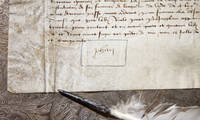
14502275018/10/1450. <blockquote><p>We can recall nothing similar having reached the market</p><p> </p><p>From the collection of Dr. Otto O. Fisher who bought primarily in the 1930s and 1940s so this not been offered for sale in nearly a century</p></blockquote><p>The Hundred Years’ War was one of the most notable conflicts of the Middle Ages. For 116 years interrupted by several truces five generations of kings from two rival dynasties - the English House of Plantagenet and the French House of Valois - fought for the throne of the largest kingdom in Western Europe - France. The war’s effect on European history was lasting. Both sides produced innovations in military technology and tactics such as professional standing armies and artillery that permanently changed warfare in Europe; chivalry which had reached its height during the conflict subsequently declined. Stronger national identities took root in both countries which became more centralized and gradually rose as global powers that expanded into the New World.</p><p>In the 1430s-50s the English clung to their dwindling possessions while French King Charles VII of the Valois dynasty slowly chipped away at them one piece at a time. By 1440 the French had driven the English completely from the valley of the Loire and the English retained only Normandy in the north and Gascony in the south. The Truce of Tours in 1444 gave the French a much-needed respite during which time Charles completed some necessary military reforms and prepared for the final grinding campaigns in a conflict that had begun more than a century earlier—well before anyone’s living memory.</p><p>Soon the war started up again. Under the weak kingship of Henry VI England seemed powerless to stop the French offensive of 1449 to recapture Normandy. The last major battle occurred in April 1450. With no other significant English forces in Normandy the whole region quickly fell to the victorious French. Caen was captured in June and Cherbourg the last English-held fortress in Normandy fell in August.</p><p>Among the commanders on the French side were the Count of Armagnac and his son the Viscount both named John.</p><p><strong>Autograph document signed</strong><em> ""Jehan John D'Armagnac""</em> October 18 1450 receiving 2000 livres a significant sum originally bestowed by the French King to Estienne Petit the treasurer to King Charles VII in the region the <em>""last march""</em> as the document notes for the purpose of attacking the English in April 1450 and after. <em>""I Jehan d'Armagnac Vicomte de Lomagne swear that I have received from Mr. Etienne Petit treasurer and collector of Languedoc the sum of 2000 livres that Mons. the King by distribution of his finances for Languedoc of 170000 livres awarded to the said Seigneur a Montpelier in the month of March last gave to furnish for us our expenses and to compensate for our efforts done in the surveying and conquest of Normandy.""</em></p><p>Jehan V was the last in the line of powerful Armagnac rulers. He fell out of favor with Charles who dispatched ""John the Bourbon"" to capture him but John fled to Spain. He was granted a return by Louis XI but soon revolted against him as well. Armagnac was part of the league that called itself ""Bien public"" or ""public good"" and threatened Paris at the head of 6000 mounted men. In 1469 Louis responded under the pretense that John was treating with ambassadors from England and sent an army under Antoine de Chabannes to rout him. John fled to Spain only to reappear in 1471 in the train of the king's rebellious brother the duc de Guyenne. John was stabbed to death in the 1470s without eligible male heir.</p> unknown
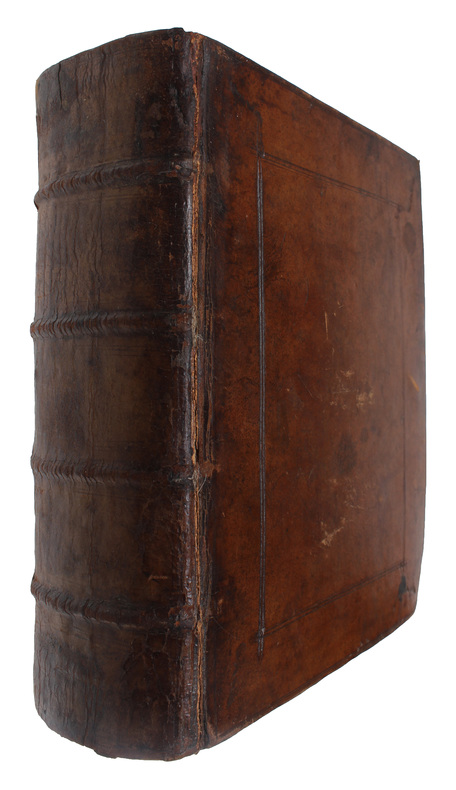
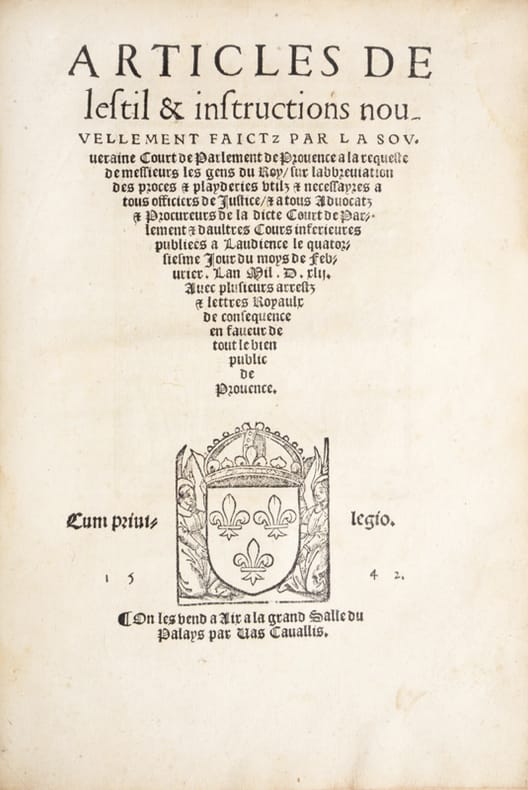
153942759Sans lieu, , 1539. In-4 gothique de (24) ff. (sign. a-f4). Relié avec : 2. [Provence. Ordonnances]. Ordonnances du très chrestien Roy de France Françoys premier de ce nom réduictes par tiltres & articles & ordre selon les matières ordonnées estre gardées & observées en ces pays de Provence, Forcalquier & terres adiacentes selon s'en ensuyvant la réformation par luy faicte sur le faict de la iustice desdictz pays lan mil cinq cens trente cinq (....) . Avignon, Jean de Channey, août 1536. In-4 gothique de CV-(9) ff. (sign. A-T6), table, titre dans un encadrement gravé. 3. [Provence. Articles]. Articles de lestil & instructions nouvellement faictz par la souveraine court de Parlement de Provence à la requeste de messieurs les gens du Roy, sur labbréviation des procès & playderies utilz & nécessayres a tous officiers de justice & a tous advocatz & procureurs de ladicte Court de Parlement & daultres Cours inférieures, publiées à l'audience le quatorziesme jour du moys de febvrier. Lan mil D. XLII. Avec plusieurs arrestz & lettres royaulx de conséquence en faveur de tout le bien public de Provence. Cum privilegio. On les vend à Aix en la grand salle du Palays par Vas Cavallis 1542. In-4 gothique de 16 ff. (sig. A-D4), armes de France au titre, bois représentant saint Louis au verso du titre.Les trois pièces reliées en 1 vol. in-4, vélin dur, dos à nerfs, titre manuscrit à l’encre noire sur le dos, triple filet d’encadrement et fleur de lys à froid dans les angles (reliure de l’époque).
1481ABC_50450Cologne: colophon: Johann Koelhoff the Elder 1481. 18th-century gold-tooled beige calf with red and green labels lettered in gold on the spine gold-tooled board edges red edges marbled endpapers. Folio. With an anonymous engraved portrait in a sprinkled frame on the verso of the second flyleaf the whole rubricated in red. First incunable edition of the Methodus utriusque iuris emerged from one of the most enterprising presses of the late 15th century that of Johann Koelhoff the Elder active ca. 1471-1487 died 1493.Koelhoff was not originally a printer. Born in Lübeck he began his career as a merchant trading in cattle grain wool and paper a commercial background that would later shape his success in the book trade. By 1471 he had established a printing house in Cologne likely after learning the craft in Venice possibly in the workshop of Wendelin von Speyer active in Venice 1468 to 1477. The clear rotunda type he favoured along with other technical features suggests a Venetian influence carried north to the Rhineland. His press produced over 125 known editions primarily Latin theological and philosophical works though from 1475 onwards he also printed legal texts intended for university use.This Methodus utriusque iuris belongs precisely to that academic world. It served as a methodological guide and lexical aid for the study of the two laws: civil law Roman law rooted in the Corpus Juris Civilis of Justinianus I and canon law. Cologne home to the influential University of Cologne was a centre for the study of the ius commune and works such as this were essential tools for students and jurists alike.With an ownership label mounted on the front pastedown reading Ex libris Van Vaernewyck of Albert-Philippe-Charles Vicomte de Vaernewyck 1762-1841 his library was sold at auction in Mechelen in July 1847. Contemporary manuscript annotations to the recto and verso of the final leaf including references such as Digesti Veteris. Otherwise in very good condition.l BMC I 224; Catalogue d'une riche et nombreuse collection des livres et gravures formant la bibliothèque rénommé de seu Messire Albert-Philippe-Charles Vicomte de Vaernewyck 1847 no. 5256; Copinger part I no. 1895; GW M23075; ISTC im00526500; Polain 2683; Proctor 1048A; Rhodes Oxford 1197; USTC 741179; Voulliéme 787; not in Goff. (colophon:) Johann Koelhoff the Elder, unknown
8vo. (2), XXIX, (1), 400, (4) pp. Modern red half morocco with original printed wrappers preserved, marbled boards, spine in six compartments, gilt lettering. Top edge gilt. First, very rare and unexpurged edition of the proceedings of the important Third Congress of the Russian Social-Democratic Workers' Party, held in London. "Believing that an insurrection was imminent, Lenin set out to wrest control of the Party from the Mensheviks. In April he summoned his followers for what he designated the Third Congress of the All-Russian Social Democratic Party. Convening in London from 25 April to 10 May 1905, this Congress was attended only by Bolsheviks, including Litvinov, Kamenev, Rykov, Krassin and Lunacharsky. "Lenin had little difficulty getting his programme adopted in London. The Bolshevik delegates accepted him as their leader, and gave him carte blanche. The immediate task was to organize an armed uprising, the Congress declared. The Mensheviks were virtually excommunicated, a fact which had no practical significance, inasmuch as they did not recognize the authority of the Third Congress. As far as they were concerned, the London gathering was the first Congress of the Bolshevik party" (David Shub, Lenin, p. 100). - Because this work contains two lengthy discourses by Lenin, the volume is considered a Lenin first edition. Lenin represented the city of Odessa, a city he had never visited. Lev Kamenev and Alexei Rykov made their political débuts at this congress. - The first few leaves and front cover show some small and unobtrusive spots. A very fine copy. Zaleski 2064. Anderson 3136.
8vo. 82 pp. Later red cloth with handwritten spine label. Second edition, first published in Berlin in 1869: an expanded German revision of the series of articles written by Eccarius in collaboration with his friend Karl Marx, entitled "A Working Man's Refutation of Some Points of Political Economy Endorsed and Advocated by John Stuart Mill", which had appeared in the "Commonwealth" newspaper in 1866-67, just as Marx was completing "Das Kapital". Much of the book, revised by Marx and thus an authorized expression of his views, is dedicated to the subject of capital, labour and population. Both Marx and Engels owned copies inscribed to them by the author; Marx mentioned the title twice in his correspondence with Engels (and later Engels in an 1885 letter to H. Schlüter). At the time of writing, Eccarius was one of the few so privileged to be shown parts of "Das Kapital" as it neared completion, and told friends that "the Prophet Himself is just now having the quintessence of all wisdom published". The copy of "Das Kapital" which Marx inscribed to Eccarius has recently been displayed at the Hamburg exhibition commemorating the 150th anniversary of what remains one of the most influential books ever published. - J. G. Eccarius (1818-89) was a German emigré tailor and labour activist in the English branch of the League of the Just. When Marx and Engels joined the League in 1846, it evolved into the Communist League, and in 1848 Eccarius was elected member of the new three-man Central Committee. A year later Eccarius co-opted Marx onto the same Committee (Marx later became President) and became his staunch supporter over the next two decades. Indeed, it was Marx who had given Eccarius his first publishing opportunity: Eccarius's article on "Tailoring in London or the Struggle Between Large and Small Capital" appeared in the London "Revue der Neuen Rheinischen Zeitung" in 1850. Marx helped him write the article, edited it, and probably formulated some of the passages - and then presented it to the public with a special blare of trumpets: "The author of the article is himself a worker in one of the London tailor shops. We ask the German bourgeoisie how many writers they have who are capable of comprehending the actual development in similar fashion [...] here a purely materialist and free conception, undistorted by emotional grumbling, confronts bourgeois society and its development" (quoted in the preface). Throughout the 1850s Marx continued to encourage Eccarius. He paid his friend's rent at a time when when he had to give up tailoring due to bad health, and when three of Eccarius's children died of scarlet fever in 1862, it was Marx who organised an appeal to cover the funeral expenses. In 1864 Eccarius attended the first meeting of the International Workingmen's Association, the "First International", and was nominated by Marx to speak on his behalf. Three years later, just before "Das Kapital" was published, Eccarius was elected the organisation's Secretary General. Despite this close collaboration and friendship, relations between the two deteriorated over time, and ultimately Marx openly split with him, describing his former friend as "a scoundrel pure and simple - canaille even". Stammhammer II, 99. Cf. Die Bibliotheken von Marx und Engels (MEGA IV.32), no. 350f. Francis Wheen, Karl Marx, pp. 276f. John Cunningham Wood, Karl Marx's Economics, pp. 275f.
Small 8vo. 26, (2) pp. Original staple-stitched self-wrappers. Printed on thin onion-skin paper. First and only edition of Lenin's witty denunciation of the so-called "zemstvo campaign" advanced by the Geneva-based Menshevik journal "Iskra" ("The Spark"). In a letter dated November 1904, the editors presented a plan for influencing the non-revolutionary "bourgeois opposition" in Russia by disseminating the demands of the Social Democrats through local zemstvos and discussion among the intelligentsia: thus, they hoped to stimulate liberal politicians to vote according to social-democratic views. In response, Lenin fiercely ridiculed the Mensheviks' ignorance of the disadvantages of liberal democracy, as well as the impracticality of tasking local zemstvos with influencing politicians. - Front wrapper bears the printed note "Only for party members"; this, as is revealed on p. 26, is a pun on the fact that Iskra's zemstvo plan, which was meant to be democratically disseminated across Russia, was issued with a similar conspiratorial disclaimer, a fact which Lenin found ridiculous. - Item 747 in the Bernstein and Souvarine catalog, which notes that the pamphlet was distributed illegally among local party offices in Russia and "played an important role in building up the Bolshevik iron discipline" and in convincing the Socialists that "pressure must be applied to the government, not liberals" (p. 126). - Light wear and spotting; corners somewhat creased; tiny nick to front wrapper.
Folio (230 x 350 mm). Parts 1 and 2 (of 4) in one volume, each with separate title-page printed in red and black. (8), 163, (9), 12 pp. With engraved frontispiece, engr. portrait, 2 folding engr. maps, 46 double-page-sized or folding engr. views of cities and fortresses, naval battles, historical scenes, equestrian portraits, plants, etc. (the Tower of Babylon on two unconjoined plates), 3 engravings in the text, and 12 woodcuts in the text (4 of which are full-page). (4), 140, (4) pp. With engr. frontispiece, 2 double-page-sized engraved maps, and 36 mostly double-page-sized or folded views and plates (including two plates showing two smaller views each). 18th century red half calf over marbled boards. Second editions of the first two parts of Wagner's grand description of Hungary, the Ottoman Empire, the Middle East and the Orient. First published in 1684/85, the work catered to a rapidly growing interest in eastern geography and all things oriental in the wake of the 1683 Battle of Vienna and the ongoing Turkish War. While the author would later expand the scope of his work to include India and East Asia, the present set covers the kingdom of Hungary (still largely under Ottoman rule), the Balkan states, the Mediterranean and Anatolia, the Holy Land, Syria and Palestine, Mesopotamia, Assyria, Chaldea, as well as Arabia and parts of Africa. Apart from the principal fortresses in Hungary, views include the Church of the Holy Sepulchre in Jerusalem, the Egyptian pyramids, Constantinople, Vienna, Rome and Venice, Lepanto, Cairo, Aden, Damascus, Sissek, Nauplia, and Kotor. Camels and crocodiles are illustrated, as are the tamarind tree and other tropical plants, with accompanying descriptions of the Turkish flora and fauna, the Ottoman court, manners, and potentates. An extensive chapter in pt. 1 (pp. 99-109) discusses Arabia, including Mecca and the Hajj. - Binding somewhat rubbed and scuffed. Paper insignificantly browned; untrimmed as issued. A near-contemporary note of acquisition on the pastedown states that the book was bought thus for 8 guilders in Amsterdam on 19 September 1924 from the local bookseller Samuel Schönewald ("Ao. 1724 den 19ten Sept. in Amsterdam von dem Buchführer Samuel Schönewaldt mit den 2ten Theil zusammen gekauft vor 8 fl."). Latterly in the library of the Viennese collector Werner Habel (1939-2015), with his handwritten and stamped ownership, dated 1978, to the pastedown. Very well preserved. - Even single volumes are usually not encountered complete with all plates as present; not a single copy with all four volumes in the trade or at auctions of the last decades. The only comparable copy (still lacking vol. IV) was auctioned in 2009 (Sotheby's London, 13 Nov. 2008, £20,000). VD 17, 3:301648N & cf. 39:135607B. Graesse VI/2, 409. Cat. Fischer Libr. 621. Hiler 889. Lipperheide Lb 22. Nebehay/Wagner 794. Not in Apponyi, Colas, Cordier, Ibrahim-Hilmy, Kainbacher, Paulitschke, Payer or Schwab.
- s.d. (septembre 1983), 21,5x28cm, une page sur un feuillet. - There is a long-standing myth that if two economists discuss any topic, they will have at least three opinions about it. Autograph manuscript signed, one a page written in black ink on a sheet of yellow lined paper and bearing in highlight, by the hand of the author: "Draft 8 - Preface for French edition 8 - Price Theory"; numerous erasures and corrections. At the top left of the sheet, in ballpoint pen, autograph signed: "For Bernadette Platte, Milton Friedman". Extremely rare autograph manuscript signed by the 1976 Nobel Prize winner, one of the most influential economists of the 20th century, whose entire archives are now kept at the Hoover Institution Library & Archives, Stanford University. The few Friedman manuscripts still in private hands are particularly desirable and sought after. Important theoretical text of the first two paragraphs of the preface to Price and economic theory, first French translation, published in 1983 by Economica editions, of Price Theory. Completed on September 7, 1983 at Stanford University, this original version in English is completely new. Price Theory, Friedman's major work (Chicago, Aldine Press, 1962) whose definitive version was published in 1976, the year Friedman won the Nobel, is a fundamental essay directly inspired by his courses at Chicago University. For his first publication in France, seven years later, Friedman therefore undertook to compose a completely new preface intended for this public less naturally won over to monetarist ideas than the Americans. Our manuscript, the final version of a text that required eight rewrites as evidenced by the exergue, still bears multiple repentances underlining the attention paid by Friedman to the reception of his work by the French readership. Spearhead of Ronald Reagan's economic policy, Friedman's theory of prices comes from a long tradition of French and Anglo-Saxon thinkers whom the economist takes care to quote in this manuscript: "From the French physiocrats and Adam Smith to Léon Walras and Alfred Marshall to Maurice Allais and Paul Samuelson, a body of theory has been elaborated and refined that essentially all economists accept and use in their analysis of the problems for which it is relevant". As a connoisseur of the French spirit, Friedman thus insists on the connection between the economic liberalism of his famous "school of Chicago" and the philosophy of the Enlightenment, dear to the intelligentsia of the old continent. It is moreover in homage to this French critical spirit that he opens his preface with an ironic anecdote on the relativity of economic theories: "There is a long-standing myth that if two economists discuss any topic, they will have at least three opinions about it". We note, however, that he replaces the real author of this trait, who is none other than Churchill, with an anonymous "long-standing myth". The repetitions and redactions on our manuscript show Friedman's temptation to analyze the origin of this myth: "This myth rests like most myths" is crossed out and replaced by an irrevocable "Whatever small element of validity this myth may have with respect to some topics, it has none whatsoever with respect to the core of economics... price theory. " The second paragraph of our manuscript is an apology for the monetarist theories defended by Friedman which, at the beginning of the 1980s, had just borne fruit: their application by the American Federal Reserve led to a sharp decline in inflation and a historic rise of the dollar. At the height of his influence, Friedman then saw his works, including Price Theory, republished, taught around the world and translated into several languages. He emphasizes here the central importance of his theory for understanding the world market: "For price theory seeks to understand how the actions of hundreds of millions of people spread around the surface of the globe interact through a market to determ
- s.d., 21,4x27,2cm, 9 pages sur 8 feuillets. - "In the end, 5 hours of work for example to produce - per man - all that is necessary to man." n.d., 21,4x27,2cm, 9 pages on 8 leaves. Complete autograph manuscript in French by Antoine de Saint-Exupéry. 9 pages on 8 leaves in black ink. Traces of horizontal and vertical folds. A small piece of paper missing in the center of two leaves. Exceptional unpublished manuscript by Saint-Exupéry, to be compared with his political and economic reflections in Carnets (1989, p. 43). Personally affected by the 1929 crisis, Saint-Exupéry "the self-taught writer" writes passionately about the economy and puts forward reform strategies. The manuscript features a lot of mathematical formulas and equations, along with remarks "To make the ideas clear about what is happening today" (p. 1), on the national economic system and the labor market. These unpublished pages testify to Saint-Exupéry's great intellectual curiosity, his insatiable need for innovation in all fields of knowledge: mechanics, technology, politics, economics... Saint-Exupéry writes on capitalist reform, as he was an outspoken critic of the system which he later personified in The Little Prince "businessman" character. He develops theories where the State becomes the only employer, banker, and overall production manager: "If the State pays all the salaries including those of the administrations and considers itself as owner of all the products (nothing to be changed within the capitalist system in the sense that it can pay to the administrations special bonuses returning in their salaries and according to the quality as well as the quantity. He disburses an amount X. He sells (having taxed his stocks so that they express Y)". His reflection is directly related to the stock market crash that bankrupted the Aéropostale, the pioneering airline company where Saint-Exupéry had displayed his talents as an aviator-writer. One also remembers the splendid lines from Terre des Hommes on the value of work: "The greatness of a profession is perhaps, above all, to unite men: there is only one true luxury, and that is human relations". Concerned about a better distribution of wealth, he develops throughout the pages several labor market and pension system theories, halfway between Keynes and Marx. The writer was well aware of the value of labor having himself spent long hours on his aircrafts' mechanics. He details his views on the duration of a working day "In the end, 5 hours of work for example to produce - per man - all that is necessary to man. With little work and it is possible to supply men with everything that is - and can with the increase of luxury - become necessary to them", and makes calculations on savings, pensions, purchasing power. His novels and personal writings contain numerous references to labor and hopes for a more equal human community: "Saint-Exupéry was also a man of his time, passionate about modernity, especially technical innovation, who constantly tried to reflect on all the problems that arose from it. Hence the countless notebooks, notes, and scattered sheets of paper that he constantly filled in and carried in his pockets and trunks, with which he might one day have written a book. (Jean-Claude Perrier) Rare manuscript from a true Humanist, a talented artist, aviator, novelist, political and economic thinker. Saint-Exupéry tries to build a harmonious social order and lay the theoretical groundwork for an ideal society. [FRENCH VERSION FOLLOWS] Manuscrit autographe complet d'Antoine de Saint-Exupéry. 9 pages sur 8 feuillets à l'encre noire. Traces de pli horizontaux et verticaux. Un petit manque au centre de deux feuillets. Exceptionnel manuscrit inédit de Saint-Exupéry, à rapprocher de ses réflexions politico-économiques publiées dans les Carnets (1989, p. 43). Alors que les effets de la crise de 1929 se font ressentir en France, celui qu'on a surnommé "l'écrivain autodidacte", se passionne ici pour l
167257075Londini Scanorum (Lund), Adami Junghaus - Vitus Haberegger, 1672. 4to. Contemporary or slightly later full mottled calf five raised bands to richly gilt spine. Edges of boards gilt. Very neat restorations to corners and hinges, barely noticeable. Blank front free end-paper with a few restorations. A mostly faint damp stain inner margin of first section of leaves. Some brownspotting. Title-page printed in red/black. (20), 1227,(9) pp.
Londini Scanorum (Lund), Adami Junghaus - Vitus Haberegger, 1672. 4to. Contemporary or slightly later full mottled calf five raised bands to richly gilt spine. Edges of boards gilt. Very neat restorations to corners and hinges, barely noticeable. Blank front free end-paper with a few restorations. A mostly faint damp stain inner margin of first section of leaves. Some brownspotting. Title-page printed in red/black. (20), 1227,(9) pp.