Antoine de SAINT-EXUPÉRYLivre Rare Book
BEUGNOT (Comte)Livre Rare Book
Les Olim ou registres des arrêts rendus par la Cour du Roi..
1839001064Paris Imprimerie Royale 1839
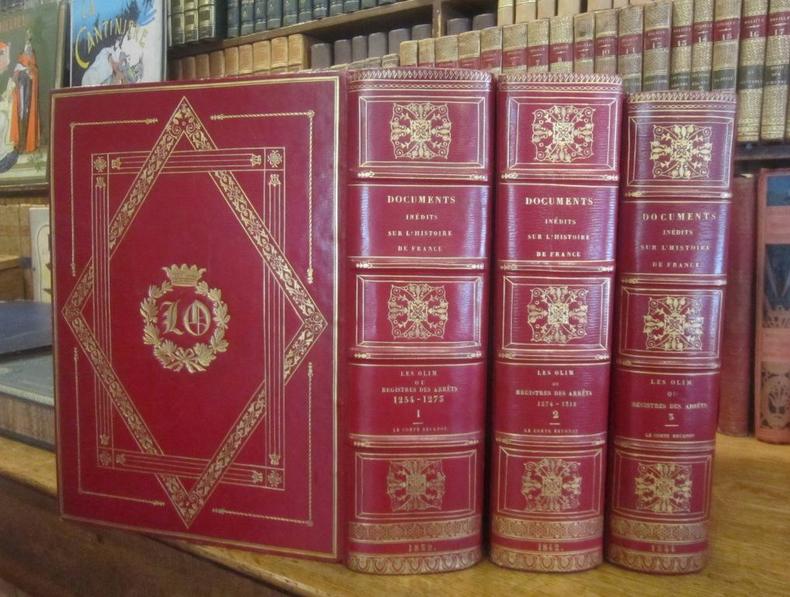
Henri Picard et Fils · Paris, France10 000,00 €
86 422 résultats
193082278s. d. | 21.40 x 27.20 cm | 9 pages sur 8 feuillets
1839001064Paris Imprimerie Royale 1839
8vo. 38, (2) pp. Original printed wrappers. Stapled. First edition of this manifesto of Leninism: the very scarce elucidation and expansion of the "April Theses", Lenin's statement of the principles that the Bolsheviks must adopt in the evolving revolution. Developed into a coherent party platform, the work was printed in September 1917, one month before the Bolsheviks seized power and put the policies into action. - In April 1917 Lenin returned from exile, and moved to take control of the Bolshevik Party and reorientate it according to his own vision. He wrote and presented his desired policies the same month, urging the Bolsheviks to withdraw their support from the Provisional Government, withdraw from the war, distribute land to the peasantry, and seize power for the Soviets, who would control the production of goods. These policies, since known as the "April Theses", were published in Pravda under the same title as the present pamphlet (The Tasks of the Proletariat in Our Revolution). Despite initially being rejected by a gathering of Social Democrats and then the Bolshevik committee, they were adopted by the party's seventh all-Russian conference in late April. The principles became very popular among the workers and soldiers of St Petersburg, broadening the Bolshevik Party's reach and support. Lenin subsequently developed and expanded the principles of the April Theses into a coherent party platform, which was printed in the present pamphlet in September, comprising effectively a manifesto of Leninism which guided the Bolsheviks as they overthrew the Provisional Government and secured their power. The pamphlet includes a postscript written by Lenin since the first printing of the April Theses, and is appended with the 1915 Zimmerwald Conference resolution calling for the end of the World War. - Wrappers detached; small tears to spine, slightly spotted. Only a handful of library copies traceable, none outside the US or the UK. Last seen at auction in 1972. Zalesky 3526. Lenin, Complete Works XXXI, 149-186. Lenin Collected Works 24, 55-92. OCLC 49450035.
198382270s. d. [septembre 1983] | 21.50 x 28 cm | une page sur un feuillet
plein veau fauve moucheté d’époque, titre & tomaison dorés sur pièces bordeaux et brunes, dos à 6 nerfs ornés de fleurons et frises, impression des pages de tit. en deux couleur, Portrait gravé de l’auteur en frontispice, ex-libris manuscrit ancien sur chaque tome, livre de prix de la « Faculté de droit de Paris - Concours de 1870 - Droit romain - 1er Prix » et reliure au prix des tomes 1 et 11, (restauration légère et visible sur qq. coupes et coins, d’autres restent très légèrement frottés avec de mq. mineurs, marque d’humidité au dos du dernier tome et qq. traces sur les 5 derniers ff., qq. accrocs aux coiffes de queue), reliure en excellent état et papier presque immaculé Nous présentons ici la dernière et la plus importante édition des œuvres de Cujas. En effet, l’édition napolitaine reprend celle de paris de 1658 ; elle contient en outre, et parmi les textes les plus importants de l’auteur, les Paratitla codicis, les Recitationes solemnes sur les Decretales de Gratien et les Recitationes exactissimæ. Cette collection est également rendue particulièrement intéressante par la présence des deux volumes de supplément, les PROMPTUARIUM UNIVERSORUM OPERUM. Jacques Cujas est regardé depuis toujours comme le juriste le plus novateur et important du droit “moderne”. A. Terrasson évoque l’auteur dans ces termes : “Quelque grand qu’ait été le mérite des Jurisconsultes dont j’ai parlé jusqu’à présent, on ne saurait le comparer à Jacques Cujas, qui sans contredit, tient le premier rang parmi les interprètes du droit romain. Si Cujas était venu au monde quelques temps auparavant, il aurait tenu lieu de tous les autres commentateurs. On connait parfaitement l’esprit du droit romain, & l’on n’ignore même de rien lorsqu’on sait ce qui est contenu dans les ouvrages de Cujas [...]. Il me resterait à recueillir les éloges qui ont été donnés à ce Jurisconsulte : mais outre qu’ils sont en trop grand nombre pour qu’il me soit possible de les rapporter, ils sont d’ailleurs tous rassemblés dans quelques termes de l’Épitaphe que j’ai ci-dessus rapportée, & dans lequel Cujas est appelé le premier & le dernier des Interprètes du Droit Romain, Juris Romani Interpres primus & ultimus ; ce qui donne clairement à entendre qu’avant Cujas on n’avait pas éclairci les Loix Romaines, et que ce grand Jurisconsulte a tout expliqué dans ses commentaires. En effet, on ne saurait refuser à Cujas la gloire d’avoir écarté de la Jurisprudence ces subtilités scholastiques qui ne servent qu’à jeter de l’embarras dans l’esprits, & et d’y avoir substituer de cette belle et noble littérature qui est si intimement liée avec les Lois Romaines, que sans son secours elles sont toujours énigmatiques & impénétrables.” (Terrasson Antoine, Histoire de la jurisprudence romaine, Despilly Père, Paris 1750, P. 463 et ss.). Localisation : Bibliothèques universitaires en France : - Bibl. Cujas - B.U. de Dijon - Bibl. Lyon III - B.U. Centrale Rennes II - B.N.U.S. de Strasbourg - Ctre Histoire du Droit Toulouse I Bibliothèques du monde : - BNF (Réf. FRBNF30290669) - British Library (réf. 000833296 - mq. 1 vol.) Nous noterons que cette édition manque à Berkeley, à la Library of Congress, à la Staatsbibliothek zu Berlin
A uniform set of 15 volumes comprising a total of more than 280 printed pamphlets from the period of the French Revolution. Privately bound in mottled half calf over marbled boards with giltstamped red spine labels (ca. 1840). Marbled endpapers. Uncommonly comprehensive collection of contemporary pamphlets, satires and literary works, often exceptionally rare, as well as printed resolutions of and responses by, petitions addressed to, and speeches given before the revolutionary Assemblée nationale, in support of or attacking the French Revolution. The collection was assembled and thematically arranged by the great French naturalist and politician François Vincent Raspail (1794-1878), whose signature is stamped to the first title-page of each volume and whose handwritten tables of contents are inserted after the front flyleaves. Raspail, a pioneer in the fields of cell theory, microscopy, and antiseptics, had been a member of the secret Carbonari society, was wounded on the barricades in 1830 and spent many years in prison for his republican beliefs. A candidate for the Presidency of the Second Republic in 1848, he lost to Napoleon III. Today, the longest boulevard in Paris, the "Boulevard Raspail", is named in his honour. - Among the pamphlets contained, some of great historical importance, others known in only a single or a handful of copies, and some otherwise unattested in this specific variant printing, are such works as: Lafayette, "Mémoire sur l'état des finances" (1787); Rabaut, "Considérations très-importantes sur les intérêts du Tiers État" (1788); Abbé Sièyes, "Qu'est ce-que le Tiers-État?" (1789); Desmoulins, "Discours sur la lanterne aux parisiens" (1789); Target, "Projet de déclaration des droits de l'homme" (1789); "Quand aurons-nous du pain" (1789); "Marie-Antoinette d'Autriche, reine de France, a la Nation" (1789); Mirabeau, "Discours sur l'exposition des principes de la constitution civile du Clergé" (1790); Hébert, "Petit carême de l'Abbé Maury" (1790); "Constitution française" (1791), "Defense de Louis XVI" (1792); "Adresse au peuple français" (1793); Aignan, "La mort de Louis Seize" (1793); etc. - Occasional slight edge defects; a few items incomplete. Bindings slightly bumped but still a very attractive ensemble compiled and systematically arranged by one of the figureheads of early French Republicanism. A complete list of the 289 works contained is available on application. Catalogue des livres principalement sur les sciences et sur la Révolution francaise, composant la bibliothèque de feu M. F-V. Raspail dont la vente aura lieu le lundi 19 Janvier 1880... (Labitte, 1879), no. 1722 (this set: "jolie demi-reliure veau jaspé. Très-belle collection en parfait état").
(4), 185, (3) SS. Etwas späterer Pappband mit goldgepr. rotem Rückenschildchen. 8vo. Sehr seltene Erstausgabe einer der bedeutendsten programmatischen Schriften des Vormärz und des Frühsozialismus. "Ein Manifest der Philosophie der Tat. Sie wollte aber nicht nur eine neue Philosophie begründen, sondern auch Aufgaben des auszufechtenden Kampfes aufzeigen. Diesem setzte sie als Ziele die Neugestaltung Europas, die Loslösung des Staates von der Kirche und die Realisierung der sozialen Gleichheit. Der Titel des Buches weist nur auf einen außenpolitischen Gegenstand hin, tatsächlich behandelt es noch zwei andere Hauptthemen: die Stellung der Religion im Staate und das soziale Problem im allgemeinen" (Silberner). In Kapitel II geht Hess auf den geistigen Standort seiner Zeitgenossen ein, ferner behandelt er Judenemanzipation, Freimaurerei etc. - Leicht braunfleckig, Innendeckel mit Spuren eines entferntem Exlibris. Stammhammer I, 250. Silberner (Works) A 2. Silberner (Lebensbeschreibung) S. 74ff. Zlocisti S. 44ff. Holzmann/B. IV, 5897. Hevesi 789. Stammhammer I, 250. Herlitz/Kirschner II, 1577. Nicht bei Kress und in der C. Menger Coll.
8vo (248 x 168 mm). 196 pp. Original printed wrappers. First and only issue (a double issue) of the journal founded by Lenin, containing the first appearance of his important article "Krakh II Internatsionala" ("The collapse of the II International", written May-June, 1915). In this work, Lenin "was signalling, for the first time in his career, that the establishment had become an immediate possibility and objective" and indicated his striving towards a third International (Fobert Service, Lenin, p. 82). Two other articles by Lenin are also printed here: "Chestnyi golos frantsuzskogo sotsialista" ("The honest voice of a French socialist") and "Imperializm i sotsializm v Italii" ("Imperialism and socialism in Italy"). Work on the publication was complicated by conflicts within the editorial team: Lenin opposed the anti-Party group around Bukharin and Piatakov, seeking to expose its anti-bolshevik views and to create two separate groups. He was extremely disappointed when the journal eventually appeared and, as a result, the editors of "Sotsial-Demokrat" began publishing a new journal, entitled "Sbornik sotsial-demokrata" beginning in 1916; "Kommunist" was discontinued. "In his subsequent account, Lenin claimed that the journal had served its purpose once it had printed Socialism and the War by Lenin and Zinoviev" (Service, Lenin, p. 112). - Rare; we are unable to locate auction records either in Russia or the West. - Wrappers lightly toned; else a very good, uncut and unopened copy. Souvarine and Bernshtein catalog (Dekker & Nordemann BV, 1980), no. 604.
1720J68DA7J71DZAAmsterdam 1720. Folio ca. 39 x 25.5 cm. Contemporary elaboratly gold-tooled mottled calf sewn on 6 supports with corresponding raised bands on the spine and with the title lettered in gold on the spine gold-tooled board edges marbled edges bound by the so-called Double Drawer Handle Bindery in Amsterdam between 1720 and 1742 - Storm van Leeuwen With the title-page printed in red and black and 76 engraved plates mostly double-page and several are larger folding sheets including several maps the plate with the complete set of 52 playing cards and an extra copy of plate 18 Muller loosely inserted at the front of the work. 1 1 blank 25 1 52 "31" = 29 1 blank 8 10 pp. and engraved ll. A famous collection of texts and plates satirizing the Englishman John Law his Mississippi Company and the international land and trading speculation in worthless shares of the South Sea Bubble of 1719-1720 which resulted in an international scandal. The speculation began in Paris London and Hamburg spreading to the Netherlands in the summer of 1720. While plays satirizing the speculation already opened in September 1720 the bubble really burst in October. Pieter Langendijk and Gysbert Tysens have been identified as authors of some of the plays. The book also provides the texts of official documents relating to the Dutch trading companies involved.Text and plates were originally issued in parts and were continuously supplemented over a longer period. Work on the book as a whole must have begun after the Amsterdam disturbances of 5 October 1720 though some of the plays and other items had been separately published before that. There are four editions known of the letterpress of which this one is listed as the first by Muller. Within each edition the number and makeup of the plates varies greatly from copy to copy. Muller gives a list of 74 plates in the most extensive contemporary published list but no copy of any edition includes them all some are alternatives and several plates frequently included are not in those lists. The present copy includes 72 in Muller's list of 74 omitting nos. 57 and 74 and includes 4 not in that list Muller 3611-3613 and 3615. The book is an important source for multidisciplinary research e.g. iconology economic history colloquial proverbs and idioms.The binding is very slightly rubbed the joints have been professionally reinforced slightly browned throughout some plates show small tears along the folding lines without any loss. Otherwise in very good condition.l De Bruyn "Het Groote Tafereel . " in: Eighteenth-Century Life XXIV 2000 pp. 62-87; Kress 3217 eds. not distinguished; Muller Historieplaten II pp. 103-124; Van Rijn het groote tafereel der dwaasheid 1905; Sabin 28932 eds. not distinguished; STCN 254984576; cf. slightly differing collation or fingerprint STCN 254984185 293084076 228136539; for the binding: Storm van Leeuwen vol. I pp. 228-284. hardcover
8vo. III-VII, 72 pp. Contemporary half calf. First separate edition, revised from a review of C. N. Starcke's book on Feuerbach which Engels had published in the "Neue Zeit" IV (1886). An influential treatise, constituting an important step towards the philosophical system of dialectic materialism within Marxism-Leninism, containing the first printing of Marx's propositions on Feuerbach, "the first document in which the ingenious seed of the new world view is sown" (cf. p. VII). The article was meant to provide a brief, comprehensive account of Marx's and Engels's position toward the philosophy of Hegel, as well as a previously lacking appreciation of their early debt to Feuerbach. In the present form, equipped with the author's new preface, Dietz would publish the essay in no fewer than eight editions until 1922. - A good copy without the half-title. Rubel (Appendix) 97 (note). Emig, Dietz-Vlg. A 44. Stammhammer I, 72, 6. Neubauer 336. Schwarz 180.
8vo. VII, (1), 72 pp. Modern marbled boards. With giltstamped leather label to spine. First separate edition, revised from a review of C. N. Starcke's book on Feuerbach which Engels had published in the "Neue Zeit" IV (1886). The article was meant to provide a brief, comprehensive account of Marx's and Engels's position toward the philosophy of Hegel, as well as a previously lacking appreciation of their early debt to Feuerbach. In the present form, equipped with the author's new preface, Dietz would publish the essay in no fewer than eight editions until 1922. - Paper slightly browned as common; short tear to lower edge of final leaves; old handwritten shelfmark "No. 1181" to half-title. An excellent copy. Emig A 44. Schwarz 180. Rubel (Appendix) 97 (note).
8vo. (4), VI, (3)-199, (1), IX, II, (1) pp. Publisher's brown cloth, gilt lettered to the spine. Now housed in bespoke brown cloth case. First British edition of the first English translation. This British edition was almost certainly issued to tie in with the publication of the latest English translation of Engels and Marx's "Manifesto of the Communist Party", also published by Reeves in London in 1888. It was published using the sheets of the first US edition which appeared in New York the previous year; the first edition printed in the UK did not appear for another four years. Whilst the first New York edition is uncommon, this London edition is particularly scarce with scant few auction records and not many institutional holdings: Copac lists two in the UK, at the British Library and Oxford, with Worldcat listing three more, two in the US and one in the Netherlands. - A few blemishes to the contents, occasional old pencilled underlining and marginalia, sometime neatly recased with new endpapers, some light wear to the edges of the binding, but generally a decent copy. Provenance: formerly in the Midlands Workers' Library of Birmingham with their loan label to the second free endpaper (listing a single loan in March 1945) and the faint remains of a white numbered shelfmark to the spine; the library's highly distinctive and attractive pictorial bookplate to the front pastedown featuring illustrations of workers set amid Communist iconography. Cf. MEGA IV.32: A copy of the U.S. edition (New York: Lovell, 1887) in Engels's library. Stammhammer I, 72, 9.
8vo. (4), 410 pp., final blank leaf. Original printed wrappers. Published in commemoration of the 25th anniversary of Karl Marx's death. Contains, among other pieces, the first printing of Lenin's article "Marxism and Revisionism", a detailed analysis of revisionist currents, ending with the programmatic slogan: "The ideological struggle waged by revolutionary Marxism against revisionism at the end of the nineteenth century is but the prelude to the great revolutionary battles of the proletariat, which is marching forward to the complete victory of its cause despite all the waverings and weaknesses of the petty bourgeoisie". - Title-page a little fingerstained; light wrinkling to corners of wrapper; a few flaws to the spine restored. Altogether a finely preserved copy of a rare work. OCLC 86139210.
12mo. 48 pp. Original printed wrappers bound within later half calf over marbled boards with giltstamped spine-title. Second edition of Lenin's agitational pamphlet on factory legislation. A simple explanation of the laws and fines imposed on the working class, it is "a brilliant example of how to approach the average worker of that time, and, proceeding from the workers' needs, to lead them step by step to the question of the necessity of political struggle" (Le Blanc). Written in the autumn of 1895, the work was first printed in 3,000 copies in December of that year at the illegal Lahta Press in St Petersburg. In 1897 it was re-issued in Geneva by the League of Russian Social-Democrats Abroad. The brochure circulated widely: according to reports of the Police Department of the years 1895-1905, countless copies were confiscated during searches and arrests in St Petersburg, Kiev, Yaroslavl, Ivanovo-Voznesensk, Kazan, Sormovo, Nizhni Novgorod, Orekhovo-Zuyevo, Saratov, Krasnoyarsk, Perm, and other Russian towns. - Small marginal flaws to title-page; upper right corners slightly creased, otherwise very well preserved. Lenin, Collected Works II, 29-72. Le Blanc, Lenin and the Revolutionary Party 20. OCLC 1190894021.
8vo. (14), 466, (14) pp. Title-page printed in red and black. With engraved frontispiece and 1 folding plate. Contemporary half calf with gilt-stamped red label to richly gilt spine. First edition; very rare. The first German-language work on money-lending institutions. Also treats life annuities, widows' and funeral funds, and lotteries. - Marperger worked at a Lyons trading firm and occupied himself with matters of trade and business life. He counts among the most productive and widely read authors of German Cameralism. - Upper spine end slightly damaged; edges slightly rubbed. Interior clean and evenly browned; endpapers with slight gluestain. Humpert 6787. Kress 2964. Goldsmiths' 5238. Cf. Menger 55 (only 2nd ed.).
8vo. XXXI, (1), 154, (2) pp., 2 blank leaves. Publisher's printed wrappers with advertisements on the back. First Russian edition of Marx's "Misère de la philosophie", which was written as a comment on "The System of Economic Contradictions, or the Philosophy of Poverty" ("Système des contradictions économiques ou philosophie de la misère", 1846) by the French anarchist Pierre-Joseph Proudhon. "Numerous commentators in the Marxist tradition recognize 'The Poverty of Philosophy' as a pivotal work in Karl Marx's intellectual and political development. Shortly after it was published in July 1847, Frederick Engels hailed it as the basis of 'our programme', a necessary theoretical guide to any platform of an emerging proletarian party" (Roberto). - The present edition was published by the Gruppa Osvobozhdenie Truda (Association for the Emancipation of Labour), the first Russian-language Marxist political organization, based in Geneva. The group was very active in translating, publishing Marxist works in Russian and distributing them. - Spine split. Traces of earlier side-stitching, but lacking the threads, hence many loose leaves. Right corner torn off from the head of the wrapper. Some minor browning in the lower margins and a tiny hole in the title page, but with the text generally sound. OCLC 54864287. Cf. M. J. Roberto, Karl Marx, Progress and World History: Significance of the Poverty of Philosophy.
Folio (248 x 370 mm). 2 parts in 1 vol. (8), 535 (but: 435) pp. (8), 459 (but: 463) pp. With half-page handcoloured woodcut vignette on both title-pages. Contemporary armorial red morocco, finely gilt and signed by Jean-Édouard Niédrée. All edges gilt, gilt inner dentelle, leading edges gilt. Splendid deluxe copy of the Rouen-printed reprint of the first two parts of the Duke of Sully's notorious memoirs. Here, he develops his vision of a Europe comprised of fifteen roughly equal-sized European states, under the direction of a "Very Christian Council of Europe", and possessed of a common army. This famous "Grand Design", a utopian plan for a Christian republic, is often cited as one of the first grand schemes anticipating the European Union. This Rouen edition of 1649 was precisely copied after the very scarce editio princeps, printed between 1639 and 1640 by Jacques Bouquet at Château de Sully in fewer than 400 copies. The first two parts cover the years from 1570 to 1605. The editio princeps of part III and IV was published by Augustin Courbé in Paris in 1662. - Finely copy bound by Niédrée for the Baron François-Florentin-Achille de Seillière (1813-73). Cioranescu 63703. Kress 537. Einaudi 5506. Goldsmiths' 686. L. Avezou, Sully à travers l'histoire (2001), p. 119f. Rahir 649. Leblanc, De Thomas More à Chaptal (1961), 8.
4to. 2 vols. (2), XVI, 366, (2) pp. (2), 367-768, (2). With one plate. Contemporary half calf over marbled boards with giltstamped spine-title. First Russian edition: Lenin's extremely scarce translation of an important work by the socialist couple Sidney and Beatrice Webb. A crucial work of the social sciences, this study of British trade unionism introduced the idea of industrial democracy and reflected on the organisation of trade unions and collective bargaining. Essentially a joint effort, Lenin prepared the translation with much assistance from his wife, Nadezhada Krupskaya, during his three-year exile in Siberia. In spite of their tenuous command of English, they did a "creditable job" (Ulam), consulting a dictionary as well as the German edition during the process, "though as Struve recalls venomously, he had to spend some time straightening out the stylistic and literary side of the translation" (ibid.). - Covers slightly rubbed. Interior very well preserved. With the pink errata slip to vol. 1 bound at the beginning of vol. 2. Not seen at auction since 1982. A single copy of both volumes traceable in the Bibliothek des Ruhrgebiets, Bochum, Germany. A copy of the second volume alone is held at the International Institute of Social History in Amsterdam. An excellent copy of an otherwise near-unobtainable publication. Ulam, The Bolsheviks, 135. Loginov, Vladimir Lenin: How to Become a Leader, p. (14) of the introduction. OCLC 602549261 and 86129063.
1720B6829Amsterdam. 1720. Plates are clean and crisp.<br><br>. Edition: First Edition. Binding: Full contemporary mottled Dutch calf expertly rebacked in matching calf. Matching upper and lower boards with triple frame of decorative gilt fillet and a panel of darker calf between inner two gilt frames. Gilt stamp in centers of boards. Spine with 5 raised bands decorative gilt fillet on bands and in compartments. Title in gilt lettering on brown label in 2 remaining compartments with gilt stamps. Decorative gilt rolls on board edges. Notes: “The engravings which illustrate the rise and fall of the great speculation are full of humor; many of them are exceedingly ludicrous and some very obscene†Sabin. “Published in Amsterdam the giant tome includes pamphlets legal documents economic analyses maps satirical plays poems playing cards and more than seventy prints. The volume attracted wide audiences feeling the sting of the financial crises taking place in England France and the Dutch Republic that together resulted in the first international stock market crash.â€<br>“Het Groote Tafereel der Dwaasheid references Tulipmania in the Dutch Republic where the prices of tulip bulbs spiked and abruptly plummeted in 1637; the South Sea Bubble in England and Mississippi Bubble in France that burst in 1720; and other British French and Dutch enterprises that failed in 1720. Investing frenzy is characterized as a form of contagion moving from one country to the next: a consequence of the craze for international emulation as was evident in the English for example adopting the measures of John Law’s Mississippi Company that ultimately resulted in the South Sea Bubble. Prints in the volume commonly depict the dreams disordered states of mind and moral failures of investors caught up in the speculative zeal—alluding to herd behavior gambling corruption insanity immorality and demonic possession.â€<br>The text first appeared in 1720/21 and continued to be reprinted throughout the 18th century. Very few copies of this book survive as most were broken apart so that engravings could be sold individually. Professor Arthur Cole writes: “Rarely does a single volume combine in itself so much economic interest and so many bibliographical puzzles as Het Groote Tafereel Der Dwaasheid. There is scarcely another item just like it. Not merely are the identity of the compiler and the place of publication unknown and not merely is the date of original issuance uncertain but the volume went through an evolutionary process over time quite unnoticeable by ordinary superficial inspection. Moreover so strange was the mode of issuance that no two specimens even of approximately the same actual issue date are exactly the same. Neither the textual material nor the engraved prints are always identical nor do they appear in the same sequence within the volume.â€<br><br> Size: Folio 390x248 mm Illustration: Text in Dutch.<br>With the exceedingly rare index leaf. Extra illustrated with 80 plates.<br>A near fine example of this “extraordinary visual record of the first banking crash showing the shocking effects of the South Sea Bubble in France England and Holland and placing John Law 1671-1729 with his Mississippi company scheme squarely at the centre of the disastrous chain of events. ‘A unique historical document … of real significance’†Cole p.1. This copy is complete with the 74 plates listed in the very scarce index leaf included in this text in addition to 6 extra plates; 80 plates in total. With many folding and double-page plates. Includes frontispiece original engraving of John Law and a deck of “bubble cards.†Title in red and black. Pg. 43 mislabeled as 23. In full contemporary decorative Dutch calf. References: Cole Great Mirror of Folly 1949; Goldsmiths' 5879; Kress 3217; Sabin 28932. Pages: Blank 2. Frontispiece. Blank. Title. Blank. Index. P. 1 – 25. Aanwyzinge Der Projecten. 1 – 52. Versameling van Gedigten… 1 – 31. Blank. Papegaay of Actie-Kaart… 1 – 8. Copye Van Een Brief… 1 – 10. 80 plates. Blank 2. Category: Book Caricatures; Book Europe Benelux; Book Plate Books General; hardcover
1720297394Amsterdam 1720. First. hardcover. very good. Rubricated title 25 1 52 31 10 pages 74 copper engraved plates 58 folding including 3 maps 2 folding and 1 plate laid in. Bookplate of Dutch writer Jan Te Winkel pasted on upper corner of title page. Light dampstain on the top margin of some plates. Folio full contemporary mottled calf elaborately gilt spine and covers black leather spine label rubbed at corners and bottom of spine. Amsterdam: 1720. Very good.<br/><br/> Contemporary Dutch account of the Mississippi Land bubble. A renowned monument for the speculative mania of 1720: The great mirror of folly showing the rise progress and downfall of the bubble in stocks and windy speculation in France England and the Netherlands. It constitutes a collection of mostly satirical plates on the operations of John Law in France and the South Sea Bubble in England together with the text of the charters of speculative companies in Holland and a number of satyrical plays and comedies published during the bubble. The first text-part reprints the charters of some 30 speculative companies of commerce navigation and assurance' established or at least projected in Holland between June and October 1720. The following parts contain comedies and poetry published during the mania an explanation of the large print with playing cards known as April-kaart'. The book is divided into six sections with no general table of contents. The first part contains the articles of various Dutch companies. The second section consists of comedies and farces; the third part poems often containing street language; the fourth part descriptions of playing cards satirizing speculators; the fifth part four letters to "N.N."; and the sixth section chiefly pictures. A.H. Cole The Great Mirror of Folly Boston 1949; Kress 3217; Sabin 28932.<br/><br/> unknown books
1720297394Amsterdam 1720. First. hardcover. very good. Rubricated title 25 1 52 31 10 pages 74 copper engraved plates 58 folding including 3 maps 2 folding and 1 plate laid in. Bookplate of Dutch writer Jan Te Winkel pasted on upper corner of title page. Light dampstain on the top margin of some plates. Folio full contemporary mottled calf elaborately gilt spine and covers black leather spine label rubbed at corners and bottom of spine. Amsterdam: 1720. Very good.<br/> <br/> Contemporary Dutch account of the Mississippi Land bubble. A renowned monument for the speculative mania of 1720: The great mirror of folly showing the rise progress and downfall of the bubble in stocks and windy speculation in France England and the Netherlands. It constitutes a collection of mostly satirical plates on the operations of John Law in France and the South Sea Bubble in England together with the text of the charters of speculative companies in Holland and a number of satyrical plays and comedies published during the bubble. The first text-part reprints the charters of some 30 speculative companies of commerce navigation and assurance' established or at least projected in Holland between June and October 1720. The following parts contain comedies and poetry published during the mania an explanation of the large print with playing cards known as April-kaart'. The book is divided into six sections with no general table of contents. The first part contains the articles of various Dutch companies. The second section consists of comedies and farces; the third part poems often containing street language; the fourth part descriptions of playing cards satirizing speculators; the fifth part four letters to "N.N."; and the sixth section chiefly pictures. A.H. Cole The Great Mirror of Folly Boston 1949; Kress 3217; Sabin 28932.<br/> <br/> unknown
1700176470London: Printed by the Assigns of Richard and Edward Atkyns Esquires for John Walthoe 1700. The first English treatise devoted exclusively to family law First edition in an exceptionally well-preserved binding of this oft-cited work on the legal position of women in 17th- and 18th-century England and a key summary of the social mechanisms underpinning such works as The Taming of the Shrew. "Baron and Feme" refers to the legal fiction that husband and wife shared one legal personhood. The anonymous author of this treatise draws heavily on Sir Edward Coke's edition of Littleton aiming to codify and explain family law "in all the Circumstances of Life from the Solemnization of Marriage to the Divorce" p. vi. "Although written in English at a time when many law books were still published in Latin and law French it was clearly intended for a legally trained reader" Glover p. 75. This copy includes extensive ink annotations in an 18th-century hand suggesting a similar level of legal training. The annotations mainly cite other legal reference works but they also explicate several points of law and invoke others to challenge assertions in the text. The notes on the rear blank verso for instance observe that "the Wife's Portion consisting of Choses in action shall not upon ye husb's death be liable to his debts tho' ye husb: before marriage had made an adequate Jointure on her". Further editions appeared in 1719 and 1738. Octavo 192 x 115 mm pp. xxxii 380 misprinting pp. 178-9 182-3 186-7 and 190-1 as 162-3 166-7 170-1 and 174-5 36. Contemporary calf spine ruled in black and lettered in black manuscript covers with double fillet in black. Housed in custom green morocco book-form case. With 18th-century ink annotations and infrequent underlining to contents and rear blank verso. One corner just worn at tip infrequent brown marks to several pages contents otherwise bright and fresh: a fine copy. ESTC R6177; Wing B899. Susan Glover Engendering Legitimacy: Law Property and Early Eighteenth-century Fiction 2006. unknown
1791173742Edinburgh: for Peter Haill and George Kearsley London 1791. The first biography of the economic pioneer First edition of the first biography of Law whose financial schemes of an expanded paper money supply brought economic ruin to France yet paved the way for the modern credit economy. The biographer John Philip Wood was a local historian of Cramond where Law was born. He had "access to certain materials which are not now available" and "included a number of interesting genealogical and personal details in his book" though he "made no attempt to examine the 'system' objectively or even to analyse his subject's character in the light of his career" Hyde pp. 36 216. Both Antoin Murphy and James Buchan cite Wood's work in their scholarly biographies of Law although part of Wood's account of Law's genealogy is challenged by Murphy. The work was republished in an expanded edition in 1824. Quarto pp. 4 ii 48. Original stab-sewn blue wrappers edges uncut. Housed in 20th-century clamshell portfolio backed with earlier marbled paper. Rear wrapper detached a little chipped and torn at extremities light spotting and patch of toning to title page else contents fresh: a very good copy. ESTC T8458; Goldsmiths' 14941; Kress B2240. H. Montgomery Hyde John Law 1969. unknown
1739164842The Hague: Pierre de Hondt 1739. The best contemporary account of John Law's system First edition of Marmont's history of French finance during the minority of Louis XV an important record of the activities and operations of John Law. A tax collector from Flanders Marmont was a great admirer of Law's system despite its dramatic collapse in 1720. He covers Law's foundation of the Banque Générale through to the formation of the Compagnie des Indes which by absorbing various other chartered companies acquired the monopoly on trade to Africa America and the Far East. This finally transformed into the Mississippi Company giving Law control of France's finances most notably tax collection and debt management. 6 vols bound in 3 duodecimo 160 x 93 mm. Engraved plate in vol. 4 2 folding letterpress tables printed on both sides in vol. 6 woodcut devices and vignettes title pages printed in red and black. Contemporary sprinkled calf spines decorated in gilt in compartments red morocco labels marbled endpapers red edges silk bookmarkers. Head of spines of vols 2 and 3 slightly chipped corners worn front cover of vols 1 and 2 slightly darkened in places; marginal stain to fore edge of preliminary leaves of vol. 1 contents otherwise clean and fresh: a very good copy. Einaudi 3728; Goldsmiths' 7712; INED 1553; Kress 4447; Mattioli 2247; Sraffa 3776. unknown
2 vols. Folio (250 x 378 and 285 x 405 mm). Modern card wrappers. A set of two runs of the British anarchist journal "Freedom", produced under the editorship of John Turner (1865-1934). Comprises May 1930 to February 1932, omitting September through October 1930 (issued monthly), and January to May 1933 (issued weekly). "Freedom' was founded in London in 1886 by N. Chaikovski and F. S. Merlino as well as Prince Kropotkin. It appeared under slightly changing sub-headings until 2014 and now continues as an online publication. The present issues contain reports on the peace and workers' movement, protest marches and various activities as well as notes on topical publications in England and abroad. - Occasional browning, but very well preserved in all. Rare. ZDB-ID 1071239-2.