86 313 résultats
185446907Leipzig Johann Ambrosius Barth 1854. Contemp. marbled boards. In: "Annalen der Physik und Chemie. Hrsg. von J.C. Poggendorff" Vierte Reihe Bd. 3 = Poggendorff Bd. 93. Entire volume offered. Two stamps to titlepage. X632 pp. and 4 folded engraved plates. Clausius's paper: pp. 481-506. Internally clean and fine. <br/><br/><em>First printing of this milestone paper in thermodynamics which together with his paper from 1850 established the second law of thermodynamics. In the offered paper Clausius introduces the symbol T for the universal function of temperature a 1 and he introduces the concept of "entropy" the greek word for 'transformation' but without using the word Clausius introduced the word later in 1865 he calls this new theorem "the principle of the equivalence of transformations". This principle paints a dramatic picture of the end of the world the so-called "heath-death of the universe"."Entropy on the other hand of the complementary experience of water seeking its own level of hot bodies cooling of springs untensing of magnetism wearing off and electrical charges leaking away of a destiny suchThat no life lives forever; - That dead men rise up never; that even the weariest river Winds somewhere safe to sea: a world getting old and running down."Gillespie in "The edge of Objectivity" p. 400-01."Clausius discovered that if he took the ratio of the heat content of a system and its absolute temperature this ration would always increase in any process taken place in a closed system. A closed system is one that loses no energy to the outside world and gains no energy from it. With perfect efficiency which is never realized in the real world of course the ratio would remain constant but i would never under any circumstances decrease."Asimov. - Parkinson: Breakthroughs 1854 C. </em> hardcover
175650678London N. Gibson 1756. 8vo. Contemp. full calf. Raised bands. Titlelabel with gilt lettering. Blindtooling to covers. A neath repair at upper compartment. Spine slightly rubbed. VIII4764 pp. A very faint dampstain to lower right corners. A few scattered brownspots. Printed on good paper. <br/><br/><em>Very scarce first edition in English a translation of the relevant part of Chr. V's Danske Lov 1683 relating to the Danish West Indies. All laws and regulations on St. Thomas St. Croix and St. John were based on this lawcomplex in the period of the Danish possession of these islands.Sabin No 18501. </em> hardcover
175650678London, N. Gibson, 1756. 8vo. Contemp. full calf. Raised bands. Titlelabel with gilt lettering. Blindtooling to covers. A neath repair at upper compartment. Spine slightly rubbed. VIII,476,(4) pp. A very faint dampstain to lower right corners. A few scattered brownspots. Printed on good paper.
170953073(København), 1709. Folio. (53x36,5 cm.). Nyere smukt helldrbd. i lysebrun kalv. Ryg med 5 ophøjede bind. Forgyldt skindtitel på ryg. Stregforgyldninger på permer samt stor oval med forgyldt titel på forpermen. Indvendige false i skind. I matchende kassette med kanter i skind. 19 kobberstukne folioblade. Trykt på svært skrivepapir. Velbevaret eksemplar.
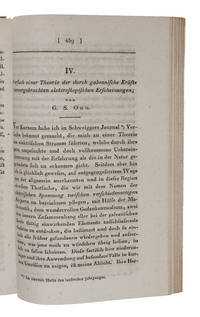
182643632Leipzig Johann Ambrosius Barth 1826. Without wrappers as issued in "Annalen der Physik und Chemie. Hrsg.von Poggendorff" Bd. 6 7 Viertes u. Fünftes Stück. Entire issues 4 and 5 present. Titlepage to vol. 6. Pp. 369-514 a. 1 engraved plate Titlepage to vol. 7. Pp. 1-136 a. 1 engreved plate. Ohms paper: pp. 459-469 pp. 45-54 a. pp. 117-118. Clean and fine. <br/><br/><em>First appearence of a major paper in 19th century electrical theory breaking new ground in associating an electric tension with both open and closed galvanic circuits unifying the theory of Galvanic electricity and containing Ohm's Law in the simpler and last form."Ohm's second major paper of 1826 announced the beginnings of a comprehensive theory of galvanic electricity based he said on the fact that the contact of heterogenous bodies produced and maintained a constant electric tension Spannung. He deferred the systematic exposition of thsi theory to a later work however and limited himself to stating without derivation the two eqautions that constituted its heart: X=kwa/l and u-c = /- x/lawhereX is the strenght of the electric current in a conductor of lenght l cross section w and conductibility Leitungsvermögen k produced by a difference in electric tension a at its end points. By means of the first equation one can .reduce the actual lenght of a wire of whatever cross section and conductibility to the equivalent lenght of one of the wire chosen arbitrarily as a standard. Letting l now be this equivalent lenght - called the reduced lenght reducirte Länge of the conductor - Ohm WROTE HIS FIRST LAW IN THE SIMPLER FORM X=a/l THE EXPRESSION WHICH HAS BECOME KNOWN AS OHM'S LAW."DSB X pp. 188-89. </em> unknown
(Slesvig, Nicolai Wegener), 1593. 4to. Helpergamentsbind fra 1600-taller. Ved ombindingen er bagerst indsat ca. 100 blanke blade. Forgyldt titeletiket i skind på ryg. Etiketten med lidt tab. Gl. ejernavn Bille Brahe (Hvedholm). 129 blade. På titelbladet er 2 linier, som var trykt med rødt overskrevet med sort. Blad 1b med stort træsnit af Danmarks våben. Blad 2a med helsides træsnit, Christian IV's portræt. Gl. ejernavn på titelbladet. Rent eksemplar trykt på kraftigt skrivepapir og med talrige samtidige tilskrifter i en net hånd.
(København), 1709. Folio. (53x36,5 cm.). Nyere smukt helldrbd. i lysebrun kalv. Ryg med 5 ophøjede bind. Forgyldt skindtitel på ryg. Stregforgyldninger på permer samt stor oval med forgyldt titel på forpermen. Indvendige false i skind. I matchende kassette med kanter i skind. 19 kobberstukne folioblade. Trykt på svært skrivepapir. Velbevaret eksemplar.
152932012Paris, apud Galliotum Praetensem, 1529. Groß 8°. Beschädigter, wohl späterer Halbledereinband. [5 Warenabbildungen]
1939187818O.O. 1918-1939. 8° bzw. 4°. Hlwd. Teils etwas berieben u. angestaubt. Jgge. teils in 2 Bänden geb. Teilw. m. wenigen Anmerk. bzw. Sign./St. 1920 Bind vorn lose u. 1939 in Heften. Jg. 1920 fehlt H. 88.
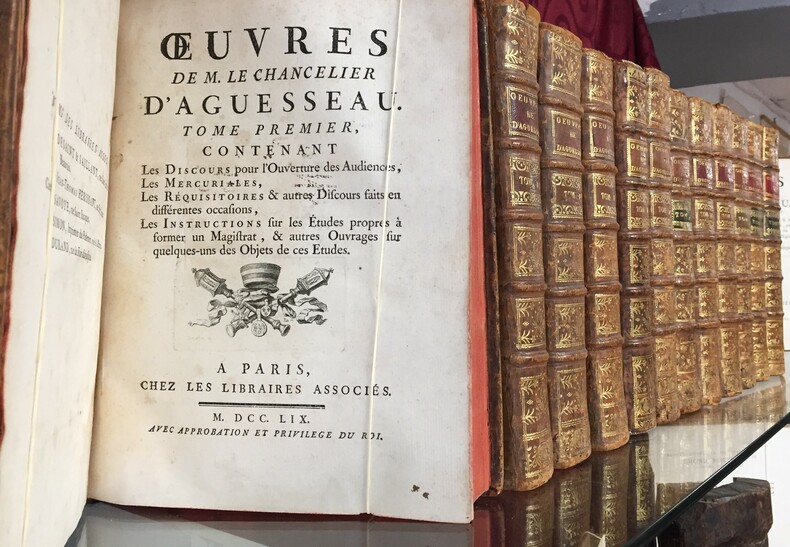
175971Œuvres de monsieur Le Chancelier D'Aguesseau contenant les discours pour l'ouverture des audiences, les mercuriales, les réquisitoires - autres discours et les instructions. A Paris chez les libraires associés, 1759. Avec approbation et privilège du Roi Reliure cuir. Intérieurs bon état, quelques traces de frottement sur les coins, mors et coiffes. Quelques rousseurs sur certains volumes.
Folio (ca. 268 x 395 mm). (10), 127, (1) pp. With engraved title-page, 14 (instead of 15) engraved plates (11 of which double-page sized), and woodcut printer's device to title-page. Contemporary giltstamped full calf with title label to spine. First edition. Lavishly illustrated account of the 1691 entrance of William of Orange, King William III of England and stadtholder of Holland, to The Hague, the place of his birth. The splendid plates by the Dutch artist Romeyn de Hooghe (1645-1713) show the ceremonial architecture erected in William's honour as well as parades, grand fireworks, and the King's route, including his arrival at Honslerdyk castle, his passing Westend bridge with several windmills in the background, and the triumphal arches with their allegorical designs. - Wants the engraved portrait of William by Philipp van Gunst. Binding somewhat rubbed, spine-ends chipped, hinges starting, corners repaired. A few leaves show marginal tears, barely affecting text or image. A good, wide-margined copy of this sumptuous work of monarchical representation. Lipperheide 2667. Kat der Ornamentstichsammlung Berlin 2952. Ruggieri 1095. Vinet 752. Graesse I, 419. Landwehr, Splendid Ceremonies 146. Landwehr, R. de Hooghe as book illustrator 79. Printmaking in the Age of Rembrandt, cat. Museum of Fine Arts Boston, 209. Lotz, Das Feuerwerk 105. Sievernich, Feuerwerkskunst 6/36.
356 x 279 mm. Rare shot from the camera of Perfecto Romero, the photographer of the Cuban Revolution, who signed and dated "1959" on the verso. The subject of the photograph is Camilo Cienfuegos (1932-1959), hero of the revolution who was presumed dead only months later when his small plane mysteriously disappeared on a night flight. The verso also has a note from the Museo de la Revolucion, which thanks Rosa Maria Medel, the daughter of the Cuban-American singer Rosita Fornés, for this image: "A usted, por sos valores profesionales, patrioticos, eticos y por su firmeza como digna representante de un pueblo que jamàs ha claudicado / Museo de la Revolución / Octobre - 31 - 1998". - Slightly creased and with a few edge flaws; one larger tear on the left edge rebacked.
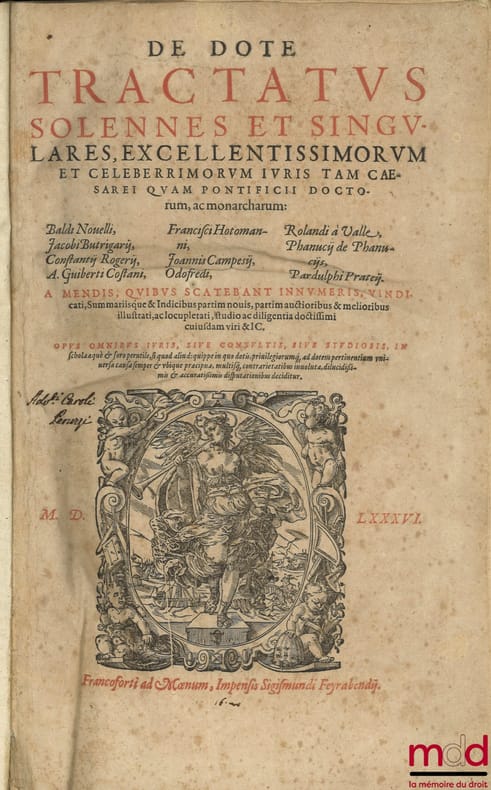
53033, Francoforti ad Mœnum [Franfort/ Main], Impensis Sigismundi Feyrabendii 1586, in-folio, demi-vélin beige, tit. manuscrit au dos, lettrines ornées, vignettes et bandeaux, imp. en double colonne, Ex-Libris collé sur le contreplat, (coupes et plats frottés avec qq. mq. de papier, qq. trous de vers non traversants au dos, coiffe inf. frottée avec mq. de cuir, papier acidifié, qq. piqûres, très rares et discrètes annotations à l’encre), int. frais et bien conservé malgré les défauts mentionnés, [5]-849p. + [Index].
Messing-Gedenkplakette zu Lindberghs Flug, ausgegeben von der US-Luftfahrthandelskammer. 89:64 mm. - Programm und Menüfolge für das Festbankett zu Ehren Lindberghs am 16. Juni 1927 im Waldorf-Astoria. 4 SS. Kordelgeheftete Büttenmappe. Folio. - Sitzplatzliste für das anschließende Galadiner. 16 SS. Bedr. OBr. - Tischkeks in rot-weiß-blauer Papierumhüllung und Etikett "À la Lindbergh". Beilagen. Interessante Sammlung von Erinnerungsstücken an das letzte New Yorker Festbankett und Diner zu Ehren des soeben nach Amerika zurückgekehrten Atlantikfliegers, der mit seiner kühnen Alleinüberquerung des Ozeans (20.-21. Mai 1927) über Nacht zum weltbekannten Helden geworden war und eine noch nie dagewesene Welle der Luftfahrtbegeisterung ausgelöst hatte. Am 11. Juni erreichte Lindbergh per Schiff wieder Washington, wo er im Mayflower Hotel von der National Aeronautic Association geehrt wurde, bevor er am 13. Juni in einen triumphalen Einzug in New York hielt und in einer Konfettiparade durch die Fifth Avenue zog. Am 14. ehrte ihn der Bürgermeister bei einem Prachtbankett im Hotel Commodore, am 15. gab es ein Festessen in "Wilfred's Restaurant" in der Wall Street. Am 16. schließlich, am Tag bevor Lindbergh in seine Heimatstadt St. Louis flog und damit seine große Amerikatour begann, nahm Lindbergh aus den Händen des Stifters den mit 25.000 Dollar dotierten "Orteig-Preis" entgegen, den der New Yorker Hotelier Raymond Orteig 1919 für den ersten Nonstopflug zwischen New York und Paris ausgesetzt hatte und der für Lindbergh (wie für andere, weniger Erfolgreiche vor ihm) die treibende Kraft für seine Unternehmung gewesen war. Doch Lindbergh versagte Orteig das Galadiner, auf das dieser jahrelang gehofft hatte: Nur kurz tauchte er zum Tee-Empfang im Hotel Brevoort auf, um das Preisgeld entgegenzunehmen und sich dann mit dem Hinweis auf eine "andere Verpflichtung" wieder von Orteig, Orville Wright und den zahlreichen anderen Würdenträgern zu verabschieden (vgl. Batterby, "On the Town in New York", S. 228). Diese "andere Verpflichtung", die Lindbergh kurioserweise dem Festmahl Orteigs vorzog, war das von der "Aeronautical Chamber of Commerce of America" veranstaltete "Banquet in Honor of Charles Lindbergh", welches diesen Abend im Waldorf-Astoria Hotel stattfand und von dem die hier vorliegenden Erinnerungsstücke stammen. Die Messing-Gedenkplakette zeigt ein Relief der "Spirit of St. Louis" und Legende "Per Aspera Ad Astra", revers die Legende: "Commemorating First Nonstop New York To Paris Flight By Capt. Charles A. Lindbergh May 20-21, 1927. Aeronautical Chamber of Commerce of America" (in maßgefertigter Samt-Präsentationsunterlage). Der Tischkeks wiederum, mit allen für Nahrungsmittel in ihrem neunten Jahrzehnt typischen Merkmalen fortgeschrittenen Verfalls (berieben und bestoßen, mit kl. Wurmspuren und Mottenfäden), ist von zeitgenössischer Hand auf der Papierumhüllung als Stück von ebendiesem Festessen bezeichnet. Von derselben Hand ist der im Sitzplan als "Mr. Shults" bezeichnete Name in "Schult" korrigiert - wohl zu identifizieren mit dem Sammler Gustav Schult, der die vier Memorabilien aus dem Waldorf mit nach Hause nahm und aufbewahrte. Auf eine schwedische Heimat des Diner-Gastes Schult weist die Beilage: eine Sammlung von schwedischsprachigen Zeitungsausschnitten aus den 1940er und 50er-Jahren über Lindberghs Pioniertat (zumeist erschienen zum 25-Jahr-Jubiläum der Überquerung) in einer Mappe mit Lindberghs Portrait. - Teils mit schwedischem Sammleretikett des Pehr Ehnemark.
Folio (375 x 320 mm). 8, 204 pp. With 200 full-page illustrations. Contemporary cloth with giltstamped title to spine and cover. First edition. Cf. Parr/Badger and Parr/Wassink Lundgren.
Folio (210 x 317 mm). (10), 76, (8) pp. Printed title within engraved historiated border, 10 double-page engraved plates and 2 folding plates. Contemporary vellum, lacking ties. Third French edition, first published in Italian 1612. - Basta enjoyed major success as commander of the cavalry under Alessandro Farnese, Duke of Parma; after the Duke's death he entered the service of Rudolf II. This was his most important treatise, in which he described how to free the cavalry from its historically close operational ties with the infantry so that it might be able to act as "la pupilla degli eserciti". - Provenance: bote of purchase by Hugo Montgomery in 1617 to title-page. Bookplate of Sir John Cope, Baronet, to front pastedown. Later in the collection of Thomas Fremantle, 3rd Baron Cottesloe (1862-1956), commander of the Territorial Army and president of the Society for Army History Research. A good copy. Spaulding/Karpinski 89. Cockle 724. De la Lance I, p. 84. USTC 6813390.
1553110491553 3 tomes reliés en un volume, reliure janséniste en vélin blanc parcheminé in-quarto (jansenist's binding full vellum in-4) (17,5 x 24,7 cm), reliure d'époque, titre manuscrit à l'encre brune sur le dos (handwritten title on the spine), plats muets (cover without text), dos long (spine without raised band), tranches lisses (edges smoothes), titre en rouge et noir, Texte en Latin, Impression rouge et noire sur 2 colonnes encadrée de gloses (Johannes Andreae). (Baudrier VII-338)., orné d'un superbe bois (engraving-wood) (full page engraving) en noir en frontispice face à la page 1 intitulé "Bonifacius Octavius" + deux planches hors-texte (full page engraving) gravée sur bois (engraving-wood) en noir insérée entre la page 330 et 331 intitulées : "Arbor Afinitatis" et "Arbor Consanguinitatis" pour le SEXTUS. Liber decretalium, une planche dépliante gravée sur bois (engraving-wood) hors-texte (full page engraving) en noir intitulée : "Arbor Feu Figura Declarativa Titul. De jure Patro" pour le CLÉMENT V. Constitutiones , pas d'hors-texte pour le JEAN XXII. Extravagantes, les trois tomes sont ornés de superbes lettrines (dropped initial) gravées sur bois (engraving-wood), [(36)-463 pp] + [(16)-191 pp] + [(14) pp, (1) f. bl., 262 pp.] pages, 1553 Lyon, Hugues de La Porte & Antoine Vincent Editeurs,
1771144411771 un volume, reliure plein veau brun raciné (reliure de l'époque) in-quarto (binding full calfskin in-quarto), dos à nerfs (spine with raised bands), décoration or (gilt decoration) à filets or (gilt lines) et à froid (blind-stamping decoration) - entre-nerfs à fleuron au fer plein (between the raised bands floweret with full blocking stamp) - compartiments à fleurons (compartment with floweret) - titre frappé or (gilt title) - pièce de titre sur fond bordeaux (label of title) avec filet or (label of title with gilt line) - légèrement manquante dans la partie supérieure mais trés léger (it misses a little of the label of title) - dos légèrement frotté avec léger manque de dorure (blurred gilding) , plats avec de légères épidermures (front cover with light scratches) - plats muets (cover without text), coins émoussés (corners blunt) écornés (corners dog-eared), filet sur les coupes (gilt line on the cuts) manque de dorure (blurred gilding), marque-page en tissu (bookmark in tissue), tête lisse (top edge smooth), toutes tranches lisses (all smooth edges) rouges (all red edges) avec une tache d'encre sur la tranche de tête, texte à manchette (marginal note), sans illustration (no illustration) excepté vignettes de titre aux armes royales (certaines légèrement hachurées à l'encre brune ou recouverte d'un lavis bleu-blanc-rouge "Révolution Oblige" (title page decorated with a vignette of title) gravées sur bois en noir + et orné de bandeaux - lettrines et de culs-de-lampe (illuminated of headpieces and dropped initials and of tailpieces) gravées sur bois en noir, Quelques rares trous de vers mais n'atteignant pas le texte, XIII, 344, 7, 11, 8, 27, 12, 14 pp. + 48 pages de table des matières pour ORDONNANCE DU ROI, CONCERNANT LA MARINE DU 25 MARS 1765 + Règlement concernant les Etats-Majors et Equipages dont les Vaisseaux et autres Bâtiments du Roi seront armés; ensemble les Appointements et Soldes et ceux qui doivent les composer (Brest Malassis 1768) 22 pages + Règlement contenant les Canons, les Armes et les Ustensiles et Munitions qui en dépendent, pour l'Armement de Vaisseaux et autre Bâtiments du Roi (-52 pages- Imprimerie Royale 25 mars 1765) + Règlements contenant les Aménagemens qui seront à l'Avenir pratiqués dans les Vaisseaux et autres Bâtiments du Roi; ensemble les Agrès, Ustensiles et Munitions pour leur Armement et Equipement en Tems de Guerre et en Tems de Paix, pour six mois de Campagne (Brest Malassis 1766 - 188 pages) + Ordonnance du roi concernant la Régie et Administration Générale et Particulière des Ports et Arsenaux de Marine du 27 septembre 1776 (Paris Imprimerie Royale 1776 - 160 pages) + Ordonnance du Roi pour régler les Fonctions dont les Officiers de la Marine seront chargés sur les Escadres et à Bord des Vaisseaux, relativement aux consommations et remplacements des Munitions et des Effets, et aux Revues des Equipages dans le cours des Campagnes du 27 septembre 1776 (Paris Imprimerie Royale 1776-23 pages-) (dont Ordonnance du Roi pour donner le Rang de Lieutenant-Colonel aux cinquante plus anciens Lieutenans de Vaisseaux du 10 mai 1777 - 2 pages- de l'imprimerie royale 1777- intercalée entre la page 10 et 11) + Ordonnance du Roi concernant les Officiers de Port du 27 septembre 1776 (4 pages- Paris Imprimerie Royale 1776) + Ordonnance du Roi portant réglement sur les Pavillons et Marques de Commandement que les Vaisseauxl porteront à la mer du 19 novembre 1776 (Paris Imprimerie Royale -12 pages) + Ordonnance du Roi pour la suppression du Corps des Officiers d'Administration et des Ecrivains de la Marine du 27 septembre 1776 (4 pages- Paris imprimerie Royale 1776) + Ordonnance du Roi portant établissement des Commissaires Généraux et Ordinaires des Ports et Arsenaux de Marine, et de Gardes-Magasins du 27 septembre 1776 (8 pages - Paris Imprimerie Royale 1776) + Ordonnance du Roi portant établissement de Commissaires et de Syndics des Classes du 27 septembre 1776 (4 pages- Paris Imprimerie Royale 1776) + Ordonnance du Roi portant établissement de Controleurs de la Marine du 27 septembre 1776 (4 pages- paris imprimerie royale 1776) , 1765- 1776 Paris Imprimerie Royale + Brest Malassis Editeur,
In Fiorenza, nella Stamperia di Zanobi Pignoni, 1643, volume unico, in-4, legatura settecentesca che riutilizza due pergamene più antiche (probabilmente smontate da rilegature di libri di formato inferiore), con dorso rinforzato in carta decorata antica e titolo calligrafato su tassello in carta, pp. 610, [2]. Frontespizio stampato in rosso e nero con stemma mediceo, 23 incisioni xilografiche nel testo (fra cui forme geometriche, la pianta di un passaggio segreto, mobili a doppio fondo, teschi e ossa umane) e una tavola allegorica in rame fuori testo (che quasi mai si trova) raffigurante un liuto senza una corda su cui si poggia una cicala e con motto latino "Ut suppleat" - simbologie per la stonatura delle perversioni del genere umano, sostenuta però dall'intelletto personificato dall'apollinea cicala -. Rara opera seicentesca sul diritto criminale scritta da Antonio Maria Cospi, giudice in varie sedi dello Stato toscano fra la fine del Cinquecento e l'inizio del Seicento, ed edita postuma dal nipote Ottaviano. Si tratta di un testo di pratica giudiziaria che tenta di organizzare i ricordi e le conoscenze professionali dell'autore. Si spazia infatti dalla trattazione scientifica alla spicciola quotidianità del criminalista, passando per la superstizione e l'aneddotica. Il Cospi si sofferma nella prima parte sulla deontologia del giudice, indicando la lussuria e quindi - in una visione fortemente antifemminile - la donna come "ianua diabuli". Nella seconda parte tratta gli ambiti della criminalità, soprattutto quelli fra reato e peccato, quali la magia, la divinazione, l'eresia, la stregoneria. Nella terza, oltre che su negromanzia, avvelenamenti, stupri, aborti, ladri, zingari e bari (alle carte o ai dadi), si sofferma a lungo sull'importanza della ricognizione del cadavere e del luogo del suo ritrovamento. Ci troviamo di fronte a un quasi manuale per "la scena del crimine", con tanto di descrizioni dettagliate e illustrazioni. L'autore sostiene proprio che il giudice necessiti di conoscenze scientifiche, anatomiche, chimiche e di disegno, oltre a quelle prettamente giuridiche e morali, per poter analizzare al meglio e mettere a verbale ogni caso in modo critico. Altro concetto innovativo e fondamentale è quello della testimonianza, intesa come interrogatorio al fine di trarre indizi dall'esame del reo e vista come unica via laddove la scienza non può arrivare. Dalle bibliografie a nostra disposizione (Piantanida/Diotallevi/Livraghi 1948, Michel 1970 e la rivista "Le Carte e la Storia" edita da Il Mulino 2002) questa del 1643 risulterebbe come prima edizione, anche se, probabilmente in tempi successivi, ne sarebbe stato censito un unico esemplare, alla Biblioteca Nazionale di Firenze, datato invece 1638. Più probabilmente però, secondo la nostra interpretazione, si tratterebbe di un errore tipografico sulla data di quest'ultimo esemplare: MDCXXXVIII (1638) invece di MDCXXXXIII (1643). La carta Oo presenta uno strappo con perdita di qualche carattere; minuto camminamento di tarlo alle 6 carte da Vv3 a Xx4, solamente marginale; alcuni fascicoli leggermente bruniti per la fattura della carta. Comunque un bell'esemplare.
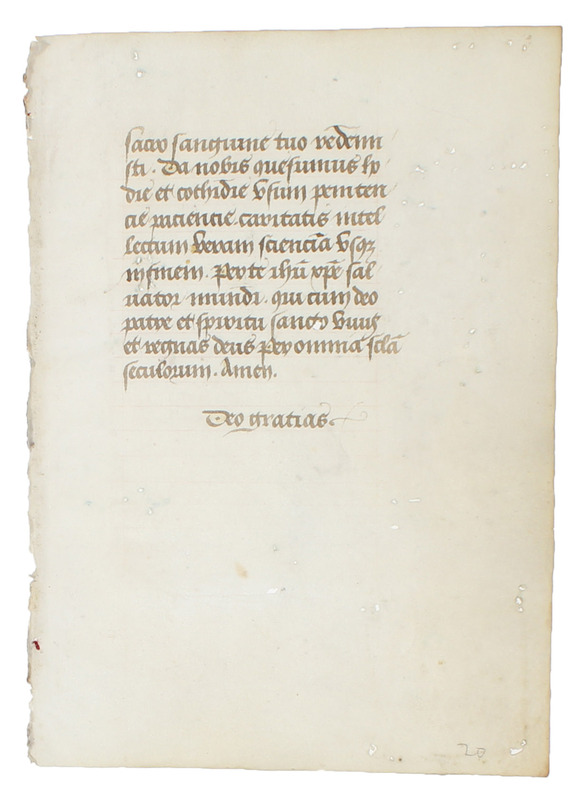
8vo. XVI, 248 pp. Publisher's original giltstamped red cloth with original dust jacket (spine a little stained, rear cover a littel sunnned with a short tear tp the upper edge). First edition of this classic study of the totalitarian state. - After years of professional and underground resistance to Hitler's regime, the German lawyer Ernst Fraenkel (1898-1975) escaped Nazi Germany to the UK in 1938, subsequently emigrating to America in 1939, where he studied American law at the University of Chicago. During this period he revised and completed his manuscript of the present work that he had brought with him from Germany, discussing the political structure of the Nazi regime. It was translated by the young Edward Albert Shils, later a highly distinguished professor of sociology at the University of Chicago. Following the book's publication, Fraenkel became one of the founding fathers of German political science. - In excellent state of preservation. From the library of the Prague-born law historian Guido Kisch (1889-1985 in Basel), an outstanding scholar in mediaeval Jewish history at the Hebrew Union College and in Basel, with a 1980s provenance slip inserted. OCLC 2062629.
8vo. 11 vols. With 6 engraved frontispieces, 3 engraved headpieces, 76 (mostly folding) engraved plates, and several engravings in the text. Contemporary calf. All edges red. First German edition. - Translation of the "Histoire de l'Académie Royale des Inscriptions de Belles Lettres", containing articles on archaeology, linguistics, history, numismatics, biographies of members of the Academy, etc., including on Mount Vesuvius; Piracy; ivory carvings; nicknames and mocking names; the first printed book, etc. - Bindings rubbed and bumped; spine-ends and hinges damaged, upper cover of vol. 6 is loose. Some engravings wrinkled or showing tears; others loose. Cf. Fromm 11749. Goedeke III, 362, 15. Kirchner 164.
4to. 3 pts. in 1 vol. (14), 650 pp. (6), 388 pp. 207, (5) pp. With 2 engr. title pages and 1 engr. frontispiece. Contemp. blindstamped pigskin over wooden boards on 4 raised double bands with 2 driven brass clasps. Ms. spine and shelfmark labels. Second complete German edition. Egidio Albertino's classic Baroque translation also contains de Guevara's popular mirror for magistrates, "Reloj de principes", containing many hints about child care, education, as well as gynecological and cosmetic advice (cf. Hayn/G. II, 704). - Fine roll-tooled binding shows the arms of the Roman Empire, Austria, Lower and Upper Austria (Haebler I, 329, 5) and platestamps of Justitia and Fortuna (I, 89, II & III). Haebler ascribes the tools to the Nuremberg bookbinder Hans Pfister (d. 1600) or the Wittenberg master Hans Dietz (d. 1582): thus, the present volume serves as a fine example for the continuing use of Renaissance stamps for many decades of the 17th century. - Browned and stained throughout; several thumb indices (the last one torn out). Binding rubbed, but altogether nicely preserved. VD 17, 23:000185K. Dünnhaupt, 236, 53.1. Goedeke II, 583, 42. Palau 110.076. Cf. Faber du Faur 901.
156010Paris, Simart, 1725 2 forts vol. in-4, titre-front. gravé, [10]-XXII-[2]-739 et [2]-642 pp., avec 31 pl. gravées, veau fauve raciné, dos lisse à caissons richement ornés, hachures dorées sur les coupes, tranches citron (rel. de la fin du XVIIIe ). Dos uniformément insolés.
8vo. 2 parts in one volume. (4), 476 pp.; 80 (instead of 160) pp. Contemporary half calf over marbled boards with giltstamped spine and spine title-label. First edition of the earliest English socialist journal in book form. Edited by the political activist and chartist leader G. J. Harney (1817-97), seeking "to present his own manifesto for radical political change" (Carter). In circulation for a mere 16 months, from June 1849 to September 1850, the magazine occupied a large group of unpaid writers on European affairs and the Italian question in particular, including Alexandre Ledru-Rollin, Giuseppe Mazzini, Friedrich Engels and Louis Blanc. The "Review" criticized domestic parliamentary decisions which impacted negatively on working-class interests, and repeatedly invoked the evils of the monarchical system. - Occasionally somewhat browned and brownstained. Hinges professionally repaired. Volume two lacking the separate title-page and preliminaries, as well as the issues of August and September 1850; pencil note about the incomplete volume 2 to first page. - Provenance: contemporary pencil ownership of Adam Smack, 13 Cornwall Street, to flyleaf. Presumably acquired from the Museum Book Store in London, with their label to pastedown. Latterly in the collection of Chimen Abramsky (1916-2010), London. Harrison/Thompson, Bibliography of the Chartist Movement 102. Carter, Britain, Ireland and the Italian Risorgimento 65ff.
4to (186 x 225 mm). 142, (10) pp. With 20 engraved plates (10 of them folding) and numerous engravings in text. Contemporary speckled boards, rebacked with modern giltstamped brown calf spine. The final volume of the second edition of the "Observations-Puncte", Khevenhüller's grand three-part collection of army service directions, hailed as the first drill-book in military history. This section on the cavalry first appeared separately in 1726, then again in 1734; it is here added to the "Observations-Puncte" for the first time. "The most interesting study of the cavalry produced in the age of Charles VI" (Jähns II, 1688). Khevenhüller's (1683-1744) military books long formed "the basis for all organizational and tactical institutions in the Imperial army (Khevenhüller was an Austrian field marshal) and also provide a vivid and accurate portrait of the military affairs of his time" (ADB). - Boards rubbed. Uncut and untrimmed copy, with the sometimes-lacking final leaf of publisher's ads and instructions for the bookbinder. Very rare. Provenance: from the collection of Thomas Fremantle, 3rd Baron Cottesloe (1862-1956), commander of the Territorial Army and president of the Society for Army History Research. Jähns II, 1589. De Ridder 251. Cf. Lipperheide Qe1. Hiler 494.