34 339 résultats
Very Good Turkish, Ottoman (1500-1928) Original manuscript paper. 40x28 cm. In Ottoman script. 2 p. Mehmed Emin Rauf Pasha was an Ottoman industrialist and statesman, who was Grand Vizier of the Ottoman Empire twice under Mahmud II (reign 1808-1839) and three times under Abdülmecit I (reign 1839-1861) during the Tanzimat period of reformation. He was one of the most prominent figures in funding the Crimean War. According to Shaw and Shaw, Mehmed Emin Rauf Pasha and his predecessor, Mustafa Resit Pasha, "acted mainly as mediators" for Mahmud II, "attempting to balance conflicting interests while participating in the factional activities and disputes endemic in Ottoman governmental life.". Buyuruldu (or Buyrultu, Buyurildi, Buyurdu etc.) is the order of an Ottoman grand vizier, vizier, beglerbegi , defterdâr , or other high officials to a subordinate. The term is derived from the word 'buyuruldi', it has been ordered, in which the order usually ends and which gradually developed into a conventional sign. Buyuruldus are of two main types: a) decisions written in the margin (der kenâr) of an incoming petition or report, often ordering that a fermân (firman) (or berât , etc.) be issued to a certain effect... (Brill, Encyclopedia of Islam). "Menzils" were early post organizations in the Ottoman Empire before the Reform period. In the Ottoman Empire, every 35 kilometers - the distance one could travel in a day - on the main roads, there were buildings called "menzil" or "menzilhane" (destination, post station). Surrounded by walls, these yards had a hostelry, barn, market, bath, and restaurant. Hosted at the complex for free, travelers shopped, took baths and fed their animals, and continued their journeys the following day. At the complex, officials - registered and paid by the state - served the guests. Within time, menzils turned into bazaars where locals sold their products. Then, villages and towns started to pop up around them. Commodities needed by the army for expeditions were preserved at menzils and soldiers were accommodated at these facilities if needed during expeditions. Mailmen operating between two faraway destinations changed their horses with those waiting at menzils and went on their route without losing time. (Source: Ekrem Bugra Ekinci). It's written on paper with 'ahar'. Used black ink only. It includes approx. 63 lines on front and verso of the paper and two buyuruldus. Different calligraphic "riq'a" styles by different bureaucrats and Grand Vizier and owner of a petition (Bende, Osman). Grand vizier's handwriting is in 'diwanî' script. An extremely rare autograph manuscript is a good example of the Ottoman state organization in the early 19th century.
Very Good Tatar Original wrappers. Demy 8vo. (21 x 14,5 cm). In Crimean Tatar in Arabic script. 25 p. Chipped on extremities, wear on spine, slightly stained and dusty covers. Overall a good copy. First and only edition of this first regulations consisting of 87 articles under 11 main headings, of the parliamentary (qurultai) of the Crimean People's Republic, which was the first Turkic and Muslim democratic republic in the world, existed from December 1917 to January 1918 in the Crimean Peninsula, a modern day Ukrainian territory currently occupied by the Russian Federation. The Crimean People's Republic was declared by the initiative of the Qurultai of Crimean Tatars, which stipulated the equality of all ethnicities within the peninsula. Noman Çelebicihan (1885-1918) was chosen as the first President of the nascent Republic. The Qurultai, in opposition to the Bolsheviks, published a "Crimean Tatar Basic Law", which convened an All-Crimean Constitutional Assembly, established a Board of Directors as a provisional government, and erected a Council of National Representatives as a provisional parliament. The Board of Directors and the Central Council of Ukraine both mutually recognized each other. This attempt to build a new nation was quickly defeated by the Bolshevik- and anarchist-dominated Black Sea Fleet. Already on 16 December 1917, the Bolsheviks captured Sevastopol where the headquarters of the Black Sea Fleet was located and dissolved the local council of deputies. The power in the city was transferred to the local revkom. The Bolsheviks were supported by some ships of the Black Sea Fleet. To defend itself, the Crimean government created a United Crimean Headquarters on 19 December 1917, that had at its disposal two cavalry and one infantry regiment of Crimean Tatars as well as some Ukrainian and Russian formations that amounted to some thousand people. Several armed incidents took place during January 1918. On 14 January 1918, the Bolsheviks captured Simferopol where they managed to arrest former President of Crimea (Head of Directorate) Noman Çelebicihan who had just resigned on 4 January 1918. He was transferred back to Sevastopol and interned until 23 February 1918, when he was executed without trial. The body of Çelebicihan was thrown into the sea. On the initiative of Çelebicihan on 10 January 1918, the Qurultai created a special commission that conducted talks with the Bolsheviks to stop the armed conflict in Crimea. On the initiative of Çelebicihan on 10 January 1918, the Qurultai created a special commission that conducted talks with the Bolsheviks to stop the armed conflict in Crimea. By the end of January 1918, the Bolsheviks had captured the whole of Crimea and dissolved both the Kurultai as well as the Council of National Representatives. The Red Terror engulfed the peninsula. With Çelebicihan in the Reds' custody, another leader of the Crimean Tatars, Cafer Seydamet Qirimer, managed to escape to the Caucasus across continental Ukraine. Many Crimean military formations retreated to the mountains. The government of Ukraine blockaded Crimea while trying to re-establish control over the Black Sea Fleet and the city of Sevastopol. Any Muslim supporting military formations on the way to Crimea was stopped. That, in turn, triggered a protest from the All-Russian Muslim military council. By the end of January 1918, the Ukrainian government itself was forced to declare war on the Russian SFSR due to the advancement of the Red Guard forces of Moscow and Petrograd into Ukraine without explicit notification. The Bolsheviks briefly established the Taurida Soviet Socialist Republic on Crimean territory in early 1918 before the area was overrun by forces of the Ukrainian People's Republic and the German Empire. Some officials of the national government, such as Seydamet Qirimer who managed to escape the Bolsheviks' terror sought political asylum in Kyiv and petitioned for military help from the advancing Ukrainian Army as w
Very Good Turkish, Ottoman (1500-1928) Contemporary quarter leather bdg. Rebacked boards. Foolscap 8vo. (18 x 12 cm). In Ottoman script (Old Turkish with Arabic letters). 220 p. Very rare early book of the concise biographies of 137 people who served as admirals in the Ottoman Empire between 1352 and 1853, written by Mehmed Izzet Pasha (d. 1853), son of Turkish admiral Abdullah Râmiz Pasha (d. 1813). Ceridehâne Printing House was founded for publishing Ceride-i Havâdîs [i.e. The Journal of News], which was the first semi-official newspaper in the Ottoman Empire. This journal was published from 1840 to 1877 and was founded by William Nosworthy Churchill (1796-1846), a British-born journalist who moved to Turkey aged 19. He was the cause of a diplomatic incident that resulted in the temporary severance of diplomatic relations between Britain and the Ottoman Empire. Babinger p. 323/2.; Özege 6951.; Library of Congress. Karl Süssheim Collection, no. 1336., OCLC: 11810438, 880485954.
Very Good Turkish Paperback. Small 4to. (26 x 18 cm). In Turkish. 5 volumes set (2392 p.). Extremely rare as set with fascicles. A well-known and useful bibliographic catalogue of printed books with Arabic letters from Muteferrika Printhouse (1789) to 1928-1936 (Listed in modern Turkish trascription). In all 25,554 works are described not counting re-editions, listed in alphabetical order of titles. Eski harflerle basilmis Türkçe eserler katalogu. [Özege catalogue]. 5 volumes set.
Very Good Turkish, Ottoman (1500-1928) Contemporary burgundy cloth. Cr. 8vo. (20 x 14 cm). In Ottoman script (Turkish with Arabic letters). 223 p., 224 p. (Two books bound together with 'Düsünce fikrinin gayr-i matbua' es'arindan'). Extremely rare first Turkish edition of Shakespeare's 'Antony and Cleopatra', translated by Abdullah Cevdet, (1869-1932). This is the last translation of Shakespeare into Turkish language made by Abdullah Cevdet. Cevdet translated and published five of Shakespeare's plays in his own printing house first in Cairo and then in Istanbul, beginning with Hamlet in 1908 and ending the series with Antony and Cleopatra in 1921. OCLC 66685311, 907298598. Library of Congress. Karl Süssheim Collection, no. 605.
Very Good Turkish, Ottoman (1500-1928) In modern, handsome full brown morocco. Foolscap 8vo. (18 x 12.5 cm). In Ottoman script (Old Turkish with Arabic letters). 159 p. Extremely rare first Turkish translation of Macbeth, printed in Ottoman Cairo. Macbeth reflected Abdullah Cevdet's reaction against Hamidian despotism and his love and advocacy of liberty. One must also remember him as one of the founding members of the Party of Union and Progress - a secret organization that conspired to overthrow Abdülhamid's absolutist regime. The argument that Abdullah Cevdet's translation of Hamlet, Julius Caesar and Macbeth reflected his opposition to Abdülhamid II's absolute monarchy could be justified with the fact that the themes of the translated plays were perceived by the political authorities as threatening since they were about the murder of kings and heads of state. In Abdullah Cevdet's view, Macbeth is famous as a drama of "ambition for status" (hirs-i cah). Abdullah Cevdet was an Ottoman-born Turkish intellectual and physician of Kurdish ethnic descent, and one of the founders of the Committee of Union and Progress (CUP). In 1908, he joined the Democratic Party that later on merged with the Freedom and Accord Party in 1911. He was also a translator, radical free-thinker, and ideologist of the Young Turks until 1908. The son of a physician, and himself a graduate from the Military College in Constantinople as an ophthalmologist, Cevdet, initially a pious Muslim, was influenced by Western materialistic philosophies and came to oppose institutionalized religion but thought that "although the Muslim God was of no use in the modern era, the Islamic society must preserve Islamic principles." He published the periodical Içtihat from 1904 to 1932, of which articles he used to promote his modernist thoughts. He was arrested and expelled from his country several times due to his political activities and lived in European cities including Vienna, Geneva and Paris. His poetry was linked with the Symbolist movement in France and he received accolades from leading French authors like Gustave Kahn. (Source: DR. ABDULLAH CEVDET'S TRANSLATIONS (1908-1910): THE MAKING OF A WESTERNIST AND MATERIALIST "CULTURE REPERTOIRE" IN A "RESISTANT" OTTOMAN CONTEXT; Ayluçtarhan, Sevda). "Between 1908 and 1910, Abdullah Cevdet produced a large oeuvre of translations, including four translations of Shakespeare's tragedies: The translations of Hamlet and Julius Caesar (translated by Cevdet as Jül Sezar) were published in 1908, the same year as the declaration of the Second Constitution. Macbeth, translated by Cevdet as Makbes, was published in the following year. [.] Nonetheless, Abdülhamid II seemed to be even less tolerant of the dissemination of Hamlet, Macbeth, and Julius Caesar, since they were all about unjust rulers who were executed in the end. It is not surprising that the performances of these plays became subject to strict censorship in the Ottoman lands and banned (Paker 1986: 91). This could be shown as a reason why Abdullah Cevdet was able to publish the translations of these plays only after 1908, though he had finished translating Hamlet in 1902, Julius Caesar and Macbeth in 1904, and Romeo and Juliet in 1905 (Süssheim 1987). As Abdullah Cevdet was a planner of culture, his literary translations cannot merely be judged on an "aesthetic" level. It will be discussed in this chapter that Abdullah Cevdet's translations of Hamlet, Julius Caesar and Macbeth could be read as critical texts directed against Abdülhamid II's absolutist regime. [.] Due to the fact that the selection of source language and culture is an important factor in accounting for any kind of "translation policy", Abdullah Cevdet's selection of both these instruments needs to be taken into account (Toury 2000: 202). Özege 12009. Only one copy in OCLC: 949612474 (Bogaziçi University Library of Turkey).
Very Good Turkish, Ottoman (1500-1928) Full morocco in Ottoman style. Foolscap 8vo. (18,5 x 12 cm). In Ottoman script (Old Turkish with Arabic letters). 176 p. Extremely rare first Turkish translation of the Merchant of Venice by Shakespeare in book form. The Merchant of Venice (1885) and The Comedy of Errors (1886-87) were the earliest translations into Turkish by Hasan Sirri, which had the chance to be published in book form. Translators in the Ottoman era had to cope with three obstacles: cultural differences, difficulty in language, and censorship. Shakespeare's works were no exception, as Gönül Bakay argues "the early, Ottoman-period translators and producers expunged the negative imagery" (2004: np) of the Turks in his plays. Even The Merchant of Venice was banned because "it was believed that the theme would offend the Empire's (after 1923, the Republic's) Jewish population". The first play fully translated for print was actually the Merchant of Venice, published in 1885 in Turkish (Arabic letters - Ottoman script). There is a good deal of conjecture about the name of the translator: Only two initials appear on the book, H. and I. now claimed to be the first letter of the first name and the last letter of the last name of a Hasan Sirri. The translator of this book Örikagasizâde Hasan Sirri, (1861-1939), was an administrator and educator who grew up during the reign of Abdulhamid II and was in state service for almost forty years. He was the son of Turkish diwan poet Ahmet Nafiz Pasha and the father of author Nahid Sirri Örik. Özege 22638.; Only three copies in OCLC: 929866546 (NY Uni Lib.; Bogaziçi Uni Lib.; and Library of Congress. Karl Su?ssheim Collection, no. 1527).
1868007605Boston: Ticknor & Fields 1868. The First Ticknor & Fields edition in the publisher's original dark brown pebbled cloth with gilt lettering and decorations on the spine both covers decorated in blind stamped wreaths and rules dark brown end pages 415 pp. Contemporary small bookplate front paste down dated 1871 of F. M. Thayer Evansville Indiana for many years editor of the Journal of that city and Postmaster. Near Fine bottom corner last 2 pages creased that corner bumped 1/4" dark mark rear cover overall a lovely tight copy that feels unread. Thoreau's first book a classic of American writing. . Second Issue . Cloth. Near Fine/No Jacket As Issued. 8vo - over 7¾" - 9¾" tall. Ticknor & Fields Hardcover books
1948ZB3943951948-1976. volumes 1-29. 1948-1976. partly bound library markings textually clean & tight PRICE IS FOR THE LOT. - If you are reading this this item is actually physically in our stock and ready for shipment once ordered. We are not bookjackers. Buyer is responsible for any additional duties taxes or fees required by recipient's country. Photos available upon request. unknown
Very Good Turkish, Ottoman (1500-1928) Paperback. Demy 8vo. (21 x 15 cm). In Ottoman script. 21 p. This tractate has no date, printing house, and not in any catalogues and libraries. Cover has a long title contains the name of the book and a notification on further two books will be published titled 'Abidin Pasha in Ankara' and 'Abidin Pasha in Adana'. Book started with an introduction by Vakkas Ali El-Buvâkî. Any biographical information could not be found about El-Buvâkî. Tractate includes thoughts of Abidin Pasha about the last Ottoman Imperial problems, degeneration in Turkish bureaucracy, international Balkan question, etc. Abidin Pasha was an Albanian patriot, politician, ideologue and diplomat; and the governor of Rhodes, Aden, Algeria, Ankara, and Adana. As a rilindas involved in the Albanian National Awakening, he was one of the founders of the League of Prizren and its chief representative for Epirus (1878). Dino was one of the main promoters in the need for the creation of the Autonomous Albanian Vilayet under the Ottoman suzerainty, and later a contributor in the Albanian independence. Abedin Dino was from Chameria and he was born in Preveza on March 23, 1843, to one of the most notable and noble families of the city (the Dino family). During the Great Eastern Crisis Dino was one of ten signatories to a memorandum addressed to Berlin Congress hosts chancellor Bismarck and Count Andrassy on 20 June 1878 calling for reforms and Albanians to remain in the Ottoman state with their rights, desires, interests, and traditions being respected. Dino strongly supported the territorial integrity of Albanian inhabited lands remaining within the Ottoman state. Together with Abdul Frashëri, Vesel Dino, and Mehmet Ali Vrioni he established local League branches of the Albanian Committee of Janina and Assembly of Preveza. On 11 January 1879, a meeting in Preveza of Albanian notables and leaders at Dino's house agreed to oppose Epirus joining Greece, even though military force if an unsatisfactory agreement was imposed by the Great Powers and to express that view to the Berlin Congress. The free movement of Dino in Preveza and his appointment as a commissioner for delineating the border was representative of the support the Ottoman Empire gave to the League during this time. From 10 June - 12 September 1880 Dino briefly served as the Minister of Foreign Affairs of the Ottoman Empire for four months and was elevated to the rank of Pasha, becoming known as Abedin Pasha. Abdul Hamid II appointed Dino as he wanted to strengthen the Ottoman position during negotiations about the border with Greece. [.] In part due to his efforts and activities, the Vilayet of Janina did not join Greece and remained within the Ottoman Empire until 1912. He became a wâli (governor) of Aden and from 1904 Vizier (minister) in the Ottoman government headed by fellow Albanian Avlonyali Mehmed Ferid Pasha. Abedin Bej Dino was also an evaluated poet, publisher, writer, and translator. He wrote many songs, including the famous one "Këngë për Shqipërin" (alb. "Song for Albania", in 1879), "Të nxiturit e Shqipërisë duke përpjeturë" (1880), "Poema e Shenjtë" (Poema of Saint, 1884), "Poetry" (1888). He translated on Albanian language poems of a 13th-century Persian poet, and Sufi mystic Rumi. His son, Rasih Abidinpasazâde Dino (who has a book titled 'Üç Mektup') was a co-founder of the first Albanian school in the city of Preveza and in 1913 he was the head of the delegation of Albania that signed the Treaty of London that recognized Albania an independent state. Abidin Pasha is the grandfather of famous Turkish painter Abidin Dino, (1913-1993). Not in Özege.; Not in OCLC.

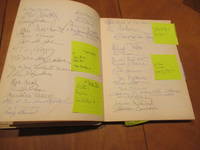
1955059850Hollywood; Kentucky; Scotland Etc.: Schmidt 1955. First Edition . Hardcover. Good. Finely Tooled Leather Autograph Album Made In Austria For High-End Dept. Store J. W. Robinson Los Angeles And Begun Circa 1930 By The Schmidt Family On Highland Avenue Los Angeles.Chipping To Corners And Front Spine Edge Repairable. Many Pages Of Autographs In U.S. And Scotland Including About 116 From Hollywood Personalities: Tony Duquette Gene Barry Red Buttons Vincente Minnelli Ray Stark Ryan O'neal William Hollingsworth Cyd Charisse Tony Martin James Mitchum Gene Kelly Barry Sullivan William Frye Samuel Goldwyn Jr. Sidney Howard Stan Kamen Hugh O'brien Polly And Edgar Bergen Agnes Moorehead Ivan Rollefson Hermione Baddeley Murray Korda Greer Garson Edward G. Robinson William Wyler George Cukor Samuel Goldwyn Jr. Sidney Howard Gene Kelly Delbert Mann Etc. Clearly From 1930'S - 1940'S More Autographs Some Indecipherable But Large Selection All Hollywood Names. Scarce Signatures Of Some Of The Early Directors And Producers. <br/> <br/> Schmidt hardcover
Good Turkish, Ottoman (1500-1928) Original full leather bdg. in traditional Ottoman style. Repaired skillfully. 4to. (29 x 18 cm). In Ottoman script. 2 volumes set in one: ([15], 327 p.; [6], 315 p.). Vasif tarihi. Mahasin ül-âsâr ve hakayik ül-ahbâr. 2 volumes set. Özege 22519. Extremely rare. First Edition. In the late eighteenth century the Ottoman Empire experienced a time of profound crisis, political as well as intellectual, moral, and ideological. This dissertation explores the mental and moral climate of the period through the work of Ahmed Vasif Efendi, a statesman, ambassador, intellectual, and author of one of the century's largest histories, and also through his personal development as a reformer. Divided into five chapters, each treating a distinct aspect of Vasif's thought, this dissertation argues that Ottoman elites after 1774 responded to growing foreign and domestic challenges with not only military reform but a broad re-evaluation of subjects like war, peacemaking, moral rule, and human agency in history. It suggests these debates, including a basic disagreement over the legitimate place of human reason and action across life's many spheres, indicate a vital if fractured response to the crisis, and an incipient breakdown in certain storied intellectual frameworks.
New New English Original bdg. Dust wrapper. 4to. (30 x 21,5 cm). In English and Turkish. 9 volumes complete set: (240 p.; [10], [iv], 440-767 pp.; [10], [vii], 769-1111 pp.; 360 p.; 420 p.; 420 p.; 420 p.; 420 p.; 440 p.). Color ills. History of Ottoman coins.= Osmanli sikkeleri tarihi. 9 volumes full set.
Very Good Turkish, Ottoman (1500-1928) Paperback. Foolscap 8vo. (18 x 12 cm). In Ottoman script. 38 p., 1 b/w portrait of Byron. A heavy tear on the back cover. The Prisoner of Chillon is a 392-line narrative poem by Lord Byron. Written in 1816, it chronicles the imprisonment of a Genevois monk, François Bonivard, from 1532 to 1536. After almost 100 years later, this poem was translated into the Ottoman Turkish by Abdullah Cevdet firstly printed in Geneva. Abdullah Cevdet, (1869-1932), was a leading Ottoman/Turkish free-thinker, materialist, and Westernizer. He was born in the town of Arapgir in Ma?muret?ül-Azîz Province of the Ottoman Empire and grew up in a pious, lower-middle-class Muslim household, where he received a strict religious education. His father's stubborn refusal of smallpox vaccination left him pockmarked for life and contributed to his eventual gravitation towards scientism. Abdullah Cevdet graduated from the Military Middle School in Ma'muret'ül-Azîz in 1885, and then entered the Kuleli Military Medical Preparatory School in Istanbul. Three years later, he enrolled in the Royal Military Medical Academy. At this time, he was still very religious; one of his early poetry books from this period includes a glowing "Na't-i Serif," a eulogy for the Prophet Mu?ammad. However, like many other cadets, Abdullah Cevdet's views underwent a drastic transformation in the academy, where he became an ardent scientistic thinker and materialist. Here he produced his first translations from major works of German Vulgärmaterialismus, such as Ludwig Büchner's Kraft und Stoff and Aus Natur und Wissenschaft. He continued to translate from European writers up until his death, including Vittorio Alfieri, Émile Boutmy, Lord (or George Gordon) Byron, Jean-Marie Guyau, Baron (or Paul-Henri Dietrich) d'Holbach, Friedrich von Schiller, William Shakespeare, and François-Marie Arouet (Voltaire). One of his most important contributions to Ottoman and Turkish intellectual debate was the translation of Gustave Le Bon's writings into Turkish and the introduction of his elitist ideas to the Ottoman elite. Abdullah Cevdet also continued to write poetry throughout his life. Although the poems he wrote in the academy bore strong Parnassian influences, his later work was increasingly Symbolist in nature. He also translated the Persian poetry of Khayyâm into Turkish. (Source: Oxford Islamic Studies Online; Cevdet, Abdullah). Özege 18963.; TBTK 7035. OCLC 754957413 (Not found an institutional copy in OCLC). First Edition. Extremely rare.
77<p><strong>Book Description</strong>: Alfred A. Knopf New York 2004. Cloth. Stated First Edition/First Printing. <strong>Book Condition</strong>: As New. Binding is tight and square. <strong>Dust Jacket Condition</strong>: As New. Not price clipped. SIGNED by author and former U.S. President "Bill Clinton" directly on the title page in blue ink. First state with typo "failure of my life" in last sentence of Acknowledgement section. 957 pages. A beautiful and extremely collectible copy.</p><p>Please feel free to email with questions. Book will be carefully wrapped and shipped in a box.</p> Alfred A. Knopf hardcover
71-0302The New Jersey State Museum Cultural Center 1967. 4to. Unpaginated. Soft Cover. Very Good. Heavy smudging on Front Cover some markings on Spine. Featured works include Mark Rothko Wassily Kadinsky and Edward Hopper. Mostly Color Plates. Provenance: From the estate of Gerald Nordland 1927-2019. Nordland was a museum director art critic educator and author.Dean of the Chouinard Art Institute 1960-64 Director of the San Francisco Museum of Art now SFMoMA 1966-73 Milwaukee Art Museum 1977-85 and the UCLA Wight Art Gallery 1973-1977. He is the author of over 60 publications including books on Lachaise Nakian Diebenkorn and Frank Lloyd Wright. The New Jersey State Museum Cultural Center, 1967 paperback
SONG1889834734NASCLA 0000-00-00. Tennessee Edition. spiral_bound. Used: Good. 0.00x0.00x0.00. Buy with confidence. Excellent Customer Service & Return policy. NASCLA unknown
New New English Original bdg. Dust wrapper. Oblong 4to. (30 x 34 cm). In English, Turkish, and Arabic. [12], 223, [1] p., color and b/w photos. Jerusalem in photographs from past to present.= Fotograflarla dünden bugüne Kudüs. Photographs (old); IRCICA archives. Photographs (new); Khaled Zaghari. Project managers; Halit Eren, Sefer Turan. This album was published within the framework of the 40th anniversary commemoration of the OIC, which has the problem of al-Quds and Palestine as its foremost cause. Prof. Ekmeleddin Ihsanoglu, Secretary General of the OIC, wrote the Foreword. As he mentions, preservation of the multicultural character of the city with due respect of the populations and the shrines of each faith is an indispensable part of any acceptable solution of the problem. This character is well reflected in the authentic photographs in the album. Due to its special importance, al-Quds/Jerusalem was visited and described by many travelers. Then, the region became the first place of interest of the pioneer photographers. The Ottoman Palace was among the first in the world to acquire photographs of the region. The Yildiz photograph collection which was formed during the reign of Sultan Abdülhamid II contains a large number of them. The album contains the reproductions of 405 photographs gathered from IRCICA's archive comprising the Yildiz Photograph Albums and several other collections. A very heavy volume. Extra shipping fee will be able to request.
18272031650Vandalia Illinois: Robert Blackwell 1827. Hardcover. Used-Very Good. Original three quarter calf over paper-covered boards. iv 1-406 pp. Some edgewear to binding but quite sturdy. Foxing to most leaves but quite legible throughout. 2000 copies were prinnted. Byrd 75. Buck 1225. Robert Blackwell hardcover
18292031676Shawnee Illinois: A.F. Grant & Co 1829. Hardcover. Used-Very Good. 5-276 pp. Printed by Lodge L'Hommedieu & Hammond in Cincinnati.Contemporary three quarter calf over paper-covered boards. Front board detached but present. Moderate foxing to some leaves but very readable throughout. Not recorded in Byrd being printed in Cincinnati it does not meet his strict crtiteria. A.F. Grant & Co hardcover
186533225New York: Kimmel & Forster 1865. Lithograph. Approximately 21" X 26. Very good. Lightly evenly age toned; blank margins either trimmed or edgeworn for the cream mat goes to the image edge at the top and sides while the bottom includes the full title line mat opening 23" X 18¼". First edition. Magnificent allegorical lithograph issued by the famed New York print publisher who also produced a companion piece entitled "The End of the Rebellion in the United States 1865." A large figure of Columbia stands at center atop a huge splitting rock looking to the viewer's right and clutching a waving flag in her right hand; meanwhile her other hand wags a pointing finger toward the viewer's left side. At her feet lie a whip and open shackles representing the abolition of slavery. To the viewer's right stands Abraham Lincoln and indeed the entire right side represents the Republican cause. A stern General Winfield Scott stand behind Lincoln and a crowd of young men strain forward some offering up bags of gold some bearing arms all willing to join the cause; a woman in the foreground covers her eyes and is comforted by two children. The background on this side is horizon of mountains and a glorious sunrise. On Columbia's other side stands the figure of Justice without her usual blindfold raising up her scales in one hand and sword in the other glaring angrily toward all those at the left side of this hectic scene. James Buchanan's sleeps blissfully at the edge of the split rock while next to him crouches his secretary of war John B. Floyd -- who was charged with corruption -- eagerly scooping up gold coins into a large sack. Further back Jefferson Davis clutching a ripped U.S. flag and Alexander H. Stephens stand beside a palm tree with a huge snake coiling up its length and spitting at the scales of justice. An angry cluster of soldiers swirls around them. The background on this side is grim and muted with battle scenes. A superb handsome example of this famous Civil War allegorical print. Kimmel & Forster unknown
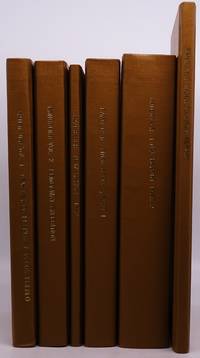
010176Cambridge/ Boston/ Albuquerque: Printed by John Wilson and Son / Published by A.Williams and Co. Book. Fine. Buckram. First Printings. 8vo - over 7¾" - 9¾" tall. Six volumes handsomely bound in recent tan buckram with the original front wrappers attached at front paste downs of each volume. A Fine and lovely set of original publications of Bandelier's works with the blindstamps of author Jonathan E. Reyman and occasional scholarly marginal notations in pencil. Included are: Papers of the Archaeological Institute of America American Series III and IV. Parts 1 and 2. Final Report of Investigations Among the Indians of the Southwestern United States Carried on Mainly in the Years 1880-1885; American Series I. 1.Historical Introduction to Studies Among the Sedentary Indians of New Mexico. 2. Report on the Ruins of the Pueblo of Pecos .American Series V. Hemenway Southwestern Archaeological Expedition. Contributions to the History of the Southwestern Portion of the United States. "Report by A. F. Bandelier of His Investigation in New Mexico in the Spring and Summer of 1882" contained in Bulletin of the Archaeological Institute of America I. January 1883. and Index to Final Report of Investigations Among the Indians of the Southwestern United States The Historical Society of New Mexico June 1942 4to- 9 3/4" to 12 3/4". Printed by John Wilson and Son / Published by A.Williams and Co. Hardcover
47928Oblong 4to. 1 page seal intact; docketed on verso. Burke and Huger each had prominent associations with the South Carolina branch of the Society of Cincinnati Huger serving as first vice-president and Burke publishing a widely circulated pamphlet warning that the organization would widen the division between "the patricians and the rabble." Folded; some browning but very good. <br/><br/> unknown books
1845230646Washington DC: Gales and Seaton 1845. First edition. Hardcover. Very Good. 8vo 693 pages publisher's black embossed cloth gilt title on spine; light water stain to top and bottom margins pp.1-16; .small ash burn hole leaf 225/226 other ash marks marginal chip at bottom p. 237 lower right corners stained pp. 41 to rear rear joint spltting a bit at both ends edgeworn corners bumped. Provenance: ex libris David Bixler; Lewis C. Groves California Historical Society with "Sold" sticker from 1944 ; and Bernhard Franz bookseller & stationer Virginia City Nevada Territory with his sticker at rear endpaper. The large Preuss Map of 36 panels has multiple breaks at folds a several old cellphane tape repairs not discolored. <br/><br/> Cohen MAPPING THE WEST pp. 130-133; Howes F370; Streeter 3131; Wagner-Camp IV: 115:1; Graff 1436; Field 565; Sabin 25845. Soliday I:861. Rosenbach 32:146. Wheat 497 & 3266; Cowan pp. 223-4; Zamorano 80 #39; Reese Best of the West 86; . Important Report by the amazing John C. Fremont also known as "The Pathfinder". This copy has the 22 plates and five maps including the two folding text maps AND the important famed large map by Charles Preuss laid in at the rear pocket: " It fills up the vast geographical chasm" between Missouir and the Columbia River. It is "monumental in its breadth - a classic of exploring literature." - Goetzmann EXPLORATION AND EMPIRE page 248. Gales and Seaton hardcover
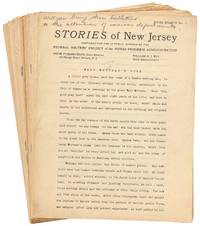
1936603498Newark New Jersey: Federal Writers' Project of the Works Progress Administration 1936. Unbound. Very Good. A collection of 50 issues. Small quartos. Most are one folio sheet folded to make four pages but issues are also one six or eight pages. Occasionally illustrated. A well-preserved very good set with occasional wear soil paperclip rustmarks or penciled notes and two with High School library stamps. The first four issues of the 1937-1938 series were printed on much cheaper paper and are therefore toned with more chipping but still sound. The Bulletin Numbers by Series are as follows: 1936-1937 Series: Nos. 1 4-6 8-9 11-13 15-16 21-29; 1937-1938 Series: Nos. 2-16 18-19; 1938-1939 Series: Nos. 1-6 8 12; 1939-1940 Series: Nos. 7-8; and 1940-1941 Series: Nos. 1-2 and 5. Also included but not counted is a Glossary to "Indian Place Names in New Jersey" 1938-1939 Series Bulletin 12. <br /> <br /> An excellent collection of these brief but informative WPA-published lessons on the history industry geography landmarks and agriculture of New Jersey as well as biographies Walt Whitman Clara Barton John Fitch and more. Apparently published between 1936 and 1942 they were issued as both bulletins as here and in six bound volumes. Individual issues are uncommon even more so a large and well-preserved collection. Federal Writers' Project of the Works Progress Administration unknown