Biblio.com

34 339 résultats
1950029765San Jose: Western Cover Society / American Philatelic Society 1950 1951 1952 Etc. 1950. 1st Edition . Soft cover. Fine. Photographs Reproductions Etc. Throughout. 256 Issues Of This Multi-Award Winning Philatelic And Western History Journal From Pre-Publication Flyer 1950 Through Volume 64 #3 2014 With All Indices And The Special New Mexico Territorial Post Offices Supplement Of 1958 Lacking Only Three Issues: Vol 22 #1 Volume 39 #2 Volume 56 # 1. All Fine. Early Issues Looseleaf Or Staplebound All In Binders Later Issues In Spine-Stapled Heavier Or Glossy Wrappers Each Issue Loose All Unmarked And Unworn. A Fine Archive Of Western History With Information On Places And Individuals And Illustrations Of Letters Documents Etc. Not Found In Other Sources. Note That A Few Issues Are Mis-Marked With Earlier Volume/Number Or Whole Number Enumerations Errors Only The Printed Date/Year Is Determinative For This Journal. Also Included Are Many Binders Of Clippings Relating To Technical Postal Information Circa 1940'S-1980'S. Three Tightly Packed File Boxes Probably 5 Boxes Shipping Postage At Actual Cost Probably About $150 By Insured Media Mail. About 5000 Pages At A Price Much Less Than That Of Locating And Photocopying These Issues And In Fine Condition Without Library Marks Etc. <br/> <br/> Western Cover Society / American Philatelic Society 1950 1951 1952 Etc. paperback
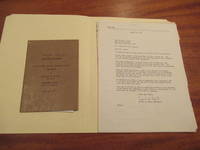
1952060215Pasadena / Los Angeles: Roland E Coate 1952. 1st Edition . Soft cover. Near Fine. Coate's Printed Specifications For His Own Residence In Pasadena Circa 1952/1953. This Residence 1685 La Vista Place Pasadena With Guest Room And Bath Across The Courtyard Was Built On A 36150 Sq Ft Lot. Printed "Copy No." On Front Cover Followed By Handwritten "1"; Handwritten "Revised 10/20/.1952 At Top. Descriptive 14 Pages Not The Plans. Extensive Pencil Revisions Throughout. With A Hand Drawn Illustration Laid In Loosely A "Recess" About 24" X 36" With A Brass Fish Box Filled With Plants. <br/> <br/> Roland E Coate paperback
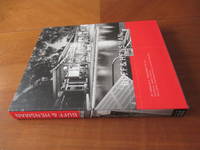
2004045964Los Angeles: Architectural Guild Press / University Of Southern California 2004. 1st Edition 1st Printing. Hardcover. Fine/Fine. 256 Pp. Grey Cloth Stamped In White. First Printing 2004. Fine In Fine Dust Jacket. Small Personal Inscription At Fore Edge Of Front Pastedown Under The Front Flap. <br/> <br/> Architectural Guild Press / University Of Southern California hardcover
1928P64651928. Leningrad: Izdanie Gosudarstvennogo Russkogo Muzeia 1928. Octavo 17.5 Ã 13.2 cm. Original decorative wrappers with a constructivist design by M. S. Brodsky; 72 pp. and 14 illustrations in the text some full-page. Very light soil to wrappers; overall a very good copy. First and only edition of this work about the hotly debated topic of "workers' art" and workers' IZO clubs comprised of amateur artists IZO being an abbreviation for Izobrazitel'noe iskusstvo or "Visual Art". The authors set out the history and basic principles of the "workers' art" movement and its connections to avant-garde art. The formation of such amateur groups was part of the push to democratize the Soviet visual arts in the service of mass propaganda and education throughout the 1920s. Under the direction of the artist Moisei Brodsky the disparate IZO clubs were unified under a more coherent program and proceeded to develop new forms for decorative and applied arts agitprop posters and design of new communist interiors "bringing art into life" and "making artists out of workers" two central conceits of the avant-garde. In an introductory essay the art historian Nikolai Punin argues for the regenerative quality of art made by workers with amateur training rather than by trained artists. The artist Vsevolod Voinov follows with a review of the 1925 exhibit of the IZO clubs at the Russian Museum where the works of the amateur artists were exhibited alongside those of the masters. Sergei Isakov traces the history of the movement to 1923 when the creation of such clubs was first proposed. In a longer essay Moisei Brodsky 1896-1944 the leader of the movement and the designer of the constructivist cover -- apparently inspired by Malevich's "Black square" -- discusses the search for "new realism" inherent in workers' art.<br/>Â <br/>The text is supplemented with photographs of the artworks exhibited at the "Iskusstvo rabochkh" Worker's art show at the Russian Museum in 1925 for which 67 IZO clubs listed by name at the end of the text provided over 1000 works. The various posters and design elements for communal cafeterias and worker's clubs are unattributed and the originals of most seem to have been lost making these photographs a rare surviving record of the contents of the show. These designs in their fragmentation of objects collaged quality and use of shadow to create volume show an unmistakable influence of Purism a movement in French painting championed by Le Corbusier among others which advocated for simplicity and precision of forms and a union of the avant-garde art with industry and technology. IZORAM an abbreviation for Izobrazitelnoe iskusstvo rabochei molodezhi or the "Visual Art of the working youth" a more focused group of worker artists was formed by Brodsky in 1928 with another exhibit of workers' art held at the Russian Museum Leningrad and later Tretiakov Gallery Moscow in 1928. The IZORAM exhibit at the Tretiakov Gallery was held at the same time and sold as part of the same ticket as a Malevich exhibit putting the abstract and "functional" avant-garde into conversation. In 1931 IZORAM was dissolved and incorporated into the newly-founded Russian Association of Proletarian Artists RAPKh. See "Avangard na sluzhbe dialektiki: Gennadi Gor Avangard i Purizm" Stanislav Savitsky 2013. One of 3000 copies. KVK OCLC show copies at the British Library Columbia Israel National Library Getty Harvard the MET NYPL Stanford and Tate. unknown books
Very Good Turkish, Ottoman (1500-1928) In contemporary black cloth. Roy. 8vo. (24 x 17 cm). In Ottoman script (Old Turkish with Arabic letters). Occasionally minor stains and fading on pages. Otherwise a good copy. 384 p. It is a rare book written after the Constitutional Monarchy at the request of the Unionists to make propaganda about Kurds. It is one of the early detached texts about Kurds written in the Ottoman period. Upon the request of the Ittihad ve Terakki [i.e. Union and Progress] leaders, he began to work in 1912 for the newly established National Security Organization (Teskilât-i Mahsusa). He then continued his intelligence work with the IAMM and AMMU, in the name of which he did his fieldwork on the Anatolian Kurds and Turcoman (Turkmen) tribes. Habil Adem's (his pseudonym means in English 'Abel Adam') writing reflect -even more openly than those of his colleague Baha Said- the unionist ambition to collect the data considered necessary for its politics of social and demographic engineering, such as information on basic demographic realities, as well as social and cultural aspects. The obvious aim of this publication was to create public knowledge favorable to the nationalization project. His book on the Kurds, printed in 1918, immediately after WW 1, under the pseudonym of a fictitious German orientalist (Dr. Friç), allegedly only translated by Habil Adem, elaborated on a thesis that would gain leverage in the early Turkish Republic and become very prominent in the 1930s, namely that the Kurds were actually Turks and the Kurdish as an independent language did not exist. In the book's section on the religion of the Kurds, he makes two distinctions such as Muslim and non-Muslim Kurds and Sunni and Shiite Muslim Kurds. (Source: Writing Religion: The Making of Turkish Alevi Islam; Dressler, Marcus). Pelister worked in the translation office of the General Directorate of Security since 1908 and in the Turkmen Branch of the General Directorate of Tribes and Immigrants from 1913, and he personally assigned him to Talat Pasha, (1874-1921). He was very good at speaking English, German, and French languages, thus, he was involved in researches related to the Kurdish and Turkmen tribes with some delegations in Ottoman Turkey in Asia. The German original of this book never existed, neither did Dr. Fritsch from the Berlin Academy of Science. Years later, Celadet Bedirxan, a Kurdish intellectual, explained the mistakes that Naci Ismail made intentionally or unknowingly on the Kurdish culture, population, history, folklore, and language, with the letters he wrote to Mustafa Kemal and drew Mustafa Kemal's attention. This book was written probably by a commission with corrigenda and footnotes by Pelister. The book generally focuses on the historical geography of the Kurds. There is an effort to Turkify in the part that talks about the origins of the Kurds. In the introduction, detailed information about Iranian and Iraqi Kurds is given and Sharafnâma is criticized. Although detailed information is available on many Kurdish tribes (Leks, Sividis, Arukhs, etc) in Anatolia and Mesopotamia, most of these are dubious. Only three institutional copies in OCLC: 977638243 (University of Toronto Robarts Library), 949451620 (Bogaziçi Library), and 164856325 (Bayerische Staatsbibliothek of Germany).; Özege 11517.; TBTK 11113. First Edition.
New Turkish Original bdg. HC. 4to. (28 x 20 cm). In Turkish. 9 volumes set: ([Lxiv], 571 p.; [Lix], 636 p.; [Lxxiv], 930 p.; [Lx], 948 p.; [Lviii], 890 p.; [Lii], 832 p.), color Ottoman documents et alli. With all 9 CDs. Diyarbekir ser'iyye sicilleri. Âmid Mahkemesi. 6 volumes set: Vol. 1: 3715 numarali sicil (h. 1065 / m. 1655)., 3789 numarali sicil (h. 1135-1136 / m. 1722-1724)., 3828 numarali sicil (h. 1135-1242 / m. 1723-1827). Vol. 2: 3709 numarali sicil (h. 1145 / 1732)., 3712 nuamarali (h. 1145-1212 / 1732-1798). Vol. 3: 3754 numarali sicil (h. 1151-1154 / 1738-1741). Vol. 4: 3756 numarali sicil (h. 1151-1152 / 1739)., 3744 numarali sicil (h. 1169-1170 / 1756)., 3773 numarali sicil (h. 1170-1296 / 1757-1879)., 3796 numarali sicil (h. 1172-1173 / 1758-1760). Vol. 5: 3743 numarali sicil (h. 1181-1182 / m. 1767- 1768). Vol. 6: 3757 numarali sicil (h. 1202-1203 / m. 1788)., 3675 numarali sicil (h. 1203 / m. 1788-1789)., 3753 numarali sicil (h. 1204-1205 / m. 1790) numarali siciller. Vol. 7:. Project consulting by Abdülkerim Ünalan. Coordinated by Abdurrahman Uçar. Oversized and very heavy set. Apprx. 14 kg. OTTOMANIA Amid Diyarbakir Local history Ottoman law History of law Islam Society.
New New English Original bdg. Dust wrapper. In publisher's special box. 4to. (1934, [4] p.), color and b/w ills. A journey through maps from the Ottoman world to the Republic of Turkey. From Constantinople to Istanbul between the 15th and the 20th centuries. The cartographic collection of Erhan Öner. 4 volumes set. A project of passion and patience: For four decades Erhan Öner has been painstakingly collecting maps of Turkey, assembling a cartographic collection that is now one of the largest and most comprehensive of the area. His maps range in date from the 15th century, the early days of the Ottoman Empire, through to the 20th century and the early days of the Republic, and encompass historical, military, marine and archaeological maps, and even postcards with maps on them. Examples by the renowned cartographers Abraham Ortelius, Gerardus Mercator, Jodocus Hondius, Homann Heirs, Freres Lotter, Visscher Family, Sanson Family, John Speed and Frederick de Wit are among the highlights. A project of passion and patience, Öner's collection is finally being published in a four-volume catalogue. Displaying as many as 1,500 maps on 2,000 pages, it will be an important reference work for academics, researchers and fellow collectors. At the same time it is a visual feast, with beautiful illustrations, engravings and vignettes. Contents: Vol. 1: HISTORICAL MAPS OF TURKEY. 15th - 16th Centuries, 17th Century, 18th Century, 19th Century, 20th Century. TURKEY IN EUROPE. Vol. 2: REGIONAL MAPS. Black Sea, Thrace, Sea of Marmara Dardanelles, Aegean Archipelago. Mediterranean Sea, Central, Eastern and South East of Turkey,Middle East, Serial. OTTOMAN VILAYETS AND SANCAKS Postcard Maps, Yumni Maps. Other Vilayet Maps PORT PLANS. RAILWAYS. RELIGION RELATED MAPS, THE RETREAT OF THE TEN THOUSAND MAPS. GEOLOGICAL MAPS. POSTCARD MAPS. CLIPPINGS. Vol. 3: MILITARY MAPS. War and Peace Maps and Plans Maps of Erkan-¿ Harbiye. Harita Umum Müdürlügü, Milli Müdâfaa Vekâleti. Harita Genel Müdürlügü, Harita Genel Direktörlügü Maps of War Office & Ordnance Survey Office, Henri & Richard Kiepert Maps. ATLASES. Vol. 4: ISTANBUL NECIP BEY MAPS OF ISTANBUL: Societe Anonyme, Ottomane d'etudes et d'entreprises Urbanies. KESFlYÂT VE ¿NSAAT TÜRK ANON¿M S¿RKETl, TURKISH SURVEY AND CONSTRUCTION COMPANY UNFINISHED MAP OF ¿STANBUL, INSURANCE PLANS OF ISTANBUL. ARCHEOLOGICAL MAPS. OTHER CITIES. INFORMATION ABOUT CARTOGRAPHERS. ENGRAVERS AND BOOK PUBLISHERS.
Very Good Turkish, Ottoman (1500-1928) Paperback. Chipped on margins. Some owner notes. Otherwise a good copy. Roy. 8vo. (24 x 18 cm). In Ottoman script. 32 p. This rare book includes the royal travel of Sultan Abdülmecid in 1262 AH [1846 AD] to Roumelia. From Edirne, Abdülmecid proceeded to Eski Zagra (Stara Zagora), Kizanlik (Kazanluk), Gabrova (Gabrovo), Tirnova (Turnovo), Rusçuk (Ruse), Silistre (Silistra), and Varna. The route of the 1846 tour followed closely, except in reverse order, Mahmud II's tour of 1837. According to witness accounts, along the way, the sultan was greeted everywhere with poetic recitations and songs of praise and prayer, both in Ottoman and Bulgarian. The pride of place among welcoming parties invariably fell on students, of all creeds, most clad in white uniforms, some in solemn church-going attire, with flowers and green branches in their hands. At every stop, ceremonial cannon salvos were fired during the day and elaborate firework illuminations were performed at night. In the town of Kizanlik, known then as now for the most fragrant roses and the best rose oil, the sultan's visit coincided, possibly by design, with the rose harvesting season. So the locals sprinkled rose water and poured rose oil before the sultan's cavalcade. According to Hristo Stambolski, in the three days of the sultan's stay in town, no rose harvesting was done so that the whole area would be exquisitely scented in his honor. For his part, the sultan had doctors vaccinate all children against smallpox in public before sending each one off with a small gift of money. Even people with rare diseases were, on occasion, summoned to the sultan's presence so his doctors could cure them. The sublime visit caused the locals, who were unaccustomed to direct contact with the center of power, quite a stir. The most detailed account, albeit from a hostile source, relates the sultan's visit to Rusçuk, which, at four days, may have also been the longest. According to Nayden Gerov, the greeting ceremonies proceeded on a communal basis, with the Jews being placed closest to the town walls, next to them the Armenians, then the Bulgarians, and finally, the Muslims, situated the farthest from town, yet being the first to see and welcome the sultan. As the sultan approached, each group of youngsters would in turn sing for him, everyone else bowing profusely. Based on Gerov's description, it seems that Abdülmecid was dressed in a slightly more luxurious fashion than during state ceremonies in Istanbul. ((Source: Sultan Abdülmecid's Tour of Rumelia and the Trope of Love by Stephanov). The sultan began to travel by the way of the gate of Yedikule in Istanbul in May 6, 1846. He followed the way of Ayastefanos, Silivri, Çorlu, Burgaz, Edirne, Zagra-i Atik, Kizanli, Trnova, Rusçuk, Silistre, Rusçuk, Shumnu, and Varna and came back to Istanbul by way of the sea on June 14, 1846. During this travel, the Sultan listened to people's problems and ordered the authorities to be solved with those problems. He received successful military and administrative authorities in settlements on the way of travel and rewarded them. He also received the governors of Serbia, Eflak and Bogdan, and the representatives of foreign states. With this travel, the Sultan aimed to strengthen the connection to the center of people and administrators in provinces. Özege 17910. First Edition.
New German Original bdg. HC. Elephant folio. (67 x 51 cm). -Text book: 30 x 24 cm- In German. 2 volumes set: ([xii], [vii], [Lii], 140 p., 2 plates.; 39 color and b/w plts. (Tafeln)). Limited reprint edition (all copies are numbered) of 1854-1855 Berlin edition of Salzenberg's book exemplifying a growing 19th-century appreciation of Romanesque and 'Byzantine' architecture. For the original edition see Blackmer 1483; Brunet V, 103. "Salzenberg's important work remains the major source of information about the mosaics of St. Sophia". (Blackmer). 1000 copies were printed for individual persons. This copy belonged to 'Ender S. Özer Bagciman. All copies were numbered. (651/1000). The churches Salzenberg describes illustrating the development of a Christian architecture away from the secular long nave basilica or of the classical temple (never intended for congregational use), to a Greek-cross plan with a central dome, allowing greater accessibility to the altar table. Most of the text is devoted to the cathedral of the Holy Wisdom [i.e. Hagia Sophia], built-in Constantinople for Justinian I by Anthemius of Tralles and Isidore of Miletus, who dared to set a large dome over a square with the support of pendentives, achieving, with eastern and western half-domes, an uninterrupted span of over 200 feet. This building provided a model or inspiration to architects of the Middle East and Europe seeking to experiment with central, domed structures. Contents: Titelblatt.; Frontispiz.; Titelblatt.; Inhalt des Textes.; Vorwort.; Einleitung.; Verschiedene Baureste der aelteren Zeit.; Agios Johannes, Klosterkirche des Studios.; Agios Sergios, Kirche des Klosters Hormisdas.; Agia Sophia.; Agia Irene.; Agia Theotokos, Klosterkirche des Lips.; Agios Pantokrator.; Saalbau des Hebdomon.; Cisterne des Philoxenos (Bin-Bir-Direk).; Wasserpfeiler oder Suterasi.; Kirchen aus Klein-Asien.; Anmerkungen.; Anhang: Des Silentiarius Paulus: Beschreibung der Heiligen Sophia und des Ambon.; Vorwort.; I-VI i: Die H. Sophia des Silentarius Paulus.; VII-XIV Der Ambon.; Verzeichniss der Abbildungen.; Blatt I - XXXIX.; Maßstab/Farbkeil.
1934025579Concord New Hampshire 1934. 1st Edition 1st Printing. Map. Near Fine. map. Near as new collection first 4 in the original heavy card-stock folders. 1941/42 & 1942/43 1943/44 & 1944/45 are missing they were likely not produced due to the paper shortage/publishing bans during WWII. This collection is considered complete until such a time as I find or am made aware of those missing years being available. NOTE: I have included a pamphlet entitled: New Hampshire recreational calendar winter season 1944-1945. It does not have the usual large map but includes all of the public & private ski areas in the state and their schedules. All of these were amassed by one collector who with very deep pockets chose only the finest of copies available. This collection is exemplary and all are in near fine to fine as new condition. <br/> <br/> unknown
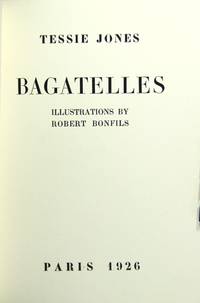
192620993Paris: Maurice Darantiere 1926. Edition limited to 100 numbered copies printed by Maurice Darantiere small 4to pp. 5-58 5; 20 small pochoir illustrations by Bonfils; original stiff pictorial wrappers; fine copy in a nearly fine glassine sleeve and the printed copy designation slip laid in. Robert Étienne Bonfils 1886-1972 was a French illustrator painter and designer not to be confused with the American illustrator Robert Bonfils. Tessie Jones was the talented daughter of the famed collector of rare Americana Herschel V. Jones of Minneapolis. Maurice Darantiere unknown
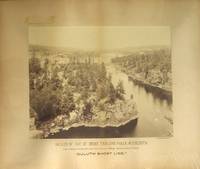
188059140Taylor's Falls Minnesota: Sanford C. Sargent for the St. Paul & Duluth Railroad n.d. 1880. Mammoth albumen photograph approx. 12¾" x 16¼" on a mount approx. 20" x 24" with printed caption; one corner of the mount bent and the mount toned; overall very good. Sargent 1851-1914 was born in New York and had studios in both Taylor's Falls and Minneapolis. He was active in Minnesota in the 1880s and 1890s. Sanford C. Sargent for the St. Paul & Duluth Railroad, n.d. unknown
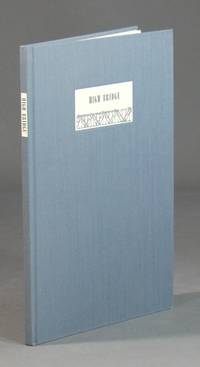
198750217Saint Paul: Midnight Paper Sales Press 1987. Edition limited to 200 copies this being copy no. 145 of 174 numbered copies signed by Schanilec there was also an issue of 26 lettered copies containing an extra suite of the engravings; 8vo 2 p.l. 19 1 leaves and so paged; text in double column; 10 colored wood engravings 1 double-page; fine in original gray cloth printed paper labels on spine and upper cover. Schanilec's first attempt at colored wood engraving and the book which effectively launched his career. Out of print from the get-go the text was inspired by the demolition of the High Bridge which connected St. Paul with South St. Paul from 1889 to 1987. Quarter to Midnight A.77.b. <br/><br/> Midnight Paper Sales Press hardcover books
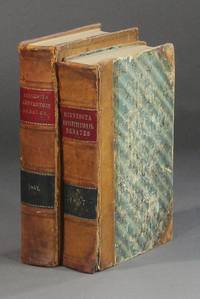
18572921St. Paul: E.S. Goodrich territorial printer Pioneer & Democrat Office 1857. Offered with: Debates and Proceedings of the Constitutional Convention for the Territory of Minnesota to form a state constitution preparatory to its admission into the union as a state by T.F. Andrews official reporter to the convention St. Paul: G.W. Moore printer 1858. Together 2 volumes 8vo later sheep red morocco labels; Martin Minnesota Imprints 139 & 194. Debates and proceedings of the Republican and Democratic wings of the convention to make Minnesota's state constitution. A tempestuous battle had ensued over which party would control the convention as that party would dictate the provisions of the constitution and so arrange the formation of congressional and legislative districts that Senators and Representatives in Congress would be of that party's faith. The political control of Congress might depend on the outcome in the new state of Minnesota and so the whole country became interested in the election of delegates to Minnesota's Constitutional Convention. Agreement between the parties could not be reached and thus two separate conventions were convened. "The two conventions met daily. Their proceedings were uniformly orderly dignified and most interesting. Various important measures far reaching and influential in their character and nature were proposed in each convention and some of them adopted. In a few weeks after the rival conventions assembled the better judgement sound sense and devotion to the interests of the people among the members generally asserted themselves." Private conferences were held and at last Democratic leaders conferred with leading Republicans and on the 28th of August 1857 agreement was reached upon the entire draft of the constitution the printed version of which appears at the back of each volume and in the case of the Democratic Proceedings may be the earliest appearance of the constitution in print see Minnesota in Three Centuries 1908 III 42-48. <br/><br/> E.S. Goodrich, territorial printer (Pioneer & Democrat Office) unknown books
18572921St. Paul: E.S. Goodrich territorial printer Pioneer & Democrat Office 1857. Offered with: Debates and Proceedings of the Constitutional Convention for the Territory of Minnesota to form a state constitution preparatory to its admission into the union as a state by T.F. Andrews official reporter to the convention St. Paul: G.W. Moore printer 1858. Together 2 volumes 8vo later sheep red morocco labels; Martin Minnesota Imprints 139 & 194. Debates and proceedings of the Republican and Democratic wings of the convention to make Minnesota's state constitution. A tempestuous battle had ensued over which party would control the convention as that party would dictate the provisions of the constitution and so arrange the formation of congressional and legislative districts that Senators and Representatives in Congress would be of that party's faith. The political control of Congress might depend on the outcome in the new state of Minnesota and so the whole country became interested in the election of delegates to Minnesota's Constitutional Convention. Agreement between the parties could not be reached and thus two separate conventions were convened. "The two conventions met daily. Their proceedings were uniformly orderly dignified and most interesting. Various important measures far reaching and influential in their character and nature were proposed in each convention and some of them adopted. In a few weeks after the rival conventions assembled the better judgement sound sense and devotion to the interests of the people among the members generally asserted themselves." Private conferences were held and at last Democratic leaders conferred with leading Republicans and on the 28th of August 1857 agreement was reached upon the entire draft of the constitution the printed version of which appears at the back of each volume and in the case of the Democratic Proceedings may be the earliest appearance of the constitution in print see Minnesota in Three Centuries 1908 III 42-48. E.S. Goodrich, territorial printer (Pioneer & Democrat Office) unknown
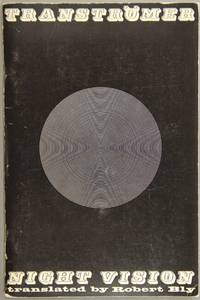
50256Northwood Narrows N.H.: Lillabulero Press 1971. First edition 8vo pp. 10 4-44 1; original pictorial wrappers slightly rubbed. This copy inscribed by Robert Bly: "Written by:" and in Transtromer's hand: "Tomas Transtromer." And in Bly's hand again: "Translated by Robert Bly" with a typical Bly drawing of a one-eyed blob beneath. Lillabulero Press unknown
197150256Northwood Narrows N.H.: Lillabulero Press 1971. First edition 8vo pp. 10 4-44 1; original pictorial wrappers slightly rubbed. This copy inscribed by Robert Bly: "Written by:" and in Transtromer's hand: "Tomas Transtromer." And in Bly's hand again: "Translated by Robert Bly" with a typical Bly drawing of a one-eyed blob beneath. <br/><br/> Lillabulero Press unknown books
1970ZB679366Utah State University 1970-2000. Volumes 1-31 1970-2000 bound library markings else text clean and bindings tight. - If you are reading this this item is actually physically in our stock and ready for shipment once ordered. We are not bookjackers. Buyer is responsible for any additional duties taxes or fees required by recipient's country. Photos available upon request. Utah State University unknown
New English Original bdg. HC. Folio. (46 x 37 cm). In English, Turkish, and Arabic. [xxviii], 433, 20 p., ills. Bursa in photographs of the period of Sultan Abdülhamid II.= Sultan II. Abdülhamid dönemi fotograflariyla Bursa.= Madinah al-Burusa fi 'ahd al-Sultan Abd al-Hamid al-Thani min khilal al-suwar al-tarikhiyah. Text by Mustafa Armagan. The city of Bursa, situated in the north-west of Turkey, has been for millennia a settlement area at the intersection of travel and trade routes. From 1335 to 1363 it was the capital of the Ottoman State. IRCICA has published a deluxe album of photographs of Bursa dating from the period of Sultan Abdulhamid II, i.e. from the end of the 19th-beginning of the 20th century. The photographs were selected from the collections contained in the archives of IRCICA. The album contains photographs of districts, gates, mosques, tombs, fountains, roads, bridges, ceremonies, personalities. There is also a section on "Photographers and Photograph Studios". This album appeared in the 2011 Evliya Celebi Year declared by UNESCO, since for Evliya Celebi (1611-1684) Bursa was of special importance. It was the first city that he visited outside Istanbul and one of the very few he traveled to specifically to learn about it. OTTOMANIA Bursa Brousse Broussa Prusa Collection Ottoman cities Photography.
1893ZB679371Iowa State Historical Dept 1893-1988. third series Volumes 1-49 1893-1988 mostly bound very good. - If you are reading this this item is actually physically in our stock and ready for shipment once ordered. We are not bookjackers. Buyer is responsible for any additional duties taxes or fees required by recipient's country. Photos available upon request. Iowa State Historical Dept unknown
Very Good Turkish, Ottoman (1500-1928) Original illustrated wrappers. Cr. 8vo. (20 x 13 cm). In Ottoman script (Old Turkish with Arabic letters). 220, [2] p., 41 unnumbered plates (incl. 68 b/w photos), and 3 maps. Pages are partly untrimmed and uncut. Slight stains on cover and wear at spine. Overall a good copy. Roumi: 1326 = Hegira: 1327 = Gregorian: 1910. First and only edition of this extremely rare book, including a historically significant eyewitness account of Cami Baykurt, who was an Ottoman officer during the Tripoli War (1911-1912), describing the flora, and the fauna in the Sahara desert and around Libya; the Bedouins and their customs with their social life, their culinary culture and their special drinks in his book during his travels to the south of Libya, to the Fezzan region, to participate in the Ottoman military operations at the fortress of Ghat, serving as a commander and governor. This book was prepared to present Tripoli, located in the Libyan lands today, Fezzan in the south, and the desert roads in between to the Ottoman court as well as the intelligentsia. Baykurt was a Turkish politician and soldier who served as deputy of the first period of the Turkish Republican Parliament. He was the first minister of Turkish foreign affairs in the Republican period. He had participated as an officer in the Battle of Tripoli back in the day. The provinces of Tripoli and Fezzan were accepted as destinations of exile in the last period of the Ottoman Empire. The province of Tripoli, the last center of a few Ottoman sanjaks, had been the granary of ancient Rome in the past with its large villages. Özege 21177.; Kursun p. 294.; Not in ATYB I (Askeri Tarih Yayinlari Bibliyografyasi).; OCLC 165148162 (with some misread and misspelled words; Kursun mentioned in his bibliography those misread words, especially 'Kazan mebusu -deputy of Kazan- instead of a deputy of Fizan about his title in some catalogs like OCLC. Kursun has a short but useful biography of Câmî).
Very Good Turkish, Ottoman (1500-1928) Modern black cloth, Arabic lettered gilt on spine. Roy. 8vo. (23 x 16 cm). In Ottoman script (Old Turkish with Arabic letters). 207 p. First edition of this extremely rare Turkish book, including Qirimi's first-hand account of the Prut War and Treaty (1711) and the defense of the city he participated in during the Russian invasion of Crimea (1735-36). The book was translated into Ottoman Turkish and edited by Turkish turcologist and soldier Necib Asim Yaziksiz, (1861-1935), with annotations, from the original work titled "Umdet al-Akhbar" [i.e. The principle of the news]. Abdulgaffar Qirimi was a Crimean scholar who lived in the Crimean Khanate in the first half of the 18th century and served in various government positions. Qirimi dedicated his work to Genghis Khan, the Golden Horde, and the Crimean Khanate. He reported many original details and, especially for the 18th century, his information is authentic and based on personal descriptions. The main part of the work is devoted to the Golden Horde (starting from Genghis Khan and his descendants), Crimean Khanate, Gerayids, and murzas. When Abdulgaffar Qirimi wrote a history of the descendants of Jochi Khan, he used in his book more than 20 historical works as sources. He stated the names of these works and indicated where he got this or that information. At the same time, he had access to the archives of the Crimean Khanate and used his family legends as well as popular traditions. Plenty of space in his work occupies his own observations as a participant in military campaigns and court life. His work concerning khans Berke, Tokhta, Uzbek, Tokhtamish, and Ulugh Muhammad reflects the popular version and is based on the oral historiography of the Tatars. The Russo-Ottoman War of 1710-1711, also known as the Prut River Campaign, was a brief military conflict between the Tsardom of Russia and the Ottoman Empire. The main battle took place during 18-22 July 1711 in the basin of the Pruth river near Stanile?ti (Stanilesti) after Tsar Peter I invaded Ottoman Moldavia, following the Ottoman Empire's declaration of war on Russia. The ill-prepared 38,000 Russians with 5,000 Moldavians, found themselves surrounded by 200,000 Turks under Grand Vizier Baltaci Mehmet Pasha. After three days of fighting and heavy casualties, the Tsar and his armies were allowed to withdraw after agreeing to abandon the fortress of Azov and its surrounding territory. The Ottoman victory led to the Treaty of the Prut which was confirmed by the Treaty of Adrianople. Özege 21999.; TBTK 479.; OCLC 281773486.
Very Good Turkish, Ottoman (1500-1928) Original illustrated wrappers. Chipping on top edge and front cover. Occasional foxing on pages. Overall a good copy. Roy. 8vo. (23 x 15 cm). In Ottoman script (Old Turkish with Arabic letters). 103 p., b/w plates (19 unnumbered b/w plates and 1 map). First edition of this extremely rare first-hand and historically significant eyewitness account of the Syrian and the Suez Canal Operations during the Great War by an Ottoman soldier and statesman. Erden describes in this book his return to Istanbul after his military attaché duty in Paris and his departure to Damascus to join the 4th Army in Syria under the command of Cemal Pasha (1872-1922). He then discusses the Arab Revolt in Hejaz and its possible effects on the Ottoman Empire (The Arab Uprising was initiated by Sharif Hussein bin Ali in June 1916 during the Great War with the aim of creating an independent and united Arab state comprising of Aden in Yemen and Aleppo in Syria against the Imperial Ottoman). After disclosing his views and the actions of the army in the region, he goes on to describe Jerusalem, the Suez Canal, and the wars that took place there. Erden gave new information on the reasons and results of the Canal operation, the condition of the Turkish army along Palestine and Syria fronts, the relations among the Turkish staff, and the nature of the Arab revolt through his views and observations in Egypt, Palestine, and Syria fronts accumulated as he was Cemal Pasha's chief of staff. Erden was a Turkish soldier and war historian. After graduating from the Military Academy in 1903, he worked in the units and headquarters in Yemen, as the staff of the 3rd Corps in the Balkan War and as the Paris Military Attaché. During the Great War, he served as the Chief of Staff of the 4th Army within the entourage of Admiralty Minister Cemal Pasha in Syria. Özege 16174. Kursun p. 51.
Very Good Turkish, Ottoman (1500-1928) Original bdg. Large roy. 8vo. (24 x 20 cm). In Ottoman script. (Old Turkish with Arabic letters). 16 p., 15 chromo-lithographed maps. Some markings on the two maps. Otherwise a very good copy. First edition of this scarce atlas for Turkish primary schools drawn and published by Turkish geographical educators and cartographers in the early Republican period of Turkey. This fine atlas was printed in London, in a period after the proclamation of the Republic, before the Letter Revolution in 1928. Duran studied in Istanbul and Paris. He worked as a geography teacher in various high schools then he became a lecturer and a manager at Ankara Gazi Education Institute for a while. He was known for his writings on various topics and especially for his works on geography. Born in the imperial period, Duran signed the first cartographic studies of the Republic of Turkey with the transition to the Republican administration. Özege 8764.
201548167Minneapolis: privately printed 2015. Edition limited to 50 copies this being one of 45 there are 5 artist's proofs; small tall folio pp. 24; illustrations in the text 1 full-page and in color large double-page folding plate printed in color; original stiff orange wrappers with gilt vignette the whole in a plexiglass slipcase. As new at the published price. Electric Tulips 5.1 was conceived as a dialogue between an imaginary literary critic Gallo and the poet Gallo and revolves around the writing and presentation of his poem Electric Tulips 5.1. The essay which results Future Preterite by the esteemed critic Alessandro S. Stompanado is intended to emulate that of the essay by James Joyce written under the pseudonym Vladimir Dixon; and which appeared in the Sylvia Beach publication of 1929: Our Exagmination Round His Factification for Incamination of Work in Progress in which Joyce writes an appreciation of his own novel Ulysses. As such the book is a multi-layered pastiche of both literary and typographic treatments along with a magnificent double gatefold presentation of the poem in eight colors each of the seven stanzas in a separate color and the seminal tulip in an eighth; the type all set by hand and printed letterpress and polymer from Permanent Headline Open from the now defunct foundry Ludwig & Mayer. <br/><br/> privately printed unknown books