2 100 résultats
Very Good French In contemporary 1/3 black leather bdg. Demy 8vo. (24 x 17 cm). In French and Turkish. 46, 31 p., x numerous b/w plates of Ottoman registers. 46 p. in Turkish (Modern); 31 p. in French. "Les metayers-serfs et quelques centres d'exploitation sous le regime du etayage servile: Quelle a ete l'importance de la main d'oeuvre servile sous l'Empire Ottoman, surtout aux epoques ou, selon toutes les apparences, le continengt d'esclaves introduits a ete le plus eleve dans les diverses branches de l'activite economique en particuler et en general dans la vie politique et militaire du pays?...". From the first etude: "The sharecroppers and some exploitation centers under the regime of servile shoring: What was the importance of servile labor under the Ottoman Empire, especially at times when, in all appearances, the continence of slaves introduced was highest in the various branches of economic activity in Europe particularly and in general in the political and military life of the country?...". Signed and inscribed by Barkan, (1903-1979) in Ottoman script, to Ibrahim Fazil Pelin, (1886-1944), as "Hocamiz Fazil Beyefendiye saygilarimla". Barkan was a Turkish economical historian, also one of the most important economist. Barkan, is primarily a scientist who has brought innovation to the understanding of history and examination in Turkey. He noticed more with his researches in the field of Turkish economic history; The 'Tahrir registries' were first studied systematically by him. He has revealed their importance in terms of agricultural, social and demographic. His researches were usually on the 16th century. First and Only Edition.
041231770 Neuchatel Au dépends de la Société Typographique. 17 x 10 cm - 204187 pgs - plein veau marbré avec titre estampé en or sur de dos dos lisse avec fleuron dans la caissons estampée en or - coiffe usée autrement bel exemplaire l'intérieur est très bien petite fente en bas du mors suppérieur en bas <br/> <br/> 1770 Neuchatel Au dépends de la Société Typographique unknown
182330930C. H. F. Hartmann. 1823. Hardcover. Good in No Dust Jacket dust jacket. Books rebound in brown marbled boards. Gilt bands and lettering to spines. Ex-library copy with usual stamps. Spines has some edgewear with colour flecking off in places. Corners edgeworn. Some foxing. Ink initials to inner covers.; V1: XII 316 pp. ; V2: 317-750; 2 Volumes in 1 COMPLETE; 1-2; 750 pages . C. H. F. Hartmann hardcover
Very Good Turkish, Ottoman (1500-1928) Original b/w map on cloth. Very good. Folded. Oblong atlas folio. (54 x 71 cm). In Ottoman script. Scale: 1/2.000.000. [MILITARY MAP of OTTOMAN CAUCASUS] Kafkasya Darü'l-Harekâti. (Fasil: 3 - Numero: 3). Tiflis ve civari, Bahr-i Siyah, Don Kazaklari, Kalmuk, Kirgiz, Bahr-i Hazer-i Kuzgun Denizi (Derya-i Hazar), Kuban Kazaklari, Çerkezistan, Nogay, Termerek Kazalari etc. Military map of Ottoman Caucasus. Shows Tbilisi and around, Khazar Sea, Kuban Cosacks, Don Cosacks, Kalmuks, Kyrgyzstan, Circassia, Nogai, Termerek Cosacks, Maveraünnehir, etc.
New English Original bdg. Hardbound in setalux cloth and in special and original slipcase. Large 4to. (36.5 x 26 cm). Color and b/w ills. 132 p. This beautiful book on the Byzantine and Ottoman architectural heritage of Istanbul contains detailed images of the city's domed structures accompanied by an illuminating essay by Prof. Semavi Eyice on the historical development of the city's spaces since the earliest days.
Fine English Original bdg. and paperback. 4to. (34 x 23 cm). In English and Turkish. 7 volumes set: (959, [17] p.; 295 p., 288 p.; 300 p., 300 p.), b/w ills. Very comprehensive catalogues of engravings of Turkey. Turkey in gravures.= Gravürlerle Türkiye. 7 volumes full set. Vol. 1-3: Istanbul. Vol. 4-5: Anadolu = Anatolia. Vol. 6-7: Giysiler portreler = Garments, portraits. First Edition.
New New English Original binding with original dust wrapper. 4to. (30 x 24 cm). Turkish Edition. 3 volumes set: ([xi], 1182 p. in total). 2400 postcards. Born in 1852 in Kalucz, a town on the eastern border of the Austro-Hungarian Empire, Max Fruchtermann came to Istanbul in 1867 and two years later opened a picture framing shop in the city. Having decided to have the first Ottoman Postcard Series printed at Breslau in 1895, he ensured through his cards, which number in the millions, that the name "Turkey and the multifarious images associated with it" spread throughout the entire world from Canada to New Zeland. In 1966 when Fruchtermann's daughter-in-law Anna, before closing down the establishment, sold her remaining stock (subsequently realized to number around 600,000) to a secondhand dealer for 2500 liras, she probably never imagined the importance of her father-in-law's postcards. They are not simply photographs of landscape panoramas monumental buildings and people of the time. They are individual documents that reflect in their human types and cross-sections of everyday life the noteworthy political incidents of the late 19th and early 20th centuries and the ethnic and cultural diversity embodied in the Ottoman identity. As such they have acquired significance far in excess of original expectations. It always comes as a pleasant surprise to collectors to see that ordinary objects left to us from the past, and usually assumed to be of mere functional value, in time acquire special significance. For us, however, far more than a pleasant surprise these postcards are a door opening up on our recent history. The places, incidents and types that Fruchtermann saw and appraised with his own eyes have been given new life and brought together as a whole thanks to this study and up-to-date treatment by Mert Sandalci.
407publiées pour la première fois par Mgr Louis Petit, X. A. Sideridès, Martin Jugie Paris, Maison de la bonne presse, 1928-1936 8 volumes brochés (25,3x16,8cm) de 500 pages environ (série complète) . Introduction en français, texte en grec. T1: Œuvres oratoires- Traités théologiques sur la Providence et sur l'âme. T2: Traités polémiques sur la procession du Saint-Esprit. T3:Oeuvres polémiques- Questions théologiques. Ecrits apologétiques. T4: Polémique contre Pléthon- Œuvres pastorales, ascétiques, liturgiques, poétiques- Correspondance. Chronographie. T5: Résumé de la Somme contre les Gentils et de la première partie de la Somme théologique de saint Thomas d'Aquin. T6: Résumés, traductions et commentaires thomistes. T7: Commentaires et résumés des ouvrages d'Aristote T8: Fin des œuvres et des traductions philosophiques- Grammaire- Varia- Appendices divers Bon état intérieur Vignettes et tampons de congrégation religieuse Rare 8,5 kgs
New New English Original bdg. Dust wrapper. 4to. (34 x 24 cm). In English. 2 volumes set: (735 p.), b/w and color ills. The photographers of Constantinople. Pioneers, studios and artists from 19th century Istanbul. 2 volumes set. Prep. by Bahadir Taskin. Vol. 1: Texts and photographs: Istanbul photographers of the 1850"s exhibiting in London, Paris and Brussels; Ottoman court photographers; and studios and artists that made their mark. Vol. 2: The Album: the imperial family; statesmen, celebrities and court officials; memories of a vanished world; costumes; professions and street sellers; everyday life; palaces and other edifices; the sea and Istanbul; panoramas; bibliography and index.
New English Original bdg. HC. In publisher's special slip-case. Folio. (40 x 30 cm). In English, French, Turkish, and Arabic. 80 p., full page color ills. Reprint of the 1852 Edition. St. Sofia converted by Mehmed the Conqueror into a mosque after the conquest of Istanbul often has been restored. There was again needed a major restoration in the era Sultan Abdulmecid. Sultan was appointed architect Gaspard Fossati for this restoration. For this restoration, about 800 workers worked and all the building has been almost completely repaired. Fossati has produced 25 drawings showing the interior and exterior of Hagia Sophia and he suppressed these drawings as a album in 1852 in French. The Fossati brothers, Gaspare and Giuseppe (1822-1891), were Swiss architects. They completed more than 50 projects in Turkey during the Tanzimat Era. They belonged to the Morcote branch of the Fossati, a prominent Ticinese family with mentions in the historical record going back to the 14th century. This Edition is a reprint and translated edition which is almost identical to original. A very heavy volume. 1000 copies were printed.
As New As New English III. Selim. Iki asrin Donemecinde Istanbul, II. Abdulhamid. Modernle¿me surecinde Istanbul, II. Mahmud. Yeniden yapilanma surecinde Istanbul = III. Selim, Istanbul at a Turning Point between Two Centuries, II. Abdulhamid, Istanbul During the Modernization Process, II. Mahmud, Istanbul in the Process of Being Rebuilt [In the original slip-cases 3 volumes set], edit by: Coskun Yilmaz, Istanbul 2010 Avrupa kultur baskenti, Ist., 2010. Original bdg. Dust wrapper. In the publisher's original slip-cases. Mint. 4to. (34 x 25 cm). Heavy volumes. B/w and color pcs. 520, 528, [1], 519, [1] p. In English and Turkish.
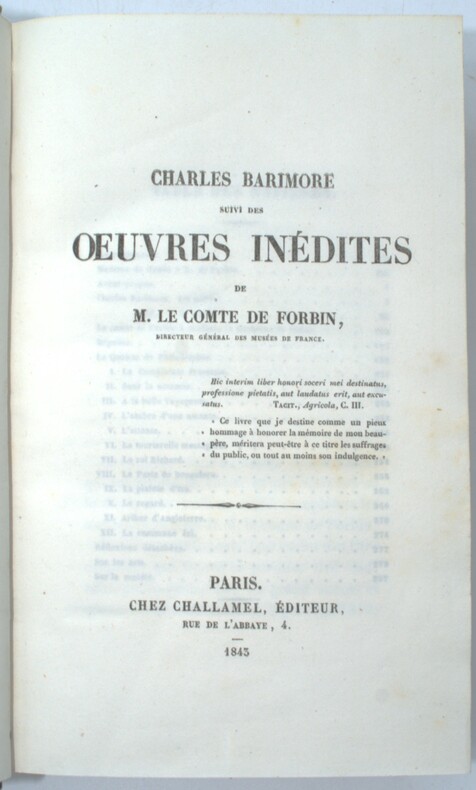
1819PHO-1484Paris, Challamel et Imprimerie Royale, Delaunay libraire,1843 et 1819, 1 vol.in 8*, 298pp. et 460 pp., une planche dépliante in fine, relié demi chagrin vert, dos à nerfs avec auteur et titre.
96662Paris, Librairie Archéologique de de Victor Didron, 1861, 1 volume in-folio de 320x250 mm environ, 240 pages + 3 planches (dont 2 double page), broché sous couverture illustrée, feuillets non coupés. Manque de papier sur le coin supérieur de la page de faux-titre, quelques rousseurs, couverture insolée avec dos fendillé, sinon bon état.
90577A Paris, chez Treuttel et Wütz, Libraires, A Strasbourg, même Maison de Commerce, 1824/ Londres, Chez Treuttel, Würtz Treuttel Fils, et Richter, 1827, 2 textes reliés dans un volume in-8 de 130x210 mm environ, (1) un portrait de l'auteur en frontispice, dessiné d'après nature et sur pierre par C. Carbonnier, Lith. de G. Engelmann, viij-440-80 pages, (1) f., cartonnage moderne. Avec un envoi de l'auteur sur la première garde du premier texte. Des rousseurs et petites mouillures claires dans les marges du premier texte, sinon bon état.
32955Carte au format 10,5 x 15,5 cm - écrite recto-verso - bon état -
Very Good Turkish, Ottoman (1500-1928) First and Only Edition of this extremely rare first user guide for the Ottoman market for a sewing machine manufactured by the Singer Company. This richly illustrated user guide in Ottoman Turkish, printed for "28 K" model (manufactured in 1882) of Singer sewing machines includes numerous diagrams showing the parts of the machine and threading the needle, sewing techniques, using the belt wheel and foot pedal, measuring techniques, the thickness of needles and threads, and how to detect and avoid counterfeits of the brand. In Ottoman Empire, Singer sewing machines were initially started to be offered for sale in Constantinople and Smyrna (today's Istanbul and Izmir) in the 1880s, soon after Isaac Merritt Singer & Company was incorporated with Edward B. Clark, Attorney-at-law from New York in 1851. The company opened its first dealer/dealership in the last period of the Imperial Ottoman at Cadde-i Kebîr [i.e. Istiklâl Street] in Pera, and became the first foreign company to open a dealer/dealership and issue an invoice in Turkey. As the first company to use the "direct marketing" method, Singer went to mountain villages in Turkey, together with its salespersons, instructors, and technicians, who were in charge of showing and informing people on how to use Singer sewing machines, for many years. Singer was the first company to prepare user's guides, to provide extensive service, to initiate the practice of "Guarantee Coupon", to deliver training on sewing - embroidery, and to introduce gas stoves and ovens to Turkish people. In addition, Schneidertempel (Tailors Synagogue), which was founded in 1894 by Mayer Schönman, who was the tailor of Sultan Abdulhamid II in the Ottoman palace, and the head of the tailor's guild at that time, broke the monopoly of male tailors in the Ottoman Empire and led the way for every woman to do sewing at home. At the beginning of the 20th century, free sewing courses for women started to be organized by Singer in Turkey. Furthermore, Singer played a role in the history of all leading garment-industry brands of Turkey. (Source: Official Singer Website - History). ABOUT ZELLICH PRINTING HOUSE: Antonio Zelic (Zellich) of Brela was one of many Dalmatians who left his homeland in pursuit of a better life during the 19th century. However, instead of going west, he set out toward the East, to the Ottoman imperial capital - Istanbul. Upon arrival in the city on the Bosphorus, Zelic found employment at the first lithographic print house founded by Henri Cayol in the Ottoman Empire. In 1869, Zelic opened his own lithographic print house called "Zellich and Sons" (A. Zellich et fils). His descendants continued his work with great success, and the Zellich Print House, now known as "Zellich Brothers" (Zellich frères), became one of the most renowned in the Empire. The Zellich Brothers won recognition due to the high quality of their products, and, above all, the amazing beauty of their postcards and posters. Their crowning achievement was an order for the printing of the Ottoman Turkish Lira banknotes in 1914. The Zellichs received many Ottoman and international awards, including medals conferred by the Pope, the Persian shah, and the Serbian king.". (Source: Documentary film "Zelic- Printers to the Empire", Levantineheritage). Original illustrated wrappers. Roy. 8vo. (24 x 16 cm). In Ottoman script (Old Turkish with Arabic letters, pre-1928). 24 p., [24] unnumbered b/w engraved ills. Heavily stains on top of the pages, a trace of folding. Overall a good copy. Özege 15450.; Only one institutional copy in the Library of Congress according to the WorldCat: OCLC 125421484.
New English Paperback. 4to. (28 x 22 cm). In English and Turkish. 120 p., b/w photos. Istanbul: A selection of Collection Point Hotel. For the first time, tells his photos with stories.= Istanbul: Point Hotel Koleksiyonundan seçmeler. Fotograflarini ilk kez öykülerle anlatti. Signed by Ara Güler.
Very Good English Original b/w portolan chart. Folded. A little foxing and some pencil markings and notes in Ottoman script in its period. Oblong double elephant folio. (70 x 102 cm). In English. Bosphorus to Kerempeh from the Russian survey of 1834 with additions and corrections by Commander W. J. L. Wharton., R. N. 1872-80. It's written 'London published according to Act of Parliament at the Hydrographic Office of the Admiralty Jare. 16th 1854. Also shows Killa Bay (Shile Bay) from a survey by Lieut. Comm. W. R. Pristen and the midshipmen of H. M. S. Royal Sovereign, 1920. Topography partly from a Turkish map. Up side of map, engraved a view from sea of entrance of the Bosphorus, Rumili (sic. Rumeli) Lighthouse and environment with several hills. And also shows Amastra (Ancient Amastris) from Russian surveys, 1834-41; Kosku Bay from a surbey by Capt. Spratt R. N. 1854; and Sungul Bay (Zonguldak) from the Heraclee Companys plans to 1915. A rare navigation chart.
New English Original bdg. In special slip-case. Oblong folio. (31 x 41 cm). In English. 180 p., color and b/w photos. "This visual journey takes in the Byzantine and Ottoman monuments and cityscapes that make Istanbul unique among the world's great metropolises. Aerial photographs and detailed views of the city walls, St Sophia, St Savior in Chora, the Grand Bazaar, aqueducts, the mosques of Sinan, and other landmarks are accompanied by views of Bosphorus villas and scenes of the Princes' Islands and reproductions of old engravings. The accompanying text is by Dr Cyril Mango, a professor of Byzantine art and architecture. 30 by 40 cms, 180 pages. Hardbound in Setalux cloth and presented in a slipcase.".
260791828. On one side of 31 x 21 cm. A frail survival worn aged and with closed tears with the backing damaged and stained. Text clear and entire in Greek key border. Blind stamp of Cardinal Zurla at bottom left. Signed by 'J. Patr. Constantinop. Vicesgs.' and by the scribe who completed the printed document in manuscript. Somewhat crudely printed with Zurla's arms at the head. Headed: 'D. PLACIDUS ORDINIS S. BENEDICTI / CONGREGATIONIS CAMALDULENSIS / TITULI S. CRUCIS IN JERUSALEM S. R. E. PRESBYTER / CARDINALIS ZURLA / SSmi Domini Nostri PAPAE VICARIUS GENERALIS.’ The manuscript part of the document concerning 'sacred particles from the neck of Saint Theresa the Virgin reads: 'sacras particulas ex ossibus S. Teresiae Virg; quas ex authenticis locis extractas reverenter collo cavimus in thea ex aurichalco argento obducto ovalis figurae unico crystallo munita’. See scan. 1828. unknown
Very Good Turkish Original manuscript map of Alexandria Port and its immediate hinterland. Folio. (33 x 41 cm). In Turkish (Modern). Folded. No scale. The manuscript shows Alexandria Port and the Palace of the King Farouk of Egypt, customs shores, ports and harbors, locations of the British ships, radio station, location of SS Ramlah, strait, Great Pass (?), waterfront for the lumber ships, sea current zones and probably entrance and exit routes etc. A very detailed map, decorated with ships. Some repairs with tape, tears, foxing and stains. Overall a good copy.
Very Good French This attractive color lithographed map shows the Imperial Ottoman territories in the Balkan Peninsula, Anatolia, also North African shores and Maghreb countries, Egypt and Vilayet de Tripoli (Libya) and Liva de Benghasi. It has small views with a small scale of Tripoli, Europe, Egypt, and Nubia with the Arabian Peninsula. This map reflects the territories and situation of the last period of the Ottoman Empire soon after the Second Constitutional Era in 1908. Inside the red lines in this map shows the Ottoman territories in 1909 with its maximum extent, just before the Balkan Wars, (1912-1913). In Europe, Western Thrace territories up to Montenegro including Adrianople are within the borders of the Empire. E. Nardin was a French cartographer who prepared more than sixty maps in the early 19th century, especially mapping Middle Eastern, North African, Sub-Saharan African areas. Original color lithograph folded map in its original wrappers. Oblong double elephant folio. (77x95 cm). Wrappers dimensions: (21,5x14 cm). In French. Echelle 1/4.165.000 (Scale). Only two copies in OCLC. Extremely rare. No date.
Very Good Turkish, Ottoman (1500-1928) Original color map on cloth. Oblong atlas folio. (44 x 58 cm). Scale: 1/200.000. Toponyms in Ottoman script /Turkish with Arabic letters). Shows southwest of the Gallipoli Peninsula [and the Hellespont], Edremid Gulf, Tenedos, and North Aegean shores of Anatolia]. Folded. This is one of the series of the Bonn projection maps which are the first map series in modern techniques in Turkey and the Ottoman Empire. In order to produce these maps covering Turkish territory, Reconnaissance Branch was incorporated into The Mapping Commission. The maps were produced in the datum based on the latitude and longitude of the Ayasofya Mosque in equal area Bonn Projection. The field works for the 123 sheets covering the country were conducted by 76 staff. The production was completed in 18 years starting from east-west. Fieldworks continued without stopping except in the years 1914 and 1920. This map series called also reconnaissance maps contributed a lot to producing 1:25.000 scale maps. Hegira: 1336 = Gregorian: 1920. Not description on map-maker. Extremely rare.
Very Good Turkish, Ottoman (1500-1928) Original chromolithograph folded map. Oblong atlas folio. (49 x 65 cm). In Ottoman script. Repaired with a band in the contemporary period from its backside. Set including 4 sheets. Other sheets are Basrah, Bagdad, and Qut al-Amare. This is the first sheet including 'Samawah'. Rare. Scale is 1/500.000. Samawah city was settled by the Arab tribe of Banu Quda'a around the 3rd century AD. It is built on both sides of the Euphrates river; there are four bridges in the center of town for crossing between the two sides. The west bank of the city contains the commercial heart of the city and includes the old town and the Jewish quarter, Agd al Yahood. The west bank is the site of the covered market Suq Al Masgoof, which dates to the Ottoman period. The area surrounding the market is the old city with its Byzantine maze of crowded markets and streets. The eastern side of the city including 'Qushla' has a more modern feel and contains a number of estates of apartment blocks built during the 1970s and 1980s, As Samawah Stadium, which is home to the local Muthanna football team Samawa FC, as well as technical colleges and the polytechnic. There too is Al Qushla, the historic "Ottoman Barracks". The most famous attraction of Samawah in the ruins of the ancient Sumerian city of Uruk which dates to 4000 BC. This was the largest city in Sumer, extending over 2 km2. Uruk was not only the largest conurbation of the first urban civilization on earth, but it is also the place where the first written script was discovered, the oldest dating back to 3300 BC. The palm groves of Samawah: Samawah is built on both sides of the Euphrates and is surrounded by hundreds of palm groves that give it a tropical feel, especially in the southern and northern suburbs. These groves provide cool respite from the scorching heat of Mesopotamia and were the inspiration for the famous Iraqi folk song "The Palm of Samawah".
Very Good Turkish, Ottoman (1500-1928) Original map of Kars Fortress. Oblong: 45x57 cm. In Ottoman script. Scale: 1/21000. [PLAN OF KARS FORTRESS] Kars Kal'asi plâni (Based on 1898 discoveries and 1908 practice). A very detailed plan in Ottoman script of Kars Fortress and is environment. Some red markings. Extremely rare.