8 476 résultats
In-16 gr. (mm. 182x115), p. pergamena antica, tit. oro al dorso, pp. (14),662, marca tipografica al frontespizio, ornato da grandi capilettera figurati a vignetta, con alcune figure nel t., inc. su legno. Rara edizione di questa celeberrima summa del sapere umano dell’epoca, pubblicata per la prima volta nel 1588 in soli 4 libri, poi aumentati fino a 20. Vi sono trattati fra gli altri: l’origine delle specie animali - la conservazione di alimenti e la preparazione di conserve, tipi di pane, liquori, olii ecc. - la creazione di gemme false - il magnetismo - la preparazione di rimedi di vario tipo (sonniferi, balsami per labbra rotte, cure per mal di testa, coliche, calcoli, fertilità, peste, piaghe, ecc.) - gli specchi ustori e la rifrazione - pure inclusa è la prima descrizione della camera oscura e nell’ultimo capitolo, intitolato “Chaos”, sono affrontate tematiche di vario tipo, dal morso della vipera ai draghi volanti. L’opera ebbe numerose ediz. nel ‘5/’600 e traduzioni in varie lingue. Cfr. Brunet,IV,826 - Graesse,V,417 - Caillet,III,8853: "C'est le meilleur traité de Magie pratique ou céremonielle, et il renferme toutes les pratiques employées par les nécromanciens du Moyen Age. Il contient de fort curieux secrets sur la beauté des femmes, les teintures, les fards, les cosmétiques, etc." - Bibliotheca Esoterica,3733: “Porta contribua dans une très large mesure à répandre en Italie l’usage des substances vénéneuses. On rencontre en outre dans cet ouvrage une foule de renseignements intéressants sur divers points concernant l’histoire naturelle, la lumière, les feux d’artifice, l’optique, etc.”. Antiche scritte a penna, qualche fiorit. sulle prime 8 carte e con lievi tracce d’uso, ma certamente un buon esemplare.
Ad Illustriss. et Sapientiss. Anhaltinum Principem CHRISTIANUM, Comitem Ascaniae, Dynasten Servestae, ac Bemburgi Dominum, &cc. Dominum & Patronum suum clementissimum, Osvaldi Crollii Epist. Dedicatoria - Iho Hartmannus Med. D. et CHymiatriae in Academia Marpurgensi Professor Ordinarius, Lectori S. (Anno Gratiae MDCXI) - Pauli Melissi Franci... Ode Alcaica ad Osvaldum Crollium - PRAEFATIO Admonitoria 1 21x17 cm., legatura in piena pergamena rigida, titolo in oro su tassella al dorso, tagli in grigio scuro, pp. (16), 283 (25 Index), Frontespizio con grande marca figurata del " Osvaldi Crolii Tractatus de Signaturis Interni rerum, seu de vera e viva Anatomia majoris & minoris mundi" pp. (14 Epistola Nuncupatoria ad ...Petrum Wok Ursinum Dominum Rosenberg...), 80 (14 Index ), Frontespizio con marca "Elegia De Vera Antiqua Philosophica Medicina scripta da M. Ulrico Bollingero ad Osvalum Crollium...e Frontespizio "Encomium ..."24; pagine con filetto di contorno e uno spazio di circa 2 cm. al lato esterno dedicato a numerose annotazioni, testate, capilettera e finalini importanti, 2 tavole nel testo. In lingua latina. In apertura importante e interessante Frontespizio generale pieno di simboli, emblemi, stemmi, personaggi ecc, relativi alla materia. Difetti: Frontespizio sbiadito e macchiato, ma completo; pagine tutte pi? o meno brunite e con gore sparse. Buon esemplare.
1810ST17557<p>Albany New York: Balance Press 1810. FIRST EDITION. 170 x 103 mm. 6 3/4 x 4". vi 76 pp. Errata slip tipped onto final page. <br />Contemporary marbled boards backed with sheepskin smooth spine divided into panels by single gilt rules. Front free endpaper with bookplate of the Ricky Jay Collection. Front pastedown with neat early owner's signature pencilled initials "M. A." in a juvenile hand adjacent to a rudimentary pencil sketch of two people; rear pastedown with pencilled signature of Sally E. Original errata slip pasted onto bottom half of final page the slip defective at lower left corner. Sabin 67364; Shaw & Shoemaker 21169. Sheepskin a bit rubbed marbled paper boards somewhat chafed stained and quite worn at corners endpaper a bit spotted torn or at back missing other minor defects but the unsophisticated original insubstantial binding still solid. Title page and front flyleaves with light dampstain to gutter and tail margin a little foxing and faint browning other imperfections but the volume still generally clean and surprisingly fresh despite its cheap paper.<br /><br />Written by a Lutheran minister in upstate New York this entertaining treatise gives a brief history of the supernatural from ancient times to the present day and seeks to educate the audience about the dangers and follies of harboring magical beliefs noting that "witchcraft can never take root unless it be supported by credulity." According to the author's preface Frederick Henry Quitman 1760-1832 was motivated to write this work after a neighbor's home was besieged by supposed "supernatural" occurrences that included thrown stones and theft. Even though Quitman a staunch skeptic endeavored to attribute the activity to mischievous entities of the human variety the damage had been done: "Scarcely had the rumour about the forementioned witchcraft a little subsided when we heard the report of the appearance of apparitions in several quarters of the town. And it is really to be feared that during this dull winter all the corners of the town for want of other employment will be infested with demons." The Annotations at the end of the book contain many amusing definitions and descriptions of such things as talismans popular magic gothic novels and ventriloquists. Our copy was owned by the eminent magician actor writer scholar and sleight of hand artist Ricky Jay 1946-2018. In their catalogue Sotheby's notes that "Ricky Jay's accomplishments were as varied as are the formats and subjects of the material in his celebrated Collection . . . . He is one of the very select company of persons who assembled a collection of the very first rank in a field in which he was not only a world-renowned practitioner but also a scholar of considerable note." Our 1810 printing--the only early edition of this work--is rare on the market with RBH recording just four copies at auction in more than 60 years.</p> Balance Press
1st Edition Period Half Leather with raised bands and gilt spine lettering and adornment. 8vo, iv, 572, iv, 572 pages. Complete 1st 24 issues of the New Series of this monthly spiritualist periodical. Continuation of The British Spiritual Telegraph and The Christian spiritualist. Includes essays by Henry Ward Beecher, and about Bengal Spiritualism, Levitation in Spain, Spiritualism and Christianity, Zouave a Young Creative Medium, etc. Bibliography of Spiritualism, Lincolns Dream of Warning, Manx Superstitions, SUBJECT(S): Spiritualism -- Periodicals. OCLC: 728344879. OCLC lists only 3 holdings worldwide (Boston Pub Libm Kings Col London, British Lib). Front blank endpaper of Vol I loose, all text pages clean and nice, binding solid and good. Some rubbing and edgwear to boards and spine, Still attractive, About Very Good- Condition Overall. Rare and important. (AC-22-18)
1 27.3x19.8 cm., XXIV, 334, [2] pp., XXV tavv. in b/n in fondo al testo, legatura in tela edit. con titoli al dorso e stemma dell'Universit? del Michigan impresso a secco al piatto anteriore, prima edizione, esemplare ben conservato, in inglese Rara edizione originale di questo importante studio sugli amuleti magici greci ed egiziani.
024837Paris, chez LESCLAPART, 1788 (pour les trois premiers volumes), Bruxelles, veuve Dujardin, et à Paris, chez Defer et Maisonneuve, 1789 (pour le quatrième et dernier volume) 0 Cinq ouvrages en quatre volumes petits in-8° (100 x 171mm), demi-percaline à coins rouge, dos lisses ornés de l'auteur, du titre et de petits fers dorés (reliure de la fin du xixe). ( dos insolés et légèrement salis, exemplaires très rognés avec la perte de quelques lettres, la plupart des feuillets des quatre volumes sont uniformément et fortement roussis, trace de brûlure au feuillet 89-90 du volume du Codicille et au feuillet 121-122 du volume des Petites Aventures, SONT MANQUANTS : les frontispices, le portrait, les feuillets 125-126 et 127-128 du volume de la Magie blanche dévoilée, les feuillets d'explication (8 pp.) et d'éclaircissements (32 pp.) ainsi que 2 planches du volume de Supplément à la Magie). VOLUME 1 : La Magie Blanche dévoilée, ou Explication des Tours surprenans qui font depuis peu l'admiration de la Capitale & de la Province, avec des réflexions sur la Baguette divinatoire, les Automates joueurs d'Échecs, &c. Seconde édition corrigée par l'auteur. Paris, chez LESCLAPART, 1788. XXIV 124 pp. (sont manquants les deux derniers feuilllets). Une figure page 117.; Relié à la suite du même : Supplément à la Magie Blanche dévoilée, Contenant l'explication de plusieurs Tours nouveaux, joués depuis peu à Londres, Avec des éclaircissements sur les artifices des Joueurs de profession. Les Cadrans sympathiques, le Mouvement perpétuel, les Chevaux savans, les Poupées parlantes, les Automates dansans, les Ventriloques, les Sabots élastiques, &c. Paris, LESCLAPART, 1788. VII 287 (1) pp. 2 planches de 2 figures chaque (homme enchaîné) et 29 figures; VOLUME 2 : TESTAMENT de JEROME SHARP, Professeur de Physique amusante, où l'on trouve parmi plusieurs tours de subtilité, qu'on peut exécuter sans aucune dépense, des préceptes et des exemples sur l' Art de faire des chansons impromptu ; pour servir de suite à la magie blanche dévoilée. Paris, LESCLAPART, 1788. XX 328 pp. 2 planches repliées (musique) et 69 figures. Bandeaux et vignettes; VOLUME 3 : CODICILE de Jérôme Sharp, Professeur de Physique amusante ; Où l'on trouve, parmi plusieurs Tours dont il n'est point parlé dans son Testament, diverses Récréations relatives aux Sciences & Beaux-Arts ; pour servir de troisième suite à la Magie blanche dévoilée ; avec 64 figures. Paris, LESCLAPART, 1788. 286 pp. (2) pp. (approbation). Nombreuses figures au feuillet 31-32, 64 figures et deux tableaux dépliants reliés en fin de volumes; VOLUME 4 : Les Petites Aventures de Jérôme Sharp, Professeur de Physique amusante ; ouvrage contenant autant de tours ingénieux que de leçons utiles, avec quelques petits portraits à la manière noire ; par l'auteur de la Magie Blanche. Bruxelles, chez la veuve DUJARDIN, et à Paris, chez Defer de Maisonneuve, 1789. 386 pp. 17 figures. Cachet d'ex-libris. Henri Decremps (1746-1826) publia en 1784 " La Magie blanche dévoilée " afin de démasquer charlatans et escrocs dont le plus fameux d'entre eux à la veille de la Révolution Joseph Pinetti, prétendu physicien et magicien de la cour de Louis XVI qui publiait la même année ses Amusements physiques. Decremps, le premier, démystifia l'escamoteur par l'explication de toutes ses expériences (tours de cartes, gobelets et gibecières etc.) et dressa la liste des techniques de tricherie, comme les faux mélanges, les sauts de coupe, la donne en second, etc. RARE
ix, [1], [2]-206 pp. Color frontispiece. Black and white diagrams in text. Provides instruction for twenty-three paper tricks, seven paper folds, eleven paper tears, and sixteen paper puzzles. Square and unmarked with moderate wear to publisher's red cloth lettered in black. Binding intact. Moderate foxing to first few leaves. Chips from head of backstrip. Insect holes to upper periphery of backstrip partially touched up with bit of bleed to back hinge. No dust jacket. A sound copy of this wonderful Houdini collectible. Book
4 volumes Veau marbré de l'époque, dos à nerfs et fleuronnés, pièces de titre rouges, tomaisons vertes, tranches rouges 1750, 1750, in-8, 4 volumes, Veau marbré de l'époque, dos à nerfs et fleuronnés, pièces de titre rouges, tomaisons vertes, tranches rouges, 136 planches gravées sur cuivre, certaines dépliantes, représentant différentes expériences, la plupart avec les instruments et appareils pour les réaliser. Nouvelle édition des célèbres Récréations. Ce grand classique, toujours très recherché, du mathématicien Ozanam (1640-1717), a paru à l'origine en 1692. Il contient le Traité des horloges, qui est une traduction de l'ouvrage de Domenico Martinelli : Horologii elementari publié à Venise en 1669. "Cet ouvrage curieux, beaucoup plus ample que ceux qui avaient déjà paru sous le même titre, contient la solution d'une foule de problèmes d'arithmétique, de géométrie, d'optique, de gnomonique, de mécanique, de pyrotechnique, etc." (Quérard). "Il contient la solution d'une quantité de problèmes mathématiques, tours de gobelets, de cartes et d'escamotage, tous décrits avec les perfectionnements désirables pour l'époque" (Ruegg). Une bonne partie du premier volume est consacrée à la théorie des nombres qu'Ozanam connaissait parfaitement. Bel exemplaire. Ruegg, Bibliographie de la prestidigitation française, p. 71-72
183919929Stuttgart, Scheible, 1839. Kl. 8°, 379; 342; 324; 340; 338; 342 Seiten mit 1 lithogr. Frontispiz-Portrait und 46 gefalteten Kupfertafeln. Marmorierte Pappbände der Zeit mit goldgeprägtem Rückenschild und 3seitigem Marmorschnitt.
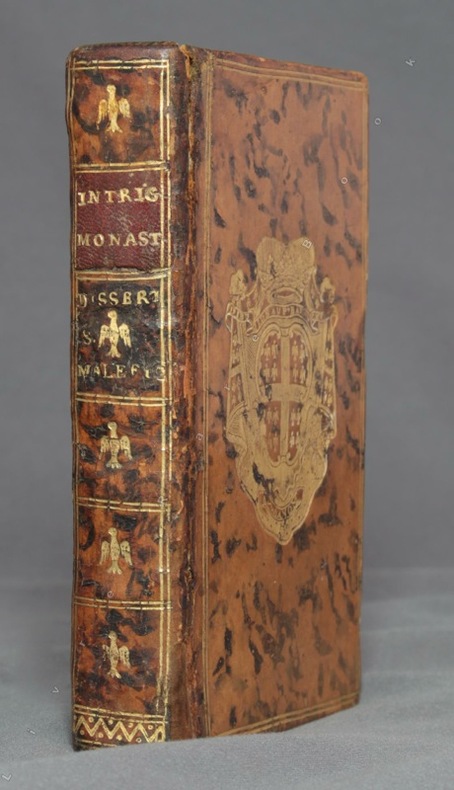
9367A La Haye [et] A Tourcoing, chez Jean van den Bergh [et] sans nom, 1739 [et] 1752. 2 tomes en un volume in-16 de [6]-256; de 2 à 102 pages (manque p. 3/4), plein veau marbré fauve, dos lisse orné de filets et 4 alérions dorés, double filet doré encadrant les plats, simple sur les coupes, armes d'Anne Léon (Ier) de Montmorency avec la devise: Dieu aide au premier baron chretien, ainsi que la devise grecque. Mors frottés et légèrement fendus, tampon rose répété deux fois sur chaque page de titre, restauration à la première, avec une cote de bibliothèque à l'encre bleue.
120553aafLondon, Luzac and Co, 1900, lg. in-8vo, XVII + 85 plates + 30 p. (publ. ads) / XCI (+1) + 1 leaf + 147 p., full publisher’s clothbound, spine richly gilt with titles, series and author, first cover with gilt impression of series, light stains on both volumes. In all a desirable copy.
In-8° (cm. 20.6x15,3), carte (68).non num., 416 cc. num. (= pp. 968), legatura tutta pergamena floscia, al dorso e presso le cerniere piccole mancanze di pergamena professionalmente risarcite, superba marca tipografica (FONTANA di 12 zampilli da un vaso e dal putti gaiamente orinanti, che lo sorreggono), 32 RITRATTI incisi (cm. 4x5, ma uno di cm. 9,8x6, il Placentinus con scolari) di giureconsulti, molti capilettera ornati, gran titolo calligrafico coevo al taglio inferiore, testo nitido e fittissimo su due colonne. Eccellente, solido e perlopiù immacolato esemplare, pur con lievi fioriture, gore e macchioline a varie pagine, Alla sguardia nome d'appart. anticam. cancellato e davvero sibillina strofa calligrafica coeva in 4 versi latini, firmata "Salvator Manaceus Lucensis" (cioè di LUCCA) alludente alla tormentata vicenda di Lucio III (che non nomina) nato a Lucca (1097), vescovo di Ostia, papa a Roma ma esiliato, morto a Verona; al front. altra firma di appartenenza anticam. cancellata. Ricco repertorio cinquecentesco contenente una raccolta di TRATTATI di 32 autori raccolti ed emendati da ZILETTI famoso giureconsulto veneto: de accusationibus, de crimine laese maiestatis, de persecutionibus, Giov. Franc. PONZIO da Parma: de LAMIIS (= STREGHE, 39 fitte colonne, in cui saggiamente nega il sabba diabolico), Paolo GHIRLANDO, de SORTILEGIIS (118 colonne), de HAERETICIS eorumque POENIS (4 trattati, 204 colonne), de fuga, de carceribus, de indiciis et TORTURA, de quaestionibus et tormentis (116 col.), de BANNITIS (cioè esiliati) di Iacopus De Arena (178 colonne), de modo procedendi contra APOSTATAS, COITUS contra naturam ecc. ecc. A richiesta, titoli ed Autori dei vari TRATTATI. Cimelio tipografico del grande COMINO da TRINO nel MONFERRATO. Raro e prezioso di sterminati contenuti, non solo giuridici!.
17796888ABBerlin - Stettin, Friedr. Nicolai, 1779 - 1789. IV + 68 + 416 + 10, 16 n.n. + 406 + 12, 28 n.n. + 400 + 6 S. Priv. Hld. der Zeit, auf fünf Bünden u. mit RSchild., Abbildung 2 Bde.
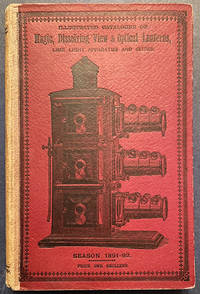
1891BB112<i>Magic Lantern Catalogue<br /></i><br /><b><i>Illustrated Catalogue of Magic</i></b> Dissolving View & Optical Lanterns Lime-light Apparatus and Slides. <br /><br />Rare generic trade catalogue for the entire industry almost certainly <br /><br />London 1891-92 but without imprint. <br /><br /><i>Wood-engraved illustrations of magic lanterns accessories and occasionally the projected image. <br /></i><i><br />8vo. 352 pp. with </i><i>detailed listings of sets of slides all with prices and various types of magic lanterns with optical projections a few pages browned pp 44/45; </i><i>original pictorial cloth lettered in black a little rubbed front cover beginning to warp. </i> No imprint, hardcover
1885WRCAM37786Providence: What Cheer Print 1885. Broadside 29 1/4 x 10 1/2 inches. Accompanied by 6 1/2 x 8 1/4-inch wood engraving signed by Jackson's Print. Printed on inexpensive advertising paper now a light brown tone. Three minor holes one barely affecting the image. Very good. A marvelous and extremely rare example of late 19th-century American advertising ephemera for Prof. H.B. Reynolds "the world renowned sorcerer necromancer and magician." The wood engraving shows the Professor on stage with a few of the elements to be seen during his performances including demons birds and cards in various stages of flight; a boiling cauldron; two separate card displays; and a table with three objects used in the act including an additional demon's head. The text of the broadside which is nearly two and a half feet in height details the wonders the audience will see. These include "original and more marvellous illusions than was sic ever performed by the Ancient Egyptians or the Necromancer of India.The wonderful power of producing realities from nothing and commanding articles to be constructed from the ashes of the earth.His marvellous power of conjuring is manifested by merely asking for or moving his hand that his desires are complied with." Reynolds also claimed to be "cabalistic in his superiority of multitude of mankind allowing himself to be bound with 100 feet of cord in the hands of the most expertitious in knot tying; when in a moment of unseen gesture he frees himself from the cords that bound him and is found within the silent enclosure of a structure whose walls have been permanently secured with screens and nails locked and sealed and bound with ropes." <br> <br> Although much detail is provided regarding Reynolds' skills and attributes the actual place of performance is not indicated. Space was intentionally left blank for the name of the venue to be added when available but the price of admission "15 and 25 cts. Children under 10 years 15 cents" and performance times "Doors open at 7 p.m. Oracles 8 p.m." are noted. Printed in Providence the name of the printing house What Cheer Print is derived from the Narragansett Indian's greeting to Roger Williams in June 1636 "What cheer Netop" friend. <br> <br> A fascinating example of late 19th-century American advertising ephemera. Extremely rare not in OCLC but one copy in the Smith Magic Collection at Brown University. What Cheer Print unknown books
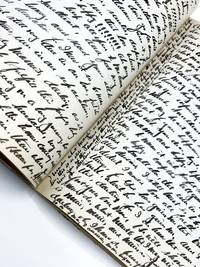
191745784Ithaca NY: n.p. 1917. Very good plus. Original manuscript journal containing the wildly ardent lovelorn musings of "Magie" to "Margie" written while waiting for the finalization of Margie's divorce. To call "Magie's" love for "Margie" superlative would be an understatement: his writing in this journal is comprised of verbose expressions of fondness and adoration for her "the only blessed wonderful loyal fine sweet true adorable lovable precious beautiful altogether lovely incomparable perfect little woman in God's great universe whom I ever have ever can really love!!!!!!!!!" Magie's enthusiasm even bleeds into the margins of some leaves where he has written additional missives around the main text. <br /> <br /> Who is the lovesick "Magie" the author of this manuscript journal that positively oozes with pent-up emotion and who is the "Margie" for whom he so desperately pines Magie's remark that "our marriage . will be so far different from the marriages we knew that they will seem like a bad dream" as well as several references to the day when Margie will be "legally free" to "give and receive" love indicate that both parties had been married previously and that Margie was likely still in the divorce process or the remarriage waiting period when this journal was written. The US divorce rate in 1917 was just 1.2%; this borderline-taboo action often had dire social consequences for the parties involved particularly the women and a state- or self-imposed period of waiting before remarriage was not unusual. Magie apparently spent this separation in varying degrees of agony emptying his evidently very full heart into this journal almost every day from May 28th to July 22nd. <br /> <br /> The lovebirds remain somewhat elusive in official records despite several tantalizing pieces of information nestled within Magie's lovelorn ramblings: references to "this fearful year" which in addition to a mention of a state military census pins the date of this journal pretty convulsively to 1917 which was "three quarters of the way through" by July 19th his occupation as a lawyer and the address 302 N. Cayuga Street a location Magie calls "our office". That address is sometimes listed as the location of a local Ithaca restaurant The City Cafeteria but more frequently as the longtime residence of prominent citizen and noted Wordsworth collector - her collection was donated to Cornell Cynthia Woodward Morgan St. John. Her son Edward Morgan St. John Cornell 1911 Cornell Law 1913 did work as an attorney and in the records of his 1919 marriage to Ruth Cronk he lists at least one and possibly two previous marriages though we find only a 1910 marriage to Lena Marie Smith. Cronk however does not. Which suggests perhaps sadly that "Margie" if she existed at all did not get her happily ever after. Nevertheless a compelling document overall and a vivid vernacular portrait of limerence. 10.25'' x 7.5''. Original cloth-backed marbled boards with printed label to front board hand-lettered "I". 94 manuscript leaves written both recto and verso. Boards with light edgewear. Hinges a touch cracked. Tight and clean. n.p. unknown
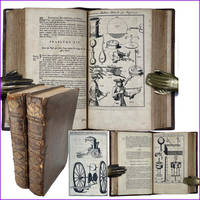
169628<p>the forerunner of mathematical recreations and its use in the art of illusionism and magic</p><p>an early manual for the first "mentalists"</p><p>Ozanam Jacques<strong>.</strong> <em>Recreations mathematiques et physiques VOL I. </em>Amsterdam: Gallet 1696.</p><p>Togheter with</p><p>Ozanam Jacques<strong>.</strong> <em>Recreations mathematiques et physiques VOL II. </em>Paris : Jombert 1696.</p><p>2 volumes in 8vo 188x120 mm contemporary calf with gilt decorations at spine pp. 16 265 1; 266-583 25 the last is blank. Engraved title-page.</p><p>Second edition of the forerunner of modern books on mathematical recreations including illusionism mentalism fireworks conjuring sundials and clocks.</p><p>84 engraved folding plates 45 first Vol. 39 second that support the solution of mathematical arithmetic geometric optical or cosmographic problems or that visualize the mechanism of a clock.</p><p>Scarce second edition 1st published in 1694 of the first work on recreational mathematics. This is one of the most popular books on the subject dealing among the other subjects with fireworks conjuring and presenting in vol. 2 a translation of Domenico Martinelli's treatise on clocks printed in Venice in 1663 p. 473</p><p>The volumes are divided into 9 topics</p><p>Vol 1: 1 Arithmetic 2 Geometry 3 Optics 4 Gnomonics and 5 Cosmography.</p><p>Vol 2 6 Mechanics 7 Pyrotechnics 8 Physics and 9 the translation Martinelli treatise on Watches.</p><p>For each topic Ozanam presents a series of problems with the various possible solutions described and often illustrated</p><p>Among the problems of mechanics Ozanam describes and illustrate a form of transport that foreshadows the automobile: behind the driver who holds reins in his hands stands a valet who activates with his feet two spring-loaded boards giving the carriage its impetus playing the role of a modern engine.</p><p>Most of the chapter about arithmetic is dedicated to the art of illusionism and mathematical games. A long chapter is dedicated to magic squares from pp. 36 on but many are the tricks described always in the form of a problem/solution which today are attributed to a kind of illusionism called <strong><em>mentalism</em></strong> a form of illusionism whose practitioners through techniques such as <em>cold reading</em> or <em>hot reading</em> give the illusion of being able to read others 'minds demonstrating supernatural or at least highly developed mental and intuitive ability.</p><p>In their performances mentalists give the impression of being able to exercise telepathy clairvoyance divination precognition psychokinesis mediumship mind control hypnosis prodigious memory and rapid mental calculation.</p><p>Among the games described in the text that can be accounted under this category we remember for example:</p><p>Problem XII: Thrown two dice how to guess the values on the top two sides without looking at them.</p><p>Problem XIV: Guessing a number that someone has chosen by asking him questions</p><p>Problem XVI: Guessing a number someone has chosen without asking them questions</p><p>problem XX: Guess how many coins a spectator hides in his hands</p><p>Problem XXVIII: Given three known playing cards and three spectators guess which card each one has chosen.</p><p>problem XXXI: Among different cards arranged on three decks how to guess which one the spectator has chosen</p><p>and many others.</p><p>Jacques Ozanam 1640 - 1718 was a French mathematician.</p><p>Although his father pushed him toward an ecclesiastical career he was much more attracted by science and mathematics that continued to study as a self-taught. At the age of 15 he was able to write a treatise on mathematics but his father induced him to enroll in courses in theology despite his little inclination for the priestly life. After four years of theological studies his father died and he returned to scientific studies.</p><p>In 1670 he published trigonometric and logarithmic tables more accurate than the existing Ulacq Pitiscus and Briggs works and numerous and well received mathematical publications.</p><p>In particular he had great success with <em>Dictionnaire mathématique</em> the five volumes of the <em>Cours de mathématiques</em> and <em>Récréations mathématiques et physiques </em>; his manuscript entitled <em>Les six livres de l'Arithmétique de Diophante augmentés et reduits à la spécieuse</em> received commendations from Leibnitz himself.</p><p><em>Récréations mathématiques et physiques</em> was also successful in the English translation and is still well known and looked after today.</p><p>He was elected a member of the <em>Académie Royale des Sciences</em> now <em>Académie des Sciences </em>in 1701. The death of his wife plunged him into deep sorrow and the loss of his foreign pupils through the War of the Spanish Succession reduced him to poverty.</p><p>Conditions: light marks of use at bindng in general very good condotions</p><p>Provenance: Paper ex-libris pasted at title page of both volumes " Engeg. Gio Battisa Carraca.</p>
in-4, pp. (26), 268, (1) bianca. Al frontespizio marca tipografica, capilettera istoriati e testatine xilografici, frontespizio anticamente restaurato: la porzione superiore contenente il titolo è stata elegantemente vergata in inchiostro bruno su un foglio antico sulla cui parte inferiore fu applicata la marca di Giolito originale impressa a stampa. Legatura coeva in pergamena floscia, sul dorso liscio titolo manoscritto. Prima edizione di un'opera resa affascinante dal suo contenuto e dalla sua storia testuale. Si tratta di un trattato sullo scibile umano, i temi spaziano dall'aritmetica, alla filosofia, alla politica, all'economia fino alle arti magiche. Ma l'opera, libera traduzione della Vision deleytable de la philosophia y artes liberales dello spagnolo Alfonso de la Torre, subì accuse di vero e proprio plagio: leggenda vuole che il figlio di Delfino avrebbe trovato il manoscritto originale spagnolo e, dopo averne curato la traduzione, avrebbe attribuito l'opera al padre senza fare alcun riferimento allo scrittore quattrocentesco spagnolo. Gli stessi spagnoli dimenticarono la vera paternità del trattato, ristampando l'opera con il nome di Delfino. Testo sicuramente accattivante, "essendo steso nella forma ora affatto inusitata d'una visione, dove l'intelletto e l'ingegno, percorrono per vie generali tutto lo scibile divino ed umano; con molte altre allegorie e sogni..." (Bongi). Buon esemplare, arrossature e fioriture marginali, gore al margine superiore di alcuni ff. Sul recto del foglio di guardia ex libris mss. di Giovanni Andrea Rovetti (poeta italiano attivo tra il 1600 e il 1637, autore del Mormorio d'Elicona: poesie divise in Vaghezze amorose, Diporti pastorali, Soggetti eroici, Echo supplicante, Pompe nuziali, Teneri affetti, Duelli festini). Al titolo antica nota in inchiostro evanescente; iniziali O.S. impresse al piatto ant. della pergamena.. Bongi I, pp. 503-5. Riccardi I, 402: «Bella e rara edizione». . Smith, Rara arithmetica, p. 275. Biblioteca magica Casanatense, 1263. Olschki, Coix VI, 6429. Ebert, 23039. Cantamessa, III, n. 8059: ''prima edizione in italiano e prima edizione attribuita a Domenico Delfino''. Bongi I, pp. 503-5. Riccardi I, 402: «Bella e rara edizione». . Smith, Rara arithmetica, p. 275. Biblioteca magica Casanatense, 1263. Olschki, Coix VI, 6429. Ebert, 23039. Brunet V, 887. Cantamessa, III, n. 8059: ''prima edizione in italiano e prima edizione attribuita a Domenico Delfino''. .
17612-0-28Frankfurt und Leipzig, o.V. (Stahel), 1761. 8°, 4 Bll., 600 S., Ldr. d. Zt
In folio (38×23,7 cm); (28), 746 (i. e. 742), (62) pp. Legatura in mezza pergamena del primo novecento con piatti foderati con carta a motivi viola e verdi. Titolo e anno impressi in oro su fascetta in pelle ad un tassello. Dorso a 5 nervi. Come in tutti gli esemplari, durante la stampa del volume, sono state saltate nella numerazione le p. 116-117 e 727-728. Titolo in rosso e nero. Magnifica incisione al piatto anteriore delineata dal pittore olandese della scuola fiamminga che fu uno dei migliori allievi ed assistente di Rubens, Abraham van Diepenbeke (1596–1675) ed incisa da Peter Clouwet (1629-1670), raffigurante l’ingresso del giardino d’“Elysian”, fiancheggiato a sinistra da una donna con sette seni, sotto due studiosi (uno in possesso di un rotolo) e la parola “Natura”, e sulla destra da una donna che tiene un globo, sotto due uomini che conversano e la parola “Ars”, a significare che il percorso verso l’”Elysium”, o il paradiso è attraverso la convergenza di arte e natura. Sopra l’ingresso, che sembra essere un’apertura nel terreno o la bocca di una grotta, siedono dieci donne, delle quali, due suonano strumenti. Un cavallo alato spicca il volo nell’angolo in alto a destra dell’immagine alto a destra. Testatine, iniziali e finalini xilografici. Esemplare ancora in barbe. Alcune pagine leggermente ed uniformemente brunite a causa della qualità della carta e nel complesso esemplare in buone-ottime condizioni di conservazione. Prima rara edizione (una seconda edizione venne edita nel 1670) di questo studio di interesse medico, farmacologico ed alchemico scritto dal noto medico e fisico portoghese nato ad Evorà ma che lavorò a Carmona, l’odierna Sevilla. L’opera, divisa per domande, tratta di temi differenti: Aristofane, Virgilio, Galeno, Ippocrate, Platone, corona spagnola, sul cadavere umano, “daemones morbos”, Vergine in un chiostro, urine, il termine tubercolosi e ostetricia “obstetrices”, Nudipedalia, mutazione dei genitali maschili e femminili, la sterilizzazione animale, vari tipi di occupa di febbre come “Elodes, Thyphodes [tifo], Crymoides, Tritaeophiae, querzerae, Phricodeis, Assodes, Almyrodes, Pemphigodes, [e] Tarachodeis. ” e tanti altri temi legati alla medicina, alla farmacologia, all’alchimia e alla fisica. La domanda 94 discute i poteri di una pozione basata su una miscela di latte e vino, forse in riferimento a Plinio il Vecchio. Nell’opera appare anche la parola “Abracadabra”. L’opera appare nelle bibliografie alchemiche perché tratta di vari argomenti legati alla magia, a guarigioni legate a particolari proprietà magiche di alcune piante e minerali e dei Bezoar, le pietre rinvenute negli stomaci dei alcuni animale e che si credeva avessero proprietà magiche. L’opera contiene anche la descrizione di diversi casi medici seguiti da Franco a Carmona, l’odierna Sevilla. Diôgo Barbosa Machado & Bento José de Sousa Farinha, Summario da bibliothecaluz …, Lisboa, 1786-87, v. II, p.168) scrive riguardo a quest’opera: “A remarkable example of the penchant for the bizarre in mid-seventeenth-century medical literature is the much-cited anthology of near-miraculous historiae excerpted and collected by the Portuguese physician Gaspar de los Reyes Franco” (Pomata, p. 134). In Penzer si dice “The idea of poisonous breath,” prevalent in literature in the form of the poison-damsel story, is claimed by numerous medieval medical and pseudo-medical practitioners, such as Peter of Albano, the Jesuit del Rio, Michael Bapst, Wolfgang Hildebrand and Gaspar de los Reyes” (Penzer, p. 41). Rif. Bibl.: Krivatsy, NLM, 9595; Penzer, Norman Mosley. Poison-Damsels. Manchester, NH: Ayer, 1980; Pomata, Giana. Historia: Empiricism and Erudition in Early Modern Europe. Cambridge, MA: MIT Press, 2005. Not in Wellcome. Not in Duveen, Ferguson, Partington or Thorndike.
In-8 p. (mm. 204x150), p. pelle coeva (lievi abras.), dorso a cordoni con titolo oro su tassello dipinto (piccole manc. alle cuffie), cc.nn. 20, pp.num. 787, ornato da grandi iniziali e finali inc. su legno. L’opera divisa in “diece appartamenti, secondo i vari & ammirabili oggetti, cioè di mostri, prodigii, prestigii, sorti, oracoli, sibille, sogni, curiosità astrologica, miracoli in genere e meraviglie, narrate da’ più celebri scrittori e descritte da’ più famosi historici e poeti, le quali talhora occorrono, considerandosi la loro probabilità, ovvero improbabilità, secondo natura.. Con tre copiosissime tavole“. "Prima edizione postuma", uscita a cura del fratello Bartolomeo, di un’opera “sorpendente e bizzarra usata a illustrare argomenti strani e inusitati e con gusti e modi che preannunciano il Seicento.. di Tommaso Garzoni da Bagnacavallo (1549-1589), uomo assai colto, avidissimo ricercatore e collezionista di dati, notizie e aneddoti del più vario genere..” (così Diz. Opere Bompiani, p. II,29). Cfr. Graesse,III,32 - Parenti p. 253 - Caillet,4352 bis. Corto di margini, con pagine brunite o arrossate interc. nel t., due macchie margin. a p. 593, ma complessivam. buon esemplare.
520931Chamuel - Bibliothèque Chacornac Paris 1897 Fort in-8 ( 215 X 145 mm ) de 808 pages, demi-basane fauve marbrée, dos à nerfs janséniste, couvertures conservées. Nombreuses illustrations dans et hors-texte. EDITION ORIGINALE à la bonne date de 1887, exemplaire de remise en vente avec une nouvelle couverture ( Bibliothèque Chacornac ) et papillon collé sur la page de titre "Bibliothèque Chacornac" sur la mention Chamuel. Bel exemplaire. De la bibliothèque Gilbert TAPPA ( Ex-Libris ).Caillet, 4809. - R.Y Plessis, 894.
Tre tomi in 8° (cm 12,6 x 20), belle legature piena pelle coeve, piatti incorniciati da motivo a dentelle dorato, al centro dei piatti anteriore e posteriore, grande monogramma "RDG", dorsi con doppi tasselli e fregi in oro; pp xvi, 375 per il primo tomo; vii, 410 per il secondo; (5), 408 per il terzo. Il primo vol. corredato di 32 incisioni in rame, il secondo di 48, il terzo di 22. Esemplare in buone condizioni, il dorso del primo tomo con piccole mancanze di pelle , uniformi lievi bruniture . Affascinante trattato di esperimenti attinenti alla scienza e alla magia: magnetismo, elettricità, geometria, matematica, ottica, fisica, chimica (esperimenti con fuoco, aria e acqua), numerologia, meccanica, scrittura occulta, corredato di tavole illustranti gli esperimenti con dovizia di realistici utensili e strumenti, associati a grotteschi e simbolici particolari, quali amorini alati e animali fantastici. Illustrazioni nel testo e tabelle schematiche. Un esemplare censito in CCFr. Caillet n. 4900 per altre ediz. "Recueil infinement plus complet que tous ceux parus depuis..."
20449Anvers, Hevdrick Connix, 1584. In-4, [12]-653-[23] pp. (*4, **2, a-z4, A-Z4, Aa-Zz4, Aaa-Qqq4; Qq4 est 1 f. bl.), parchemin souple ivoire, dos long, titre manuscrit au dos, traces de liens (liens manquants, restaurations, taches, importantes mouillures sans dommage pour la lecture, taches).
1839303248-1Stuttgart, Scheible 1839. Kl.8°. 376; 342; 324; 340; 338; 342 S. Mit lithogr. Porträt u. 46 lithogr. Tafeln. Marmor. Pappbände d. Zt.