15 962 résultats
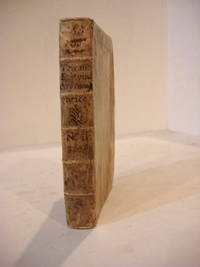
15641907280011Genevae : Ex officina Francisci Perrini M.D. LXIIII 1564. First Edition. Hardcover. Good. Calvin's 16th century commentary on the book of Joshua and Beza'z Biography of Calvin Bound in contemporary vellum. Some soiling to cover. Octavo. 32 316 p. Printer's woodcut device on title-page. Slight worming in inner margin towards beginning not affecting text. Bookplate of Duncan Shaw and early inscription of Franciscus Saluardus. Calvin's last work. Includes the Latin translation Theodore de Besze's Life of Calvin. Adams C280. The French edition was printed in 1565. Genevae : Ex officina Francisci Perrini, M.D. LXIIII hardcover
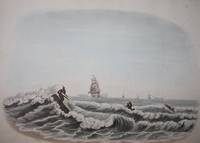
185128441New York: Nagel & Weingaertner 1851. Hand-coloured lithograph after Hanson titled below the image. Expert restoration closing tears. The first America's Cup: a rare hand coloured lithographed view of the winning yacht which gave its name to the cup.<br/> <br/> In 1851 the Royal Yacht Squadron proposed a race around the Isle of Wight. A group of New York Yacht Club members led by Commodore John Cox Stevens built a yacht designed to compete in such races. Designed by Steers and Co. and captained by Richard Brown the yacht America would win the race by eighteen minutes giving its name to one of the oldest and best-known trophies of the sport: the America's Cup. This lithograph and lithographer are not recorded by Harry T. Peters; we find no other extant examples of this rare print.<br/> <br/> For Nagel and Weingaertner see Peters America on Stone pp. 291-294. Nagel & Weingaertner unknown
185128441New York: Nagel & Weingaertner 1851. Hand-coloured lithograph after Hanson titled below the image. Expert restoration closing tears into the image. The first America's Cup: a scarce hand coloured lithographed view of the winning yacht which gave its name to the cup.<br/> <br/>In 1851 the Royal Yacht Squadron proposed a race around the Isle of Wight. A group of New York Yacht Club members led by Commodore John Cox Stevens built a yacht designed to compete in such races. Designed by Steers and Co. and captained by Richard Brown the yacht America would win the race by eighteen minutes giving its name to one of the oldest and best-known trophies of the sport: the America's Cup. This lithograph and lithographer are unrecorded by Harry T. Peters; we find no other extant examples of this rare print.<br/> <br/>On Nagel and Weingaertner see Peters America on Stone pp. 291-294. Nagel & Weingaertner unknown books
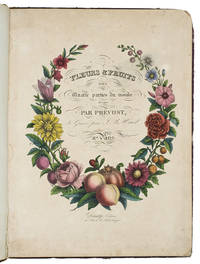
1837ABC_47224Paris 1837. Folio ca. 35 x 26.5 cm. Dauty Contemporary half sheepskin maroon watered silk sides title in gold on the front board. With an engraved title-page and 11 of 23 engraved botanical prints: 4 showing 5 kinds of fruits each 3 showing 9 types of flowers each and 4 showing flower bouquets. All prints are stipple engravings and coloured by a contemporary hand some parts glazed with egg white. 12 ll. Extremely rare botanical print series showing both European and exotic fruits and flowers engraved by Jean-Baptiste Huet the younger 1772-1852 after designs of Benoît-Louis Prévost 1735-1804 or Jean-Louis Prévost 1760-1810. It also includes four plates showing bouquets from Europe America Asia and Africa. Only one complete copy is known at the Bibliothèque nationale de France we have traced no copy in sale or auction records and it is not mentioned in the usual botanical bibliographical works. The BnF copy is described in the Inventaire du fonds français après 1800 where the series consists of 23 prints issued all together under this title. The BnF and the IFF date the work ca. 1837-1839 but it is more likely that it is ca. 1837-1838 as Dauty died in 1838 and he printed at Rue de Bibliothèque no. 16 only in 1827 and 1835-1838. The BnF ascribes the designs for the prints to Benoît-Louis Prévost but Jean-Louis Prévost remains a possibility for he produced another famous print series of flowers and fruits in the same style of stipple engravings Collection des fleurs et fruits 1805.With a contemporary inscription "A M.elle Vincent" on the first free endleaf dedicating it to or belonging to the famous French 19th-century botanical painter Henriette Vincent 1786-1834 who was a student of Gerard van Spaendonck and Pierre-Joseph Redouté. Head and foot of the spine damaged and spine slightly worn boards a little rubbed edges slightly worn corners bumped. Some light browning and foxing throughout title-page a little more browned and with a light marginal water stain. Lacking 12 plates according to IFF. Otherwise in good condition. An extremely rare botanical print series vividly hand-coloured.l BnF FRBNF40503621; IFF Inventaire du fonds français après 1800 Huet p. 518; not in Nissen BBI; Pritzel; Stafleu & Cowan. hardcover
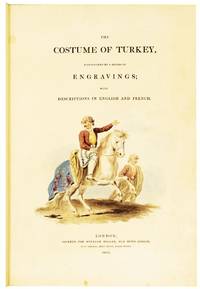
18026160<p>"ONE OF THE BASIC WORKS ON TURKISH COSTUME" ATABEY</p><p>Folio 35 x 24.4 cm. Hand-colored vignette title-page in English followed by title-page in French; preface in English and French 8 pp; table of contents in English and French 2 pp.; and 60 hand-colored stipple engravings many on paper with watermarks dated 1796 after Octavian Dalvimart and engraved by John Dadley or William Poole the title-page vignette by R. Jones; each engraving always printed on the verso with facing description page English on recto and French on verso. Occasional light spotting and off-setting from plates to the facing description; plate 1 and tissue guard bound at the beginning preceding English title-page. Early 20th-century red straight morocco by Bayntun-Rivière their stamp in upper left-hand corner of front flyleaf blind- and gilt-stamped tooling on boards turn-ins and spine marbled endpapers; some rubbing but generally excellent.</p><p>First edition with watermarks dated 1796 of "one of the basic works on Turkish costume which has provided the prototypes for numerous other illustrative material" Atabey. Dalvimart's vivid plates primarily depict the vibrant attire of the ruling classes and their servants but they also showcase traditional garments—especially those worn by women—from the extensive territories of the Ottoman Empire at the time encompassing regions such as Bosnia Albania Greece Syria and Egypt.</p><p>Octavian Dalvimart remains a somewhat enigmatic figure. He appears to have been active as an artist and engraver in England and France in the early 19th century. According to the preface he traveled to Athens in 1797 and Turkey in 1798 where he created the original drawings for the plates consistently sketching from life. The characters are precisely drawn and handsomely depicted in vivid colors. The accompanying descriptive text is sometimes attributed to William Alexander drawing heavily from the published accounts of Turkey by James Dallaway 1797 Baron de Tott who resided in Constantinople for many years until 1790 and other sources. This first edition was followed by subsequent editions in 1818 and 1820.</p><p>Little is known about the two engravers John Dadley 1767–after 1807 who worked in London and William Poole active 1803-1807. R. Jones active early 19th century exhibited at the Royal Academy from 1780 to 1812.<br /><br /> Abbey Travel 370; Atabey 312; Blackmer 444 ca. 1820 impression Colas 782; H. Hiler Bibl. of Costume 1939; Lipperheide 1422; Vinet 2337; Bénézit III p. 317 Dadley III p. 335 Dalvimart and VI p. 95 Jones no entry for Poole.</p> London, Printed for William Miller, Old Bond Street, by T. Bensley, Bolt Court, Fleet Street hardcover
1636D6036Rome: Typis S. Cong de propag: Fide 1636. Hardcover. Very Good. 4to 230 x 170mm. xxiv 338pp. ii. Illustrated throughout with woodcut tables and charts of Egyptian characters and hieroglyphs. Contemporary vellum; intermittently browned occasional spots. <br/><br/>Father Athanasius Kircher was a 17th-century German Jesuit scholar and polymath who published around 40 works most notably in the fields of oriental studies geology and medicine. He was heralded as possessing the secret of deciphering hieroglyphics and was widely regarded as the physical embodiment of all the learning of his age. He had over 760 correspondents including scientists Jesuit missionaries and world potentates and wrote about an enormous range of interests ranging from optics to music from Egyptology to magnetism. Perhaps best known of his correspondents is Jan Marek Marci of Kronland 1595-1667 for sending Kircher a mysterious illustrated manuscript written in an unknown script famously known today as the Voynich Manuscript. In 1635 Kircher began to write his book Prodromus Coptus Introduction to Coptic Language and in the autumn of 1636 the book was printed. Kircher saw the ancient languages as an essential foundation for any pious philosophy. Kircher envisioned Rome as a unique center within to unlock the mysteries of Hermetic knowledge inscribed on the obelisks. The project of restoring Egyptian wisdom entailed nothing less than an effort to renovate the lost arts of communication that linked divine and human languages. Unfortunately while in other disciplines he made valuable discoveries his explanation of hieroglyphs was absolutely incorrect. We can probably explain it by his passion that might have sometimes blinded his reasoning. Yet Kirchers Prodomus remains an important study from a most respected scholar. Brunet III 668; Caillet II 5790. Typis S. Cong de propag: Fide hardcover books
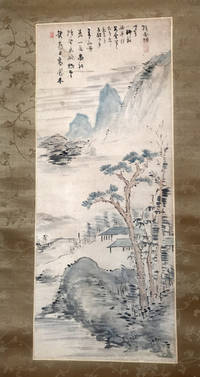
90223Rai KyÅhei é ¼äº¬å¹³ aka ShunsÅ or Manshiro artist. Kakemono 掛ã‘物 - Hanging Scroll Landscape. N.p. n.d. Landscape painting of a mountain scene with pine trees. Hanging scroll kakemono 掛ã‘物 beautifully mounted on brocade with black wooden jiku handles. Image size 44.7x18.4cm with 49.5cm silk fabric at top 26.5cm at bottom and borders of approx 5-5.5cm on either side.<br /> <br /> Rai KyÅhei é ¼äº¬å¹³ c.1756-1834 was an influential Confucian scholar and the uncle of the famous kanshi poet Rai SanyÅ. Sanyo was known for TÅjun KagetsuchÅ å旬花月帖 Journal of Flowers in 100 Days/ A Few Brief Moments Describing Moon and Flowers a collaborative work of poetry with floral and landscape paintings created after a three month walking tour through central Japan with his nephew and mother in the 1820s. The three poets and their entourage were influenced by the lyrical scenes of nature observed in Kyoto and Nara during their travels. This scroll is likely inspired by that period of travel and reflection in nature.<br /> <br /> Slight foxing on the image. Encased in a wooden scroll box 40.7 x 6.4cm with artist’s name brushed on label laid down on end of box. unknown
1961014593Alès PAB 1961 In-8 carré Pleine reliure d'époque Signé par l'auteur et l'illustrateur
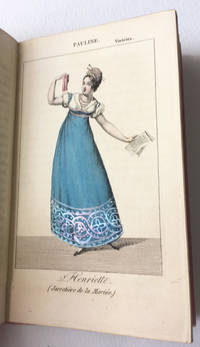
1818Flo136<p>Very rare complete set of all 8 volumes of this review of French theatre in the years 1818-1824.</p><p>All eight years of publication complete with 8 handcolored engraved title pages and over 90 finely handcolored engraved portraits of actors actresses opera singers ballet dancers and comedians in costumes of their famous roles.</p><p>"Very interesting almanac attributed to Charles Malo or Francois-Adolphe Loeve-Weimars giving a summary of Parisian and provincial theaters reviews on the plays and their performers notes on debuts repertoires etc." Grand-Carteret<em> Les almanachs français</em></p><p>Includes portraits of sopranos Mme. Gavaudan and Angelica Catalini tenors Jean-Blaise Martin and Simon Cheard ballet dancers Emilie Bigottini Genevieve Gosselin Antoine Paul and Mlle. Clotilde child actress Leontine Fay actors Francois-Joseph Talma and Charles-Gabriel Potier and many more. Odd volumes turn up occasionally but it is very rare to find the complete set of this intriguing anecdotal overview of Parisian theatre from the first quarter of the 19th century.</p><p>Condition: All volumes in their pastel card slipcases paper bindings holding some spots of foxing to a few plates but overall very good with tissue guards. Complete with all engravings and calendars at end.</p><p>Charles Malo 1790-1871 was a French author editor and translator whose books included a series of gift books for women illustrated by Pancrace Bessa almanacs city guides battlefield guides etc.</p> Louis Janet paperback
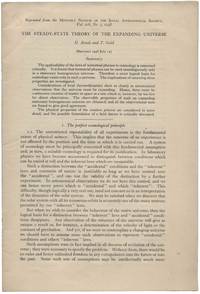
19484162London: Monthly Notices of the Royal Astronomical Society 1948. First edition. First edition the extremely rare offprint of the first published paper to propound the 'steady-state' model of the universe according to which the universe is expanding but unchanging with no beginning or end and in which matter is continually being created throughout space so that its average density remains constant. Hardcover. THE STEADY-STATE MODEL OF THE UNIVERSE. First edition the extremely rare offprint of the first published paper to propound the 'steady-state' model of the universe according to which the universe is expanding but unchanging with no beginning or end and in which matter is continually being created throughout space so that its average density remains constant. Bondi and Gold's Cambridge colleague Fred Hoyle published his own formulation of steady-state theory four months later in the same journal 'A New Model for the Expanding Universe' MNRAS Vol. 108 No. 5 pp. 372-382. Bondi Gold and Hoyle were led to steady state theory because of well-known problems associated with the then current evolving models of the expanding universe: such models predicted a cosmic age that was problematic less than the known age of some stars and they disliked Lemaȋtre's idea of a universe with an explosive beginning. Although the steady-state theory was eventually disproved by the discovery of the cosmic microwave background in the 1960s "Steady state was of enormous importance in the history of astronomy because it turned cosmology into a serious observational part of science by making predictions different from those of an evolutionary universe for which Hoyle coined the name big bang. The predictions included numbers sizes colors and brightnesses of galaxies at large distances compared to those near us" DSB under Gold. In 2014 an unpublished manuscript was discovered probably dating from early 1931 in which Einstein himself considered the possibility of a universe that expands but remains essentially unchanged his 'cosmological constant' being responsible for the continuous creation of matter from empty space O'Raifeartaigh et al. We have located only one other copy of this offprint at the Royal Society in London no copy on OCLC. No copies in auction records.</p> <br /> <p>"To the extent that there existed a standard cosmology in the late 1940s it was the evolutionary universe based on Einstein's field equations of 1917 either in the big bang version or the ever-expanding but no-bang Lemaître-Eddington version. In their discussions of 1946 and 1947 Hoyle Gold and Bondi agreed that an evolutionary universe governed by general relativity was unsatisfactory in whatever version. They concluded that an unchanging yet expanding universe was preferable and for this reason they postulated continual creation of matter to occur throughout space at such a rate that it compensated for the expansion and left the average density of matter constant the idea came from Gold. In early 1948 Gold and Bondi and independently Hoyle worked out their two formulations of the steady state universe.</p> <br /> <p>The theory presented in the 1948 Bondi-Gold paper was deductively founded on what they called the perfect cosmological principle the postulate that the universe is uniform not only spatially but temporally as well: it has always looked the same. This principle they claimed was a fundamental axiom from which physical results should be deduced; if theoretical extrapolations from experiments conflicted with the principle such as did the law of energy conservation they had to be rejected. Bondi and Gold consequently denied that the universe could be described by the energy-conserving theory of general relativity. Moreover they objected that relativistic cosmology was "utterly unsatisfactory" because it covered so many models and was based on so many free parameters that as a whole it could not be falsified observationally. In spite of the qualitative and philosophical flavor of their paper Bondi and Gold could prove that their theory led to a number of definite predictions including a specific rate of matter creation of about 10-43 g/s/cm3. It also followed from their theory that the metric of the steady state universe had to be of the De Sitter type a flat space expanding exponentially" DSB under Bondi.</p> <br /> <p>"There is a charming story not taken seriously by all historians about how steady state theory began. The idea came in 1947 Hoyle claimed when he and his fellow scientists Hermann Bondi and Tommy Gold went to a movie. The three knew each other from shared research on radar during World War II. Hoyle was versatile undisciplined and intuitive; Bondi had a sharp and orderly mathematical mind; Gold's daring physical imagination opened new perspectives. The movie was a ghost story that ended the same way it started. This got the three scientists thinking about a universe that was unchanging yet dynamic. According to Hoyle "One tends to think of unchanging situations as being necessarily static. What the ghost-story film did sharply for all three of us was to remove this wrong notion. One can have unchanging situations that are dynamic as for instance a smoothly flowing river." But how could the universe always look the same if it was always expanding It did not take them long to see a possible answer-matter was continuously being created. Thus new stars and galaxies could form to fill the space left behind as the old ones moved apart.</p> <br /> <p>"To many philosophical minds the steady-state universe proposed by Hoyle Bondi and Gold had a major advantage over the big-bang expanding universe. In their universe the overall density was kept always the same by the continuous creation of matter. In the big-bang universe with its radically changing density various physical laws might not apply the same way at all times. It would be impossible to extrapolate with confidence from the present back to the super-dense origin of the universe.</p> <br /> <p>"Steady-state theory also had an observational advantage over big-bang theory in 1948. The rate of expansion then observed when calculated backward to an initial big bang gave an age for the universe of only a few billion years-well below the known age of the solar system! That was certainly an embarrassment for the big bang theory.</p> <br /> <p>For some time cosmologists had measured ideas against a "cosmological principle" which asserted that the large-scale properties of the universe are independent of the location of the observer. In other words any theory that put we humans at some special place like the center of the universe could be rejected out of hand. Bondi and Gold insisted that the universe is not only homogenous in space but also in time-it looks the same at any place and at any time. They grandly called this the "perfect cosmological principle" and insisted that theory should be deduced from the axiom that we are not at any special place in either space or time.</p> <br /> <p>"Hoyle was less insistent that the perfect cosmological principle was a fundamental axiom. He preferred to have theory follow from a modification he proposed to Einstein's relativistic universe adding the creation of matter. The two different steady-state theories had enough in common however to be considered one for most purposes.</p> <br /> <p>"Much of the later development of steady-state theory came in response to criticism. In Great Britain especially scientists gave considerable attention to elaborating the theory. Their arguments were largely of a philosophical nature with little appeal to observation.</p> <br /> <p>"The cosmological debate acquired religious and political aspects. Pope Pious XII announced in 1952 that big-bang cosmology affirmed the notion of a transcendental creator and was in harmony with Christian dogma. Steady-state theory denying any beginning or end to time was in some minds loosely associated with atheism. Gamow even suggested steady-state theory was attached to the Communist Party line although in fact Soviet astronomers rejected both steady-state and big-bang cosmologies as "idealistic" and unsound. Hoyle himself associated steady state theory with personal freedom and anti-communism.</p> <br /> <p>"Astronomers in the United States found the steady-state theory attractive but they took a pragmatic approach. The rival claims of big-bang and steady-state theory must be settled by observational tests. One test involved the ages of galaxies. In a steady state with continuous creation of matter there would be a mixture of young and old galaxies throughout the universe. In a big bang with only an initial creation galaxies would age with time. And astronomers could look back in time by looking at more distant galaxies for observing a galaxy a billion light-years away meant seeing it in light that had left it a billion years ago. Observations reported in 1948 purported to find that more distant galaxies were indeed older. Score one for the big bang. Bondi and Gold reviewed the data carefully and in 1954 they showed that the reported effect was spurious. Score one for steady state. The age test might be able to distinguish between the rival theories in principle but in practice it could not.</p> <br /> <p>"Another possible test involved the rate of expansion of the universe. In a big bang the expansion rate would slow; in a steady state universe it would remain constant. Data from the Mount Wilson Observatory seemed to favor the big bang but not certainly enough to constitute a crucial test.</p> <br /> <p>"Meanwhile there was a solution to the embarrassing calculation that put the age of a big-bang universe less than the age of the solar system. Walter Baade showed that estimates of the distances to galaxies had mixed together two different types of stars. As a result the size of the universe had been underestimated by about a factor of two. If galaxies were twice as distant as previously thought then calculation with the observed rate of expansion gave an age of the universe twice as great as previously calculated - safely greater than the age of the solar system.</p> <br /> <p>"The most serious challenge to steady-state theory came from the new science of radio astronomy. Fundamental knowledge in the techniques of detecting faint radio astronomy signals advanced greatly during World War II especially with research on radar and especially in England. After the war research programs at Cambridge at Manchester and at Sydney Australia built radio telescopes to detect signals from outer space. They dominated radio astronomy for the next decade.</p> <br /> <p>"The program at Cambridge was led by Martin Ryle who in 1974 would receive the Nobel Prize in physics for his overall contributions to radio astronomy. In 1951 Ryle believed that radio sources were located within our galaxy and hence were of no cosmological interest. But over the next few years he became convinced that most of the radio sources he was detecting were extragalactic. His observations then could be used to test cosmological models. Ryle argued that his survey of almost 2000 radio sources completed in 1955 contradicted steady-state theory because more distant/older sources seemed to be distributed differently from nearby ones. But he overstated the significance of his initial data. Only after more years of work would radio observations argue strongly against steady-state theory" American Institute of Physics ;/a>.</p> <br /> <p>Both Bondi 1919-2005 and Gold 1920-2004 were born into Jewish families in Vienna but left Austria shortly before the Anschluss. Bondi was admitted as a foreign student at Trinity College Cambridge where he arrived in the fall of 1937; Gold became an undergraduate student at Trinity in the following year. In 1940 the British government concerned about possible fifth columnists interned many Austrian and German émigrés as enemy aliens. Thus it was that Bondi and Gold who did not previously know each other met as internees in a camp in Quebec Canada where they soon became close friends. The slightly more senior camp resident Max Perutz organized an informal "school" at which the young students could teach each other. Bondi's extraordinary mathematical skills and Gold's outstanding physical insights soon became obvious and complementary. Bondi and Gold did not return to England until 1942.</p> <br /> <p>Hoyle 1915-2001 entered Emmanuel College Cambridge in 1933 and went on to do graduate work in theoretical physics under Rudolf Peierls and Paul Dirac. In 1939 he secured a fellowship at St. John's College Cambridge. In 1940 the Admiralty the British government department responsible for the Royal Navy recruited Hoyle for theoretical research on radar. As director of the theory division at the radar establishment Hoyle recruited Bondi in June 1942 and on Bondi's advice in October 1942 Hoyle brought in Thomas Gold. Bondi Gold and Hoyle shared a small rented house close to their place of work spending their evenings and weekends debating problems in astrophysics. All three returned to Cambridge in 1945 and from 1947 they started to work together on cosmology.</p> <br /> <p>O'Raifeartaigh et al 'Einstein's steady-state theory: an abandoned model of the cosmos' European Physical Journal 39 353-367. For a very detailed account of the Bondi & Gold and Hoyle papers see Kragh Cosmology and Controversy 1996 pp. 162-201. The Einstein manuscript on a steady-state universe is 'Zum kosmologischen Problem' Albert Einstein Archive Online Archive No. 2-112 <br/> <br/> Offprint from: Monthly Notices of the Royal Astronomical Society Vol. 108 No. 3 1948. 8vo pp. 252-270. Stapled as issued in self-wrappers. / Hardcover. Monthly Notices of the Royal Astronomical Society unknown
1806004050London: G. and W. Nicoll spelled on the plates with one "l". Printed by Bunney and Co. 1806. Half Leather Marbled Boards. Very Good Minus. Folio 34.5 by 27.5 cm. Only 25 of 49 hand-colored aquatint plates but including several of the most interesting of plates including the Cattamarans -- possibly the earliest depiction of surfing -- a Gentoo Zealot Snake-Men Plates are watermarked 1798 to 1801. A few bear no date. Abbey Travel 428. Rebacked with most of original spine preserved and laid on missing lower compartment. The surviving spine is rubbed cracked and dry but nonetheless a plus to have. Marbled boards are rubbed and worn. Corners are heavily rubbed and abraded. Hinges restored. Scattered light soiling and a few minor closed tears. <br/><br/> G. and W. Nicoll (spelled on the plates with one "l"). Printed by Bunney and Co. hardcover books
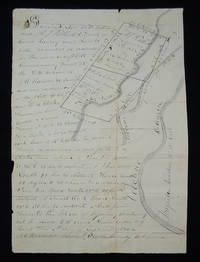
185268368Placer County California 1852. GOLD RUSH. Gold Rush Map Manuscript. Being a Survey for the adjoining plots of land belonging to H.H. Watson and A.J. Polhill. Placer County California: 1852.<br> <br> Two pages on a single sheet 17 1/8 x 10 7/8 in.; 438 x 275 mm. Manuscript document with map dated variously between 4-24 September 1852 and signed by H.H. Watson A.J. Polhill and others. Sheet with some mild staining and ink blots. Some minor chipping at edges and some separations at the creases. Creases reinforced with nearly invisible tape. Overall a very interesting piece of gold rush history. We could not find any other California mine surveys at auction in the past 50 years.<br> <br> "Survey for H.H. Watson and A.J. Polhill. A Tract of land laying near ville bounded as described in the annex plot commencing point as the S.W. corner of J.H. Hancock survey." "Survey made by N.O. Hinman County Surveyor."<br> <br> "In the present survey the tracts of land being issued to Watson and Polhill are bounded on the right by the Volcano Mining Company Ditch and Volcano Canion sic with the Todds sic Valley Company Ditch running through each plot. The Volcano Gold Gravel Mining Company was one of the most extensive gravel mines during the Gold Rush and hundreds of acres of valuable mining lands were drained by its enterprises. Placer County falls in both the Sacramento Valley and Sierra Nevada regions in what is known as the Gold Country. The discovery of gold in this region in 1848 brought tens of thousands of miners from around the world and thousands more settled in the area to provide goods and services to them. The name "Placer" is taken from the Spanish word for gravel or sand deposits containing gold." From Sotheby's.<br> <br> HBS 68368.<br> <br> $3500. Placer County, California unknown
1963C1354Program for the First Piatigorsky Cup: International Grandmaster Chess Tournament July 2 to 27 1963 48 pages with photographs including photographs of the contestants table and diagrams. Octavo 8 1/2" x 4 1/2" bound in original publisher's spiral binding in blue felt wrappers with black and silver Piatigorsky Cup stamped to cover. Included nine first day tickets for the cup. Signed or inscribed by all the contestants to Mrs Piatigorsky. <br /><br />The Piatigorsky Cup was a triennial series of double round-robin grandsmaster chess tournaments held in the United States in the 1960's. Sponsored by the Piatigorsky foundation only two events were held in 1963 and 1966. the Piatigorsky Cups were the strongest U S Chess tournaments since New York 1927. Jacqueline Piatigorsky was married to cellist Gregor Piatigorsky. One of the strongest woman chess players in the U S and a regular competitor in the U S Women's Chess Championship she designed the cup and was the primary organizer of the tournaments. The prize funds were among the largest of any chess tournament up to that time. Every player was guaranteed a prize and all traveling and living expenses were paid. The First Piatigorsky Cup was held in the Ambassador Hotel Los Angeles in July 1963. The tournament field of eight included players from five countries. the soviet representatives Paul Keres and World Champion Tigran Petrosian finished equal first to share the cup with a score of 8 1/2/14 receiving more than half of the $10000 prize fund $3000 for first. Keres won most of the games in the tournament six but lost twice to Samuel Reshevsky. The Cup was Petrosian's first tournament since winning the 1963 World Championship match with Mikhail Botvinnik and was one of two first prizes he shared in his six-year reign as champion. He was the first reigning champion to play in an American tournament since Alexander Alekhine at Pasadena 1932. After losing the second round to Svetozar Gligoric Petrosian was never in danger the rest of the tournament. The remainder of the tournament field included to Americans Reshevsky and Pal Benko two Argentinians Oscar Panno and Miguel Najdorf and two Europeans Gligoric Yugoslavia and Frank Olafsson Iceland. U S Champion Bobby Fischer decline an invitation after his demand for $2000 appearance fee was refused by the tournament organizers. Gligoric led halfway through the tournament with 4 1/2/7 but scored only three draws in the last seven games and finished fifth behind Najdorf and Olafsson. Petrosian finished the strongest with 5/7 in the second half. Before the last round Petrosian led with 8 points followed by Keres with 7½ and Najdorf and Ólafsson with 7. Both Petrosian and Keres had Black in the final round. Petrosian drew his game against Reshevsky but Keres beat Gligorić to result in a tie for first place with 8½ points each.<br /><br /><b>Condition:</b> Edges sunned inscriptions to front end paper and title else spiral spine cracked else very good. Piatigorsky Cup Committee paperback books
167535334London: William and John Leake 1675. Two parts in one 8vo. 28 148; 16 159 1pp. Contemporary mottled calf covers ruled in blind rebacked to style flat spine ruled in blind red morocco lettering piece<br/> <br/>Provenance: F. H. early initials on the title<br/> <br/>The final edition complete with both parts of among the most influential English gardening books of the 17th century.<br/> <br/>"Sir Hugh Platt 1552-1608 held by Richard Weston to be 'the most ingenious husbandman of the age he lived in' . devoted his life to literary work and to the study of husbandry and gardening. He was also interested in all kinds of inventions and experiments and in consideration of his services in this field was knighted by James I on 22 May 1605 . His work on gardening entitled Floraes paradise . appeared in 1608 the year of his death . He wrote his book from his own practical experience as well as from information supplied to him by other gardeners . Floraes paradise continued to be published after the author's death but with the new title of The Garden of Eden and edited by Charles Bellingham . In 1660 was issued The second part of The Garden of Eden . Readers who questioned the authenticity of this work were invited to 'see the original manuscript under the authors own hand.'" Henrey. Styled on the title as the sixth edition it is the second combined edition of both parts and the final edition published in the 17th century. The second part includes its own title and pagination.<br/> <br/>Fussell pp.15-16; Henrey 299; Hunt 340; Wing P2388; ESTC R31801. William and John Leake unknown books
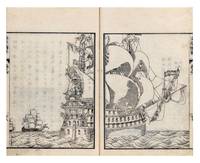
10340Many fine woodcuts throughout. Four parts & appendices in five vols. 8vo orig. semi-stiff wrappers a little frayed old stitching orig. title slips on covers. Tokyo: Yamasakiya Seishichi 山崎屋清七 et al. 1852.<br /> <br> <br> <br /> <br /> First printed edition of this artillery manual from the bakumatsu period. In the early 19th century Japan came under increased pressure from Western nations that wanted access to Japanese ports. “The Shogunate government issued the Order to Drive Away Foreign Ships in 1825 and commanded that foreign ships appearing along the coast of Japan be fired upon so the domains along the coast began building gun batteries and installing cannons. This is when the gun batteries and emplacements were built at Odaiba in Edo Bay and at Uraga Nakaminato Tahara Maiko Dannoura Uwajima Kagoshima and elsewhere. Dutch coastal artillery books were referred to when building these gun batteries†NDL Japan-Netherlands Exchange in the Edo Period online. Our book was published in this historical context.<br /> <br> <br> The book had already been translated by Motoki Masahide 1767-1822 who had left it unpublished at his death manuscript copies exist. Nunokawa TsÅ«boku 布å·é€šç’ž who edited Motoki’s translation and brought it to print in his Preface referenced the order that the domains build coastal defenses as one justification for publication. Motoki had studied not only Dutch but also French Russian and English. He published an English-language primer in 1811 and an English-Japanese dictionary in 1814. <br /> <br> <br> The Dutch original from which the book was translated was titled Het Nieuwe Licht Der Bosschieterye 1699 and was written by Gerrit van der Tollen fl. 1721-23 who worked for the Dutch East India Company.<br /> <br> <br> Our book is richly illustrated with a series of fine single- and double-page woodcuts of many kinds of cannons and mortars cannonballs and Western warships along with diagrams of problems in ballistics. Sections include illustrations and explanations of the structure and dimensions of cannons the measurement of gunpowder and lists of Dutch terms translated into Japanese. Some sections are written in a question-and-answer format “Which countries produce cannons Is there a difference in the making of light and heavy cannonballsâ€. The book begins with a history of artillery a topic that is treated further in the appendices which were not written by Motoki. The appendices treat the history of artillery both in Europe and in China.<br /> <br> <br> Note that Google Books presents the copy at the Bavarian State Library as being published in 1825 but the digitized title page says Kaei mizunoene which corresponds to 1852 and is the same date as seen in our book.<br /> <br> <br> Very fine set.<br /> <br> <br> ⧠Motoki: Christopher Joby The Dutch Language in Japan 1600-1900 Leiden & Boston: 2021 pp. 74 121 186 191 196-97 276 285 & 320. unknown
15386173Venice: Per Agostino de Bindoni 1538. Sm. 8vo. 344pp. Illustrated with a large woodcut vignette on title page verso of title and colophon with devices and 78 woodcuts of hands keyed to the text. Cont. vellum with manuscript spine lettering. Light browning and soiling including title page but overall a very nice copy in a contemporary binding. An early Italian language edition of one of the most popular works on chiromancy of the 16th century. Tricasso 1491-c.1550 was a disciple of Barthelemy Cocles. At variance with Cocles on a number of points he set out in this work to analyze the significance of 78 configurations of hands as well as to outline the supposed astrological implications. His work is frequently cited by many later writers on the subject. As with other copies cited in OCLC the date at the conclusion of the author's preface is misprinted "1635" it should be "1535" the date of the first Italian edition of this title. Brunet V:945; STC of Italian Books p. 680. Caillet 10830. Per Agostino de Bindoni hardcover books
17161469Haarlem: Weduwe van Hermanus van Hulkenroy 1716. Early 19th-century marbled boards with a paper title label on the spine. 4to. With an etched frontispiece an etching of a mermaid on the title 2 folding etchings 2 full-page etchings and 21 etchings in the text all after Adriaen van Ostade. Further with musical annotation to all songs. First edition of a rare Dutch songbook with songs for farmer's festivals all with musical annotation. The work has been beautifully illustrated with etchings after the famous Dutch painter of country life Adriaen van Ostade 1610-1685. The fine etchings newly made and in reverse present an exemplary survey of Van Ostade's work showing busts of peasants women on their way to the market carrying baskets farmers smoking merry parties dancing in front of the farm a knife-grinder a schoolmaster etc. Together they give a lively impression of country life.The work was published anonymously but has been attributed to either Jan van Gijsen 1668-1722 or Aäron van Hulkenroy 1687-1733. Van Gijsen was a popular author who wrote a large number of occasional poems. His collected works were published at Amsterdam in three volumes in 1707-1711 but the present selection was probably published only once partly with the address of the Widow of Van Hulkenroy and partly with the address of J. van Egmont who had also published the collected works. Aäron van Hulkenroy was the son of publisher Hermanus van Hulkenroy and took over the publishing company after both his parents had passed. He was also a poet who wrote various poetry collections which were always published by his mother or later himself. The present work has been attributed to him because the very first poem on the verso of the half title is signed with his initials.The boards and spine are rubbed with some loss of material at the lower outer corner of the front board. The leaves and plates are somewhat foxed a small tear in the margin of first folding plate has been repaired on the back. Otherwise in good condition.l Goovaerts 1011; Cat. Muziekhist. Museum Scheurleer II p. 92; Scheepers I 284 "Hoogst zeldzaam"; Scheurleer Liedboeken 199 lists both 1716-issues; STCN 154032301; cf. Hollstein XV pp. 1-70 for the etchings; NNBW 8 col. 648 Gijsen and NNBW 4 col. 790 Hulkenroy; not in Arents Tobacco. Weduwe van Hermanus van Hulkenroy, hardcover
pp. xv, [i] 245. Index. First printing. "Aims to show how unstable in buying power are all monetary units, including the dollar; what hidden causes produce that instability; what harm results, although ascribed to other causes; and what are the various remedies which have been tried or proposed. The purpose is not to propose any one remedy as the best but to put the problem to the reader, especially to the business reader." - Preface. Very light wear to original olive cloth. Dust soiling to top edge. Binding sound. Several faint pencil erasures to contents. Dust jacket not included. A remarkably well-preserved copy. Fisher M-1344, Masui p.1410, Batson p.137, Pressman p.142, Hutchinson 682. Book
154388<p>8° mm 151x104; cc. 32. Marca tipografica al frontespizio. Margine superiore un poco rifilato. Pergamena posteriore.</p><p>Seconda edizione del dialogo albertiano - meglio conosciuto sotto il titolo di <em>Theogenius</em> - dopo quella che priva di dati tipografici ISTC cataloga come: "Florence 1500" cfr. L.B. Alberti <em>Opere volgari</em> II <em>Rime e trattati morali</em> a cura di C. Grayson Bari 1966 p. 409.</p><p>Il <em>Theogenius</em> rappresenta un capitolo poco noto della fortuna e dell'influsso dell'epicureismo nel Quattrocento. In questo dialogo infatti l'Alberti illustra diversi temi dell'etica epicurea e <strong>traduce alcuni versi del <em>De rerum natura</em> di Lucrezio </strong>S. Gambino <em>Alberti lettore di Lucrezio: motivi lucreziani nel "Theogenius"</em> "Albertiana" IV 2001 pp. 69-84.</p><p>Leon Battista Alberti's <em>Theogenius</em> revived and revised the ancient view developed in the Hellenistic age according to which philosophy aims to form rather than inform people showing them how to cultivate a specific attitude towards existence through a rational comprehension of the nature of humanity and its place in the cosmos. This view of philosophy as a way of life was challenged by the development of scholastic philosophy seen as a body of speculative doctrines and professional skills ancillary to the superior wisdom of theology. Nevertheless it survived thanks to Renaissance humanists like Petrarch Alberti Erasmus and Montaigne. <strong>On the influence of Lucretius on Italian Humanism after Poggio Bracciolini's discovery of the only surviving manuscript of <em>De rerum natura</em> 1417</strong> cf. A. Brown <em>The Return of Lucretius to Renaissance Florence</em> Harvard University Press 2010 and S. Greenblatt <em>The Swerve: How the Renaissance Began</em> London 2011.</p> Appresso Paulo Girardo, [colophon:] per Venturino Rosinello
1759137120Paris: J. Barbou 1759. Full period French binding in Calf five raised bands gilt ornamentation on spine author and title in gilt on red leather spine label in second compartment. 8vo. Full period French binding in Calf five raised bands gilt ornamentation on spine author and title in gilt on red leather spine label in second compartment. 263 pages. First edition Bigmore and Wyman p.228. Minor soiling to the text block else a fine copy.<BR> <br /> <BR> <br /> In this volume Fournier sets out to prove that Gutenberg was not the inventor of the printing press by examining the history of printing. He believes that the technology Gutenberg made popular existed long before the German printer's work. <BR> <br /> <BR> <br /> "Peter Simon Fournier a French engraver and letter-founder was born at Paris 1712 and died 1768. He studied under Colson painter of the Academy of Saint Luc and devoted himself first to the art of wood-engraving; he afterwards as an engraver on steel rendered himself famous in all countries. In some of his works he seeks to prove that Gutenberg is not the inventor of printing and maintains that long before Gutenberg engraving on wood had been employed for printing images and inscriptions; that during his residence in Strasburg Gutenberg attempted the application of this art to the printing of books and that on his return to Mayence he first printed the Donatus and the Catholicon of Johannes de Janua with engraved and solid blocks. Fournier's ingenious theories were ably refuted by Baron Heinecken in his "Idée Générale d'une Collection complette d'Estamples" Leipsic: 1771" Bigmore & Wyman p 229. J. Barbou unknown
1936015728Paris EDITION ORIGINALE. Tirage à 1012 exemplaires numérotés. Un des 35 sur Hollande van Gelder mis dans le commerce, second papier après vingt-cinq Japon . Bel exemplaire relié à l'époque : demi-maroquin noir à coins et filets or, dos à nerfs et pièce de titre rouge et lettre or, tête dorée, couverture et dos conservés. 1936 fort in-8 Broché Edition originale
192232975-509Moscow and Berlin Gelikon January 1922. Illustrated with 16 photogravures on plates and line illustrations by F. Léger and others. 140 2 publisher's adv. 2 blank pp. 8vo. Orig. illus. wrappers with a Cubist drawing by F. Léger 220 x 160 mm. Moscow and Berlin Gelikon January 1922. First edition of an important work with a strong visual preseentation of Erenburg's text. One of 100 copies of an edition limited to 500 copies. The typography is Futurist amd is stikingly juxtaposed with Leger's illustrations. This rare treatise on contemporary avant-garde art by Erenburg 1891-1967 is not only noteworthy for its typographical experimentation but it defends Contructivism in early art "Oblozhka raboty Fernanda Lezhe" and includes also a penetrating analysis of the "new architecture" which Vladimir E. Tatlin and his work are seen to have generated. Among the artists the Russian critic considers are Léger Lipchitz Lissitzky Picasso Rodchenko Van Doesburg and even from a Charlie Chaplin film. - A very good uncut copy in the original wrappers designed by Léger. - Senkevitch Soviet Architecture 1917-1962 no. 1120; cf. Compton Russian Avent-Garde Books 1917-34 p. 52 & p. 153 no. 64; MoMA no. 401. LITERATURE: RUSSIAN ; ART - GENERAL & APPLIED ; ARCHITECTURE ; Moscow and Berlin, Gelikon unknown
15416509Luguduni sic: Lyon: Seb. Gryphium Sebastian Gryphius 1541. Early reprint. Leatherbound. Good. 12mo. Pp. 314 13. Early 18th-C. tree calf five raised bands with gilt tooled decorations and lettering piece edges trimmed and dyed red. Decorative initial caps italic text with roman titles table of Latin and Greek chapter titles marginal notes index following text followed by a tail-piece that of a gryffin in reference to printer Gryphius. Includes Appendicula de condituris varijs ex Ioanne Damasceno a section of fourteen recipes for “condimenta†and “condituræ†between De Re Culinaria and Facultatibus alimentorum. Spine ends chipped edges rubbed endpapers stained marginal annotations in ink tight binding. Presents four culinary and health texts as called for appearing together with Torinus' introduction the same year as a nearly identical Basel edition but in smaller format for a different market. <p>The collection of Roman recipes De Re Culinaria attributed to Apicius first appeared in this form in the fifth century AD. Torinus' sources were "codexes" found in Maguelone and Transylvania. Bartolomeo Sacchi Platina's De Honesta Voluptate given an alternate title by Torinus was the first movable-type cookbook based on Maestro Martino da Como's recipes. Paul of Aegina was a Byzantine Greek physician.</p> <p>Gryphius learned printing from his father in Germany then in Venice moving to Lyon around 1520. By the 1540s he had the city's largest printing establishment and reputation for a high standard of editing and impression specializing in Humanist works in small format modeled on Aldus Manutius. DURLING Sixteenth Century Printed Books in the National Library of Medicine 232.</p> . Seb. Gryphium [Sebastian Gryphius] unknown
15384474Venice: Per Agostino de Bindoni 1538. Sm. 8vo. 344pp. Illustrated with a large woodcut vignette on title page verso of title and colophon with devices and 78 woodcuts of hands keyed to the text. Nicely rebound in faux period calf gilt tooled spine in 3 compartments. Small chip and tear into blank upper margin of B1 and small printing flaw at bottom corner of A2 verso. An early Italian language edition of one of the most popular works on chiromancy of the 16th century. Tricasso 1491-c.1550 was a disciple of Barthelemy Cocles. At variance with Cocles on a number of points he set out in this work to analyze the significance of 78 configurations of hands as well as to outline the supposed astrological implications. His work is frequently cited by many later writers on the subject. As with other copies cited in OCLC the date at the conclusion of the author's preface is misprinted "1635" it should be "1535" the date of the first Italian edition of this title. Brunet V:945; STC of Italian Books p. 680. Caillet 10830. Per Agostino de Bindoni unknown books
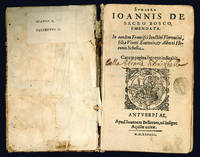
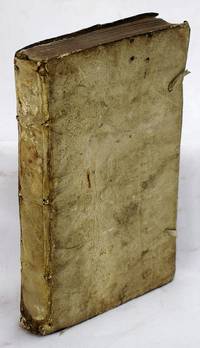
158273<p>COPY CONTAINING THE MINUTE OF A LETTER ADDRESSED BY GIORGIO RAGUSEO TO HIS COLLEAGE OF THE UNIVERSITY OF PADUA GIROLAMO PALLANTIERI</p><p>8vo 153x93 mm. 16 327 1 pp. and 1 folding plate with the movable parts to be cut out and the instructions on how to assemble them. Collation: †8 A-V8 X4. Printer's device on title page and several woodcut diagrams and illustrations in text. On the front pastedown label with the shelf mark "Scansia N. G10 Palchetto N.". On title page is the ownership's entry "Della libraria di Brisighella" and an old faded stamp. Contemporary binding made with a manuscript vellum leaf datable to the 12th-13th century inked title on spine and on the upper edge round worm holes and small losses to the panels heavier loss to the bottom part of the spine lacking ties and front flyleaf. Leaves †6 and †7 stained and with minor losses of paper and occasionally also of text small hole in the middle of quire M affecting a few letters other hole in the lower blank margin of ll. V3-X4 with no loss of text uniformly browned throughout first quire slightly loose. A genuine copy.</p><p>On back flyleaf recto is a manuscript note containing the minute of a letter presumably autograph by Giorgio Raguseo d. 1622 dated "Patavi ex academia nostra V. Non. Marti 94" 3 March 1594 and addressed to the "Admodum Rev.do ac Ecellentiss.o Patri Magistro Hieronimo Palanterio in almo Patavino Gimnasio theologiam publice proficienti" in which Raguseo thanks his colleague and professor of theology Girolamo Pallantieri 1533-1619 and asks his permission to print some not better specified academic "conclusiones ex variis doctoribus scholasticiis" which he thinks are worth publishing. It is also not clear which academy he is referring to in the letter.</p><p>On the verso of the same leaf is another note by the same hand quoting as a reminder the 1566 Giovanni Battista & Marchiò Sessa edition of <i>Le nuove teoriche de i pianeti</i> by Georg Peurbach in the translation by Orazio Toscanella.</p><p>RARE EDITION published in Antwerp of Sacrobosco's famous astronomical treatise accompanied by notes of Francesco Giuntini 1523-1590 Elie Vinet 1509-1587 and Albert Hero d. 1589 which appeared for the first time in the Lyon edition of 1562.</p><p>"Sacrobosco's <i>Sphaera</i> written in Paris around 1220 enjoyed a long popularity as the leading introduction to spherical astronomy. First printed in 1472 it went through at least a score of editions in the fifteenth century and something over 100 in the sixteenth … Publishing Sacrobosco entered a new and different phase in Wittenberg in 1531. Prior to that year all the editions were folio or quarto that is large often quite beautiful and presumably expensive volumes. In 1531 the Lutheran University of Wittenberg apparently sponsored a version cheap enough to become a required textbook for the astronomy course. It is fully illustrated with didactic figures and comes with a preface in praise of astronomy by Philipp Melanchthon … Demand for the small Sacrobosco textbook remained high at Wittenberg and a new edition was issued every few years. In 1538 a revised revision appeared: for the first time three of the diagrams incorporated moving parts. This proved to be such a popular feature that virtually every octavo Sacrobosco from the 1540s on – regardless of whether it was printed in Paris Antwerp Cologne or Venice – included these same identical volvelles. Incidentally these volvelles were not pre-cut and pasted by the printer. They were issued on ancillary sheets together with instructions for assembling them. Hence it is possible to find copies of these text books with no sign that the volvelles were ever in place and very occasionally the original sheet with the instructions and cutouts can still be found with the book" O. Gingerich <i>Sacrobosco as a Textbook</i> in: "Journal of History of Astronomy" 19 no. 4 Nov. 1988 pp. 269-273.</p><p>The letter contained in the present copy is particularly interesting as it connects two prominent figures of the University of Padua at the end of the 16th century highlighting their academic and professional ties. It is also worth noting that Raguseo wrote a commentary on Sacrobosco's <i>Sphaera</i> <i>Expositio super spheram Ioannis de Sacrobosco</i> Milan Biblioteca Ambrosiana manuscript N.207 sup. which has remained unpublished.</p><p>Giorgio di Ragusa or Raguseo as he was called after the name of his hometown today's Dubrovnik in Dalmatia was born on an unspecified date in the second half of the 16th century. He spent his youth in Venice where he was educated in mathematics by his father in the letters by L. Natali and in astrology his favourite discipline by Osvaldo da Gent and F. Barozzi. He then studied and graduated at the Studio of Padua first in the arts the exact date is not known then in 1592 in theology and in 1601 in medicine. In the meantime he took the minor orders and gained a certain reputation as an expert in Lull's art taking part in two public disputes over theological conclusions exposed according to R. Lull's method one in Venice in 1594 and the other in Padua in 1595. In 1599 he set off on a journey that kept him away from Venice for two years. In Pisa he met G. Mercuriale while in Naples he made the acquaintance of G. Della Porta. When he returned to Padua in the spring of 1601 he was appointed to the second ordinary chair of natural philosophy at the local Studio replacing C. Cremonini recently promoted to the first chair. In the following years he was deeply involved in all academic activities not only in teaching. His name in fact is one of those that most often appears in the commission that conferred the doctorate titles according to the practice of the Palatine counts and in this capacity on April 25 1602 he conferred the title of doctor in philosophy and medicine to W. Harvey. In 1613 in Venice he published twenty-four Aristotelian disputes under the title of <i>Peripateticae disputationes</i>. Around 1618 Raguseo took part in the discussions raised by the appearance of a comet. Despite his academic Aristotelianism he expressed an original position in the debate supporting the need for critical scrutiny by the senses and experience. From a letter of 1611 we also know that he used the telescope to verify some of discoveries announced by Galileo in the <i>Sidereus nuncius</i>. Raguseo died in Padua on 13 January 1622 cf. C. Preti <i>Giorgio da Ragusa</i> in: "Dizionario Biografico degli Italiani" LV 2001 s.v.; see also L. Thorndike <i>A history of magic and experimental science</i> VI New York 1941 pp. 198-202; M. Josipovic <i>Il pensiero filosofico di G. Raguseo</i> Milan 1985; and G.F. Tomasini <i>Gymnasium Patavinium</i> Udine 1654 pp. 309 and 445 for Ragueseo and p. 284 for Girolamo Pallantieri professor of theology from 1580 to 1603.</p><p>Bernardino Pallantieri was born in Castel Bolognese in 1533. In 1547 at the age of fourteen he entered the order of friars minor conventual taking the name of Girolamo. In Ferrara he studied philosophy with the theologian Filippo Braschi and the famous philosopher Vincenzo Maggio. He then continued his studies in Bologna under the guidance of Giovanni Antonio Delfini and Franceschino Visdomini. At first appointed regent of the Studio of Pavia in 1566 Pallantieri took up the chair of theology at that university. In 1568 he was called to Milan by St Charles Borromeo archbishop of that city who appointed him as preceptor of the candidates for priesthood and as his personal theologian. Pallantieri remained in Milan for 5 years then in 1573 he resumed his teaching in Pavia. Between 1575 and 1581 he was in Rome at the service of Cardinal Felice Peretti as his personal advisor and theologian. In 1581 he was called back to Bologna and in 1582 he was elected minister provincial of the friars minor of the province of Bologna. He was also a member of the Accademia degli Infiammati of Parma with the name of "Solingo". When his three-year mandate in Bologna expired in 1585 Pallantieri was called by the Reformers of the Studio of Padua to occupy the chair of theology and at the same time he was appointed superior of the convent of the Saint Anthony the patron of the city. Girolamo remained in Padua for ten years until about 1595. In 1603 he was appointed bishop of Bitonto by Pope Clement VIII but he moved to his diocese only in 1605. Pallantieri died in Bitonto in 1619 at the age of eighty-six cf. E. Papagna <i>Pallantieri Bernardino</i> in: "Dizionario Biografico degli Italiani" LXXX 2014 s.v.</p>Houzeau-Lamcaster no. 1658; L. Desgraves <i>Elie Vinet</i> Genève 1977 no. 125. Jean Bellère books