15 962 résultats
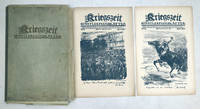
92759Berlin Paul Cassirer 1914-16. 2° 48 x 32 cm je 2 Bl zahlreiche Abb. davon teilweise blattgrosse Orig.-Lithogr. Lose Hefte in Original-Flügelmappe Mappe etwas fleckig u. eingerissen. Hefte sauber 3 Hefte min. wasserrändig am Fuss. Die ersten Hefte auf sehr holzhaltigem sprödem Papier darum gebräunt u. kleine Fehlstellen am Rande - insgesamt gute Exemplare. Alle Lithographien im Stein signiert.Mit Beiträgen in Form von Originallithographien von Ernst Barlach Max Beckmann Hans Baluschek Erich Büttner August Gaul Rudolph Grossmann Franz Heckendorf Otto Hettner Dora Hitz Ferdinand Hodler Heinrich Hübner Willy Jaeckel Georg Kolbe Max Liebermann Hans Meid Oskar Nerlinger Max Oppenheimer Max Slevogt Ottomar Starke Max Unold Wilhelm Wagner E.R. Weiss und vielen anderen.Die überwiegend nationalistisch kriegsbejahenden Lithographien etwa Max Liebermanns erscheinen neben Arbeiten von Ernst Barlach Max Beckmann August Gaul Willy Jaeckel Käthe Kollwitz oder Wilhelm Trübner mit teilweise sogar chauvinistischem Unterton die speziell für diese Zeitschrift angefertigt wurden. Künstler die gemeinhin eher für eine oppositionelle Haltung zum politischen Establishment des Deutschen Kaiserreichs bekannt sind fügten sich nach Kriegsausbruch zunächst dem politischen „Burgfrieden“ und stellten sich freiwillig in den Dienst einer nationalen Begeisterung für den Krieg. Dieser Grundströmung folgte aber schon bald die Ernüchterung die ihren Niederschlag in veränderten Themen fand. Statt hurra-patriotisch stürmender Soldaten in Kampfszenen erschienen zunehmend eskapistische mit kritischen Untertönen versehene Bildwerke mit teils sogar auch verstohlen pazifistischen Ansätzen.Schon Mitte 1915 begann der Verleger die zunächst wöchentliche Erscheinungsweise des Periodikums auf einen zweiwöchigen Publikationsrhythmus zu strecken ehe es vor seiner Einstellung 1916 nurmehr unregelmäßig veröffentlicht wurde. Ihm folgte „Der Bildermann“ das neue Zeitschriften-Projekt Paul Cassirers das in gleichem Umfang und mit gleicher Ausstattung wie die „Kriegszeit“ aber mit anderer inhaltlicher Ausrichtung ab 1916 erschien. 010 Berlin, Paul Cassirer, 1914-16 unknown
20155126DBohne Ortsangabe, Oris Mediaevalis, Editoria Internacional de Facsimiles. 2015. 8° (130 x 95 mm). 150 Blatt. Alles Seiten mit Miniaturen von Jean Colombe. Roter Lederband mit reicher Goldverzierung in Acryl-Box.
18020009162BETHEL TOWNSHIP LEBANON COUNTY PENNSYLVANIA. Good. 1802. On offer is an interesting document of early 19th century education an original handwritten note book covering a myriad of subjects related to mathematics. The owner and creator of this book was a man named Henry Snevely also written as Snavely and the book dates from 1802 - 1803. It seems Snevely was born in the United States and lived his whole life in Southeastern Pennsylvania. At the time of the creation of the book Snevely was almost 50 years old an established land owner in Bethel Township Lebanon County. Why he had a book of mathematics is unknown however I have found records of a Henry Snavely who taught at a school in Bethel Township from 1797 onwards. It may be likely that this book is actual not for Henry himself but for the instruction of his students. Either way the book presents a fantastic overview of early 18th century knowledge. The book covers a very large range of topics however Math pertaining to financial matters is dominant throughout. As well there are conversions of Irish and British currency. The primary immigrants to the area at the time of the book were indeed Scotch-Irish so teaching Irish and British currency conversions wouldnt be too far off. Currency exchange in particular is a primary focus owing to the large amount of immigrants to the area. Individual page headings in the book include Exchange many pages Exchange of Arbitrations Barter Profit and Loss Fellowship Fellowship with Time Allegation Media Alternate Partial and Total Square Root Cube Root Arithmetical and Geometric Progression Compound Interest Single and Double Position Reduction Addition Subtraction Multiplication and Division of Fractions and Vulgar Fractions Rule of Three in Fractions and Questions for Exercise. There is a later manuscript memorandum on rear endpaper dated 1829 bearing the names of additional members of the Pennsylvania Snavely clan Molly George and John. The name Martin Rupp also appears in memorandum and our research confirms various Martin Rupps residing in southeastern Pennsylvania during this time. The book is in fair to good condition. The volume is bound in the original stiff paper wraps. The cover is very worn and the spine is torn and partially detached. There is mild age-toning and occasional staining but the internal pages are generally clean. The black ink is still bold and easily legible throughout. The book contains about 85 pages of manuscript entries and the book itself is approximately 90 pages. It measures 12.5 x 8 inches. Biography: Henry Snavely was born on August 2 1755 in Bethel Township Lebanon County Pennsylvania. .Henry Snavely was a Lutheran. At that time he was considered a good scholar and is said to have been a hard student obtaining his knowledge principally by his own exertion. He taught the school from 1797 to 1807.; A report from 1773 shows his farm had 150 acres 5 horses 4 cattle and no servants. OVERALL: G; Manuscript; Folio - over 12" - 15" tall; KEYWORDS: HISTORY OF HENRY SNEVELY HENRY SNAVELY EARLY 19TH CENTURY KNOWLEDGE SCIENTIFIC REVOLUTION MATHEMATICS GEOMETRY TRIGONOMETRY FINANCIAL CALCULATIONS BARTERING INTEREST TEACHER'S BOOK BETHEL TOWNSHIP LEBANON COUNTY SOUTHEASTERN PENNSYLVANIA COMPLEX MATHEMATICS ALGEBRA MARTIN RUPP PRACTICAL MATH FOR FARMERS 19TH CENTURY AMERICA EARLY 1800S IN THE MID-ATLANTIC STATES CYPHER BOOK AMERICANA HANDWRITTEN MANUSCRIPT DOCUMENT LETTER AUTOGRAPH WRITER HAND WRITTEN DOCUMENTS SIGNED LETTERS MANUSCRIPTS HISTORICAL HOLOGRAPH KEEPSAKE WRITERS AUTOGRAPHS PERSONAL MEMOIR MEMORIAL ARCHIVE DIARY DIARIES JOURNAL LOG ANTIQUITÉ CONTRAT VÉLIN DOCUMENT MANUSCRIT PAPIER ANTIKE BRIEF PERGAMENT DOKUMENT MANUSKRIPT PAPIER OGGETTO D'ANTIQUARIATO ATTO VELINA DOCUMENTO MANUSCRITTO CARTA ANTIGÜEDAD HECHO VITELA DOCUMENTO MANUSCRITO PAPEL . paperback
20219London: Printed for A. Bettesworth and J. Pemberton. 1720. First edition. First edition. Octavo. Twentieth-century half calf in period style over marbled boards. The spine with five raised bands and morocco title label lettered in gilt. Woodcut head- and tail-pieces and decorative initials. A very good copy the binding square and firm. The contents with some occasional scholarly annotations in pencil to page margins the odd minor crease to the top corner of a handful of pages a pinprick hole to the title page light scattered foxing and a little browning to the margins of the preliminary pages are otherwise in very good order. The first edition of this collection of stories and essays most notable for its inclusion of an important early Australian imaginary voyage - "The Fortunate Shipwreck or a Description of New Athens" - a castaway narrative detailing the discovery of a utopian society on the southern coast of the Terra Australis published just one year after Defoe's Robinson Crusoe. Taking the form of a series of letters the work traces the experiences of the fictional English adventurer Maurice Williams after his chance arrival on the Australian continent following a shipwreck. Once ashore he discovers a utopian society founded by ancient Greeks who had themselves travelled for three years across desert and ocean in order to realise their "New Athens" in "Terra Australis incognita" Country of the South. As Williams explains after their arrival the Greeks had peacefully integrated with the original inhabitants those who "may properly be call'd the Aborigines of the place" and established a new society free from the manifold follies of contemporary Europe. In the tradition of utopian literature as established by Thomas More's seminal 1516 work Williams describes in detail the architecture and administration of the great Greek-Australian city its politics and laws and the customs and manners of its inhabitants. He then goes on to discuss the way in which he and his companions introduce the New Athenians to English poetry the art of printing the manufacture of gunpowder and the construction of war ships apparently to the great benefit of the latter. In addition to its early Australian setting the narrative also notably contains the first reference to the American territory of "Carolina" in fiction as Williams after having been caught in yet another violent storm on his return from New Athens finds himself "very well pleas'd" to be able to get ashore on Carolina's cost knowing that he was "pretty secure of finding a passage to Old England". The main contributor to the collection was the dramatist Thomas Killigrew the younger 1657-1719 although Charles Gildon recorded by CBEL as the editor may be the author of the second imaginary voyage. Chief amongst the work's other contents are: "A Voyage to the Mountains of the Moon under the Æquator" "Mahomet no Imposter written in Arabick by Abdulla Mahumed Omar" a defence of Islam purportedly written by a Muslim "Alberoni or a Vindication of that Cardinal" "The Secret History of the Amours of Don Alonzo" "The Garden of Adonis" and "An Account of Bad and Good Women Ancient and Modern". Scarce in commerce. Grove Imaginary Voyages p.234; ESTC T117537. Further details and images for any of the items listed are available on request. Lucius Books welcomes direct contact with our customers. London: Printed for A. Bettesworth and J. Pemberton. 1720 hardcover
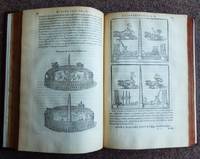
155252798<p>Lugduni apud Joan. Tornaesium 1552. TITLE CONTINUED: Accesserunt Gulielmi Philandri Castilionii civis Romani annotationes castigatiores & plus tertia parte locupletiores. Adiecta est Epitome in omnes Georgii Agricolae de mensuris & ponderibus libros eodem autoter cum Graeco pariter & Latino indice lucupletissimo. FIRST JEAN DE TOURNES EDITION OF VITRUVIUS 1552 Latin text. 4to approximately 235 x 155 mm 9¼ x 6¼ inches printer's device of vipers on title page a different De Tournes device on verso final page 83 woodcut illustrations 1 folding plate of an inscription portrait of Philandrier the editor on final page of prelims arabesque headpieces to the 10 books and historiated initials throughout pages: 16 447 57 - including index errata and Extrait du Privilege with last line: Achevé d'imprimer le huitieme février 1552 the last leaf with printer's device on verso bound in modern full blind panelled calf raised bands blind rules and gilt lettered morocco label to spine all edges red new endpapers. Small repair to inner edge of title page plus 2 ink names pages lightly age-browned tiny chip to fore-edge of 1 prelim page small closed tear to 1 margin repaired neatly some early mostly neat ink marginal notes some small corrections to text and a little neat underlining a couple of small ink stains and smudges text still easily legible very light foxing to a few margins. A good tight copy. This edition published in Lyon by Jean de Tournes was the second edited by Guillaume Philandrier the first was published in Strasbourg in 1550 as a 16mo. As the secretary to the bishop of Rodez the French humanist Philandrier friend of Rabelais had spent 10 years in Italy in Venice and Rome many of them studying Vitruvius and in 1544 he published his illustrated annotations separately in Rome. See: Laurence Hall Fowler The Fowler Architectural Collection of the Johns Hopkins University pages 318-319; Adams Books Printed in Europe 1501-1600 Volume II V908; Harvard French 16th Century Books Volume II No. 550. MORE IMAGES ATTACHED TO THIS LISTING ALL ZOOMABLE. FURTHER IMAGES ON REQUEST. POSTAGE AT COST.</p> Lugduni, apud Joan. Tornaesium, 1552. hardcover
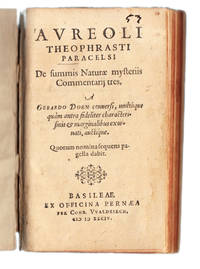
117924Basel ex Officina Pernæa per Conr. Waldkirch 1584. 8vo. 16 128 127-147 wrongly paginated 173 10 pp. Illustrated with several woodcuts and the last 10 pp. are only woodcuts. A full page woodcut portrait. Richly annotated and underlined in both ink and pencil by different hands. Slight browning and minor stain in the beginning. Manuscript notes on the final endpaper. Eighteenth century blue paper boards spine lettered in ink but head of spine worn with loss of text red edges. Initials â€C.S†dated â€Freiburg den 21 Marti 1748†on front fly leaf and with a 20th century bookplate. VD 16 P507. Adams P274. Duveen p. 453. Second edition the first came in 1570 of this rare compilation of works said to be by Paracelsus and translated and edited by Gerard Dorn c. 1530-84. However according to Sudhoff Versuch einer Kritik der Echtheit Paracelsischen Schriften 125 & 201 it is more probably a forgery by Dorn. He claims to have translated the original from German into Latin but as no original German edition exists it seems reasonable to assume that the editor was in fact also its author. The book is divided into four sections: De spiritibus planetarum; De occulta philosophia; Medicina coelestis sive de signis zodiaci & mysteriis eorum and the brief De transmutationis metallorum tempore.The Swiss physician philosopher theologian and alchemist Paracelus 1493-1540 was born Theophrastus Bombastus von Hohenheim but took the name Paracelsus later in life meaning 'superior to Celsus' an early Roman physician. hardcover
elala6170London: Atchley And Co. c1850. Including views of Southampton Isle of Wight Bay of Biscay Berlingas Cintra the Tagus Trafalgar Tarifa Gibraltar Algiers Panteleria Malta Alexandria Mahmoudie Canal Boulac Cairo Cemetery of the Mussulmans Dead Camel Central Station Arabs on Horseback Encampment by Night Women Drawing Water Joseph's Well Red Sea Suez Jeddah Mocha Aden Point de Galle in Ceylon Madras and Calcutta. oblong folio. 32 wood-engraved plates incl. engraved title by W.Measom H.Sears & others after drawings by the aforementioned artists. with tissue guards. 4-page folio prospectus with plate descriptions loosely inserted. original pictorial bds joints cracked & chipped spine ends damaged light foxing to few plates. inscription dated 1851 on front flyleaf. elala6170 London: Atchley And Co., [c1850] unknown
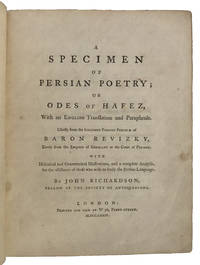
1774ME1081London:: Printed and Sold at No. 76 Fleet-Street 1774. 1774. 4to. iv xv 1 68 pp. Original full calf gilt spine; neatly rebacked to style preserving original endsheets. Inscribed by an early owner "This Book belonging to Monsieur Pierre Monneron." Extremely rare. This is the first edition in English of the ghazals of Hafez translated by one of the leading Persian orientalists of his day John Richardson FAS of Wadham College Oxford and famous for his seminal work written in conjunction with Sir William Jones the work being A Dictionary Persian Arabic and English 1777. / Hafez was previously unknown to the western world until Count Karl Emerich Reviczky von Revisnye 1737-1793 the Hungarian Orientalist and bibliophile 'discovered' him and brought his poetic classic to Europe with this Vienna printing. The work features an extensive text on Hafez and a translation of selected ghazals . Reviczky von Revisnye also issued in 1784 1794 a catalogue of his Greek and Latin library using the pseudonym of "Periergus Deltophilus". In the prefatory essay for that volume he shows an interest in the printing of Nicolas Jenson Aldus Manutius and the Estiennes. / Hafez was born in Shiraz Persia and lived approximately from 1325/26–1389/1390. He is considered a mystic and poet. His life and poems are the subject of much analysis commentary and interpretation influencing post-fourteenth century Persian writing more than any other author. FULL TITLE: A Specimen of Persian Poetry; or Odes of Hafez With an English Translation and Paraphrase. Chiefly from the Specimen Poeseos Persicae of Baron Revizky Envoy from the Emperor of Germany to the Court of Poland. With Historical and Grammatical Illustrations and a complete Analysis for the assistance of those who wish to study the Persian language. Printed and Sold at No. 76, Fleet-Street, 1774. unknown books
51-5496Francofurti : Impensis Lucae Jennisii MDCXXVII 1627 Frankfurt: Luca Jennis 1627. A Collection of 88 of 160 engravings with related text mounted on 9 sheets. The text to each image is numbered in Roman numerals between L and CLX. Each sheet is signed and dated 1759 on the verso. Engravings 41 x 32mm.The engravings of famous thinkers from first edition of this important alchemical emblem book. The allegorical engravings in this work first appeared two years prior at the end of a German alchemical miscellany by the same publisher with no explanatory text. The present offering combines the images with explanatory prose and poetic captions to express the secrets of transmutation on the model of Michael Maier’s 1617 Atalanta fugiens and Stoltzius’s own 1624 Viridarium Chymicum. Caillet 10386; Duveen p. 566; Ferguson II p. 410-411; Landwehr 561.NOTE: It is possible that the engravings are from Johann Daniel Mylius' "Opus medico-chymicum: Continens tres Tractatus sive Basilicas: Quorum prior inscribitur Basilica Medica. Secundus Basilica Chymica. Tertius Basilica Philosophica" Frankfurt : Lucam Jennis 1618. Francofurti : Impensis Lucae Jennisii, MDCXXVII [1627] (Frankfurt: Luca Jennis, 1627) unknown
181726835London: Printed by McMillan Sold By T. Egerton / John Murray Albemarle Street 1817. Book. Very Good. Hardcover. First Edition / Revised and Enlarged. Octavo. 2 Volumes bound in one: 1 A NARRATIVE OF OCCURRENCES IN THE INDIAN COUNTRIES OF NORTH AMERICA SINCE THE CONNEXION OF THE RIGHT HON. THE EARL OF SELKIRK WITH THE HUDSON'S BAY COMPANY AND HIS ATTEMPT TO ESTABLISH A COLONY ON THE RED RIVER; WITH A DETAILED ACCOUNT OF HIS LORDSHIP'S MILITARY EXPEDITION TO AND SUBSEQUENT PROCEEDINGS AT FORT WILLIAM IN UPPER CANADA. London: Printed by B. McMillan Sold by T. Egerton 1817. First Edition. Attributed to Samuel Hill Wilcocke - The Macmillan Dictionary of Canadian Biography / W. Stewart Wallace. Attributed also to Simon McGillivray or to Edward Ellice the elder - National Union Catalog pre-1956 imprints. Pp. xiv 152 iv 87 - Appendix. Volume 2 STATEMENT RESPECTING THE EARL OF SELKIRK'S SETTLEMENT UPON THE RED RIVER IN NORTH AMERICA; ITS DESTRUCTION IN 1815 AND 1816; AND THE MASSACRE OF GOVERNOR SEMPLE AND HIS PARTY. WITH OBSERVATIONS UPON A RECENT PUBLICATION ENTITLED "A Narrative of Occurrencies in the Indian Countries" &c. London: John Murray 1817. A new revised and enlarged edition with the added "Observations Upon a Recent Publication ." published the same year. Pp. viii 194 ii i - xcx - Appendix 4 - publ. adverts dated July 1817. With a frontispiece map of Part of Hudsons Bay Company's Territory. Drawn and engraved by A. Arrowsmith London 12th February 1817. Bound together in half red morocco and comb-marbled boards gilt titles direct to spine top edge gilt others deckled matching marbled endpapers with binders' ticket T.W. Taylor Winnipeg. Covers scuffed front free endpaper splitting near gutter some offsetting to text and map else very good copy. Printed by McMillan, Sold By T. Egerton / John Murray, Albemarle Street Hardcover
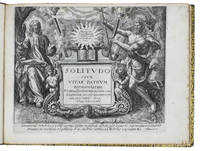
160663TA003RHVIKParis 1606. Small oblong folio 19 x 25.5 cm. Thomas de Leu Gold-tooled blue goatskin morocco ca. 1890 bound by Bernard David or his son Salvador David in Paris on 5 recessed supports each board with elegant double borders title and date reading up the spine with decorations above and below gold-tooled turn-ins and board edges curl-marbled endpapers signed with a stamp - in sans-serif capitals - in the corner of the first free endleaf DAVID. With an engraved allegorical title page including a 2-line quotation from Hebrews 11:37-38 and 29 engraved prints plate size ca. 15 x 19 cm: mostly numbered but a few unnumbered or irregularly numbered illustrating the lives of the early Christian hermits living in the desert 7 signed by Thomas de Leu as printer-publisher in 2 cases accompanied by the monogram NB the engraver Nicolaes de Bruyn. 1 29 engraved ll. Finely engraved title page and prints depicting the lives of hermits living in the desert as described by Hieronymus in his famous Vitae patrum. The engraved title page and prints were printed and published by Thomas de Leu or de Leeuw 1560-1612 a Flemish engraver in Paris who probably engraved many himself. He had begun his career in Antwerp and some of the prints signed by him excudit also bear the NB monogram of the engraver Nicolaes de Bruyn 1571-1656 in Antwerp. The Antwerp painter Maarten de Vos 1531/32-1603 had drawn numerous hermit scenes: four series engraved printed and published by Johannes I Sadeler ca. 1550-ca. 1600 and his brother Raphael I Sadeler 1560-1632 who continued alone with three further series making in total seven series containing 7 engraved title pages and 107 prints all published at Antwerp at least the first series in or before 1584. De Leu and De Bruyn very skillfully copied all seven series including the title pages and captions. The present selection includes the title page of the first series Solitudo which originally contained 29 prints but only 16 of the present 29 prints come from that series the other 13 are taken from series 2 Sylvae 1 3 Trophaeum 1 4 Oraculum 5 Sylvae 2 and 6 Trophaeum 2.Bernard David 1824-1895 studied under Lortic and other leading Paris bookbinders before setting up on his own there. His son Salvador d. 1929 took over the workshop in 1890. The laid endpapers show no watermark. With aa small marginal tear repaired occasional minor marginal spots and a few tiny and insignificant scuff marks on the edges of the binding. Book and binding otherwise in very good condition and with ample margins.l Hollstein XXI pp. 147-155 nos. 377-450 & pp. 240-245 nos. 118-157 the Sadeler eds. but noting the De Leu eds. at the end of each series; www.calcografica.it many of the prints in these De Leu series; USTC 6000645 3 copies; cf. for De Leu also: Benezit 6 p. 623; Thieme-Becker 23 pp. 143-144. unknown
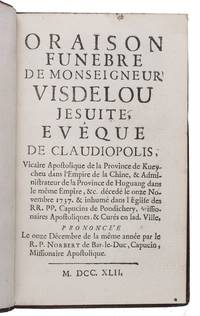
174289PBMXY3Z0MCAvignon: no publisher 1742. Contemporary calf gold-tooled spine with red label marbled endpapers red edges. 8vo. Second or third edition of the funeral oration for the sinologist and mathematician Claude de Visdelou 1656-1737 by Father Norbert of Bar-le-Duc 1703-1769 dedicated to Pope Benedict XIV. The oration prooved highly important in the so-called Struggle of the rites in China between the Jesuit missionaries and the Chinese emperor and the Pope.The author of the oration Norbert de Bar-le-Duc a Capuchin monk 1716 and priest 1729 also known as Norbert de Lorraine Curé Pierre Parisot or Abbé Platel was sent to Malabar and later to Pondicherry in December 1736 after being appointed procurator of the French mission. He stayed for three years in Pondicherry where he soon came into conflict with the Jesuits on the same issue - the struggle of the now Malabaric rites -which had lead to Visdelous exile in the same Capuchin monastery in the same town. So the anti-Jesuit Father Norbert de Bar-le-Duc understandably delivered Visdelous funeral oration .An undated 4to edition that names no printer or place of printing appears to be the first edition of the funeral oration. Sommervogel and Cordier mention an 8vo edition nominally printed by Antoine Pereira in Cadiz though other sources suggest it was printed in Avignon with the same collation as our edition and published in the same year making the present edition the second or third.Fine copy with bookplate on inside front cover: ''Devie Prêtre''. Binding skilfully repaired; head of second fly-leaf damaged.l De Backer & Sommervogel VIII col. 843; Cordier Sinica 1100-1; Librairie Polak Coll. de M.M.: Extreme oriênt du 16e siècle au 20e siècle 305; Adelhelm Jann Die katholischen Missionen in Indien China und Japan 1915 passim; Claudia von Collani & Claudio Filippo Grimaldi S.J. Zur Ankunft des päpstlichen Legatien Charles-Thomas Maillard de Tournon in China in: Monumenta Scrica 42 1944 pp. 329-359; Robert Streit & Joh. Dindinger eds. Bibliotheca Missionum 7 1932 pp. 105-107; Biogr. univ. XLIII cols. 638-640; not in Lust. [no publisher], unknown
"Everyone who is concerned with international finance listens when Schacht speaks. His new plan, designed to restore Europe's economic well-being, is an ingenious, essentially uncomplicated idea which has already affected official plans for dealing with Europe's [post WWII] exchange problems. For the rest of his life Dr. Schacht will remain a controversial figure on account of the political role he played in Germany from 1930 onwards; but as a financial and banking expert - as friend and collaborator of Montague Norman, and many other experts in this field - he has had hardly an equal in our time." - dust jacket. 125, [1] pp. First English printing of the 1949 German first edition. Original light yellow cloth lettered in red is very well preserved. Binding tight. Former library copy but with only two markings: a stamp inside the front board and a stamp upon the copyright page. Modest lean to spine. Average wear to dust jacket which is now preserved in archival-grade Brodart. A quality copy of this daring proposal. Peterson p.367 Book
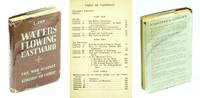
1953237j0879London: Britons Publishing Society. Good in Good dust jacket. 1953. Fourth Edition - Revised and Enlarged. Hardcover. "On the surface it would seem madness for millionaires to strive for Communism but there is irrefutable evidence that they do so strive and in Russia have in fact created a dictatorship which masquerades under the name of Communism while its only real achievement has been the liquidation of the gentile aristocracy and every Christian institution. The facts revealed in this book including the detailed plan for world revolution and world government discovered long before the first world war are so damning that no newspaper would dare to offend British readers by denying the truth. Hence the discreet silence in the Press and the slowness with which vital knowledge is spread. Their aim is a World State and a Slave State in which the masters will be of one tribe and one religious persuasion. There may be only a short time in which to learn the truth and act upon it." - dust jacket. 8-267 p. Index. Rubber stamp upon back free endpaper otherwise tanned contents clean and unmarked. Binding intact. Average wear to dust jacket now preserved in archival-grade Brodart. A sound copy. Singerman 882. ; 12mo - over 6¾" - 7¾" tall; Waters Flowing Eastward: The War Against the Kingship of Christ Unemployment World Wars Revolution Slumps Depression Antichrist . Britons Publishing Society hardcover
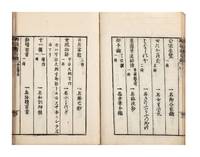
7548151 folding leaves. Three parts in one vol. Thickish 8vo orig. patterned wrappers upper wrapper a little worn orig. block-printed title label on upper cover label somewhat defective new stitching. From the colophon: Kyoto: Nakamura Magobei 1710.<br/> <br/> First edition of this important and useful bibliography. In 1710 “the Kyoto publisher Nakamura Magobei compiled a catalogue known as Bengi shomokuroku. The aim of this catalogue was to help the reader disentangle book titles which could be easily confused because they were read in the same way because they used the same characters but different readings or because they were known by several titles…Nakamura Magobei included manuscripts kakihon and explained that he had ‘given the majority of the many titles of manuscripts that have been circulating since past times’.â€â€“Laura Moretti “The Japanese Early-Modern Publishing Market Unveiled: A Survey of Edo-Period Booksellers’ Catalogues†in East Asian Publishing and Society Vol. 2 2012 pp. 206n & 245.<br/> <br/> Nice copy preserved in a chitsu. Some minor worming carefully repaired.<br/> <br/> ⧠Peter Kornicki The Book in Japan pp. 441-42–â€The publication of Bengisho mokuroku in 1710 went considerably further. The author was Nakamura Magobee a Kyoto publisher and bookseller and it was written for fellow members of the book trade. He considered books printed with movable type as a separate category and was the first to draw up a catalogue of them. He directed some attention to the book trade which also explains his attention to the titles of books not yet published and to books with homophonic titles that could easily be confused. At the same time the compilation of catalogues for commercial and for private purposes was becoming commonplace and bespeaks a growing concern with the identification of books by their distinguishing characteristics.â€. unknown
155133109-74Augsburg Philip Ulhard October 1551. Diagrams showing eclipses and celestial positions in the format of astrological squares. 346 leaves author's name crossed out on title. 4to. Contemporary vellum. Augsburg Philip Ulhard October 1551. First edition of a little known work by Cyprian Leowitz 1524-1574. The celebrated Bohemian astronomer was professor of astronomy and appointed mathematician to Elector Palatine Otho Henry German: Ottheinrich 1502-1559 and acquired a high reputation at the time of the reception of the Copernican theory. It is well known that the cosmological elements of the Copernican theory i.e. the "centrality" of the Sun and the Earth's revolution about it were not widely accepted for nearly a century after the publication of the "De Revolutionibus". Leowitz played a central role in facilitating conjunctionist theory and the actual contents of the "Tabulae" are in line with those by Stöffler. From the end of the 15th century onwards many editions of the tables of Regiomontanus were produced with commentaries and additions i.e. by Erasmsus Reinhold Luca Gaurico Leowitz with participation of Melanchthon etc. The present huge work by Leowitz appeared without introduction and without explanation. It contains so-called position plates for the places from the 33rd to the 60th latitude the pole height of the places gradus latitudinis. A final short "secundes pars" with plates up to the 66th latitude appeared in November 1551 and is not present here as in a microfiche copy stored in the Herzogin Anna Amanlia Bibliothek Weimar. . "Position" is not be taken here in the sense of modern astronomy. It is well known that the cosmological elements of the Copernican theory was not widely accepted for a long time after the publication of the "De Revolutionibus" see Burmeister Magister Rhecicus 2015. A current subject of investigation is the variety in response to the theory in the various countries of Europe. Tycho Brahe 1546-1601 visited Cyprian Leowitz in 1569. According to Tycho Leowitz told him that in his opinion the predictions of Copernicus agreed better with observations of the superior planets and solar eclipses while Ptolemy's predictions were more accurate for lunar eclipses and the positions of the inferior planets. Leowitz was correct about the relative superiority of the two theories in predicting the longitudes of the planets.- Good copy. _ _ - Adams L-520; Zinner 2018; NBG 30 814; not in Houzeau & Lancaster; cf. VD 16 L 1276. SCIENCE:ASTRONOMY & ASTROLOGY ; Augsburg, Philip Ulhard hardcover
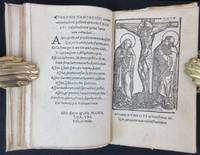
153612039Antwerp: Simon Cock Cocus. Good with no dust jacket. 1536. First Edition. Vellum. 44 ff. Small octavo. Newer vellum binding over card. Vellum has some light wear some browning to the rear. Newer end papers. Title page a bit grubby. Some occasional small staining/thumbing but otherwise very nice. Recto of last leaf has a full-page woodcut of the crucifixion verso has an errata and a neat older owner name in ink. A very scarce copy only 5 recorded in World Cat of a collection of religious verse hymns elegies and prayers by three Neolatin poets. The first is "Cornelius" which may refer to Cornelius Crocus Kroock 1500-1550 a Dutch theologian and educator; then Joannes Fernandus and Rodolphus Langius. There is an introductory poem by Faustus Andrelinus and a final poem by J. B. Cantalicius. Printed in March 1536. OCLC 69408729 NK 1631. ; 8vo 8" - 9" tall; 88 pages . Simon Cock (Cocus) hardcover
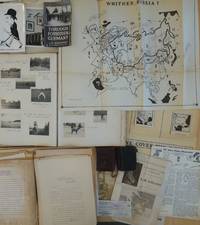
1950List2425Europe and California 1950. Includes two small diaries from 1901 and 1917 with sporadic entries a large photo album measuring 14 x 11 with appx. 400 small photographs from 1906-1909 attached to album pages most measuring 3 x 2 as well as a few larger format images laid in. With 100 plus pages of typed pages including retained correspondence story ideas and various other manuscripts. With eleven maps produced for his “Of Men and Maps†series including five copies of a large map entitled “Whither Russia†in varied states and in large sizes up to 30 by 36 inches and a handful of small ephemeral pieces. Generally near fine condition with the exception of the album which is missing its rear board and has some pages loose and torn. Very Good. J.M. de Beaufort a war correspondent for the London Daily Telegraph and New York American during World War I recounted his wartime adventures in the 1917 book "Behind the German Veil: A Record of a Journalistic War Pilgrimage." Originally arriving in Chicago in 1909 he married a steel magnate's daughter and pursued a career in show business. However by 1912 he had gone through a divorce and transitioned to newspaper work earning the moniker of the "Dude Reporter." Originally born in the Netherlands as Jacques Albert Uilenbroek he was thought to be a deserter. He spent the latter part of his life in the United States apparently jailed in San Francisco for a stint in the 1920s and eventually settled in Los Angeles. <br /> Offered here is an interesting smattering of material from the life of the mysterious De Beaufort which bookends his most unusual career and life with a large visual photographic record of his life in Europe as a young man and over a hundred pages of manuscript material from late in his life with a highlight being several maps in draft form for an apparently unpublished project called “Of Men and Maps.†As a group the material shows the work of an ex-con artist and war correspondent trying to regain his form while living in Los Angeles. He was still writing as a “Special Correspondent†at this point though the title seems to have been fully honorary. Also included are two small pocket journals with sporadic notations from his life in Europe in 1900 and in 1917. In its entirety the group gives an interesting visual and manuscript record of a literary fraudulent and imaginative transatlantic life and intellect. <br /> The cartographic highlight of the group is several iterations of a large map called “Whither Russia†in varied forms which show an interesting interpretation of the sphere of influence of the USSR and its growth from 1939 to 1946. Also included are two drafts of a map of Operation Market-Garden in the Netherlands in 1944 an unidentifed tactical map of a military battlefield a map called “Middle East Jackpot†showing the division of territory between the Allied and Axis powers a map called “Dawn’s Early Light some reproduced small format maps from the De Beaufort’s and a small map called “Gifts from Yalta.†De Beaufort was working on these maps for a column called “Of Men Maps and Memories†that was published in the East Los Angeles Tribune. He also sent the columns out in newsletter form from his address at 1635 N. Ogden Drive in Los Angeles. <br /> The collection of manuscripts drafts and retained correspondence tackle a range of subjects perhaps most interestingly those detailing De Beaufort’s creative process - drafts of stories lists of ideas for stories and letters. His over the top style is on display in a lot of the writings some of which are of unknown origin and purpose. The documents contain correspondence between De Beaufort and Edwin Pauley the oil man and presidential advisor. In one untitled essay he asks himself the question “What has been your most thrilling experience†and his reply is “ Silly questions. Who or at least what newspaperman of some 25 turbulent years standing - and falling - could answer such a question. A reporter’s life has a thousand thrills. There was that rainy day in Marcy 1915 in the fortress of Loetzen when I stood face to face with Hindenburg. Hm yes that was quite a thrill…†De Beaufort was entrenched in the Los Angeles journalistic scene at this point and the documents show the degree to which he relied on his former glories to attempt various career revitalizations endeavors. <br /> The album of photographs from 1906-1909 over 400 in total give a visual record of the young Uilenbroek’s life in Europe. The star of the collection is his bulldog Bob who travels throughout Europe with him and eventually comes to America by 1907. Mary who we presume to be his future wife is featured heavily in the images. It is unclear whether he was working at this point the images show affluent young people and their dog in varied cities and are purely of a personal nature. Other photographs laid in are relics from his war correspondent period. The loose photographs and ephemera are a mix of portraits from different periods from his life including two pictures of Sydney Turing Barlow Lawson one signed by his widow. The journals are sporadically filled and hard to decipher though one legible passage says “drinking all day.â€<br /> Overall the group gives evidence of this intriguing life and is the only extant group of material relating to Beaufort to our knowledge with the exception of a single journal from his time in Belgium during WWI that was sold at Bonhams and is still available in the trade as of this writing. unknown
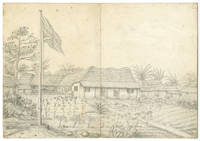
1836WRCAM52991N.p. but near present-day Prampram Ghana 1836. Three pencil sketches on wove paper each approximately 7 x 10 inches. Central vertical crease to each drawing the first two titled in a contemporary hand in pencil to verso the third similarly titled below the image. Very good. An attractive set of skillfully-executed original pencil sketches featuring British colonial structures in Prampram Gold Coast present-day Ghana likely between 1819 and 1836. The sketches are titled in pencil as follows: "Commandant's Residence Pam Pram Gold Coast" "Lower Town Pam Pram from the Upper Town" and "Abandoned Fort at Appolonia from the Beach." <br> <br> The Union Jack flies proudly in the foreground of the sketch of the Commandant's residence. Officially Great Britain colonized the Gold Coast region from 1867 until the independence of Ghana in 1957 though the British had maintained and controlled forts along the West African coastline since long before 1867. Fort Appolonia in the extreme southwestern corner of the country had been a British trading and military outpost from 1691 until 1819 and then again from 1836 onwards when it changed hands from the British to the Dutch then back to the British again. As such if the artist here labeled Fort Appolonia as "Abandoned" he or she must have sketched the fort during the period it was shuttered between 1819 and 1836. <br> <br> A fascinating trio of original sketches offering unique views from a rarely- visualized period in British colonial affairs in West Africa. unknown books
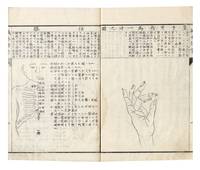
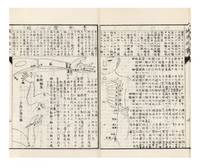
6530Numerous woodcut illustrations in the text. 31 folding leaves. 8vo orig. wrappers wrappers a little rubbed orig. block printed title label on upper cover label a little defective new stitching. Kyoto & Tokyo: 1864. First edition and rare. Imamura 1814-90 a leading doctor and historian of Japanese medicine was physician to the future Emperor Taisho when he was a youth. Imamura professor of medicine at Tokyo University found that many of the contemporary Japanese works on acupuncture had strayed from the classic teachings of the Chinese physicians. In this work Imamura makes a series of highly detailed and organized corrections to refine the fourteen meridians. The numerous striking woodcuts depict various parts of the body and pressure points. Very nice copy. Some light dampstaining. ❧ Mestler Old Japanese Medical Books I p. 297. unknown books
7485Numerous woodcut illustrations in the text. Title-page 31 folding leaves one leaf of colophon. 8vo orig. patterned blue semi-stiff wrappers orig. block-printed title label on upper cover label rubbed new stitching. Tokyo Kyoto & Osaka: 1864.<br /> First edition and rare. Imamura 1814-90 was a leading physician and historian of Japanese medicine of his period. Professor of medicine at Tokyo University he was physician to the future Emperor Taisho when he was a youth.<br /> Imamura found that many of the contemporary Japanese works on acupuncture had strayed from the classic teachings of the Chinese physicians. In this work he makes a series of corrections to refine the fourteen meridians.<br /> The numerous woodcuts depict various parts of the body and pressure points.<br /> Very nice copy. Light stain to first few leaves.<br /> ⧠Mestler Old Japanese Medical Books I p. 297. unknown books
7485Numerous woodcut illustrations in the text. Title-page 31 folding leaves one leaf of colophon. 8vo orig. patterned blue semi-stiff wrappers orig. block-printed title label on upper cover label rubbed new stitching. Tokyo Kyoto & Osaka: 1864.<br/> <br/> First edition and rare. Imamura 1814-90 was a leading physician and historian of Japanese medicine of his period. Professor of medicine at Tokyo University he was physician to the future Emperor Taisho when he was a youth.<br/> <br/> Imamura found that many of the contemporary Japanese works on acupuncture had strayed from the classic teachings of the Chinese physicians. In this work he makes a series of corrections to refine the fourteen meridians.<br/> <br/> The numerous woodcuts depict various parts of the body and pressure points.<br/> <br/> Very nice copy. Light stain to first few leaves.<br/> <br/> ⧠Mestler Old Japanese Medical Books I p. 297. unknown
6812Eight full-page drawings & one illus. in the text. 17 folding leaves. 8vo 243 x 165 mm. orig. blue semi-stiff wrappers some dampstaining to upper portion of each leaf. Japan: mid-Edo. Kagawa 1683-1755 a member of the medical family dynasty studied in Kyoto with Ryozan Goto and Jinsai Ito from whom he learned moxibustion and the therapeutic value of the waters of hot springs. Kagawa established the successful Ippondo medical school and was one of the most enthusiastic practitioners of moxibustion of his time. There is another manuscript of this text at Kyoto University attributed to Kagawa. Some of the illustrations are very different. The introductory remarks describe the importance of the precise placement of the moxa on the skin how to measure the placements based on distance from certain bones or joints of the body and the various techniques and occasions for moxibustion applications. Following this the text precisely describes the moxibustion locations on the body and how to locate each one with references to Simiao Sun's classic text Qian jin fang Essential Prescriptions Worth a Thousand Gold Pieces compiled in 650-59. Kagawa lists many diseases and injuries for which moxibustion is appropriate. There is a most interesting section on how to treat unsuccessful moxibustion procedures application of certain ointments etc. The attractive illustrations depict moxibustion loci on an osteological background and loci on the stomach arms legs and feet. As mentioned above there is dampstaining to the upper fifth of each leaf but all the characters remain completely legible. unknown books
6812Eight full-page drawings & one illus. in the text. 17 folding leaves. 8vo 243 x 165 mm. orig. blue semi-stiff wrappers some dampstaining to upper portion of each leaf. Japan: mid-Edo.<br/> <br/> Kagawa 1683-1755 a member of the medical family dynasty studied in Kyoto with Ryozan Goto and Jinsai Ito from whom he learned moxibustion and the therapeutic value of the waters of hot springs. Kagawa established the successful Ippondo medical school and was one of the most enthusiastic practitioners of moxibustion of his time. There is another manuscript of this text at Kyoto University attributed to Kagawa. Some of the illustrations are very different.<br/> <br/> The introductory remarks describe the importance of the precise placement of the moxa on the skin how to measure the placements based on distance from certain bones or joints of the body and the various techniques and occasions for moxibustion applications.<br/> <br/> Following this the text precisely describes the moxibustion locations on the body and how to locate each one with references to Simiao Sun’s classic text Qian jin fang Essential Prescriptions Worth a Thousand Gold Pieces compiled in 650-59. Kagawa lists many diseases and injuries for which moxibustion is appropriate. There is a most interesting section on how to treat unsuccessful moxibustion procedures application of certain ointments etc.<br/> <br/> The attractive illustrations depict moxibustion loci on an osteological background and loci on the stomach arms legs and feet.<br/> <br/> As mentioned above there is dampstaining to the upper fifth of each leaf but all the characters remain completely legible. unknown
51-5055Paris: Société des Cent-Une 1938. 4to. 24 x 30.5 cm. 317pp. Sheets loose as issued in original parchment wraps parchment board chemise and slipcase. One of 101 numbered copies in Roman numerals from a total edition of 134; with 15 full page etchings printed by Roger Lacourière. Traduction de Marcel PreÌvost.Provenance: la comtesse de Serionne.Luc Monod Manuel de l'amateur de livres illustrés modernes no. 8808; OCLC Number: 459962764.Printed in red and black.Latin text and French translation on opposite pages.Derain's 15 etchings are included in the pagination.". le tirage est duÌ‚ aÌ€ Roger LacourieÌ€re graveur aÌ€ Paris et des esquisses des 30 culispices que Pierre Bouchet imprimeur . a eÌxeÌcuteÌs sur bois"--Colophon.Ed. of 135 numbered copies.4° 309 p. en feuilles couv. parcheminée rempl. chemise en demi-vélin titrée en rouge étui. Edition illustrée de 15 eaux-fortes originales et 30 culispices d'André Derain gravés sur bois par Pierre Bouchet. Tirage limité à seulement 135 ex. num. 1/101 en chiffres romains. Ex. nominatif pour la comtesse de Serionne. Bel exemplaire. Paris: Société des Cent-Une, 1938 paperback